dumpspedia logo

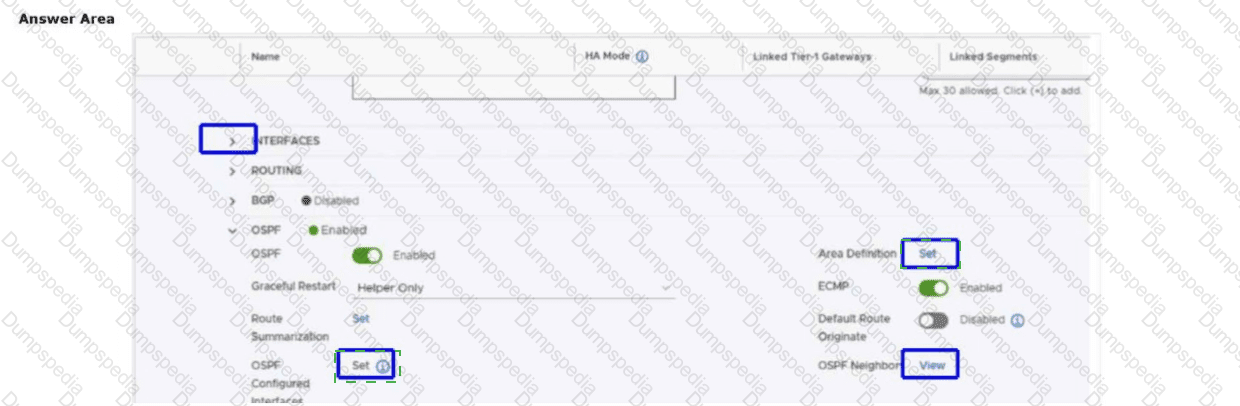
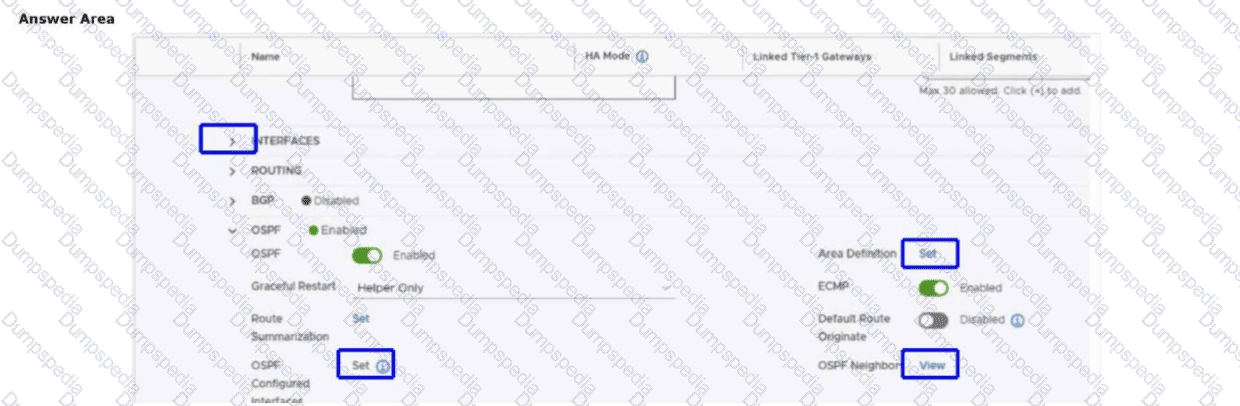
An administrator has been tasked with enabling OSPF as the routing protocol for a Tier-0 Gateway. Which two items must be configured to enable OSPF for a Tier-0 Gateway?
Mark two answers by clicking the two correct locations on the image. (Choose two.)
A large multinational corporation is seeking proposals for the modernization of a Private Cloud environment. The proposed solution must meet the following requirements:
• Support multiple data centers located in different geographic regions.
• Provide a secure and scalable solution that ensures seamless connectivity between data centers and different departments.
Which three NSX features or capabilities must be included in the proposed solution? (Choose three.)
Which of the following statements is true when configuring Remote Tunnel End Points (RTEPs) with NSX Federation?
An administrator is troubleshooting an issue where workloads connected to a Tier-1 Gateway named T1-App can no longer reach external North/South destinations.
• The Tier-1 is connected to an Active/Standby Tier-0 Gateway named T0-Prod.
Symptoms observed:
• VMs on segments attached to T1-App can ping each other.
• VMs on T1-App cannot reach any external IP outside T0-Prod.
• From a VM on the segment, ping to the T1-App Distributed Router (DR) IP succeeds.
• Ping from the VM to the T1-App Service Router (SR) fails.
• The Edge cluster hosting the T1-App SR shows both Edge nodes Up and Healthy.
• No failover has occurred — the same Edge node is still shown as Active for T1-App.
What is the most likely cause of this issue?
An administrator is responsible for a VMware Cloud Foundation (VCF) Private Cloud. The administrator has been tasked with identifying why there is no data ingress into a
workload domain.
The workload domain has been configured with:
. A dedicated NSX Edge Cluster.
. A Tier 0 gateway.
. A Tier-1 gateway that is configured for Distributed Routing only.
. An NSX segment where a test virtual machine is located.
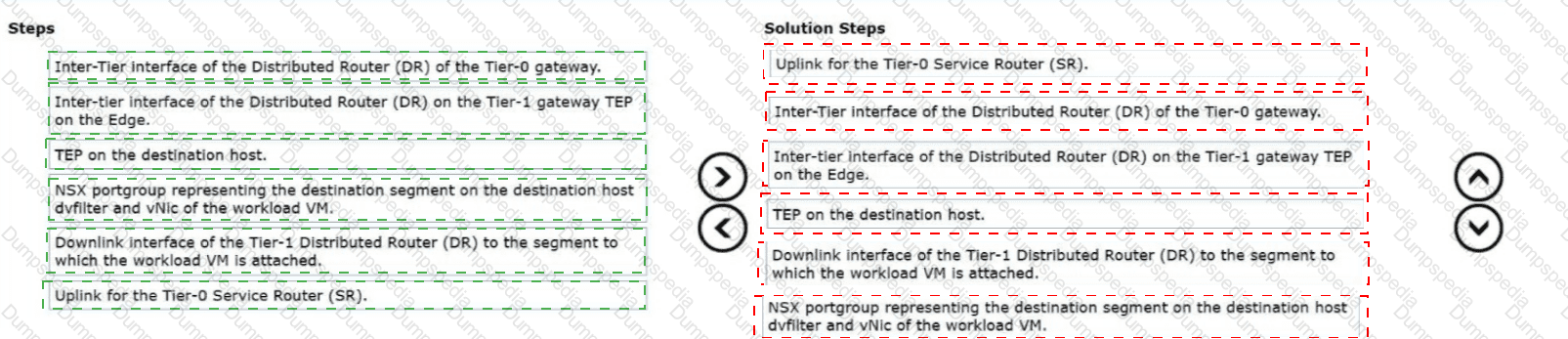
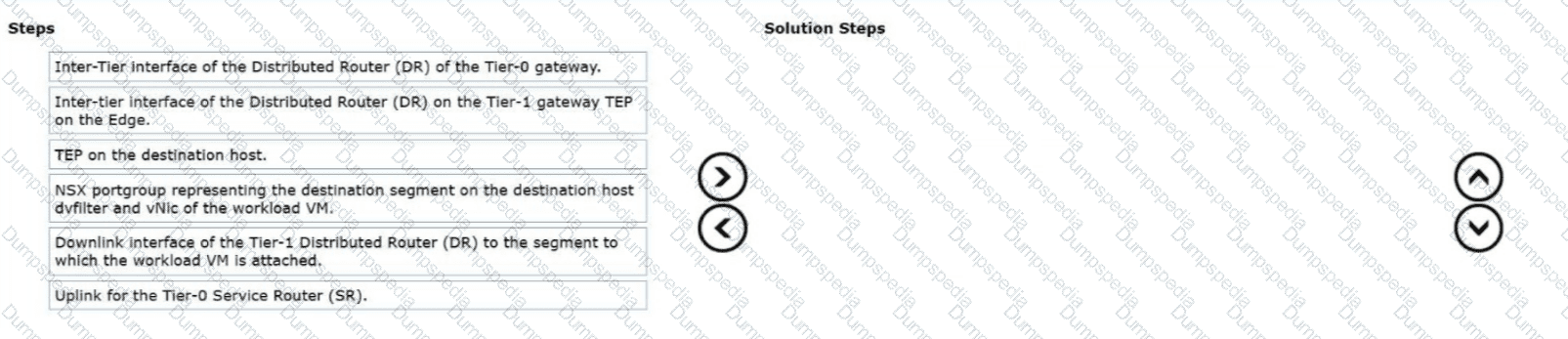
As part of the exercise, the administrator must map the traffic flow for data ingress into the workload domain to identify the steps that external network traffic will take to
ingress into the workload domain and reach the virtual machine.
Drag and drop the six steps from the Steps list on the right and place them in order in the Solution Steps. (Choose six.)
An administrator is troubleshooting BGP flapping in a VMware Cloud Foundation (VCF) 9 environment. A Tier-0 Gateway is running in Active/Active mode with two Edge nodes. BFD is enabled on the eBGP sessions to the upstream routers. Each Edge node uses its own uplink IP for BGP. After some network maintenance, one BGP session starts flapping every few minutes. The other BGP sessions stay stable. On the affected Edge node, the command get bfd-sessions shows:
• State: Down
• Diag: Detect Time Expired
Symptoms:
• The upstream router also shows the BFD session as Down with control Detection Time Expired.
• There are no interface errors, no packet loss for normal traffic, and clearing the BFD session temporarily brings it back up - but it flaps again after few minutes.
What is the root cause?
An administrator is troubleshooting why workloads in NSX cannot reach the external network 10.100.0.0/16. The Tier-0 Gateway is in Active/Active mode and has the following configuration:
• Uplink-1 (VLAN 100): 192.168.100.0/24 -> router R1 at 192.168.100.1
• Uplink-2 (VLAN 101): 192.168.101.0/24 -> router R2 at 192.168.101.1
• A static route for 10.100.0.0/16 was added with both next-hops (192.168.100.1 and 192.168.101.1).
• The Scope of this route is set to Uplink-1.
Symptoms:
• Virtual Machines (VMs) cannot reach 10.100.0.0/16
• Traceroute from the VM stops at the Tier-0 gateway with "Destination Net Unreachable"
• Pings from the Edge nodes to both 192.168.100.1 and 192.168.101.1 are success
What explains why workloads in NSX cannot reach the external network?
An administrator has been tasked with providing a networking solution including a Source and Destination NAT for a single Tenant. The tenant is using Centralized Connectivity with a Tier-0 Gateway named Ten-A-Tier-0 supported by an Edge cluster in Active-Active mode. The NAT solution must be available for multiple subnets within the Tenant space. The administrator chooses to deploy a Tier-1 Gateway to implement the NAT solution. How would the administrator complete the task?
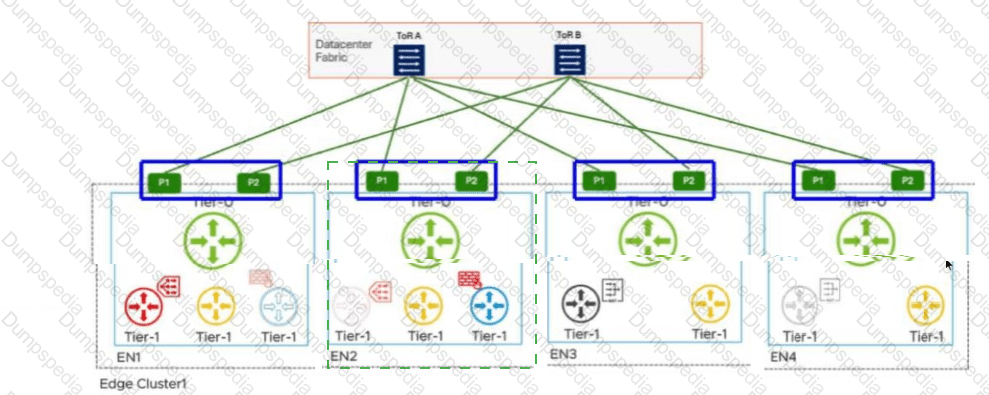
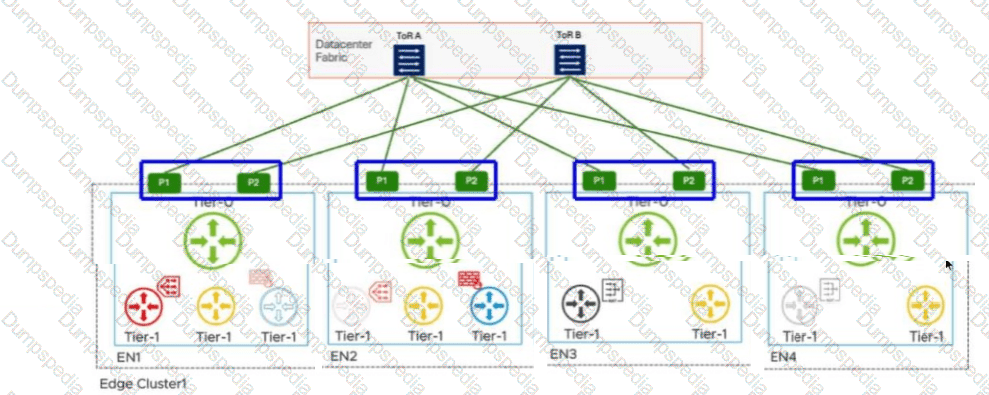
The network team has decided to use a single Edge Cluster to provide Tier-0 A/A Gateway routing and Tier-1 Gateway A/S services.
The active Tier-1 with a Gateway Firewall service is on EN2.
Which highlighted options will show the ECMP paths used by that Tier-1 GFW?
An administrator has a vSphere 8 Update 1a with NSX 4.1.0.2 environment. What option can the administrator use to converge this vSphere with NSX environment into a VMware Cloud Foundation (VCF) Workload Domain?
Which two statements describe the recommended strategy for configuring and synchronizing security policies across Federated NSX sites? (Choose two.)
During a design review, the administrator is asked to explain which underlying technology enables the NSX Edge to perform fast packet processing and achieve near line-rate performance for Virtual Network Functions (VNFs). Which technology is leveraged in the NSX Edge for fast packet processing?
An administrator has observed an NSX Local Manager (LM) outage at the secondary Site. However, the NSX Global Manager (GM) in secondary Site remains operational. What happens to data plane operations and policy enforcement at the secondary site?
An administrator changed the SFTP server used for scheduled NSX Manager backups. The backup jobs now fail with the error "Host KEY Verification Failed." The connectivity and credentials are correct. How would an administrator resolve the error?
An administrator is tasked to configure NSX Federation between separate VMware Cloud Foundation (VCF) Fleets. Which requirement must all sites meet before being added to a Global Manager (GM) for NSX Federation?

TESTED 14 Sep 2026