dumpspedia logo

When designing an AI agent for a high-stakes deployment task, which feature combination ensures that the system functions safely and predictably in a production environment?
Bounded goals, explicit tool definitions, cost/latency budgets, and human approval gates.
Unbounded token limits, parallel tool execution, and self-healing error bypasses.
High temperature settings, unlimited token access, and autonomous self-correction.
High temperature settings, implicit tool definitions, and automated deployment triggers.
Safe production deployment of agentic AI requires explicit operational boundaries, well-defined tool interfaces, resource controls, and authorization mechanisms. Option A is correct because it combines complementary safeguards that promote predictable agent behavior and limit the impact of errors.
Bounded goals restrict an agent to clearly defined objectives and prevent uncontrolled expansion of its responsibilities.
Explicit tool definitions establish permitted operations, required parameters, and expected responses. This reduces ambiguity when the agent interacts with external systems.
Cost and latency budgets control resource consumption by establishing limits on model calls, execution duration, and operational expenditure.
Human approval gates prevent consequential operations from proceeding without authorization.
For example, a production deployment agent might generate a Kubernetes configuration, validate it, run automated checks, and request engineering approval before applying the change.
Option B is incorrect because unrestricted token usage and error bypasses undermine operational control.
Option C is incorrect because high temperature and unlimited autonomy can increase behavioral variability and resource consumption.
Option D is incorrect because implicit tool definitions and uncontrolled deployment triggers increase execution risk.
These safeguards should be supplemented with observability, least-privilege permissions, rollback mechanisms, and defined failure-handling procedures.
Specific Cisco AITECH Course Guide References:
AI-Powered Workflows and Agentic AI
Generative AI Security and Privacy Fundamentals
Exam Objective 6.2: AI agent design principles and orchestration
Exam Objective 6.4: Human-in-the-Loop strategies
===================
An AI model detects 300 duplicate entries in a customer feedback dataset. What is the responsible way to address these duplicates before continuing with analysis?
Ignore the duplicates to preserve the statistical weight of the feedback data.
Flag the duplicates and manually review a sample to confirm redundancy before removal.
Merge the duplicate records to preserve all potential data points for final analysis.
Instruct the AI to delete all duplicates without reviewing the source records.
Duplicate detection is an important data preparation activity that identifies potentially repeated records before analytical processing. Option B is correct because flagging duplicates and reviewing representative examples provides a validation mechanism before potentially irreversible changes are made.
AI-assisted deduplication systems can identify exact matches, near-duplicate text, and semantically similar feedback entries.
However, records that appear similar are not necessarily redundant. Multiple customers may independently report the same issue, and those individual complaints can carry legitimate statistical significance.
For example, two support tickets containing identical descriptions may represent separate incidents affecting different customers.
Automatically deleting both as duplicates could distort complaint frequency and produce inaccurate conclusions.
Option A is incorrect because retaining confirmed duplicate records may artificially inflate counts.
Option C is not universally appropriate because merging records without verifying their identity can combine distinct observations.
Option D is incorrect because deleting records without validation risks losing legitimate data.
A responsible deduplication process should define matching criteria, preserve original records, assess false-positive matches, and maintain an audit trail.
Sample review is a useful validation step, but higher-risk cases may require broader inspection or automated integrity checks.
Specific Cisco AITECH Course Guide References: AI for Data Engineering and Exploration; Objective 4.2 — Data preparation, quality checks, cleaning, and transformation; Objective 4.3 — Ethical considerations in AI-assisted analysis.
===================
An autonomous agent is intended to carry out bulk deletions of old customer records from a production database. Which design pattern should be used to avoid accidental data loss?
Implement a human-in-the-loop approval gate before the database write occurs.
Use a more powerful foundation model to ensure the agent is highly capable and less likely to make mistakes.
Increase the agent's token budget to allow for more thorough and complex reasoning loops.
Set the agent to autonomous mode to ensure it can react quickly to database changes.
Human-in-the-Loop (HITL) is an AI governance and workflow design pattern requiring human review or authorization before selected high-risk actions are executed. Option A is correct because bulk deletion of production customer records can cause irreversible data loss, operational disruption, and potential compliance violations.
In a properly controlled workflow, the autonomous agent first identifies records that meet established deletion criteria.
The agent then generates a proposed deletion plan specifying affected records, selection conditions, expected impact, and recovery options.
Before executing the database operation, the workflow enters an approval state requiring an authorized reviewer to evaluate the proposed changes.
Option B is incorrect because increasing model capability does not eliminate hallucinations, incorrect assumptions, or unauthorized actions.
Option C is incorrect because a larger token budget allows additional processing but does not guarantee more reliable decisions.
Option D is incorrect because unrestricted autonomy increases the potential impact of mistakes when handling sensitive production data.
Additional safeguards should include least-privilege database permissions, transaction controls, pre-deletion backups, deletion thresholds, audit logging, and tested rollback procedures.
HITL provides an explicit authorization boundary that prevents the agent from executing high-impact operations without appropriate oversight.
Specific Cisco AITECH Course Guide References:
AI-Powered Workflows and Agentic AI
Generative AI Security and Privacy Fundamentals
Exam Objective 6.4: Human-in-the-Loop strategies
Exam Objective 3.4: AI governance, risk management, and compliance
===================
Drag and drop the use case from the left onto the AI system type on the right.
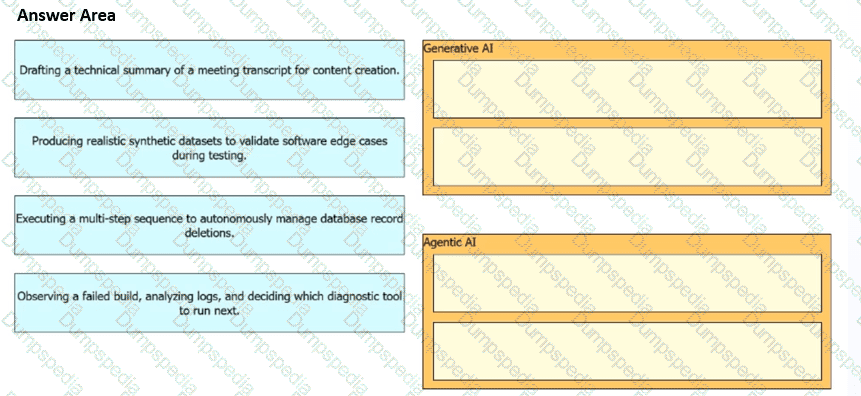
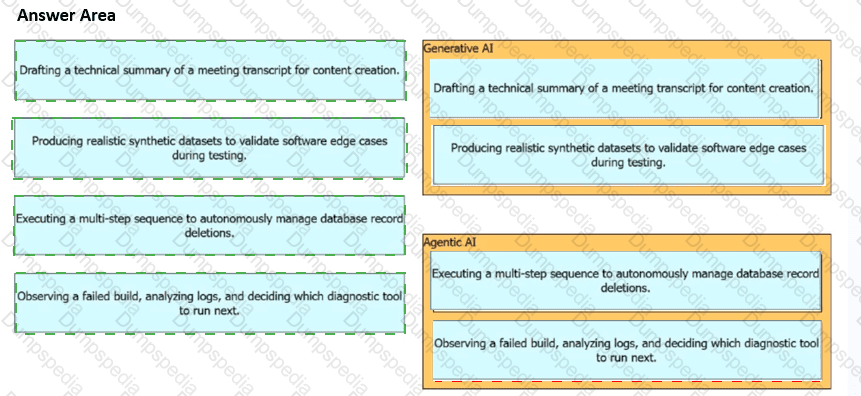
Correct Drag-and-Drop Placement:
Generative AI
Drafting a technical summary of a meeting transcript for content creation.
Producing realistic synthetic datasets to validate software edge cases during testing.
Agentic AI
Executing a multi-step sequence to autonomously manage database record deletions.
Observing a failed build, analyzing logs, and deciding which diagnostic tool to run next.
Generative AI and Agentic AI represent different approaches to applying artificial intelligence, particularly regarding content creation, autonomous decision-making, and workflow execution.
1. Generative AI — Technical Summary: Generative AI produces new content based on supplied information. Summarizing meeting transcripts involves processing existing text, identifying important information, and generating a coherent technical summary. The task does not require autonomous execution of external actions.
2. Generative AI — Synthetic Test Data: Generative AI can create realistic artificial datasets to support software testing. These datasets can simulate normal transactions, boundary conditions, and exceptional scenarios without exposing actual customer information.
3. Agentic AI — Database Record Deletion: Agentic AI can coordinate multiple actions toward a defined objective. Managing database deletions may involve identifying qualifying records, validating deletion criteria, invoking database tools, and verifying results. Production deletions should require appropriate human authorization.
4. Agentic AI — Build Troubleshooting: An agentic system can observe a failed software build, analyze diagnostic logs, select troubleshooting tools, and adapt its next action based on execution results. This demonstrates iterative, goal-directed problem-solving.
The fundamental distinction is that Generative AI primarily creates content, whereas Agentic AI coordinates decisions and actions to accomplish operational goals.
Specific Cisco AITECH Course Guide References:
Generative AI Ecosystem
AI-Driven Software Engineering
AI-Powered Workflows and Agentic AI
Exam Objective 6.1: Differentiate Agentic AI from Generative AI use cases
Exam Objective 6.2: AI agent design principles, autonomous capabilities, and orchestration
Exam Objective 5.1: AI across the software development lifecycle
Cisco's published AITECH blueprint explicitly covers these distinctions.
In the Model Context Protocol (MCP), what function does the client fulfill?
To act as a tool or service provider
To orchestrate interactions with servers
To act as an LLM for inferencing
To provide resources for task execution
The Model Context Protocol (MCP) defines a standardized mechanism through which AI applications interact with external tools, data sources, and services. Option B is the best answer because an MCP client manages communication with an MCP server and enables the AI host application to access server-provided capabilities.
MCP uses a host-client-server architecture. The host represents the AI application, while MCP clients establish and maintain connections to individual servers.
Through these connections, clients exchange protocol messages, discover available tools and resources, and facilitate authorized operations.
For example, an AI development assistant may use an MCP client to communicate with a server exposing repository information, source files, or development utilities.
Option A is incorrect because MCP servers, rather than clients, typically provide externally accessible tools and resources.
Option C is incorrect because an MCP client is a communication component, not inherently a language model performing inference.
Option D is incorrect because resources are exposed by MCP servers.
A technical distinction is important: the host application performs overall orchestration, while each MCP client manages communication with its associated server.
Therefore, Option B describes the closest available responsibility, provided orchestration is understood as facilitating client-server interactions.
Specific Cisco AITECH Course Guide References: AI Systems Integration with APIs; AI-Powered Workflows and Agentic AI; Exam Objective 6.3 — MCP framework primitives.
The official MCP architecture confirms the separation between host-level orchestration and client-server communication.
===================
When preparing a comprehensive proposal from multiple AI-synthesized research documents, which workflow is most effective at ensuring the AI preserves context and consistency throughout the entire document?
Draft each section in a separate chat session to prevent the AI from becoming confused.
Create a "Master Briefing Document" and provide it as context for each drafting prompt.
Rely on the AI's built-in long-term memory to recall all previous research documents.
Instruct the AI to generate the entire proposal in a single prompt to ensure flow.
A Master Briefing Document provides a centralized, consistent reference containing the essential information required to produce a coherent document across multiple AI-assisted drafting stages. Option B is correct because repeatedly supplying the same authoritative context helps preserve terminology, requirements, assumptions, and structural consistency.
A comprehensive technical proposal may incorporate architecture specifications, implementation constraints, stakeholder priorities, financial assumptions, and research findings.
Without a shared reference, independently generated sections may introduce conflicting statements, inconsistent terminology, or unsupported assumptions.
A Master Briefing Document can establish the proposal's objectives, intended audience, technical scope, approved findings, formatting requirements, and document structure.
Each drafting prompt can reference this shared information while focusing on a particular section.
Option A is incorrect because isolated chat sessions may increase inconsistency when they lack common contextual information.
Option C is incorrect because model memory is not guaranteed to retain every relevant research finding accurately or completely.
Option D is incorrect because generating an extensive document in a single prompt can increase context-management challenges and reduce opportunities for intermediate validation.
An effective workflow combines centralized context, sequential drafting, consistency reviews, and verification against original research sources.
Specific Cisco AITECH Course Guide References:
Prompt Engineering for Technical Precision
Advanced Prompting Strategies
AI-Powered Discovery and Synthesis
Exam Objective 2.2: Iterative, sequential, and chained prompting
Exam Objective 4.4: AI-assisted research and content drafting
===================
A network engineer uses an AI to examine a 500-page technical manual while troubleshooting a particular hardware fault. The AI successfully processes the first 200 pages, but it then cannot reference information from the document’s latter half. What is the most likely cause of this problem?
The document size has exceeded the model's context window limit.
The API key has reached its monthly token quota.
The model has reached its knowledge cut-off date.
The temperature setting is too high, causing the AI to lose focus.
A large language model's context window determines the maximum quantity of input and generated tokens that can be accommodated within an inference context. Option A is correct because the 500-page manual may exceed the amount of content the model or its surrounding application can process in a single request.
When this limit is reached, different applications may reject the request, truncate portions of the document, or process only selected sections.
In the described scenario, the model can reference earlier pages but not the latter half, suggesting that only part of the manual was successfully included in the available context.
Option B is incorrect because exhaustion of an API quota would typically cause billing, quota, or request-processing errors rather than selective inability to reference particular pages.
Option C is incorrect because a knowledge cut-off concerns information learned during training, not documents supplied during inference.
Option D is incorrect because temperature affects sampling behavior and does not determine the maximum input document size.
Appropriate solutions include document chunking, hierarchical summarization, and Retrieval-Augmented Generation.
A RAG system can retrieve relevant sections of the manual without requiring the entire document to be transmitted with every request.
Specific Cisco AITECH Course Guide References:
Generative AI Ecosystem
Customizing AI Models
Exam Objective 1.3: Context windows and token limits
Exam Objective 1.5: Retrieval-Augmented Generation
===================
Which attack type occurs when an attacker uses a jailbreak prompt to make an AI disregard its safety filters and produce instructions for creating malware?
Data poisoning
Model inversion
Direct injection
Indirect injection
Direct prompt injection is an attack technique in which an adversary submits malicious instructions directly to an AI application in an attempt to override its intended behavior, bypass restrictions, or induce unauthorized outputs. Option C is correct because the attacker uses a jailbreak prompt to manipulate the model through its immediate interaction interface.
Jailbreaking generally involves crafting adversarial instructions intended to defeat a model's safety restrictions or application-level policies.
In the described scenario, the attacker attempts to persuade the model to disregard its established safety controls and produce prohibited content.
Option A is incorrect because data poisoning targets the information used to train or otherwise influence a model through datasets rather than relying on an immediate adversarial prompt.
Option B is incorrect because model inversion involves attempting to infer sensitive information about model training data or internal representations from model behavior.
Option D is incorrect because indirect prompt injection uses malicious instructions embedded in external information sources, such as retrieved webpages, documents, or tool outputs.
Direct injection defenses include robust instruction hierarchy enforcement, restricted tool permissions, input risk assessment, output safeguards, and monitoring.
These controls should be applied in combination because no single prompt-based defense reliably prevents every adversarial attempt.
Specific Cisco AITECH Course Guide References: Generative AI Security and Privacy Fundamentals; Prompt Engineering for Technical Precision; Objective 2.3 — Prompt injection attack types; Objective 3.3 — AI-specific security threats.
===================
In the context of AI-assisted data analysis, what does the term "aggregation bias" refer to?
When data is omitted due to incompatible formats
When AI uses summary statistics instead of raw data
When a summary masks subpatterns
When AI fails to combine conflicting patterns
Aggregation bias occurs when combining observations into broader groups obscures meaningful differences, relationships, or patterns within individual subgroups. Option C is correct because an aggregated summary may conceal important variations that become visible only when data is analyzed at a more granular level.
In AI-assisted exploratory data analysis, models frequently summarize large datasets to identify general trends. However, excessive aggregation can produce misleading conclusions when distinct populations exhibit different characteristics.
For example, an organization might calculate an overall customer satisfaction score of 85%. This appears favorable, but segment-level analysis could reveal that enterprise customers have significantly lower satisfaction than small-business customers.
The overall summary conceals an important operational problem.
In certain situations, aggregation can also contribute to Simpson's paradox, where relationships observed within subgroups change or reverse when the groups are combined.
Option A is incorrect because omitting data due to incompatible formats is primarily a data integration or preparation problem.
Option B is incorrect because using summary statistics is not inherently biased; problems arise when aggregation conceals relevant differences.
Option D is incorrect because failure to combine conflicting patterns does not define aggregation bias.
Analysts should validate aggregated conclusions through segmentation, subgroup comparisons, and appropriate statistical analysis.
Specific Cisco AITECH Course Guide References: AI for Data Engineering and Exploration; Generative AI Security and Privacy Fundamentals; Exam Objective 4.1 — Exploratory data analysis; Objective 3.1 — Bias mitigation and responsible AI.
Cisco Learning Content
===================
What role does AI play when it comes to assisting with refactoring software code?
Identifying flaws and improving design
Creating a new database schema
Integrating a new API
Reducing manual code documentation
Code refactoring involves restructuring existing software to improve its internal design, readability, maintainability, or efficiency without intentionally changing its externally observable behavior. Option A is correct because AI-assisted refactoring can identify structural weaknesses and recommend improvements to software design.
AI coding assistants analyze source code to identify duplicated logic, excessive complexity, poor modularity, inconsistent naming conventions, and opportunities for abstraction.
For example, an AI assistant might identify repeated validation logic across several Python functions and recommend extracting that logic into a shared utility function.
Such changes can reduce duplication, improve code readability, and simplify subsequent maintenance.
Option B is incorrect because creating a new database schema is primarily a data modeling or database design activity. Although schema changes may accompany broader refactoring initiatives, they do not define code refactoring.
Option C is incorrect because integrating a new API introduces external functionality or connectivity rather than necessarily improving existing code structure.
Option D is incorrect because documentation automation is a separate development productivity capability, even though documentation may be updated during refactoring.
AI-generated refactoring recommendations should undergo code review, static analysis, regression testing, and relevant performance checks to verify that expected behavior remains unchanged.
Specific Cisco AITECH Course Guide References:
AI-Driven Software Engineering
Debugging and Correcting AI-Generated Outputs
Exam Objective 5.5: AI-assisted code quality, debugging, error handling, and documentation
Cisco's development domain emphasizes improving code quality and software engineering workflows through AI assistance.
===================
An organization operates under regulatory requirements that forbid any proprietary source code from leaving its internal network. Which hosting strategy offers the greatest degree of data sovereignty?
Cloud-based API with Zero Data Retention
Hybrid deployment with cloud-based backup
Managed SaaS AI platform with SOC 2 audit
Local LLM deployment on internal hardware
Data sovereignty concerns an organization's ability to control where information is stored, processed, and governed, particularly when legal or regulatory requirements restrict data movement. Option D is correct because deploying an LLM on internally controlled hardware offers the strongest direct control over proprietary source code and its processing environment.
With a fully local deployment, model inference can occur within the organization's internal network without transmitting prompts or sensitive source code to external AI providers.
For example, an enterprise can deploy an internally hosted coding assistant that processes confidential repositories while operating under its existing authentication, network security, and access control policies.
Option A is incorrect because Zero Data Retention does not necessarily eliminate external transmission or processing. The data still leaves the internal network.
Option B is incorrect because cloud-based backup may transfer proprietary information outside the permitted environment.
Option C is incorrect because SOC 2 attestation provides assurance regarding specified controls but does not establish that sensitive data remains within the organization's internal network.
A local deployment must still enforce security controls, including access restrictions, encryption, audit logging, and secure model management.
Administrators should also disable unauthorized telemetry, external tool calls, and data synchronization features that could violate the organization's restrictions.
Specific Cisco AITECH Course Guide References: AI Architect's Toolkit; Customizing AI Models; Generative AI Security and Privacy Fundamentals; Exam Objective 1.2 — Cloud versus local hosting trade-offs; Objective 3.2 — Corporate data privacy and security.
Cisco Learning Content
===================
What is the reason that assigning a persona is regarded as a technical best practice in prompt engineering?
It provides instructions for desired action.
It reduces the total token usage.
It provides a pattern to emulate.
It guides the tone and vocabulary.
Persona assignment is a prompt engineering technique that establishes a particular role, professional perspective, communication style, or intended audience for a generative AI model. Option D is correct because assigning a persona helps guide the terminology, tone, vocabulary, and explanatory depth of generated responses.
For example, a practitioner might instruct an AI model to respond as an experienced Cisco network architect explaining a routing problem to junior engineers.
This role encourages the model to use relevant networking terminology, present structured technical explanations, and communicate at an appropriate level of expertise.
Similarly, assigning the persona of a compliance auditor can encourage a more formal, evidence-oriented style when evaluating governance documentation.
Option A is incorrect because explicitly describing the desired action belongs primarily to task instructions rather than persona definition.
Option B is incorrect because assigning a persona does not inherently reduce token consumption. Role descriptions may increase prompt length.
Option C is less accurate because supplying a pattern to emulate is more directly associated with example-based prompting, especially few-shot prompting.
Persona prompting influences how a model frames its response, but it does not establish actual professional qualifications or guarantee technical correctness.
Effective prompts combine role information with clear objectives, contextual details, constraints, and output requirements.
Specific Cisco AITECH Course Guide References: Prompt Engineering for Technical Precision; Advanced Prompting Strategies; Exam Objective 2.1 — Prompt engineering principles and patterns, including roles, instructions, and constraints.
Cisco Learning Content
===================
Drag the responsible AI principle on the left to its corresponding action on the right. Not every option will be used.
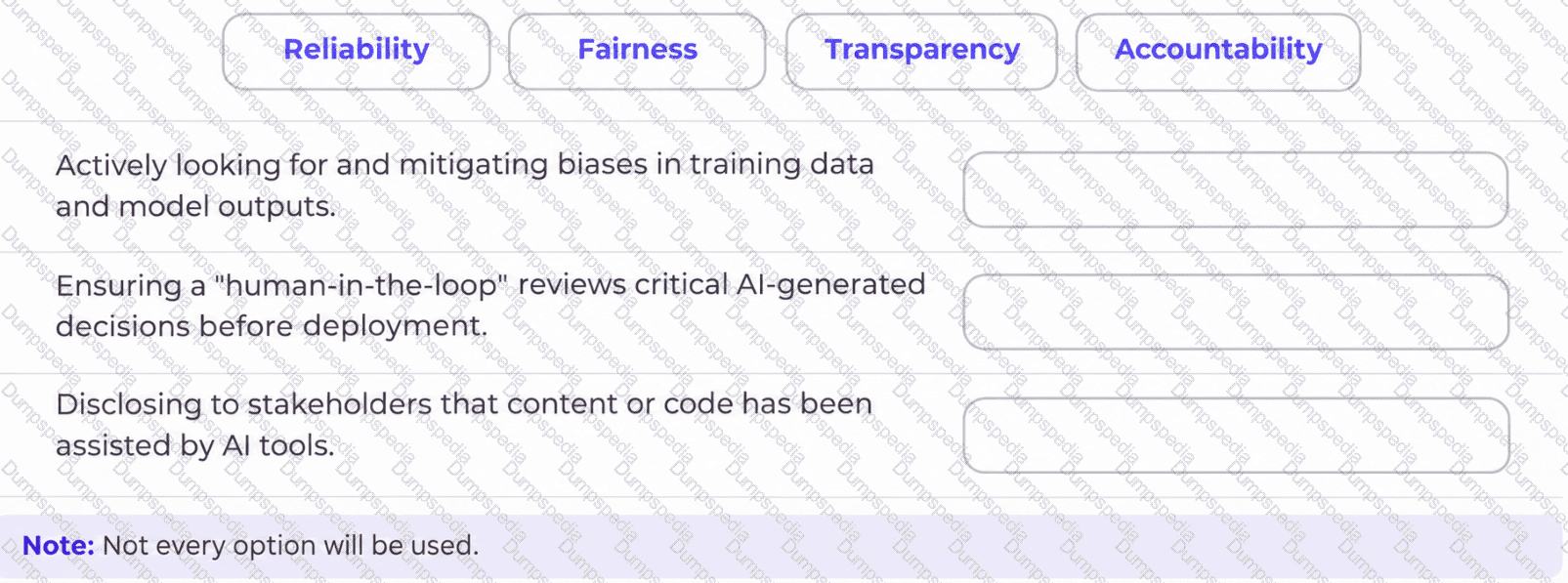
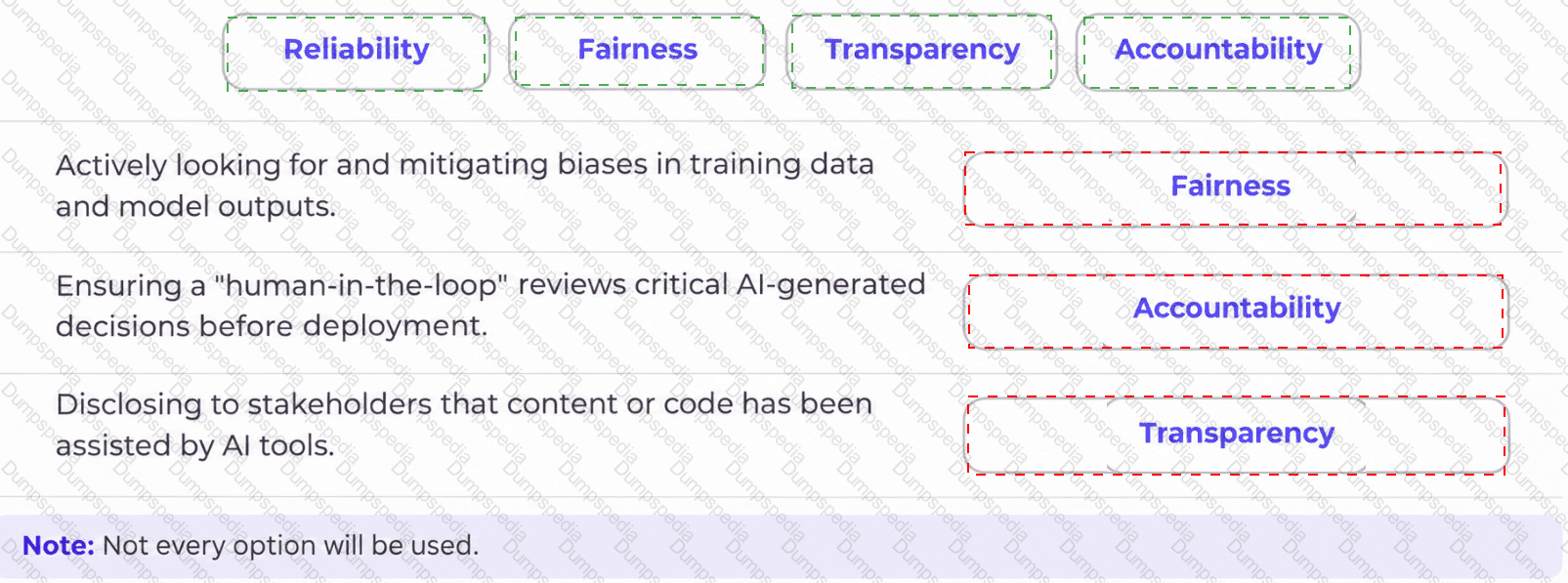
Correct Drag-and-Drop Sequence:
Fairness
Accountability
Transparency
Responsible AI principles establish ethical and operational standards for developing, deploying, and governing artificial intelligence systems. The three scenarios illustrate Fairness, Accountability, and Transparency, which Cisco explicitly identifies under its Ethics and Security examination domain.
1. Fairness: This principle requires AI systems to minimize unjustified discrimination and systematically biased outcomes. Actively identifying and mitigating biases in training datasets and model outputs helps ensure that AI-generated recommendations do not unfairly disadvantage particular individuals or groups. Fairness audits, representative datasets, and subgroup performance evaluations are important mitigation techniques.
2. Accountability: Accountability establishes responsibility for AI-generated decisions and their consequences. Implementing Human-in-the-Loop (HITL) reviews ensures that qualified personnel examine critical recommendations before deployment or execution. Human oversight supports governance, provides opportunities to identify errors, and establishes clear decision-making responsibility.
3. Transparency: Transparency requires organizations to communicate relevant information about AI involvement in processes and outputs. Disclosing that documents, software code, or other content were produced with AI assistance enables stakeholders to understand the technology's role and evaluate its limitations.
Reliability is the unused option. Reliability concerns consistent, dependable system performance under expected operating conditions rather than the three specific actions described.
Specific Cisco AITECH Course Guide References:
Generative AI Security and Privacy Fundamentals
Responsible AI Principles and Bias Mitigation
AI Governance, Policy, and Risk Management
Exam Objective 3.1: Fairness, Transparency, Accountability, Bias Mitigation, and Safety
Exam Objective 3.4: AI Governance Considerations
Official Cisco Reference: Cisco AI Technical Practitioner (810-110) Exam Topics
An AI-powered system must dynamically determine which tools to use when troubleshooting complex network outages. Why is an autonomous agentic system typically more costly to operate than a directive workflow for this task?
Agents require specialized, high-cost GPU hardware clusters to maintain the state of the reasoning loop during tool execution.
Agents require multiple API keys for every tool they access, which increases subscription costs.
Agents consume tokens for every step of their internal reasoning loop, whereas workflows execute fixed, pre-programmed logic.
Agents are billed by the hour of uptime, whereas workflows are billed only when a request is made.
Autonomous agentic systems frequently involve iterative model inference, decision-making, tool selection, and evaluation of intermediate results. Option C is the best answer because repeated model interactions can generate substantially greater token consumption than a directive workflow following predefined execution logic.
For example, a network troubleshooting agent may retrieve interface statistics, analyze routing tables, inspect logs, identify possible causes, and select additional diagnostic tools.
Each model invocation may process accumulated context and produce new outputs, increasing inference usage and associated costs.
A directive workflow can instead execute predefined diagnostic steps using conditional logic without requiring the model to independently choose every operation.
Option A is incorrect because agentic behavior does not inherently require dedicated GPU clusters to maintain workflow state.
Option B is incorrect because multiple tool integrations do not necessarily require separate paid API subscriptions.
Option D is incorrect because agentic systems are not universally billed according to elapsed uptime.
A technical distinction is that not every agent step necessarily consumes model tokens. Deterministic tool execution and waiting states may occur without new inference requests.
Likewise, directive workflows can incur token charges when they invoke LLMs.
The principal cost difference concerns the number, size, and complexity of model interactions.
Specific Cisco AITECH Course Guide References:
AI-Powered Workflows and Agentic AI
AI Architect's Toolkit
Exam Objective 5.4: Token usage, latency, and cost
Exam Objective 6.1: Agentic versus generative AI use cases
Exam Objective 6.2: Autonomous orchestration
===================
In a multi-agent system built for complex software testing, why is the coordinator pattern favored instead of letting every agent run in parallel?
It reduces the number of API calls, making the system more cost-effective than parallel execution.
It increases the reasoning depth of each agent by allowing them to share their internal model weights in real-time.
It allows agents to execute tasks in parallel, reducing the total latency of the testing process.
It provides a structured hand-off where each agent validates its output before the next agent begins.
The coordinator pattern is a multi-agent orchestration approach in which a supervisory component manages task allocation, dependencies, communication, and the consolidation of results. Option D is the best answer because structured hand-offs enable dependent tasks to execute in an appropriate order with intermediate validation.
In complex software testing, different specialized agents may be responsible for test generation, execution, failure analysis, remediation, and regression verification.
For example, a coordinator may direct one agent to generate integration tests, wait for test execution results, and then assign a failure-analysis agent to investigate unsuccessful cases.
This dependency-aware sequence prevents subsequent agents from operating on incomplete or unverified information.
Option A is incorrect because coordination does not inherently reduce the number of API calls.
Option B is incorrect because cooperating agents do not normally exchange or modify one another's model weights.
Option C is incomplete because parallel execution can be supported by a coordinator, but maximizing parallelism does not explain why coordination is preferable for dependent tasks.
A coordinator does not necessarily force every task to run sequentially. Independent tasks can execute concurrently, while tasks requiring previous results use controlled hand-offs.
This approach improves traceability, error handling, and workflow reliability.
Specific Cisco AITECH Course Guide References: AI-Powered Workflows and Agentic AI; Objective 6.2 — AI agent design, autonomous capabilities, and orchestration.
===================
When recommending AI for use with proprietary software documentation, which argument addresses the main intellectual-property legal risk?
AI tools may expose confidential intellectual property risking trade secret violations and loss of IP ownership protections.
AI models are trained on public domain data, so all outputs are exempt from copyright infringement claims.
AI-generated content is automatically granted full copyright protection under existing international intellectual property treaties.
Organizations must obtain a commercial use license from the AI provider before proprietary documentation can be legally protected.
Organizations using AI services to analyze proprietary software documentation must consider confidentiality, intellectual property protection, and contractual data-handling obligations. Option A is the best answer because disclosing confidential technical information to an unauthorized external service can compromise trade secrets and create legal or commercial risks.
Proprietary documentation may contain source code, system designs, unpublished algorithms, customer-specific implementations, or confidential architectural information.
Submitting such material to an unapproved AI platform may expose it to third-party processing, retention, or access.
Trade secret protection can be particularly sensitive because it generally depends on maintaining reasonable measures to preserve confidentiality.
Option B is incorrect because AI training datasets are not necessarily restricted to public-domain material, and generated outputs are not universally exempt from copyright claims.
Option C is incorrect because copyright eligibility for AI-generated material depends on applicable law and the nature of human authorship.
Option D is incorrect because a commercial AI license does not automatically determine ownership or legal protection of preexisting proprietary documentation.
Importantly, disclosure does not automatically transfer IP ownership. The actual consequences depend on applicable law, contractual terms, and circumstances.
Organizations should assess vendor agreements, data retention, training-use provisions, and access controls before sharing confidential material.
Specific Cisco AITECH Course Guide References:
Generative AI Security and Privacy Fundamentals
AI Architect's Toolkit
Exam Objective 3.2: Corporate data privacy and security
Exam Objective 3.4: AI governance, policy, risk management, and compliance
===================
A user incorporates project background information along with specific technical constraints into a prompt. Which prompt engineering principle does this represent?
Defining a persona
Describing the situation
Using few-shot
Stating the purpose
Describing the situation is a fundamental prompt engineering principle that establishes the contextual information, operational environment, and technical boundaries within which an AI model must perform a task. Option B is correct because providing project background and technical constraints enables the model to understand the circumstances surrounding the requested work.
In technical prompt engineering, contextual information may include existing system architecture, technology stacks, organizational requirements, deployment environments, resource limitations, and compatibility constraints.
For example, a practitioner designing a network automation solution might specify that the organization uses Cisco Catalyst switches, requires Python-based automation, and prohibits modifications to existing production VLAN configurations.
These details establish the situation and guide the model toward technically relevant recommendations.
Option A is incorrect because defining a persona assigns a particular role or professional identity to the AI, such as a network architect or security engineer.
Option C is incorrect because few-shot prompting supplies representative examples demonstrating expected input-output behavior.
Option D is incorrect because stating the purpose identifies the desired objective or outcome rather than describing the operating context.
Effective situational prompting improves response relevance, reduces ambiguity, and increases the likelihood that generated recommendations satisfy real-world technical requirements.
Specific Cisco AITECH Course Guide References:
Prompt Engineering for Technical Precision
Advanced Prompting Strategies
Exam Objective 2.1: Prompt engineering principles involving roles, instructions, and constraints
Cisco's official blueprint includes these foundational prompt design concepts under Domain 2.0, Prompt Engineering.
===================
When instructing an AI system to summarize a particular technical document, which approach helps reduce the risk of hallucinations in the output?
Requesting citations for the summary
Using a short system prompt
Increasing the model creativity
Removing negative constraints
AI hallucination occurs when a generative model produces information that is unsupported, inaccurate, or fabricated while presenting it as plausible. Option A is correct because requesting citations encourages the model to associate factual claims with supporting evidence from the technical document.
For example, a practitioner summarizing a networking standard can instruct the AI system to include section references for significant technical assertions.
This creates an opportunity to check whether the generated summary accurately reflects the source material.
For stronger reliability, the application should provide the authoritative document, require references to specific passages, and verify that cited evidence supports the corresponding statements.
Option B is incorrect because reducing system prompt length does not inherently improve factual accuracy. Removing essential instructions may make reliability worse.
Option C is incorrect because increasing generation randomness can introduce greater variability and does not inherently reduce hallucinations.
Option D is incorrect because removing useful constraints may weaken the boundaries governing the model's response.
Importantly, citations generated by an AI model can themselves be fabricated. Merely requesting citations does not establish factual correctness.
The strongest approach combines source-grounded generation, accurate references, evidence validation, and explicit instructions to avoid unsupported claims.
Specific Cisco AITECH Course Guide References: Prompt Engineering for Technical Precision; Debugging and Correcting AI-Generated Outputs; Exam Objective 2.4 — Defensive prompting and mitigation of AI-generated errors.
Cisco Learning Content
===================
During the Testing phase of the SDLC, a QA engineer must validate a new payment-processing function. Why is AI-generated synthetic data regarded as a high-value asset at this stage?
It replaces the need for a dedicated testing framework by executing the payment function directly within the inference engine.
It provides a verified legal certification that the payment processing logic is fully compliant with global financial regulations.
It enables comprehensive validation of edge cases and error handling without exposing sensitive customer information.
It automatically detects and remediates logical vulnerabilities within the payment function during the data ingestion process.
AI-generated synthetic data enables software testing teams to construct representative, artificial datasets that simulate realistic application inputs without requiring exposure of actual customer records. Option C is correct because synthetic data supports testing of normal transactions, boundary conditions, exceptional scenarios, and error-handling mechanisms while reducing the privacy risks associated with using production payment information.
For example, a QA engineer can generate fictional payment transactions involving expired cards, insufficient balances, duplicate payment requests, invalid currencies, unusually large amounts, and transaction timeouts.
These scenarios help validate payment-processing logic, input validation, exception handling, and transaction consistency.
Option A is incorrect because synthetic data supplies test inputs but does not replace testing frameworks, execution environments, or automated test assertions.
Option B is incorrect because generating test data does not establish compliance with PCI DSS, financial regulations, or other legal requirements. Compliance requires independent assessment against applicable controls.
Option D is incorrect because synthetic data generation does not automatically discover and remediate vulnerabilities.
Synthetic datasets should undergo quality assessment to ensure appropriate coverage and avoid reproducing sensitive records.
AI-generated test data is most valuable when combined with established testing frameworks, controlled test environments, and reproducible validation procedures.
Specific Cisco AITECH Course Guide References:
AI-Driven Software Engineering
AI for Data Engineering and Exploration
Exam Objective 5.1: AI across SDLC phases, including testing
Exam Objective 4.2: Automated data preparation and quality checks
===================
What distinguishes generative AI from agentic AI?
Generative AI uses retrieval-augmented generation and agentic AI does not support external data sources.
Generative AI operates autonomously and agentic AI requires a prompt for each action.
Generative AI produces single-turn responses and agentic AI executes multi-step reasoning loops.
Generative AI requires tool access and agentic AI relies on its training data.
The primary distinction between generative AI and agentic AI concerns the degree of autonomy, task execution capability, and workflow orchestration. Option C is the best answer because it contrasts conventional prompt-response generation with agentic systems designed to execute multi-step decision and action cycles.
Generative AI models primarily produce content such as text, images, audio, software code, or structured data in response to input.
Agentic AI extends these capabilities by incorporating goal-directed planning, external tool invocation, environmental feedback, and iterative task execution.
For example, an agentic network operations assistant might investigate a service outage, retrieve device telemetry, identify probable causes, recommend remediation, and request authorization before executing changes.
Option A is incorrect because both conventional generative AI applications and agentic systems can use RAG and external knowledge sources.
Option B is incorrect because agentic systems are specifically designed to perform authorized actions without requiring a new user prompt at every intermediate step.
Option D is incorrect because generative models do not inherently require tools, while agentic applications frequently depend on external tools and APIs.
A technical qualification is important: generative AI is not limited to single-turn conversations. It can support multi-turn interactions. The meaningful distinction is autonomous orchestration and action-oriented execution.
Specific Cisco AITECH Course Guide References:
Generative AI Ecosystem
AI-Powered Workflows and Agentic AI
Exam Objective 6.1: Differentiate agentic AI from generative AI use cases
Exam Objective 6.2: Autonomous capabilities and orchestration
Cisco identifies agentic autonomy and workflow execution as central learning outcomes.
===================
A developer observes that an AI model is unable to solve complex logic puzzles accurately. The developer adds “Let’s think step by step” to the following prompt. Which prompting technique is being used?
Few-shot Prompting
Persona Role-play
Chain-of-Thought
Negative Constraints
Chain-of-Thought (CoT) prompting is a reasoning-oriented prompting technique that encourages a language model to approach a complex problem through intermediate reasoning steps rather than immediately producing a conclusion. Option C is correct because the instruction “Let's think step by step” is a conventional example of zero-shot chain-of-thought prompting.
Complex logic puzzles often require multiple dependent deductions. Encouraging structured reasoning can help the model organize assumptions, identify relationships, and verify intermediate conclusions.
For example, when solving a network addressing problem, a model may benefit from determining subnet requirements, calculating address boundaries, and checking whether allocated subnets overlap before presenting the final configuration.
Option A is incorrect because few-shot prompting provides examples demonstrating expected task behavior.
Option B is incorrect because persona role-play establishes a role or professional perspective rather than explicitly encouraging multistep reasoning.
Option D is incorrect because negative constraints specify prohibited behaviors or outputs.
CoT prompting is distinct from prompt chaining, which distributes work across multiple prompts and can pass results between stages.
Modern reasoning models may perform internal reasoning without displaying every intermediate step. Consequently, verification should focus on the correctness of the final answer and independently checkable calculations.
Specific Cisco AITECH Course Guide References: Advanced Prompting Strategies; Prompt Engineering for Technical Precision; Objective 2.2 — Advanced and sequential prompting techniques; Objective 2.4 — Improving response reliability.
===================
A practitioner is examining a production failure in which an autonomous agent repeatedly invoked the same tool using different parameters, consuming thousands of tokens without progressing. Which artifact explains why the agent made those decisions?
The system dashboard showing aggregate CPU and memory usage.
The cumulative token consumption report generated for the entire execution period.
The final output generated by the agent after the timeout limit was reached.
The reasoning trace showing the chain-of-thought and the sequence of tool calls.
An agent execution trace records observable steps within an autonomous workflow, including model interactions, tool invocations, input parameters, returned results, errors, and execution order. Option D is correct because this information helps practitioners reconstruct how an agent progressed through a task and identify why it repeatedly invoked a tool without achieving its objective.
For example, an agent might repeatedly query a monitoring API with slightly different filters because the returned information never satisfies its completion criteria.
A trace can reveal successive tool parameters, unsuccessful responses, repeated retries, and the absence of meaningful state changes.
Option A is incorrect because CPU and memory dashboards provide infrastructure-level performance metrics rather than detailed agent execution history.
Option B is incorrect because aggregate token consumption identifies cost but does not explain individual decisions.
Option C is incorrect because a final response generally lacks the full sequence of actions preceding the failure.
A technical qualification is necessary: execution traces do not necessarily expose a model's private internal chain-of-thought. They typically provide observable actions, recorded inputs and outputs, and available decision summaries.
Agent tracing supports root-cause analysis, loop detection, operational auditing, and workflow optimization.
Specific Cisco AITECH Course Guide References: AI-Powered Workflows and Agentic AI; Objective 5.3 — Workflow monitoring; Objective 6.2 — Agent orchestration and autonomous behavior.
Agent observability documentation confirms that traces can record tool calls and execution steps without requiring access to private model reasoning.
===================
Why is implementing MCP preferable to creating custom tool-binding integrations for an agent that accesses three internal systems?
It replaces the requirement for an LLM reasoning engine by automating the tool-selection logic internally.
It provides a unified protocol, meaning the team only builds the integration once for any MCP-compatible model.
It automatically encrypts all data at rest without requiring any additional configuration.
It increases execution speed by allowing the agent to bypass the operating system.
The Model Context Protocol (MCP) provides a standardized interface for connecting AI applications to external tools, services, and information sources. Option B is the best answer because protocol standardization allows integrations to be reused across compatible AI hosts rather than requiring entirely separate proprietary tool-binding implementations.
For example, an organization may build MCP servers that expose functionality from an inventory database, an incident management platform, and a configuration repository.
An MCP-compatible host application can discover and interact with these capabilities through a consistent client-server protocol.
This reduces integration duplication and improves portability across applications supporting MCP.
Option A is incorrect because MCP does not eliminate the need for language models or application-level reasoning and tool-selection logic.
Option C is incorrect because MCP does not automatically encrypt all stored information. Encryption and access controls remain separate security responsibilities.
Option D is incorrect because MCP operates through ordinary communication mechanisms and does not bypass operating system services.
A qualification is necessary: each internal system still requires an appropriate MCP server or adapter, and compatibility depends on supported capabilities and authorization.
MCP standardizes integration interfaces; it does not make every model or application automatically interoperable.
Specific Cisco AITECH Course Guide References:
AI Systems Integration with APIs
AI-Powered Workflows and Agentic AI
Exam Objective 6.3: MCP framework primitives
The official MCP documentation confirms standardized client-server interactions, including tool discovery and invocation.
===================
Within a multi-agent AI framework, what is the role of a coordinator agent?
It orchestrates task delegation across specialized agents and aggregates the outputs.
It replaces the need for multiple agents by handling tasks within a single reasoning loop.
It serves as the external data source that each agent queries for grounding information.
It fine-tunes each agent's model weights to optimize performance on assigned tasks.
A coordinator agent is a supervisory component within a multi-agent AI architecture responsible for organizing work, delegating tasks, managing dependencies, and consolidating results from specialized agents. Option A is correct because orchestration and output aggregation are defining responsibilities of a coordinator.
Multi-agent architectures distribute responsibilities among agents with different skills, tools, or operational roles.
For example, an AI-powered infrastructure assessment framework might contain a discovery agent, security assessment agent, capacity planning agent, and documentation agent.
The coordinator receives the overall objective, decomposes it into manageable subtasks, assigns responsibilities, and coordinates execution according to task dependencies.
After the specialized agents complete their assignments, the coordinator evaluates their outputs, resolves inconsistencies where possible, and consolidates the findings into a coherent response.
Option B is incorrect because replacing specialized agents with one reasoning component describes a single-agent architecture rather than multi-agent coordination.
Option C is incorrect because external knowledge sources are typically provided through databases, retrieval systems, APIs, or other tools.
Option D is incorrect because model fine-tuning is a training process involving parameter updates, not a normal coordinator-agent responsibility.
Effective coordination improves modularity, task specialization, workflow traceability, and operational control.
Specific Cisco AITECH Course Guide References:
AI-Powered Workflows and Agentic AI
AI Systems Integration with APIs
Exam Objective 6.2: AI agent design principles, autonomous capabilities, and orchestration
Cisco's blueprint directly identifies orchestration as an essential agentic AI competency.
===================
A prototype application has high latency during the "time-to-first-token" phase. To ensure the AI has the needed information, the developer currently includes the entire 50-page technical manual in every prompt. What is the most effective approach to reduce latency while preserving prototype quality?
Implement a RAG approach to send only the most relevant sections of the manual.
Remove all formatting from the manual to reduce the character count.
Increase the max_tokens limit to allow the AI to process more information at once.
Switch to a larger model to handle the processing of the manual.
Retrieval-Augmented Generation (RAG) is an architectural approach that retrieves relevant information from an external knowledge source and supplies that information to a generative model during inference. Option A is correct because retrieving only the relevant portions of a 50-page technical manual significantly reduces unnecessary input-token processing while preserving task-specific information.
Time-to-first-token (TTFT) measures the interval between submitting an inference request and receiving the first generated token. Processing extensive input context can contribute to increased prefill latency.
A RAG pipeline typically divides the technical manual into passages, creates searchable representations, and retrieves relevant sections based on the user's query. Only selected passages are included in the prompt.
Option B is incorrect because removing formatting may save some tokens but does not address the fundamental inefficiency of transmitting the entire manual.
Option C is incorrect because increasing the output-token allowance does not reduce input processing time.
Option D is incorrect because larger models can have higher inference costs and latency.
RAG can improve response relevance and resource efficiency, although retrieval introduces its own processing overhead. Effective implementation requires appropriate chunking, indexing, retrieval evaluation, and source validation.
Specific Cisco AITECH Course Guide References: Customizing AI Models; AI Architect's Toolkit; Objective 1.5 — RAG and vector databases; Objective 5.4 — Token usage, latency, cost, and output quality.
===================
Which risk occurs when an AI model gives an obsolete technical specification, since the model's training concluded before the new standard was published?
Data poisoning
Knowledge cut-off
Disinformation
Misinformation
Knowledge cut-off refers to the limitation of a pretrained AI model whose internal knowledge does not automatically include information published after the relevant training period. Option B is correct because the model provides an obsolete technical specification specifically because its training concluded before the updated standard became available.
Large language models learn statistical representations of information from training datasets. Their parameters do not automatically incorporate newly published standards, security advisories, software releases, or regulatory changes.
For example, a model trained before a new networking standard was published might recommend an older protocol specification when answering an infrastructure design question.
The response may reflect historically valid information but fail to meet current technical requirements.
Option A is incorrect because data poisoning involves deliberately manipulating influential training or retrieval data to compromise AI behavior.
Option C is incorrect because disinformation typically involves intentionally misleading information, whereas the scenario describes outdated knowledge without evidence of malicious intent.
Option D is incorrect because misinformation describes false or misleading information more broadly. Although an obsolete specification can constitute misinformation, knowledge cut-off identifies its specific underlying cause.
Organizations can reduce this risk through Retrieval-Augmented Generation, authoritative document retrieval, current reference verification, and appropriate model updating.
Specific Cisco AITECH Course Guide References:
Generative AI Ecosystem
Customizing AI Models
Debugging and Correcting AI-Generated Outputs
Exam Objective 1.5: Retrieval-Augmented Generation
Exam Objective 2.4: Mitigation strategies for AI-generated errors
Exam Objective 3.3: AI-specific threats and misinformation
These Cisco objectives cover model knowledge limitations and mechanisms for improving the currency and reliability of generated information.
Cisco AI Technical Practitioner (810-110 AITECH) — Questions 26–50
The answers below are checked against the official Cisco AITECH course outline and 810-110 AITECH v1.0 exam objectives . Cisco's public materials establish the relevant competencies but do not publish an answer key for these individual questions. Explanations therefore distinguish established technical principles from the wording of the options.


TESTED 29 Nov 2026