dumpspedia logo

A company is onboarding multiple external data sources into Adobe Real-Time CDP and they want to ensure that the profile merge is performed efficiently. In what two ways could they configure the Identity Service to facilitate an efficient profile merge? (Choose two.)
A data architect is designing a Real-Time Customer Profile to capture user interactions across multiple channels for an online media company. The company tracks user interactions such as article reads, video views, and ad clicks across its website, app, and email newsletters. Currently, the Real-Time Customer Profile schema design contains a User Profile Class and an Experience Event Class. The Experience Event Class captures each interaction as a separate event record and contains an identity field (user_id) linking to the user profile.
Upon review, the data architect realizes that the schema design is unable to accurately capture the sequence of interactions made by a single user during one session (defined as a continuous period of activity without more than 30 minutes of inactivity).
How should the data architect modify the schema design to better capture the sequence of user interactions within a single session in the Real-Time Customer Profile?
A data architect is tasked with maintaining synchronization between Edge and Adobe Real-Time CDP profiles in a dynamic data environment. The developer needs to determine the frequency and extent of the synchronization between Edge and Adobe Real-Time CDP profiles. What is the primary factor that should be used to complete this task?
A financial institution is implementing Adobe Real-Time CDP and has critical data coming from multiple sources, raising data security concerns. What is the recommended Adobe Experience Platform feature to use to ensure this sensitive data, such as customer's financial details and transactional data, is handled properly?
How does the Adobe Real-Time CDP manage data when multiple records, coming from different sources but belonging to the same customer, are processed?
A data architect is tasked with designing an Adobe Experience Platform architecture for a multi-channel retail business. Which two identity namespaces would be used to model the identities on the dataset of online and offline transactions? (Choose two.)
A marketing firm wants to create an audience for their new campaign focusing on repeat customers. What should they use in Adobe Real-Time CDP to build this audience segment considering recency and frequency of the customer visits?
A Marketing Specialist in a travel agency firm has imported an externally created audience which contained a "Destination.City" attribute into Adobe Experience Platform. The Marketing Specialist then wanted to use this attribute in segment builder to combine with other Event attributes to create a more complex audience but is facing challenges with building the new audience. What is the reason for the issue the Marketing Specialist is facing?
An administrator of a multinational corporation is configuring attribute-based access control (ABAC) within Adobe RTCDP for the purpose of restricting data access based on both geographical location and department. Which two steps are essential in this ABAC configuration? (Choose two.)
A company uses Real-Time Customer Profile and provides the following Customer Profile schema to the data architect in charge of designing the Real-Time Customer Profile:

They have business requirements to carry out customer segmentation based on purchasing behavior, demographic data (including gender), and multi-channel marketing activities and need to consider data consistency, and minimizing system complexity for future data ingestion and updates.
What would be the recommended modeling approach to accommodate these requirements?
A gaming company wants to send user's gaming event data from the console to Adobe Experience Platform through Adobe Experience Platform Server API and Edge Network for serving personalized experiences at a later stage. In the Server API call what is the right endpoint to use to send the data to Adobe Experience Platform after the company configures the necessary Schema, Dataset and Datastream?
A data architect is building an XDM Experience Event Schema for loading event data from the Adobe Experience Platform (AEP) Web SDK. The data is intended to be used in the Real-Time customer profile and requires a primary identity to be present in the schema. The architect wants to be able to store both ambiguous and authenticated web data.
Does the data architect need to select a field as a primary identity?
A customer needs to exclude profiles from re-entering an audience once they have already been in the audience. How can this be achieved?
A data engineer encounters persistent ingestion failures for a batch ingestion in the Adobe Real-Time CDP. To troubleshoot and resolve the issue, what two steps would the data engineer take? (Choose two.)
A financial services customer wishes to suppress people from active credit card campaigns as soon as they submit an application for the associated credit card name. The business's goal is to optimize ad spend by suppressing people quickly who convert and use the savings to help funnel more money back into their acquisition strategies. The current data model that IT has provided from their data warehouse looks like the following:
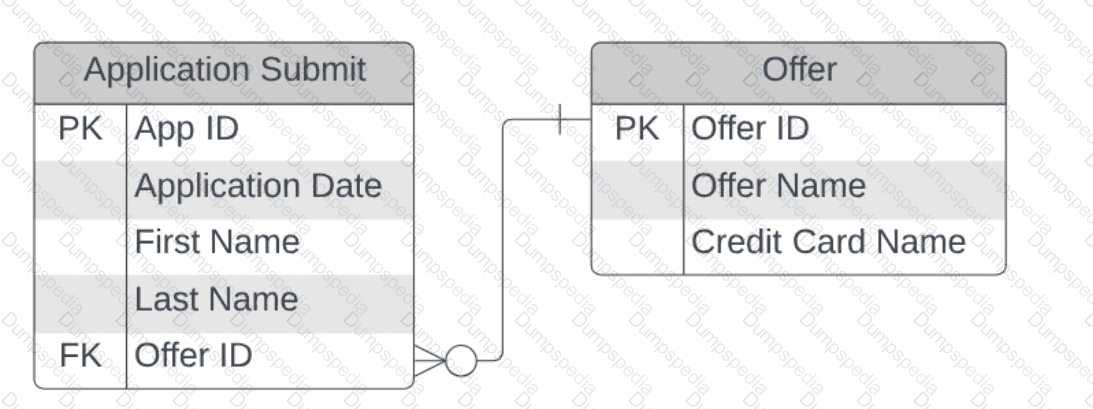
It is assumed that each application submit contains an offer that is always associated to a credit card name. Assuming all applications are streamed into the Real-Time Customer Profile, in which two ways could a developer model the application submit event to ensure the real-time suppression requirement is supported? (Choose two.)
A media company uses Adobe Experience Platform to process large quantities of media consumption data. This data was previously stored in a relational database management system (RDBMS) but has been migrated to the Adobe Real-Time CDP's NoSQL data model for improved scalability and performance. The data set includes information such as user ID, media content ID, play duration, pause durations, and timestamps of each interaction. Which combination of Experience Data Model (XDM) schemas should be used to efficiently capture and retrieve this data with the Adobe Real-Time CDP's NoSQL data model, considering the real-time analytics needs?

TESTED 14 Oct 2026