You have a frequently asked questions (FAQ) PDF file.
You need to create a conversational support system based on the FAQ.
Which service should you use?
QnA Maker
Text Analytics
Computer Vision
Language Understanding (LUIS)
A FAQ PDF file contains structured Q & A content. The QnA Maker (now part of Azure Language Service) can automatically extract questions and answers from such a document and build a knowledge base for conversational bots. This allows users to interact naturally with the content via chat interfaces.
Other options:
B. Text Analytics → Extracts insights, not conversational content.
C. Computer Vision → Used for image analysis.
D. LUIS → Handles intent detection, not static question–answer responses.
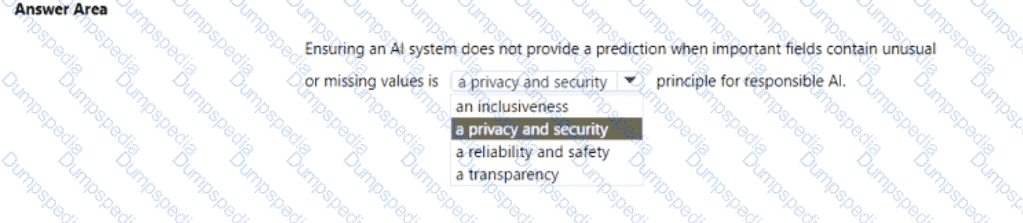
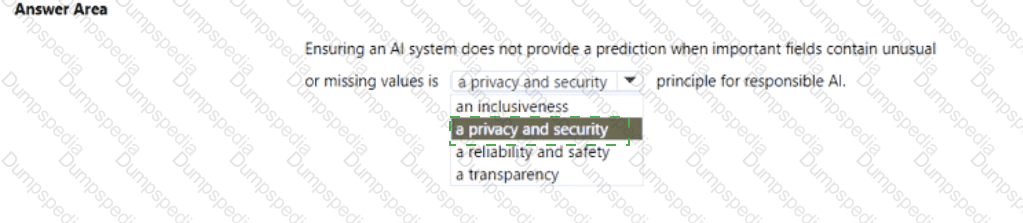
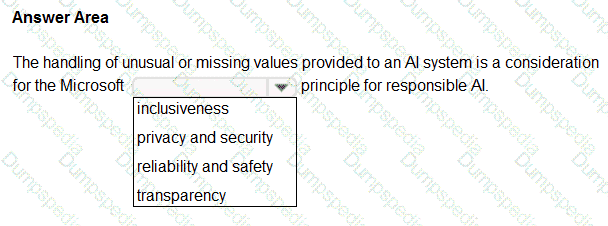
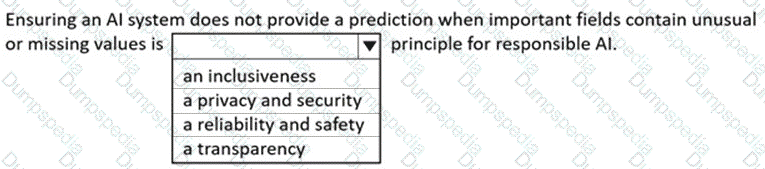
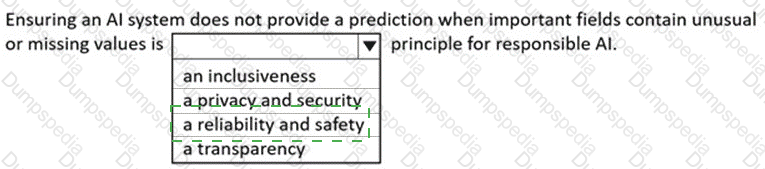
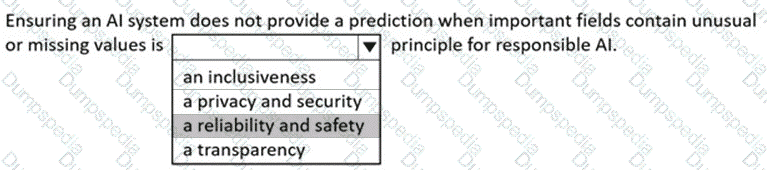
Select the answer that correctly completes the sentence


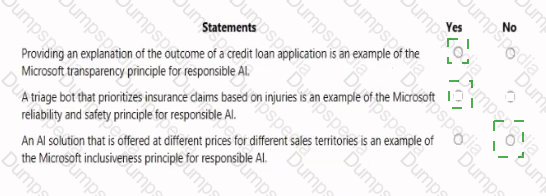
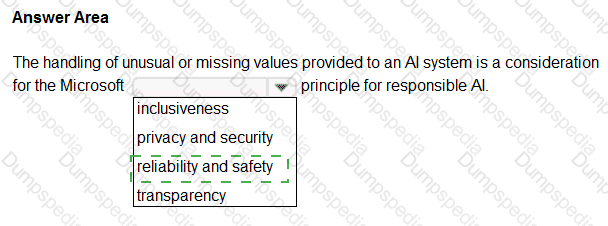
According to the Microsoft Azure AI Fundamentals (AI-900) official study guide and Microsoft’s Responsible AI Framework, the Reliability and Safety principle ensures that AI systems operate consistently, accurately, and as intended, even when confronted with unexpected data or edge cases. It emphasizes that AI systems must be tested, validated, and monitored to ensure stable performance and to prevent harm caused by inaccurate or unreliable outputs.
In the given scenario, the AI system is designed not to provide predictions when key fields contain unusual or missing values. This approach demonstrates that the system is built to avoid unreliable or unsafe outputs that could result from incomplete or corrupted data. Microsoft explicitly outlines that reliable AI systems must handle data anomalies and input validation properly to prevent incorrect predictions.
Here’s how the other options differ:
Inclusiveness ensures accessibility for all users, including those with disabilities or from different backgrounds. It’s unrelated to prediction control or data reliability.
Privacy and Security protects sensitive data and ensures proper handling of personal information, not system prediction logic.
Transparency ensures that users understand how an AI system makes its decisions but doesn’t address prediction reliability.
Thus, stopping a prediction when data is incomplete or abnormal directly supports the Reliability and Safety principle — it ensures that the AI model functions correctly under valid conditions and avoids unintended or harmful outcomes.
This principle aligns with Microsoft’s Responsible AI guidance, which highlights that AI solutions must “operate reliably and safely, even under unexpected conditions, to protect users and maintain trust.”
You need to predict the sea level in meters for the next 10 years.
Which type of machine learning should you use?
classification
regression
clustering
In the most basic sense, regression refers to prediction of a numeric target.
Linear regression attempts to establish a linear relationship between one or more independent variables and a numeric outcome, or dependent variable.
You use this module to define a linear regression method, and then train a model using a labeled dataset. The trained model can then be used to make predictions.
Match the Azure Al service to the appropriate generative Al capability.
To answer, drag the appropriate service from the column on the left to its capability on the right. Each service may be used once, more than once, or not at all.
NOTE: Each correct match is worth one point.
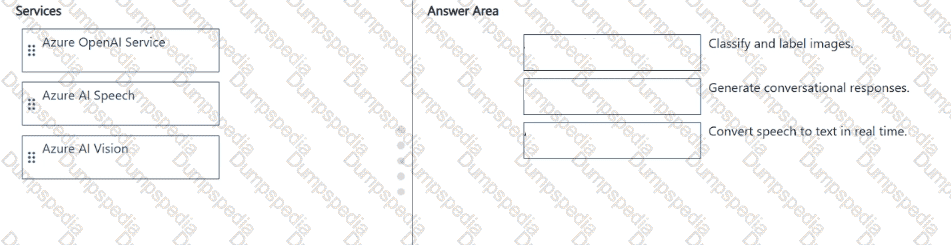


This question maps each Azure AI service to its correct capability based on the Microsoft Azure AI Fundamentals (AI-900) syllabus and Microsoft Learn documentation on Azure Cognitive Services.
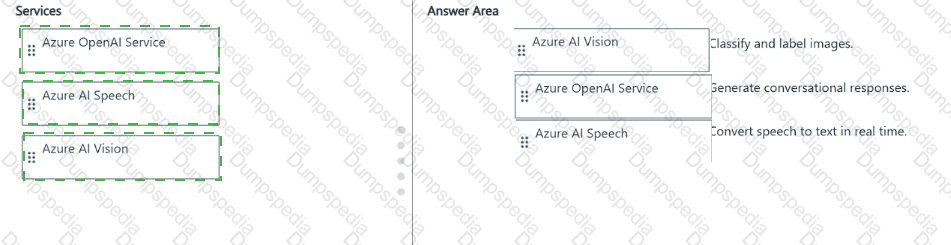
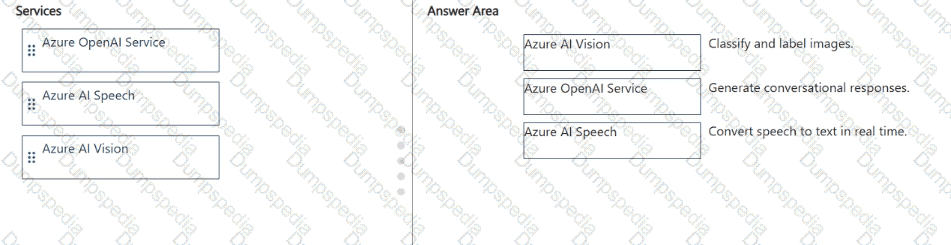
Classify and label images → Azure AI VisionAzure AI Vision (formerly Computer Vision) provides capabilities to analyze visual content, detect objects, classify images, and extract information from pictures. It includes object detection, image classification, and tagging, which are core vision tasks. This service enables businesses to build solutions that understand visual input, such as identifying products, reading signs, or detecting faces in images.
Generate conversational responses → Azure OpenAI ServiceAzure OpenAI Service integrates powerful large language models such as GPT-3.5 and GPT-4, capable of generating human-like text responses, summarizations, translations, and dialogues. These models are designed for natural language generation (NLG) and conversational AI, making them ideal for chatbots, virtual agents, and intelligent assistants that produce dynamic, context-aware replies.
Convert speech to text in real time → Azure AI SpeechAzure AI Speech provides speech-to-text capabilities (speech recognition) that convert spoken language into written text instantly. It is commonly used in transcription services, voice command systems, and live captioning applications. Additionally, the Speech service supports text-to-speech (speech synthesis) and speech translation, making it versatile for voice-based AI applications.
By understanding each service’s specialization—Vision for visual data, OpenAI for generative text, and Speech for audio processing—you can correctly match the capabilities.
Select the answer that correctly completes the sentence.


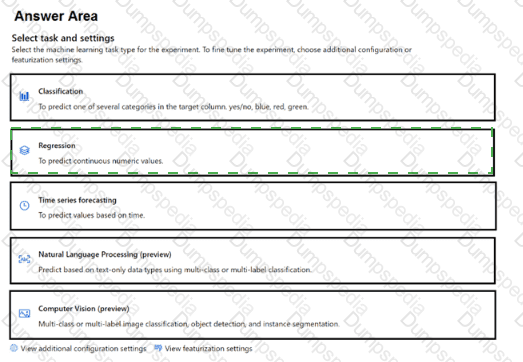
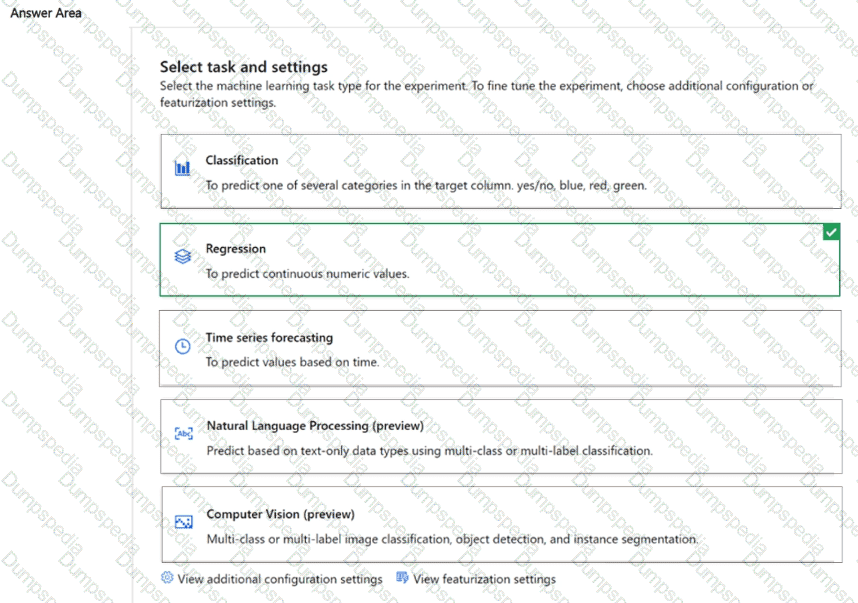
According to the Microsoft Azure AI Fundamentals (AI-900) Official Study Guide and the Microsoft Learn module “Explore fundamental principles of machine learning,” regression is a supervised machine learning technique used to predict continuous numeric values based on input data.
In this scenario, the goal is to predict how many hours of overtime a delivery person will work depending on the number of orders received. The output — the number of overtime hours — is a continuous variable (for example, 1.5 hours, 3.2 hours, etc.), not a category. This makes it a regression problem, where the model learns patterns from historical data and uses those patterns to estimate a continuous numeric outcome.
Why Regression Applies Here:
Regression models work by finding the mathematical relationship between input features (independent variables) and output values (dependent variables). In this case:
Input (feature): Number of orders received
Output (label): Predicted overtime hours
Azure Machine Learning supports several regression algorithms, including Linear Regression, Decision Tree Regression, and Neural Network Regression, all of which can handle scenarios where a numeric prediction is required.
Why Not the Other Options:
Classification: Used for predicting discrete categories or labels (e.g., “on-time” vs. “late”). It does not output continuous numbers.
Clustering: An unsupervised learning technique used to group data points with similar characteristics, not to make numeric predictions.
Thus, when the output variable is a numeric prediction (such as hours, prices, quantities, or time), the correct machine learning task is Regression.
You need to create a customer support solution to help customers access information. The solution must support email, phone, and live chat channels. Which type of Al solution should you use?
natural language processing (NLP)
computer vision
machine learning
chatbot
According to the Microsoft Azure AI Fundamentals (AI-900) official study materials and Microsoft Learn module “Describe features of common AI workloads”, a chatbot (also known as a conversational AI agent) is a solution designed to interact with users through natural language conversation across multiple channels such as email, phone, webchat, and messaging apps.
Chatbots use Natural Language Processing (NLP) to interpret what users are saying, identify their intent, and provide relevant responses. In Azure, this functionality is implemented using the Azure Bot Service integrated with the Azure Cognitive Service for Language (Question Answering and Language Understanding). The study guide emphasizes that chatbots are used in customer service, information retrieval, and support automation to reduce the workload on human agents and improve response times.
The requirement in this question — supporting email, phone, and live chat channels — aligns exactly with the definition of a conversational AI chatbot, which can operate across multiple communication platforms. Microsoft Learn clearly identifies that chatbots can be deployed to assist customers in retrieving information, answering FAQs, and escalating complex issues when necessary.
The other options are incorrect because:
A. NLP is the underlying technology used by the chatbot but not the solution itself.
B. Computer vision involves analyzing images or videos, which is unrelated to this scenario.
C. Machine learning is a broader AI field and not a specific customer support solution type.
You have a dataset that contains experimental data for fuel samples.
You need to predict the amount of energy that can be obtained from a sample based on its density.
Which type of Al workload should you use?
Classification
Clustering
Knowledge mining
Regression
As described in the AI-900 study guide under “Identify features of machine learning,” regression is a supervised learning technique used to predict continuous numerical values. In this scenario, the goal is to predict energy output (a continuous variable) based on density (a numeric input).
Regression models find relationships between variables by fitting a line or curve that best represents the trend of the data. In Azure Machine Learning, regression algorithms such as linear regression, decision tree regression, and boosted decision trees are commonly used for such predictions.
Classification (A) predicts discrete labels (e.g., “High” or “Low”), not numeric values.
Clustering (B) groups similar data points but does not perform prediction.
Knowledge mining (C) extracts insights from unstructured data using tools like Azure AI Search and Cognitive Skills.
Hence, based on AI-900 fundamentals, predicting energy based on density requires a regression workload.
You plan to create an Al application by using Azure Al Foundry. The solution will be deployed to dedicated virtual machines. Which deployment option should you use?
serverless API
Azure Kubernetes Service (AKS) cluster
Azure virtual machines
managed compute
Which two components can you drag onto a canvas in Azure Machine Learning designer? Each correct answer presents a complete solution.
NOTE: Each correct selection is worth one point.
dataset
co mpute
pipeline
module
In Azure Machine Learning designer, a low-code drag-and-drop interface, users can visually build machine learning workflows. According to the AI-900 study guide and Microsoft Learn module “Create and publish models with Azure Machine Learning designer”, two key components that can be dragged onto the designer canvas are datasets and modules.
Datasets (A): These are collections of data that serve as the input for training or evaluating models. They can be registered in the workspace and then dragged onto the canvas for use in transformations or model training.
Modules (D): These are prebuilt processing and modeling components that perform operations such as data cleaning, feature engineering, model training, and evaluation. Examples include “Split Data,” “Train Model,” and “Evaluate Model.”
Compute (B) and Pipeline (C) are not drag-and-drop items within the designer. Compute targets are infrastructure resources used to run the pipeline, while a pipeline represents the overall workflow, not a component that can be added like a dataset or module.
Hence, the correct answers are A. Dataset and D. Module.
Which metric can you use to evaluate a classification model?
true positive rate
mean absolute error (MAE)
coefficient of determination (R2)
root mean squared error (RMSE)
For evaluating a classification model, the appropriate metric from the options provided is the True Positive Rate (TPR), also known as Sensitivity or Recall. According to the Microsoft Azure AI Fundamentals (AI-900) official study guide and Microsoft Learn module “Evaluate model performance”, classification models are evaluated using metrics that measure how accurately the model predicts categorical outcomes such as “yes/no,” “spam/not spam,” or “approved/denied.”
The True Positive Rate measures the proportion of correctly identified positive cases out of all actual positive cases. Mathematically, it is expressed as:
True Positive Rate (Recall)=True PositivesTrue Positives + False Negatives\text{True Positive Rate (Recall)} = \frac{\text{True Positives}}{\text{True Positives + False Negatives}}True Positive Rate (Recall)=True Positives + False NegativesTrue Positives
This metric is important when missing positive predictions carries a high cost, such as in medical diagnosis or fraud detection. Microsoft Learn highlights classification evaluation metrics such as accuracy, precision, recall, F1 score, and AUC (Area Under the Curve) as suitable for classification models.
The other options—Mean Absolute Error (MAE), Root Mean Squared Error (RMSE), and Coefficient of Determination (R²)—are regression metrics used to evaluate models that predict numeric values rather than categories. For example, they apply to predicting house prices or temperatures, not yes/no decisions.
Therefore, the correct classification evaluation metric among the choices is A. True Positive Rate.
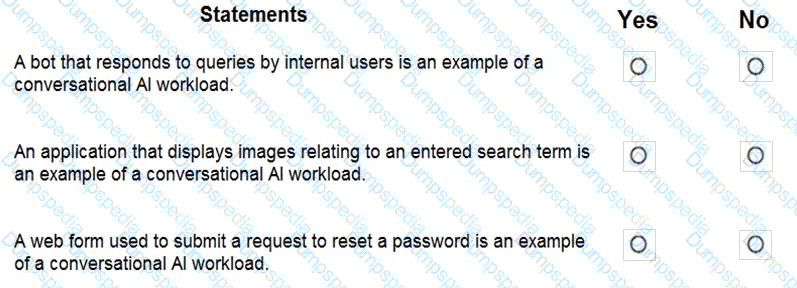
For each of the following statements, select Yes if the statement is true. Otherwise, select No.
NOTE: Each correct selection is worth one point.

Statements
Yes
No
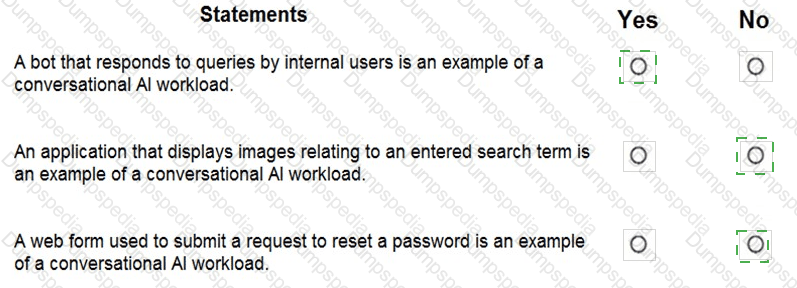
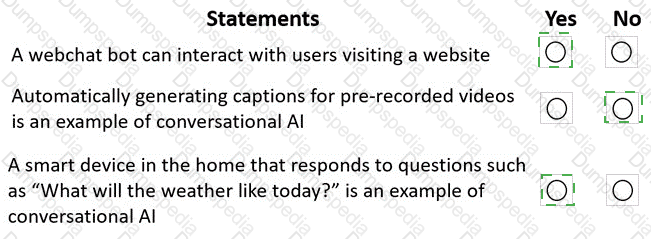
A bot that responds to queries by internal users is an example of a conversational AI workload.
✅ Yes
An application that displays images relating to an entered search term is an example of a conversational AI workload.
✅ No
A web form used to submit a request to reset a password is an example of a conversational AI workload.
✅ No
According to the Microsoft Azure AI Fundamentals (AI-900) official study materials, conversational AI workloads are those that enable interaction between humans and AI systems through natural language conversation, either by text or speech. These workloads are typically implemented using Azure Bot Service, Azure Cognitive Services for Language, and Azure OpenAI Service. The key characteristic of a conversational AI workload is the presence of dialogue—the AI interprets user intent and provides a meaningful, contextual response in a conversation-like manner.
“A bot that responds to queries by internal users is an example of a conversational AI workload.” → YESThis fits the definition perfectly. A chatbot that helps employees (internal users) by answering questions about policies, IT issues, or HR procedures is a typical example of conversational AI. It uses natural language understanding to interpret questions and provide automated responses. Microsoft Learn explicitly identifies chatbots as conversational AI solutions designed for both internal and external interactions.
“An application that displays images relating to an entered search term is an example of a conversational AI workload.” → NOThis is not conversational AI because there is no dialogue or language understanding involved. It is an example of information retrieval or computer vision if it uses image recognition, but not conversation.
“A web form used to submit a request to reset a password is an example of a conversational AI workload.” → NOA password reset form is a simple UI-driven process that doesn’t require AI or conversational logic. It performs a fixed function based on user input but does not understand or respond to natural language.
Therefore, based on the AI-900 study guide, only the first statement is an example of a conversational AI workload, while the second and third statements are not.
You use Azure Machine Learning designer to publish an inference pipeline.
Which two parameters should you use to consume the pipeline? Each correct answer presents part of the solution.
NOTE: Each correct selection is worth one point.
the model name
the training endpoint
the authentication key
the REST endpoint
According to the Microsoft Azure AI Fundamentals (AI-900) Official Study Guide and the Microsoft Learn module “Explore Azure Machine Learning”, when you publish an inference pipeline (a deployed web service for real-time predictions) using Azure Machine Learning designer, you make the model accessible as a RESTful endpoint. Consumers—such as applications, scripts, or services—interact with this endpoint to submit data and receive predictions.
To securely access this deployed pipeline, two critical parameters are required:
REST endpoint (Option D):The REST endpoint is a URL automatically generated when the inference pipeline is deployed. It defines the network location where clients send HTTP POST requests containing input data (usually in JSON format). The endpoint routes these requests to the deployed model, which processes the data and returns prediction results. The REST endpoint acts as the primary access point for consuming the model’s inferencing capability programmatically.
Authentication key (Option C):The authentication key (or API key) is a security token provided by Azure to ensure that only authorized users or systems can access the endpoint. When invoking the REST service, the key must be included in the request header (typically as the value of the Authorization header). This mechanism enforces secure, authenticated access to the deployed model.
The other options are incorrect:
A. The model name is not required to consume the endpoint; it is used internally within the workspace.
B. The training endpoint is used for training pipelines, not for inference.
Therefore, according to Microsoft’s official AI-900 learning objectives and Azure Machine Learning documentation, when consuming a published inference pipeline, you must use both the REST endpoint (D) and the authentication key (C). These parameters ensure secure, controlled, and programmatic access to the deployed AI model for real-time predictions.
You need to develop a mobile app for employees to scan and store their expenses while travelling.
Which type of computer vision should you use?
semantic segmentation
image classification
object detection
optical character recognition (OCR)
According to the Microsoft Azure AI Fundamentals (AI-900) official study guide and Microsoft Learn module “Explore computer vision”, Optical Character Recognition (OCR) is a form of computer vision that enables a system to detect and extract printed or handwritten text from images or documents. OCR is particularly useful in scenarios where the goal is to digitize textual information from physical documents, such as receipts, invoices, or travel expense forms — exactly as described in this question.
In the given scenario, employees need a mobile application that allows them to scan and store expenses while traveling. The process involves taking photos of receipts that contain printed text, such as vendor names, totals, dates, and item descriptions. The OCR technology automatically detects the text areas within the image and converts them into machine-readable and searchable data that can be stored in a database or processed further for expense management.
Microsoft’s Azure Cognitive Services include the Computer Vision API and the Form Recognizer service, both of which use OCR technology. The Form Recognizer builds upon OCR by adding intelligent document understanding, enabling it to extract structured data from expense receipts automatically.
Other answer options are incorrect for the following reasons:
A. Semantic segmentation assigns labels to every pixel in an image, typically used in autonomous driving or medical imaging, not for text extraction.
B. Image classification identifies the overall category of an image (e.g., “This is a receipt”), but it does not extract the textual content.
C. Object detection identifies and locates objects in an image with bounding boxes but is not used for text reading or conversion.
Therefore, based on the official AI-900 training and Microsoft Learn content, the correct answer is D. Optical Character Recognition (OCR) — the technology that enables extracting textual information from scanned expense receipts.
You are building a tool that will process images from retail stores and identity the products of competitors.
The solution must be trained on images provided by your company.
Which Azure Al service should you use?
Azure Al Custom Vision
Azure Al Computer Vision
Face
Azure Al Document Intelligence
According to the Microsoft Azure AI Fundamentals (AI-900) official study materials and Microsoft Learn documentation, Azure AI Custom Vision is specifically designed for training custom image classification and object detection models using images that a company provides. In this scenario, the company wants to identify competitor products from images captured in retail stores — a classic use case for custom image classification or object detection, depending on whether you are labeling entire images or identifying multiple items within an image.
Azure AI Custom Vision allows users to:
Upload their own labeled training images.
Train a model that learns to recognize specific objects (in this case, competitor products).
Evaluate, iterate, and deploy the model as an API endpoint for real-time inference.
This fits perfectly with the requirement that the solution “must be trained on images provided by your company.” The key phrase here indicates the need for a custom-trained model rather than a prebuilt one.
The other options are not suitable for this scenario:
B. Azure AI Computer Vision provides prebuilt models for general-purpose image understanding (e.g., detecting common objects, reading text, describing scenes). It is not intended for training on custom datasets.
C. Face service is limited to detecting and recognizing human faces; it cannot be trained to identify products.
D. Azure AI Document Intelligence (formerly Form Recognizer) is focused on extracting structured data from documents and forms, not analyzing retail images.
Therefore, per Microsoft’s official AI-900 training content, when a solution must be trained on custom company images to recognize specific products, the appropriate service is Azure AI Custom Vision.
You need to create a clustering model and evaluate the model by using Azure Machine Learning designer. What should you do?
Split the original dataset into a dataset for features and a dataset for labels. Use the features dataset for evaluation.
Split the original dataset into a dataset for training and a dataset for testing. Use the training dataset for evaluation.
Split the original dataset into a dataset for training and a dataset for testing. Use the testing dataset for evaluation.
Use the original dataset for training and evaluation.
According to the Microsoft Learn module “Explore fundamental principles of machine learning” and the AI-900 Official Study Guide, when building and evaluating a model (such as a clustering model) in Azure Machine Learning designer, data must be divided into two subsets:
Training dataset: Used to train the model so it can learn patterns and relationships in the data.
Testing dataset: Used to evaluate the model’s performance on unseen data, ensuring that it generalizes well and does not overfit.
In Azure ML Designer, this is typically done using the Split Data module, which separates the dataset into training and testing portions (for example, 70% training and 30% testing). After training, you connect the testing dataset to an Evaluate Model module to assess metrics such as accuracy, precision, or silhouette score (for clustering).
Other options are incorrect:
A. Split into features and labels: Clustering is an unsupervised learning technique, so it doesn’t use labeled data.
B. Use training dataset for evaluation: This would cause overfitting, as the model is being tested on the same data it learned from.
D. Use the original dataset for training and evaluation: Also causes overfitting, offering no measure of generalization.
Select the answer that correctly completes the sentence.


According to the Microsoft Azure AI Fundamentals (AI-900) Official Study Guide and the Microsoft Learn module “Explore computer vision in Microsoft Azure,” computer vision is a field of artificial intelligence that enables computers to interpret and understand visual information from the world — such as images or videos.
In this scenario, the task is to count the number of animals in an area based on a video feed. This requires the system to:
Detect the presence of animals in each frame of the video (object detection).
Track and count them across multiple frames as they move.
These are classic computer vision tasks, as they involve analyzing visual inputs (video or image data) and identifying objects (in this case, animals). Azure provides services such as Azure Computer Vision, Custom Vision, and Video Indexer, which can perform object detection, counting, and activity recognition using AI models trained on visual datasets.
Why the other options are incorrect:
Forecasting: Involves predicting future values based on historical data (e.g., predicting sales or weather), not analyzing video feeds.
Knowledge mining: Focuses on extracting insights from large text-based document repositories, not images or videos.
Anomaly detection: Identifies unusual patterns in numeric or time-series data, not visual objects.
Therefore, identifying and counting animals in video footage falls under computer vision, since it uses AI to visually detect, classify, and quantify objects in real-time or recorded feeds.
You are building an AI-based app.
You need to ensure that the app uses the principles for responsible AI.
Which two principles should you follow? Each correct answer presents part of the solution.
NOTE: Each correct selection is worth one point.
Implement an Agile software development methodology
Implement a process of Al model validation as part of the software review process
Establish a risk governance committee that includes members of the legal team, members of the risk management team, and a privacy officer
Prevent the disclosure of the use of Al-based algorithms for automated decision making
The correct answers are B. Implement a process of AI model validation as part of the software review process and C. Establish a risk governance committee that includes members of the legal team, members of the risk management team, and a privacy officer.
According to the Microsoft Azure AI Fundamentals (AI-900) Official Study Guide and the Microsoft Responsible AI principles, responsible AI emphasizes six key principles: fairness, reliability and safety, privacy and security, inclusiveness, transparency, and accountability. These principles ensure that AI systems are trustworthy, ethical, and safe for users and society.
Option B aligns with the reliability and safety principle. Model validation ensures that AI models behave as expected, perform accurately across different data conditions, and produce consistent results. Microsoft teaches that AI models should be validated, tested, and monitored regularly to avoid unintended outcomes, bias, or failures. Validation processes help ensure that the AI behaves responsibly before deployment and continues to perform reliably over time.
Option C aligns with the accountability and governance principle. Establishing a risk governance committee that includes legal, privacy, and risk management experts ensures that AI development and deployment are overseen responsibly. This committee is responsible for reviewing compliance with data protection laws, ensuring ethical practices, and managing risks associated with AI-driven decisions. Microsoft emphasizes that accountability requires human oversight and governance structures to ensure ethical alignment throughout the AI system’s lifecycle.
The incorrect options are:
A. Implement an Agile software development methodology: Agile is a software project management approach, not a Responsible AI principle.
D. Prevent the disclosure of the use of AI-based algorithms: This violates the transparency principle, which requires organizations to disclose when and how AI is used.
Therefore, following the official Responsible AI framework taught in AI-900, the correct and verified answers are B and C, as they directly promote reliability, safety, accountability, and governance in AI systems.
You are building a tool that will process images from retail stores and identify the products of competitors.
The solution will use a custom model.
Which Azure Cognitive Services service should you use?
Custom Vision
Form Recognizer
Face
Computer Vision
to 300 words in Explanation:
The Custom Vision service under Azure Cognitive Services is specifically designed for image classification and object detection tasks that require a custom-trained model. According to the AI-900 official study materials, Custom Vision enables developers to “build, deploy, and improve image classifiers that recognize specific objects in images based on custom data.”
In this question, the goal is to build a system that processes images from retail stores and identifies products of competitors. Since these are unique products that may not be part of Microsoft’s pre-trained models, a custom model must be created. The Custom Vision service allows you to upload your own labeled images (e.g., product pictures), train a model to recognize those products, and then deploy it as an API for image recognition tasks.
Other options explained:
B. Form Recognizer is used to extract text, key-value pairs, and tables from structured or semi-structured documents like invoices or receipts. It is not suitable for object identification.
C. Face service detects and analyzes human faces, providing attributes like age, emotion, and facial landmarks, but cannot recognize general objects like products.
D. Computer Vision is a general-purpose image analysis service used for tagging, OCR, and scene recognition, but it uses pre-trained models. It doesn’t allow for custom product identification.
Thus, based on Microsoft’s guidance, the best fit for recognizing competitor products from images using a custom-trained model is A. Custom Vision.
You have the process shown in the following exhibit.
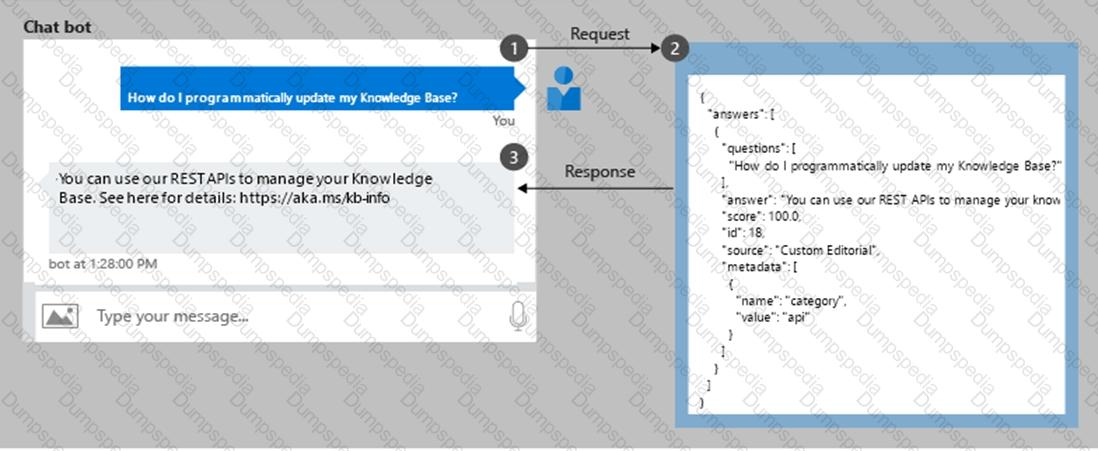
Which type AI solution is shown in the diagram?
a sentiment analysis solution
a chatbot
a machine learning model
a computer vision application
For each of the following statements, select Yes if the statement is true. Otherwise, select No.
NOTE: Each correct selection is worth one point.
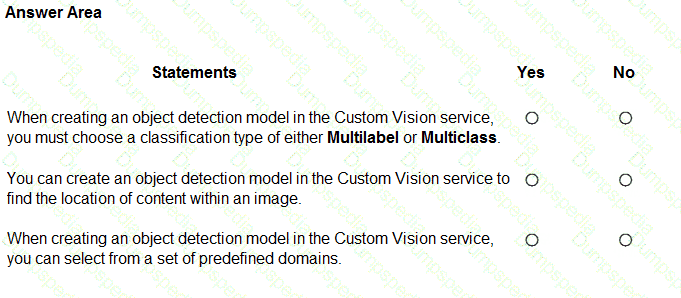


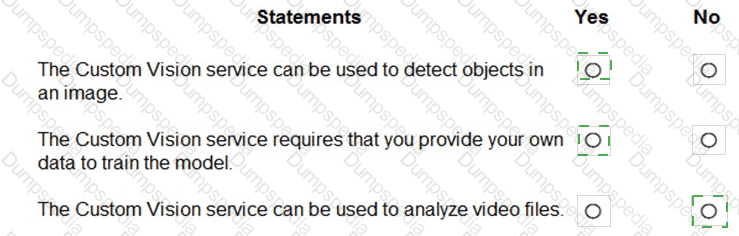
According to the Microsoft Azure AI Fundamentals (AI-900) official study guide and the Microsoft Learn module “Identify features of the Computer Vision and Custom Vision services”, the Custom Vision service is used to train, deploy, and improve custom image classification and object detection models using your own labeled data.
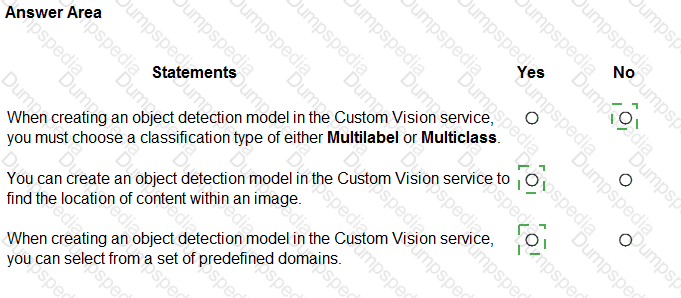
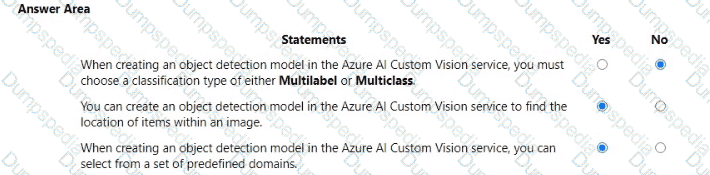
Multilabel or Multiclass Selection – NOThe statement is false because the Multilabel or Multiclass choice applies only to image classification models, not object detection models. In image classification, “Multiclass” means one label per image, while “Multilabel” means multiple labels per image. In contrast, object detection models identify and locate multiple objects in an image using bounding boxes; thus, this classification-type selection does not apply.
Object Detection Locates Content in an Image – YESThis statement is true. The object detection functionality in Custom Vision is designed to both identify what objects appear in an image and determine their location through bounding box coordinates. For example, a model could detect and locate multiple products on a store shelf. Microsoft documentation describes object detection as “identifying the presence and location of objects in an image.”
Predefined Domains – YESThis statement is true as well. When you create a new Custom Vision project, you must select a domain, which is a predefined optimization setting tailored to specific use cases such as retail, food, landmarks, or general images. These domains are designed to improve model accuracy by applying specialized transfer learning features based on the type of images you will analyze.
In summary:
Classification type (Multilabel/Multiclass): No (only for classification models)
Detect object location: Yes
Choose predefined domain: Yes
For each of the following statements, select Yes if the statement is true. Otherwise, select No.
NOTE: Each correct selection is worth one point.
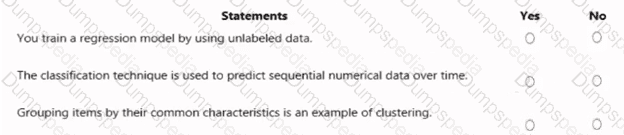


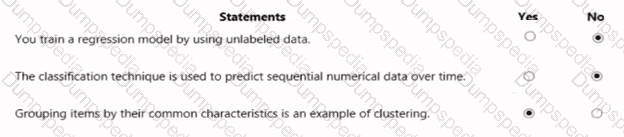
According to the Microsoft Azure AI Fundamentals (AI-900) official study guide and the Microsoft Learn module “Identify features of common machine learning types”, there are three main types of machine learning: supervised learning, unsupervised learning, and reinforcement learning. Within supervised learning, two common approaches are regression and classification, while clustering is a primary example of unsupervised learning.
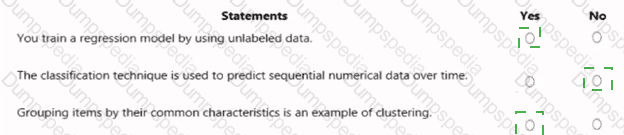
“You train a regression model by using unlabeled data.” – No.Regression models are trained with labeled data, meaning the input data includes both features (independent variables) and target labels (dependent variables) representing continuous numerical values. Examples include predicting house prices or sales forecasts. Unlabeled data (data without target output values) cannot be used to train regression models; such data is used in unsupervised learning tasks like clustering.
“The classification technique is used to predict sequential numerical data over time.” – No.Classification is used for categorical predictions, where outputs belong to discrete classes, such as spam/not spam or disease present/absent. Predicting sequential numerical data over time refers to time series forecasting, which is typically a regression or forecasting problem, not classification. The AI-900 syllabus clearly separates classification (categorical prediction) from regression (continuous value prediction) and time series (temporal pattern analysis).
“Grouping items by their common characteristics is an example of clustering.” – Yes.This statement is correct. Clustering is an unsupervised learning technique used to group similar data points based on their features. The AI-900 study materials describe clustering as the process of “discovering natural groupings in data without predefined labels.” Common examples include customer segmentation or document grouping.
Therefore, based on Microsoft’s AI-900 training objectives and definitions:
Regression → supervised learning using labeled continuous data (No)
Classification → categorical prediction, not sequential numeric forecasting (No)
Clustering → grouping by similarity (Yes)
What should you use to explore pretrained generative Al models available from Microsoft and third-party providers?
Azure Synapse Analytics
Azure Machine Learning designer
Azure Al Foundry
Language Studio
You have a database that contains a list of employees and their photos.
You are tagging new photos of the employees.
For each of the following statements select Yes if the statement is true. Otherwise, select No.
NOTE: Each correct selection is worth one point.
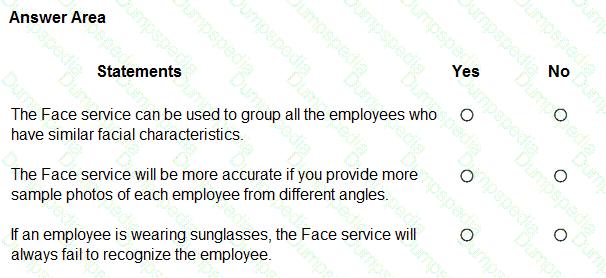


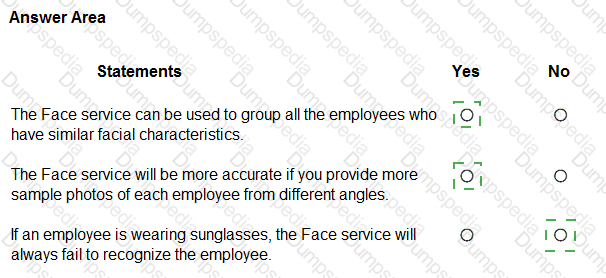
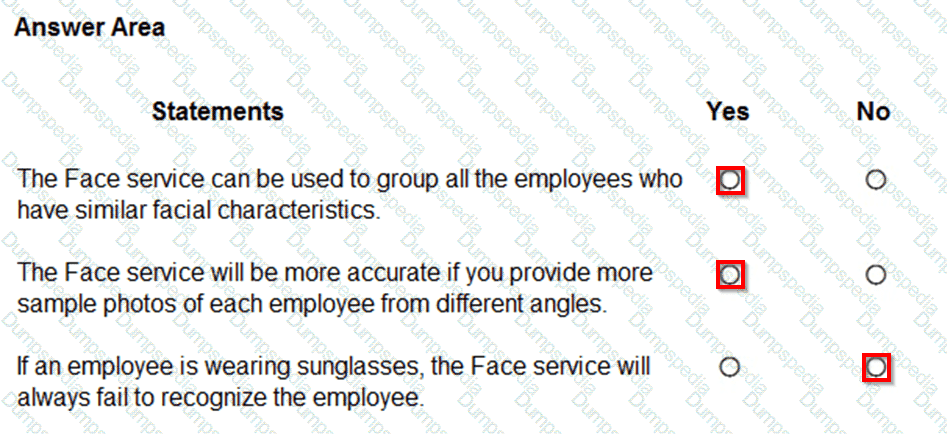
These answers are derived from the Microsoft Azure AI Fundamentals (AI-900) Official Study Guide and the Microsoft Learn module “Explore computer vision in Microsoft Azure.” The Azure Face service, part of Azure Cognitive Services, provides advanced facial recognition capabilities including detection, verification, identification, grouping, and similarity analysis.
Let’s analyze each statement:
“The Face service can be used to group all the employees who have similar facial characteristics.” → YesThe Face service supports a grouping function that automatically organizes a collection of unknown faces into groups based on visual similarity. It doesn’t require labeled data; instead, it identifies clusters of similar-looking faces. This is particularly useful when building or validating datasets of people.
“The Face service will be more accurate if you provide more sample photos of each employee from different angles.” → YesAccording to Microsoft documentation, model accuracy improves when you provide multiple high-quality images of each person under different conditions—such as varying lighting, poses, and angles. This diversity allows the service to better learn unique facial characteristics and improves recognition reliability, especially for identification and verification tasks.
“If an employee is wearing sunglasses, the Face service will always fail to recognize the employee.” → NoThis is incorrect. While occlusions (like sunglasses or hats) can reduce accuracy, the service may still recognize the person depending on how much of the face remains visible. Microsoft Learn explicitly notes that partial occlusion affects recognition confidence but does not guarantee failure.
In conclusion, the Face service can group similar faces (Yes), become more accurate with diverse samples (Yes), and still recognize partially covered faces though with lower confidence (No). These principles align directly with the Face API’s core functions and AI-900 learning objectives regarding computer vision and responsible AI-based facial recognition.
You are evaluating whether to use a basic workspace or an enterprise workspace in Azure Machine Learning.
What are two tasks that require an enterprise workspace? Each correct answer presents a complete solution.
NOTE: Each correct selection is worth one point.
Use a graphical user interface (GUI) to run automated machine learning experiments.
Create a compute instance to use as a workstation.
Use a graphical user interface (GUI) to define and run machine learning experiments from Azure Machine Learning designer.
Create a dataset from a comma-separated value (CSV) file.
The correct answers are A. Use a graphical user interface (GUI) to run automated machine learning experiments and C. Use a graphical user interface (GUI) to define and run machine learning experiments from Azure Machine Learning designer.
According to the Microsoft Azure AI Fundamentals (AI-900) official documentation and Microsoft Learn module “Create and manage Azure Machine Learning workspaces”, there are two workspace tiers: Basic and Enterprise. The Enterprise workspace provides advanced capabilities for automation, visualization, and collaboration that are not available in the Basic tier.
Specifically:
Automated machine learning (AutoML) using a GUI is only available in the Enterprise tier. AutoML automatically selects algorithms and tunes hyperparameters through the Azure Machine Learning studio interface.
Azure Machine Learning designer, which allows users to visually drag and drop datasets and modules to create machine learning pipelines, also requires the Enterprise workspace.
In contrast:
B. Create a compute instance and D. Create a dataset from a CSV file are fundamental actions supported in both Basic and Enterprise workspaces. These do not require the advanced licensing features of the Enterprise edition.
Therefore, tasks involving the graphical, no-code tools—Automated ML (AutoML) and the Designer—require the Enterprise workspace, aligning with AI-900’s learning objectives.
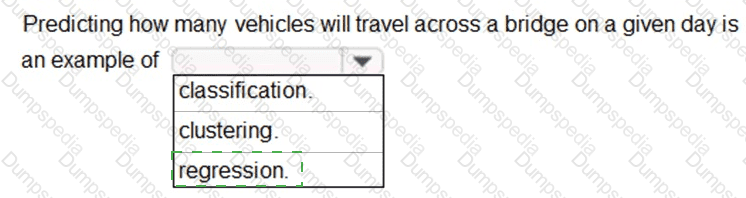
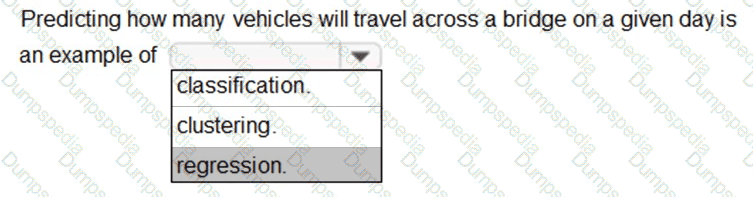
To complete the sentence, select the appropriate option in the answer area.


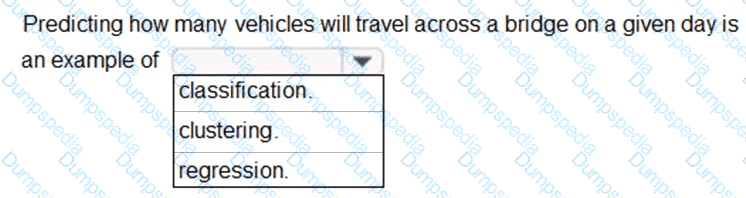
In the context of Microsoft Azure AI Fundamentals (AI-900) and general machine learning principles, regression refers to a type of supervised learning used to predict continuous numerical values based on historical data. The goal of regression is to model the relationship between input variables (features) and a continuous output variable (target).
In this scenario, the task is to predict how many vehicles will travel across a bridge on a given day. The number of vehicles is a numerical value that can vary continuously depending on factors such as time of day, weather, weekday/weekend, or traffic trends. Because the output is numeric and not categorical, this problem type clearly fits into regression analysis.
Microsoft’s official learning content for AI-900, under “Identify features of regression and classification machine learning models,” specifies that regression models are used to predict values such as sales forecasts, demand estimation, temperature prediction, or traffic volume—all of which share the same underlying objective: predicting a quantity.
To clarify other options:
Classification is used when predicting categories or discrete classes, such as determining whether an email is spam or not spam, or if an image contains a cat or a dog.
Clustering is an unsupervised learning technique used to group similar data points without predefined labels (for example, grouping customers by purchasing behavior).
Since predicting the number of vehicles results in a continuous numerical output, it aligns precisely with the regression workload type described in the Microsoft AI-900 study materials.
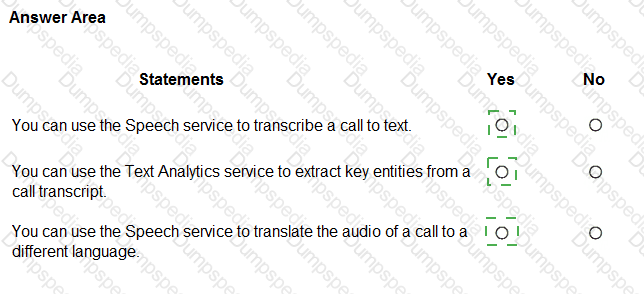
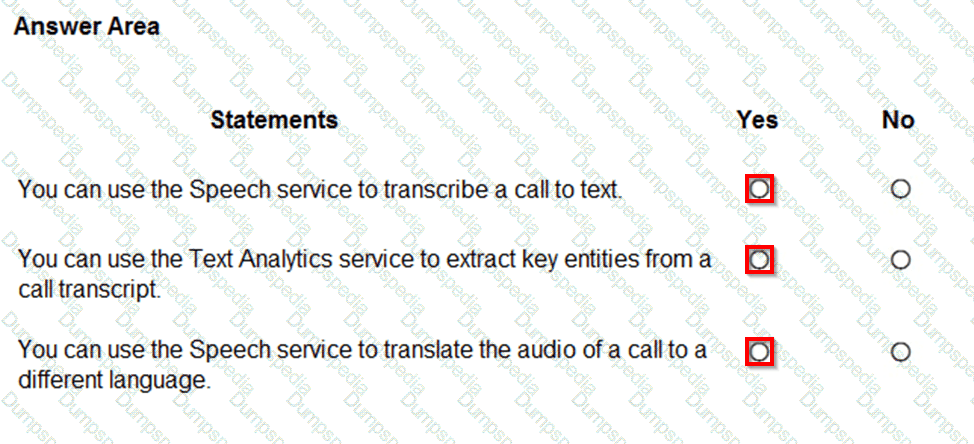
For each of the following statements, select Yes if the statement is true. Otherwise, select No.
NOTE: Each correct selection is worth one point.
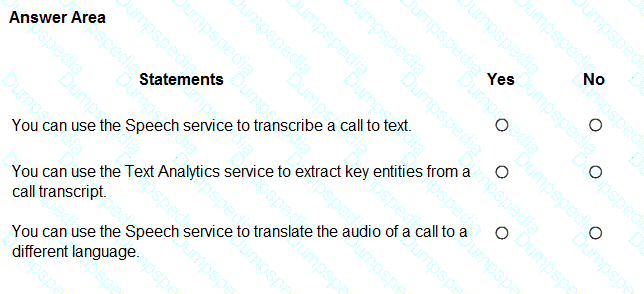


This question assesses knowledge of the Azure Cognitive Services Speech and Text Analytics capabilities, as described in the Microsoft Azure AI Fundamentals (AI-900) official study guide and Microsoft Learn modules “Explore natural language processing” and “Explore speech capabilities.” These services are part of Azure Cognitive Services, which provide prebuilt AI capabilities for speech, language, and text understanding.
You can use the Speech service to transcribe a call to text → YesThe Speech-to-Text feature in the Azure Speech service automatically converts spoken words into written text. Microsoft Learn explains: “The Speech-to-Text capability enables applications to transcribe spoken audio to text in real time or from recorded files.” This makes it ideal for call transcription, voice assistants, and meeting captioning.
You can use the Text Analytics service to extract key entities from a call transcript → YesOnce a call has been transcribed into text, the Text Analytics service (part of Azure Cognitive Services for Language) can process that text to extract key entities, key phrases, and sentiment. For example, it can identify names, organizations, locations, and product mentions. Microsoft Learn notes: “Text Analytics can extract key phrases and named entities from text to derive insights and structure from unstructured data.”
You can use the Speech service to translate the audio of a call to a different language → YesThe Azure Speech service also includes Speech Translation, which can translate spoken language in real time. It converts audio input from one language into translated text or speech output in another language. Microsoft Learn describes this as: “Speech Translation combines speech recognition and translation to translate spoken audio to another language.”
correctly completes the sentence.


Features
The correct completion of the sentence is:
“In a machine learning model, the data that is used as inputs are called features.”
According to the Microsoft Azure AI Fundamentals (AI-900) official study materials and Microsoft Learn module “Identify features of common machine learning types,” the term feature refers to an individual measurable property or characteristic of the data that is used by a machine learning model to make predictions or decisions.
In supervised and unsupervised learning, features serve as the inputs to the model. They are the variables that represent the information the algorithm learns from. For example, if a model predicts the price of a house, the features might include square footage, number of bedrooms, location, and age of the property. These features feed into the model so that it can learn the relationship between inputs and outputs.
Microsoft Learn further defines these key concepts:
Features: Input variables (independent variables) used by the model to learn patterns.
Labels: The desired output or target variable that the model is trained to predict (e.g., price, category).
Instances: Individual rows or data records within the dataset (each instance has multiple features).
Functions: Algorithms or mathematical operations used during training and prediction — not data inputs.
Therefore, among the provided options — features, functions, labels, instances — only features accurately describe the data elements used as inputs for training or inference in a machine learning model.
In summary, within the AI-900 learning context:
Features = inputs to the model.
Labels = outputs for supervised learning.
Instances = examples (rows) of data.
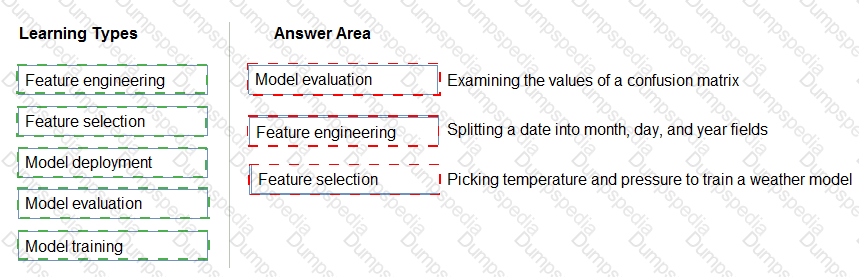
Match the machine learning tasks to the appropriate scenarios.
To answer, drag the appropriate task from the column on the left to its scenario on the right. Each task may be used once, more than once, or not at all.
NOTE: Each correct selection is worth one point.
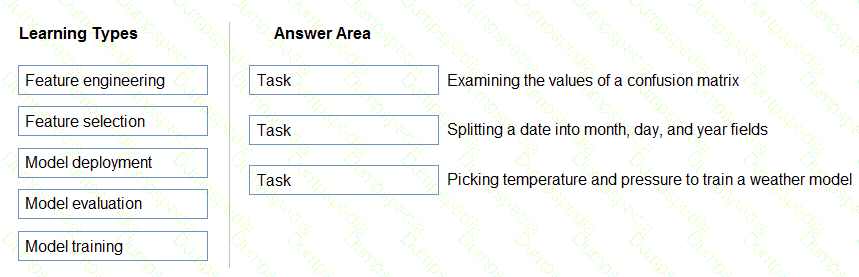


This question tests your understanding of machine learning workflow tasks as described in the Microsoft Azure AI Fundamentals (AI-900) study guide and the Microsoft Learn module “Explore the machine learning process.” The AI-900 curriculum divides the machine learning lifecycle into key phases: data preparation, feature engineering and selection, model training, model evaluation, and model deployment. Each phase has specific tasks designed to prepare, build, and assess predictive models before deployment.
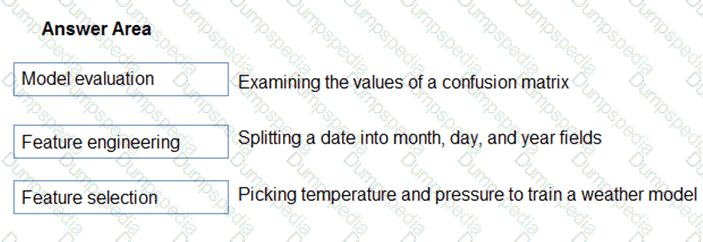
Examining the values of a confusion matrix → Model evaluationIn Azure Machine Learning, evaluating a model involves checking its performance using metrics such as accuracy, precision, recall, and F1-score. The confusion matrix is one of the most common tools for this purpose. According to Microsoft Learn, “model evaluation is the process of assessing a trained model’s performance against test data to ensure reliability before deployment.” Analyzing the confusion matrix helps determine whether predictions align with actual outcomes, making this task part of model evaluation.
Splitting a date into month, day, and year fields → Feature engineeringFeature engineering refers to transforming raw data into features that better represent the underlying patterns to improve model performance. The study guide describes it as “the process of creating new input features from existing data.” Splitting a date field into separate numeric fields (month, day, year) is a classic example of feature engineering because it enables the model to learn from temporal patterns that might otherwise remain hidden.
Picking temperature and pressure to train a weather model → Feature selectionFeature selection involves identifying the most relevant variables that have predictive power for the model. As defined in Microsoft Learn, “feature selection is the process of choosing the most useful subset of input features for training.” In this scenario, selecting temperature and pressure variables as inputs for a weather prediction model fits perfectly within the feature selection stage.
Therefore, the correct matches are:
✅ Examining confusion matrix → Model evaluation
✅ Splitting date field → Feature engineering
✅ Picking temperature & pressure → Feature selection
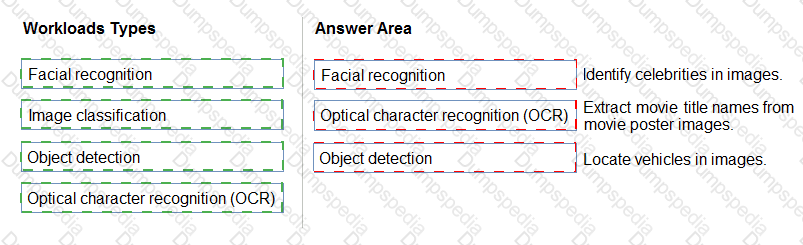
Match the types of computer vision to the appropriate scenarios.
To answer, drag the appropriate workload type from the column on the left to its scenario on the right. Each workload type may be used once, more than once, or not at all.
NOTE: Each correct selection is worth one point.
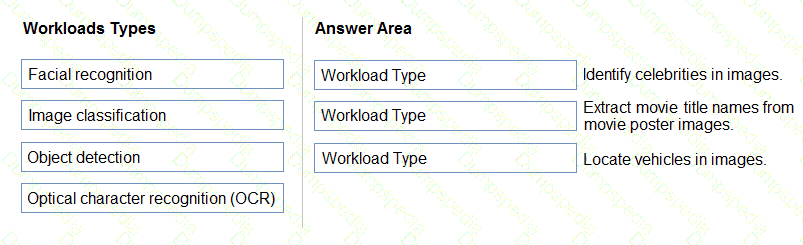

The correct mappings are based on the Microsoft Azure AI Fundamentals (AI-900) curriculum topic: “Describe features of computer vision workloads.” Microsoft divides computer vision tasks into key workload types — image classification, object detection, facial recognition, and optical character recognition (OCR) — each designed for specific visual analysis objectives.
Identify celebrities in images → Facial recognitionFacial recognition goes beyond simple face detection; it can identify or verify specific individuals by comparing facial features with known profiles. According to Microsoft Learn, the Face service in Azure Cognitive Services can detect, recognize, and identify people in photos or videos. Recognizing celebrities or known individuals is a prime example of facial recognition.
Extract movie title names from movie poster images → Optical Character Recognition (OCR)OCR is used to detect and extract text content from images, such as printed or handwritten words. Azure’s Computer Vision API uses OCR technology to read text in various languages from photos, scanned documents, or posters. Therefore, extracting movie titles or actor names from a poster image is a perfect use case for OCR.
Locate vehicles in images → Object detectionObject detection identifies and locates specific objects within an image, returning bounding boxes that indicate their positions. In Azure, the Custom Vision service or Computer Vision object detection models are used to detect multiple objects like vehicles, pedestrians, or animals in a single image.
Summary:
Facial recognition → Identifies specific people (celebrities)
OCR → Extracts text (movie titles)
Object detection → Finds and locates physical items (vehicles)
Thus, the verified and official answer is:
You need to implement a pre-built solution that will identify well-known brands in digital photographs. Which Azure Al sen/tee should you use?
Face
Custom Vision
Computer Vision
Form Recognizer
According to the Microsoft Azure AI Fundamentals (AI-900) Official Study Guide and the Microsoft Learn module “Explore computer vision in Azure,” the Computer Vision service can analyze images to detect objects, landmarks, celebrities, and brands.
The brand detection capability in the Computer Vision Image Analysis API uses pre-trained models to identify well-known brand logos within images. When an image is analyzed, the service returns brand names, confidence scores, and bounding box coordinates where the logos appear.
Let’s examine the other options:
A. Face: Detects and analyzes human faces, not brand logos.
B. Custom Vision: Used for training custom models to recognize unique objects (e.g., company-specific products), not pre-built brand detection.
D. Form Recognizer: Extracts text and data from structured or semi-structured documents like invoices and receipts.
Thus, since the question specifies identifying well-known brands using a pre-built AI model, the correct Azure service is Computer Vision.
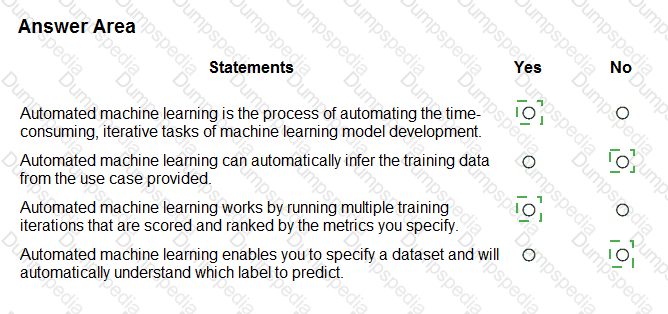
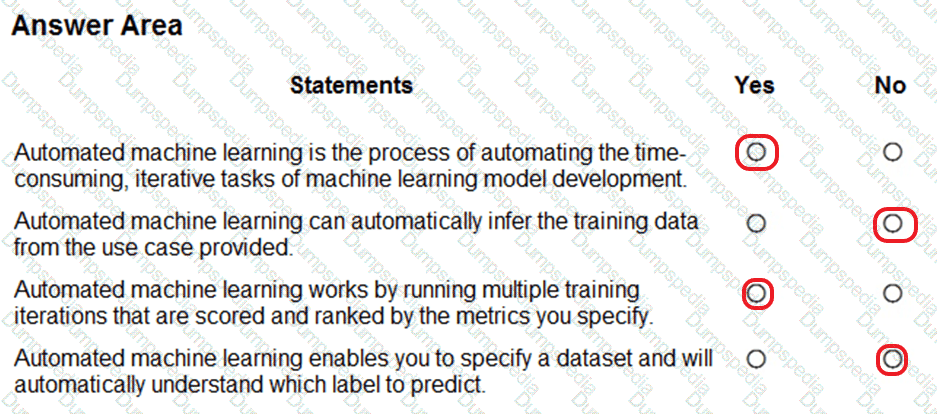
For each of the following statements, select Yes if the statement is true. Otherwise, select No.
NOTE: Each correct selection is worth one point.
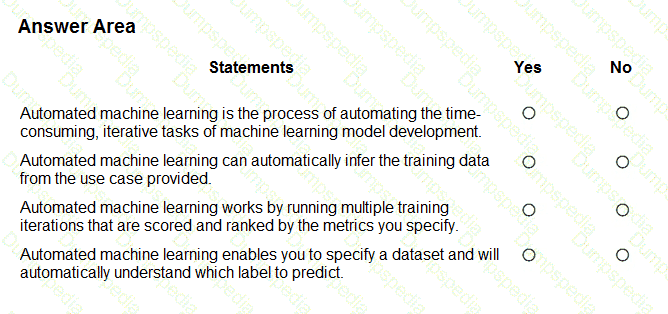


Box 1: Yes
Automated machine learning, also referred to as automated ML or AutoML, is the process of automating the time consuming, iterative tasks of machine learning model development. It allows data scientists, analysts, and developers to build ML models with high scale, efficiency, and productivity all while sustaining model quality.
Box 2: No
Box 3: Yes
During training, Azure Machine Learning creates a number of pipelines in parallel that try different algorithms and parameters for you. The service iterates through ML algorithms paired with feature selections, where each iteration produces a model with a training score. The higher the score, the better the model is considered to " fit " your data. It will stop once it hits the exit criteria defined in the experiment.
Box 4: No
Apply automated ML when you want Azure Machine Learning to train and tune a model for you using the target metric you specify.
The label is the column you want to predict.
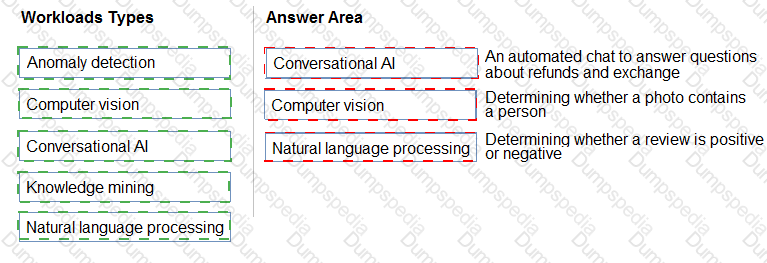
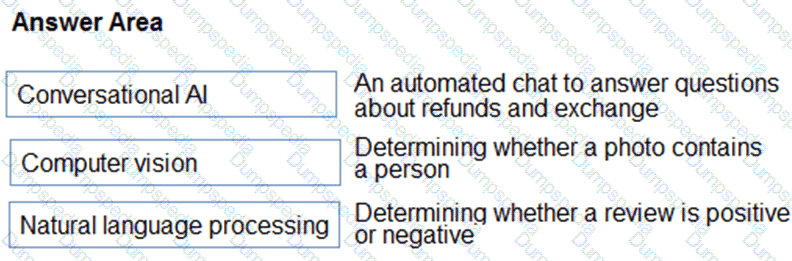
Match the types of AI workloads to the appropriate scenarios.
To answer, drag the appropriate workload type from the column on the left to its scenario on the right. Each workload type may be used once, more than once, or not at all.
NOTE: Each correct selection is worth one point.
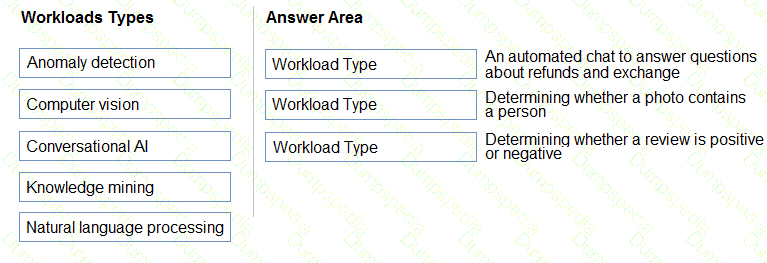


Box 3: Natural language processing
Natural language processing (NLP) is used for tasks such as sentiment analysis, topic detection, language detection, key phrase extraction, and document categorization.
To complete the sentence, select the appropriate option in the answer area.


Reliability and safety: To build trust, it ' s critical that AI systems operate reliably, safely, and consistently under normal circumstances and in unexpected conditions. These systems should be able to operate as they were originally designed, respond safely to unanticipated conditions, and resist harmful manipulation.
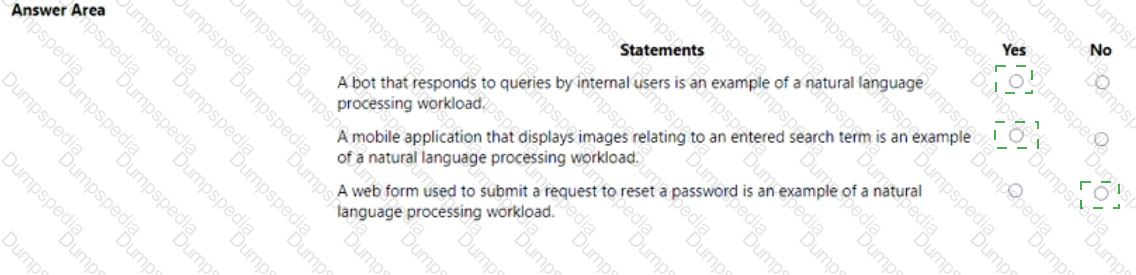
For each of the following statements, select Yes if the statement is true. Otherwise, select No. NOTE: Each correct selection is worth one point.
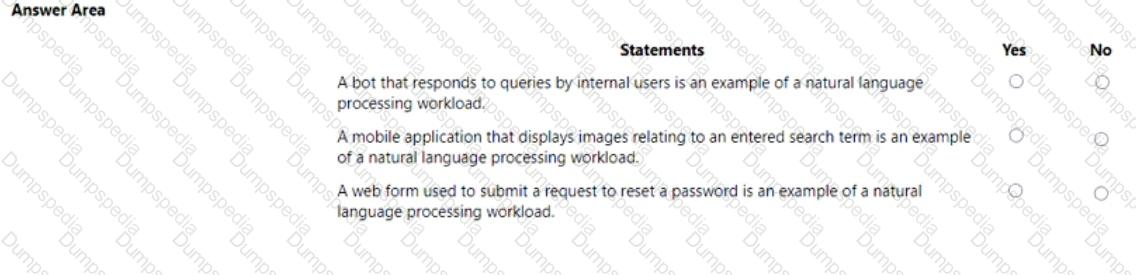


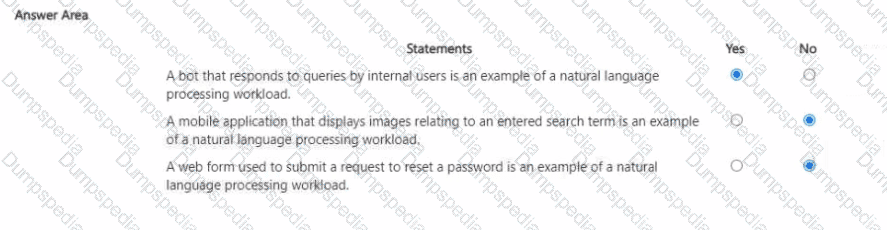
This question is based on identifying Natural Language Processing (NLP) workloads, which is a fundamental topic in the Microsoft Azure AI Fundamentals (AI-900) certification. According to the official Microsoft Learn module “Describe features of natural language processing (NLP) workloads on Azure”, NLP enables computers to understand, interpret, and generate human language — both written and spoken.
A bot that responds to queries by internal users – YesThis is an example of a natural language processing workload because it involves understanding and generating human language. A chatbot interprets user input (queries written or spoken) using language understanding and text analytics, and then produces appropriate responses. On Azure, this can be implemented using Azure AI Language (LUIS) and the Azure Bot Service, both core NLP technologies.
A mobile application that displays images relating to an entered search term – NoThis application involves searching for or displaying images, which falls under the computer vision workload, not NLP. Computer vision focuses on analyzing and interpreting visual data like photos or videos, while NLP deals with language and text processing.
A web form used to submit a request to reset a password – NoA password reset form involves structured input fields and user authentication, not natural language understanding or generation. It’s part of standard web development and identity management, not an NLP-related process.
Therefore, based on Microsoft’s AI-900 curriculum definitions:
✅ The only true NLP example is the bot responding to user queries, since it processes and understands natural language input to generate conversational output.
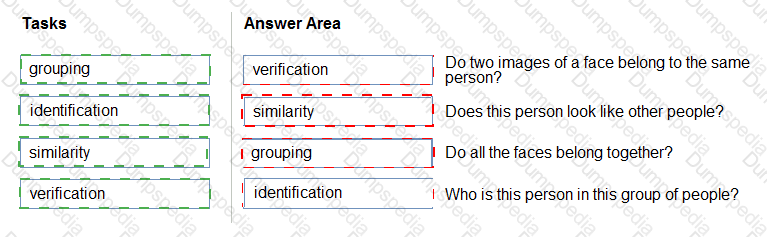
Match the facial recognition tasks to the appropriate questions.
To answer, drag the appropriate task from the column on the left to its question on the right. Each task may be used once, more than once, or not at all.
NOTE: Each correct selection is worth one point.
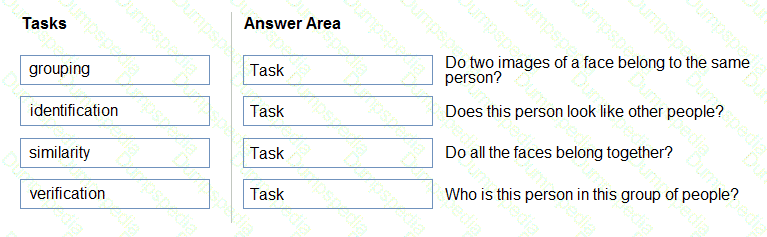


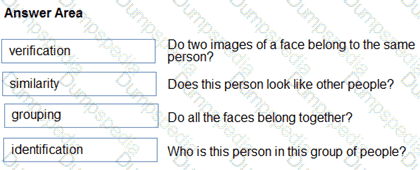
The correct matches are based on the Microsoft Azure AI Fundamentals (AI-900) Official Study Guide and the Microsoft Learn module “Explore computer vision in Microsoft Azure.” These materials explain that facial recognition tasks can be categorized into four major operations: verification, identification, similarity, and grouping. Each task serves a distinct purpose in facial recognition scenarios.
Verification – “Do two images of a face belong to the same person?”The verification task determines whether two facial images represent the same individual. Azure Face API compares the facial features and returns a confidence score indicating the likelihood that the two faces belong to the same person.
Similarity – “Does this person look like other people?”The similarity task compares a face against a collection of faces to find visually similar individuals. It does not confirm identity but measures how closely two or more faces resemble each other.
Grouping – “Do all the faces belong together?”Grouping organizes a set of unknown faces into clusters based on similar facial features. This is used when identities are not known beforehand, helping discover potential duplicates or visually similar clusters within an image dataset.
Identification – “Who is this person in this group of people?”The identification task is used when the system tries to determine who a specific person is by comparing their face against a known collection (face database or gallery). It returns the identity that best matches the input face.
According to Microsoft’s AI-900 training, these tasks form the basis of Azure Face API’s capabilities. Each helps solve a different type of facial recognition problem—from matching pairs to discovering unknown identities—making them essential components of responsible AI-based vision systems.
For each of the following statements, select Yes if the statement is true. Otherwise, select No.
NOTE: Each correct selection is worth one point.
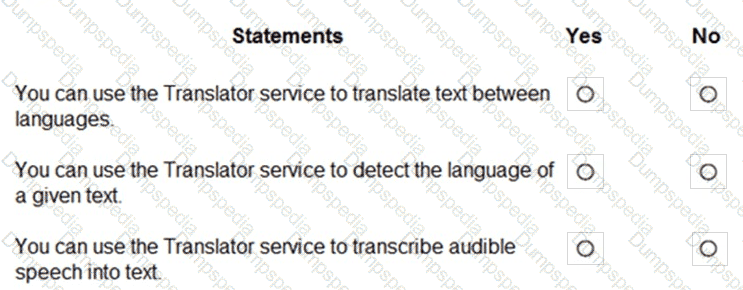


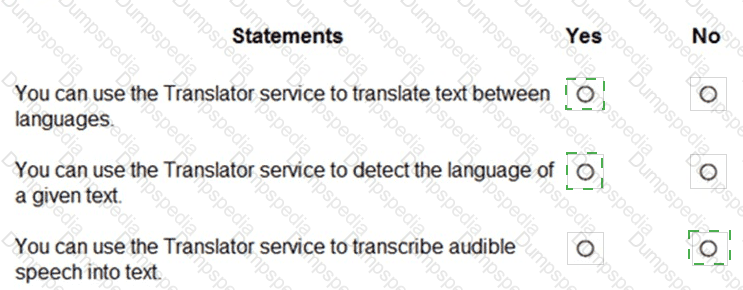
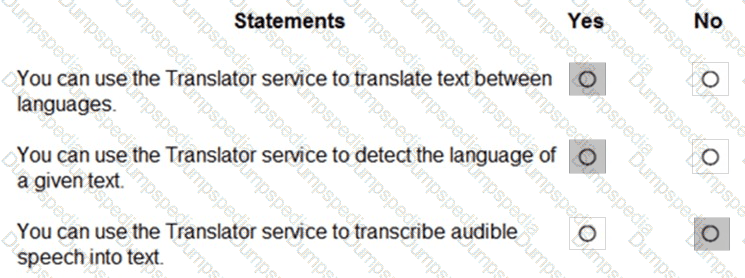
The Translator service, part of Microsoft Azure Cognitive Services, is designed specifically for text translation between multiple languages. It is a cloud-based neural machine translation service that supports more than 100 languages. According to Microsoft Learn’s module “Translate text with the Translator service”, this service provides two main capabilities: text translation and automatic language detection.
“You can use the Translator service to translate text between languages.” → YesThis statement is true. The primary purpose of the Translator service is to translate text accurately and efficiently between supported languages, such as English to Spanish or French to Japanese. It maintains contextual meaning using neural machine translation models.
“You can use the Translator service to detect the language of a given text.” → YesThis statement is also true. The Translator service includes automatic language detection, which determines the source language before translation. For instance, if a user submits text in an unknown language, the service can identify it automatically before performing translation.
“You can use the Translator service to transcribe audible speech into text.” → NoThis statement is false. Transcribing speech (audio) into text is a function of the Azure Speech service, specifically the Speech-to-Text API, not the Translator service.
Therefore, the Translator service is used for text translation and language detection, while speech transcription belongs to the Speech service.
For each of the following statements, select Yes if the statement is true. Otherwise, select No.
NOTE; Each correct selection is worth one point.
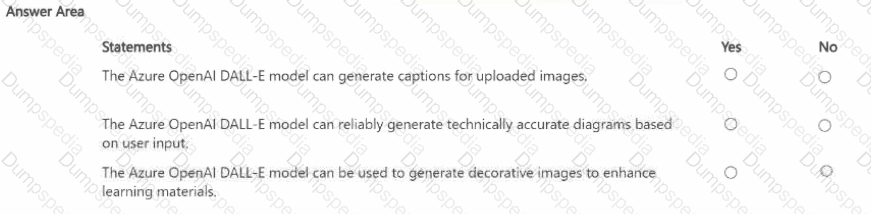


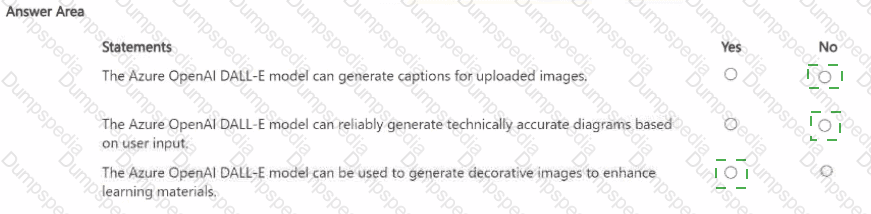
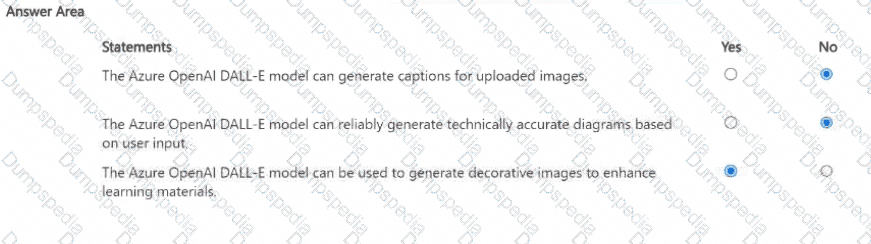
The Azure OpenAI DALL-E model is a generative image model designed to create original images from textual descriptions (prompts). According to the Microsoft Learn documentation and the AI-900 study guide, DALL-E’s primary function is text-to-image generation—it converts creative or descriptive text input into visually relevant imagery.
“Generate captions for uploaded images” → NoDALL-E cannot create image captions. Captioning an image (describing what’s in an uploaded image) is a vision analysis task, not an image generation task. That functionality belongs to Azure AI Vision, which can analyze and describe images, detect objects, and generate captions automatically.
“Reliably generate technically accurate diagrams” → NoWhile DALL-E can create visually appealing artwork or conceptual sketches, it is not designed for producing precise or technically correct diagrams, such as engineering schematics or architectural blueprints. The model’s generative process emphasizes creativity and visual diversity rather than factual or geometric accuracy. Thus, it cannot be relied upon for professional technical outputs.
“Generate decorative images to enhance learning materials” → YesThis is one of DALL-E’s strongest use cases. It can generate decorative, conceptual, or illustrative images to enhance presentations, educational materials, and marketing content. It enables educators and designers to quickly produce unique visuals aligned with specific themes or topics, enhancing engagement and creativity.
You are building a knowledge base by using QnA Maker. Which file format can you use to populate the knowledge base?
PPTX
XML
ZIP
QnA Maker supports automatic extraction of question-and-answer pairs from structured files such as PDF, Microsoft Word, or Excel documents, as well as from public webpages. This makes PDF the correct file format for populating a knowledge base.
Other options are invalid:
B. PPTX – Not supported.
C. XML – Not a recognized input for QnA Maker.
D. ZIP – Used for packaging, not Q & A content.
You have a dataset that contains the columns shown in the following table.
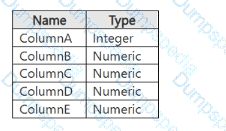
You have a machine learning model that predicts the value of ColumnE based on the other numeric columns.
Which type of model is this?
regression
analysis
clustering
The dataset described contains numeric columns (ColumnA through ColumnE). The model’s task is to predict the value of ColumnE based on the other numeric columns (A–D). This is a classic regression problem.
According to the Microsoft Azure AI Fundamentals (AI-900) study guide and Microsoft Learn module “Identify common types of machine learning,” a regression model is used when the target variable (the value to predict) is continuous and numeric, such as price, temperature, or—in this case—a numerical value in ColumnE.
Regression models analyze relationships between independent variables (inputs: Columns A–D) and a dependent variable (output: ColumnE) to predict a continuous outcome. Common regression algorithms include linear regression, decision tree regression, and neural network regression.
Option analysis:
A. Regression: ✅ Correct. Used for predicting numerical, continuous values.
B. Analysis: ❌ Incorrect. “Analysis” is a general term, not a machine learning model type.
C. Clustering: ❌ Incorrect. Clustering is unsupervised learning, grouping similar data points, not predicting values.
Therefore, the type of machine learning model used to predict ColumnE (a numeric value) from other numeric columns is Regression, which fits perfectly within Azure’s supervised learning models.
Select the answer that correctly completes the sentence.


According to the Microsoft Azure AI Fundamentals (AI-900) official study guide and the Microsoft Learn module “Identify features of common machine learning types”, the classification technique is a type of supervised machine learning used to predict which category or class a new observation belongs to, based on patterns learned from labeled training data.
In this scenario, a banking system that predicts whether a loan will be repaid is dealing with a binary outcome—either the loan will be repaid or will not be repaid. These two possible results represent distinct classes, making this problem a classic example of binary classification. During training, the model learns from historical data containing features such as customer income, credit score, loan amount, and repayment history, along with labeled outcomes (repaid or defaulted). After training, it can classify new applications into one of these two categories.
The AI-900 curriculum distinguishes between three key supervised and unsupervised learning approaches:
Classification: Predicts discrete categories (e.g., spam/not spam, fraud/not fraud, will repay/won’t repay).
Regression: Predicts continuous numerical values (e.g., house prices, sales forecast, temperature).
Clustering: Groups data based on similarity without predefined labels (e.g., customer segmentation).
Since the banking problem focuses on predicting a categorical outcome rather than a continuous numeric value, it fits squarely into the classification domain. In Azure Machine Learning, such tasks can be performed using algorithms like Logistic Regression, Decision Trees, or Support Vector Machines (SVMs), all configured for categorical prediction.
Therefore, per Microsoft’s official AI-900 learning objectives, a banking system predicting whether a loan will be repaid represents a classification type of machine learning problem.
Select the answer that correctly completes the sentence.


During model training, a portion of the dataset (commonly 70–80%) is used to teach the machine learning algorithm to identify patterns and relationships between input features and the output label. The remaining data (usually 20–30%) is held back to evaluate the model’s performance and verify its accuracy on unseen data. This ensures the model is not overfitted (too tightly fitted to training data) and can generalize well to new inputs.
Key steps highlighted in Microsoft Learn materials:
Model Training: Use the training data to fit the model — the algorithm learns relationships between input features and labels.
Model Evaluation: Use the test or validation data to assess the accuracy, precision, recall, or other metrics of the trained model.
Model Deployment: Once validated, the model is deployed to make real-world predictions.
Other options explained:
Feature engineering: Involves preparing and transforming input data, not splitting datasets for training and testing.
Time constraints: Not a machine learning process step.
Feature stripping: Not a recognized ML concept.
MLflow models: Refers to an open-source tool for tracking and managing models, not dataset splitting or training.
Thus, when you use a portion of the dataset to prepare and train a machine learning model, and retain the rest to verify results, the process is known as model training.
You need to develop a chatbot for a website. The chatbot must answer users questions based on the information m the following documents
• A product troubleshooting guide m a Microsoft Word document
• A frequently asked questions (FAQ) list on a webpage
Which service should you use to process the documents?
Language Undemanding
Text Analytics
Azure Bot Service
QnA Maker
QnA Maker (now part of Azure AI Language Service – Custom Question Answering) enables bots to answer user queries by extracting questions and answers from structured sources like FAQs, webpages, and documents (e.g., Word, PDF). In this scenario, where data comes from a Microsoft Word troubleshooting guide and a FAQ webpage, QnA Maker automatically extracts knowledge and creates a searchable knowledge base.
Other options are incorrect:
A. Language Understanding (LUIS): Detects intents, not question-answer pairs.
B. Text Analytics: Extracts key phrases and sentiment but does not support conversational responses.
C. Azure Bot Service: Hosts bots, but it requires QnA Maker for knowledge sources.
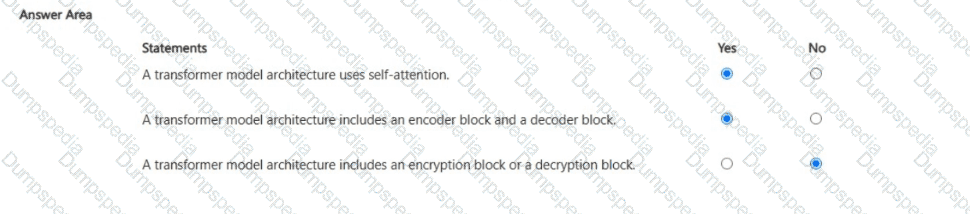
For each of the following statements, select Yes if the statement is true. Otherwise, select No. NOTE: Each correct selection is worth one point.
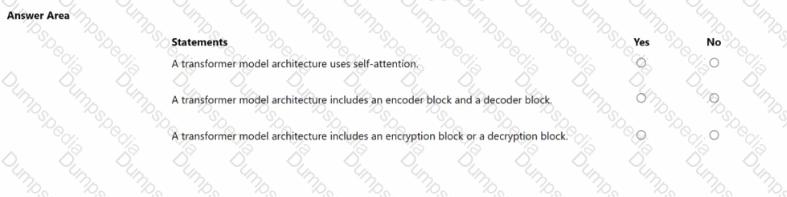


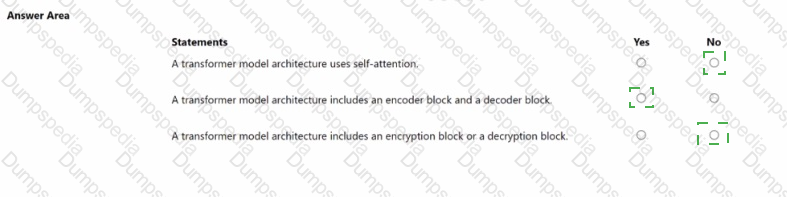
The Transformer model architecture is a foundational deep learning model introduced in the 2017 research paper “Attention Is All You Need.” It serves as the core architecture for modern large language models such as GPT, BERT, and T5, all of which are used in Azure OpenAI Service.
“A transformer model architecture uses self-attention.” – YesThe self-attention mechanism is the defining feature of transformer models. It allows the model to evaluate the relationships between words (tokens) in a sequence and assign weights based on contextual relevance. This means that each word in an input sentence can " attend " to every other word, capturing dependencies regardless of their position in the text. This mechanism replaced older recurrent (RNN) and convolutional (CNN) architectures for sequence processing because it provides parallelization and better context understanding.
“A transformer model architecture includes an encoder block and a decoder block.” – YesThe original Transformer architecture includes both an encoder and a decoder. The encoder processes the input sequence into contextual representations, and the decoder generates the output sequence based on both the encoder’s output and previously generated tokens. Models like BERT use only the encoder stack, while GPT models use only the decoder stack, but the full Transformer design conceptually includes both.
“A transformer model architecture includes an encryption block or a decryption block.” – NoTransformers are not related to cryptography. They perform encoding and decoding of language data for representation learning—not encryption or decryption for data security. The terms “encoder” and “decoder” here refer to neural network components, not cryptographic processes.
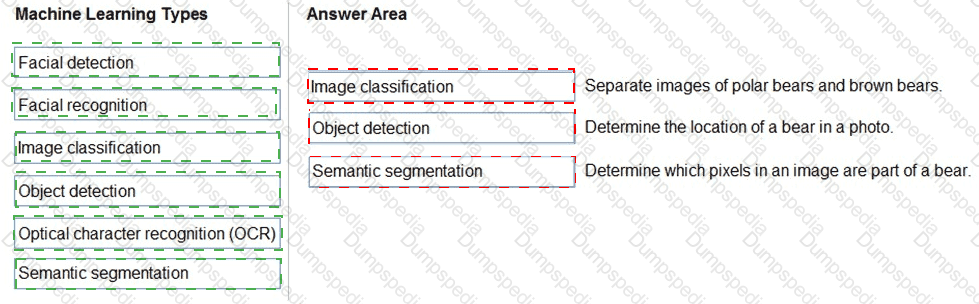
Match the types of machine learning to the appropriate scenarios.
To answer, drag the appropriate machine learning type from the column on the left to its scenario on the right. Each machine learning type may be used once, more than once, or not at all.
NOTE: Each correct selection is worth one point.
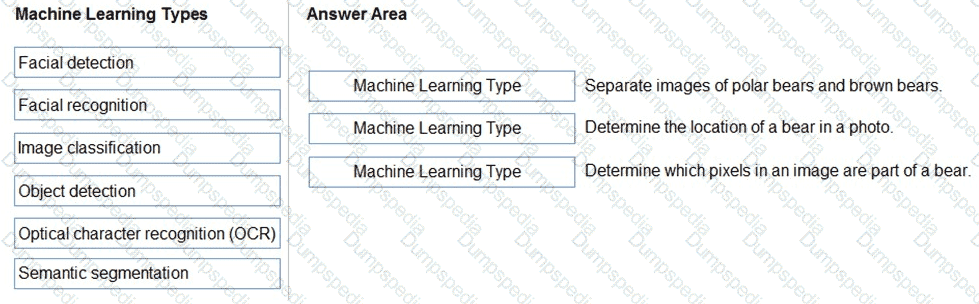


According to the Microsoft Azure AI Fundamentals (AI-900) official study guide and the Microsoft Learn module “Identify features of computer vision workloads on Azure”, computer vision models can perform different types of image analysis depending on the goal of the task. The main types include image classification, object detection, and semantic segmentation. Each method analyzes images at a different level of granularity.
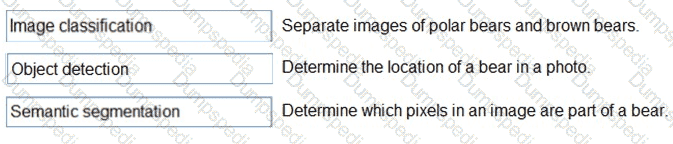
Image Classification → Separate images of polar bears and brown bearsImage classification assigns an entire image to a specific category or label. The model analyzes the image as a whole and determines which predefined class it belongs to. For example, in this case, the model would look at the features of each image and decide whether it shows a polar bear or a brown bear. The Microsoft Learn materials define classification as “assigning an image to a specific category.”
Object Detection → Determine the location of a bear in a photoObject detection identifies where objects appear within an image by drawing bounding boxes around them. This type of model not only classifies what object is present but also provides its location. Microsoft Learn explains that object detection “detects and locates individual objects within an image.” For instance, the model can detect a bear in a forest scene and highlight its position.
Semantic Segmentation → Determine which pixels in an image are part of a bearSemantic segmentation is the most detailed form of image analysis. It classifies each pixel in an image according to the object it belongs to. In this scenario, the model identifies every pixel corresponding to the bear’s body. The AI-900 content defines this as “classifying every pixel in an image into a category.”
To summarize:
Image classification → Categorizes entire images.
Object detection → Locates and labels objects within images.
Semantic segmentation → Labels each pixel for precise object boundaries.
https://nanonets.com/blog/how-to-do-semantic-segmentation-using-deep-learning/
Which OpenAI model does GitHub Copilot use to make suggestions for client-side JavaScript?
GPT-4
Codex
DALL-E
GPT-3
According to the Microsoft Azure AI Fundamentals (AI-900) learning path and Microsoft Learn documentation on GitHub Copilot, GitHub Copilot is powered by OpenAI Codex, a specialized language model derived from the GPT-3 family but fine-tuned specifically on programming languages and code data.
OpenAI Codex was designed to translate natural language prompts into executable code in multiple programming languages, including JavaScript, Python, C#, TypeScript, and Go. It can understand comments, function names, and code structure to generate relevant code suggestions in real time.
When a developer writes client-side JavaScript, GitHub Copilot uses Codex to analyze the context of the file and generate intelligent suggestions, such as completing functions, writing boilerplate code, or suggesting improvements. Codex can also explain what specific code does and provide inline documentation, which enhances developer productivity.
Option A (GPT-4): While some newer versions of GitHub Copilot (Copilot X) may integrate GPT-4 for conversational explanations, the core code completion engine remains based on Codex, as per the AI-900-level content.
Option C (DALL-E): Used for image generation, not for programming tasks.
Option D (GPT-3): Codex was fine-tuned from GPT-3 but has been further trained specifically for code generation tasks.
Therefore, the verified and official answer from Microsoft’s AI-900 curriculum is B. Codex — the OpenAI model used by GitHub Copilot to make suggestions for client-side JavaScript and other programming languages.
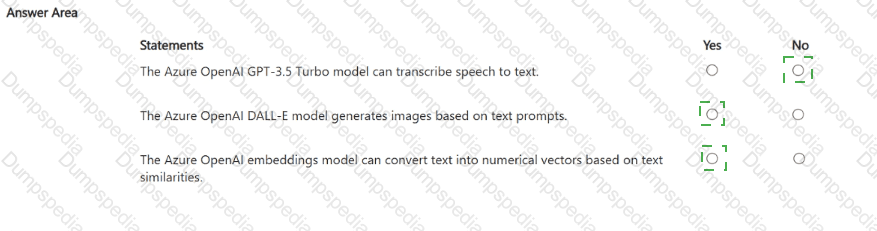
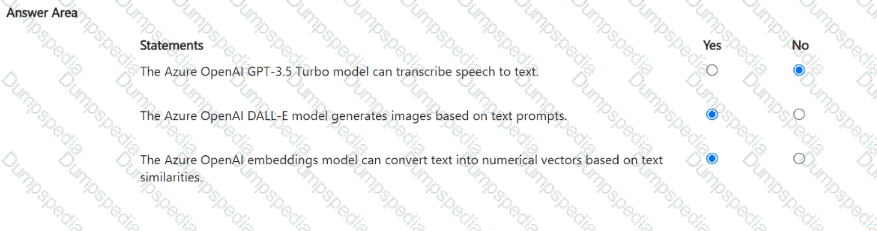
For each of the following statements, select Yes if the statement is true. Otherwise, select No.
NOTE: Each correct selection is worth one point.
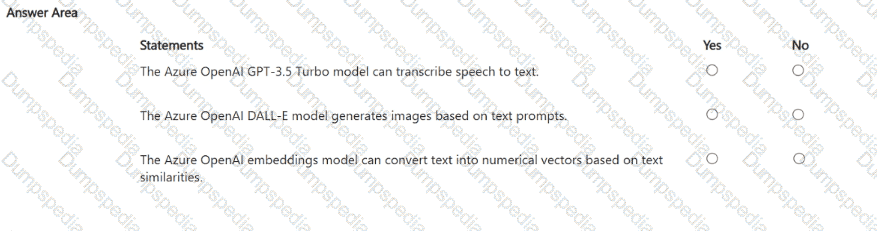


“The Azure OpenAI GPT-3.5 Turbo model can transcribe speech to text.” — NOThis statement is false. The GPT-3.5 Turbo model is a text-based large language model (LLM) designed for natural language understanding and generation, such as answering questions, summarizing text, or writing content. It does not process or transcribe audio input. Speech-to-text capabilities belong to Azure AI Speech Services, specifically the Speech-to-Text API, not Azure OpenAI.
“The Azure OpenAI DALL-E model generates images based on text prompts.” — YESThis statement is true. The DALL-E model, available within Azure OpenAI Service, is a generative AI model that creates original images from natural language descriptions (text prompts). For example, given a prompt like “a futuristic city at sunset,” DALL-E generates a unique, high-quality image representing that concept. This aligns with generative AI workloads in the AI-900 study guide, where DALL-E is specifically mentioned as an image-generation model.
“The Azure OpenAI embeddings model can convert text into numerical vectors based on text similarities.” — YESThis statement is also true. The embeddings model in Azure OpenAI converts text into multi-dimensional numeric vectors that represent semantic meaning. These embeddings enable tasks such as semantic search, recommendations, and text clustering by comparing similarity scores between vectors. Words or phrases with similar meanings have vectors close together in the embedding space.
In summary:
GPT-3.5 Turbo → Text generation (not speech-to-text)
DALL-E → Image generation from text prompts
Embeddings → Convert text into numerical semantic representations
Correct selections: No, Yes, Yes.
Match the tool to the Azure Machine Learning task.
To answer, drag the appropriate tool from the column on the left to its tasks on the right. Each tool may be used once, more than once, or not at all
NOTE: Each correct match is worth one point.



The correct matching aligns directly with the Microsoft Azure AI Fundamentals (AI-900) official study guide and Microsoft Learn modules under “Identify features of Azure Machine Learning”. Azure Machine Learning provides a suite of tools that serve different functions within the model development lifecycle — from creating workspaces, to training models, to automating experimentation.
The Azure portal → Create a Machine Learning workspace.The Azure portal is a web-based graphical interface for managing all Azure resources. According to Microsoft Learn, you use the portal to create and configure the Azure Machine Learning workspace, which acts as the central environment where datasets, experiments, models, and compute resources are organized. Creating a workspace through the portal involves specifying a subscription, resource group, and region — tasks that are part of the setup stage rather than model development.
Machine Learning designer → Use a drag-and-drop interface used to train and deploy models.The Machine Learning designer (formerly “Azure ML Studio (classic)”) provides a visual, no-code/low-code interface for building, training, and deploying machine learning pipelines. The designer uses a drag-and-drop workflow where users connect modules representing data transformations, model training, and evaluation. This tool is ideal for beginners and those who want to quickly experiment with machine learning concepts without writing code.
Automated machine learning (Automated ML) → Use a wizard to select configurations for a machine learning run.Automated ML simplifies model creation by automatically selecting algorithms, hyperparameters, and data preprocessing options. Users interact through a guided wizard (within the Azure Machine Learning studio) that walks them through configuration steps such as selecting datasets, target columns, and performance metrics. The system then iteratively trains and evaluates multiple models to recommend the best-performing one.
Together, these tools streamline the machine learning workflow:
Azure portal for setup and resource management,
Machine Learning designer for visual model creation, and
Automated ML for guided, automated model selection and tuning.
You need to provide customers with the ability to query the status of orders by using phones, social media, or digital assistants.
What should you use?
Azure Al Bot Service
the Azure Al Translator service
an Azure Al Document Intelligence model
an Azure Machine Learning model
According to the Microsoft Azure AI Fundamentals (AI-900) official study guide and Microsoft Learn module “Identify Azure services for conversational AI,” the Azure AI Bot Service is specifically designed to create intelligent conversational agents (chatbots) that can interact with users across multiple communication channels, such as web chat, social media, phone calls, Microsoft Teams, and digital assistants.
In this scenario, customers need the ability to query the status of their orders through various interfaces — including voice and text platforms. Azure AI Bot Service enables this by integrating with Azure AI Language (for understanding natural language), Azure Speech (for speech-to-text and text-to-speech capabilities), and Azure Communication Services (for telephony or chat integration).
The bot can interpret user input like “Where is my order?” or “Check my delivery status,” call backend systems (such as an order database or API), and then respond appropriately to the user through the same communication channel.
Let’s analyze the incorrect options:
B. Azure AI Translator Service: Used for real-time text translation between languages; it doesn’t handle conversation logic or database queries.
C. Azure AI Document Intelligence model: Extracts data from structured and semi-structured documents (e.g., invoices, receipts), not user queries.
D. Azure Machine Learning model: Builds and deploys predictive models, but doesn’t provide conversational or multi-channel interaction capabilities.
Thus, for enabling multi-channel conversational experiences where customers can inquire about order statuses using voice, chat, or digital assistants, the most appropriate solution is Azure AI Bot Service, as outlined in Azure’s AI conversational workload documentation.
For each of the following statements, select Yes if the statement is true. Otherwise, select No.
NOTE: Each correct selection is worth one point.
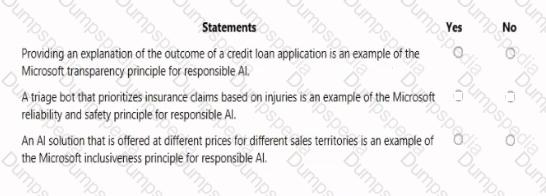

Statement
Yes / No
Providing an explanation of the outcome of a credit loan application is an example of the Microsoft transparency principle for responsible AI.
Yes
A triage bot that prioritizes insurance claims based on injuries is an example of the Microsoft reliability and safety principle for responsible AI.
Yes
An AI solution that is offered at different prices for different sales territories is an example of the Microsoft inclusiveness principle for responsible AI.
No
This question is based on the Responsible AI principles defined by Microsoft, which are part of the AI-900 Microsoft Azure AI Fundamentals curriculum. Microsoft’s Responsible AI framework consists of six key principles: Fairness, Reliability and Safety, Privacy and Security, Inclusiveness, Transparency, and Accountability. Each principle ensures that AI systems are developed and used in a way that benefits people and society responsibly.
Transparency Principle – YesProviding an explanation for a loan decision aligns with the Transparency principle. Microsoft defines transparency as helping users and stakeholders understand how AI systems make decisions. For example, when a credit scoring AI model approves or denies a loan, explaining the factors that influenced that outcome (such as credit history or income level) ensures that customers understand the reasoning process. This builds trust and supports responsible deployment.
Reliability and Safety Principle – YesA triage bot that prioritizes insurance claims based on injury severity relates directly to Reliability and Safety. This principle ensures AI systems operate consistently, perform accurately, and produce dependable outcomes. In the case of the triage bot, it must reliably assess the input data (injury descriptions) and rank claims appropriately to avoid harm or misjudgment, aligning with Microsoft’s emphasis on designing AI systems that are safe and robust.
Inclusiveness Principle – NoAn AI solution priced differently across sales territories is not related to Inclusiveness. Inclusiveness focuses on ensuring accessibility and eliminating bias or exclusion for all users—especially those with disabilities or underrepresented groups. Pricing strategy is a business decision, not an inclusiveness issue. Therefore, this statement is No.
In summary, based on the AI-900 Responsible AI principles, the correct selections are:
You need to predict the population size of a specific species of animal in an area.
Which Azure Machine Learning type should you use?
clustering
regression
classification
In Azure Machine Learning, regression is a supervised machine learning technique used to predict continuous numerical values based on input data. According to the Microsoft AI Fundamentals (AI-900) study guide and the Microsoft Learn module “Identify common types of machine learning,” regression models are ideal when the goal is to estimate a quantity — such as price, temperature, or, in this case, population size.
In the scenario, the task is to predict the population size of a specific species within a defined area. Population size is a numerical, continuous value that varies depending on multiple factors (like time, environment, and resources). A regression algorithm, such as linear regression or decision tree regression, can be trained on historical data (e.g., species count, area, temperature, food availability) to forecast future population numbers.
Option analysis:
A. Clustering: Used for unsupervised learning, where the goal is to group similar data points into clusters without predefined labels (e.g., grouping animals by behavior or habitat).
C. Classification: Used to predict discrete categories or labels (e.g., “endangered” vs. “not endangered”), not numerical values.
Therefore, the correct machine learning type for predicting a continuous value such as population size is Regression.
Match the types of natural languages processing workloads to the appropriate scenarios.
To answer, drag the appropriate workload type from the column on the left to its scenario on the right. Each workload type may be used once, more than once, or not at all.
NOTE: Each correct selection is worth one point.
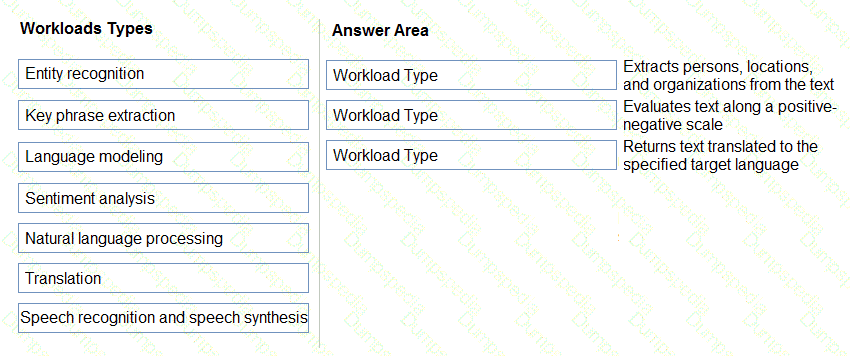

According to the Microsoft Azure AI Fundamentals (AI-900) official study guide and the Microsoft Learn module “Identify features of Natural Language Processing (NLP) workloads on Azure”, Azure Cognitive Services provides several text analytics and language understanding workloads that perform different types of language processing tasks. Each workload extracts specific information or performs distinct analysis operations on text data.
Entity Recognition → Extracts persons, locations, and organizations from the textEntity recognition is a feature of Azure Cognitive Service for Language (formerly Text Analytics). It identifies and categorizes named entities in unstructured text, such as people, organizations, locations, dates, and more. The study guide defines this workload as: “Entity recognition locates and classifies named entities in text into predefined categories.” This allows applications to extract structured information from raw text data—for example, identifying “Microsoft” as an organization and “Seattle” as a location.
Sentiment Analysis → Evaluates text along a positive–negative scaleSentiment analysis determines the emotional tone or opinion expressed in a piece of text. It classifies text as positive, negative, neutral, or mixed, which is widely used for social media monitoring, customer feedback, and product reviews. Microsoft’s official documentation describes it as: “Sentiment analysis evaluates text and returns a sentiment score indicating whether the sentiment is positive, negative, neutral, or mixed.”
Translation → Returns text translated to the specified target languageThe Translator service, part of Azure Cognitive Services, automatically translates text from one language to another. It supports multiple languages and provides near real-time translation. The AI-900 content specifies that “translation workloads are used to automatically translate text between languages using machine translation models.”
In summary:
Entity Recognition → Extracts entities like names and locations.
Sentiment Analysis → Determines emotional tone.
Translation → Converts text between languages.
✅ Final Answers:
Extracts persons, locations, and organizations → Entity recognition
Evaluates text along a positive–negative scale → Sentiment analysis
Returns text translated to the specified target language → Translation
Your company wants to build a recycling machine for bottles. The recycling machine must automatically identify bottles of the correct shape and reject all other items.
Which type of AI workload should the company use?
anomaly detection
conversational AI
computer vision
natural language processing
According to Microsoft’s AI-900 study guide and the Microsoft Learn module “Identify common types of AI workloads”, computer vision is the branch of AI that enables machines to interpret and act upon visual inputs such as photos, videos, or camera feeds.
In this scenario, the recycling machine must identify bottles based on their shape and reject other objects. This requires the AI system to visually analyze an image or a video stream and make a decision based on shape recognition—a classic computer vision application.
Computer vision models are trained with labeled image data (e.g., images of correct bottle shapes vs. incorrect items). Using techniques such as object detection or image classification, the model learns to detect patterns and identify whether an image matches the desired object.
The other options are not suitable:
A. Anomaly detection identifies unusual data patterns, not visual features.
B. Conversational AI handles human-computer interactions via text or voice.
D. Natural language processing (NLP) deals with understanding and generating human language.
Therefore, because the task requires visual recognition of bottle shapes, the appropriate AI workload is Computer Vision.
What can be used to analyze scanned invoices and extract data, such as billing addresses and the total amount due?
Azure Al Search
Azure Al Document intelligence
Azure Al Custom Vision
Azure OpenAI
The correct answer is B. Azure AI Document Intelligence (formerly Form Recognizer).
This Azure service uses AI and OCR technologies to analyze and extract structured data from documents such as invoices, receipts, and purchase orders. It identifies key fields like billing address, invoice number, total amount due, and line items. The service supports prebuilt models for common document types and custom models for specialized layouts.
Option review:
A. Azure AI Search: Used for knowledge mining and semantic search, not document data extraction.
B. Azure AI Document Intelligence — ✅ Correct. Designed for form and invoice extraction.
C. Azure AI Custom Vision: Used for image classification and object detection, not text extraction.
D. Azure OpenAI: Generates or processes language but not structured document data.
Therefore, Azure AI Document Intelligence is the right service to extract data from scanned invoices.
To complete the sentence, select the appropriate option in the answer area.


According to the Microsoft Azure AI Fundamentals (AI-900) official study guide and Microsoft Learn module “Explore fundamental principles of machine learning”, regression models are used to predict numerical or continuous values based on patterns found in historical data. When the goal is to forecast or estimate a real-valued outcome—such as price, temperature, sales, or age—the appropriate model type is regression.
In this question, the task is to predict the sale price of auctioned items. Since price is a continuous numeric value that can vary within a range (for example, $100.50, $105.75, $120.00, etc.), it fits perfectly into a regression problem. Microsoft Learn defines regression as “a supervised machine learning technique that predicts a numeric value based on relationships found in input features.” Common regression algorithms include linear regression, decision tree regression, and neural network regression.
By contrast:
Classification is used when the output variable represents categories or classes, such as predicting whether an email is spam or not spam, or whether a transaction is fraudulent or legitimate. Classification predicts discrete labels, not continuous values.
Clustering, on the other hand, is an unsupervised learning method used to group similar data points together without predefined labels. Examples include grouping customers by purchasing behavior or grouping images by visual similarity.
In a predictive business scenario, like estimating the price of an auctioned item based on features such as age, condition, and demand, regression models are most appropriate. Azure Machine Learning supports regression experiments using built-in algorithms and AutoML to automatically choose the best-performing model for continuous output prediction.
You have an Internet of Things (loT) device that monitors engine temperature.
The device generates an alert if the engine temperature deviates from expected norms.
Which type of Al workload does the device represent?
natural language processing (NLP)
computer vision
anomaly detection
knowledge mining
According to the Microsoft Azure AI Fundamentals (AI-900) Official Study Guide and the Microsoft Learn module “Explore fundamental principles of machine learning,” anomaly detection is a machine learning workload used to identify data points or patterns that deviate significantly from expected behavior.
In this scenario, the IoT device monitors engine temperature and generates alerts when the readings deviate from normal operating ranges. This directly matches the definition of anomaly detection, where the AI system learns what “normal” looks like and identifies outliers or abnormal conditions that may indicate potential issues.
Common real-world uses of anomaly detection include:
Detecting equipment malfunctions or overheating in IoT systems.
Identifying fraudulent transactions in finance.
Detecting unusual spikes or drops in system metrics (e.g., temperature, traffic, or pressure).
Other options are incorrect:
A. NLP (Natural Language Processing): Focuses on understanding and interpreting human language, not sensor data.
B. Computer Vision: Involves analyzing images or videos, which is unrelated to temperature data.
D. Knowledge Mining: Refers to extracting information from large document stores, not identifying abnormal readings.
You have a large dataset that contains motor vehicle sales data.
You need to train an automated machine learning (automated ML) model to predict vehicle sale values based on the type of vehicle.
Which task should you select? To answer, select the appropriate task in the answer area.
NOTE: Each correct selection is worth one point.
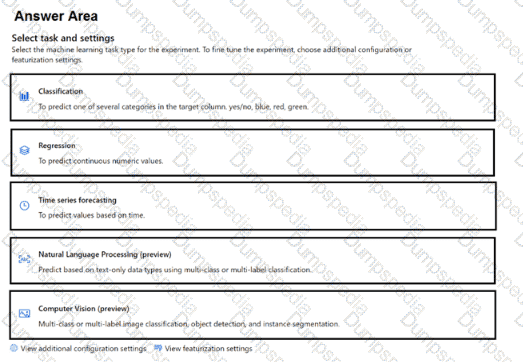


According to the Microsoft Azure AI Fundamentals (AI-900) and Azure Machine Learning documentation, regression is the appropriate machine learning task when the goal is to predict continuous numeric values—such as prices, sales amounts, or other measurable quantities.
In this scenario, the dataset contains motor vehicle sales data, and the objective is to predict vehicle sale values. A vehicle’s sale value (price) is a continuous numeric variable, meaning it can take on a wide range of possible numbers (for example, $15,000, $28,500, $42,300). Regression models are designed to analyze relationships between input features (like make, model, mileage, age, fuel type) and a continuous output variable (price).
Automated Machine Learning (AutoML) in Azure simplifies this process by automatically testing multiple regression algorithms (e.g., Linear Regression, Random Forest, Gradient Boosted Trees) and hyperparameters to find the best-performing model.
Let’s evaluate why the other options are incorrect:
Classification – Used for predicting discrete categories (e.g., car type: sedan, SUV, or truck). Sale value prediction is not categorical.
Time series forecasting – Used when predicting future values based on time-dependent data (e.g., sales over months or years). The question focuses on predicting price based on vehicle characteristics, not over time.
Natural Language Processing (NLP) – Deals with text-based data, not numeric vehicle data.
Computer Vision – Applies to image-based tasks (e.g., detecting car types from photos).
Therefore, per Microsoft Learn’s Automated ML task selection guidance, when predicting a numeric output like vehicle sale value, the correct machine learning task type is Regression.
✅ Final Answer: Regression
You are building an AI system.
Which task should you include to ensure that the service meets the Microsoft transparency principle for responsible AI?
Ensure that all visuals have an associated text that can be read by a screen reader.
Enable autoscaling to ensure that a service scales based on demand.
Provide documentation to help developers debug code.
Ensure that a training dataset is representative of the population.
According to the Microsoft Azure AI Fundamentals (AI-900) Official Study Guide and Microsoft Learn module “Describe principles of responsible AI”, the transparency principle ensures that AI systems are understandable, explainable, and well-documented so that users, developers, and stakeholders can know how the system operates and makes decisions. Transparency involves clear communication, documentation, and interpretability.
Microsoft defines transparency as the responsibility to make sure that people understand how AI systems function, their limitations, and how decisions are made. For developers, this means providing detailed documentation and model interpretability tools so others can inspect, debug, and understand the AI model’s behavior. For users, it means ensuring that the purpose, capabilities, and limitations of the AI system are clearly explained.
Providing documentation to help developers debug and understand how a service works directly aligns with this transparency principle. It ensures that the system’s logic and behavior are open to inspection and that any unintended consequences can be identified and corrected. Transparency also builds trust in AI solutions by enabling accountability and oversight.
Let’s analyze the other options:
A. Ensure that all visuals have an associated text that can be read by a screen reader – This supports inclusiveness, not transparency, as it focuses on accessibility for all users.
B. Enable autoscaling to ensure that a service scales based on demand – This is related to system performance and scalability, not responsible AI.
D. Ensure that a training dataset is representative of the population – This supports fairness, as it prevents bias and ensures equitable outcomes.
Therefore, based on the official AI-900 training content and Microsoft’s Responsible AI framework (which includes fairness, reliability, privacy, inclusiveness, transparency, and accountability), the correct answer is C. Provide documentation to help developers debug code, because this directly promotes transparency in how the AI system operates and communicates its inner workings
A smart device that responds to the question. " What is the stock price of Contoso, Ltd.? " is an example of which Al workload?
computer vision
anomaly detection
knowledge mining
natural language processing
The question describes a smart device that can understand and respond to a spoken or written question such as, “What is the stock price of Contoso, Ltd.?” This scenario directly maps to the Natural Language Processing (NLP) workload in Microsoft Azure AI.
According to the Microsoft AI Fundamentals (AI-900) study guide and the Microsoft Learn module “Describe features of common AI workloads,” NLP enables systems to understand, interpret, and generate human language. Azure AI Language and Azure Speech services are examples of NLP-based solutions.
In this case, the smart device performs several NLP tasks:
Speech recognition – converts spoken input into text.
Language understanding – interprets the user’s intent, i.e., retrieving the stock price of a specific company.
Response generation – formulates a meaningful answer that can be presented back as text or speech.
This process shows a full pipeline of natural language understanding (NLU) and conversational AI. It does not involve visual data (computer vision), data pattern analysis (anomaly detection), or document search (knowledge mining).
Hence, the correct AI workload is D. Natural Language Processing.
To complete the sentence, select the appropriate option in the answer area.


Reliability & Safety
https://en.wikipedia.org/wiki/Tay_(bot)
“To build trust, it ' s critical that AI systems operate reliably, safely, and consistently under normal circumstances and in unexpected conditions. These systems should be able to operate as they were originally designed, respond safely to unanticipated conditions, and resist harmful manipulation. It ' s also important to be able to verify that these systems are behaving as intended under actual operating conditions. How they behave and the variety of conditions they can handle reliably and safely largely reflects the range of situations and circumstances that developers anticipate during design and testing. We believe that rigorous testing is essential during system development and deployment to ensure AI systems can respond safely in unanticipated situations and edge cases, don ' t have unexpected performance failures, and don ' t evolve in ways that are inconsistent with original expectations”
Match the types of computer vision workloads to the appropriate scenarios.
To answer, drag the appropriate workload type from the column on the left to its scenario on the right. Each workload type may be used once more than once, or not at all.
NOTE: Each correct match is worth one point.



In the Microsoft Azure AI Fundamentals (AI-900) curriculum, computer vision workloads are grouped into distinct types, each serving a specific purpose. The three major workloads illustrated here are image classification, object detection, and optical character recognition (OCR). Understanding their use cases is essential for correctly mapping them to real-world scenarios.
Generate captions for images → Image classificationThe image classification workload is used to identify the main subject or context of an image and assign descriptive labels. In Microsoft Learn’s “Describe features of computer vision workloads,” image classification models are trained to recognize content (e.g., a cat, a beach, or a city). Caption generation expands on classification results by describing the image’s contents in human-readable language—based on what the model identifies as key visual features.
Extract movie title names from movie poster images → Optical character recognition (OCR)OCR is a vision workload that detects and extracts text from images. Azure AI Vision’s Read API or Document Intelligence OCR models can identify printed or handwritten text within posters, signs, or documents. In this case, the movie title text from a poster is best extracted using OCR.
Locate vehicles in images → Object detectionThe object detection workload identifies multiple objects within an image and provides their locations using bounding boxes. It’s ideal for tasks like counting cars in a parking lot or tracking objects in traffic images.
What is the maximum image size that can be processed by using the prebuilt receipt model in Azure Al Document Intelligence?
5 MB
10MB
50 MB
100 MB
According to the Microsoft Learn documentation for Azure AI Document Intelligence (formerly Form Recognizer) and the AI-900 official study materials, the prebuilt receipt model in Azure AI Document Intelligence supports analyzing image and PDF files up to a maximum size of 10 MB per document.
Azure AI Document Intelligence is a cloud-based service that applies advanced optical character recognition (OCR) and machine learning to extract structured information from documents such as receipts, invoices, identity cards, and business forms. The prebuilt receipt model is specifically designed to extract key data fields from retail receipts—such as merchant name, transaction date, items purchased, subtotal, tax, and total—without requiring users to build or train a custom model.
As per Microsoft’s service limits, the input file for the prebuilt models (including receipts, invoices, business cards, and identity documents) must:
Not exceed 10 MB in file size.
Not exceed 17 x 17 inches (43 x 43 cm) in physical dimensions.
Be in a supported image or document format such as JPG, PNG, BMP, TIFF, or PDF.
Let’s examine why other options are incorrect:
A. 5 MB → Too small; the service allows up to 10 MB.
C. 50 MB and D. 100 MB → Exceed the official maximum file size supported by Azure AI Document Intelligence.
Therefore, when using the prebuilt receipt model, you must ensure that the input file is 10 MB or smaller to be successfully processed by the service.
Select the answer that correctly completes the sentence.


According to the Microsoft Azure AI Fundamentals (AI-900) official study guide and the Microsoft Learn module “Identify features of common machine learning types”, a regression model is a type of supervised machine learning model that is used to predict continuous numeric values based on one or more input variables (features).
In supervised learning, models are trained using labeled data, where each input record has a known target value (label). For regression specifically, the label represents a numeric quantity — such as price, age, temperature, or sales figures. The model learns to approximate a function that maps input variables to numeric outputs.
For example:
Predicting house prices based on size, location, and number of rooms.
Predicting monthly sales revenue from marketing spend and seasonality.
Forecasting temperature based on historical weather data.
In Azure Machine Learning Designer and AutoML, when building a regression model, the label column must therefore be of numeric data type (integer or float). If the label were categorical (for example, “yes/no” or “approved/denied”), the appropriate model type would be classification, not regression.
To contrast with other options:
Boolean – used in binary classification problems (true/false outcomes).
Datetime – used for time series forecasting, not standard regression labels.
Text – used as input features for NLP models, not as regression targets.
Hence, when configuring a regression task in Azure, ensuring the target variable (label) is numeric is a fundamental requirement. The model’s performance metrics—such as Mean Absolute Error (MAE), Root Mean Squared Error (RMSE), and R²—also rely on numeric computations.
Which machine learning technique can be used for anomaly detection?
A machine learning technique that understands written and spoken language.
A machine learning technique that classifies objects based on user supplied images.
A machine learning technique that analyzes data over time and identifies unusual changes.
A machine learning technique that classifies images based on their contents.
According to the Microsoft Azure AI Fundamentals (AI-900) Official Study Guide and the Microsoft Learn module “Explore fundamental principles of machine learning,” anomaly detection is a specialized machine learning technique used to identify data points, patterns, or events that deviate significantly from normal behavior.
Anomaly detection is widely used for monitoring time-series data and detecting unexpected or rare occurrences that may indicate problems, opportunities, or fraud. For example:
Detecting fraudulent transactions in banking systems.
Identifying equipment malfunctions in industrial IoT applications.
Monitoring network intrusions in cybersecurity.
Detecting unexpected spikes or drops in web traffic or sales.
In Azure, this workload is supported by the Azure AI Anomaly Detector service, which uses statistical and machine learning algorithms to learn from historical data and establish a baseline of normal behavior. When the system detects data points that fall outside expected patterns, it flags them as anomalies.
Let’s evaluate the incorrect options:
A. A machine learning technique that understands written and spoken language → This describes Natural Language Processing (NLP), not anomaly detection.
B. A machine learning technique that classifies objects based on user-supplied images → This refers to image classification, typically using computer vision.
D. A machine learning technique that classifies images based on their contents → Also describes computer vision, not anomaly detection.
Therefore, the correct answer is C, since anomaly detection specifically refers to analyzing data over time and identifying unusual or abnormal patterns that differ from the expected trend.
Select the answer that correctly completes the sentence.


In Azure OpenAI Service, the temperature parameter directly controls the creativity and determinism of responses generated by models such as GPT-3.5. According to the Microsoft Learn documentation for Azure OpenAI models, temperature is a numeric value (typically between 0.0 and 2.0) that determines how “random” or “deterministic” the output should be.
A lower temperature value (for example, 0 or 0.2) makes the model’s responses more deterministic, meaning the same prompt consistently produces nearly identical outputs.
A higher temperature value (for example, 0.8 or 1.0) encourages creativity and variety, causing the model to generate different phrasing or interpretations each time it responds.
When a question specifies the need for more deterministic responses, Microsoft’s guidance is to decrease the temperature parameter. This adjustment makes the model focus on the most probable tokens (words) rather than exploring less likely options, improving reliability and consistency—ideal for business or technical applications where consistent answers are essential.
The other parameters serve different purposes:
Frequency penalty reduces repetition of the same phrases but does not control randomness.
Max response (max tokens) limits the maximum length of the generated output.
Stop sequence defines specific tokens that tell the model when to stop generating text.
Thus, the correct and Microsoft-verified completion is:
“You can modify the Temperature parameter to produce more deterministic responses from a chat solution that uses the Azure OpenAI GPT-3.5 model.”
For each of the following statements, select Yes if the statement is true. Otherwise, select No.
NOTE: Each correct selection is worth one point.
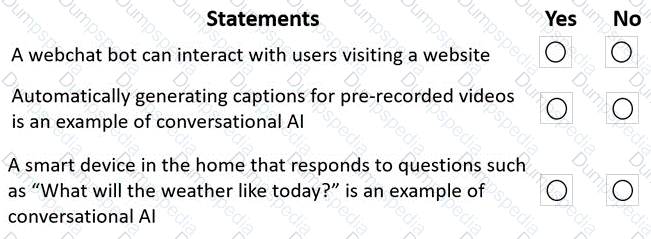


These answers align with the Microsoft Azure AI Fundamentals (AI-900) Official Study Guide and the Microsoft Learn module “Explore conversational AI in Microsoft Azure.”
1. A webchat bot can interact with users visiting a website → Yes
This statement is true. The Azure Bot Service allows developers to create intelligent chatbots that can be integrated into a webchat interface. This enables visitors to interact with the bot directly from a website, asking questions and receiving automated responses. This is a typical use case of conversational AI, where natural language processing (NLP) is used to interpret and respond to user input conversationally.
2. Automatically generating captions for pre-recorded videos is an example of conversational AI → No
This statement is false. Automatically generating captions from video content is an example of speech-to-text (speech recognition) technology, not conversational AI. While it uses AI to convert spoken words into text, it lacks the two-way interactive communication characteristic of conversational AI. This task is typically handled by the Azure AI Speech service, which transcribes spoken content.
3. A smart device in the home that responds to questions such as “What will the weather be like today?” is an example of conversational AI → Yes
This statement is true. Smart home assistants that engage in dialogue with users are powered by conversational AI. These devices use speech recognition to understand spoken input, natural language understanding (NLU) to determine intent, and speech synthesis (text-to-speech) to respond audibly. This represents the full conversational AI loop, where machines communicate naturally with humans.
Extracting relationships between data from large volumes of unstructured data is an example of which type of Al workload?
computer vision
knowledge mining
natural language processing (NLP)
anomaly detection
Extracting relationships and insights from large volumes of unstructured data (such as documents, text files, or images) aligns with the Knowledge Mining workload in Microsoft Azure AI. According to the Microsoft AI Fundamentals (AI-900) study guide and Microsoft Learn module “Describe features of common AI workloads,” knowledge mining involves using AI to search, extract, and structure information from vast amounts of unstructured or semi-structured content.
In a typical knowledge mining solution, tools like Azure AI Search and Azure AI Document Intelligence work together to index data, apply cognitive skills (such as OCR, key phrase extraction, and entity recognition), and then enable users to discover relationships and patterns through intelligent search. The process transforms raw content into searchable knowledge.
The key characteristics of knowledge mining include:
Using AI to extract entities and relationships between data points.
Applying cognitive skills to text, images, and documents.
Creating searchable knowledge stores from unstructured data.
Hence, B. Knowledge Mining is correct.
The other options—computer vision, NLP, and anomaly detection—deal with image recognition, language understanding, and data irregularities, respectively, not large-scale information extraction.
You use natural language processing to process text from a Microsoft news story.
You receive the output shown in the following exhibit.
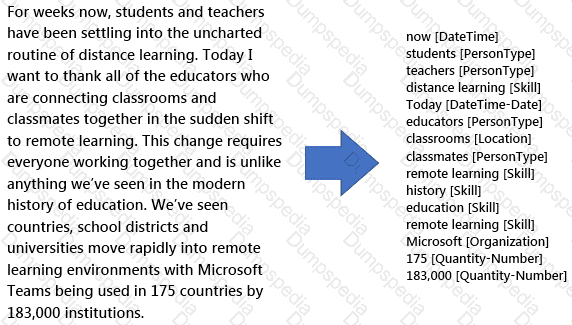
Which type of natural languages processing was performed?
entity recognition
key phrase extraction
sentiment analysis
translation
https://docs.microsoft.com/en-us/azure/cognitive-services/text-analytics/overview
You can provide the Text Analytics service with unstructured text and it will return a list of entities in the text that it recognizes. You can provide the Text Analytics service with unstructured text and it will return a list of entities in the text that it recognizes. The service can also provide links to more information about that entity on the web. An entity is essentially an item of a particular type or a category; and in some cases, subtype, such as those as shown in the following table.
You are processing photos of runners in a race.
You need to read the numbers on the runners’ shirts to identity the runners in the photos.
Which type of computer vision should you use?
facial recognition
optical character recognition (OCR)
semantic segmentation
object detection
According to the Microsoft Azure AI Fundamentals (AI-900) official study guide and the Microsoft Learn module “Identify features of computer vision workloads”, Optical Character Recognition (OCR) is a core capability within the computer vision domain that enables systems to detect and extract text from images or documents. OCR technology can identify printed or handwritten characters in photographs, scanned documents, or camera feeds, and convert them into machine-readable text.
In this scenario, the task is to read the numbers on runners’ shirts in race photos. These numbers are textual or numeric characters embedded within images. OCR is specifically designed for this purpose — to locate and recognize characters within visual data and convert them into usable text. Once extracted, those numbers can be cross-referenced with a database to identify each runner.
Let’s analyze why the other options are incorrect:
A. Facial recognition focuses on identifying individuals based on unique facial features, not reading text or numbers.
C. Semantic segmentation classifies each pixel of an image into categories (for example, separating road, sky, and people), but it doesn’t read text.
D. Object detection identifies and locates objects within an image (such as detecting people or vehicles) but does not extract readable text or numbers.
Therefore, since the task involves reading textual or numeric content from an image, the appropriate type of computer vision to use is Optical Character Recognition (OCR).
You have a custom question answering solution.
You create a bot that uses the knowledge base to respond to customer requests. You need to identify what the bot can perform without adding additional skills. What should you identify?
Register customer complaints.
Answer questions from multiple users simultaneously.
Register customer purchases.
Provide customers with return materials authorization (RMA) numbers.
According to the AI-900 Microsoft Learn modules on Conversational AI, a custom question answering solution built using Azure AI Language (formerly QnA Maker) enables a chatbot to respond to user questions based on a predefined knowledge base. When integrated with a bot, the solution can automatically respond to multiple user queries in real time without additional programming.
This capability is known as scalability and concurrency, which allows chatbots to manage simultaneous conversations with multiple users. This feature is built into the Azure Bot Service, meaning you don’t need to add extra “skills” or custom logic for concurrent interactions.
Other options require additional integration or logic:
Register customer complaints or purchases would require connecting the bot to a CRM or sales system.
Provide RMA numbers requires business process logic or database access.
Therefore, the out-of-the-box functionality of a custom question answering bot is the ability to answer questions from multiple users at once, which is supported natively by Azure Bot Service and the QnA knowledge base.
For each of the following statements, select Yes if the statement is true. Otherwise, select No.
NOTE: Each correct selection is worth one point.
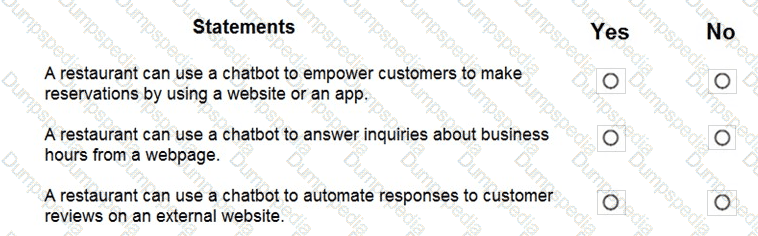

Yes, Yes, and No.
According to the Microsoft Azure AI Fundamentals (AI-900) official study guide and Microsoft Learn modules under the topic “Describe features of common AI workloads”, conversational AI solutions like chatbots are used to automate and enhance customer interactions. A chatbot is an AI service capable of understanding user inputs (text or voice) and providing appropriate responses, often integrated into websites, mobile apps, or messaging platforms.
A restaurant can use a chatbot to empower customers to make reservations using a website or an app – Yes.This statement is true because conversational AI is designed to handle structured tasks such as booking, scheduling, and information retrieval. Chatbots built with Azure Bot Service can connect to backend systems (like a reservation database) to let customers make or modify reservations through a chat interface. The AI-900 study guide explicitly notes that chatbots can help businesses “automate processes such as booking or reservations” to improve efficiency and customer experience.
A restaurant can use a chatbot to answer inquiries about business hours from a webpage – Yes.This is also true. Chatbots can be trained using QnA Maker (now integrated into Azure AI Language) or Azure Cognitive Services for Language to answer common customer questions. FAQs such as opening hours, menu details, and directions are ideal for chatbot automation, as outlined in the AI-900 modules discussing customer support automation.
A restaurant can use a chatbot to automate responses to customer reviews on an external website – No.This is not a typical chatbot use case taught in AI-900. Chatbots are meant for direct interactions within controlled channels, such as a company’s own website or messaging app. Managing and posting responses to reviews on external platforms (like Yelp or Google Reviews) would involve policy restrictions, authentication issues, and reputational risk. The AI-900 course specifies that responsible AI usage requires maintaining human oversight in public-facing communications that influence brand image.
You have an app that identifies the coordinates of a product in an image of a supermarket shelf.
Which service does the app use?
Azure Al Custom Vision object detection
Azure Al Computer Vision Read
Azure Al Computer Vision optical character recognition (OCR)
Azure Al Custom Vision classification
The described app identifies the coordinates of a product within an image of a supermarket shelf. This scenario directly corresponds to the object detection capability of Azure AI Custom Vision. As per the Microsoft Learn module “Train a Custom Vision model”, the object detection project type allows developers to train models that can both detect and locate objects within an image. It returns bounding box coordinates along with predicted labels for each detected item.
In this use case, the app doesn’t just classify what products are present—it needs the position of the product (coordinates). That function distinguishes object detection from classification. Classification simply assigns a label to the entire image, while object detection provides spatial information for multiple items in one image.
The other options are incorrect:
B. Azure AI Computer Vision Read and C. Azure AI Computer Vision OCR are used for extracting text from images, not locating objects.
D. Azure AI Custom Vision classification only categorizes images but cannot determine where objects appear.
Therefore, to build an app that finds and locates products in images, the correct choice is A. Azure AI Custom Vision object detection.
In which two scenarios can you use the Azure Al Document Intelligence service (formerly Form Recognizer)? Each correct answer presents a complete solution.
NOTE: Each correct selection is worth one point.
Extract the invoice number from an invoice.
Identify the retailer from a receipt.
Find images of products in a catalog.
Translate a form from French to English.
The Azure AI Document Intelligence service (formerly Form Recognizer) is designed to analyze, extract, and structure data from scanned or digital documents such as invoices, receipts, contracts, and forms. According to the Microsoft Learn module “Extract data from documents with Azure AI Document Intelligence”, the service uses optical character recognition (OCR) and pretrained machine learning models to automatically extract key information.
A. Extract the invoice number from an invoice – YESThe prebuilt invoice model in Document Intelligence can detect and extract key fields such as invoice number, date, total amount, tax, and vendor details from scanned or digital invoices.
B. Identify the retailer from a receipt – YESThe prebuilt receipt model can recognize fields like merchant name (retailer), transaction date, total spent, and tax amount, making this option correct as well.
C. Find images of products in a catalog – NOThis is a computer vision or Custom Vision use case, not a document data extraction task.
D. Translate a form from French to English – NOTranslation involves Azure AI Translator, part of the Language service, not Document Intelligence.
Hence, the correct and Microsoft-verified answers are:
✅ A. Extract the invoice number from an invoice
✅ B. Identify the retailer from a receipt
For each of the following statements, select Yes if the statement is true. Otherwise, select No.
NOTE: Each correct selection is worth one point.
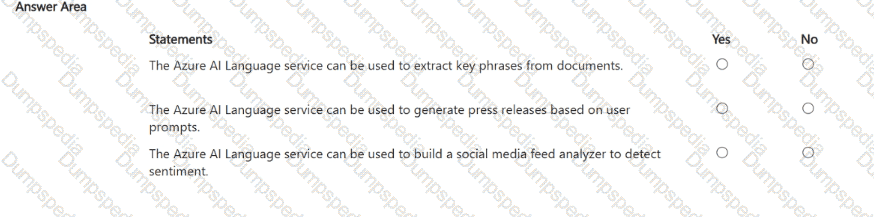

✅ Yes – Extract key phrases
❌ No – Generate press releases
✅ Yes – Detect sentiment
The Azure AI Language service is a powerful set of natural language processing (NLP) tools within Azure Cognitive Services, designed to analyze, understand, and interpret human language in text form. According to the Microsoft Azure AI Fundamentals (AI-900) study guide and Microsoft Learn documentation, this service includes several capabilities such as key phrase extraction, sentiment analysis, language detection, named entity recognition (NER), and question answering.
Extract key phrases from documents → YesThe Key Phrase Extraction feature identifies the most relevant words or short phrases within a document, helping summarize important topics. This is useful for indexing, summarizing, or organizing content. For instance, from “Azure AI Language helps analyze customer feedback,” it may extract “Azure AI Language” and “customer feedback” as key phrases.
Generate press releases based on user prompts → NoThis functionality falls under generative AI, specifically within Azure OpenAI Service, which uses models such as GPT-4 for text creation. The Azure AI Language service focuses on analyzing and understanding existing text, not generating new content like press releases or articles.
Build a social media feed analyzer to detect sentiment → YesThe Sentiment Analysis capability determines the emotional tone (positive, neutral, negative, or mixed) of text data, making it ideal for analyzing social media posts, reviews, or feedback. Businesses often use this to gauge customer satisfaction or brand reputation.
In summary, the Azure AI Language service analyzes text to extract insights and detect sentiment but does not generate new textual content.
For each of the following statements, select Yes if the statement is True. Otherwise, select No. NOTE: Each correct selection is worth one point.
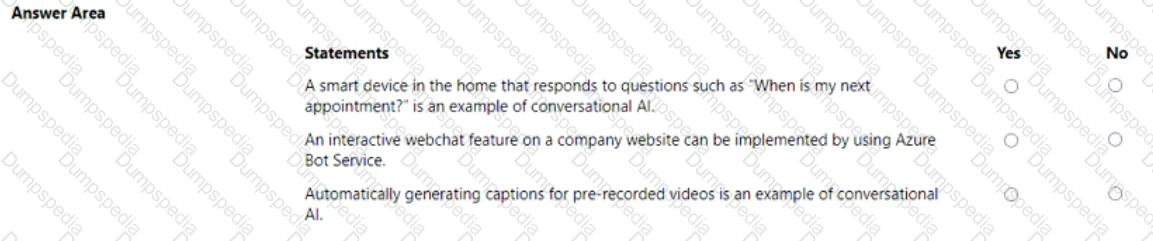

< Smart home device answering questions → Yes
Webchat using Azure Bot Service → Yes
Auto-caption generation for videos → No
According to the Microsoft Azure AI Fundamentals (AI-900) official study guide and the Microsoft Learn module “Describe features of common AI workloads”, Conversational AI refers to systems designed to engage in human-like dialogue through natural language—either text or speech. These systems include chatbots, virtual assistants, and voice-enabled smart devices, all of which can interpret user intent and respond meaningfully.
A smart device in the home that responds to questions such as “When is my next appointment?” – Yes.This is a classic example of Conversational AI. Devices like smart speakers or personal digital assistants use speech recognition, natural language understanding (NLU), and language generation to interpret spoken input and respond conversationally. The AI-900 study materials identify these as examples of voice-based conversational AI systems, which fall under the Speech and Language AI workloads.
An interactive webchat feature on a company website can be implemented by using Azure Bot Service – Yes.This statement is true. The Azure Bot Service is the primary Microsoft tool for creating and deploying conversational bots across various channels, including websites, Microsoft Teams, and other messaging platforms. The AI-900 syllabus specifically cites this as an example of implementing conversational AI for customer support or information retrieval.
Automatically generating captions for pre-recorded videos is an example of conversational AI – No.This is not conversational AI; instead, it falls under the Speech AI workload, specifically speech-to-text transcription. Automatically generating captions involves converting audio from video into written text but does not involve dialogue or interaction between a user and a system.
Thus, based on the official AI-900 guidance, only the first two scenarios describe conversational AI use cases.
Which two actions can you perform by using the Azure OpenAI DALL-E model? Each correct answer presents a complete solution.
NOTE: Each correct answer is worth one point.
Create images.
Use optical character recognition (OCR).
Detect objects in images.
Modify images.
Generate captions for images.
The correct answers are A. Create images and D. Modify images.
The Azure OpenAI DALL-E model is a text-to-image generative AI model that can create original images and modify existing ones based on text prompts. According to Microsoft Learn and Azure OpenAI documentation, DALL-E interprets natural language descriptions to produce unique and creative visual content, making it useful for design, illustration, marketing, and educational applications.
Create images (A) – DALL-E can generate new images entirely from textual input. For example, the prompt “a futuristic city skyline at sunrise” would result in a custom-generated artwork that visually represents that description.
Modify images (D) – DALL-E also supports inpainting and outpainting, allowing users to edit or expand existing images. You can replace parts of an image (for example, changing a background or object) or add new elements consistent with the visual style of the original.
The remaining options are incorrect:
B. OCR is performed by Azure AI Vision, not DALL-E.
C. Detect objects in images is also an Azure AI Vision (Image Analysis) feature.
E. Generate captions for images is handled by Azure AI Vision, not DALL-E, since DALL-E generates—not interprets—visuals.
You need to predict the income range of a given customer by using the following dataset.
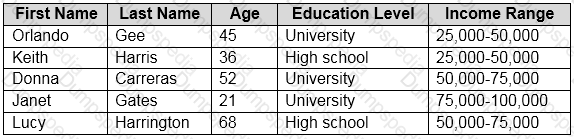
Which two fields should you use as features? Each correct answer presents a complete solution.
NOTE: Each correct selection is worth one point.
Education Level
Last Name
Age
Income Range
First Name
According to the Microsoft Azure AI Fundamentals (AI-900) official study guide and the Microsoft Learn module “Describe core concepts of machine learning on Azure”, when building a predictive machine learning model, features are the input variables used by the algorithm to predict the target label. The target label is the output or value the model is trained to predict.
In this dataset, the target variable is clearly the Income Range, since the goal is to predict a customer’s income bracket. Therefore, Income Range (D) is the label, not a feature. Features must be other attributes that help the model make this prediction.
The fields Education Level (A) and Age (C) are the most relevant features because both can logically and statistically influence income level.
Education Level is a categorical variable that often correlates strongly with income. Individuals with higher education levels tend to earn more on average, making this an important predictor.
Age is a numerical variable that typically affects income level due to factors such as experience and career progression.
By contrast:
First Name (E) and Last Name (B) are irrelevant as features because they are identifiers, not meaningful predictors of income. Including them could lead to bias or model overfitting without contributing to accurate predictions.
Hence, according to AI-900 principles, the features used to train a model predicting income range would be Education Level and Age.
For each of the following statements, select Yes if the statement is true. Otherwise, select No. NOTE: Each correct selection is worth one point.



According to the Microsoft Azure AI Fundamentals (AI-900) official study guide and Microsoft Learn module “Identify features of Natural Language Processing (NLP) workloads and services,” the Azure Cognitive Service for Language – Question Answering capability is designed to allow applications to respond to user questions using information from a prebuilt or custom knowledge base. It relies on Natural Language Processing (NLP) to match user queries to the most relevant answers but does not directly execute queries against databases or infer user intent.
“You can use Language Service’s question answering to query an Azure SQL database.” → NOThe Question Answering feature does not connect directly to or query structured databases such as Azure SQL. Instead, it retrieves answers from unstructured or semi-structured content (FAQs, manuals, documents). Querying SQL databases would require traditional database access, not a cognitive service.
“You should use Language Service’s question answering when you want a knowledge base to provide the same answer to different users who submit similar questions.” → YESThis statement is correct and aligns exactly with Microsoft’s official documentation. Question Answering enables organizations to create a knowledge base that can automatically answer repeated or similar customer queries using natural language understanding. For instance, two users asking “How do I reset my password?” and “Can you help me change my password?” would receive the same predefined response.
“Language Service’s question answering can determine the intent of a user utterance.” → NODetermining user intent is handled by Language Understanding (LUIS) or Conversational Language Understanding, not by Question Answering. While both belong to the Language Service, Question Answering focuses on retrieving relevant answers, whereas LUIS focuses on intent detection and entity extraction.
What should you do to ensure that an Azure OpenAI model generates accurate responses that include recent events?
Modify the system message.
Add grounding data.
Add few-shot learning.
Add training data.
In Azure OpenAI, grounding refers to the process of connecting the model to external data sources (for example, a database, search index, or API) so that it can retrieve accurate and up-to-date information before generating a response. This is particularly important for scenarios requiring current facts or events, since OpenAI models like GPT-3.5 and GPT-4 are trained on data available only up to a certain cutoff date.
By adding grounding data, the model’s responses are “anchored” to factual sources retrieved at runtime, improving reliability and factual accuracy. Grounding is commonly implemented in Azure OpenAI + Azure Cognitive Search solutions (Retrieval-Augmented Generation or RAG).
Option review:
A. Modify the system message: Changes model tone or behavior but doesn’t supply real-time data.
B. Add grounding data: ✅ Correct — allows access to recent and domain-specific information.
C. Add few-shot learning: Provides examples in the prompt to improve context understanding but not factual accuracy.
D. Add training data: Refers to fine-tuning; this requires retraining and doesn’t update the model’s awareness of current events.
Hence, the best method to ensure accurate and current responses from an Azure OpenAI model is to add grounding data, enabling the model to reference real, updated sources dynamically.
Which Azure Machine Learning capability should you use to quickly build and deploy a predictive model without extensive coding?
ML pipelines
Copilot
DALL-E
automated machine learning (automated ML)
According to the Microsoft Azure AI Fundamentals (AI-900) curriculum and Microsoft Learn’s “Explore Automated Machine Learning in Azure Machine Learning” module, Automated ML (AutoML) is the Azure Machine Learning capability that allows users to quickly build, train, and deploy predictive models with minimal or no coding experience.
Automated ML automatically performs tasks that would normally require expert data science knowledge, such as:
Selecting appropriate algorithms (e.g., decision trees, logistic regression, random forests)
Performing hyperparameter tuning to optimize model accuracy
Handling missing data and feature scaling automatically
Generating performance metrics and best model recommendations
This feature is especially useful for business analysts, developers, or beginners who want to leverage machine learning for predictions (like sales forecasting, churn analysis, or demand prediction) without having to write complex Python code.
Other options explained:
A. ML pipelines automate and organize workflows for model training and deployment but still require pre-built models.
B. Copilot is an AI-powered assistant embedded in Microsoft tools for productivity, not a model training feature.
C. DALL-E is an image generation model under Azure OpenAI, not a predictive modeling tool.
Thus, per official Microsoft Learn content, Automated Machine Learning is the correct capability to quickly build and deploy predictive models with minimal coding.
In which two scenarios can you use speech recognition? Each correct answer presents a complete solution.
NOTE: Each correct selection is worth one point.
an in-car system that reads text messages aloud
providing closed captions for recorded or live videos
creating an automated public address system for a train station
creating a transcript of a telephone call or meeting
The correct answers are B and D.
Speech recognition, part of Azure’s Speech service, converts spoken audio into written text. It is a core feature of Azure Cognitive Services for speech-to-text scenarios.
Providing closed captions for recorded or live videos (B) – This is a typical application of speech recognition. The AI system listens to audio content from a video and generates real-time or post-event captions. Azure’s Speech-to-Text API is frequently used in broadcasting and video platforms to improve accessibility and searchability.
Creating a transcript of a telephone call or meeting (D) – Another common use case is automated transcription. The Speech service can process real-time audio streams (such as meetings or calls) and produce accurate text transcripts. This is widely used in customer service, call analytics, and meeting documentation.
The incorrect options are:
A. an in-car system that reads text messages aloud – This uses Text-to-Speech, not speech recognition.
C. creating an automated public address system for a train station – This also uses Text-to-Speech, since it generates spoken output from text.
Therefore, scenarios that convert spoken words into text correctly represent speech recognition, making B and D the right answers.
Which Computer Vision feature can you use to generate automatic captions for digital photographs?
Recognize text.
Describe the images.
Identify the areas of interest.
Detect objects.
According to the Microsoft Azure AI Fundamentals (AI-900) official study guide and the Microsoft Learn module “Describe features of computer vision workloads on Azure,” the “Describe Image” feature within Azure’s Computer Vision service automatically generates textual captions that describe the contents of an image.
This feature uses a deep learning model trained on millions of labeled images to identify objects, people, and scenes, then formulates a natural language sentence summarizing what it sees. For example, given a photograph showing “two people sitting at a table with a laptop,” the service might generate the caption: “A man and a woman sitting at a desk using a laptop.”
Here’s how the other options differ:
A. Recognize text: Refers to Optical Character Recognition (OCR), which extracts written text from images, not generates descriptive captions.
C. Identify the areas of interest: Refers to detecting regions of an image that stand out visually, such as hotspots or significant features, not descriptive captioning.
D. Detect objects: Identifies and classifies objects in an image (e.g., cars, chairs, people) but doesn’t produce a sentence or caption summarizing them.
Thus, only “Describe the images” generates automatic, human-readable captions that summarize photo content, a core computer vision workload taught in AI-900.
You ate building a Conversational Language Understanding model for an e-commerce business.
You need to ensure that the model detects when utterances are outside the intended scope of the model.
What should you do?
Export the model.
Create a new model.
Add utterances to the None intent.
Create a prebuilt task entity.
In Conversational Language Understanding (CLU), a core service within Azure AI Language, intents represent the goals or purposes behind user utterances (for example, “Track my order” or “Cancel my subscription”). However, in real-world scenarios, users often provide inputs that do not match any defined intent. To handle such cases gracefully, Microsoft recommends including a “None” intent that captures out-of-scope utterances — text that doesn’t belong to any other intent in your model.
According to the Microsoft Learn module: “Build a Conversational Language Understanding app”, the None intent serves as a catch-all or fallback category for utterances that the model should ignore or respond to with a default message (e.g., “I’m sorry, I don’t understand that.”). By training the model with multiple examples of irrelevant or unrelated utterances in this intent, you improve its ability to distinguish between valid and invalid user inputs.
The other options are incorrect:
A. Export the model: Exporting only saves or transfers the model; it does not influence how the model detects irrelevant utterances.
B. Create a new model: A new model would not inherently solve out-of-scope detection unless properly trained with a None intent.
D. Create a prebuilt task entity: Entities identify specific data (like dates or products) within valid intents, not irrelevant utterances.
Thus, the correct approach to ensure that your CLU model can detect utterances outside its intended scope is to add examples of unrelated or off-topic phrases to the None intent. This improves classification accuracy and prevents incorrect intent matches.
✅ Correct Answer: C. Add utterances to the None intent
Select the answer that correctly completes the sentence.


Safety system.
According to the Microsoft Learn documentation and the AI-900: Microsoft Azure AI Fundamentals official study guide, the safety system layer in generative AI architecture plays a crucial role in monitoring, filtering, and mitigating harmful or unsafe model outputs. This layer works alongside the model and user experience layers to ensure that generative AI systems—such as those powered by Azure OpenAI—produce responses that are safe, aligned, and responsible.
The safety system layer uses various techniques including content filtering, prompt moderation, and policy enforcement to prevent outputs that could be harmful, biased, misleading, or inappropriate. It evaluates both user inputs (prompts) and model-generated outputs to identify and block unsafe or unethical content. The system might use predefined rules, classifiers, or human feedback signals to decide whether to allow, modify, or stop a response.
In contrast, the other layers serve different purposes:
The model layer contains the core large language or generative model (e.g., GPT or DALL-E) that processes inputs and produces outputs.
The metaprompt and grounding layer ensures the model’s responses are contextually relevant and factually supported, often linking to organizational data sources or system prompts.
The user experience layer defines how users interact with the AI system, including the interface and conversational flow, but does not manage safety enforcement.
Therefore, the layer that uses system inputs and context to mitigate harmful outputs from a generative AI model is the Safety system layer.
This aligns with Microsoft’s responsible AI principles—Fairness, Reliability and Safety, Privacy and Security, Inclusiveness, Transparency, and Accountability—ensuring generative AI operates ethically and safely.
Select the answer that correctly completes the sentence.


“Optical Character Recognition (OCR) extracts text from handwritten documents.”
According to the Microsoft Azure AI Fundamentals (AI-900) official study guide and Microsoft Learn module “Identify features of computer vision workloads,” Optical Character Recognition (OCR) is a computer vision capability that enables AI systems to detect and extract printed or handwritten text from images, scanned documents, and photographs.
Microsoft Learn explains that OCR uses machine learning algorithms to analyze visual data, locate regions containing text, and then convert that text into machine-readable digital format. This capability is essential for automating processes such as document digitization, form processing, and data extraction.
OCR technology is provided through services such as the Azure Cognitive Services Computer Vision API and Azure Form Recognizer. The Computer Vision API’s OCR feature can extract text from both typed and handwritten sources, including receipts, invoices, letters, and forms. Once extracted, this text can be processed, searched, or stored electronically, enabling automation and efficiency in document management systems.
Let’s review the incorrect options:
Object detection identifies and locates objects in an image by drawing bounding boxes (e.g., detecting vehicles or people).
Facial recognition identifies or verifies individuals by comparing facial features.
Image classification assigns an image to one or more predefined categories (e.g., “dog,” “car,” “tree”).
None of these perform the task of extracting textual content from images — that is uniquely handled by Optical Character Recognition (OCR).
Therefore, based on the AI-900 official study content, the verified and correct answer is Optical Character Recognition (OCR), as it specifically extracts text (printed or handwritten) from image-based documents.
Select the answer that correctly completes the sentence.


The correct completion of the sentence “_____ is an example of speech recognition.” is A voice-activated security key system.
According to the Microsoft Azure AI Fundamentals (AI-900) official study guide and Microsoft Learn module “Describe features of common AI workloads”, speech recognition refers to the ability of a system or application to convert spoken language into text or actionable commands. It allows computers to interpret and respond to human speech inputs, bridging human-computer interaction through natural language.
Microsoft Learn clearly explains that speech recognition is used in applications such as voice assistants, dictation software, and voice-activated security systems, where the spoken input from a user is captured, analyzed, and translated into commands or text. For example, when a user says “Unlock door” or “Open session,” the speech recognition system interprets that sound input, converts it into text or a command, and then performs the appropriate action. This is a direct implementation of speech-to-text processing combined with command execution logic.
Let’s analyze the other options:
Creating an audio commentary for a video recording is related to speech synthesis (text-to-speech), not recognition.
Creating captions for a video recording involves speech-to-text transcription, which is a subset of speech recognition, but the question emphasizes a system that responds to voice commands, making the first option more accurate.
Identifying key phrases in a video transcript involves natural language processing (NLP) techniques rather than speech recognition.
Therefore, the voice-activated security key system best represents the use of speech recognition technology because it interprets spoken commands and takes a corresponding action based on recognized speech patterns. This aligns directly with the AI-900 learning objectives where speech recognition is defined as a process that enables applications to interpret and respond to human voice input.
To complete the sentence, select the appropriate option in the answer area.


According to the Microsoft Azure AI Fundamentals (AI-900) official study materials, object detection is a type of computer vision workload that not only identifies objects within an image but also determines their location by drawing bounding boxes around them. This functionality is clearly described in the Microsoft Learn module “Identify features of computer vision workloads.”
In this scenario, the AI system analyzes an image to find a vehicle and then returns a bounding box showing where that vehicle is located within the image frame. That ability — to detect, classify, and localize multiple objects — perfectly defines object detection.
Microsoft’s study content contrasts object detection with other computer vision workloads as follows:
Image classification: Determines what object or scene is present in an image as a whole but does not locate it (e.g., “this is a car”).
Object detection: Identifies what objects are present and where they are, usually returning coordinates for bounding boxes (e.g., “car detected at position X, Y”).
Optical Character Recognition (OCR): Extracts text content from images or scanned documents.
Facial detection: Specifically locates human faces within an image or video feed, often as part of face recognition systems.
In Azure, object detection capabilities are available through services such as Azure Computer Vision, Custom Vision, and Azure Cognitive Services for Vision, which can be trained to detect vehicles, products, or other objects in various image datasets.
Therefore, based on the AI-900 study guide and Microsoft Learn materials, the verified and correct answer is Object detection, as it accurately describes the process of returning a bounding box indicating an object’s position in an image.
Which scenario is an example of a webchat bot?
Determine whether reviews entered on a website for a concert are positive or negative, and then add athumbs up or thumbs down emoji to the reviews.
Translate into English questions entered by customers at a kiosk so that the appropriate person can call the customers back.
Accept questions through email, and then route the email messages to the correct person based on the content of the message.
From a website interface, answer common questions about scheduled events and ticket purchases for a music festival.
According to the Microsoft Azure AI Fundamentals (AI-900) official study materials, a webchat bot is defined as a conversational AI application that interacts with users through a web-based chat interface. It simulates human conversation using text (and sometimes voice) to answer questions, assist with transactions, or provide information automatically. Microsoft Learn’s “Describe features of common AI workloads” module highlights conversational AI as a major AI workload, where bots and virtual agents are used to provide automated, intelligent responses in real time through web, mobile, or messaging platforms.
In this scenario, the chatbot on the festival website provides immediate answers about scheduled events and ticket purchases. This aligns exactly with how a webchat bot operates — interacting with users through a website, handling repetitive inquiries, and providing consistent information without human intervention. This type of solution is commonly built using Azure Bot Service integrated with Azure Cognitive Services for Language, which allows the bot to understand user intent and respond naturally.
Let’s examine the other options to reinforce why D is correct:
A describes a text analytics or sentiment analysis scenario, not a conversational bot, because it classifies text sentiment but doesn’t “chat” with a user.
B is an example of machine translation using the Translator service, not a chatbot.
C is an email classification or natural language processing task, not a webchat interaction.
The AI-900 exam objectives clearly distinguish conversational AI from other cognitive services such as translation or sentiment analysis. Conversational AI focuses on dialogue and interaction through natural language conversation channels like websites or messaging apps.
Therefore, the verified and officially aligned answer is D. From a website interface, answer common questions about scheduled events and ticket purchases for a music festival.
Match the Azure Al service to the appropriate actions.
To answer, drag the appropriate service from the column on the left to its action on the right Each service may be used once, more than once, or not at all.
NOTE: Each correct match is worth one point.
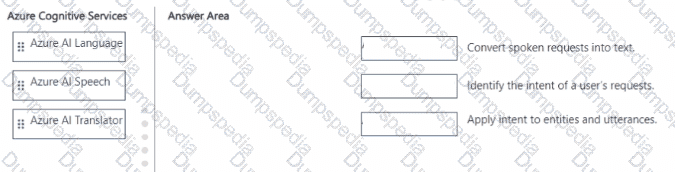


The correct mapping is based on how each Azure Cognitive Service functions within the Microsoft AI ecosystem, as detailed in the Microsoft Azure AI Fundamentals (AI-900) study guide and Microsoft Learn Cognitive Services documentation.
Convert spoken requests into text → Azure AI SpeechThe Azure AI Speech service provides speech-to-text (STT) capabilities, which enable an application to recognize spoken language and convert it into written text. This functionality is foundational in voice-enabled applications like digital assistants or transcription services. When a user speaks, this service captures the audio signal and produces an accurate textual representation that can then be processed by other AI services.
Identify the intent of a user’s requests → Azure AI LanguageThe Azure AI Language service (which includes Conversational Language Understanding, formerly LUIS) is designed to extract meaning from text. It identifies intents—the goals or actions a user wants to perform—and entities, which are key details within that request. For example, in the command “Book a flight to Paris,” the intent is “book a flight,” and the entity is “Paris.”
Apply intent to entities and utterances → Azure AI LanguageAgain, the Language service performs this deeper contextual analysis. It not only identifies what the user wants (intent) but also applies it to utterances (specific user expressions) and entities (data elements extracted from text). This helps conversational AI systems take meaningful actions, such as fulfilling user requests.
In summary, Azure AI Speech handles audio-to-text conversion, while Azure AI Language performs natural language understanding, mapping intents and entities—a workflow essential in intelligent conversational applications.
Select the answer that correctly completes the sentence.


According to the Microsoft Azure AI Fundamentals (AI-900) official study guide and the Microsoft Learn module “Describe features of natural language processing (NLP) workloads on Azure,” Natural Language Processing refers to the branch of AI that enables computers to interpret, understand, and generate human language. One of the main NLP workloads identified by Microsoft is speech-to-text conversion, which transforms spoken words into written text.
Creating a text transcript of a voice recording perfectly fits this definition because it involves converting audio language data into text form — a process handled by speech recognition models. These models analyze the acoustic features of human speech, segment phonemes, identify words, and produce a text transcript. On Azure, this function is implemented using the Azure Cognitive Services Speech-to-Text API, part of the Language and Speech services.
Let’s examine the other options to clarify why they are incorrect:
Computer vision workload: Involves interpreting and analyzing visual data such as images and videos (e.g., object detection, facial recognition). It does not deal with speech or audio.
Knowledge mining workload: Refers to extracting useful information from large amounts of structured and unstructured data using services like Azure Cognitive Search, not transcribing audio.
Anomaly detection workload: Involves identifying unusual patterns in data (e.g., fraud detection or sensor anomalies), unrelated to language or speech.
In summary, when a system creates a text transcript from spoken audio, it is performing a speech recognition task—classified under Natural Language Processing (NLP). This workload helps make spoken content searchable, analyzable, and accessible, aligning with Microsoft’s Responsible AI goal of enhancing accessibility through language understanding.
Which two languages can you use to write custom code for Azure Machine Learning designer? Each correct answer presents a complete solution.
NOTE; Each correct selection is worth one point.
C#
Scala
Python
R
According to the Microsoft Learn module “Describe features of Azure Machine Learning” and the AI-900 study guide, Azure Machine Learning designer supports extending workflows through custom code modules written in Python and R.
Python is the most commonly used language for AI and machine learning due to its extensive library support (such as TensorFlow, Scikit-learn, and PyTorch).
R is widely used for statistical computing and data visualization, making it valuable for analytical workloads.
In Azure Machine Learning, users can insert Python Script or Execute R Script modules within the visual designer to perform advanced operations or custom data transformations.
C# and Scala are not supported directly in Azure Machine Learning Designer. C# is more common in application development, and Scala is primarily used in big data frameworks like Apache Spark.
Hence, the correct answers are C. Python and D. R.
You are developing a Chabot solution in Azure.
Which service should you use to determine a user’s intent?
Translator
Azure Cognitive Search
Speech
Language
In Azure, the Language service unifies several natural language capabilities, including LUIS, QnA Maker, and Text Analytics, into one comprehensive service. To determine a user’s intent in a chatbot, you use the Conversational Language Understanding (CLU) feature of the Language service, which is the evolution of LUIS.
CLU helps chatbots and applications comprehend natural language input by identifying the intent (the purpose of the user’s statement) and extracting entities (important details). For example, when a user types “Book a meeting for tomorrow,” the model recognizes the intent (BookMeeting) and the entity (tomorrow).
The other options do not determine intent:
Translator (A) is used for language translation.
Azure Cognitive Search (B) retrieves documents based on search queries.
Speech (C) converts audio to text but doesn’t analyze meaning.
Thus, to determine a user’s intent in a chatbot scenario, the correct service is D. Language.
You have an Azure Machine Learning pipeline that contains a Split Data module. The Split Data module outputs to a Train Model module and a Score Model module. What is the function of the Split Data module?
selecting columns that must be included in the model
creating training and validation datasets
diverting records that have missing data
scaling numeric variables so that they are within a consistent numeric range
According to the Microsoft Azure AI Fundamentals (AI-900) official study guide and Microsoft Learn module “Identify features of Azure Machine Learning”, the Split Data module in an Azure Machine Learning pipeline is used to divide a dataset into two or more subsets—typically a training dataset and a testing (or validation) dataset. This is a fundamental step in the supervised machine learning workflow because it allows for accurate evaluation of the model’s performance on data it has not seen during training.
In a typical workflow, the data flows as follows:
The dataset is first preprocessed (cleaned, normalized, or transformed).
The Split Data module divides this dataset into two parts — one for training the model and another for testing or scoring the model’s accuracy.
The Train Model module uses the training data output from the Split Data module to learn patterns and build a predictive model.
The Score Model module then takes the trained model and applies it to the test data output to measure how well the model performs on unseen data.
The Split Data module typically uses a defined ratio (such as 0.7:0.3 or 70% for training and 30% for testing). This ensures that the trained model can generalize well to new, real-world data rather than simply memorizing the training examples.
Now, addressing the incorrect options:
A. Selecting columns that must be included in the model is done by the Select Columns in Dataset module.
C. Diverting records that have missing data is handled by the Clean Missing Data module.
D. Scaling numeric variables is done using the Normalize Data or Edit Metadata modules.
Therefore, based on the official AI-900 learning objectives, the verified and most accurate answer is B. creating training and validation datasets.
To complete the sentence, select the appropriate option in the answer area.


According to Microsoft’s Responsible AI principles, one of the key guiding values is Reliability and Safety, which ensures that AI systems operate consistently, accurately, and safely under all intended conditions. The AI-900 study materials and Microsoft Learn modules explain that an AI system must be trustworthy and dependable, meaning it should not produce results when the input data is incomplete, corrupted, or significantly outside the expected range.
In the given scenario, the AI system avoids providing predictions when important fields contain unusual or missing values. This behavior demonstrates reliability and safety because it prevents the system from making unreliable or potentially harmful decisions based on bad or insufficient data. Microsoft emphasizes that AI systems must undergo extensive validation, testing, and monitoring to ensure stable performance and predictable outcomes, even when data conditions vary.
The other options do not fit this scenario:
Inclusiveness ensures that AI systems are accessible to and usable by all people, regardless of abilities or backgrounds.
Privacy and Security focuses on protecting user data and ensuring it is used responsibly.
Transparency involves making AI decisions explainable and understandable to humans.
Only Reliability and Safety directly address the concept of an AI system refusing to act or returning an error when it cannot make a trustworthy prediction. This principle helps prevent inaccurate or unsafe outputs, maintaining confidence in the system’s integrity.
Therefore, ensuring an AI system does not produce predictions when input data is incomplete or unusual aligns directly with Microsoft’s Reliability and Safety principle for responsible AI.
For each of the following statements, select Yes if the statement is true. Otherwise, select No.
NOTE: Each correct selection is worth one point.
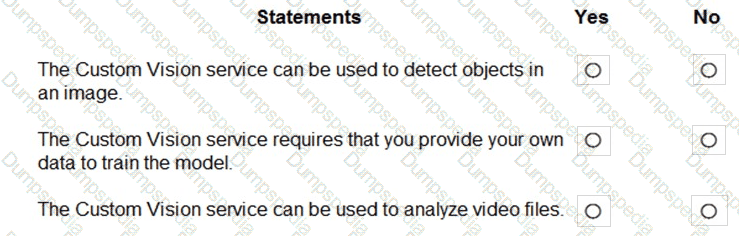



According to the Microsoft Azure AI Fundamentals (AI-900) study guide and Azure Cognitive Services documentation, the Custom Vision service is a specialized computer vision tool that allows users to build, train, and deploy custom image classification and object detection models. It is part of the Azure Cognitive Services suite, designed for scenarios where pre-built Computer Vision models do not meet specific business requirements.
“The Custom Vision service can be used to detect objects in an image.” → YesThis statement is true. The Custom Vision service supports object detection, enabling the model to identify and locate multiple objects within a single image using bounding boxes. For example, it can locate cars, products, or animals in photos.
“The Custom Vision service requires that you provide your own data to train the model.” → YesThis statement is true. Unlike pre-trained models such as the standard Computer Vision API, the Custom Vision service requires users to upload and label their own images. The system uses this labeled dataset to train a model specific to the user’s scenario, improving accuracy for custom use cases.
“The Custom Vision service can be used to analyze video files.” → NoThis statement is false. The Custom Vision service works only with static images, not videos. To analyze video files, Azure provides Video Indexer and Azure Media Services, which are designed for extracting insights from moving visual content.
TESTED 22 Apr 2026