Summer Sale - Limited Time 65% Discount Offer - Ends in 0d 00h 00m 00s - Coupon code: 65percent

Welcome To DumpsPedia

CCAR-P Sample Questions Answers

Questions 4

You are diagnosing a Claude Code session whose subagent uses 50,000 tokens of context before the engineer types a single message.

Which root cause is most likely?

Options:

A.

The developer's keyboard layout or input-method configuration is the cause of the elevated context consumption, introducing extra tokens before the engineer types any message.

B.

Many MCP servers are configured, each contributing tool definitions to the context budget; Tool Search is not enabled, so all definitions load upfront.

C.

The model has internal personal preferences or default behaviors that silently consume large portions of context budget before any user message is processed, independent of tool configuration.

D.

The font rendering or display-scaling settings of the IDE are converting visual output into additional context tokens, causing the high pre-session context consumption.

Buy Now
Questions 5

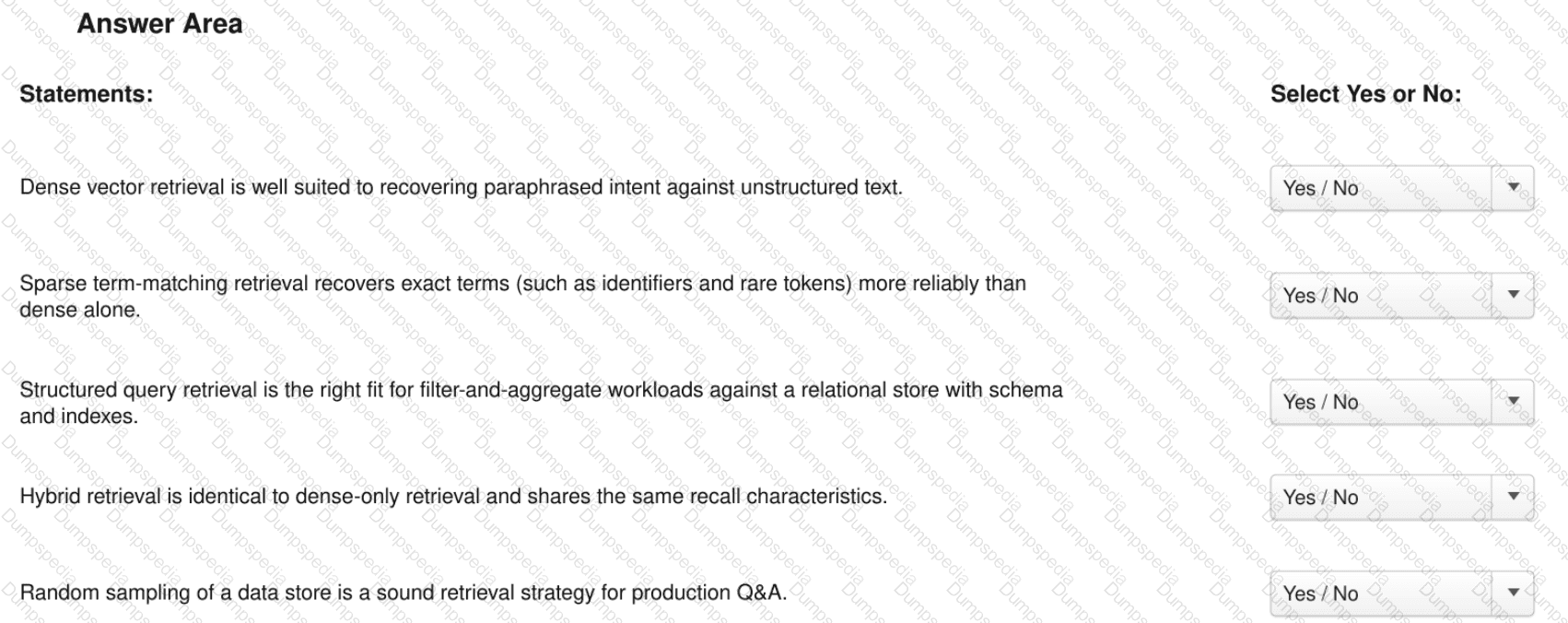
You are evaluating model-selection claims used by a peer team.

For each statement, select yes if the statement is generally true. Otherwise, select no.

5

Options:

Buy Now
Questions 6

You are compiling guardrail tactics for a customer-facing assistant.

Which two tactics belong on the guardrail list?

Each correct answer presents a complete solution.

Options:

A.

Embed approved override phrases that let trusted users relax guardrails on demand.

B.

Lower sampling temperature globally to reduce the chance of off-policy completions.

C.

Validate the model output against a structured schema before downstream actions are taken.

D.

Layer prompt-level guardrails with runtime content checks rather than relying on either alone.

E.

Rely on a single hardened system prompt that enumerates every disallowed behavior.

Buy Now
Questions 7

You are compiling factors that should drive the choice between Model Context Protocol (MCP), direct API integration, and agent-to-agent handoff.

Which two factors belong on the list? (Select two.)

Each correct answer presents a complete solution.

Options:

A.

Whether the vendor publishes detailed reference documentation for each candidate protocol.

B.

Whether the team has prior implementation experience with any of the candidate protocols.

C.

Whether the underlying transport supports encryption in transit between the integrated services.

D.

Whether the integration must be portable across multiple AI clients in the ecosystem.

E.

Whether the interaction is stateless and latency-sensitive or stateful and longer-running.

Buy Now
Questions 8

During an architectural review, the security team identifies a risk that adversarial content injected into retrieved documents could manipulate the model’s behavior.

Which mitigation most directly addresses this threat?

Options:

A.

Treat all retrieved content as untrusted input and apply input classifiers with output validation.

B.

Require citations for each claim and constrain responses to source-supported content.

C.

Restrict outbound tool calls to an approved destination allow-list.

D.

Score outputs against a stable adversarial evaluation set on each model-version change.

Buy Now
Questions 9

After a prompt-template update, several previously passing test cases now produce unexpected outputs.

Which test type is specifically designed to detect this category of failure?

Options:

A.

Integration tests that validate cross-component pipeline behavior.

B.

Adversarial tests that probe for prompt-injection vulnerabilities.

C.

Regression tests scored against a stable reference set of known-good behavior.

D.

Smoke tests that confirm high-level system availability after the change.

Buy Now
Questions 10

A Claude architect is designing a HIPAA-compliant pipeline that processes patient records.

Which two design decisions directly support HIPAA compliance requirements? (Select two.)

Options:

A.

Setting max_tokens to a low value to minimize the volume of text generated per request.

B.

Selecting the highest-capability Claude model to maximize diagnostic accuracy.

C.

Enforcing role-based access controls so that PHI is retrievable only by authorized personnel.

D.

Ensuring patient data is never included in training feedback loops sent to the model provider without a BAA in place.

E.

Using streaming responses to reduce perceived latency for clinical users.

Buy Now
Questions 11

You are producing an architecture guide for a new deployment and must complete the planning steps before drafting each section.

Which two steps must be completed BEFORE drafting each section of the guide? (Select two.)

Each correct answer presents part of the solution.

Options:

A.

Identify the audience and the questions the guide must answer for that audience.

B.

Translate the guide into the supported regional languages for the candidate population.

C.

Validate the guide with the implementation team and incorporate corrections.

D.

Establish the document under version control with a defined review cadence and approver list.

E.

Outline the guide sections covering the overview, components, contracts, flows, runbooks, and limitations.

Buy Now
Questions 12

The compliance team at a firm has approved a Claude Skill that generates client-facing investment summaries. The Skill includes the firm’s required disclaimers and prohibited-language list. A product manager has asked whether additional guardrails are needed at the application layer or whether the Skill alone is sufficient.

Which two guardrail responsibilities should remain at the application layer rather than the Skill? (Select two.)

Each correct answer presents part of the solution.

Options:

A.

Log every generated summary to the firm’s compliance audit trail for retention.

B.

Verify the requesting user is authorized to generate investment summaries at all.

C.

Format output sections according to the firm’s standardized house style guidelines.

D.

Apply the disclaimer template that the compliance team has standardized firm-wide.

E.

Apply the prohibited-language list that the compliance team maintains and updates.

Buy Now
Questions 13

You are supporting an engineer whose newly added MCP server does not appear in their Claude Code session.

Which diagnostic step should be tried first?

Options:

A.

Disable every MCP server in the configuration to isolate the issue, removing all tool access rather than confirming whether the new server is registered.

B.

Switch the team to a different Claude product family unrelated to the existing workflow, abandoning the current configuration rather than diagnosing the registration issue.

C.

Verify the MCP server is registered using the listing command, then reconnect the session if needed, since configuration changes typically require a restart to take effect.

D.

Reinstall the developer’s operating system from scratch, discarding all local configuration and tool state before attempting any targeted diagnostic steps.

Buy Now
Questions 14

An architect is reviewing a Claude-based candidate-screening tool prior to deployment. A stakeholder asserts that because the model was not trained on company data, no bias evaluation is necessary.

Which two responses most accurately challenge this assertion? (Select two.)

Options:

A.

Transparency obligations are satisfied by disclosing that an AI system is in use, without further evaluation.

B.

Fairness testing is required only when the training dataset is known to contain protected-class labels.

C.

The model may carry demographic biases from pretraining that manifest in screening outcomes regardless of fine-tuning.

D.

The system should be evaluated on outcome-disparity metrics across protected groups before deployment.

E.

Bias evaluation is unnecessary when the model provider has published a responsible-use policy.

Buy Now
Questions 15

A security audit uncovers two issues: (1) all end users share a single API key, and (2) tool calls are executed without logging the initiating user.

Which two mitigations directly address these specific findings? (Select two.)

Options:

A.

Validate structured outputs against a schema before downstream actions are executed.

B.

Enforce RBAC at the retrieval layer before content enters the model context.

C.

Move credentials out of the prompt context and resolve them from a server-side secret store.

D.

Add actor attribution to tool-call logs so each call records the initiating user identity.

E.

Replace the shared API key with per-user OAuth tokens carrying scope-restricted permissions.

Buy Now
Questions 16

You are designing a content moderation classifier that processes high volumes of user-generated comments under a tight per-message latency budget using well-defined classification labels.

Which model selection best aligns with the workload?

Options:

A.

Opus, because every moderation decision requires maximum reasoning depth regardless of classification complexity.

B.

Haiku, because its latency and cost profile align with high-volume classification workloads that require limited reasoning depth.

C.

Sonnet, because larger general-purpose models are preferred even when workload latency requirements are strict.

D.

Sonnet with extended thinking enabled, because deeper reasoning should be applied to every moderation request to improve edge-case handling.

Buy Now
Questions 17

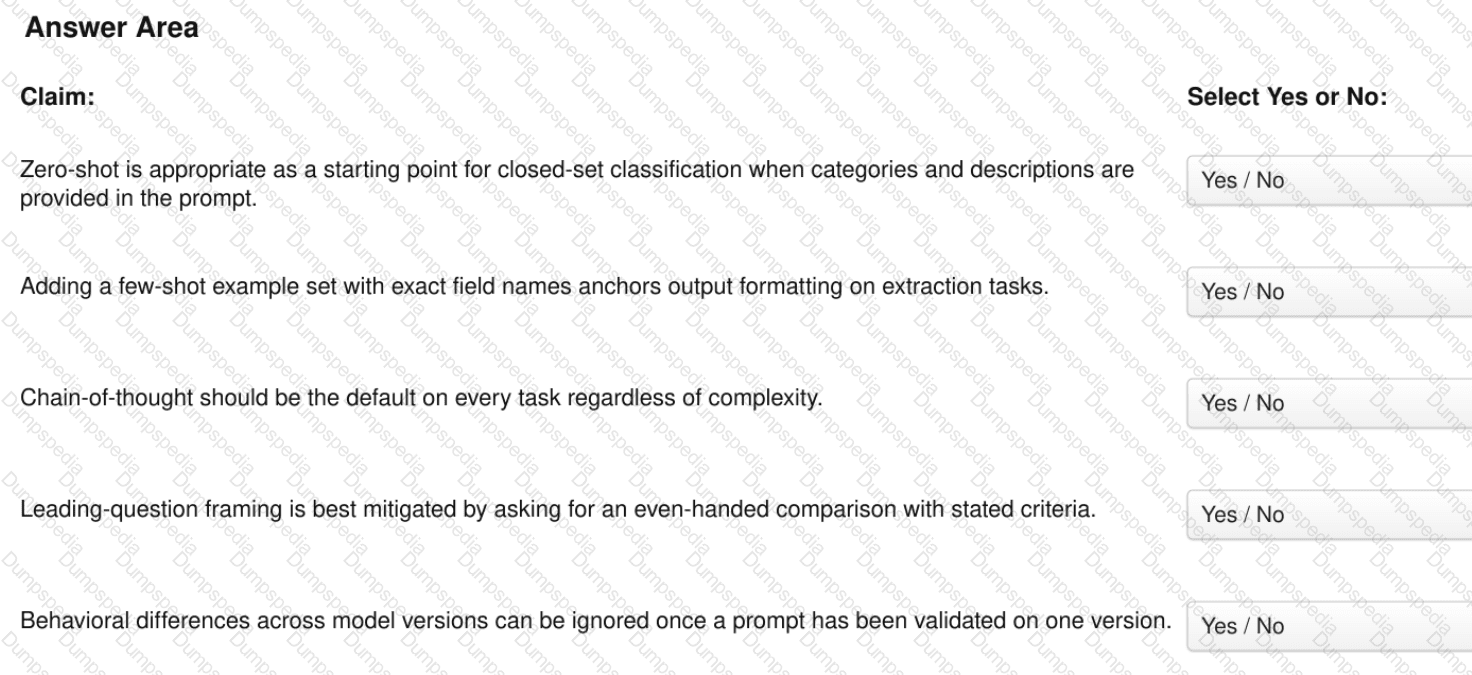
You are evaluating prompting claims in a peer’s design document.

For each claim, select yes if the claim reflects sound practice. Otherwise, select no.
17

Options:

Buy Now
Questions 18

You are a solution architect evaluating candidate use cases for a Claude-based program.

For each scenario, select Yes if Claude is appropriate as the primary solution at the architectural level. Otherwise, select No.

18

Options:

Buy Now
Questions 19

You are identifying inefficiency in a Claude Code workflow where each engineer manually re-explains the project's conventions and architecture in every session.

Which adjustment most directly removes this inefficiency?

Options:

A.

Forbid the use of Claude Code on the project entirely to avoid the session-initialization overhead, accepting that the team loses all AI-assisted development productivity for this codebase.

B.

Capture the project's conventions and architecture in a project-scoped CLAUDE.md (or equivalent persistent project-context file) committed to the repository, so each session loads it automatically.

C.

Tell each engineer to retype the project conventions and architecture context more quickly at the start of each session, reducing time lost without eliminating the repeated manual effort.

D.

Remove all documented project conventions and architectural standards so engineers have nothing to re-explain at session start, accepting the loss of consistency and shared coding standards.

Buy Now
Questions 20

A revenue projection assistant has missed its monthly cost target by 38 percent. Profiling shows three contributors: a 6,000-token policy preamble repeated on every call (45 percent of cost), retrieval of historical sales chunks averaging 3,000 tokens per call (30 percent), and inference on a flagship-tier model (25 percent). Stakeholders require that projection accuracy remain unchanged.

Which two optimizations should you sequence first to reduce cost without affecting accuracy? (Select two.)

Each correct answer presents part of the solution.

Options:

A.

Reduce the number of historical sales chunks retrieved across each query run.

B.

Truncate the policy preamble to remove non-essential clauses from the prompt.

C.

Enable prompt caching on the static policy preamble across the recurring calls.

D.

Switch the workload to a smaller, faster Claude model tier across all queries.

E.

Cache common retrieved sales chunks accessed across many of the daily queries.

Buy Now
Questions 21

You are supporting a team whose Claude Code sessions consistently load 60 or more MCP tools from many servers, exhausting context budget before the session begins.

Which adjustment most directly addresses this issue without removing capability?

Options:

A.

Enable Tool Search so tool definitions are deferred and discovered on demand rather than loaded into context upfront.

B.

Disable every MCP server in the configuration to free up context budget, accepting that the team loses all tool access and cannot perform any MCP-dependent task in the session.

C.

Increase the prompt’s verbosity with additional instructions and context, which consumes more of the context budget rather than reducing the tool-definition overhead causing the issue.

D.

Add additional MCP servers to give the team more capability, which increases rather than reduces the number of tool definitions loaded into the session’s context budget.

Buy Now
Questions 22

You are integrating human review into a high-volume classification pipeline where reviewing every output is infeasible.

Which sampling strategy best balances throughput with quality oversight?

Options:

A.

No sampling, relying entirely on user complaints to reveal quality and safety problems after they affect users.

B.

Risk-stratified sampling that reviews all low-confidence and high-impact outputs and a smaller random sample of high-confidence routine outputs.

C.

Inverse sampling that reviews only high-confidence routine outputs and skips low-confidence and high-impact outputs.

D.

Universal review of every output regardless of confidence or throughput impact.

Buy Now
Questions 23

You are sequencing decomposed components in an invoice-processing pipeline.

For each of the decomposed components, select the execution layer it belongs to: “Pre-Processing,” “Model Stage,” or “Post-Processing.”

23

Options:

Buy Now
Questions 24

You are running a risk assessment on a planned Claude-based deployment and must complete the inventory steps before assessing threats against assets.

Which two steps must be completed BEFORE assessing threats against assets to estimate likelihood and impact? (Select two.)

Each correct answer presents part of the solution.

Options:

A.

Document the assessment outcome with risks, mitigations, residual risk, and acceptance owners.

B.

Recommend mitigations and residual-risk acceptance for the risks that remain after analysis.

C.

Identify the assets that the deployment touches, along with the sensitivity of each asset.

D.

Recommend mitigations and residual-risk acceptance for risks that remain.

E.

Enumerate the threat actors and attack vectors relevant to the deployment.

Buy Now
Questions 25

You are listing characteristics of strong architectural-decision communication.

Which two characteristics belong on the list? (Select two.)

Each correct answer presents a complete solution.

Options:

A.

Ownership and review cadence for revisiting the decision when conditions or assumptions change.

B.

Distribution to a standing review forum with mandatory attendance from senior engineering leaders.

C.

Omission of rejected alternatives to keep the decision document focused and concise for readers.

D.

Alternatives considered along with the criteria that were used to evaluate each alternative.

E.

Use of a consistent template across the team to standardize the visual presentation of decisions.

Buy Now
Questions 26

You are integrating Claude Code into a workflow that runs against a production database.

Which guardrail design most directly preserves safety on data-modifying operations?

Options:

A.

Allow Claude Code to write directly to the production database without subagent scoping, read-only credential defaults, or human confirmation gates on data-modifying operations.

B.

Configure the database MCP server with a fully privileged credential that can perform any read or write operation, and allow all operations to proceed without explicit human confirmation.

C.

Disable all logging and auditing on database operations through the MCP server to reduce alert noise, removing the observability needed to detect unintended data modifications.

D.

Configure the database MCP server with a read-only credential by default, restrict the subagent’s tool list to read-only operations, and require explicit human confirmation on any operation that would modify data.

Buy Now
Questions 27

You are identifying the highest-impact optimization for a deployment whose token cost is dominated by a long, repeated system prompt and a large retrieved context per request.

Which optimization most directly targets the dominant cost driver?

Options:

A.

Increase retrieval depth on every request to maximize recall, worsening the dominant cost driver by adding more retrieved tokens per request rather than reducing them.

B.

Add additional repeated content to the system prompt to give the model more guidance.

C.

Move the long, repeated system prompt into a cacheable prefix and trim retrieved context to the spans relevant to each query.

D.

Switch every request to the heaviest available model to maximize output quality, accepting that higher per-request inference cost compounds rather than addresses the dominant cost driver.

Buy Now
Questions 28

You are reviewing a peer’s draft system prompt that contains contradictory instructions: one section says never to speculate beyond the supplied source, while another says to confidently fill in any gaps.

Which response is most appropriate?

Options:

A.

Add a priority instruction directing the model to evaluate all instructions and apply whichever appears most contextually appropriate on each request.

B.

Remove or rewrite the gap-filling instruction so the prompt consistently constrains the model to source-supported content.

C.

Increase temperature so output randomness masks the contradiction.

D.

Keep both instructions and rely on the model to decide which one to follow on each request.

Buy Now
Questions 29

You must present an architectural recommendation to deploy a Claude-based contract review assistant to a steering committee that includes the CFO, the general counsel, and the CIO. Each stakeholder cares about different aspects of the decision.

How should you structure the recommendation document?

Options:

A.

Lead with the technical architecture diagram and the full component list before any other section.

B.

Lead with detailed cost projections across the full multi-year horizon before the rationale section.

C.

Present the same dense narrative throughout with no stakeholder differentiation in any section.

D.

Lead with the architectural decision, then address each stakeholder’s primary concerns directly.

Buy Now
Questions 30

You are defining an SLA for a Claude-based assistant.

Which SLA definition is most operationally meaningful?

Options:

A.

A target tied to a stakeholder sentiment measure such as “the team feels satisfied,” which cannot be measured objectively or used to trigger a documented breach response.

B.

A measurable target with a defined metric, threshold, evaluation window, and consequence for breach—for example, “p95 per-request latency under 800 ms over a 28-day window.”

C.

A qualitative commitment such as “the system will be fast and reliable,” which names no metric, threshold, or evaluation window.

D.

A target that names the metric and threshold but omits the evaluation window and breach consequence, leaving compliance periods and remediation triggers undefined.

Buy Now
Questions 31

You are evaluating an evaluation set used to score a Claude-based hiring-support tool. The set is drawn from one geographic region and one tenure band.

Which response is most appropriate?

Options:

A.

Discard all quantitative evaluation and replace it with qualitative impressions collected from a small, convenience-selected group that may not represent the tool’s full user population.

B.

Expand the evaluation set to cover the geographic regions and tenure bands the tool will serve, and rescore the system on the expanded set before broader release.

C.

Reduce the evaluation set further to a single demographic subgroup to simplify score interpretation, narrowing coverage rather than expanding it to match the intended user population.

D.

Continue using the narrow evaluation set drawn from one region and one tenure band because the existing benchmark scores are already high on that subset.

Buy Now
Questions 32

You are defining transparency practices for a customer-facing assistant whose responses are materially shaped by AI.

Which transparency practice most directly supports responsible deployment?

Options:

A.

Misrepresent the AI’s role in producing responses in order to make the assistant feel more trustworthy or more human, undermining informed user consent and organizational transparency.

B.

Refuse to answer any user question about how the responses were produced or whether AI was involved, treating the AI’s role as confidential operational information.

C.

Disclose AI involvement to end users in line with the organization’s transparency policy and provide a documented path to reach a human when needed.

D.

Disclose AI involvement only to internal staff and operators while withholding that information from the end users whose interactions are materially shaped by the AI system.

Buy Now
Questions 33

You are reviewing instrumentation in a multi-agent system.

Which two findings constitute valid observability gaps in the instrumentation? (Select two.)

Each correct answer presents a complete solution.

Options:

A.

Trace spans for each agent step are exported to the shared distributed-tracing backend.

B.

Latency and token usage on every span are emitted to the central metrics pipeline.

C.

Tool-call payloads and outcomes are recorded with redaction applied to known sensitive fields.

D.

Model identity and version on each turn are not recorded with the turn artifacts.

E.

Request-scoped correlation identifiers do not propagate across agent and tool calls.

Buy Now
Questions 34

You are preparing a HIPAA-eligible deployment for a healthcare customer.

Which configuration supports HIPAA compliance using Anthropic-offered tools?

Options:

A.

Claude Free with no contractual addendum, since consumer products meet HIPAA requirements out of the box.

B.

Claude Enterprise with a signed Business Associate Agreement, Zero Data Retention enabled, and audit logging configured for compliance tracking.

C.

Disabling all audit logging so that no PHI is recorded in any log store, on the assumption that the absence of logs satisfies HIPAA requirements without a signed BAA.

D.

An ad-hoc personal Claude account used by individual clinicians for PHI-related tasks, with no Business Associate Agreement, no Zero Data Retention, and no audit logging configured.

Buy Now
Exam Code: CCAR-P
Exam Name: Claude Certified Architect - Professional
Last Update: Aug 25, 2026
Questions: 114

PDF + Testing Engine

$59.99 $171.4

Testing Engine

$44.99 $128.55

PDF (Q&A)

$49.99 $142.82