dumpspedia logo

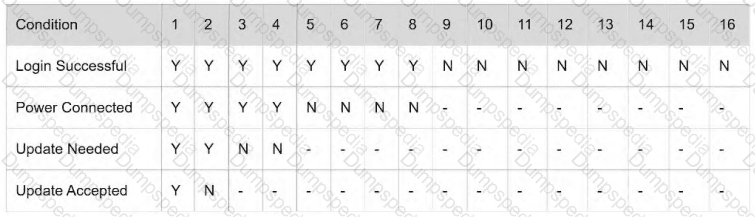
You have been given the following partially minimized decision table. What further minimization is required?
You are designing test cases based on this use case:
Use case: logging in to the online banking system
1. The user opens the banking application.
2. The system displays the login page.
3. The user enters their username and password.
4. The user clicks the “Login” button.
5. The system verifies the username and password in the database.
6. The system starts the multi-factor authentication (MFA) procedure.
7. The user undergoes MFA verification.
8. The system logs the user in and redirects them to the welcome screen.
Alternative flows:
3A: The user clicks the “Forgot Password” button. The system sends an e-mail containing a link to reset the password and returns to step 2.
5A: Incorrect password. The system displays the message “Incorrect password”, and, after the user closes the message window, returns to step 3.
Exceptions:
2A: The system is unavailable because of maintenance work. The system displays the message “Maintenance work in progress; try later” and the login process ends.
7A: MFA verification error. The system displays the message “MFA verification failed” and the login process ends.
The test strategy requires coverage of the main scenario, alternative flows, and exceptions for each use case. The strategy permits testing multiple alternative flows in one test case. Each exception must be tested in a separate test case, although a test case can contain alternative flows.
What is the MINIMUM number of test cases that achieves this coverage?
A pricing system for determining the postage cost of a company’s letters examines two input variables, representing the length (L) of the envelope in centimeters and the weight (W) of the letter in grams. Envelopes can only have three lengths, 15cm (Small), 20cm (Standard) and 25cm (Large).
For standard length envelopes (20 cm), a premium postage rate is applied if the weight is equal or greater than 50 grams. This is represented as:
IF L = 20 AND W > 50 then RETURN Cost ‘Premium rate’
Which set of test points (each represented as variables L, W) achieves 100% SIMPLIFIED domain coverage for the Standard letter postage cost domain?
Which activity involves a test analyst creating the schedule for test execution and preparing the test environments and test data?
The following decision table shows the rules for sending a package. Same day delivery will not be provided for big packages. All combinations of same day delivery and international destination have been removed as they are infeasible.
Id
Conditions
1
2
3
4
5
6
7
8
9
10
11
12
Infeasible
C1
Size, Small / Average / Big
S
S
S
S
A
A
A
A
B
B
B
B
-
C2
High value. Yes / No
y
y
n
n
y
y
n
n
y
y
n
n
-
C3
Same Day wanted. Yes / No
Y
N
Y
N
Y
N
Y
N
N/A
N/A
N/A
N/A
Y
C4
International, Yes / No
N
N
N
N
N
N
N
N
N
N
N
N
Y
Actions
A1
Charge Extra %
0
0
0
0
10
10
10
10
20
20
20
20
A2
Provide insurance
X
X
X
X
X
X
X
X
A3
Deliver Same Day
X
X
X
X
How many columns will the table have after all possible minimization has been performed?
What is the typical relationship between high-level test cases and low-level test cases?
In your role as a Test Analyst for the development of a business application, you asked the Product Owner to help you understand how the various product risks would affect the users.
Which product risk management activity was this?
You are defining test environment requirements for an online retail application that will have to handle high transaction volumes and uses a third-party payment authorization gateway.
Which requirement is MOST important for the functional testing?
You are using a lightweight test charter form to describe a testing session for testing an ATM application. What information is missing from the following charter statement:
" Explore the account balance functionality to discover if the data is accurate "
You are testing an e-commerce website. There have been issues with the shopping cart displaying the wrong number of items. You want to expand the tests to include varying numbers of items in the cart and checking the cart total. The metamorphic relationship is that the number of items selected should match the number of items in the cart.
Which of the following is the input for the test case?
You are working on a project to build a purchasing system. The main requirements for the system are that it shall:
1. Allow users to enter details of items that they wish to have purchased and, from these details, create a purchase request.
2. Take each purchase request through a workflow that will allow the requestor’s line manager to approve the request, reject it or return it for clarification / modification.
3. Forward approved requests to the Purchasing Department.
4. Allow purchasers to find the best available supplier for each approved request and place the request on that supplier as a purchase order.
The solution is being developed according to the company’s traditional V-model methodology. The requirements are clearly documented and include a business process model.
System testing has finished and the test manager has asked you, the senior TA, to identify any parts of the product that should be focused on during acceptance testing. The results of this may be used to adjust the acceptance test plan.
You are using defect cluster analysis, only counting defects with severity levels 1 to 3, ignoring low severity levels 4 and 5. Function point analysis was used for estimating, so you have used function points as the unit of size for the various functional areas of the product. No numeric estimates of expected defect quantities were made for them individually but, as a result of product risk analysis, these functional areas have been ranked according to the amount of product risk that was predicted in them, with risk ranking 1 being the highest and 5 the lowest; the thoroughness of the testing performed so far has been proportional to that. The results are presented in the table below.
Functional area
Total function points
Product risk ranking
Defects found
Purchase Request entry
2000
2
30
Purchase Request workflow
1500
4
15
Purchase Request authorisation
1000
5
25
Supplier identification
2000
1
30
Purchase Order creation
1000
3
30
Which functional areas would you recommend for more test focus in acceptance testing?
a) Purchase Request entry
b) Purchase Request workflow
c) Purchase Request authorization
d) Supplier Identification
e) Purchase Order creation
Your company, which specializes in medical software, has designed an application for use on smartphones and tablets, that calculates a person’s BMI (Body Mass Index). How can a test analyst BEST contribute to adaptability testing for this application?
You have been working on minimizing a decision table. The full (unminimized) table had a checksum of 16. When you add up the checksum for your minimized table, you get 14 instead. What is the problem?
You are conducting a system test of an airline’s flight reservation system and have written a series of test conditions to address the following requirement specification:
• RS-BK14 - Upon successful processing of payment for a new flight booking, the system shall complete the process by displaying a message notifying the customer that the booking reservation has been applied, appended by the booking reference number and, where applicable, the pre-paid seat numbers.
Which test condition is an example of functional appropriateness testing for this requirement?
In a sequential (V-model) software development lifecycle, at what point does test design and implementation take place?
You have been assigned as Test Analyst on a project that is in the test design stage. Test cases have been written, which activity should you do next before test design is complete?
During a sprint retrospective it was noted that some test cases were interpreted differently between the Product Owner and the Test Analysts. Which test case quality criteria may need some attention?
Your organization is implementing a food-ordering application that is intended to have an intuitive user interface (easy navigation and fast search) and to offer functions such as:
personalization of the order (the ability to modify ingredients and add comments for the restaurant)
verification of order correctness before it is sent
real-time order tracking
viewing order history
Management has decided to test the requirements listed above with a checklist and has asked you to prepare one. Consider the following four checklists.
Checklist 1 -
[ ] Does the system reject an order with an incorrect zip code?
[ ] Does the system reject an order with an unfilled mandatory field?
Checklist 2 -
The interface allows the user to easily navigate the application (YES / NO / PARTIALLY)
The search function allows the user to quickly search for restaurants (YES / NO / PARTIALLY)
Checklist 3 -
[ ] Is the time from order placement to order confirmation less than 10s?
[ ] Is the user interface free of grammatical errors?
Checklist 4 -
The application works properly on the Android operating system (YES / NO)
The application works properly on the iOS operating system (YES / NO)
Which of the following is an example of a read-do checklist that is useful for testing the application described in the scenario?
You are developing test cases for an application which performs complex calculations and have decided to model these calculations on a spreadsheet, to determine expected results from inputs.
Which solution to the test oracle problem BEST describes the approach you are using?
You are working with an experienced team of testers. Each tester is familiar with the domain and has spent many years performing checklist-based testing. You want each tester to build their own checklist. What type of checklist should each of them be developing?
Which of the following is NOT an example of a test-data requirement for an online food-ordering application?
A system accepts two natural-number inputs, T1 and T2, representing successive temperature readings. Temperature is recorded in whole degrees Celsius. It returns temperature-change information using this logic:
IF T1 = T2, return the message “Temperature has not changed.”
IF T1 ≠ T2, return the message “Temperature has changed.”
You apply domain-based testing to verify that the preceding requirement is implemented correctly, following the SIMPLIFIED coverage technique.
Which set of test points, interpreted as temperature pairs (T1, T2), provides 100% of this coverage?
As an experienced Test Analyst, you have been asked to collaborate in usability test sessions for a new shopping cart application. In which way would you BEST contribute to this activity?
You are testing a beverage vending machine. The beverage costs $1. The machine accepts 25c, 50c, and $1 coins. When the total value of inserted coins is equal to or greater than the beverage price, the system dispenses the beverage and returns any change. However, if it cannot dispense change because it lacks coins, or if the user presses Cancel, the system does not dispense the beverage and returns the inserted coins.
You use a keyword-based approach and have the following keywords available.
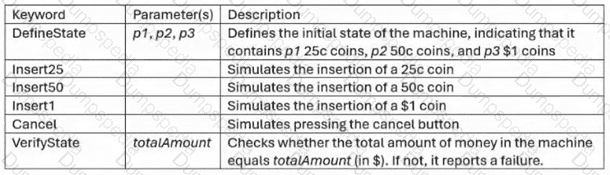
Consider this keyword-based test script used to execute a particular test scenario.
DefineState(1,1,1)
Insert25
Cancel
Insert50
Insert50
Which keyword should end this test script?
Which of the following demonstrates the test analyst’s contribution to interoperability testing?
You intend to test a computer game across several configurations. A configuration includes:
operating system (2 possible values: Windows 10, Windows 11)
browser (3 possible values: Edge, Chrome, Firefox)
RAM type (3 possible values: 16 GB, 32 GB, 64 GB)
You apply pairwise testing. So far, you have designed these test cases:
TC1: Windows 10, Edge, 64 GB -
TC2: Windows 11, Chrome, 32 GB -
TC3: Windows 10, Firefox, 64 GB -
TC4: Windows 10, Firefox, 16 GB -
TC5: Windows 11, Chrome, 64 GB -
TC6: Windows 11, Edge, 32 GB -
What is the MINIMUM number of test cases that must be added to the existing six test cases so that the resulting test set attains 100% pairwise coverage?
You are testing a loan-assignment system. You have been given the following decision table to analyze; each condition can take only the value Y (yes, the condition holds) or N (no, the condition does not hold).
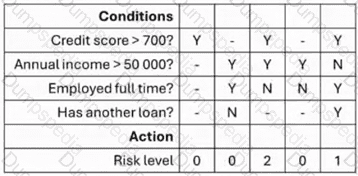
What inference can be made from this decision table?
Your project is developing an application to generate quotes for motor insurance. The calculation requires a wide range of input data and a reliable model of it has been built in a spreadsheet. There will not be enough time to get adequate functional correctness coverage from the base choice or pairwise techniques, so you have decided to do some random testing based on a probability distribution of variable values that is weighted towards their business criticality.
Which limitation of random testing should you be MOST concerned about?
A Customer Relationship Management (CRM) system will be developed for a company that runs a chain of hotels. These are some of the requirements relating to staff in the call center.
• R1. High. An operator shall be able to find and see the details of a customer’s booking. The data that may be used for the search include customer name, customer registration number (in the company’s loyalty enrolment scheme) and booking reference.
• R2. High. An operator shall be able to amend a customer’s booking. The data that may be amended include check-in and check-out dates, hotel, room type and tariff (with / without breakfast).
• R3. High. Before a booking amendment is accepted, the system shall display to the operator any difference in price with respect to the original booking. The operator shall confirm that the customer accepts the revised price and then the system shall record the accepted amendment.
• R4. Medium. Details of the amended booking shall be sent to the customer (see requirements for original customer booking for details).
• R5. High. Details of the extra amount payable shall be sent to the billing system for customer invoicing (see requirements for invoicing of the original customer booking for details).
You have been asked to review these requirements using this checklist:
1. Specific - does each requirement deal with only a single aspect of the solution?
2. Clear - is each requirement expressed in an unambiguous way with no possibility of interpretation or uncertainty about its meaning?
3. Complete - does the set of requirements cover all of the stakeholders’ reasonable needs?
4. Unique - does each requirement address something that no other requirement also covers?
Assume that the other requirements referred to by R4 and R5 have been reviewed with a satisfactory outcome. Considering these five requirements, to which checklist items would you answer ‘No’?
You are designing test cases from the following state-transition diagram.
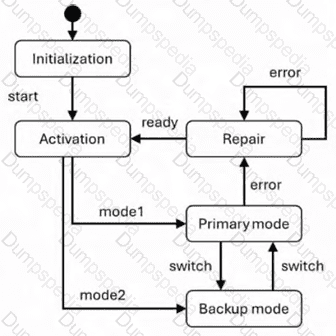
So far, the only test case designed is:
TC1: start, mode1, error, error, ready, mode1, switch, switch, switch, switch.
You use the ROUND-TRIP coverage approach. What round-trip coverage is achieved by this test case?
You are developing a project management system with three object types: projects, tasks, and users. You are conducting a CRUD matrix analysis to identify potential specification defects.
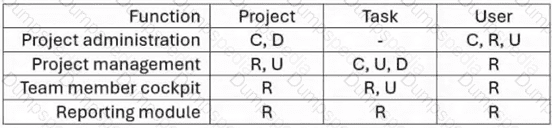
Which anomaly can be identified from analysis of the CRUD matrix above?

TESTED 29 Nov 2026