Summer Sale - Limited Time 65% Discount Offer - Ends in 0d 00h 00m 00s - Coupon code: 65percent

Welcome To DumpsPedia

Databricks-Certified-Professional-Data-Engineer Sample Questions Answers

Questions 4

A data engineering team is migrating off its legacy Hadoop platform. As part of the process, they are evaluating storage formats for performance comparison. The legacy platform uses ORC and RCFile formats. After converting a subset of data to Delta Lake , they noticed significantly better query performance. Upon investigation, they discovered that queries reading from Delta tables leveraged a Shuffle Hash Join , whereas queries on legacy formats used Sort Merge Joins . The queries reading Delta Lake data also scanned less data.

Which reason could be attributed to the difference in query performance?

Options:

A.

Delta Lake enables data skipping and file pruning using a vectorized Parquet reader.

B.

The queries against the Delta Lake tables were able to leverage the dynamic file pruning optimization.

C.

Shuffle Hash Joins are always more efficient than Sort Merge Joins.

D.

The queries against the ORC tables leveraged the dynamic data skipping optimization but not the dynamic file pruning optimization.

Buy Now
Questions 5

Although the Databricks Utilities Secrets module provides tools to store sensitive credentials and avoid accidentally displaying them in plain text users should still be careful with which credentials are stored here and which users have access to using these secrets.

Which statement describes a limitation of Databricks Secrets?

Options:

A.

Because the SHA256 hash is used to obfuscate stored secrets, reversing this hash will display the value in plain text.

B.

Account administrators can see all secrets in plain text by logging on to the Databricks Accounts console.

C.

Secrets are stored in an administrators-only table within the Hive Metastore; database administrators have permission to query this table by default.

D.

Iterating through a stored secret and printing each character will display secret contents in plain text.

E.

The Databricks REST API can be used to list secrets in plain text if the personal access token has proper credentials.

Buy Now
Questions 6

When evaluating the Ganglia Metrics for a given cluster with 3 executor nodes, which indicator would signal proper utilization of the VM ' s resources?

Options:

A.

The five Minute Load Average remains consistent/flat

B.

Bytes Received never exceeds 80 million bytes per second

C.

Network I/O never spikes

D.

Total Disk Space remains constant

E.

CPU Utilization is around 75%

Buy Now
Questions 7

A junior data engineer has been asked to develop a streaming data pipeline with a grouped aggregation using DataFrame df. The pipeline needs to calculate the average humidity and average temperature for each non-overlapping five-minute interval. Events are recorded once per minute per device.

df has the following schema: device_id INT, event_time TIMESTAMP, temp FLOAT, humidity FLOAT

Code block:

df.withWatermark( " event_time " , " 10 minutes " )

.groupBy(

________,

" device_id "

)

.agg(

avg( " temp " ).alias( " avg_temp " ),

avg( " humidity " ).alias( " avg_humidity " )

)

.writeStream

.format( " delta " )

.saveAsTable( " sensor_avg " )

Which line of code correctly fills in the blank within the code block to complete this task?

Options:

A.

window( " event_time " , " 5 minutes " ).alias( " time " )

B.

to_interval( " event_time " , " 5 minutes " ).alias( " time " )

C.

" event_time "

D.

lag( " event_time " , " 5 minutes " ).alias( " time " )

Buy Now
Questions 8

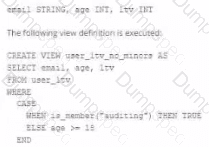
A table named user_ltv is being used to create a view that will be used by data analysis on various teams. Users in the workspace are configured into groups, which are used for setting up data access using ACLs.

The user_ltv table has the following schema:
8

An analyze who is not a member of the auditing group executing the following query:

8

Which result will be returned by this query?

Options:

A.

All columns will be displayed normally for those records that have an age greater than 18; records not meeting this condition will be omitted.

B.

All columns will be displayed normally for those records that have an age greater than 17; records not meeting this condition will be omitted.

C.

All age values less than 18 will be returned as null values all other columns will be returned with the values in user_ltv.

D.

All records from all columns will be displayed with the values in user_ltv.

Buy Now
Questions 9

A member of the data engineering team has submitted a short notebook that they wish to schedule as part of a larger data pipeline. Assume that the commands provided below produce the logically correct results when run as presented.

9

Which command should be removed from the notebook before scheduling it as a job?

Options:

A.

Cmd 2

B.

Cmd 3

C.

Cmd 4

D.

Cmd 5

E.

Cmd 6

Buy Now
Questions 10

An upstream system is emitting change data capture (CDC) logs that are being written to a cloud object storage directory. Each record in the log indicates the change type (insert, update, or delete) and the values for each field after the change. The source table has a primary key identified by the field pk_id .

For auditing purposes, the data governance team wishes to maintain a full record of all values that have ever been valid in the source system. For analytical purposes, only the most recent value for each record needs to be recorded. The Databricks job to ingest these records occurs once per hour, but each individual record may have changed multiple times over the course of an hour.

Which solution meets these requirements?

Options:

A.

Create a separate history table for each pk_id resolve the current state of the table by running a union all filtering the history tables for the most recent state.

B.

Use merge into to insert, update, or delete the most recent entry for each pk_id into a bronze table, then propagate all changes throughout the system.

C.

Iterate through an ordered set of changes to the table, applying each in turn; rely on Delta Lake ' s versioning ability to create an audit log.

D.

Use Delta Lake ' s change data feed to automatically process CDC data from an external system, propagating all changes to all dependent tables in the Lakehouse.

E.

Ingest all log information into a bronze table; use merge into to insert, update, or delete the most recent entry for each pk_id into a silver table to recreate the current table state.

Buy Now
Questions 11

A data engineer manages a production Lakeflow Declarative Pipeline that processes customer transaction data. The pipeline includes several data quality expectations such as transaction_amount > 0 and customer_id IS NOT NULL. These expectations are defined using the EXPECT clause in SQL.

The engineer aims to monitor the pipeline’s data quality by analyzing the number of records that passed or failed each expectation during the latest pipeline update. The Lakeflow Declarative Pipelines event logs are stored in a Delta table named event_log_table.

For the most recent pipeline update, determine a programmatically appropriate approach to extract information like the name of each expectation, associated dataset, count of records that passed the expectation, and count of records that failed the expectation.

Which method retrieves the desired data quality metrics from the Lakeflow Declarative Pipelines event log?

Options:

A.

Access the event_log_table, filter for events where event_type = ' flow_progress ' , and parse details.flow_progress.data_quality.expectations field to extract the required metrics.

B.

Use the Lakeflow Declarative Pipelines UI to navigate to the specific pipeline, select the dataset, and view the Data Quality tab to manually retrieve the expectation metrics.

C.

Query the event_log_table for events with event_type = ' data_quality ' and directly select the passed_records and failed_records fields.

D.

Access the event_log_table, filter for events where event_type = ' expectation_result ' , and extract the expectation metrics from the details field.

Buy Now
Questions 12

Which statement regarding stream-static joins and static Delta tables is correct?

Options:

A.

Each microbatch of a stream-static join will use the most recent version of the static Delta table as of each microbatch.

B.

Each microbatch of a stream-static join will use the most recent version of the static Delta table as of the job ' s initialization.

C.

The checkpoint directory will be used to track state information for the unique keys present in the join.

D.

Stream-static joins cannot use static Delta tables because of consistency issues.

E.

The checkpoint directory will be used to track updates to the static Delta table.

Buy Now
Questions 13

A data engineer has created a new cluster using shared access mode with default configurations. The data engineer needs to allow the development team access to view the driver logs if needed.

What are the minimal cluster permissions that allow the development team to accomplish this?

Options:

A.

CAN ATTACH TO

B.

CAN MANAGE

C.

CAN VIEW

D.

CAN RESTART

Buy Now
Questions 14

A data engineering team is configuring access controls in Databricks Unity Catalog . They grant the SELECT privilege on the sales catalog to the analyst_group, expecting that members of this group will automatically have SELECT access to all current and future schemas, tables, and views within the catalog.

What describes the privilege inheritance behavior in Unity Catalog?

Options:

A.

Granting SELECT at the catalog level applies to existing schemas and tables but not to those created in the future.

B.

Privileges in Unity Catalog do not cascade; SELECT must be explicitly granted on each schema and table, even if granted at the catalog level.

C.

Privileges granted at the schema level override any catalog-level privileges and prevent access unless explicitly revoked.

D.

Granting SELECT on a catalog automatically applies SELECT to all current and future schemas, tables, and views within that catalog.

Buy Now
Questions 15

Given the following error traceback:

AnalysisException: cannot resolve ' heartrateheartrateheartrate ' given input columns:

[spark_catalog.database.table.device_id, spark_catalog.database.table.heartrate,

spark_catalog.database.table.mrn, spark_catalog.database.table.time]

The code snippet was:

display(df.select(3* " heartrate " ))

Which statement describes the error being raised?

Options:

A.

There is a type error because a DataFrame object cannot be multiplied.

B.

There is a syntax error because the heartrate column is not correctly identified as a column.

C.

There is no column in the table named heartrateheartrateheartrate.

D.

There is a type error because a column object cannot be multiplied.

Buy Now
Questions 16

Incorporating unit tests into a PySpark application requires upfront attention to the design of your jobs, or a potentially significant refactoring of existing code.

Which statement describes a main benefit that offset this additional effort?

Options:

A.

Improves the quality of your data

B.

Validates a complete use case of your application

C.

Troubleshooting is easier since all steps are isolated and tested individually

D.

Yields faster deployment and execution times

E.

Ensures that all steps interact correctly to achieve the desired end result

Buy Now
Questions 17

Which is a key benefit of an end-to-end test?

Options:

A.

It closely simulates real world usage of your application.

B.

It pinpoint errors in the building blocks of your application.

C.

It provides testing coverage for all code paths and branches.

D.

It makes it easier to automate your test suite

Buy Now
Questions 18

A Data Engineer is building a simple data pipeline using Lakeflow Declarative Pipelines (LDP) in Databricks to ingest customer data. The raw customer data is stored in a cloud storage location in JSON format. The task is to create Lakeflow Declarative Pipelines that read the raw JSON data and write it into a Delta table for further processing.

Which code snippet will correctly ingest the raw JSON data and create a Delta table using LDP?

Options:

A.

import dlt

@dlt.table

def raw_customers():

return spark.read.format( " csv " ).load( " s3://my-bucket/raw-customers/ " )

B.

import dlt

@dlt.table

def raw_customers():

return spark.read.json( " s3://my-bucket/raw-customers/ " )

C.

import dlt

@dlt.table

def raw_customers():

return spark.read.format( " parquet " ).load( " s3://my-bucket/raw-customers/ " )

D.

import dlt

@dlt.view

def raw_customers():

return spark.format.json( " s3://my-bucket/raw-customers/ " )

Buy Now
Questions 19

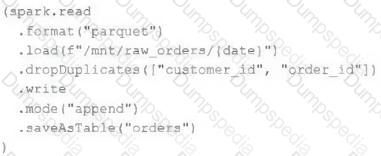
An upstream source writes Parquet data as hourly batches to directories named with the current date. A nightly batch job runs the following code to ingest all data from the previous day as indicated by the date variable:
19

Assume that the fields customer_id and order_id serve as a composite key to uniquely identify each order.

If the upstream system is known to occasionally produce duplicate entries for a single order hours apart, which statement is correct?

Options:

A.

Each write to the orders table will only contain unique records, and only those records without duplicates in the target table will be written.

B.

Each write to the orders table will only contain unique records, but newly written records may have duplicates already present in the target table.

C.

Each write to the orders table will only contain unique records; if existing records with the same key are present in the target table, these records will be overwritten.

D.

Each write to the orders table will only contain unique records; if existing records with the same key are present in the target table, the operation will tail.

E.

Each write to the orders table will run deduplication over the union of new and existing records, ensuring no duplicate records are present.

Buy Now
Questions 20

A data engineer is testing a collection of mathematical functions, one of which calculates the area under a curve as described by another function.

Which kind of the test does the above line exemplify?

Options:

A.

Integration

B.

Unit

C.

Manual

D.

functional

Buy Now
Questions 21

A data governance team at a large enterprise is improving data discoverability across its organization. The team has hundreds of tables in their Databricks Lakehouse with thousands of columns that lack proper documentation. Many of these tables were created by different teams over several years, with missing context about column meanings and business logic. The data governance team needs to quickly generate comprehensive column descriptions for all existing tables to meet compliance requirements and improve data literacy across the organization. They want to leverage modern capabilities to automatically generate meaningful descriptions rather than manually documenting each column, which would take months to complete.

Which approach should the team use in Databricks to automatically generate column comments and descriptions for existing tables?

Options:

A.

Navigate to the table in Databricks Catalog Explorer, select the table schema view, and use the AI Generate option which leverages artificial intelligence to automatically create meaningful column descriptions based on column names, data types, sample values, and data patterns.

B.

Use Delta Lake’s DESCRIBE HISTORY command to analyze table evolution and infer column purposes from historical changes.

C.

Use the DESCRIBE TABLE command to extract existing schema information and manually write descriptions based on column names and data types.

D.

Write custom PySpark code using df.describe() and df.schema to programmatically generate basic statistical descriptions for each column.

Buy Now
Questions 22

A data engineer, while designing a Pandas UDF to process financial time-series data with complex calculations that require maintaining state across rows within each stock symbol group, must ensure the function is efficient and scalable.

Which approach will solve the problem with minimum overhead while preserving data integrity?

Options:

A.

Use a SCALAR_ITER Pandas UDF with iterator-based processing, implementing state management through persistent storage (Delta tables) that gets updated after each batch to maintain continuity across iterator chunks.

B.

Use a SCALAR Pandas UDF that processes the entire dataset at once, implementing custom partitioning logic within the UDF to group by stock symbol and maintain state using global variables shared across all executor processes.

C.

Use applyInPandas() on a Spark DataFrame that receives all rows for each stock symbol as a Pandas DataFrame, allowing processing within each group while maintaining state variables local to each group’s processing function.

D.

Use a grouped_agg Pandas UDF that processes each stock symbol group independently, maintaining state through intermediate aggregation results that get passed between successive UDF calls via broadcast variables.

Buy Now
Questions 23

A Spark job is taking longer than expected. Using the Spark UI, a data engineer notes that the Min, Median, and Max Durations for tasks in a particular stage show the minimum and median time to complete a task as roughly the same, but the max duration for a task to be roughly 100 times as long as the minimum.

Which situation is causing increased duration of the overall job?

Options:

A.

Task queueing resulting from improper thread pool assignment.

B.

Spill resulting from attached volume storage being too small.

C.

Network latency due to some cluster nodes being in different regions from the source data

D.

Skew caused by more data being assigned to a subset of spark-partitions.

E.

Credential validation errors while pulling data from an external system.

Buy Now
Questions 24

Each configuration below is identical to the extent that each cluster has 400 GB total of RAM, 160 total cores and only one Executor per VM.

Given a job with at least one wide transformation, which of the following cluster configurations will result in maximum performance?

Options:

A.

• Total VMs; 1

• 400 GB per Executor

• 160 Cores / Executor

B.

• Total VMs: 8

• 50 GB per Executor

• 20 Cores / Executor

C.

• Total VMs: 4

• 100 GB per Executor

• 40 Cores/Executor

D.

• Total VMs:2

• 200 GB per Executor

• 80 Cores / Executor

Buy Now
Questions 25

A new data engineer notices that a critical field was omitted from an application that writes its Kafka source to Delta Lake. This happened even though the critical field was in the Kafka source. That field was further missing from data written to dependent, long-term storage. The retention threshold on the Kafka service is seven days. The pipeline has been in production for three months.

Which describes how Delta Lake can help to avoid data loss of this nature in the future?

Options:

A.

The Delta log and Structured Streaming checkpoints record the full history of the Kafka producer.

B.

Delta Lake schema evolution can retroactively calculate the correct value for newly added fields, as long as the data was in the original source.

C.

Delta Lake automatically checks that all fields present in the source data are included in the ingestion layer.

D.

Data can never be permanently dropped or deleted from Delta Lake, so data loss is not possible under any circumstance.

E.

Ingestine all raw data and metadata from Kafka to a bronze Delta table creates a permanent, replayable history of the data state.

Buy Now
Questions 26

Assuming that the Databricks CLI has been installed and configured correctly, which Databricks CLI command can be used to upload a custom Python Wheel to object storage mounted with the DBFS for use with a production job?

Options:

A.

configure

B.

fs

C.

jobs

D.

libraries

E.

workspace

Buy Now
Questions 27

A data engineer is building a Lakeflow Declarative Pipelines pipeline to process healthcare claims data. A metadata JSON file defines data quality rules for multiple tables, including:

{

" claims " : [

{ " name " : " valid_patient_id " , " constraint " : " patient_id IS NOT NULL " },

{ " name " : " non_negative_amount " , " constraint " : " claim_amount > = 0 " }

]

}

The pipeline must dynamically apply these rules to the claims table without hardcoding the rules.

How should the data engineer achieve this?

Options:

A.

Load the JSON metadata, loop through its entries, and apply expectations using dlt.expect_all.

B.

Invoke an external API to validate records against the metadata rules.

C.

Reference each expectation with @dlt.expect decorators in the table declaration.

D.

Use a SQL CONSTRAINT block referencing the JSON file path.

Buy Now
Questions 28

A data engineer is configuring a pipeline that will potentially see late-arriving, duplicate records.

In addition to de-duplicating records within the batch, which of the following approaches allows the data engineer to deduplicate data against previously processed records as it is inserted into a Delta table?

Options:

A.

Set the configuration delta.deduplicate = true.

B.

VACUUM the Delta table after each batch completes.

C.

Perform an insert-only merge with a matching condition on a unique key.

D.

Perform a full outer join on a unique key and overwrite existing data.

E.

Rely on Delta Lake schema enforcement to prevent duplicate records.

Buy Now
Questions 29

A data engineer is masking a column containing email addresses. The goal is to produce output strings of identical length for all rows, while generating different outputs for different email values .

Which SQL function should be used to achieve this?

Options:

A.

mask(email, ' ? ' )

B.

hash(email)

C.

sha1(email)

D.

sha2(email, 0)

Buy Now
Questions 30

While reviewing a query ' s execution in the Databricks Query Profiler, a data engineer observes that the Top Operators panel shows a Sort operator with high Time Spent and Memory Peak metrics. The Spark UI also reports frequent data spilling .

How should the data engineer address this issue?

Options:

A.

Switch to a broadcast join to reduce memory usage.

B.

Repartition the DataFrame to a single partition before sorting.

C.

Convert the sort operation to a filter operation.

D.

Increase the number of shuffle partitions to better distribute data.

Buy Now
Questions 31

The data architect has decided that once data has been ingested from external sources into the

Databricks Lakehouse, table access controls will be leveraged to manage permissions for all production tables and views.

The following logic was executed to grant privileges for interactive queries on a production database to the core engineering group.

GRANT USAGE ON DATABASE prod TO eng;

GRANT SELECT ON DATABASE prod TO eng;

Assuming these are the only privileges that have been granted to the eng group and that these users are not workspace administrators, which statement describes their privileges?

Options:

A.

Group members have full permissions on the prod database and can also assign permissions to other users or groups.

B.

Group members are able to list all tables in the prod database but are not able to see the results of any queries on those tables.

C.

Group members are able to query and modify all tables and views in the prod database, but cannot create new tables or views.

D.

Group members are able to query all tables and views in the prod database, but cannot create or edit anything in the database.

E.

Group members are able to create, query, and modify all tables and views in the prod database, but cannot define custom functions.

Buy Now
Questions 32

The business reporting team requires that data for their dashboards be updated every hour. The total processing time for the pipeline that extracts, transforms, and loads the data for their pipeline runs in 10 minutes. Assuming normal operating conditions, which configuration will meet their service-level agreement requirements with the lowest cost?

Options:

A.

Schedule a job to execute the pipeline once an hour on a dedicated interactive cluster.

B.

Schedule a job to execute the pipeline once an hour on a new job cluster.

C.

Schedule a Structured Streaming job with a trigger interval of 60 minutes.

D.

Configure a job that executes every time new data lands in a given directory.

Buy Now
Questions 33

Given the following error traceback (from display(df.select(3* " heartrate " ))) which shows AnalysisException: cannot resolve ' heartrateheartrateheartrate ' , which statement describes the error being raised?

Options:

A.

There is a type error because a DataFrame object cannot be multiplied.

B.

There is a syntax error because the heartrate column is not correctly identified as a column.

C.

There is no column in the table named heartrateheartrateheartrate.

D.

There is a type error because a column object cannot be multiplied.

Buy Now
Questions 34

A query is taking too long to run. After investigating the Spark UI, the data engineer discovered a significant amount of disk spill . The compute instance being used has a core-to-memory ratio of 1:2.

What are the two steps the data engineer should take to minimize spillage? (Choose 2 answers)

Options:

A.

Choose a compute instance with a higher core-to-memory ratio.

B.

Choose a compute instance with more disk space.

C.

Increase spark.sql.files.maxPartitionBytes.

D.

Reduce spark.sql.files.maxPartitionBytes.

E.

Choose a compute instance with more network bandwidth.

Buy Now
Questions 35

The data science team has requested assistance in accelerating queries on free form text from user reviews. The data is currently stored in Parquet with the below schema:

item_id INT, user_id INT, review_id INT, rating FLOAT, review STRING

The review column contains the full text of the review left by the user. Specifically, the data science team is looking to identify if any of 30 key words exist in this field.

A junior data engineer suggests converting this data to Delta Lake will improve query performance.

Which response to the junior data engineer s suggestion is correct?

Options:

A.

Delta Lake statistics are not optimized for free text fields with high cardinality.

B.

Text data cannot be stored with Delta Lake.

C.

ZORDER ON review will need to be run to see performance gains.

D.

The Delta log creates a term matrix for free text fields to support selective filtering.

E.

Delta Lake statistics are only collected on the first 4 columns in a table.

Buy Now
Questions 36

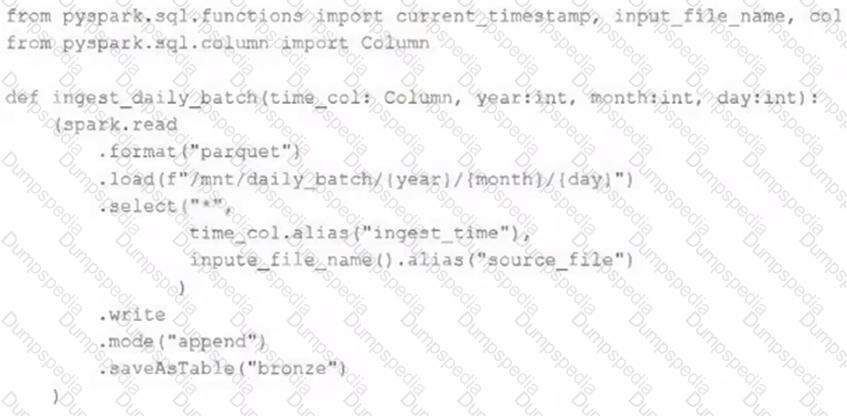
A nightly job ingests data into a Delta Lake table using the following code:
36

The next step in the pipeline requires a function that returns an object that can be used to manipulate new records that have not yet been processed to the next table in the pipeline.

Which code snippet completes this function definition?

def new_records():

Options:

A.

return spark.readStream.table( " bronze " )

B.

return spark.readStream.load( " bronze " )

C.

36

D.

return spark.read.option( " readChangeFeed " , " true " ).table ( " bronze " )

E.

36

Buy Now
Questions 37

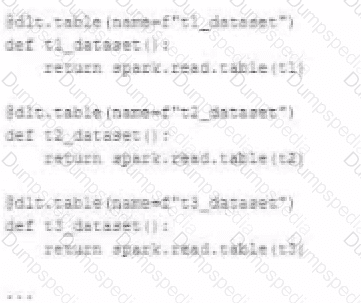
A data engineer wants to reflector the following DLT code, which includes multiple definition with very similar code:
37

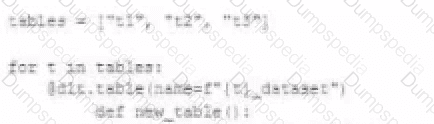
In an attempt to programmatically create these tables using a parameterized table definition, the data engineer writes the following code.
37

The pipeline runs an update with this refactored code, but generates a different DAG showing incorrect configuration values for tables.

How can the data engineer fix this?

Options:

A.

Convert the list of configuration values to a dictionary of table settings, using table names as keys.

B.

Convert the list of configuration values to a dictionary of table settings, using different input the for loop.

C.

Load the configuration values for these tables from a separate file, located at a path provided by a pipeline parameter.

D.

Wrap the loop inside another table definition, using generalized names and properties to replace with those from the inner table

Buy Now
Questions 38

The data engineer is using Spark ' s MEMORY_ONLY storage level.

Which indicators should the data engineer look for in the spark UI ' s Storage tab to signal that a cached table is not performing optimally?

Options:

A.

Size on Disk is > 0

B.

The number of Cached Partitions > the number of Spark Partitions

C.

The RDD Block Name included the ' ' annotation signaling failure to cache

D.

On Heap Memory Usage is within 75% of off Heap Memory usage

Buy Now
Questions 39

A data engineer has created a transactions Delta table on Databricks that should be used by the analytics team. The analytics team wants to use the table with another tool that requires Apache Iceberg format.

What should the data engineer do?

Options:

A.

Require the analytics team to use a tool that supports Delta table.

B.

Enable uniform on the transactions table to ' iceberg ' so that the table can be read as an Iceberg table.

C.

Create an Iceberg copy of the transactions Delta table which can be used by the analytics team.

D.

Convert the transactions Delta table to Iceberg and enable uniform so that the table can be read as a Delta table.

Buy Now
Questions 40

Which method can be used to determine the total wall-clock time it took to execute a query?

Options:

A.

In the Spark UI, take the job duration of the longest-running job associated with that query.

B.

In the Spark UI, take the sum of all task durations that ran across all stages for all jobs associated with that query.

C.

Open the Query Profiler associated with that query and use the Total wall-clock duration metric.

D.

Open the Query Profiler associated with that query and use the Aggregated task time metric.

Buy Now
Questions 41

The business reporting tem requires that data for their dashboards be updated every hour. The total processing time for the pipeline that extracts transforms and load the data for their pipeline runs in 10 minutes.

Assuming normal operating conditions, which configuration will meet their service-level agreement requirements with the lowest cost?

Options:

A.

Schedule a jo to execute the pipeline once and hour on a dedicated interactive cluster.

B.

Schedule a Structured Streaming job with a trigger interval of 60 minutes.

C.

Schedule a job to execute the pipeline once hour on a new job cluster.

D.

Configure a job that executes every time new data lands in a given directory.

Buy Now
Questions 42

A Data engineer wants to run unit’s tests using common Python testing frameworks on python functions defined across several Databricks notebooks currently used in production.

How can the data engineer run unit tests against function that work with data in production?

Options:

A.

Run unit tests against non-production data that closely mirrors production

B.

Define and unit test functions using Files in Repos

C.

Define units test and functions within the same notebook

D.

Define and import unit test functions from a separate Databricks notebook

Buy Now
Questions 43

A Databricks job has been configured with 3 tasks, each of which is a Databricks notebook. Task A does not depend on other tasks. Tasks B and C run in parallel, with each having a serial dependency on Task A.

If task A fails during a scheduled run, which statement describes the results of this run?

Options:

A.

Because all tasks are managed as a dependency graph, no changes will be committed to the Lakehouse until all tasks have successfully been completed.

B.

Tasks B and C will attempt to run as configured; any changes made in task A will be rolled back due to task failure.

C.

Unless all tasks complete successfully, no changes will be committed to the Lakehouse; because task A failed, all commits will be rolled back automatically.

D.

Tasks B and C will be skipped; some logic expressed in task A may have been committed before task failure.

E.

Tasks B and C will be skipped; task A will not commit any changes because of stage failure.

Buy Now
Questions 44

Which statement describes the correct use of pyspark.sql.functions.broadcast?

Options:

A.

It marks a column as having low enough cardinality to properly map distinct values to available partitions, allowing a broadcast join.

B.

It marks a column as small enough to store in memory on all executors, allowing a broadcast join.

C.

It caches a copy of the indicated table on attached storage volumes for all active clusters within a Databricks workspace.

D.

It marks a DataFrame as small enough to store in memory on all executors, allowing a broadcast join.

E.

It caches a copy of the indicated table on all nodes in the cluster for use in all future queries during the cluster lifetime.

Buy Now
Questions 45

The DevOps team has configured a production workload as a collection of notebooks scheduled to run daily using the Jobs UI. A new data engineering hire is onboarding to the team and has requested access to one of these notebooks to review the production logic.

What are the maximum notebook permissions that can be granted to the user without allowing accidental changes to production code or data?

Options:

A.

Can Manage

B.

Can Edit

C.

No permissions

D.

Can Read

E.

Can Run

Buy Now
Questions 46

Two data engineers are working on the same Databricks notebook in separate branches. Both have edited the same section of code. When one tries to merge the other’s branch into their own using the Databricks Git folders UI, a merge conflict occurs on that notebook file. The UI highlights the conflict and presents options for resolution.

How should the data engineers resolve this merge conflict using Databricks Git folders?

Options:

A.

Abort the merge, discard all local changes, and try the merge operation again without reviewing the conflicting code.

B.

Delete the conflicted notebook file via the Databricks workspace UI, commit the deletion, and recreate the notebook from scratch in a new commit to bypass the conflict entirely.

C.

Use the Git CLI in the cluster’s web terminal to force-push the conflicted merge (git push -force), overriding the remote branch with the local version and discarding changes.

D.

Use the Git folders UI to manually edit the notebook file, selecting the desired lines from both versions and removing the conflict markers, then mark the conflict as resolved.

Buy Now
Questions 47

A Delta Lake table representing metadata about content posts from users has the following schema:

user_id LONG, post_text STRING, post_id STRING, longitude FLOAT, latitude FLOAT, post_time TIMESTAMP, date DATE

This table is partitioned by the date column. A query is run with the following filter:

longitude < 20 and longitude > -20

Which statement describes how data will be filtered?

Options:

A.

Statistics in the Delta Log will be used to identify partitions that might Include files in the filtered range.

B.

No file skipping will occur because the optimizer does not know the relationship between the partition column and the longitude.

C.

The Delta Engine will use row-level statistics in the transaction log to identify the flies that meet the filter criteria.

D.

Statistics in the Delta Log will be used to identify data files that might include records in the filtered range.

E.

The Delta Engine will scan the parquet file footers to identify each row that meets the filter criteria.

Buy Now
Questions 48

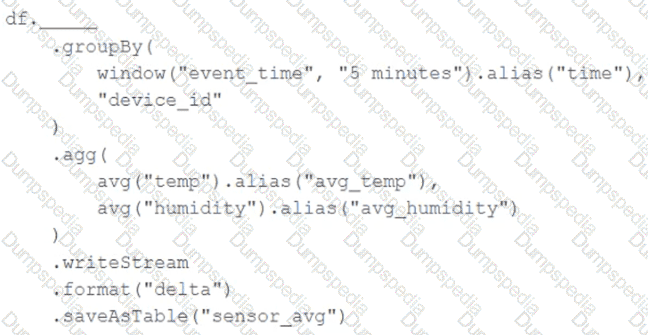
A junior data engineer has been asked to develop a streaming data pipeline with a grouped aggregation using DataFrame df. The pipeline needs to calculate the average humidity and average temperature for each non-overlapping five-minute interval. Incremental state information should be maintained for 10 minutes for late-arriving data.

Streaming DataFrame df has the following schema:

" device_id INT, event_time TIMESTAMP, temp FLOAT, humidity FLOAT "

Code block:
48

Choose the response that correctly fills in the blank within the code block to complete this task.

Options:

A.

withWatermark( " event_time " , " 10 minutes " )

B.

awaitArrival( " event_time " , " 10 minutes " )

C.

await( " event_time + ‘10 minutes ' " )

D.

slidingWindow( " event_time " , " 10 minutes " )

E.

delayWrite( " event_time " , " 10 minutes " )

Buy Now
Questions 49

A Structured Streaming job deployed to production has been resulting in higher than expected cloud storage costs. At present, during normal execution, each micro-batch of data is processed in less than 3 seconds; at least 12 times per minute, a micro-batch is processed that contains 0 records. The streaming write was configured using the default trigger settings. The production job is currently scheduled alongside many other Databricks jobs in a workspace with instance pools provisioned to reduce start-up time for jobs with batch execution. Holding all other variables constant and assuming records need to be processed in less than 10 minutes, which adjustment will meet the requirement?

Options:

A.

Set the trigger interval to 500 milliseconds; setting a small but non-zero trigger interval ensures that the source is not queried too frequently.

B.

Set the trigger interval to 3 seconds; the default trigger interval is consuming too many records per batch, resulting in spill to disk that can increase volume costs.

C.

Set the trigger interval to 10 minutes; each batch calls APIs in the source storage account, so decreasing trigger frequency to the maximum allowable threshold should minimize this cost.

D.

Use the trigger once option and configure a Databricks job to execute the query every 10 minutes; this approach minimizes costs for both compute and storage.

Buy Now
Questions 50

What statement is true regarding the retention of job run history?

Options:

A.

It is retained until you export or delete job run logs

B.

It is retained for 30 days, during which time you can deliver job run logs to DBFS or S3

C.

t is retained for 60 days, during which you can export notebook run results to HTML

D.

It is retained for 60 days, after which logs are archived

E.

It is retained for 90 days or until the run-id is re-used through custom run configuration

Buy Now
Questions 51

A data engineer is designing a Lakeflow Declarative Pipeline to process streaming order data. The pipeline uses Auto Loader to ingest data and must enforce data quality by ensuring customer_id and amount are greater than zero. Invalid records should be dropped.

Which Lakeflow Declarative Pipelines configurations implement this requirement using Python?

Options:

A.

@dlt.table

def silver_orders():

return (

dlt.read_stream( " bronze_orders " )

.expect_or_drop( " valid_customer " , " customer_id IS NOT NULL " )

.expect_or_drop( " valid_amount " , " amount > 0 " )

)

B.

@dlt.table

@dlt.expect( " valid_customer " , " customer_id IS NOT NULL " )

@dlt.expect( " valid_amount " , " amount > 0 " )

def silver_orders():

return dlt.read_stream( " bronze_orders " )

C.

@dlt.table

def silver_orders():

return (

dlt.read_stream( " bronze_orders " )

.expect( " valid_customer " , " customer_id IS NOT NULL " )

.expect( " valid_amount " , " amount > 0 " )

)

D.

@dlt.table

@dlt.expect_or_drop( " valid_customer " , " customer_id IS NOT NULL " )

@dlt.expect_or_drop( " valid_amount " , " amount > 0 " )

def silver_orders():

return dlt.read_stream( " bronze_orders " )

Buy Now
Questions 52

A Delta Lake table representing metadata about content posts from users has the following schema:

    user_id LONG

    post_text STRING

    post_id STRING

    longitude FLOAT

    latitude FLOAT

    post_time TIMESTAMP

    date DATE

Based on the above schema, which column is a good candidate for partitioning the Delta Table?

Options:

A.

date

B.

user_id

C.

post_id

D.

post_time

Buy Now
Questions 53

A user wants to use DLT expectations to validate that a derived table report contains all records from the source, included in the table validation_copy.

The user attempts and fails to accomplish this by adding an expectation to the report table definition.

Which approach would allow using DLT expectations to validate all expected records are present in this table?

Options:

A.

Define a SQL UDF that performs a left outer join on two tables, and check if this returns null values for report key values in a DLT expectation for the report table.

B.

Define a function that performs a left outer join on validation_copy and report and report, and check against the result in a DLT expectation for the report table

C.

Define a temporary table that perform a left outer join on validation_copy and report, and define an expectation that no report key values are null

D.

Define a view that performs a left outer join on validation_copy and report, and reference this view in DLT expectations for the report table

Buy Now
Questions 54

A data engineering team is setting up deployment automation. To deploy workspace assets remotely using the Databricks CLI command, they must configure it with proper authentication.

Which authentication approach will provide the highest level of security ?

Options:

A.

Use a service principal with OAuth token federation.

B.

Use a service principal ID and its OAuth client secret.

C.

Use a service principal and its Personal Access Token.

D.

Use a shared user account and its OAuth client secret.

Buy Now
Questions 55

The data engineer team is configuring environment for development testing, and production before beginning migration on a new data pipeline. The team requires extensive testing on both the code and data resulting from code execution, and the team want to develop and test against similar production data as possible.

A junior data engineer suggests that production data can be mounted to the development testing environments, allowing pre production code to execute against production data. Because all users have

Admin privileges in the development environment, the junior data engineer has offered to configure permissions and mount this data for the team.

Which statement captures best practices for this situation?

Options:

A.

Because access to production data will always be verified using passthrough credentials it is safe to mount data to any Databricks development environment.

B.

All developer, testing and production code and data should exist in a single unified workspace; creating separate environments for testing and development further reduces risks.

C.

In environments where interactive code will be executed, production data should only be accessible with read permissions; creating isolated databases for each environment further reduces risks.

D.

Because delta Lake versions all data and supports time travel, it is not possible for user error or malicious actors to permanently delete production data, as such it is generally safe to mount production data anywhere.

Buy Now
Questions 56

A DLT pipeline includes the following streaming tables:

Raw_lot ingest raw device measurement data from a heart rate tracking device.

Bgm_stats incrementally computes user statistics based on BPM measurements from raw_lot.

How can the data engineer configure this pipeline to be able to retain manually deleted or updated records in the raw_iot table while recomputing the downstream table when a pipeline update is run?

Options:

A.

Set the skipChangeCommits flag to true on bpm_stats

B.

Set the SkipChangeCommits flag to true raw_lot

C.

Set the pipelines, reset, allowed property to false on bpm_stats

D.

Set the pipelines, reset, allowed property to false on raw_iot

Buy Now
Questions 57

The data engineering team is migrating an enterprise system with thousands of tables and views into the Lakehouse. They plan to implement the target architecture using a series of bronze, silver, and gold tables. Bronze tables will almost exclusively be used by production data engineering workloads, while silver tables will be used to support both data engineering and machine learning workloads. Gold tables will largely serve business intelligence and reporting purposes. While personal identifying information (PII) exists in all tiers of data, pseudonymization and anonymization rules are in place for all data at the silver and gold levels.

The organization is interested in reducing security concerns while maximizing the ability to collaborate across diverse teams.

Which statement exemplifies best practices for implementing this system?

Options:

A.

Isolating tables in separate databases based on data quality tiers allows for easy permissions management through database ACLs and allows physical separation of default storage locations for managed tables.

B.

Because databases on Databricks are merely a logical construct, choices around database organization do not impact security or discoverability in the Lakehouse.

C.

Storinq all production tables in a single database provides a unified view of all data assets available throughout the Lakehouse, simplifying discoverability by granting all users view privileges on this database.

D.

Working in the default Databricks database provides the greatest security when working with managed tables, as these will be created in the DBFS root.

E.

Because all tables must live in the same storage containers used for the database they ' re created in, organizations should be prepared to create between dozens and thousands of databases depending on their data isolation requirements.

Buy Now
Questions 58

Review the following error traceback:

58

Which statement describes the error being raised?

Options:

A.

The code executed was PvSoark but was executed in a Scala notebook.

B.

There is no column in the table named heartrateheartrateheartrate

C.

There is a type error because a column object cannot be multiplied.

D.

There is a type error because a DataFrame object cannot be multiplied.

E.

There is a syntax error because the heartrate column is not correctly identified as a column.

Buy Now
Questions 59

A data engineer is creating a data ingestion pipeline to understand where customers are taking their rented bicycles during use. The engineer noticed that, over time, data being transmitted from the bicycle sensors fail to include key details like latitude and longitude. Downstream analysts need both the clean records and the quarantined records available for separate processing.

The data engineer already has this code:

import dlt

from pyspark.sql.functions import expr

rules = {

" valid_lat " : " (lat IS NOT NULL) " ,

" valid_long " : " (long IS NOT NULL) "

}

quarantine_rules = " NOT({}) " .format( " AND " .join(rules.values()))

@dlt.view

def raw_trips_data():

return spark.readStream.table( " ride_and_go.telemetry.trips " )

How should the data engineer meet the requirements to capture good and bad data?

Options:

A.

@dlt.table(name= " trips_data_quarantine " )

def trips_data_quarantine():

return (

spark.readStream.table( " raw_trips_data " )

.filter(expr(quarantine_rules))

)

B.

@dlt.view

@dlt.expect_or_drop( " lat_long_present " , " (lat IS NOT NULL AND long IS NOT NULL) " )

def trips_data_quarantine():

return spark.readStream.table( " ride_and_go.telemetry.trips " )

C.

@dlt.table

@dlt.expect_all_or_drop(rules)

def trips_data_quarantine():

return spark.readStream.table( " raw_trips_data " )

D.

@dlt.table(partition_cols=[ " is_quarantined " , ])

@dlt.expect_all(rules)

def trips_data_quarantine():

return (

spark.readStream.table( " raw_trips_data " )

.withColumn( " is_quarantined " , expr(quarantine_rules))

)

Buy Now
Questions 60

To reduce storage and compute costs, the data engineering team has been tasked with curating a series of aggregate tables leveraged by business intelligence dashboards, customer-facing applications, production machine learning models, and ad hoc analytical queries.

The data engineering team has been made aware of new requirements from a customer-facing application, which is the only downstream workload they manage entirely. As a result, an aggregate table used by numerous teams across the organization will need to have a number of fields renamed, and additional fields will also be added.

Which of the solutions addresses the situation while minimally interrupting other teams in the organization without increasing the number of tables that need to be managed?

Options:

A.

Send all users notice that the schema for the table will be changing; include in the communication the logic necessary to revert the new table schema to match historic queries.

B.

Configure a new table with all the requisite fields and new names and use this as the source for the customer-facing application; create a view that maintains the original data schema and table name by aliasing select fields from the new table.

C.

Create a new table with the required schema and new fields and use Delta Lake ' s deep clone functionality to sync up changes committed to one table to the corresponding table.

D.

Replace the current table definition with a logical view defined with the query logic currently writing the aggregate table; create a new table to power the customer-facing application.

E.

Add a table comment warning all users that the table schema and field names will be changing on a given date; overwrite the table in place to the specifications of the customer-facing application.

Buy Now
Exam Code: Databricks-Certified-Professional-Data-Engineer
Exam Name: Databricks Certified Data Engineer Professional Exam
Last Update: Aug 19, 2026
Questions: 202

PDF + Testing Engine

$59.99 $171.4

Testing Engine

$44.99 $128.55

PDF (Q&A)

$49.99 $142.82