dumpspedia logo

When should you use an installation access token from a GitHub App in a GitHub Actions workflow?
Which action type should be used to bundle a series of run steps into a reusable custom action?
Which statement accurately describes using labels to route GitHub Actions workflows to runners?
You are a DevOps engineer working on custom Actions development. You need to handle errors or exceptions as part of the JavaScript-based action code. What should be added to the following code block to handle errors?
const core = require( ' @actions/core ' );
try {
// action code
} catch (error) {
// insert snippet here
}
Where should workflow files be stored to be triggered by events in a repository?
In which of the following scenarios should you use self-hosted runners? Each correct answer presents a complete solution.
NOTE: Each correct answer is worth one point.
What are the two most significant advantages of adding documentation while distributing custom actions? Each correct answer presents a complete solution.
NOTE: Each correct answer is worth one point.
As a developer, what is the safest way to reference an action to prevent modification of the underlying code?
As a DevOps engineer, you need to execute a deployment to different environments such as development and testing based on labels added to a pull request. The deployment should use the releases branch and trigger only when there is a change in files under the apps folder. Which code block should be used to define the deployment workflow trigger?
As a developer, you are configuring GitHub Actions to deploy VMs to production. A member of the VMOps team must provide approval before the deployment occurs. Which two steps should you take? Each correct answer presents part of the solution.
NOTE: Each correct answer is worth one point.
What is the proper syntax to reference the system-provided run number variable?
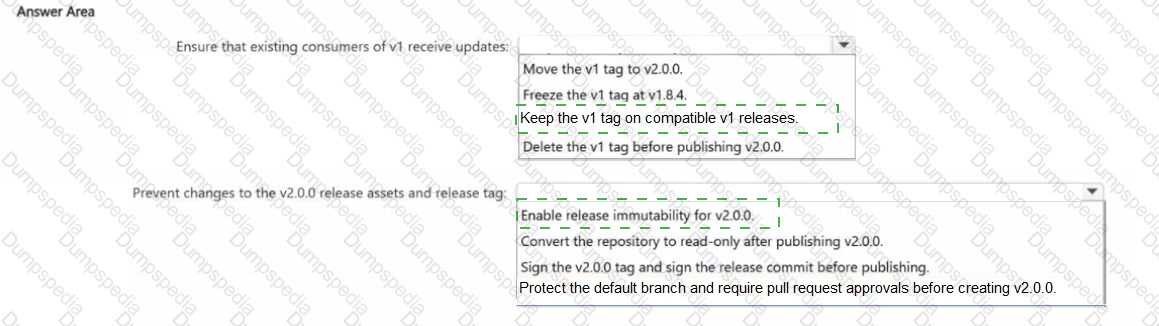
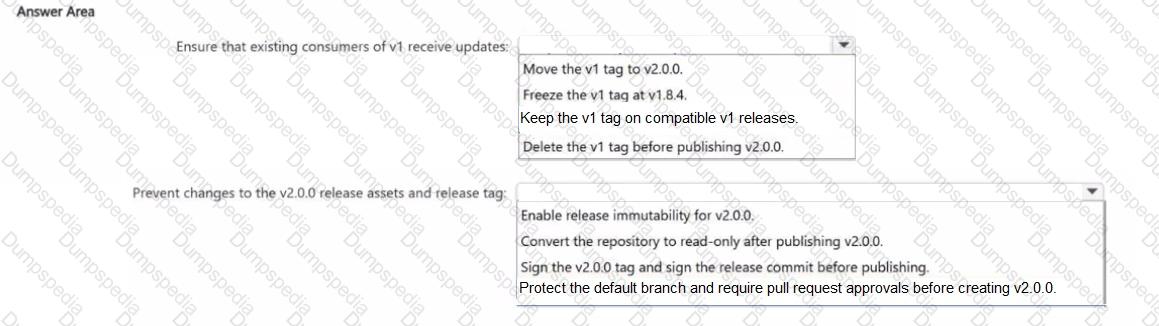
You have a GitHub Enterprise Server instance that hosts a custom action repository named action1. Production workflows use the actions in action1 as action1@vl. The current stable release of action1 is vl.8.4.
You need to publish a new release of action1 with version number v2.0.0 that changes an input name and includes release assets. The solution must meet the following requirements:
• Ensure that existing consumers of v1 continue to receive backward-compatible updates.
• Prevent changes to the published V2.0.0 release assets and release tag after publication.
What should you do for each requirement? To answer, select the appropriate options in the answer area.
NOTE: Each correct selection is worth one point.
Which choices represent best practices for publishing actions so that they can be consumed reliably?
(Each correct answer presents a complete solution. Choose two.)
You need to make a script to retrieve workflow run logs by using the API. Which is the correct API endpoint to download a workflow run log?
You are reaching your organization ' s storage limit for GitHub artifacts and packages. What should you do to prevent the storage limit from being reached? (Choose two.)
Which of the following scenarios would require the use of self-hosted runners instead of GitHub-hosted runners?
For which type of GitHub Actions workflows should you use a self hosted runner?
What are the advantages of using a matrix strategy in a job definition? (Choose two.)
Which default GitHub environment variable indicates the owner and repository name?
You are a developer, and your container jobs are failing on a self-hosted runner. Which requirements must you check to ensure that the self-hosted runner is properly configured? (Choose two.)
Which scopes are available to define custom environment variables within a workflow file? (Choose three.)
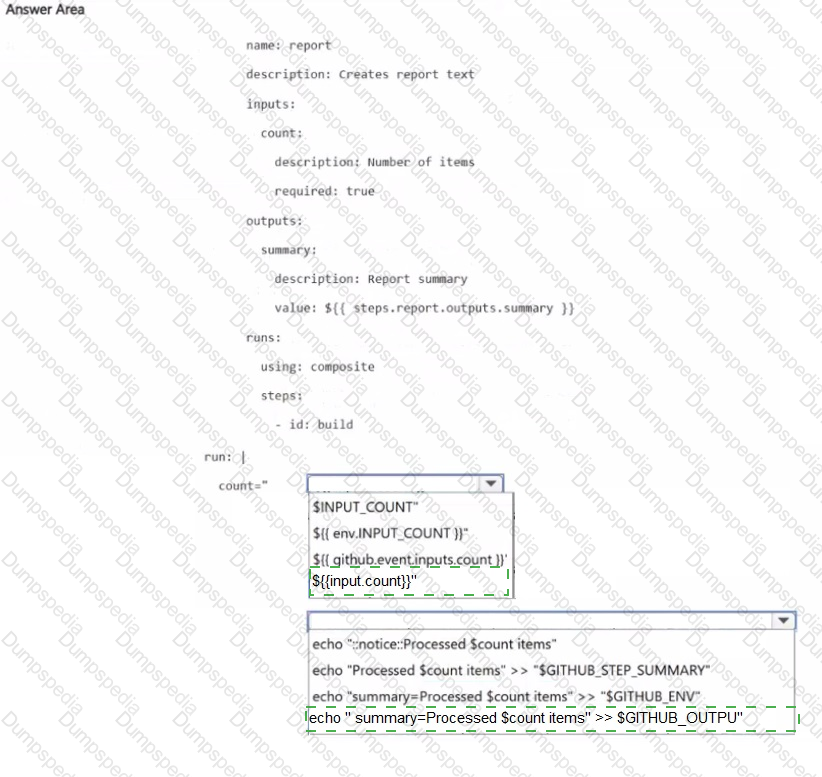
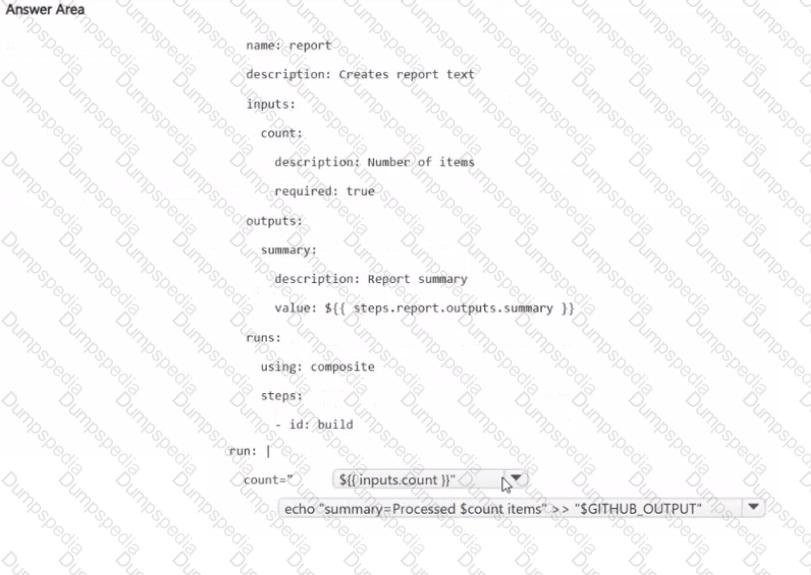
You have a GitHub repository that contains a composite action named Action1 and a workflow named Workflow1. Workflow1 contains the following steps:
• Calls Action1 in a step named report
• Passes count: ' 5 ' by using with
• Reads ${{ steps.report.outputs.summary )}
Action1 completes successfully, but the last step receives an empty value for summary.
You need to ensure that Action1 consumes the input of Workflow1 and exposes the expected output.
How should you complete the metadata file? To answer, select the appropriate options in the answer area.
NOTE: Each correct selection is worth one point.
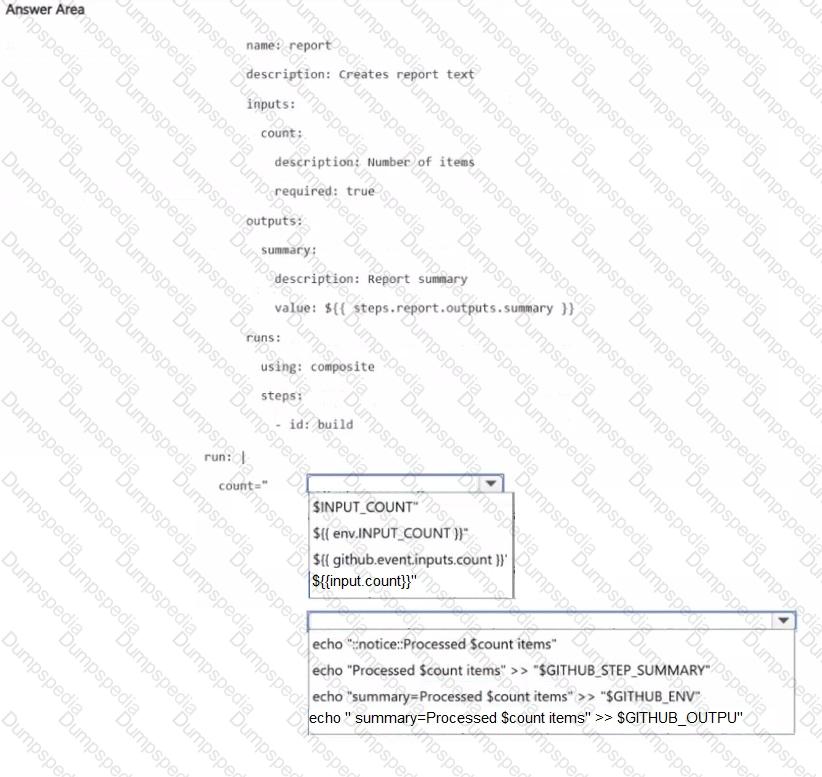
As a developer, you need to create a custom action written in Python. Which action type should you choose?
As a developer, you need to create a custom action written in Python. Which action type should you choose?
A development team has been using a Powershell script to compile and package their solution using existing tools on a Linux VM, which has been configured as a self-hosted runner. They would like to use the script as-is in an automated workflow. Which of the following should they do to invoke their script within a workflow step?
Disabling a workflow allows you to stop a workflow from being triggered without having to delete the file from the repo. In which scenarios would temporarily disabling a workflow be most useful? (Choose two.)
You have a GitHub Enterprise Cloud Organization that contains private repositories for three apps. The workflow of each app has a job that uses repository secrets and calls a shared deployment action.
You plan to replace separate deployment scripts with a single custom action.
You need to recommend a distribution and versioning approach for the custom action. The solution must meet the following requirements:
The action repository must be private.
Only specific application repositories can use the action.
The workflow reference must be resistant to changes in the action repository without requiring a workflow file change.
What should you recommend?
You are a DevOps engineer working on deployment workflows. You need to execute the deploy job only if the current branch name is feature-branch. Which code snippet will help you to implement the conditional execution of the job?
As a developer, you are authoring a workflow that will deploy to both DevCloud and TestCloud resources. Each cloud resource is accessed with a different deployment key. Which approach best allows you to use the same reusable workflow in separate jobs to target the different cloud resources?
You have a private GitHub repository that has GitHub Actions enabled. You need to create a CI workflow that can be used by GitHub Actions. You select an organization-approved workflow template.
What should you do next?
What menu options in a repository do you need to select in order to use a starter workflow that is provided by your organization?
What are the two mandatory requirements for publishing GitHub Actions to the GitHub Marketplace? Each correct answer presents part of the solution.
NOTE: Each correct answer is worth one point.
You are reaching your organization ' s storage limit for GitHub artifacts and packages. What should you do to prevent the storage limit from being reached?
Which syntax correctly accesses a job output (output1) of an upstream job (job1) from a dependent job within a workflow?
What is the most secure way to store sensitive information in GitHub Actions workflows?
As a developer, what options should you recommend to implement standards for automation reuse? (Choose two.)

TESTED 29 Nov 2026