dumpspedia logo

Actual packet transmission rates of STAs differ greatly depending on the radio modes that STAs support and the radio environment. The airtime scheduling function allocates channel resources according to the channel-occupation time of users connected to the same radio. Each user receives equal time to occupy the channel, ensuring fairness in channel occupation. If multiple users send different packet types, airtime scheduling still takes effect.
Huawei’s intelligent O & M platform, CampusInsight, offers GUIs including dashboard, issue analysis, and network experience. Which GUI is displayed in the figure?
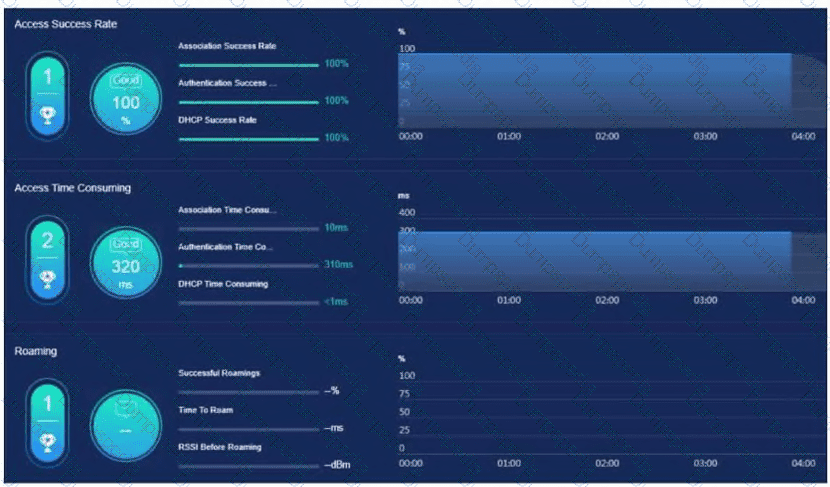
Original exhibit: Q45 Original Exhibit
In Portal authentication scenarios where the WAC acts as the access device, Portal users cannot be authenticated. Which of the following could cause this issue?
CHOOSE FOUR
An AP steers a STA when that STA satisfies the steering conditions. STAs running voice or video services are not steered.
On an agile distributed WLAN, RUs and central APs must be located on the same Layer 2 network, and each RU can associate with only one central AP.
In a network running Huawei's CloudCampus Solution, all APs are managed by iMaster NCE-Campus. Users experience STA roaming failures and worsening WLAN service quality. Which of the following can cause STA roaming failures in cloud AP scenarios?
CHOOSE THREE
Provided WLAN network coverage is ensured, AP transmit power can be reduced to lessen co-channel interference.
Like broadcast packets, multicast packets are transmitted at a low rate on a WLAN. It is recommended to enable multicast packet suppression when no multicast service is operating, so wireless network resources can be fully utilized.
Some STAs cannot access a WLAN because of coverage holes. In this situation, the transmit-power values of neighboring APs can be adjusted to enlarge the coverage area and eliminate the holes. Which command sequence is used to manually adjust AP transmit power?
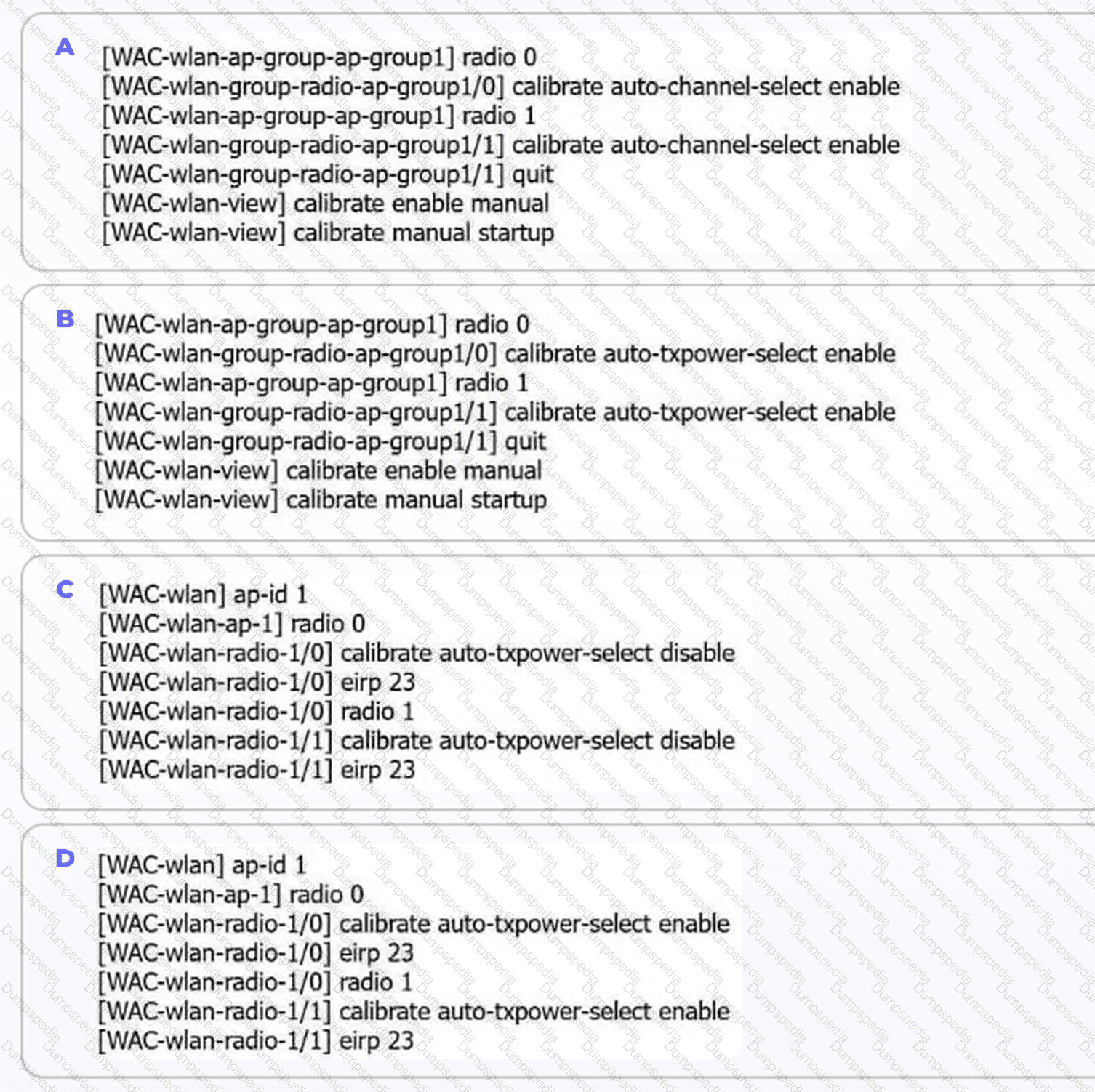
Original exhibit: Q53 Enlarged Exhibit
APs may be deployed either automatically or manually in WLAN Planner. In most scenarios, manual AP deployment is recommended. Automatic AP deployment applies only to certain scenarios with simple structures.
In the N+1 backup scenario illustrated, WAC3 has a global priority of 5, while WAC1 and WAC2 each have a global priority of 6. AP1 has an individual priority of 3 on WAC1, and AP3 has an individual priority of 3 on WAC2. When no AP is connected to WAC1, WAC2, or WAC3, which WAC will AP1, AP2, AP3, and AP4 connect to, respectively?
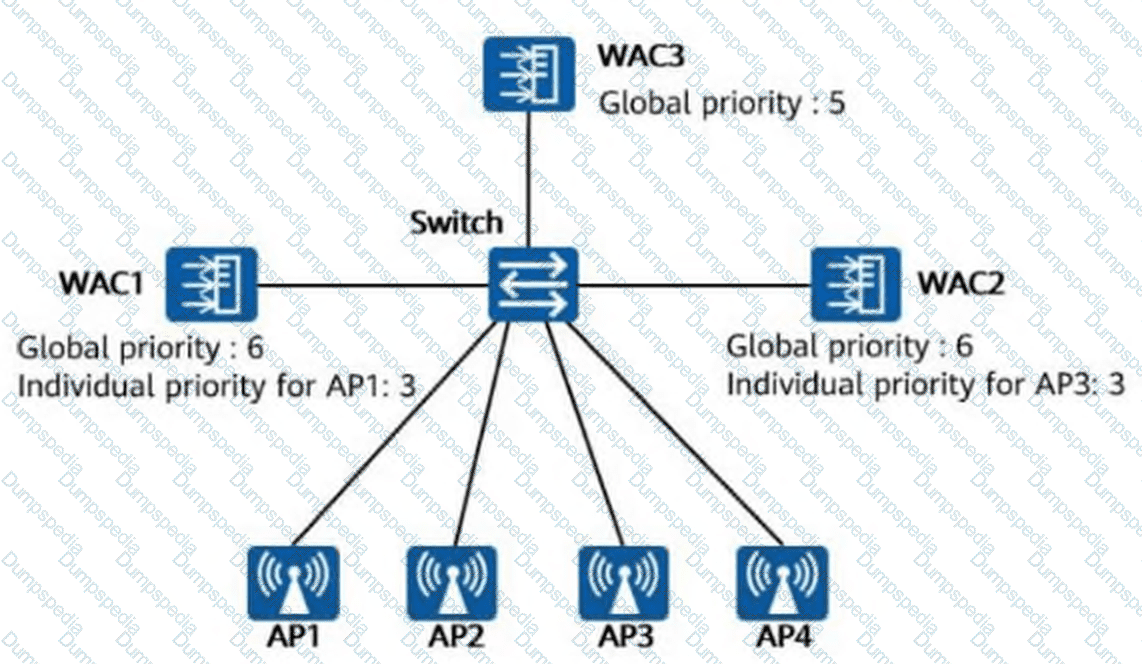
Original exhibit: Q51 Enlarged Exhibit
In a network with Huawei's CloudCampus Solution deployed, an AP cannot come online on iMaster NCE-Campus. Which of the following could cause this issue?
CHOOSE THREE
In WPA/WPA2 encryption mode, which key can be used to encrypt multicast and broadcast wireless packets?

TESTED 29 Nov 2026