dumpspedia logo

What does the user@router > clear log ospf-trace command accomplish?
The ospf-trace file is deleted.
Trace parameters are removed from the OSPF protocol configuration.
Logging data into ospf-trace is stopped.
Data in the ospf-trace file is removed and logging continues.
The clear log command is a vital operational utility within the Junos OS used to manage the size and relevance of log files without interrupting the system ' s logging processes. When a Senior Architect executes the clear log ospf-trace command, the Junos kernel truncates the specified file, effectively removing all existing text and resetting the file size to zero bytes. Crucially, the file itself is not deleted from the /var/log directory, nor is the underlying traceoptions configuration modified in any way.
Because tracing is often used for real-time debugging of protocol behaviors like OSPF, trace files can rapidly grow to several megabytes, making it difficult to find specific events. By clearing the log, the administrator ensures that any subsequent OSPF events—such as adjacency changes, LSA flooding, or SPF calculations—are recorded at the very beginning of the file, free from historical clutter. The OSPF process (rpd) continues to write to the file immediately after the truncation occurs. This operational behavior distinguishes the clear command from the file delete command, which would remove the file entirely, or the set protocols ospf traceoptions configuration command, which defines which specific events the device should record. Utilizing clear log is a standard best practice during intensive troubleshooting sessions to maintain a clean and chronologically relevant diagnostic environment.
Which two statements are correct about Junos OS? (Choose two.)
Junos OS provides the ability to run unsigned third-party binaries.
Junos OS provides modularization of software processes.
Junos OS combines security and routing policies.
Junos OS separates the control plane and the forwarding plane.
Junos OS is built upon a highly stable and secure architecture that distinguishes it from many legacy network operating systems. Two of its most defining characteristics are software modularization and the separation of the control and forwarding planes .
Modularization means that Junos OS runs each major function—such as the routing protocol process (rpd), the management process (mgd), and the interface process (dcd)—as an independent software daemon in its own protected memory space. This ensures that if a single process crashes or needs to be restarted, it does not bring down the entire system or interrupt traffic forwarding.
Furthermore, the physical and logical separation of the Control Plane (Routing Engine) and the Forwarding Plane (Packet Forwarding Engine) is a cornerstone of Junos design. The Routing Engine handles complex intelligence, protocol calculations, and management, while the Packet Forwarding Engine performs high-speed packet switching in hardware. This ensures that a heavy management load or a complex routing recalculation won ' t cause " jitter " or packet loss for transit traffic. Conversely, Junos strictly prohibits unsigned third-party binaries to maintain system integrity, and it maintains a clear functional distinction between routing policies (path selection) and security policies (traffic permit/deny).
Which statement about collision domains and broadcast domains is correct?
A router separates collision domains but forwards all broadcast traffic between its interfaces.
VLANs on a switch reduce collision domains but have no effect on broadcast domains.
A switch creates a separate collision domain for each port, but all ports remain in the same broadcast domain by default.
Broadcast domains are only relevant in IPv4 networks and are not used in IPv6 networks.
Understanding the distinction between collision and broadcast domains is fundamental to Layer 2 and Layer 3 networking. In a modern Ethernet switching environment, a switch effectively eliminates collisions by creating a separate collision domain for each of its physical ports. This is achieved through micro-segmentation and the support of full-duplex communication, which allows for simultaneous transmission and reception of data on a per-port basis.
However, while a switch segments collision domains, it does not inherently segment broadcast domains. By default, all ports on a switch reside within the same broadcast domain, meaning that a broadcast frame (such as an ARP request) received on one port will be flooded to all other ports within that specific VLAN or bridge domain. Segmenting broadcast domains requires either the configuration of Virtual LANs (VLANs) or the use of a Layer 3 device like a router, which does not forward broadcast traffic by default between its interfaces. It is a common misconception that broadcast domains are absent in IPv6; while IPv6 utilizes multicast (via NDP) instead of traditional Layer 2 broadcasts, the concept of the " link-local " scope where these packets are distributed remains functionally equivalent to a broadcast domain. For the JNCIA-Junos standard, the core takeaway is that switches provide per-port collision isolation while maintaining a unified broadcast environment unless explicitly partitioned. Reference: Networking Fundamentals, Collision and Broadcast Domains.
==========
Which statement accurately describes the Junos OS CLI?
The operational mode CLI is used to make persistent changes.
Changes made in configuration mode immediately affect the active configuration.
The commit confirmed 5 command activates the candidate configuration and automatically reverts if not confirmed in 5 minutes.
The rollback 0 command restores the device to factory defaults.
The statement describing commit confirmed 5 is correct. In Junos OS, configuration changes are first made to a candidate configuration . They do not become the active operational configuration merely because they have been entered in configuration mode. A commit operation is required to validate and activate those changes.
The commit confirmed mechanism provides an important administrative safety feature. When the administrator enters:
commit confirmed 5
Junos OS activates the candidate configuration but requires confirmation within 5 minutes . If the configuration is not confirmed before the timer expires, Junos OS automatically rolls back to the previously committed configuration. Juniper explicitly documents that the optional number following commit confirmed specifies the confirmation period in minutes.
Option A is incorrect because operational mode is primarily used for monitoring, troubleshooting, maintenance, and operational commands rather than making persistent configuration changes. Option B is incorrect because configuration-mode edits remain candidate changes until committed. Option D is also incorrect: rollback 0 does not restore factory defaults . It loads the most recently committed configuration and effectively removes pending uncommitted modifications.
Study Guide Reference Topics: Configuration Basics — candidate versus active configuration, commit operations, confirmed commits, configuration rollback, and Junos CLI modes.
What are two functions of the Routing Engine? (Choose two.)
It evaluates firewall filters for transit traffic.
It runs Junos OS.
It processes all management traffic.
It processes transit traffic.
The Routing Engine (RE) is the " brains " of a Juniper device, representing the control plane in the Junos dual-plane architecture. One of its primary functions is that it runs the Junos OS . The RE is essentially a high-performance workstation running a specialized version of FreeBSD that hosts the various software daemons responsible for the device ' s logic, such as the Routing Protocol Process (rpd) and the Device Control Process (dcd).
The second core function is that the RE processes all management traffic . Any packet destined for the router itself—such as an SSH session, an SNMP poll, a NETCONF request, or an NTP update—is handled by the Routing Engine ' s CPU. The RE also maintains the master routing table, manages configuration commits, and provides the CLI environment for the administrator.
It is critical to distinguish these control-plane duties from the duties of the Packet Forwarding Engine (PFE) . The PFE is responsible for the " heavy lifting, " such as processing transit traffic (data passing through the router) and evaluating firewall filters at wire speed. While the RE defines the policies and routing tables, it hands off a streamlined version of this information to the PFE so the RE isn ' t bogged down by millions of individual packets. This separation ensures that a busy management session or a complex routing calculation on the RE doesn ' t impact the device ' s ability to forward traffic at maximum capacity.
Which two statements about prefix lists in Junos are correct? (Choose two.)
Prefix lists can be re-used in multiple routing policies.
Prefix lists can be used in both firewall filters and routing policies.
Prefix lists cannot be used in routing policies.
Prefix lists cannot be used in firewall filters.
Prefix lists in Junos OS are named collections of IP addresses or network prefixes defined under the [edit policy-options] hierarchy. One of their most powerful features is their versatility and reusability. Because they are defined as independent objects, a single prefix list can be referenced in multiple different routing policies across the device. This modularity ensures consistency; for instance, if a set of " internal " prefixes changes, an administrator only needs to update the list in one location for those changes to propagate to every policy that utilizes it.
Furthermore, prefix lists are designed to be used across different functional areas of the Junos architecture. They are equally valid for use in routing policies (to control the import or export of routes between protocols like BGP or OSPF) and in firewall filters (to match source or destination addresses for transit or management traffic). When used in a routing policy, the prefix list typically performs an exact match on the prefix length unless modified by a match type like orlonger. In a firewall filter, it acts as a high-speed lookup table for the Packet Forwarding Engine. This dual-purpose capability makes prefix lists a foundational tool for architects seeking to implement scalable, automated security and routing logic within a unified configuration framework.
What information would you find using the CLI help command?
a URL for accessing the technical documentation
message of the day
hyperlinks for remediation actions
an explanation for specific system log error messages
The Junos OS CLI is engineered with an extensive, self-contained help subsystem designed to provide immediate technical guidance without requiring constant reference to external manuals. The help command is a versatile tool that operates through several key sub-commands: topic, reference, and log. While help topic provides conceptual overviews and help reference displays specific configuration syntax and hierarchical requirements, the help log command is specifically tailored for system maintenance and troubleshooting.
The primary purpose of help log is to provide a detailed explanation for specific system log error messages generated by the device. When a Junos daemon or process writes an entry to the syslog, it includes a unique message identifier or " tag. " By executing help log < message-tag > , an architect can retrieve a clinical breakdown of why the message was generated, the severity of the event, and often the recommended action to resolve the underlying issue. This capability is vital for rapid interpretation of complex system events in real-time. It ensures that administrators have authoritative, context-aware information directly at the terminal, effectively bridging the gap between raw diagnostic output and actionable technical intelligence within the Junos environment. Reference: User Interfaces, CLI Help Facilities, help log.
==========
You must securely log in to a Junos device to perform maintenance.
Which command would you use to accomplish this task?
ftp 172.16.10.1
traceroute 172.16.10.1
telnet 172.16.10.1
ssh 172.16.10.1
Secure remote administrative access to a Junos OS device is performed by using SSH (Secure Shell) . Therefore, ssh 172.16.10.1 is the correct command. Juniper defines the Junos CLI ssh operational command as a mechanism for opening a secure connection between a local router or switch and a remote system. The destination can be specified by hostname or IP address.
SSH provides authenticated and encrypted remote access, protecting login credentials and management traffic while the administrator performs configuration, monitoring, or maintenance operations. Junos devices can accept incoming SSH sessions when SSH is enabled under the [edit system services ssh] configuration hierarchy.
telnet 172.16.10.1 can establish a remote terminal session, but Telnet does not provide the encryption required for secure administrative access. ftp is principally a file-transfer protocol and is not the appropriate mechanism for interactive device maintenance. traceroute is an operational diagnostic utility used to identify the Layer 3 path toward a destination; it does not provide device login functionality.
Study Guide Reference Topics: User Interfaces — CLI remote access; Junos OS Fundamentals — system services; Operational Monitoring and Maintenance — secure device management.
Which statement describes the primary purpose of a routing policy in Junos OS?
It controls which routes are accepted or advertised by a routing protocol. B. It determines the physical interface used for forwarding traffic. C. It sets the maximum number of routes in the routing table. D. It enables automatic rollback of routing changes.
In Junos OS, a routing policy is a powerful tool used to manage the flow of routing information between the Routing Information Base (RIB) and routing protocols. Unlike forwarding decisions, which are handled by the Packet Forwarding Engine, routing policies function within the control plane on the Routing Engine. Their primary purpose is to define specific criteria for importing routes into the routing table from neighbors or exporting routes from the routing table to neighbors.
Routing policies consist of terms containing from (match) and then (action) statements. They allow administrators to filter prefixes (e.g., denying specific BGP routes), modify route attributes (e.g., changing OSPF metrics or BGP communities), and manipulate path selection behavior. For example, an export policy might be used to ensure that only specific internal subnets are advertised to an ISP via BGP, preventing the accidental leakage of private infrastructure addresses. By default, Junos applies " default policies " for each protocol (such as OSPF accepting all OSPF routes), but custom policies allow for granular control over how the device interacts with the rest of the network. This ensures that the routing table contains only the desired paths for optimal traffic engineering.
Exhibit:
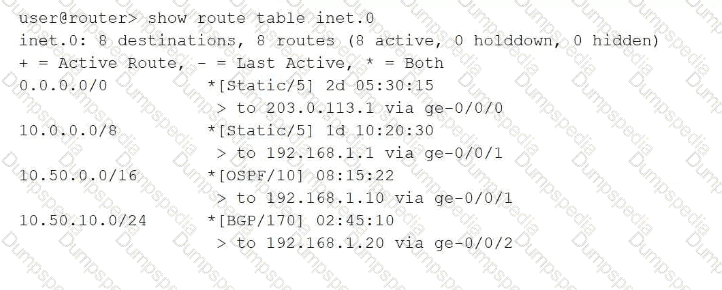
Referring to the exhibit, which route will be selected for a packet destined to IP address 10.50.10.55?
Route 0.0.0.0/0 will be selected using next hop 203.0.113.1 because the default route matches all destinations and has been active the longest.
Route 10.50.0.0/16 will be selected using next hop 192.168.1.10 because OSPF has a better preference value than BGP.
Route 10.50.10.0/24 will be selected using next hop 192.168.1.20 because it has the longest prefix match for the destination address.
Route 10.0.0.0/8 will be selected using next hop 192.168.1.1 because it was learned from the static routing protocol which has the lowest preference value.
In Junos OS, the Routing Information Base (RIB) selection process follows a strict hierarchy where the Longest Prefix Match (LPM) is the absolute primary tie-breaker. When a packet is destined for 10.50.10.55 , the Routing Engine searches the inet.0 table for all matching entries. In this exhibit, four routes match: the default route ( 0.0.0.0/0 ), a general static route ( 10.0.0.0/8 ), an OSPF route ( 10.50.0.0/16 ), and a BGP route ( 10.50.10.0/24 ).
The LPM rule dictates that the router must select the most specific route available, which is defined as the entry with the highest number of matching bits in the subnet mask. The 10.50.10.0/24 route matches 24 bits of the destination address, making it more specific than the 16-bit, 8-bit, or 0-bit alternatives. It is critical to understand that route preference (e.g., Static at 5, OSPF at 10, or BGP at 170) is only evaluated if there are multiple paths to the exact same prefix and length. Because these prefixes vary in length, the length takes precedence over the protocol preference. Therefore, the BGP-learned route via 192.168.1.20 is selected as the active path, ensuring traffic follows the most granular routing information provided to the device. Reference: Routing Fundamentals, Routing Table Selection, Longest Prefix Match.
==========
You must add a large hierarchical configuration to your Junos device. You also want to completely replace the existing candidate configuration with a new configuration file. Which command would allow you to accomplish these tasks?
load merge terminal
load override terminal
load factory default
load set terminal
The load command in Junos OS provides several operational methods for importing configuration data into the candidate buffer. When an administrator needs to perform a " clean slate " update—where the objective is to completely replace the existing candidate configuration with a new hierarchical file—the override option is the correct tool. Unlike load merge, which blends new data with the existing configuration, or load replace, which only updates specifically tagged sections, load override discards every statement currently in the candidate configuration and substitutes it entirely with the new content.
Using the terminal keyword in conjunction with override allows the architect to paste a large hierarchical configuration directly into the Command Line Interface (CLI). This is the most efficient method for applying validated templates, restoring full system backups, or migrating configurations between devices without having to manually delete existing parameters. After the data is pasted and the process is finalized (typically with a Ctrl+D sequence), the Junos OS kernel validates the new candidate configuration against the device ' s hardware and software capabilities. To make these changes active and operational, a subsequent commit command must be executed. This comprehensive replacement mechanism ensures configuration integrity by eliminating any potential remnants of previous, unwanted settings that might conflict with the new deployment.
What is the main function of the forwarding table on a Junos device?
It contains only active routes used to forward packets through the PFE.
It advertises routes to neighboring routers.
It stores all learned routes from routing protocols.
It determines the best route based on route preference.
The architecture of Junos OS is designed with a strict functional separation between the control plane and the data plane. The Routing Engine (RE) maintains the master Routing Information Base (RIB), which acts as a comprehensive database storing all potential paths learned from various routing protocols, static configurations, and direct connections. However, to achieve wire-speed performance, the device does not consult the RIB for every packet. Instead, the RE identifies the " active " or best routes for each destination based on route preference and metrics.
Once these active routes are selected, the RE distills them into a streamlined Forwarding Information Base (FIB), commonly referred to as the forwarding table, and pushes this table to the Packet Forwarding Engine (PFE). The main function of the forwarding table is to provide a high-speed, local lookup mechanism that allows the PFE to forward transit traffic across the switch fabric with minimal latency. This table contains only the specific exit interface and Layer 2 next-hop information required for packet delivery. By isolating the PFE from the overhead of complex routing protocol state machines and all inactive redundant paths, Junos OS ensures that forwarding performance remains consistent even during control plane re-convergence. Reference: Junos OS Fundamentals, Control Plane and Forwarding Plane functions.
==========
Which two statements about firewall filters are correct? (Choose two.)
Firewall filters are stateful.
Firewall filters can match Layer 4 parameters.
Firewall filters can match Layer 7 parameters.
Firewall filters are stateless.
In Junos OS, standard firewall filters operate as a primary security and traffic management tool within the forwarding plane. These filters are fundamentally stateless, meaning they evaluate each packet individually and in isolation without maintaining a session table or tracking the state of network connections. This stateless nature allows the Packet Forwarding Engine (PFE) to process filters at hardware speeds, ensuring minimal latency for transit traffic. This distinguishes them from the stateful security policies found on Junos security devices like the SRX Series, which track the entire lifecycle of a flow.
Furthermore, firewall filters are designed to inspect and match header information up to Layer 4 of the OSI model. This capability allows administrators to define terms based on parameters such as source and destination IP addresses (Layer 3) as well as TCP or UDP port numbers and protocol types (Layer 4). While they provide granular control over packet flow, they do not natively inspect Layer 7 application payloads, which is typically reserved for advanced services like Intrusion Detection and Prevention (IDP). By combining stateless execution with Layer 4 matching, Junos firewall filters provide an efficient method for implementing transit protection, rate limiting through policing, and protecting the local Routing Engine through loopback interface filtering. Reference: Routing Policy and Firewall Filters, Firewall Filter Framework.
==========
Your routing policy has three terms. A route matches the first term with an accept action. In this scenario, what happens next?
The route is rejected by default.
The route is evaluated by the second term.
The route is sent to the next policy chain.
The route is accepted and no further terms are evaluated.
Junos OS routing policies are evaluated using a sequential, " first-match " logic. When a route is compared against a policy, the system evaluates the terms in the order they are defined. Once a route meets all the match criteria (the from statement) in a term, the router executes the associated action (the then statement).
If the action is a terminating action —such as accept or reject—the evaluation of that specific route for that specific policy ends immediately. In this scenario, since the route matched the first term and the action was accept, the route is successfully processed and the policy evaluation is complete. The system will not proceed to evaluate the second or third terms. This behavior is critical for network architects to understand when ordering terms; more specific " exceptions " must be placed at the top of the policy, while broader " catch-all " terms must be placed at the bottom. If the administrator wanted the evaluation to continue to the next term despite a match, they would need to explicitly include the next term action, which is a non-terminating action. Without it, a match on an accept action signifies the final decision for that route within that policy context.
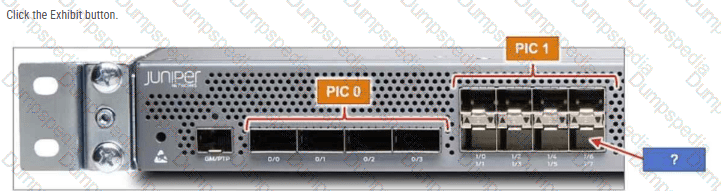
The MX204 has 12 built-in ports. Referring to the exhibit, to which interface does the arrow point?
хе-0/2/7
хе-0/0/7
хе-0/1/7
хе-0/1/6
The Juniper MX204 is a fixed-configuration router that utilizes a specific hierarchical naming convention for its physical interfaces: type-fpc/pic/port. In the MX204 architecture, there is a single built-in Flexible PIC Concentrator (FPC), which is always designated as FPC 0 . This FPC is subdivided into two logical Physical Interface Cards (PICs): PIC 0 and PIC 1 .
As shown in the exhibit, PIC 0 contains four high-speed ports (labeled 0/0 through 0/3) that typically support 40GbE or 100GbE speeds. PIC 1 contains eight ports (labeled 1/0 through 1/7) designed for 1GbE or 10GbE connectivity. These ports are arranged in a stacked, $2 \times 4$ grid. The labeling system on the chassis indicates the port numbers for each column. In the fourth column of the PIC 1 block, the top port is identified as 1/6 and the bottom port as 1/7 .
The blue arrow in the exhibit points directly to the bottom-right interface in the PIC 1 section. Correlating this physical location with the chassis labels confirms that the port number is 7. When combined with the FPC and PIC identifiers, the full interface name is xe-0/1/7 (assuming a 10GbE transceiver is installed). Understanding this physical-to-logical mapping is essential for accurate cabling and configuration within the Junos OS, ensuring that administrators apply the correct logical unit and protocol settings to the intended physical hardware.
You are creating a new user account on your Junos device. The user must be able to validate the routing table and interface statistics but should not be able to make any configuration changes. In this scenario, which permission flag would satisfy this requirement?
configure
all
view
network
User access control in Junos OS is managed through the application of permission flags within login classes. When an architect needs to define a role that allows for robust monitoring and troubleshooting without granting authority to alter the device ' s operational state, the view permission flag is the appropriate selection. This flag grants the user the ability to execute the majority of show commands in operational mode, which includes viewing the routing table, inspecting interface statistics, and checking hardware status.
The view permission is specifically designed for " read-only " access. It ensures that the user can observe all necessary telemetry data to validate network health—satisfying the requirement to check routing and interface stats—while strictly prohibiting access to configuration mode or any set commands. This contrasts with the configure flag, which allows modification of the candidate configuration, or the network flag, which provides specific permissions related to network-level operational tasks. By assigning a user to a class restricted with the view flag, an administrator maintains a secure environment where support personnel can diagnose issues without the risk of accidental or unauthorized configuration changes. This principle of least privilege is a cornerstone of Junos security management. Reference: User Interfaces, User Management and Access Control.
==========
Exhibit:
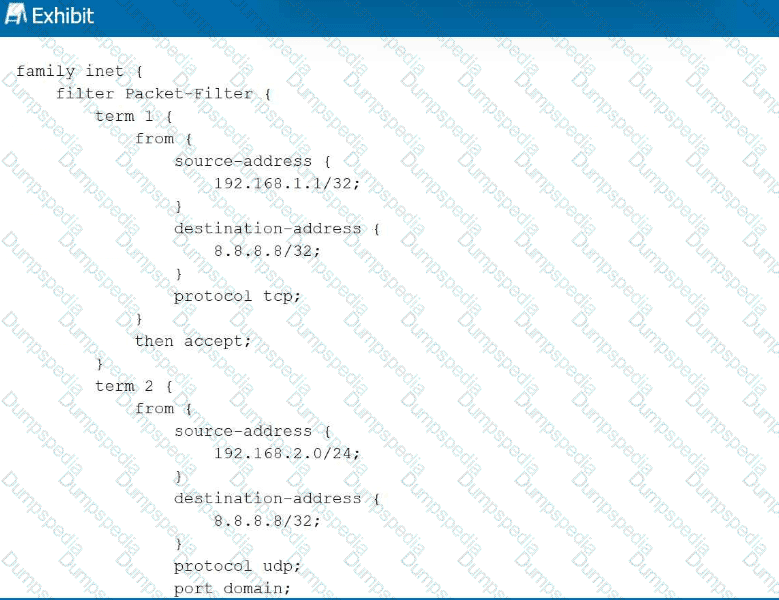
Referring to the exhibit, with firewall filter Packet-Filter attached to an interface, if traffic is sent from 192.168.1.1 to 8.8.8.8 for a UDP DNS query, what will happen to the traffic?
The traffic will match term 1 and be forwarded.
The traffic will match the default last term and be forwarded.
The traffic will match the default last term and be discarded.
The traffic will match term 3 and be forwarded.
Junos OS firewall filters operate on a first-match basis, evaluating terms sequentially from top to bottom. In this scenario, a UDP DNS packet (destination port 53) is sent from 192.168.1.1 to 8.8.8.8. Evaluation begins with term 1 , which matches the correct source and destination IP addresses but specifies protocol tcp . Because the actual traffic uses UDP, term 1 is not a match. Evaluation then moves to term 2 . While term 2 correctly identifies protocol udp and port domain (port 53), it requires the source-address to reside within the 192.168.2.0/24 subnet. Since the source is 192.168.1.1 , term 2 also fails to match.
When a packet fails to match any explicitly defined terms in a Junos firewall filter, it is subject to the implicit deny action. This default " last term " is a hardcoded safety mechanism that automatically discards all traffic that has not been explicitly permitted. Consequently, because neither term provides a match for the specific combination of source IP, protocol, and destination port, the DNS query is silently dropped by the Packet Forwarding Engine. This behavior ensures that Junos devices maintain a " deny-by-default " security posture, requiring administrators to define precise permit statements for all required transit or management traffic. Reference: Routing Policy and Firewall Filters, Firewall Filter Evaluation, Implicit Discard.
==========
Which two tasks would you perform in operational mode? (Choose two.)
requesting the system to reboot
verifying the version of Junos OS
committing your configuration
rolling back to a previous configuration
The Junos Command Line Interface (CLI) is structured into two primary hierarchical modes: operational mode and configuration mode. Operational mode is the default entry point when a user logs into the device, signified by the > prompt. This mode is designed for monitoring the health of the device, troubleshooting network issues, and executing system-level maintenance tasks. Specifically, an administrator uses operational mode to verify the version of Junos OS currently active on the device using the show version command.
Additionally, system-level administrative actions that do not involve modifying the device ' s persistent configuration logic are performed within the operational mode. This includes requesting the system to reboot or halt via the request system hierarchy of commands. In contrast, tasks that involve manipulating the configuration database—such as committing proposed changes or rolling back to a previous configuration version—require the user to transition into configuration mode, indicated by the # prompt. Understanding this distinction is vital for efficient navigation of the Junos CLI; while operational mode provides the tools to observe the system and manage its physical state, configuration mode is reserved for altering the logical parameters and routing policies that govern device behavior. Reference: User Interfaces, CLI Modes, Operational Mode Commands.
==========
Which two statements are correct about a Routing Engine? (Choose two.)
It processes management traffic.
It processes CoS marked traffic.
It forwards transit traffic.
It maintains routing tables.
The architecture of a Junos device is bifurcated into two primary functional planes: the Control Plane, managed by the Routing Engine (RE), and the Data Plane, managed by the Packet Forwarding Engine (PFE). The Routing Engine serves as the " brain " of the device. One of its primary responsibilities is the processing of management traffic, which includes handling CLI sessions (SSH, Telnet), SNMP requests, and system logging. Because the RE runs the Junos OS kernel, it provides the environment for all administrative tasks and system management utilities.
Additionally, the Routing Engine is responsible for the intelligence of the network, which involves running routing protocols (such as OSPF, BGP, or IS-IS) and maintaining the master routing tables. It populates the Routing Information Base (RIB) with all learned paths and then calculates the best paths to build the Forwarding Information Base (FIB). This FIB is then pushed to the PFE for hardware-level packet switching. It is a common misconception that the RE handles transit traffic; however, the RE only handles " exception traffic " or traffic destined for the device itself. This separation ensures that the control plane remains stable and responsive even during periods of heavy transit load on the forwarding plane. Reference: Junos OS Fundamentals, Architectural Overview, Control Plane vs. Forwarding Plane.
Which two statements are correct about logical units? (Choose two.)
A physical interface can host multiple logical units.
Logical units can have multiple IP addresses.
Logical units are used only for management interfaces.
A physical interface can host only one logical unit.
In the Junos OS architecture, interfaces are strictly divided into physical and logical components. The physical interface represents the actual hardware port (e.g., ge-0/0/0), while logical units (e.g., ge-0/0/0.0) define the protocol-specific parameters and logical segmentation required for traffic processing. A fundamental characteristic of this model is that a single physical interface can host multiple logical units. This is a mandatory requirement for technologies such as 802.1Q VLAN tagging, where each logical unit corresponds to a different VLAN ID on the same physical link, allowing for efficient micro-segmentation of traffic.
Furthermore, Junos OS allows logical units to have multiple IP addresses assigned to them within the same address family or across different families (such as inet and inet6). This flexibility enables a single logical interface to reside on multiple subnets simultaneously, which is essential for complex routing scenarios, multi-homing, or transitional dual-stack environments. It is a common misconception that logical units are reserved for management; in reality, every physical interface must have at least one logical unit (typically unit 0) configured for the device to process any transit or local traffic. Understanding the hierarchical relationship between the physical port and its logical subdivisions is critical for successful interface management and protocol deployment on Junos platforms. Reference: Junos OS Fundamentals, Interface Naming and Hierarchy.
==========
You are creating a new user account using a predefined login class on a Junos device. The account should be able to run operational mode commands such as show interfaces and ping, but should not be allowed to change or commit configuration. Which login class should you assign to this user?
maintenance
read-only
super-user
operator
Junos OS utilizes a Role-Based Access Control (RBAC) model through the use of login classes, which define the specific permissions and restrictions for different user levels. To simplify administration, Juniper provides several predefined classes that cater to common organizational roles. The requirement here is for an account that can perform basic network diagnostics (operational mode) but lacks the authority to modify the system state (configuration mode).
The operator class is specifically engineered for this purpose. It grants permissions such as clear, network, reset, trace, and view. These permissions allow the user to execute monitoring commands like show, use diagnostic tools like ping and traceroute, and clear statistics. Crucially, the operator class does not include the configure or commit permissions, preventing the user from entering configuration mode or making any permanent changes to the device.
Comparing this to other options: the read-only class is more restrictive, generally allowing only the viewing of configuration and some state data, but often restricting active diagnostic tools like ping. The super-user class provides unrestricted access, while maintenance is not a standard predefined class for general operational roles. Assigning the operator class ensures that junior staff or automated monitoring systems have the visibility they need to troubleshoot connectivity without risking the integrity of the device configuration.
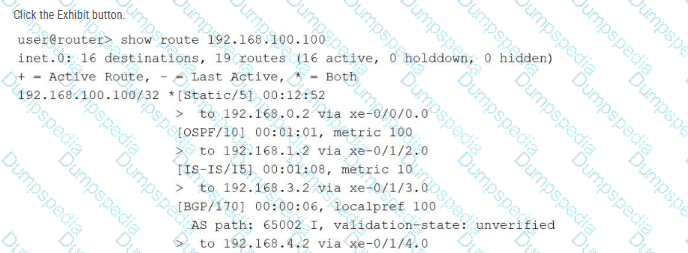
Referring to the exhibit using the show route 192.168.100.100 command output, over which interface will the traffic be forwarded?
xe-0/1/3.0
xe-0/0/0.0
xe-0/1/4.0
xe-0/1/2.0
In the Junos OS architecture, the Routing Engine (RE) manages path selection by evaluating multiple potential routes to a specific destination found within the Routing Information Base (RIB). When multiple routing sources (such as static configuration, OSPF, IS-IS, and BGP) provide information for the exact same destination prefix—in this case, 192.168.100.100/32 —the device utilizes route preference as the primary tie-breaker to determine which entry becomes the " active " route.
The provided exhibit displays the default preference values for each protocol: Static is 5 , OSPF is 10 , IS-IS is 15 , and BGP is 170 . Junos OS follows a " lower is better " logic for preference; therefore, the Static route is selected as the most trustworthy path. In the command output, the active route is explicitly identified by the asterisk (*) and plus sign (+) symbols located next to the [Static/5] entry. Looking at the specific next-hop information for this active static route, the output indicates the traffic is sent to 192.168.0.2 via xe-0/0/0.0 . Consequently, the Packet Forwarding Engine (PFE) will install this specific path into the forwarding table, causing all traffic destined for 192.168.100.100 to be egressed over the xe-0/0/0.0 interface.
Your system administrator notified the infrastructure team that all server NICs will be moving to jumbo frames. All of the NICs used by servers are 1 gigabit. The starting frame size will be 4K. The exact frame size may change depending on testing results. In this scenario, which choice would provide a flexible solution?
Create a group that adjusts MTU size on 1 gigabit interfaces and apply at the interfaces level.
Apply the MTU to each interface family for each 1 gigabit interface.
Set the app-engine compute-cluster Ethernet MTU size for the Junos VM.
Use the system internet-options path-mtu-discovery to dynamically adjust MTU.
In large-scale Junos deployments, efficiency and flexibility are achieved through the use of configuration groups . When faced with a requirement like moving all 1-gigabit interfaces to jumbo frames—with the caveat that the exact MTU value (e.g., 4000 bytes) might change after testing—manually editing every interface is both tedious and prone to error.
By creating a configuration group under the [edit groups] hierarchy, you can define the MTU parameter once. You then use the apply-groups statement at the [edit interfaces] level or on specific interface ranges. This creates a " template " effect. The flexibility comes into play during the testing phase: if results indicate that a 9000-byte MTU is preferable to 4000 bytes, the architect only needs to modify the value in the group definition. The Junos OS inheritance mechanism automatically propagates this update to every interface associated with that group.
Applying MTU at the family level (Option B) is less efficient and doesn ' t handle the physical Layer 2 MTU requirements of jumbo frames as effectively. Path-MTU discovery (Option D) is a protocol-level function for avoiding fragmentation but does not configure the local interface ' s hardware capability to accept larger frames. Thus, groups represent the best practice for centralized, scalable management.
Which statement about class of service (CoS) in a network is correct?
CoS encrypts traffic to secure data across the network.
CoS prioritizes certain types of traffic during congestion.
CoS assigns IP addresses dynamically to optimize routing.
CoS prevents broadcast storms by segmenting VLANs.
Class of Service (CoS) is a fundamental suite of features in Junos OS designed to manage traffic patterns during periods of network congestion. Rather than treating all packets equally, CoS allows the Packet Forwarding Engine (PFE) to differentiate between various types of traffic—such as latency-sensitive Voice over IP (VoIP), critical routing protocol updates, and standard " best-effort " internet traffic—and prioritize them accordingly. When egress interface buffers become saturated, the CoS mechanism uses defined schedulers and queues to ensure that high-priority packets are transmitted first, while less critical traffic may be delayed or dropped.
It is important to distinguish CoS from security or addressing functions. CoS does not provide encryption services (which is the role of IPsec or MACsec), nor does it manage IP address allocation or VLAN segmentation. Instead, it focuses entirely on the intelligent allocation of bandwidth and buffer resources. By implementing CoS, network architects can guarantee a specific level of performance for mission-critical applications, effectively minimizing jitter and packet loss for the most important data streams. This deterministic behavior is vital for modern converged networks where multiple traffic types compete for limited hardware resources across the switch fabric or WAN links. Reference: Junos OS Fundamentals, Class of Service (CoS) Overview.
==========
When multiple routes exist to the same destination IP address, which rule do routers use to select the next hop?
They choose the route with the longest prefix match.
They choose a route at random to balance paths.
They choose the route with the largest administrative distance.
They choose the route learned most recently.
The primary and most critical rule used by Junos OS (and routers in general) to determine the next hop for a specific packet is the Longest Prefix Match (LPM) algorithm. When the Routing Engine or Packet Forwarding Engine looks up a destination IP address in the routing or forwarding table, it may find several entries that technically encompass that address. The LPM rule dictates that the router must select the most specific route available—that is, the entry with the highest number of matching bits in its subnet mask (the longest prefix).
For example, if a router has a route for 10.1.1.0/24 and another for 10.1.1.0/28, a packet destined for 10.1.1.1 will always be forwarded according to the /28 route, as it is more specific. Longest prefix match takes precedence over all other selection criteria, including route preference (administrative distance) and metrics. Preference and metrics are only evaluated when the router has multiple entries for the exact same prefix length (e.g., two different paths to 10.1.1.0/24). This logic ensures that traffic is guided along the most precise path defined in the network topology. Routers never choose paths at random or based on the most recent update as their primary selection mechanism, as doing so would result in non-deterministic and inefficient routing behavior. Reference: Routing Fundamentals, Routing Table and Forwarding Table Selection.
==========
You asked a network engineer to configure a new logical interface on a Juniper router. The interface must use the fourth usable host address from the 172.16.40.128/29 subnet. Which IP address is correct in this scenario?
172.16.40.135
172.16.40.132
172.16.40.130
172.16.40.131
In the Junos OS environment, precise IP addressing and subnet calculation are foundational for interface configuration. A /29 subnet mask (255.255.255.248) provides a total of 8 IP addresses. To identify the usable host range, we must first identify the network and broadcast addresses. For the subnet 172.16.40.128/29, the network address is 172.16.40.128. The broadcast address is the last address in the block, which is 172.16.40.135.
Following standard IPv4 conventions, the first and last addresses in a block are reserved for the network identity and the directed broadcast, respectively. This leaves 6 usable host addresses: 172.16.40.129 through 172.16.40.134. Counting sequentially from the beginning of the usable range: the first usable host is .129, the second is .130, the third is .131, and the fourth usable host is 172.16.40.132. Assigning this specific address ensures that the Packet Forwarding Engine can correctly route traffic within the intended segment. As a Senior Architect, it is critical to verify these boundaries when using the set interfaces unit 0 family inet address command to prevent address overlapping or the accidental assignment of reserved network/broadcast IDs.


TESTED 04 Oct 2026