dumpspedia logo

A company is designing an integration Mule application to process orders by submitting them to a back-end system for offline processing. Each order will be received by the Mule application through an HTTP5 POST and must be acknowledged immediately.
Once acknowledged the order will be submitted to a back-end system. Orders that cannot be successfully submitted due to the rejections from the back-end system will need to be processed manually (outside the banking system).
The mule application will be deployed to a customer hosted runtime and will be able to use an existing ActiveMQ broker if needed. The ActiveMQ broker is located inside the organization's firewall. The back-end system has a track record of unreliability due to both minor network connectivity issues and longer outages.
Which combination of Mule application components and ActiveMQ queues are required to ensure automatic submission of orders to the back-end system while supporting but minimizing manual order processing?
An auto mobile company want to share inventory updates with dealers Dl and D2 asynchronously and concurrently via queues Q1 and Q2. Dealer Dl must consume the message from the queue Q1 and dealer D2 to must consume a message from the queue Q2.
Dealer D1 has implemented a retry mechanism to reprocess the transaction in case of any errors while processing the inventers updates. Dealer D2 has not implemented any retry mechanism.
How should the dealers acknowledge the message to avoid message loss and minimize impact on the current implementation?
Mule applications need to be deployed to CloudHub so they can access on-premises database systems. These systems store sensitive and hence tightly protected data, so are not accessible over the internet.
What network architecture supports this requirement?
Anypoint Exchange is required to maintain the source code of some of the assets committed to it, such as Connectors, Templates, and API specifications.
What is the best way to use an organization's source-code management (SCM) system in this context?
According to MuleSoft, what Action should an IT organization take regarding its technology assets in order to close the IT delivery.
Refer to the exhibit.
An organization is sizing an Anypoint VPC for the non-production deployments of those Mule applications that connect to the organization's on-premises systems. This applies to approx. 60 Mule applications. Each application is deployed to two CloudHub i workers. The organization currently has three non-production environments (DEV, SIT and UAT) that share this VPC. The AWS region of the VPC has two AZs.
The organization has a very mature DevOps approach which automatically progresses each application through all non-production environments before automatically deploying to production. This process results in several Mule application deployments per hour, using CloudHub's normal zero-downtime deployment feature.
What is a CIDR block for this VPC that results in the smallest usable private IP address range?
A Mule application is running on a customer-hosted Mule runtime in an organization's network. The Mule application acts as a producer of asynchronous Mule events. Each Mule event must be broadcast to all interested external consumers outside the Mule application. The Mule events should be published in a way that is guaranteed in normal situations and also minimizes duplicate delivery in less frequent failure scenarios.
The organizational firewall is configured to only allow outbound traffic on ports 80 and 443. Some external event consumers are within the organizational network, while others are located outside the firewall.
What Anypoint Platform service is most idiomatic (used for its intended purpose) for publishing these Mule events to all external consumers while addressing the desired reliability goals?
An organization is successfully using API led connectivity, however, as the application network grows, all the manually performed tasks to publish share and discover, register, apply policies to, and deploy an API are becoming repetitive pictures driving the organization to automate this process using efficient CI/'CD pipeline. Considering Anypoint platforms capabilities how should the organization approach automating is API lifecycle?
A system API EmployeeSAPI is used to fetch employee's data from an underlying SQL database.
The architect must design a caching strategy to query the database only when there is an update to the employees stable or else return a cached response in order to minimize the number of redundant transactions being handled by the database.
What must the architect do to achieve the caching objective?
An organization will deploy Mule applications to Cloudhub, Business requirements mandate that all application logs be stored ONLY in an external splunk consolidated logging service and NOT in Cloudhub.
In order to most easily store Mule application logs ONLY in Splunk, how must Mule application logging be configured in Runtime Manager, and where should the log4j2 splunk appender be defined?
A Mule application is synchronizing customer data between two different database systems.
What is the main benefit of using eXtended Architecture (XA) transactions over local transactions to synchronize these two different database systems?
A Mule application is built to support a local transaction for a series of operations on a single database. The mule application has a Scatter-Gather scope that participates in the local transaction.
What is the behavior of the Scatter-Gather when running within this local transaction?
Refer to the exhibit.
A Mule application is deployed to a multi-node Mule runtime cluster. The Mule application uses the competing consumer pattern among its cluster replicas to receive JMS messages from a JMS queue. To process each received JMS message, the following steps are performed in a flow:
Step l: The JMS Correlation ID header is read from the received JMS message.
Step 2: The Mule application invokes an idempotent SOAP webservice over HTTPS, passing the JMS Correlation ID as one parameter in the SOAP request.
Step 3: The response from the SOAP webservice also returns the same JMS Correlation ID.
Step 4: The JMS Correlation ID received from the SOAP webservice is validated to be identical to the JMS Correlation ID received in Step 1.
Step 5: The Mule application creates a response JMS message, setting the JMS Correlation ID message header to the validated JMS Correlation ID and publishes that message to a response JMS queue.
Where should the Mule application store the JMS Correlation ID values received in Step 1 and Step 3 so that the validation in Step 4 can be performed, while also making the overall Mule application highly available, fault-tolerant, performant, and maintainable?
What is the MuleSoft-recommended best practice to share the connector and configuration information among the APIs?
Which type of communication is managed by a service mesh in a microservices architecture?
The AnyAirline organization's passenger reservations center is designing an integration solution that combines invocations of three different System APIs (bookFlight, bookHotel, and bookCar) in a business transaction. Each System API makes calls to a single database.
The entire business transaction must be rolled back when at least one of the APIs fails.
What is the most idiomatic (used for its intended purpose) way to integrate these APIs in near real-time that provides the best balance of consistency, performance, and reliability?
A payment processing company has implemented a Payment Processing API Mule application to process credit card and debit card transactions, Because the Payment Processing API handles highly sensitive information, the payment processing company requires that data must be encrypted both In-transit and at-rest.
To meet these security requirements, consumers of the Payment Processing API must create request message payloads in a JSON format specified by the API, and the message payload values must be encrypted.
How can the Payment Processing API validate requests received from API consumers?
Refer to the exhibit.
A customer is running Mule applications on Runtime Fabric for Self-Managed Kubernetes
(RTF-BYOKS) in a multi-cloud environment.
Based on this configuration, how do Agents and Runtime Manager
communicate, and what Is exchanged between them?
An integration Mute application consumes and processes a list of rows from a CSV file. Each row must be read from the CSV file, validated, and the row data sent to a JMS queue, in the exact order as in the CSV file.
If any processing step for a row falls, then a log entry must be written for that row, but processing of other rows must not be affected.
What combination of Mute components is most idiomatic (used according to their intended purpose) when Implementing the above requirements?
An integration architect is designing an API that must accept requests from API clients for both XML and JSON content over HTTP/1.1 by default.
Which API architectural style, when used for its intended and typical purposes, should the architect choose to meet these requirements?
An organization is in the process of building automated deployments using a CI/CD process. As a part of automated deployments, it wants to apply policies to API Instances.
What tool can the organization use to promote and deploy API Manager policies?
Refer to the exhibit.
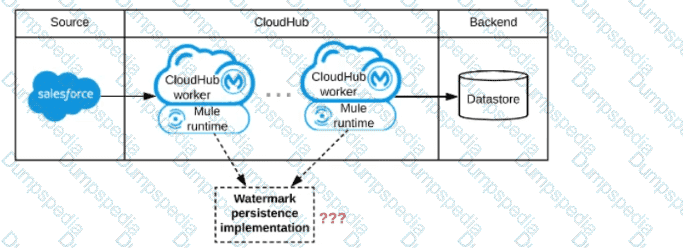
A Mule application is being designed to be deployed to several CIoudHub workers. The Mule application's integration logic is to replicate changed Accounts from Satesforce to a backend system every 5 minutes.
A watermark will be used to only retrieve those Satesforce Accounts that have been modified since the last time the integration logic ran.
What is the most appropriate way to implement persistence for the watermark in order to support the required data replication integration logic?
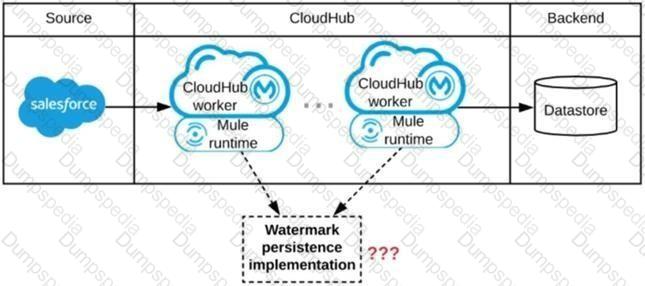
Customer has deployed mule applications to different customer hosted mule run times. Mule applications are managed from Anypoint platform.
What needs to be configured to monitor these Mule applications from Anypoint monitoring and what sends monitoring data to Anypoint monitoring?
In one of the critical payment related mule application, transaction is being used . As an enhancement to implementation , scatter gather route is introduced which is also the part of transaction group. Scatter gather route has 4 routes.
What will be the behavior of the Mule application in case of error occurs in 4th route of the scatter-gather router and transaction needs to be rolled back?
An organization is designing Mule application which connects to a legacy backend. It has been reported that backend services are not highly available and experience downtime quite often. As an integration architect which of the below approach you would propose to achieve high reliability goals?
An API client makes an HTTP request to an API gateway with an Accept header containing the value’’ application’’.
What is a valid HTTP response payload for this request in the client requested data format?
An organization is building out a test suite for their application using MUnit.
The Integration Architect has recommended using Test Recorder in Anypoint Studio to record the processing flows and then configure unit tests based on the captured events.
What Is a core consideration that must be kept In mind while using Test Recorder?
In Anypoint Platform, a company wants to configure multiple identity providers (IdPs) for multiple lines of business (LOBs). Multiple business groups, teams, and environments have been defined for these LOBs.
What Anypoint Platform feature can use multiple IdPs across the company’s business groups, teams, and environments?
Which Exchange asset type represents a complete API specification in RAML or OAS format?
A large life sciences customer plans to use the Mule Tracing module with the Mapped Diagnostic Context (MDC) logging operations to enrich logging in its Mule application and to improve tracking by providing more context in the Mule application logs. The customer also wants to improve throughput and lower the message processing latency in its Mule application flows.
After installing the Mule Tracing module in the Mule application, how should logging be performed in flows in Mule applications, and what should be changed In the log4j2.xml files?
A Mule application uses the Database connector.
What condition can the Mule application automatically adjust to or recover from without needing to restart or redeploy the Mule application?
A key Cl/CD capability of any enterprise solution is a testing framework to write and run repeatable tests.
Which component of Anypoint Platform provides the te6t automation capabilities for customers to use in their pipelines?
When designing an upstream API and its implementation, the development team has been advised to not set timeouts when invoking downstream API. Because the downstream API has no SLA that can be relied upon. This is the only donwstream API dependency of that upstream API. Assume the downstream API runs uninterrupted without crashing. What is the impact of this advice?
Mule application is deployed to Customer Hosted Runtime. Asynchronous logging was implemented to improved throughput of the system. But it was observed over the period of time that few of the important exception log messages which were used to rollback transactions are not working as expected causing huge loss to the Organization. Organization wants to avoid these losses. Application also has constraints due to which they cant compromise on throughput much. What is the possible option in this case?
A company is modernizing its legal systems lo accelerate access lo applications and data while supporting the adoption of new technologies. The key to achieving this business goal is unlocking the companies' key systems and dala including microservices miming under Docker and kubernetes containers using apis.
Considering the current aggressive backlog and project delivery requirements the company wants to take a strategic approach in the first phase of its transformation projects by quickly deploying API's in mule runtime that are able lo scale, connect to on premises systems and migrate as needed.
Which runtime deployment option supports company's goals?
An Order microservice and a Fulfillment microservice are being designed to communicate with their dients through message-based integration (and NOT through API invocations).
The Order microservice publishes an Order message (a kind of command message) containing the details of an order to be fulfilled. The intention is that Order messages are only consumed by one Mute application, the Fulfillment microservice.
The Fulfilment microservice consumes Order messages, fulfills the order described therein, and then publishes an OrderFulfilted message (a kind of event message). Each OrderFulfilted message can be consumed by any interested Mule application, and the Order microservice is one such Mute application.
What is the most appropriate choice of message broker(s) and message destination(s) in this scenario?
An external API frequently invokes an Employees System API to fetch employee data from a MySQL database. The architect must design a caching strategy to query the database only when there Is an update to the Employees table or else return a cached response in order to minimize the number of redundant transactions being handled by the database.
According to MuleSoft, a synchronous invocation of a RESTful API using HTTP to get an individual customer record from a single system is an example of which system integration interaction pattern?
An IT integration delivery team begins a project by gathering all of the requirements, and proceeds to execute the remaining project activities as sequential, non-repeating phases.
Which IT project delivery methodology is this team following?
What aspects of a CI/CD pipeline for Mule applications can be automated using MuleSoft-provided Maven plugins?
A company is planning to migrate its deployment environment from on-premises cluster to a Runtime Fabric (RTF) cluster. It also has a requirement to enable Mule applications deployed to a Mule runtime instance to store and share data across application replicas and restarts.
How can these requirements be met?
A trading company handles millions of requests a day. Due to nature of its business, it requires excellent
performance and reliability within its application.
For this purpose, company uses a number of event-based API's hosted on various mule clusters that communicate across a shared message queue sitting within its network.
Which method should be used to meet the company's requirement for its system?
An organization is designing a mule application to support an all or nothing transaction between serval database operations and some other connectors so that they all roll back if there is a problem with any of the connectors
Besides the database connector , what other connector can be used in the transaction.
An external REST client periodically sends an array of records in a single POST request to a Mule application API endpoint.
The Mule application must validate each record of the request against a JSON schema before sending it to a downstream system in the same order that it was received in the array
Record processing will take place inside a router or scope that calls a child flow. The child flow has its own error handling defined. Any validation or communication failures should not prevent further processing of the remaining records.
To best address these requirements what is the most idiomatic(used for it intended purpose) router or scope to used in the parent flow, and what type of error handler should be used in the child flow?
An organization if struggling frequent plugin version upgrades and external plugin project dependencies. The team wants to minimize the impact on applications by creating best practices that will define a set of default dependencies across all new and in progress projects.
How can these best practices be achieved with the applications having the least amount of responsibility?
An organization has various integrations implemented as Mule applications. Some of these Mule applications are deployed to custom hosted Mule runtimes (on-premises) while others execute in the MuleSoft-hosted runtime plane (CloudHub). To perform the Integra functionality, these Mule applications connect to various backend systems, with multiple applications typically needing to access the backend systems.
How can the organization most effectively avoid creating duplicates in each Mule application of the credentials required to access the backend systems?
Which productivity advantage does Anypoint Platform have to both implement and manage an AP?
When a Mule application using VM queues is deployed to a customer-hosted cluster or multiple CloudHub v1.0 workers/replicas, how are messages consumed across the nodes?
An organization has several APIs that accept JSON data over HTTP POST. The APIs are all publicly available and are associated with several mobile applications and web applications. The organization does NOT want to use any authentication or compliance policies for these APIs, but at the same time, is worried that some bad actor could send payloads that could somehow compromise the applications or servers running the API implementations. What out-of-the-box Anypoint Platform policy can address exposure to this threat?
A project uses Jenkins to implement CI/CD process. It was observed that each Mule package contains some of the Jenkins files and folders for configurations of CI/CD jobs.
As these files and folders are not part of the actual package, expectation is that these should not be part of deployed archive.
Which file can be used to exclude these files and folders from the deployed archive?
According to MuleSoft, which major benefit does a Center for Enablement (C4E) provide for an enterprise and its lines of business?
What best describes the Fully Qualified Domain Names (FQDNs), also known as DNS entries, created when a Mule application is deployed to the CloudHub Shared Worker Cloud?
What requirement prevents using Anypoint MQ as the messaging broker for a Mule application?
A Mule application contains a Batch Job with two Batch Steps (Batch_Step_l and Batch_Step_2). A payload with 1000 records is received by the Batch Job.
How many threads are used by the Batch Job to process records, and how does each Batch Step process records within the Batch Job?
An organization is creating a Mule application that will be deployed to CloudHub. The Mule application has a property named dbPassword that stores a database user’s password.
The organization's security standards indicate that the dbPassword property must be hidden from every Anypoint Platform user after the value is set in the Runtime Manager Properties tab.
What configuration in the Mule application helps hide the dbPassword property value in Runtime Manager?
What is an advantage that Anypoint Platform offers by providing universal API management and Integration-Platform-as-a-Service (iPaaS) capabilities in a unified platform?
According to MuleSoft's API development best practices, which type of API development approach starts with writing and approving an API contract?
An organization uses one specific CloudHub (AWS) region for all CloudHub deployments. How are CloudHub workers assigned to availability zones (AZs) when the organization's Mule applications are deployed to CloudHub in that region?
An organization heeds to procure an enterprise software system to increase cross-selling opportunities and better rack prospect data.
Which category of enterprise software has these core capabilities, when used for its typical and intended purpose?
Insurance organization is planning to deploy Mule application in MuleSoft Hosted runtime plane. As a part of requirement , application should be scalable . highly available. It also has regulatory requirement which demands logs to be retained for at least 2 years. As an Integration Architect what step you will recommend in order to achieve this?
An organization is migrating all its Mule applications to Runtime Fabric (RTF). None of the Mule applications use Mule domain projects.
Currently, all the Mule applications have been manually deployed to a server group among several customer hosted Mule runtimes.
Port conflicts between these Mule application deployments are currently managed by the DevOps team who carefully manage Mule application properties files.
When the Mule applications are migrated from the current customer-hosted server group to Runtime Fabric (RTF), fo the Mule applications need to be rewritten and what DevOps port configuration responsibilities change or stay the same?
A DevOps team has adequate observability of individual system behavior and performance, but it struggles to track the entire lifecycle of each request across different microservices.
Which additional observability approach should this team consider adopting?
Refer to the exhibit.
An organization is designing a Mule application to receive data from one external business partner. The two companies currently have no shared IT infrastructure and do not want to establish one. Instead, all communication should be over the public internet (with no VPN).
What Anypoint Connector can be used in the organization's Mule application to securely receive data from this external business partner?
An API implementation is being developed to expose data from a production database via HTTP requests. The API implementation executes a database SELECT statement that is dynamically created based upon data received from each incoming HTTP request. The developers are planning to use various types of testing to make sure the Mule application works as expected, can handle specific workloads, and behaves correctly from an API consumer perspective. What type of testing would typically mock the results from each SELECT statement rather than actually execute it in the production database?
How are the API implementation , API client, and API consumer combined to invoke and process an API ?
Following MuleSoft best practices, what MuleSoft runtime deployment option best meets the company's goals to begin its digital transformation journey?
A REST API is being designed to implement a Mule application.
What standard interface definition language can be used to define REST APIs?
An organization uses a four(4) node customer hosted Mule runtime cluster to host one(1) stateless api implementation. The API is accessed over HTTPS through a load balancer that uses round-robin for load distribution. Each node in the cluster has been sized to be able to accept four(4) times the current number of requests.
Two(2) nodes in the cluster experience a power outage and are no longer available. The load balancer directs the outage and blocks the two unavailable the nodes from receiving further HTTP requests.
What performance-related consequence is guaranteed to happen to average, assuming the remaining cluster nodes are fully operational?
A travel company wants to publish a well-defined booking service API to be shared with its business partners. These business partners have agreed to ONLY consume SOAP services and they want to get the service contracts in an easily consumable way before they start any development. The travel company will publish the initial design documents to Anypoint Exchange, then share those documents with the business partners. When using an API-led approach, what is the first design document the travel company should deliver to its business partners?
Which key DevOps practice and associated Anypoint Platform component should a MuteSoft integration team adopt to improve delivery quality?
Refer to the exhibit.
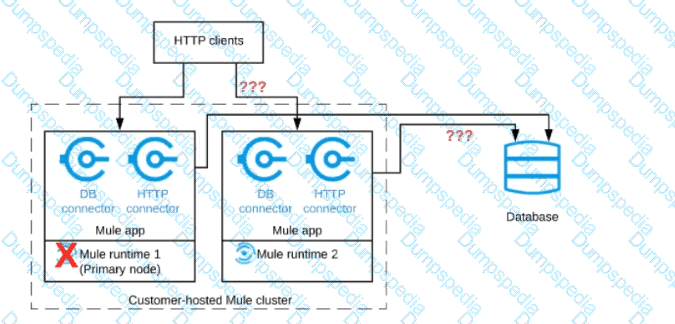
A Mule application is deployed to a cluster of two customer-hosted Mute runtimes. The Mute application has a flow that polls a database and another flow with an HTTP Listener.
HTTP clients send HTTP requests directly to individual cluster nodes.
What happens to database polling and HTTP request handling in the time after the primary (master) node of the cluster has railed, but before that node is restarted?
A team has completed the build and test activities for a Mule application that implements a System API for its application network.
Which Anypoint Platform component should the team now use to both deploy and monitor the System AP\ implementation?
An architect is designing a Mule application to meet the following two requirements:
1. The application must process files asynchronously and reliably from an FTPS server to a back-end database using VM intermediary queues for
load-balancing Mule events.
2. The application must process a medium rate of records from a source to a target system using a Batch Job scope.
To make the Mule application more reliable, the Mule application will be deployed to two CloudHub 1.0 workers.
Following MuleSoft-recommended best practices, how should the Mule application deployment typically be configured in Runtime Manger to best
support the performance and reliability goals of both the Batch Job scope and the file processing VM queues?
To implement predictive maintenance on its machinery equipment, ACME Tractors has installed thousands of IoT sensors that will send data for each machinery asset as sequences of JMS messages, in near real-time, to a JMS queue named SENSOR_DATA on a JMS server. The Mule application contains a JMS Listener operation configured to receive incoming messages from the JMS servers SENSOR_DATA JMS queue. The Mule application persists each received JMS message, then sends a transformed version of the corresponding Mule event to the machinery equipment back-end systems.
The Mule application will be deployed to a multi-node, customer-hosted Mule runtime cluster. Under normal conditions, each JMS message should be processed exactly once.
How should the JMS Listener be configured to maximize performance and concurrent message processing of the JMS queue?
An organization uses Mule runtimes which are managed by Anypoint Platform - Private Cloud Edition. What MuleSoft component is responsible for feeding analytics data to non-MuleSoft analytics platforms?

TESTED 12 Oct 2026
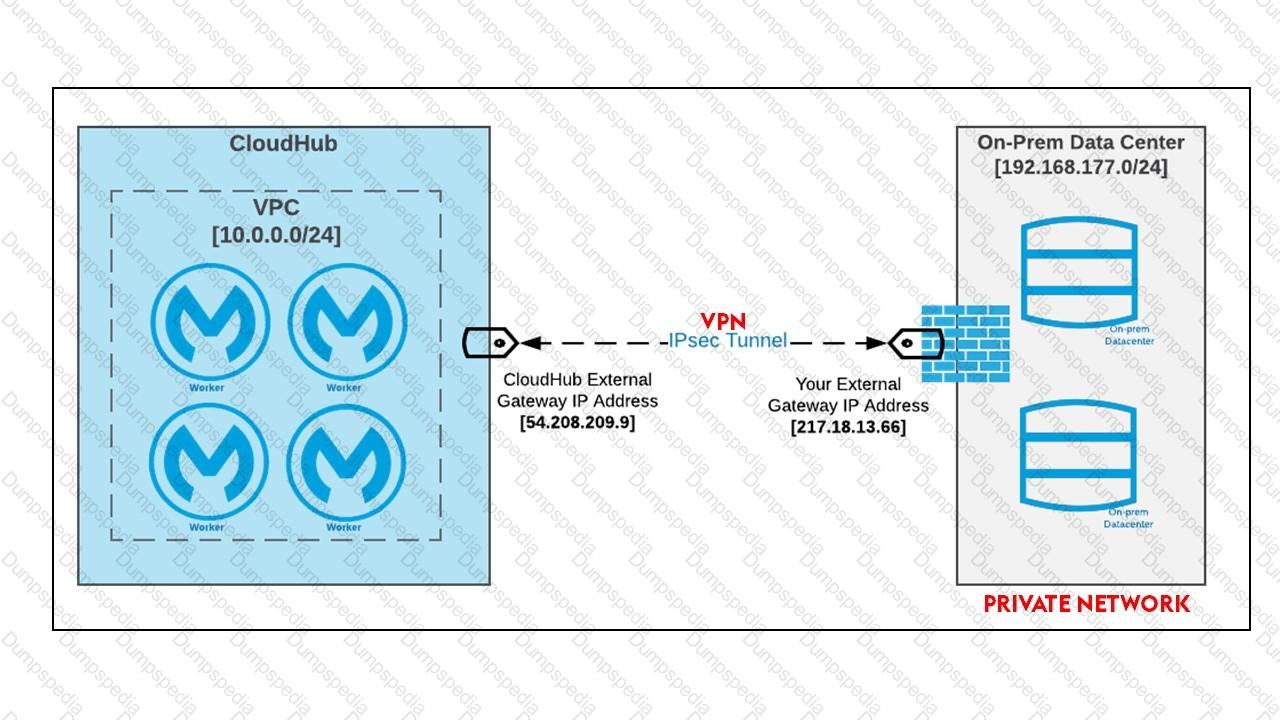 Diagram Description automatically generated
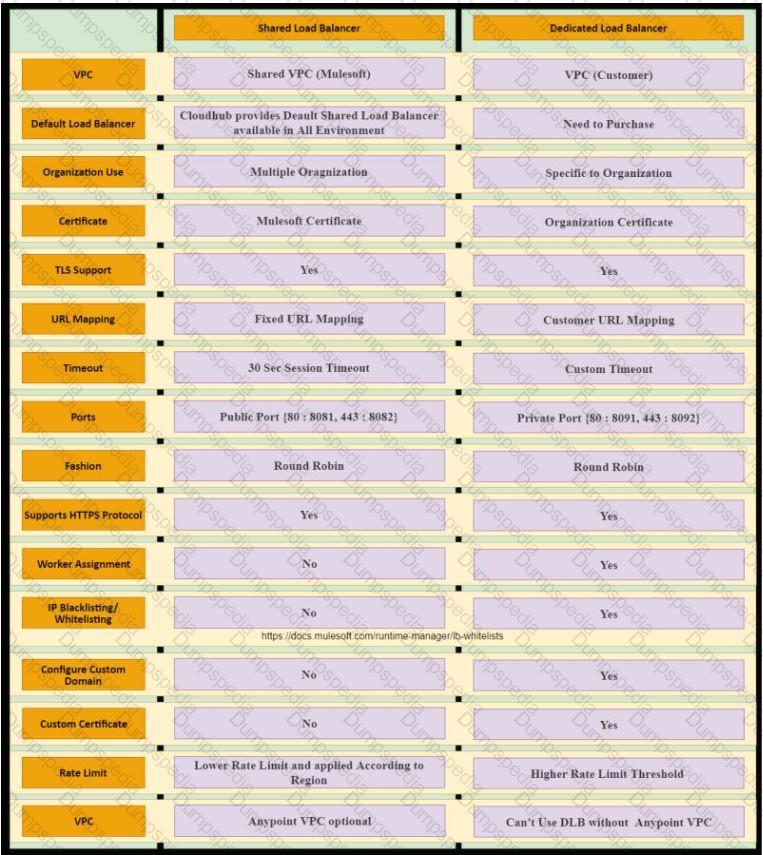 Table Description automatically generated
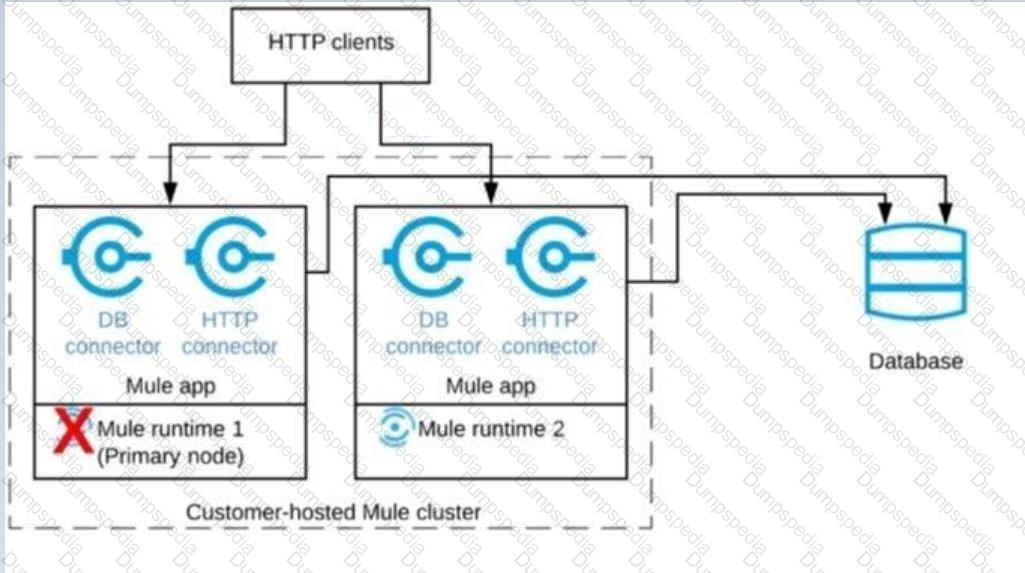 Diagram Description automatically generated