dumpspedia logo

A solution architect designs a protection policy in Prism Central to protect a specific set of VMs. The design calls for synchronous replication to two separate availability zones (AZs) simultaneously to ensure zero data loss at multiple physical locations. Which configuration limitation prevents the implementation of this specific design?
An administrator needs to perform a test failover on a Recovery Plan. What is the primary goal of this action?
An administrator notices that storage utilization continues to increase at both the primary and recovery sites after implementing a third-party backup solution that uses protection policies. Which configuration should be reviewed first?
A deployment uses native encryption for replication traffic between two clusters. An administrator subsequently enables network segmentation to isolate this traffic. Which specific maintenance step must be performed to ensure the encrypted replication functions correctly on the new segmented network?
What must the maximum Round Trip Latency be less than between a Witness VM and Metro Availability PDs?
A third-party backup solution is configured to use Nutanix application-consistent snapshots. Backups are failing for several Windows VMs, although crash-consistent snapshots succeed.
What is the most likely cause of the failure?
An administrator migrates a guest VM from a legacy Protection Domain–based DR configuration to a Prism Central (PC)–based Protection Policy. Immediately after migration, the administrator considers deleting the legacy Protection Domain snapshots to reclaim storage. According to Nutanix guidance, when is it safe to delete the legacy Protection Domain snapshots?
A company ' s two clusters are part of the same availability zone. Prism Central, which holds the protection policy configuration and recovery plans, is located on Cluster A and protected by the Prism Central Backup and Restore mechanism. What is the first step to take to execute a disaster recovery plan on the datacenter hosting Cluster A?
During a Test Failover, how can an administrator ensure that test VMs do not disrupt production?
An administrator is planning to deploy some 2-node clusters and is reviewing data protection strategies for some of the critical VMs.
What can be the minimum RPO for these VMs?
An administrator is tasked with ensuring the VMs do not experience downtime during an upcoming network maintenance on the primary cluster. The VMs are protected by a Protection Policy and are configured under a Recovery Plan. What failover mechanism should the administrator use to ensure the VMs are available on the target cluster before the maintenance window?
An administrator executes an Unplanned Failover of web server VMs from an on-premises AZ to a Nutanix Cloud Cluster (NC2) on AWS. The Recovery Plan completes, and the VMs are running. However, external users cannot access the websites hosted on these VMs. The administrator verifies that the firewall rules are set correctly. What specific configuration is required for these VMs to be reachable from the external network after failover to NC2?
An administrator protects workloads between two ESXi clusters using asynchronous (async) replication. After failover, VMs power on successfully but are placed in the default folder and resource pool instead of their original vSphere folders. Why did this occur?
An administrator recently expanded a Nutanix cluster by adding several new nodes. Shortly after, multiple backup jobs began failing. The following error is consistently reported: " Failed to perform backup: Cannot complete process ' iscsiadm --mode discovery --type sendtargets --portal X.X.X.X ' within timeout " . What is the most likely cause of the failure?
An administrator is validating a newly created Recovery Plan and receives the following warning:
IP addresses xxx.xxx.xxx.xxx cannot be preserved/mapped for VM REPORTVM01.
IP addresses cannot be preserved/mapped for entities
IP might be already in use or will be used by some other VM for recovery. IP cannot be mapped.
Only one IP address can be preserved for a vNIC in an IP address management enabled network.
What can the administrator do to resolve this warning without changing the existing IP address assigned to the VM?
A VM is protected in an Async Protection Policy with a schedule for every 1 hour. The replications are completing successfully every hour. The VM hosts a critical application and cannot afford any data loss. The administrator unprotects the VM from the Async Policy and protects the VM in a Synchronous policy. The administrator also notices that the VM is not entering the " Sync " state and is stuck in syncing for a long time. The administrator notices the error in the logs:
Enabling stretch for entity TestVM failed while notifying vm service due to error
Acropolis failed to handle VmSyncRepEnable request for VM TestVM
Failed to connect to remote Anduril
What port needs to be allowed between the clusters to fix the issue?
A company is recovering a 3-tier application (Database, Middleware, Web). The administrator executes the Recovery Plan. The Web tier VMs start up but applications immediately crash because they cannot connect to the Database tier. Which setting in the Recovery Plan should the administrator have configured to prevent this execution failure?
An organization is finalizing its Disaster Recovery (DR) plan. The primary objective is to balance cost-efficiency with a target RTO of under 15 minutes. Data currently resides in Object Storage, but the team is debating between a Zero Compute approach and a Pilot Light approach. Why would a Pilot Light infrastructure be selected over a Zero Compute model despite the higher " Moderate " cost?
What must an administrator verify before starting a migration of entities from a protection domain to a protection policy?
Which statement describes the most efficient and least disruptive method to achieve a file-level recovery without rolling back the entire VM?
An administrator is preparing to configure DR between an on-prem AZ and Nutanix Cloud AZ. Replication fails immediately after configuration. Which prerequisite should be verified?
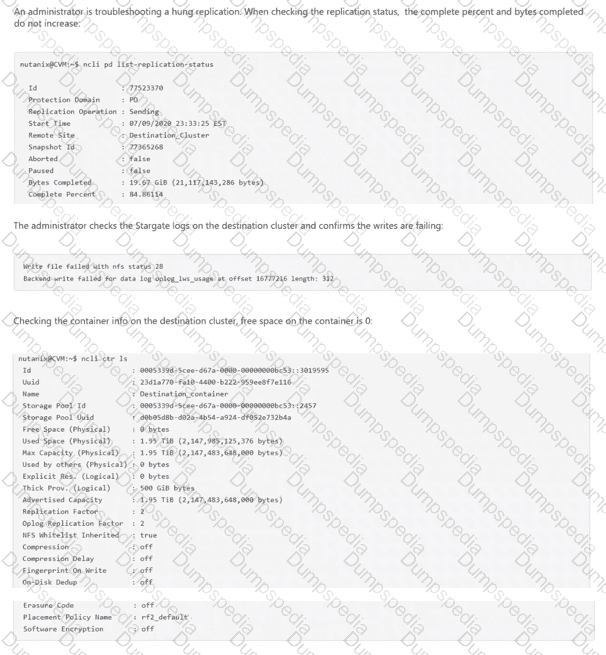
An administrator is troubleshooting a hung replication. When checking the replication status, the complete percent and bytes completed do not increase. The administrator checks the Stargate logs on the destination cluster and confirms the writes are failing with " nfs status 28 " . Checking the container info on the destination cluster, free space on the container is 0. The administrator confirms that there is sufficient space available in the storage pool. What could be the reason for free space on the container to be 0?
While attempting to execute a Commvault backup plan, an administrator received the following error for several VMs: " Virtual Machine not found " . After confirming the VMs exist, the administrator finds the following related error message: " Event Code 91:4 Virtual machine [Nutanix-Web-Server] was not found. Please verify that the virtual machine still exists and that the host is in the connected state. " Which action should the administrator take to enable successful backups?
An administrator at a retail company is preparing to apply a critical OS security patch to a production SQL Server VM. Before starting, the administrator ensures the VM is part of a Protection Domain and manually creates a local snapshot (Recovery Point). Ten minutes after the patch is applied, the SQL service fails to start, and the database logs indicate corruption in the system registry. The administrator needs to return the VM to its functional state from ten minutes ago as quickly as possible. The administrator decides to perform a Restore from the local snapshot. Under which condition would an In-place Restore (Revert) fail, forcing the administrator to use the Clone (Out-of-place) option instead?
An administrator plans to migrate guest VMs from a legacy Protection Domain–based DR plan to the Prism Central–based Disaster Recovery solution. What should be done first before removing the legacy protection domains?
Which two Data Protection technologies are compatible with Self-Service Restore? (Choose two.)
An administrator enables network segmentation for Disaster Recovery on a primary cluster to isolate replication traffic. The primary and recovery clusters are in a " brownfield " configuration, meaning the recovery cluster does not yet have network segmentation enabled.
How is the configuration of the recovery cluster handled in this scenario?
An administrator is testing the failover scenarios from a source availability zone (AZ1) to a destination availability zone (AZ2). The administrator successfully performs an unplanned failover from AZ1 to AZ2. The administrator then immediately tries to use the unplanned failover option to fail the VM back to AZ1, but does not see the VM listed under Recovery Plan. What could be the cause?

TESTED 15 Oct 2026