
Spring Sale - Limited Time 65% Discount Offer - Ends in 0d 00h 00m 00s - Coupon code: 65percent

Welcome To DumpsPedia

NCP-CN Sample Questions Answers

Questions 4

A Platform Engineer would like to deploy an NKP Platform Application to all the clusters within an NKP workspace from the command line. What is the command set to use, and what parameters must be specified with it?

Options:

A.

The nkp create appdeployment command set would be utilized. The application ID & version, as well as the NKP workspace of the clusters, must be provided.

B.

The nkp deploy platform-app command set would be utilized. The application ID, as well as the NKP workspace of the clusters, must be provided.

C.

The nkp deploy app command set would be utilized. The application ID, as well as the NKP workspace of the clusters, must be provided.

D.

The kubectl create appdeployment command set would be utilized. The application ID, as well as the NKP workspace of the clusters, must be provided.

Buy Now
Questions 5

Which NKP-supported infrastructure will not receive CAPI components when an NKP cluster is deployed to it?

Options:

A.

vSphere

B.

GCP

C.

Nutanix

D.

AKS

Buy Now
Questions 6

An administrator has been tasked with deploying NKP as the Kubernetes platform and needs to deploy their first cluster with the following requirements:

    Dark site (no Internet connectivity)

    Nutanix-provided Rocky Linux VM image

    AHV-based clusterWhat are two prerequisites to accomplish the deployment? (Choose two)

Options:

A.

Konvoy Image Builder

B.

Air-Gapped Bundle

C.

Existing local container registry

D.

Self-managed AWS cluster

Buy Now
Questions 7

During a deployment of NKP, a Platform Engineer received an error indicating an issue with the bootstrap. While troubleshooting with support, the engineer noticed that the KUBECONFIG file was missing. How would the engineer recreate the bootstrap cluster and create a context file named bootstrap-cluster.conf?

Options:

A.

nutanix create bootstrap --kubeconfig bootstrap-cluster.conf

B.

kubectl create bootstrap --kubeconfig bootstrap-cluster.conf

C.

nkp create bootstrap --kubeconfig bootstrap-cluster.conf

D.

d2iq create bootstrap --kubeconfig bootstrap-cluster.conf

Buy Now
Questions 8

An administrator has been trying to deploy an initial AHV-based NKP cluster in a dark site (no Internet connectivity) environment using the command shown in the question.

nkp create cluster nutanix \

--cluster-name=$CLUSTER_NAME \

--control-plane-prism-element-cluster=$PE_NAME \

--worker-prism-element-cluster=$PE_NAME \

--control-plane-subnets=$SUBNET_ASSOCIATED_WITH_PE \

--worker-subnets=$SUBNET_ASSOCIATED_WITH_PE \

--control-plane-endpoint-ip=$AVAILABLE_IP_FROM_SAME_SUBNET \

--csi-storage-container=$NAME_OF_YOUR_STORAGE_CONTAINER \

--endpoint=$PC_ENDPOINT_URL \

--control-plane-vm-image=$NAME_OF_OS_IMAGE_CREATED_BY_NKP_CLI \

--worker-vm-image=$NAME_OF_OS_IMAGE_CREATED_BY_NKP_CLI \

--registry-url=${REGISTRY_URL} \

--registry-mirror-username=${REGISTRY_USERNAME} \

--registry-mirror-password=${REGISTRY_PASSWORD} \

--kubernetes-service-load-balancer-ip-range $START_IP-$END_IP \

--self-managed

Which missing attribute needs to be added in order for the deployment?

Options:

A.

--airgapped

B.

--insecure

C.

--registry-url

D.

--registry-username

Buy Now
Questions 9

A Cloud Engineer wishes to attach existing AKS clusters to a newly deployed NKP management cluster.

What should the engineer consider specific to attaching these types of clusters to NKP?

Options:

A.

A separate service account should be created for them because their kubeconfig files are not usable out-of-box by NKP Kommander.

B.

AKS does not have the kubelet installed on them. Therefore the KIB-prep process should be performed on each of the nodes in the AKS clusters prior to attaching them.

C.

AKS nodes do not use containerd as its container runtime. Therefore it should be deployed to each of the nodes in the AKS clusters prior to attaching them.

D.

Cert-manager, which is included in NKP, is deployed by default on AKS clusters.

Buy Now
Questions 10

When deploying an NKP cluster onto air-gapped, pre-provisioned servers, Konvoy Image Builder is utilized to prepare the servers to become NKP cluster nodes.

What does the konvoy-image upload command do as a part of this preparation process?

Options:

A.

The command is used to create a konvoy userid on the servers, as well as upload artifacts to them such as the container runtime, the OS bundle, and Kubernetes components.

B.

The command is used to upload OS hardening scripts to the server (must be client supplied).

C.

The command uploads artifacts to the servers such as the container runtime, the OS bundle, and Kubernetes components.

D.

The command uploads artifacts to the servers such as the container runtime, the OS bundle, and Kubernetes components, including optional OS hardening scripts (must be client supplied).

Buy Now
Questions 11

A Platform Engineer has a requirement for backup and recovery and would like to leverage an Out-Of-The-Box solution distributed with NKP. What is the backup and recovery solution distributed for NKP?

Options:

A.

Tar

B.

Kasten

C.

Velero

D.

Nutanix Snapshot

Buy Now
Questions 12

A Platform Engineer needs to do an air-gapped installation of NKP. This environment needs to run without Internet access and be fully operational, including updates. Docker has been installed, and the NKP bundle exists on a bastion host. What is the first command that the engineer must run to begin the process?

Options:

A.

nkp push bundle --bundle

B.

docker load -i konvoy-bootstrap-image-v2.12.0.tar

C.

tar -xzvf nkp-air-gapped-bundle_v2.12.0_linux_amd64.tar.gz

D.

nkp create cluster nutanix

Buy Now
Questions 13

A Cloud Engineer would like to configure an NKP cluster that is running in the cloud to dynamically expand and compact its resource capacity for running container workloads. This will help ensure efficient use of resources without impacting online retail transaction performance that is increasingly hitting unpredictable spikes and lulls.

Which autoscaling method does NKP use and how does it scale?

Options:

A.

Horizontal-Pod autoscaler and worker node replicas

B.

Horizontal-Pod autoscaler and worker node CPU/memory sizing

C.

Cluster autoscaler and worker node replicas

D.

Cluster autoscaler and worker node CPU/memory sizing

Buy Now
Questions 14

A Platform Engineer is deploying an NKP workload cluster using the nkp create cluster vsphere command. The cluster will be utilized by the company’s code-green team and the engineer has already created a code-green NKP workspace on the NKP management cluster.

After issuing the deploy command, the engineer monitored the build using the nkp describe cluster command and confirmed it completed successfully. However, a few hours later, after logging into the NKP UI, the engineer checked the code-green NKP workspace and saw that the NKP workload cluster was not there.

What is the likely reason the NKP workload cluster is not in the code-green NKP workspace?
Options:

A.

The vSphere cluster cannot be displayed in the NKP UI unless its Kubernetes version is within ‘N - 1’ versions of the NKP management cluster’s Kubernetes version.

B.

The vSphere service account credentials had expired prior to the engineer’s attempt to view the cluster in the NKP UI. Once the credentials are refreshed, the vSphere cluster will reappear in the NKP workspace.

C.

The engineer did not supply the --namespace code-green parameter as part of the nkp create cluster vsphere command, therefore it was created in the default workspace and needs to be manually attached.

D.

NKP vSphere clusters cannot be assigned NKP workspaces and instead are assigned the default NKP workspace. The cluster can be viewed from this workspace instead.

Buy Now
Questions 15

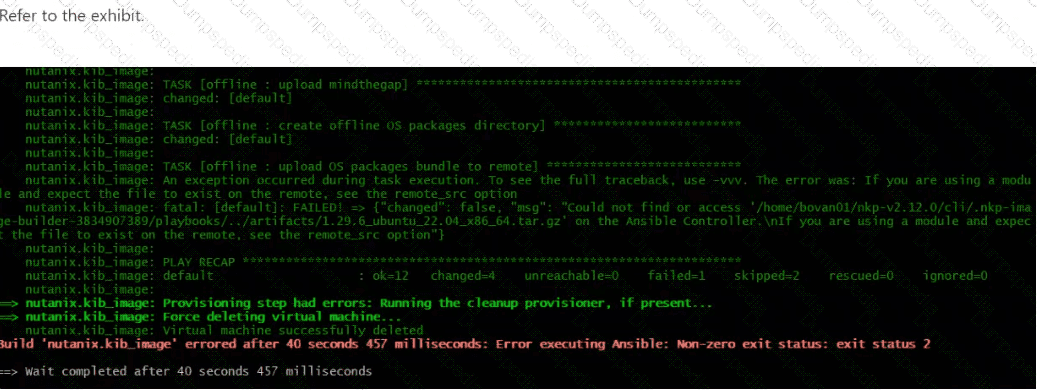
A Platform Engineer is preparing to deploy a new NKP cluster on Nutanix infrastructure into an air-gapped environment. As part of the preparation process, the engineer is supplying a Ubuntu 22.04 instance to be used for NKP cluster nodes that conforms to the corporate OS image hardening standards. However, during the NIB preparation process, the error shown in the exhibit is received.

What is the likely reason the NIB preparation attempt has failed?

Options:

A.

The engineer has supplied the inartifacts directory for the OS package bundle in the NIB-prep command.

B.

Ubuntu 22.04 is not a supported OS for NKP nodes on Nutanix infrastructure, therefore the necessary OS package bundle does not exist.

C.

The engineer has not seeded the local registry with the required NKP images prior to the NIB-prep attempt.

D.

The engineer has not created the OS package bundle prior to the NIB-prep attempt.

Buy Now
Questions 16

A company has a new DevOps team that needs to be provided cloud native computing resources. This team will need to have access to multiple NKP clusters for development, testing and validation of an in-house application. However, they also need to be restricted to a specific namespace and a consistent level of access across the clusters within this namespace so that they do not adversely impact the environment of other user groups or the clusters themselves.

As a part of this consideration, the new team also needs to be limited to the amount of storage, CPU and memory they can consume on the clusters. A Platform Engineer has been tasked with providing the appropriate level of access to the team on these multiple NKP clusters.

How should the engineer best accomplish this task?

Options:

A.

1.Create an NKP project and assign the NKP clusters to it.

2.Create quotas for the NKP project.

3.Create an NKP group for the DevOps team.

4.Assign that NKP group the proper RBAC roles within that NKP project.

B.

1.Create an NKP workspace and assign the NKP clusters to it.

2.Create quotas for the NKP workspace.

3.Create an NKP group for the DevOps team.

4.Assign that NKP group the proper RBAC roles within that NKP workspace.

C.

1.Create an NKP group for the DevOps team.

2.Assign that NKP group the proper RBAC roles in the NKP UI.

3.Select the export to yaml option once the RBAC role assignment to that NKP group is complete.

4.Apply the exported manifest to each of the NKP clusters using kubectl.

D.

1.Enable Gatekeeper on the NKP clusters.

2.Create an NKP group for the DevOps team.

3.Assign Gatekeeper quota and authorization policies to that NKP group.

Buy Now
Questions 17

After a finished project, three Kubernetes clusters within a workspace were deleted, so the workspace is empty. Now a Platform Engineer needs to delete the workspace. How should the engineer delete the workspace in NKP?

Options:

A.

Run kubectl delete workspace

B.

Run kubectl delete workspace

C.

From NKP UI, on top menu bar select Global, then select Workspaces in the menu, select the three-dot button for the workspace to delete, and then click Delete.

D.

Ask a workspace user to delete the workspace. The user has the Delete option in their workspace home page.

Buy Now
Questions 18

A DevOps team faces a growing challenge of managing logs from multiple applications in an NKP cluster. With several teams working on different projects, it is essential to implement a Multi-Tenant Logging system that allows each team to access their own logs securely and efficiently. Initially, two namespaces have been configured for each project, as shown in the exhibit. Then a ConfigMap has also been configured for each tenant, which contains the logging configuration. Which YAML output corresponds to a retention period of 30 days for tenant-innovation and seven days for tenant-analytics?

Options:

A.

yaml

CollapseWrap

Copy

apiVersion: v1

kind: ConfigMap

metadata:

name: logging-innovation-config

namespace: tenant-innovation

data:

values.yaml: |

loki:

structuredConfig:

limits_config:

retention_period: 30d

---

apiVersion: v1

kind: ConfigMap

metadata:

name: logging-analytics-config

namespace: tenant-analytics

data:<

B.

yaml

CollapseWrap

Copy

apiVersion: v1

kind: ConfigMap

metadata:

name: logging-innovation-config

namespace: tenant-innovation

data:

values.yaml: |

loki:

structuredConfig:

limits_config:

retention_period: 30d

---

apiVersion: v1

kind: ConfigMap

metadata:

name: logging-analytics-config

namespace: tenant-innovation

data:

C.

yaml

CollapseWrap

Copy

apiVersion: v1

kind: ConfigMap

metadata:

name: logging-innovation-config

namespace: tenant-innovation

data:

values.yaml: |

loki:

structuredConfig:

limits_config:

retention_period: 30h

---

apiVersion: v1

kind: ConfigMap

metadata:

name: logging-analytics-config

namespace: tenant-analytics

data:<

D.

yaml

CollapseWrap

Copy

apiVersion: v1

kind: ConfigMap

metadata:

name: logging-innovation-config

namespace: tenant

data:

values.yaml: |

loki:

structuredConfig:

limits_config:

retention_period: 30d

---

apiVersion: v1

kind: ConfigMap

metadata:

name: logging-analytics-config

namespace: tenant

data:

values.yaml: |<

Buy Now
Questions 19

When deploying NKP using the Nutanix provisioning method (CAPX), what are the supported OS platforms?

Options:

A.

CentOS and Rocky Linux

B.

Rocky Linux and Ubuntu

C.

Flatcar, Rocky Linux, and Ubuntu

D.

CentOS and Ubuntu

Buy Now
Questions 20

A Platform Engineer sees no insight in all workspaces, and it is a critical feature to control all the alerts on all company’s Kubernetes clusters. What does the engineer need to do to begin generating NKP Insights?

Options:

A.

Acquire the NKP Insights Add-on license.

B.

Install nkp-insights in every Kubernetes cluster with kubectl apply -f nkp-insights-1.2.2 --kubeconfig=.conf

C.

Create a persistent volume claim and assign it to nkp-insights; this application requires volumes to save logs and data. Install nkp-insights with nkp create appdeployment nkp-insights --app nkp-insights-1.2.2 --workspace kommander-workspace

Buy Now
Questions 21

A company has enabled auto-scaling within an NKP cluster. What is the behavior for auto-scaling?

Options:

A.

CPU is hot-added or hot-removed from a node.

B.

Memory is hot-added or hot-removed from a node.

C.

The Power-On Status/Mode of a node is changed to meet load conditions.

D.

Nodes will be CAPI-created or CAPI-deleted as needed by the cluster.

Buy Now
Questions 22

Refer to the exhibits.

A Cloud Administrator had provisioned a Kubernetes cluster named demo that is no longer actively being used. A Quick review from the Systems Engineer confirms that the following VMs are part of the demo Kubernetes cluster
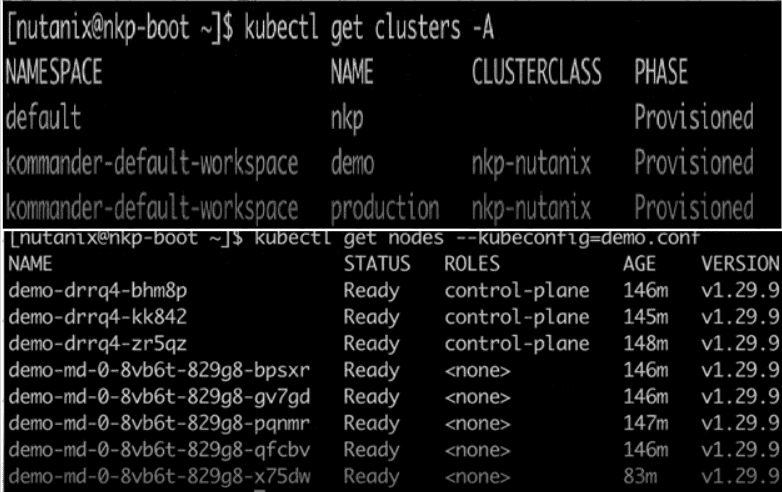
How should the demo cluster be properly deleted?

Options:

A.

Run nkp delete cluster -c demo -n kommander-default-workspace

B.

Delete all the VMs and inform of the results.

C.

Run acli vm.delete demo* from a CVM.

D.

Run kubectl config delete-cluster demo -n kommander-default-workspace and delete the VMs.

Buy Now
Questions 23

A Platform Engineer is deploying an NKP cluster within an air-gapped AWS environment. However, after an infrastructure planning session with the network team, it’s been determined that the default CIDR block range that is used by pods on NKP clusters is already in use in their environment.

How can the engineer ensure there are no collisions between NKP pod traffic and the existing network using that subnet range?

Options:

A.

Because the environment is air-gapped, there will be no network traffic collision concerns and no adjustment needs to be made to the pod network CIDR block range.

B.

Create an NKP infrastructure provider for AWS in the NKP UI.

Select the Advanced Options button from the Network section of the Create Cluster page and specify a unique CIDR block range within the pod network field.

C.

Create the NKP cluster’s manifest using the nkp create cluster command set and include the pod CIDR block range parameter when generating the cluster manifest.

Deploy the NKP cluster manifest.

D.

Create an NKP infrastructure provider for AWS in the NKP UI.

When deploying the NKP cluster through the UI, specify a unique CIDR block range for the pod network field in the Network section of the Create Cluster page.

Buy Now
Questions 24

Which NKP tier is required for the FIPS Compliant Build feature?

Options:

A.

Advanced

B.

Enterprise

C.

Starter

D.

Pro

Buy Now
Questions 25

A company has 30 Edge devices with lightweight Kubernetes, and developers need to push the application to every edge device. An NKP administrator has the NKP Ultimate license tier configured and has access to all kubeconfig files for the 30 edge devices. What is the most efficient way that the administrator can lifecycle manage the application deployments?

Options:

A.

Create a GitHub configuration, deploy it to the 30 edge devices, and configure them to use a GitHub account.

B.

Create a script to automate the deployment to every edge device.

C.

Ask the developers to delete the lightweight Kubernetes and deploy new Kubernetes clusters with NKP.

D.

Create a new Workspace and attach the 30 edge devices to this workspace with Attach Cluster.

Buy Now
Questions 26

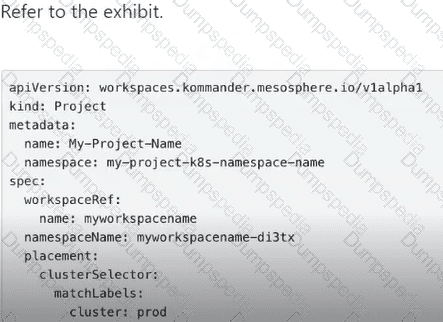
NKP cluster nodes require a disk for some of its deployed components, outside of an application’s persistent volume requirements. What are these components and where are they deployed?
Options:

A.

kubelet and containerd, in /opt/nkp

B.

kubelet and containerd in /var/lib

C.

kubectl and kubelet in /opt/nkp

D.

kubectl and kubelet in /var/nkp

Buy Now
Questions 27

After creating the project, what should the administrator configure in order for the new software releases to automatically deploy to both environments?

Options:

A.

Continue Deployment (CD)

B.

Continue Integration (CI)

C.

Project Secrets

D.

Project ConfigMaps

Buy Now
Questions 28

A Platform Engineer would like to install some NKP applications, but with a few modifications to the default configuration specs of some of the components. Additionally, Velero itself can be disabled, as the company already utilizes a different backup utility for Kubernetes.

Which procedure would the engineer utilize to accomplish these goals when deploying the applications?

Options:

A.

Execute nkp install kommander --init to an output file.

Set the custom specs for the components to be modified in the output file.

Deploy the NKP applications using the nkp install kommander command, specifying the output file.

Once the NKP applications install has completed, execute kubectl delete hr -n kommander velero.

B.

Execute nkp install kommander --init to an output file.

Disable Velero in the output file and set the custom specs for the components to be modified.

Deploy the NKP applications using the nkp install kommander command, specifying the output file.

C.

Execute nkp config kommander --init to an output file.

Disable Velero in the output file and set the custom specs for the components to be modified.

Deploy the applications using the helm install command, specifying the output file.

D.

Execute nkp config kommander.

Disable Velero in the resulting output file and set the custom specs for the components to be modified.

Deploy the NKP applications using the nkp install kommander command, specifying the output file.

Buy Now
Questions 29

A Kubernetes administrator needs to ensure that the following requirements are met whenever a new workload cluster is deployed to a workspace:

    Grafana Logging

    Grafana Loki

    Project LoggingHow would the administrator ensure that these components are deployed as part of a cluster deployment?

Options:

A.

Enable them in the Insights section under workspace.

B.

Enable them in the Projects section under workspace.

C.

Enable them in the Clusters section under workspace.

D.

Enable them in the Application section under workspace.

Buy Now
Questions 30

A current Nutanix cluster is hosting an NKP cluster and a production Kubernetes cluster named production. Infrastructure administrators recently added three nodes with NVidia GPUs for a new AI initiative, and now a Platform Engineer has been asked to add three workers with the GPUs to the production Kubernetes cluster. Which first step should the engineer take to achieve this task?

Options:

A.

Create a nodepool of workers with GPU:

text

CollapseWrap

Copy

nkp create nodepool nutanix -c $CLUSTER_NAME \

--vm-image $NAME_OF_GPU_OS_IMAGE_CREATED_BY_NKP_CLI \

-o yaml --subnets $NUTANIX_SUBNET_NAME \

--prism-element-cluster $NUTANIX_PRISM_ELEMENT_CLUSTER_NAME \

$NODEPOOL_NAME

B.

Add the GPU Operator to the new workers:

text

CollapseWrap

Copy

cat <

kind: Installation

apps:

nvidia-gpu-operator:

enabled: true

values: |

toolkit:

nodepool: md-0

EOF

C.

Configure Multi-Instance GPU (MIG):

text

CollapseWrap

Copy

kubectl label nodes ${NODE} nvidia.com/mig.config=all-1g.6gb –overwrite

D.

Create a GPU-compatible OS Image with:

text

CollapseWrap

Copy

nkp create image nutanix --gpu \

--gpu-name=${GPU_NAME} \

--cluster=${NUTANIX_CLUSTER_NAME} \

--endpoint=${NUTANIX_PC_ENDPOINT} \

--subnet=${NUTANIX_SUBNET} ubuntu-22.04

Buy Now
Questions 31

A company is developing a new web application consisting of several microservices, including:

    Authentication service

    User management service

    Payment processing service Each microservice is developed by different teams and requires an isolated environment for testing and development. To facilitate development and testing, the team decides to create a specific workspace in NKP. What should the team do to start this new creation?

Options:

A.

From the Cluster selection, select Add Cluster.

B.

From the workspace selection dropdown list in the top menu bar, select Create Workspace.

C.

From the workspace selection dropdown list in the top menu bar, select Add Workspace.

D.

From the Administration selection dropdown list in Infrastructure Providers, select Add Infrastructure Provider.

Buy Now
Questions 32

Which two statements are true regarding deploying NKP on an Azure Kubernetes Service (AKS) Infrastructure? (Choose two.)

Options:

A.

Existing AKS clusters must be attached to the Management cluster.

B.

AKS best practices encourage building customized images.

C.

NKP Management cluster with the Kommander component must be installed before installing NKP on AKS cluster.

D.

AKS clusters can be deployed as Management or Pro NKP clusters.

Buy Now
Exam Code: NCP-CN
Exam Name: Nutanix Certified Professional - Cloud Native (NCP-CN-6.10)
Last Update: Feb 28, 2026
Questions: 108
$57.75  $164.99
$43.75  $124.99
$36.75  $104.99
buy now NCP-CN