dumpspedia logo

Explain how a focus on each of the ' five rights of procurement ' can be used to meet Fast Fashion ' s objectives.
Fast Fashion is a national retailer of a variety of lower-priced clothing items, which are sold to men, women and children. It currently has 50 stores across different parts of the country and these are primarily based in the centres of towns and cities.
Fast Fashion buys its finished products, that are packaged ready for sale, from a range of global clothing manufacturers and then these are shipped directly from these suppliers to the stores. Fast Fashion then label and price the products in the stockrooms of each store, before putting them into the shops ' retail areas for sale to their customers.
As its stores are located in high-cost city and town centres, it has limited space for storage and rely on its suppliers to deliver on time and in the required quantities. Although Fast Fashion can compete with similarly priced physical high-street retailers, it is facing increased competition from global online sellers, who often buy the same product from the same suppliers, but can charge less due to the lower costs in their overall supply chain. In addition, some of its global suppliers have threatened to increase their prices, stating that their labour costs are rising in the developing economies in which they operate.
In order to meet Fast Fashion ' s objectives of effectively and efficiently managing the spend with its supply base, you have been recruited as an experienced procurement and supply manager.
See the solution in Explanation part below.
The ‘five rights of procurement’ are: right quality, right quantity, right place, right time, and right price. Focusing on each of these can help Fast Fashion meet its objective of managing spend effectively and efficiently with its suppliers.
1. Right Quality
Fast Fashion must ensure that the clothing it purchases meets the quality expectations of its customers. As a retailer of lower-priced fashion, the quality must be fit for purpose, durable enough for use, and consistent across batches.
By working closely with global suppliers and setting clear specifications, Fast Fashion can reduce issues such as defective goods or returns, which would increase costs. For example, poor-quality garments could damage brand reputation and lead to lost sales.
Therefore, achieving the right quality helps to:
Reduce waste and returns
Maintain customer satisfaction
Avoid unnecessary costs
2. Right Quantity
Due to limited storage space in city-centre stores, ordering the correct quantity is critical. Overstocking would lead to storage problems, while understocking could result in lost sales.
Fast Fashion should use demand forecasting and sales data to order appropriate quantities and possibly adopt just-in-time (JIT) delivery approaches.
For example, frequent smaller deliveries from suppliers would help balance stock levels and reduce holding costs.
This ensures:
Efficient use of limited space
Reduced inventory holding costs
Availability of products for customers
3. Right Place
Products must be delivered directly to the correct store locations, as Fast Fashion’s model relies on suppliers shipping directly to stores rather than central warehouses.
Ensuring delivery to the right place reduces handling costs and delays. If goods are sent to the wrong location, it would create additional transport costs and operational inefficiencies.
For example, accurate logistics coordination and clear delivery instructions can ensure goods arrive at the correct store first time.
This helps:
Improve operational efficiency
Reduce unnecessary transport costs
Ensure products reach customers quickly
4. Right Time
Timing is especially important in the fast fashion industry, where trends change quickly and stores have limited storage.
Fast Fashion depends heavily on suppliers delivering on time, as delays can lead to stockouts and missed sales opportunities. Late deliveries may also result in outdated stock that is no longer in demand.
For example, implementing supplier performance monitoring and agreements (such as SLAs) can help ensure timely deliveries.
This enables:
Continuous product availability
Reduced risk of lost sales
Better response to changing fashion trends
5. Right Price
Fast Fashion faces strong competition from online retailers with lower operating costs, as well as increasing supplier prices due to rising labour costs.
To achieve the right price, procurement must focus on:
Negotiating with suppliers
Building long-term relationships
Exploring alternative or lower-cost suppliers
Considering total cost of ownership (not just purchase price)
For example, consolidating orders or forming strategic partnerships may help secure better pricing.
This supports:
Cost control and profitability
Competitive pricing in the market
Efficient spend management
Conclusion
By focusing on the five rights of procurement, Fast Fashion can improve efficiency across its supply chain. This will allow the company to control costs, improve supplier performance, and remain competitive against online retailers, while meeting customer expectations.
Explain the following terms: outsourced procurement, shared service unit (SSU) and consortium procurement. What are the advantages and disadvantages of each approach to procurement? (25 points)
See the solution in Explanation part below.
How to approach this question:
- There are 3 terms and an advantage and disadvantage for each you need to talk about. So that’s 9 things. Out of 25 points you can see you’ll probably only get 1-2 points for each aspect of the question. That shows you the level of detail you need to include – not that much!
- In terms of structure feel free to use headings and bullet points for this one
Example Essay
Outsourced procurement, shared service units (SSUs), and consortium procurement are distinct approaches to managing procurement activities within organizations. Each method carries its own set of advantages and disadvantages, catering to different organizational needs and circumstances.
Outsourced Procurement: Outsourced procurement involves engaging a procurement consultant or an external organization to provide advice or handle the entire procurement process on behalf of the company. The advantages of outsourced procurement are that it frees up internal resources, allowing them to focus on other tasks. The expertise and skills brought by external consultants can also fill gaps in the organization ' s capabilities. Moreover, this approach is flexible, adapting well to irregular procurement needs. However, drawbacks include a potential loss of control, higher costs, the need for an additional management layer, and the risk of losing intellectual property (IP).
Shared Service Unit (SSU): A Shared Service Unit is an internal procurement support function within an organization that various divisions can access for assistance, resembling the outsourcing concept but within the organizational structure. The advantages of SSUs lie in potential cost savings, the ability to aggregate demand, and the establishment of common standards and processes across the company. The expertise utilized is internal, providing a sense of familiarity. The disadvantage is that measuring the success of an SSU can be challenging, and there is a risk of stifling innovation. The unit may also be perceived as remote from end users, and procurement processes might be slower due to serving multiple departments.
Consortium Procurement: Consortium procurement involves a collective effort where separate organizations join forces to purchase goods, thereby increasing their bargaining power. The advantages of this approach are in the aggregated demand, resulting in more economical purchases. Pooling knowledge and expertise within the consortium enhances the collective capabilities of its members, providing a sense of safety in numbers. However, disadvantages include a potential loss of individual organizational power, prolonged decision-making processes within the consortium, challenges in responding quickly to demands, and the potential hindrance to small and medium-sized enterprises (SMEs) competing if demand is aggregated.
In conclusion, organizations must carefully consider their specific needs, priorities, and the nature of their procurement requirements when choosing between outsourced procurement, SSUs, or consortium procurement. Each approach offers unique benefits and challenges, and the decision-making process should align with the organization ' s overall goals and strategies.
Tutor Notes:
- I’ve named lots of advantages and disadvantages for each of the models. 1-2 advantages and disadvantages of each is all you need to secure you the marks. Remember you only have 35 minutes to write this. A danger with this type of question is spending too long on one aspect of the question and running out of time to answer the rest of it.
- A good idea is to pace yourself and give yourself 10 minutes per term (outsourced, SSU and consortium) then 5 minutes at the end to review and edit your response.
- Some further details you may wish to include:
- Outsourced procurement – this is often used when the organisation doesn’t have the expertise to procure the item they need. This often happens for complex / technical procurements or highly regulated industries. An example may be a housing provider who runs a block of flats where the lift has just broken down and cannot be fixed. They need to procure a new lift but have no idea how to write a specification for this as they don’t have the technical knowledge of how lifts work. Hiring a consultant who is experienced in tendering for lifts, although expensive, may actually save money by reducing the risk of procuring the wrong thing.
- SSU – a Shared Service Unit acts as a support function for the organisation. This is described in Porter’s Value Chain- all other departments can call on the SSU when they require assistance. The SSU is responsible for managing its own costs, employs its own resources and may have contractual agreements with other divisions. The main aim of the SSU is to add value. SSUs are common in large organisations where the core activities don’t revolve around procurement (such as finance and service industries).
- Consortium – Consortium buying is encouraged in the public sector in order to maximise value for money. Consortiums can create their own Frameworks. There is a risk that large consortia can abuse their dominant market position.
- LO 3.3 p. 161
Describe the four main ways that a Public Sector organisation can procure goods or services (25 points)
See the solution in Explanation part below.
How to approach this question
- This question is testing to see if you know the 4 procurement procedures allowed in the Public Sector which are: open, restricted, competitive dialogue, competitive dialogue with negotiation. The Public Sector is limited in how it can procure due to the Public Contract Regulations, so things like Early Supplier Involvement isn’t an option.
- The question doesn’t specifically say it has to be these four, but these are the ones in the book. Because of the vagueness you could say something like running a competition and awarding via a Framework instead. Talking about Public Private Partnerships could also be appropriate but that is outside of the scope of this module (and Level! It comes up in Level 5). These answers would be accepted.
- Also note that it doesn’t say the UK in the question, so if you answered this about your own country, that would be fine.
Example Essay
Each country’s government has its own regulations relating to how goods, services and works can be procured. The UK’s procurement rules is currently dictated by the Public Procurement Regulations 2015 which is based off EU Procurement Directives. This piece of legislation will likely be superseded in Autumn 2023 due to the UK leaving the EU. Until this point, the PCR allows UK public sector organisations to procure in the following ways: open, restricted, competitive dialogue, competitive dialogue with negotiation
Open Procedure: This is the most straightforward and transparent method. A local government issues an open tender for office supplies. Any company that provides these supplies can submit a bid. The government then evaluates all bids based on price, quality, and delivery terms to select the supplier. Any interested supplier can submit a tender. The process is open from the outset, and all submissions are evaluated against pre-defined criteria. This procedure is used when you wish to attract a large number of bidders for the opportunity and is often posted online on a platform such as Find A Tender.com so that suppliers can find the opportunity. If it is a large contract it is a requirement for details to be published on OJEU. The disadvantage of using this approach is that you may receive many bids which can be time-consuming.
Restricted Procedure: In this method, the public sector organization invites suppliers to express their interest. After a preliminary selection process, only those who meet the criteria are invited to submit tenders. This is used when the opportunity is more technical, for example a healthcare authority needs specialized medical equipment. The authority would requests expressions of interest from suppliers. After reviewing these, it invites a shortlist of qualified suppliers to submit detailed bids for further evaluation. The benefit of this approach is that unsuitable suppliers are weeded out early, this saving time.
Competitive Dialogue: This is used for complex contracts where the organization cannot define the technical means or legal or financial make-up of a project in advance. A dialogue with selected bidders is conducted to develop one or more suitable solutions, which are then put out to tender. For example, a local council is planning a new public transport system but is unsure of the best solution. It enters into a dialogue with several firms specializing in transport systems to explore various options before requesting final bids based on the developed solutions. Suppliers can be eliminated through the dialogue process based on pre-determined criteria.
Competitive Dialogue with Negotiation: Similar to competitive dialogue, but with an added phase of negotiation. It ' s used for particularly complex projects where the needs cannot be met without adaptation of readily available solutions. For example: a government department requires a complex IT system that integrates various existing systems. It engages in a competitive dialogue to develop potential solutions and then negotiates with bidders to refine these solutions before finalizing the contract. This procedure allows for negotiations with the winning bidder to readjust requirements if needed.
The approach taken by a public sector organisation will depend on a number of factors, but in particular the complexity of the project and whether there is a pre-determined scope. Other factors to consider include; the time-sensitiveness of the project and how quickly the procurement exercise needs to be completed, the amount of suppliers in the marketplace, and whether suppliers need to be consulted on to create the specification.
Tutor Notes
- These four procedures are outlined on p.212. Post PCR 2015, these procedures may change, or be renamed, depending on what the UK government decide to do. So if you’re taking this exam in November 2024 or later, note that the study guide is now out of date and you should conduct a bit of your own research.
- You could also mention that the value of spend is a factor when public sector organisations are deciding on a procurement route. For really low value stuff, like they need a new sofa for the office, most organisation ' s requirements are to get three quotes and compare them. That isn ' t in the study guide, it ' s just real life (I ' ve worked in this sector so know this stuff). Each organisation will have it ' s own thresholds for what procurement route needs to be taken, so I wouldn ' t comment on that but generally if it ' s under £10k there ' s quite a bit of flexibility. Where you reach ' threshold ' then things become very serious and there ' s much more scrutiny.
- Thresholds are not part of the syllabus so don ' t worry about learning this. But if you ' re interested have a read here: New public procurement thresholds from 1 January 2024 - BM Insights - Blake Morgan
Explain, with examples, the three different ways one can categorise procurement spend: direct vs indirect, capital expenditure vs operational expenditure and stock vs non-stock items. (25 points)
See the solution in Explanation part below.
The knowledge to remember:
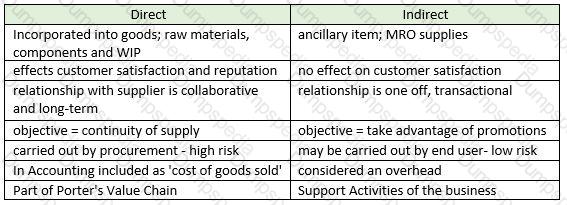
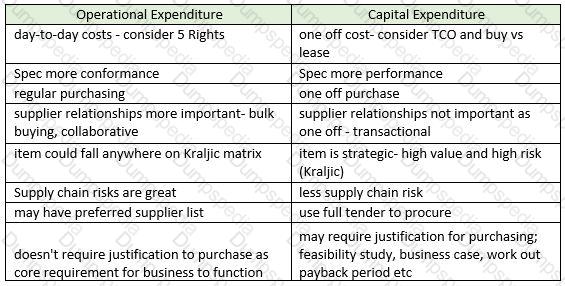 A table with text on it
Description automatically generated
A table with text on it
Description automatically generated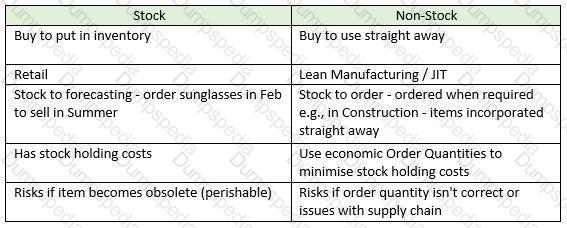
Essay Plan :
Remember to include examples for each of the six categories of spend. This is specifically asked for in the question so it’s important to include as many examples as you can. To do this you could take an example organisation such as a cake manufacturer and explain which of their purchases would fall into each category and why.
Introduction – explain why procurement categorises spend
- Direct – these are items that are incorporated into the final goods (the cakes) so would include raw materials such as flour, eggs, sugar etc
- Indirect – these are items that the company needs, but don’t go into the end product. For example, cleaning products and MRO supplies for the machines
- Capital Expenditure- these are large one-off purchases, such as buying a new piece of equipment such as a giant oven to cook the cakes.
- Operational Expenditure – these are purchases that are required to ensure the business can function day-to-day. They may include PPE for the workers in the factory and cleaning equipment
- Stock items – these are items procured in advance and held in inventory until they are needed. In a cake manufacturing factory this could be PPE for staff such as hairnets and gloves. The organisation will buy these in bulk and keep them in a stock cupboard, using these as and when they are required
- Non- stock items - items that are not stored and used right away. An example would be eggs- these will need to be put directly into the cakes as they would go off if bought in advance.
Conclusion – the categories are not mutually exclusive – an item can be direct and operational, or indirect and stock. Different companies may use different systems to classify items of spend.
Example Introduction and Conclusion
Introduction
Procurement categorizes spend to efficiently manage resources and make strategic decisions. Three primary ways of categorizing procurement spend include distinguishing between direct and indirect spend, classifying expenditures as capital or operational, and categorizing items as stock or non-stock. These distinctions aid organizations in optimizing their procurement strategies for better resource allocation.
Conclusion:
In conclusion, categorizing procurement spend into direct vs. indirect, capital vs. operational, and stock vs. non-stock items is essential for strategic resource management. While these categories provide a structured framework, they are not mutually exclusive, as an item can fall into multiple categories. For example, an item may be both direct and operational or indirect and stock. The flexibility of these categories allows organizations to tailor their procurement strategies based on their specific needs, ensuring efficient resource allocation and effective supply chain management. Different companies may adopt varying categorization approaches depending on their industry, size, and operational requirements.
Tutor notes:
- Because you’ve got 6 categories of spend to talk about you’re only going to need 3-4 sentences for each. Providing you’ve said the category, explained what it is and given one example, you’ll absolutely fly through this type of question
- You could also mention that it is useful to use categories of spend as this helps with budgeting. Different categories may also have different processes to follow for procuring the item (this could form part of your introduction or conclusion).
- This subject is LO 1.3.2 it’s quite spread out in the text book but the main info is on p.49
- Note- different companies/ industries classify items of spend differently. Particularly packaging and salaries. Some say they’re direct costs and some say they’re indirect costs. Honestly, it’s a hotly debated subject and I don’t think there is a right or wrong. I’d just avoid those two examples if you can and stick to ones that aren’t as contentious like eggs and PPE.
Sarah is thinking of setting up a charity in the UK which will look after animals that have been abandoned. What regulations and governing bodies should Sarah be aware of when setting up her charity? (25 Points)
See the solution in Explanation part below.
How to approach this question
- Your essay should mention at least one regulation and one governing body particular to the charity section and I would recommend these be the Charities Act 2011 and the Charities Commission.
- If you don’t know a lot about the sector you can bring up more generalised regulations and governing bodies, such as financial conduct and the Equalities Act, but make sure it’s relevant to Sarah. Her charity is a small, local one, so things like Modern Slavery Act will not be appropriate to talk about.
Example Essay
When setting up a charity in the UK, particularly one focused on animal welfare, there are several regulations and governing bodies that Sarah should be aware of. These ensure that the charity operates legally, ethically, and effectively.
A charity’s purpose involves raising awareness and helping someone or something, in Sarah’s case this will be local animals and potentially their owners. A charity has to satisfy two aspects: The benefit aspect and The public aspect. In the UK, both aspects are regulated by the Charities Act 2011.
To satisfy a benefit aspect, a charity must: have a purpose that must be beneficial to the community it works in – this must be in a way that is identifiable and capable of being proved by evidence. For Sarah this would be showing that her charity helps animals, potentially by taking them in off the street or removing them from dangerous homes and caring for them.
To satisfy a public aspect, a charity must benefit the public in general, or a sufficient section of the public. In Sarah’s case the public benefit may be in removing stray dogs and cats from the streets where they can transport diseases and potentially attack people. Most charities strive to satisfy both aspects but in some cases this is not possible.
All charities are regulated. Because charities are funded by donations from the public, businesses and sometimes from government, their conduct is regulated closely. Key regulatory bodies that Sarah will have to engage with include:
1. Charity Commission for England and Wales:
· As the primary regulator for charities in England and Wales, the Charity Commission oversees the registration and regulation of charities. Sarah ' s organization must meet the legal definition of a charity and apply for registration if its income is over £5,000 per year.
· The Commission ensures compliance with the Charities Act, offering guidance on charity governance, financial management, and reporting.
2. HM Revenue and Customs (HMRC):
· Charities can apply to HMRC for recognition as a charity for tax purposes. This status allows for tax reliefs and exemptions, including Gift Aid on donations.
· HMRC ensures compliance with tax obligations and scrutinizes the use of charity funds.
3. Data Protection:
· Under the General Data Protection Regulation (GDPR) and the Data Protection Act 2018, any charity handling personal data must ensure its protection and comply with data privacy laws.
4. Health and Safety Executive (HSE):
· The HSE provides guidelines for workplace safety, which are important if the charity has employees or volunteers.
In conclusion there are many regulations and bodies that Sarah should be aware of when setting up her charity. Sarah should consider seeking legal advice or consulting with charity advisory services to ensure full compliance with all relevant laws and regulations. Additionally, staying informed about changes in charity law and animal welfare legislation would be beneficial to the smooth operation of her charity.
Tutor Notes
- With case study questions you’re not expected to know anything about the specific topic, in this case Animal Charities. If it happens to be something you know about, you can bring in some of your own knowledge, but this isn’t a requirement to get a good score. You’re not expected to know, for example about the Animal Welfare Act 2006, but if you happen to do so, it could be a nice little thing to add in. Just don’t focus your essay on it. However you can make some sensible guesses on what Sarah will be doing, for example I talked about removing stray animals from the street.
- Charities comes up in LO 4.4 p.232
Explain, with examples, the advantages of a Procurement Department using electronic systems (25 marks)
See the solution in Explanation part below.
- Mention of some of the following benefits with at least one example provided against each; cost savings, time savings, more efficient, higher levels of transparency, easier to access historical records to inform upon decision making, mitigates risks such as fraudulent spending, easier to track spend against budgets, ensures compliance with regulations, provides ‘real-time’ information, paperless communications (so more environmentally friendly), assists in Supply Chain Management and integration with supply partners.
- I’d suggest 5 is a good amount to aim for
Example Essay
Procurement stands to gain numerous benefits from the adoption of electronic systems. These electronic tools and systems bring efficiency, accuracy, transparency, and cost-effectiveness to the procurement process. Here are several compelling reasons why procurement should leverage electronic systems:
Cost savings – the use of electronic tools saves organisations money. Although there is an initial cost outlay, over time the systems will save the organisation money. For example the use of e-procurement tools can save money by accessing a wider pool of suppliers. For example, when using an e-sourcing portal, a tender may reach a larger number of suppliers- this makes the tender more competitive thus driving down prices. Compared to traditional methods such as phoning suppliers for prices, the use of electronic portals encourages suppliers to ‘sharpen their pencils’ and provide the best prices in order to win work. Money is also saved as communication is digital (so there is no costs for paper and postage).
Time savings – electronic tools automate a lot of processes which saves time. An example of this is e-requisitioning tools where orders can be placed automatically by a piece of technology when quantities of a material reach a certain level. For example, in a cake manufacturing organisation they may use an MRP system which calculates how many eggs are required per day. The machine knows that when the company only have 50 eggs left, a new order needs to be issued to the supplier. The MRP system (e-requisitioning system) therefore saves time as the Procurement department doesn’t have to manually pick up the phone to place the order with the supplier- it is done automatically.
Access to higher levels of information - e-Procurement gives you centralised access to all your data. You can access the system to look at historical purchases with ease compared to having to dig through folders and filing cabinets. For example, an electronic PO system will hold details of all historical POs, this means if someone has a question about a PO that was raised 4 months ago, finding the information is much easier and quicker. Some systems may also be able to provide analytical data such as changes to spend over time, or which suppliers a buyer spends the most money with. This higher level of information can help inform upon future decision making. For example, if the organisation wishes to consolidate its supplier base it would look through historical data provided by the electronic system to find out which suppliers are used the least and remove these from the ‘pre-approved supplier list’. This level of data might not be available in manual systems.
Better budget tracking – using electronic systems allows for real-time information to be collected which allows Procurement Managers to see where spend is compared to forecasts and budgets. An example of this is in the use of Pre-Payment Cards – rather than giving staff members petty cash to make transactions and having to chase this up and collect receipts and change, a pre-payment card usually comes with an online portal where a manager can see what has been purchased and the remaining budget on that card for the month. A manager may be able to see for example that a member of staff has spend £300 of their allotted £500 monthly allowance.
Higher levels of transparency and control – using E-procurement tools allows an organisation to track who is ordering what. For example, an e-requisitioning tool may allow Procurement Assistants to make purchases up to £500 but set an automatic escalation if they try to buy something of higher value. This allows for Management to have greater levels of visibility and more control over spending. Another example of transparency and control is in the use of e-sourcing tools to run a competitive tender exercise. All communication between the buyer and suppliers is tracked on the system and award letters can be sent via the system too. This reduces the risk of information being lost.
Environmental benefits- the use of e-procurement tools means that there is less paperwork involved. For example, rather than creating a physical PO which needs to be signed by a manager, an electronic system can allow a manager to sign-off the purchase by clicking a button. This means there is no requirement for the document to be printed. This saves paper and thus has a positive on the environment. Using electronic systems may help an organisation achieve their environmental targets.
In conclusion there are numerous benefits for procurement to adopt e-procurement tools. Depending on the sector and requirements of each individualised company, some advantages may be more pertinent than others, but it is undeniable that technology is helping to shape the industry into a value adding function of organisations.
Tutor Notes
- With an essay like this you could use subheadings and number the advantages if you like. It’s a good idea to do one advantage per paragraph and using formatting really helps the examiner to read your essay.
- study guide p.108
What is the purpose of a CSR policy? What elements should it contain and how can a buyer evaluate a potential suppliers CSR policy? (25 points)
See the solution in Explanation part below.
How to approach this question
- There are three questions within this question. The purpose could be your introduction, and then take two big sections in the main body of your essay for the elements and how to evaluate it.
Example Essay
A Corporate Social Responsibility (CSR) policy serves as a formal commitment by a company to conduct its business in a socially responsible and sustainable manner. The purpose of a CSR policy is to outline the organization ' s dedication to ethical practices, environmental stewardship, and social contributions. It reflects a company ' s commitment to going beyond mere profit generation and actively engaging in initiatives that benefit society and the environment.
Elements of a CSR Policy:
1. Ethical Business Practices:
· Clearly articulated principles on fair business dealings, anti-corruption measures, and adherence to ethical standards in all operations.
2. Environmental Sustainability:
· Commitments to minimize environmental impact through sustainable practices, energy efficiency, waste reduction, and responsible sourcing of materials.
3. Social Responsibility:
· Efforts to contribute positively to the community, which may include support for education, healthcare, poverty alleviation, or other social initiatives.
4. Labor Practices:
· Fair and ethical treatment of employees, including non-discrimination, fair wages, safe working conditions, and respect for workers ' rights.
5. Supply Chain Responsibility:
· A commitment to ensuring that suppliers and partners adhere to similar ethical and CSR standards, promoting responsible practices throughout the entire supply chain.
6. Transparency and Accountability:
· Open disclosure of CSR initiatives, performance, and impacts, demonstrating a commitment to transparency and being accountable for CSR goals.
7. Stakeholder Engagement:
· A pledge to engage with and consider the interests of various stakeholders, including employees, customers, communities, and shareholders, in decision-making processes.
Evaluating a Supplier ' s CSR Policy:
Assessing a potential supplier ' s CSR policy involves a comprehensive examination of key factors to ensure alignment with ethical and responsible business practices:
1. Policy Content:
· Review the content of the CSR policy to ensure it covers a broad spectrum of social, environmental, and ethical aspects. A comprehensive policy reflects a commitment to holistic CSR practices.
2. Alignment with Industry Standards:
· Check if the CSR policy aligns with industry-specific standards and best practices. Adherence to recognized standards, such as the Global Reporting Initiative (GRI) or ISO 26000, indicates a commitment to global CSR norms.
3. Performance Metrics:
· Evaluate whether the supplier includes measurable performance metrics in their CSR policy. Clear objectives and key performance indicators (KPIs) demonstrate a commitment to continual improvement and accountability.
4. Stakeholder Engagement:
· Assess how the supplier engages with stakeholders. A robust CSR policy should involve stakeholders in decision-making processes and demonstrate an understanding of their concerns.
5. Supply Chain Responsibility:
· Check if the supplier extends CSR principles to its supply chain. This involves ensuring that suppliers and partners adhere to ethical, environmental, and social standards, contributing to a responsible and sustainable supply chain.
6. Transparency and Reporting:
· Look for transparency in reporting. A supplier that openly communicates about its CSR initiatives, achievements, and challenges indicates a commitment to accountability and transparency.
7. Continuous Improvement:
· Evaluate if the supplier emphasizes a commitment to continuous improvement in its CSR policy. This indicates a dynamic approach to addressing emerging challenges and staying ahead of evolving CSR expectations.
By thoroughly examining these aspects, a buyer can gain insights into a potential supplier ' s commitment to corporate social responsibility and make informed decisions that align with their own CSR objectives and values.
Tutor Notes
- Students often ask if they can use bullet points in their essays. Many tutors say no, but the answer is actually more nuanced than that. I’ve purposefully written the above in bullet points to show you how it can be done effectively. Bullet points are fine, providing you’re using full sentences and it makes sense as a stylistic choice. It’s not a good option if you’re just going to list things without context. Then it can be hard to follow. I’ve personally used bullet points in essays and done really well. There’s no rule against it. You’ve just got to make sure you’re doing it ‘right’.
- CSR policies are only briefly mentioned in LO 2.4 but it does come up as quite a big topic in other parts of the syllabus so is worth knowing. You could mention some examples of big companies and what their stance on CSR is. A good one to look at is The Body Shop.
- The study guide references Carroll’s Pyramid – this would be great to include in your essay Carroll ' s CSR Pyramid explained: Theory, Examples and Criticism (toolshero.com) p.112
Explain FIVE differences between organisations that operate in the public sector and those that operate in the private sector.
See the solution in Explanation part below.
Public sector organisations and private sector organisations differ in a number of important ways. These differences affect how they are managed, how they buy goods and services, and what their overall objectives are.
1. Main Objective
One key difference is the main purpose of the organisation.
Public sector organisations exist mainly to provide services for the public and meet social needs, such as healthcare, education, policing, and transport. Their aim is usually to deliver value for money and public benefit rather than make profit.
In contrast, private sector organisations mainly exist to make a profit for their owners or shareholders. Although they also want to satisfy customers, financial return is usually a major objective.
For example, a government hospital focuses on patient care, whereas a private electronics retailer focuses on sales revenue and profit.
2. Source of Funding
Another difference is where the organisations get their money from.
Public sector organisations are usually funded by taxation, government budgets, grants, and public money. This means they must be very careful in how they spend funds because they are accountable to taxpayers.
Private sector organisations normally generate income through the sale of goods and services, investment, or private finance. Their survival depends on their ability to compete and earn sufficient revenue.
This difference affects procurement because public bodies may face stricter rules over spending decisions.
3. Accountability and Transparency
Public sector organisations are generally more accountable to the public, government ministers, and regulatory bodies. They often have to show openness in their decisions and may be subject to audits, public scrutiny, and freedom of information requirements.
By contrast, private sector organisations are usually accountable mainly to their owners, shareholders, or investors. While they must still follow the law, they often have more privacy in commercial decision-making.
This means public sector procurement is usually more transparent and formal than private sector procurement.
4. Procurement Rules and Procedures
A major difference can be seen in how they buy goods and services.
Public sector organisations usually have to follow strict procurement regulations, policies, and procedures to ensure fairness, competition, and value for money. They may need to advertise contracts openly and use formal tendering processes.
Private sector organisations usually have more flexibility. They can often choose suppliers more quickly, negotiate directly, and make decisions based on commercial priorities.
For example, a local authority may need to go through a full tender process, while a private company may select a supplier based on speed, cost, or existing relationships.
5. Performance Measurement
The way success is measured is also different.
In the public sector , performance is often measured by service quality, meeting public needs, staying within budget, and achieving policy outcomes. Success may not always be easy to measure financially.
In the private sector , performance is often measured through profit, sales growth, market share, and return on investment.
For example, a public library may be judged by community access and service delivery, whereas a private bookshop may be judged by profit and customer sales.
Conclusion
In summary, public and private sector organisations differ in their objectives, funding, accountability, procurement processes, and measures of success. Public sector organisations focus more on public service and value for money, while private sector organisations focus more on profit and commercial performance.
Bottom of Form
Top of Form
Explain FIVE possible factors that influence procurement
activities in third sector (not-for-profit) organisations that
Parvinder should research. (25 marks)
Parvinder Kaur works for a leading procurement consultancy, NHB. Her
clients are based all around the world with a diverse range of products
and services. Parvinder specialises in providing procurement advice within
the public sector but she also has two major clients in the private sector.
Before beginning procurement consultancy services with a new client,
parvinder likes to research the organisation and the sector in Which it
operates so that she can understand the type of challenges that the
organisation may face. This work, ahead of the first meeting, has meant
that Parvinder has built an excellent reputation for analysing a business
quickly. It also means she has been able to establish insight into the
aspects which may have a significant impact on the success of the
procurement function in her clients.
NHB has recently won a significant contract to provide procurement
consultancy service to a large third sector (not-for-profit) organisation.
This is an important new client for NHB and the board is keen to assign
Parvinder as the key account manager, even though this is a new area for
her. Parvinder is happy to take on the additional work as she is keen to
develop a greater understanding of this sector.
See the solution in Explanation part below.
Procurement in third sector (not-for-profit) organisations operates under distinct influences compared to public or private sectors. Understanding these factors is crucial for Parvinder to provide effective consultancy tailored to the sector’s unique challenges and requirements. Below are five key factors that influence procurement activities in third sector organisations:
1. Funding Sources and Financial Constraints
Explanation: Third sector organisations typically rely on donations, grants, fundraising, and government funding rather than sales revenue. This creates tight budgetary controls and unpredictability in funding availability.
Impact on Procurement: Procurement activities must align closely with available funds, often requiring careful prioritisation, cost-effectiveness, and compliance with funders’ conditions. Parvinder should research how the organisation manages fluctuating budgets and whether there are restrictions on how funds can be spent.
2. Regulatory and Compliance Requirements
Explanation: Not-for-profit organisations are often subject to specific regulatory frameworks and reporting standards, including charity laws, governance codes, and donor-imposed conditions.
Impact on Procurement: These regulations impact supplier selection, contract management, and transparency obligations. Procurement must ensure compliance with these rules to maintain legitimacy, donor confidence, and avoid legal penalties. Parvinder should assess the regulatory environment affecting procurement processes.
3. Social and Ethical Considerations
Explanation: Third sector organisations frequently have missions linked to social good, environmental sustainability, and ethical practices. Procurement decisions are influenced by these values and stakeholder expectations.
Impact on Procurement: Procurement must prioritise suppliers who meet ethical standards, support local communities, and minimize environmental impact. This may limit supplier options but aligns procurement with organisational values and public image. Parvinder should evaluate the organisation’s sustainability and CSR policies.
4. Stakeholder Involvement and Governance
Explanation: Procurement decisions in not-for-profits often involve multiple stakeholders, including trustees, donors, beneficiaries, and volunteers, making the governance structure complex.
Impact on Procurement: This can lengthen decision-making processes, require additional approvals, and demand higher transparency and accountability. Parvinder should investigate who the key stakeholders are and how procurement decisions are governed and communicated.
5. Market and Supplier Availability
Explanation: Depending on the organisation’s geographic location, niche requirements, and mission, there may be limited availability of suitable suppliers, especially those compliant with social and ethical standards.
Impact on Procurement: Limited supplier choice can increase costs and procurement risk. Procurement strategies may need to focus on supplier development, collaboration, or partnerships to meet organisational needs. Parvinder should research supplier markets and potential supply chain risks.
Conclusion:
To effectively advise the new third sector client, Parvinder must research and understand the impact of funding limitations, regulatory compliance, ethical imperatives, stakeholder complexity, and supplier availability on procurement activities. Recognising these factors will enable her to tailor procurement strategies that support the organisation’s mission, ensure transparency, and optimise resource use—key to delivering value in the not-for-profit environment.
What is meant by Stakeholder Mapping? Describe a tool that can be used by a Procurement Professional to map the stakeholders at their organisation (25 points)
See the solution in Explanation part below.
How to approach this question:
- Define stakeholder mapping – completing an analysis of the stakeholders of an organisation and dividing them into categories depending on certain characteristics. This is often represented visually on a graph or matrix.
- Describe a Stakeholder mapping tool – the most common tool is Mendelow’s Stakeholder Matrix so I would recommend using this one. It is explained in detail in the study guide. However, the question is open so you could choose to describe another tool such as Edgar’s Stakeholder Position Analysis if you so wished. You wouldn’t be wrong choosing this, but honestly, I’d just go for Mendelow. You can’t go wrong with Mendelow. Because the Matrix has 4 sections you can imagine you’d get 5 points for the definition of stakeholder mapping, and 5 points for each of the quadrants of the matrix.
Essay Plan:
Introduction - The reason why stakeholder mapping is important is because interests and expectations of stakeholder groups will be different and possibly conflicting. Mapping this allows an organisation to see the variety and decide on an appropriate management style for each stakeholder group.
Paragraph 1 - Mendelow’s Power / Interest Matrix maps stakeholders based on their influencing power and the strength of their motivation to use that power. It uses a 2x2 grid and defines power as high or low and interest and high or low. It then provides four strategies for managing the stakeholders based on which quadrant of the grid the stakeholder falls into. These 4 categories are:
Paragraph 2 - Keep satisfied – high power but low interest. If the stakeholder becomes dissatisfied or concerned their interest may peak. Examples include regulatory bodies, shareholders, senior management. The best approach is to keep them up to date so they are informed of what is going on, but do not burden them with information they do not need.
Paragraph 3 - Manage Closely – AKA Key players – includes major customers, key suppliers, partners, senior management. These stakeholders need to know everything that is going on and approve of what is going on. The recommended strategy is early involvement and participation, and integrating their goals with yours. This group requires regular communication and meetings. You should take their opinions on board.
Paragraph 4- Monitor – minimum effort required – this is the low priority group as they have low power and low interest. Includes small volume suppliers and other organisational functions with no direct interest in your activities. This group does not need to receive regular communication.
Paragraph 5 - Keep informed - high interest, but low power. If they’re not kept in the loop and understand the need for decisions, they may lobby together to protect their interest if they feel threatened. Employee groups, suppliers and community groups may be in this category. This group should receive regular communication.
Conclusion - Mendelow created the matrix in 1991 and it is still used today. It is a popular management tool due to its simplicity. It’s important to notes that stakeholders can move through the matrix- it isn’t stagnant. For example, at the beginning of a project a manager in another department may be classed as ‘low priority’ because they are seen to have no interest and no power in the project. However, as the project progresses the manager may become interested. They will then transfer into the keep informed category. Therefore, the matrix should be redone regularly throughout the lifetime of a project to capture any movements. The matrix should also be redone for each individual project – it cannot be assumed that a stakeholder who had interest in one project would be interested in another.
Tutor Notes
- The above essay plan is basically the entire essay, I got carried away. The only thing you’d need to add into that is an example of a stakeholder for each of the sections! (e.g. the CEO is high power, but low interest stakeholder for the procurement department. He/ She doesn’t care about the day to day operations but should be kept informed of any big news). For your examples you could use your own place of work.
- At level 4 you don’t have to analyse the model, you just have to be able to memorise it and repeat it. Mendelow comes up again at Level 5 and 6 in a bit more detail. If you want to score super bonus points you could mention in your conclusion that the main disadvantage of Mendelow’s Matrix is that it doesn’t take into consideration the stakeholder’s position on the project – whether they’re for it or against it. Therefore, it doesn’t provide the full picture or provide much help on how to manage stakeholders. E.g. two stakeholders might both be in ‘manage closely’ section, but one is for the project and the other against – they’d need to be handled very differently!
- Study guide p. 65
What is a Code of Ethics? What should an Ethical Policy Contain? What measures can an organisation take if there is a breach of their Ethical Policy? (25 points)
See the solution in Explanation part below.
- Firstly give a short definition of Code of Ethics: a document that sets out moral principles or values about what is right and wrong.
- What an Ethical Policy should contain: Condition of workers, Environment, H+S, Discrimination, Gift / Bribery Policy, Whistleblowing, Confidentiality, Fair Dealings, Declaration of Conflict of Interests. You won’t have time to go into depth on all of these, so pick a few where you want to give an example.
- Measures to take if there is a breach: depending on what the breach is and who breached it this could include: education/ training, sanctions, blacklisting, reporting to authorities, publicise the issue, use a performance improvement plan, issue warnings, dismissal.
Example Essay:
A code of ethics is a formal document or set of principles that outlines the values, ethical standards, and expected conduct for individuals within an organization. It serves as a guide for employees and stakeholders, shaping their behaviour and decision-making to align with the organization ' s ethical framework. It may take the form of a Mission Statement, Core Values, Specific Guidelines or established reporting mechanisms. The purpose of the Code is to establish standards, promote integrity, mitigate risks and build trust- with both internal and external stakeholders.
A Code of Ethics may contain the following:
- Condition of workers – stating what the company will provide to the employees to make sure the environment is safe. This could include the physical environment but also hours worked, opportunities for breaks etc. Depending on the sector it could detail shift patterns, expectations regarding overtime and compensation.
- Environment – this section would discuss compliance with legislation regarding pollution, disposal of waste materials etc. Depending on the company’s goals- they may have higher commitments to the environment than those imposed by the government. Additional commitments may include NetZero targets or the use of renewable sources of energy.
- H+S- Health and Safety. Ensuring that the working environment is free of hazards and that workers have the training and equipment they need to complete the work safely. E.g. PPE
- Discrimination- a promise not to discriminate based on any characteristic. Aligns with the Equalities Act. Policy should include how the company would handle situations, for example if an employee reports an issue of discrimination or harassment. This may involve the use of a whistleblowing hotline or details on how to contact HR.
- Gift / Bribery Policy – this area of the code of conduct would explain whether the company allows staff members to receive gifts (e.g. from suppliers) and the processes to complete if they do (e.g. return the item, complete an internal document, donate the gift to charity). Different companies and industries will have different rules surrounding this, the Public Sector is much more likely to reject gifts from suppliers for example.
- Declaration of conflict of interests- this explains what staff should do if there is a conflict. For example if they are running a tender and their father owns one of the suppliers who is bidding for the work. The conflict of interest policy will explain what the person should do, how to report it and have mechanisms in place to ensure that nothing untoward could come of the situation. This may be having another member of staff mark the tender to ensure unbiasedness.
Measures to take in case of a breach
A response to a breach will depend on who breached the policy – whether this is an employee or a supplier. It will also depend on the severity of the breach.
Remedies for a supplier breach could include: education / training if the breach is minor. Supplier development if the relationship with the supplier is very important (for example if there are no other suppliers the buyer could turn to) and the breach is minor. If the breach is major such as fraud or misappropriation of funds, a buyer could look to issue sanctions, claim damages and dismiss the supplier. There could be options to claim liquidated damages if this is included in the contract. For very serious offenses the buyer may blacklist the supplier- never use them ever again and could also report the issue to the police if the breech is also criminal (e.g. modern slavery or fraud).
Remedies for an employee breach could include: for minor breaches training may be required, particularly if it was a junior member of the team and it was an innocent mistake like forgetting to fill out a form when they received a Gift. The employee could be carefully monitored and put on an Improvement Plan. If internal issues are found, such as several staff are breaching the Code of Ethics, senior management could look to review policies to make sure issues are being flagged and responded to in the best way. Employees who fail to follow the Ethical Policy, either through routinely failing to adhere to it or through a major breach could be dismissed from the organisation. There would need to be strong evidence of this.
In conclusion it is important for all organisations regardless of size of industry to have an Ethics Policy. Sharing the code of ethics with staff is a fundamental step in embedding ethical principles into the organizational culture. Regular communication and training reinforce these principles, fostering a shared commitment to ethical behaviour across all levels of the organization.
Tutor Notes
- In an essay like this it’s always a good example to use examples. They can be hypothetical – you don’t have to know any company’s Ethics policy off by heart. E.g. If a supplier breached a buyer’s Ethical Policy by employing Child Labour in their factories, an appropriate measure for the buyer to take would be to cancel the contract and find another supplier. This is because not only is Child Labour illegal, the buyer will not want to be associated with this supplier as it will have negative repercussions on their image. The best response would therefore be to distance themselves from the supplier.
- Code of Ethics and an Ethics Policy are the same thing. Just different language. The terms can be used interchangeably
- Study guide p. 128
Examine FIVE ways the Blake Corporation procurement team could add value by improving compliance with procurement policies and procedures.
Blake Corporation
Blake Corporation is a mid-sized manufacturing company that specialises in high-quality consumer electronics. Founded in 2010, it has grown steadily over the years, establishing a solid customer base and a reputation for innovation. Over the past decade, Blake Corporation has expanded its product line to include a wide range of consumer electronics, from smartphones to smart home devices. The company ' s commitment to quality and innovation has earned it a loyal customer base and a competitive position in the market.
Despite its success, Blake Corporation has faced significant challenges in procurement operations. As the company grew, so did its need for more efficient and effective procurement processes. However, the expansion has outpaced the continual development of formal procurement policies. While some good practices are in place, the approach to compliance has been inconsistent. The board of directors has recognised the significance of procurement and its impact on the bottom line, and it has appointed a new procurement director. The new director wants to implement a long-term procurement strategy to standardise category management and work more proactively with other functions, including production, marketing, finance, and research and development, in the short and longer term.
Due to time pressures, the procurement staff adopt an inconsistent approach to following current procedures, resulting in buyers from different teams purchasing materials at varying prices. The procurement director has also assessed the team ' s skills and noted that there has been an inconsistent training regime, with some staff entering their roles possessing technical expertise but lacking formal procurement training.
While there are a few categories where early buyer involvement occurs, the vast majority resort to a more transactional approach. Furthermore, the procurement director has observed that newer procurement team members are unaware of the formal processes, and recognises that this poses several compliance risks. Consequently, the new procurement director wants to introduce a more robust compliance regime with an updated vision, strategy, and a set of policies and associated procedures.
See the solution in Explanation part below.
Improving compliance with procurement policies and procedures can enable Blake Corporation’s procurement team to add significant value. This is particularly important given the current inconsistent practices and lack of formal training within the organisation.
1. Cost Control and Standardisation of Pricing
Currently, buyers are purchasing materials at varying prices due to inconsistent approaches. By improving compliance, all procurement staff would follow agreed procedures such as using approved suppliers and negotiated contracts.
This would help standardise pricing across the organisation and prevent maverick spending.
For example, if all buyers use framework agreements, the company can leverage economies of scale and reduce overall costs.
Value added:
Lower procurement costs
Improved budget control
Better financial performance
2. Reduced Risk and Improved Governance
Non-compliance exposes Blake Corporation to risks such as fraud, unethical sourcing, and legal issues. A robust compliance regime ensures that procurement activities follow ethical standards and legal requirements .
For instance, clear approval processes and audit trails can prevent unauthorised purchases.
Value added:
Reduced legal and financial risks
Improved transparency and accountability
Stronger corporate governance
3. Improved Supplier Management and Relationships
Compliance with procurement procedures ensures that suppliers are selected and managed consistently. This allows the organisation to build strategic relationships rather than relying on ad hoc purchasing.
For example, early supplier involvement (which is currently limited) can be encouraged through policy, improving collaboration with key suppliers.
Value added:
Better supplier performance
Opportunities for innovation
More reliable supply
4. Increased Efficiency and Process Consistency
The current inconsistent approach leads to inefficiencies and duplication of effort. By standardising processes and ensuring all staff follow them, procurement activities become more streamlined.
For example, clear procedures for sourcing and ordering reduce delays and confusion among staff.
Value added:
Faster procurement cycles
Reduced administrative workload
Greater operational efficiency
5. Enhanced Skills and Professionalism
The case highlights inconsistent training and lack of formal procurement knowledge among staff. Improving compliance would require structured training and clear communication of policies.
This helps ensure all team members understand procurement best practices and their responsibilities.
For example, onboarding programmes and continuous professional development (CPD) can improve capability.
Value added:
More competent procurement team
Consistent application of best practices
Increased credibility of the procurement function
Conclusion
By improving compliance with procurement policies and procedures, Blake Corporation can achieve better cost control, reduce risks, enhance supplier relationships, increase efficiency, and develop staff capability. This will support the new procurement director’s goal of implementing a strategic and value-adding procurement function.

TESTED 14 Oct 2026