dumpspedia logo

Jaycee has created an investment portfolio for his client, Adam, which is designed to achieve his long-term objectives and is consistent with his risk tolerance and constraints. It also has to be reassessed periodically to ensure that the long-term benchmark mix continues to reflect Adam’s circumstances. Which asset allocation strategy is Jaycee utilizing?
A client says, “I want to retire comfortably as soon as possible.” Which response best reflects the financial planning process?
Leena and Harry are married and hold RRSPs with a value exceeding $500,000. They are concerned about their final tax liability and want to cover the taxes after they have both died. What would their financial planner recommend them to implement in order for the couple to achieve the objective?
Bill was recently declined for a loan application at his financial institution, and he is concerned that a liability has been added to his credit bureau that does not belong to him. He asks his financial planner to review his credit bureau with him to help him identify why he may have been declined. Which area of the credit bureau might his financial planner advise Bill to review?
A client refuses to provide details about debt balances, tax returns, and monthly expenses but asks the planner to confirm whether retirement at age 55 is achievable. What should the planner do?
In which life cycle stage would a financial planner identify his client to be if they have a high mortgage balance and an unstable or lower income, and are willing to take on investment risk because of their longer time horizon?
Which asset is most likely to flow through a deceased person’s estate rather than pass automatically outside the estate?
A client sends an email alleging that a mutual fund recommendation was unsuitable because the fund declined sharply after purchase. The client asks for compensation. What is the financial planner’s first professional obligation?
Justis, age 62, and his wife Jen, age 58, are meeting with their financial planner, Luke. They are both planning to retire by age 65. Their goals are to minimize debt and reduce taxes. The couple's financial situation is outlined below.
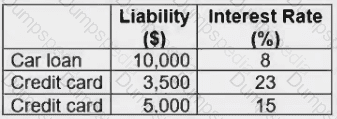
Justis' annual income is $25,000. He has a $15,000 RRSP, $30,000 single non-registered account and a $25,000 TFSA. Jen's annual income is $60,000, and she has a $150,000 RRSP, $50,000 single non-registered account and a $20,000 TFSA.
Jen's marginal tax rate is 35%, and Justis' is 25%. Assuming all investments are making interest income of 10%, what would be the most appropriate strategy for Luke to recommend for the couple?
Jonathan owns a medium size consulting firm and earns an average annual income of $150,000. He is reviewing his retirement plan with his financial planner. Jonathan asked his planner about retirement compensation arrangement and how this may benefit him. What should his financial planner tell him?
Sheeba is a financial planner and meeting with Ivana, a new client. She explains that part of her process is to recommend products and services, but prior to doing so, she will closely investigate the options to ensure they match up with Ivana's goals. Which professional responsibility has Sheeba demonstrated to Ivana?
A household has gross monthly income of $9,500. Their monthly mortgage payment is $2,100, property taxes are $425, heating costs are $175, car payments are $600, and minimum credit card payments are $250. What is their total debt service ratio?
A planner establishes a long-term target portfolio of 65% equities and 35% fixed income based on the client’s objectives and constraints, with periodic rebalancing. Which allocation approach is being used?
Todd, a financial planner, is meeting with Vanessa, a new client, to review her investment goals and objectives. During the meeting, Vanessa states that she believes the markets are very efficient and should reflect all available information in the price of securities. She is looking for an investment option that will reflect a similar level of risk and return characteristics as the Canadian market. What investment option should Todd recommend with Vanessa that would reflect her opinions?
Barbara, age 50, is meeting with her financial planner, Clark. Barbara has been hired as the Chief Executive Officer of a very successful privately owned business. Her salary will be $200,000 annually, plus a bonus. Which retirement savings option should Clark recommend for Barbara?
Mary, an accredited financial planner, recently met with clients Michael and Radha. They are high- net-worth clients who are in their mid-40s. Michael is a heavy equipment operator at a local oil field, and Radha is a homemaker. They are ready to retire in 10 years and very excited to start planning for the next chapter in their lives. Mary explained her planning process, her accreditation, and her remuneration. When Mary presented the client agreement letter, both clients were surprised. They said they did not know why they would sign a letter to get advice on their own finances. How should Mary answer their question?
Priya grants her brother trading authority over her non-registered investment account. Her brother calls the financial planner and asks for Priya’s full net worth statement, tax return, and beneficiary information so he can “help with planning.” What should the planner do?
Interest rates are expected to rise sharply. Which fixed-income security would normally have the highest price sensitivity to that change, all else equal?
A client, age 60, is in a low tax bracket today and expects a larger taxable pension after age 65. She has TFSA and RRSP room. Which contribution priority is generally more appropriate?
Keitaro, age 42, and Ruth, age 52, are married and have two children - Maximo, age 20, and Hannah, age 16, both from Keitaro's previous marriage. In the event Keitaro dies, he would like to minimize taxes, provide for Ruth for the remainder of her life, and then after her death leave the residual to his children. What estate planning strategy should his financial planner recommend to help Keitaro achieve his goal?
Sarah Jones is an incorporated owner of a successful manufacturing company. She currently has a large month to month cash flow surplus. This is expected to continue until she retires in seven years. Her personal mortgage is up for renewal. She needs to borrow $50,000 so that she can replace a piece of equipment that is needed in the manufacturing process. She would like a solution that results in paying the lowest interest cost over the life of the loan. Which loan product should the financial planner recommend to Sarah? Assume monthly compounding for all products and no pre-payment options.
Alexander and Irena, age 30 and 32 respectively, are married and have been working full-time for one year. They have a daughter, age 3, and are expecting their second child. They recently bought a home with a mortgage balance of $390,000 at 4% amortized over 25 years. Their financial planner is trying to determine their tolerance for risk. After completing the life-cycle analysis, how can their financial planner explain the stage in which the couple finds themselves and the risk tolerance associated with it?
A client’s portfolio target is 50% equities and 50% fixed income. After a strong equity market, the portfolio is now 68% equities. The client’s circumstances and objectives have not changed. What should the planner recommend?
Edward's client is updating his will and is concerned what will happen to his and his wife's estates should they die within a short time of each other. Which clause in the will should Edward recommend the couple discuss with their lawyer?
A client wants a policy that pays a lump sum if she is diagnosed with a covered serious illness and survives the required waiting period. Which product matches this need?
Derek recently inherited $900,000. He asks his financial planner to invest the entire amount in a concentrated portfolio of junior mining stocks. Derek has never invested before, has two young children, and is still deciding whether to purchase a home. What should the planner do first?
Mina has $20,000 in a savings account earning 3% before tax. She also has a $9,000 credit card balance at 22%, a $7,000 unsecured line of credit at 10%, and a $14,000 car loan at 4%. Her marginal tax rate is 35%. Which liability should she target first?
What key question should be answered during the recommending strategies stage of the financial planning process?
A client wants to state her wishes about medical treatment if she becomes incapable of communicating. Which document is most directly relevant?
A retiree receives income-tested benefits and needs occasional withdrawals for vacations and home repairs. Which account is generally most efficient for withdrawals that do not increase taxable income?
Dianna has just taken a 20-year mortgage and wants insurance only to ensure the mortgage can be repaid if she dies during that period. She is considering whole life insurance. What should her planner most likely explain?

TESTED 23 Sep 2026