dumpspedia logo

The project management processes presented in the PMBOK Guide® should:
always be applied uniformly.
be selected as appropriate by the sponsor.
be selected as appropriate by the project team.
be applied based on ISO guidelines.
According to the PMBOK® Guide, specifically in the introduction regarding the Standard for Project Management, the processes described are considered " good practice " on most projects most of the time. However, this does not mean they should be applied uniformly to every project.
Tailoring: This is the critical concept that project management is not a " one size fits all " endeavor. The project manager and the project team are responsible for determining which processes are appropriate, and what the appropriate degree of rigor for each process is, given the specific needs of the project.
Selection Criteria: When selecting processes, the team considers the project ' s size, complexity, risk, resources, and organizational culture. This ensures that the management effort is proportionate to the value and scale of the work.
Shared Responsibility: While the Project Manager often leads the effort, the PMBOK® Guide emphasizes that the project team should collaborate on these selections to ensure all functional areas of the project are adequately addressed.
Analysis of other choices:
Choice A (Always be applied uniformly): Applying all 47+ processes to every project would result in significant " gold plating " of management effort and unnecessary bureaucracy for smaller or simpler projects.
Choice B (Be selected as appropriate by the sponsor): While the sponsor provides the resources and the business case, they generally do not have the granular expertise or the day-to-day involvement required to select specific project management processes. That is the functional role of the project team.
Choice D (Be applied based on ISO guidelines): While PMI standards often align with ISO standards (like ISO 21500), the PMBOK® Guide is a self-contained framework. The decision on which processes to use is based on the project ' s specific context, not a mandate to follow ISO guidelines.
Using the three-point estimating technique, if the most likely duration is four months, the optimistic duration is two months, and the pessimistic duration is one year, how many months is the expected activity duration?
Two
Four
Five
Twelve
According to the PMBOK® Guide, specifically within the Estimate Activity Durations process, the Three-Point Estimating technique (based on the Beta/PERT distribution) is used to improve the accuracy of activity duration estimates by considering uncertainty and risk.
The Components:
Optimistic ($O$): 2 months.
Most Likely ($M$): 4 months.
Pessimistic ($P$): 12 months (converted from 1 year to maintain consistent units).
The Formula: The standard Beta distribution (or PERT) formula for the expected duration ($E$) is:
$$E = \frac{O + 4M + P}{6}$$
The Calculation:
$$E = \frac{2 + 4(4) + 12}{6}$$
$$E = \frac{2 + 16 + 12}{6}$$
$$E = \frac{30}{6}$$
$$E = 5 \text{ months}$$
By using this weighted average, the project manager accounts for the fact that the pessimistic estimate (12 months) has a significant impact on the risk profile of the activity, pulling the " Expected " duration higher than the " Most Likely " duration.
Analysis of Other Options:
A. Two: This is simply the optimistic estimate; it does not account for the other variables or the weighted average.
B. Four: This is the " Most Likely " estimate. While it is the most frequent occurrence, the three-point technique is designed to look beyond just the most likely scenario to account for risk.
D. Twelve: This is the pessimistic estimate, representing the worst-case scenario rather than the calculated expected value.
The group technique that enhances brainstorming with a voting process used to rank the most useful ideas for prioritization is called the:
majority rule technique.
nominal group technique.
Delphi technique,
idea/mind mapping technique.
According to the PMBOK® Guide, the Nominal Group Technique (NGT) is a structured form of brainstorming that ensures all voices are heard and results in a prioritized list of ideas or requirements.
How it Works: The process typically follows four steps:
Silent Generation: Participants write down their ideas privately.
Round Robin: Each participant shares one idea, which is recorded on a flip chart or board until all ideas are captured.
Discussion: The group discusses each idea to ensure clarity and shared understanding.
Voting: Participants privately rank or vote on the ideas (e.g., using a scale of 1 to 5). The ideas with the highest cumulative points are prioritized.
The Value of NGT: It is particularly useful in preventing " groupthink " and ensuring that a few dominant individuals do not overwhelm the session. By adding a voting process to standard brainstorming, it moves the group from mere idea generation to actionable prioritization.
Analysis of Other Options:
A. majority rule technique: This is a specific decision-making result (getting more than $50\%$ of the vote) rather than a comprehensive structured brainstorming technique that includes idea generation.
C. Delphi technique: This is a method used to reach a consensus among a group of experts who participate anonymously. The experts provide responses to a facilitator in multiple rounds; it does not involve the " round robin " or face-to-face brainstorming characteristics of NGT.
D. idea/mind mapping technique: This is a visual data representation technique used to consolidate ideas created through individual brainstorming sessions into a single map to reflect commonalities and differences in understanding. It does not inherently include a formal voting and ranking process.
Impacts to other organizational areas, levels of service, and acceptance criteria are typical components of which document?
Business case
Work breakdown structure
Requirements documentation
Risk register
According to the PMBOK® Guide, specifically within the Collect Requirements process, the Requirements Documentation describes how individual requirements meet the business need for the project.
Components of Requirements Documentation: Requirements can start at a high level and become progressively more detailed as more information is known. A well-structured requirements document typically includes:
Business requirements: Higher-level organizational needs.
Stakeholder requirements: Needs of a stakeholder or stakeholder group.
Solution requirements (Functional and Non-functional): Functional requirements describe the behaviors of the product, while non-functional requirements describe the environmental conditions or qualities required for the product to be effective (e.g., levels of service, performance, safety, security).
Project requirements: These include acceptance criteria and transition requirements.
Impacts to other organizational areas: This identifies how the project ' s result will affect other entities within the organization, such as the help desk, sales department, or existing infrastructure.
Comparison with other options:
A. Business case: This document focuses on the economic feasibility of the project and the cost-benefit analysis. While it justifies the project, it does not typically contain detailed acceptance criteria or specific levels of service.
B. Work breakdown structure (WBS): This is a deliverable-oriented hierarchical decomposition of the work to be executed. It shows " what " is being built but does not describe the qualitative requirements or impacts like levels of service.
D. Risk register: This document records identified risks, their analysis, and response plans. While an impact to another area could be a risk, the formal definition of these elements (especially service levels and acceptance criteria) resides in the requirements documentation.
Match the process with its corresponding Process Group:
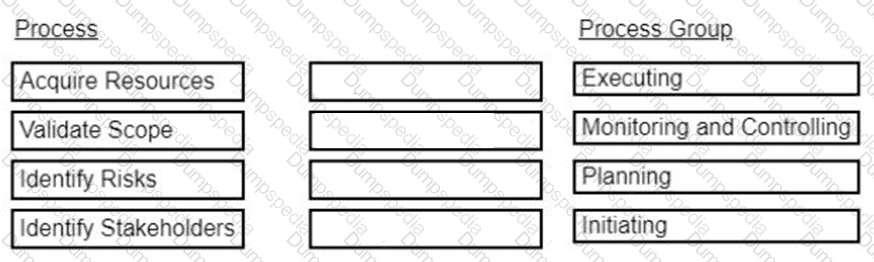

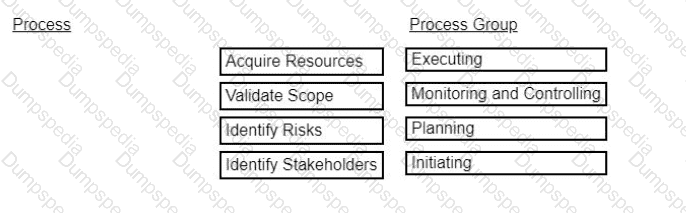
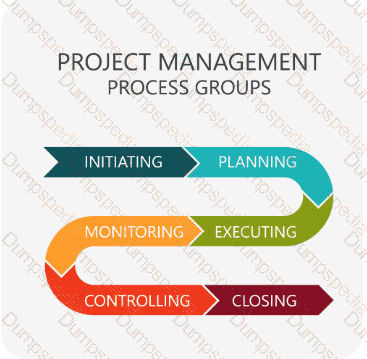
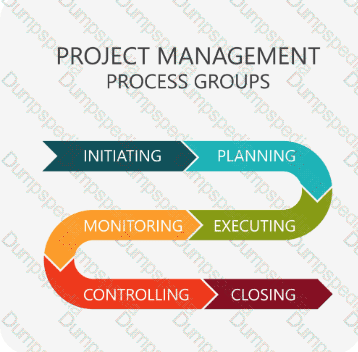
According to the PMI standard, processes are categorized into five distinct Process Groups. These groups are independent of project phases and represent the logical grouping of project management inputs, tools and techniques, and outputs.
Initiating (Process: Develop Project Charter): This group consists of those processes performed to define a new project or a new phase of an existing project by obtaining authorization to start. The Project Charter is the foundational document here.
Planning (Process: Create WBS): This group involves processes required to establish the scope of the project, refine objectives, and define the course of action required to attain those objectives. Creating the Work Breakdown Structure (WBS) is a critical part of defining the scope baseline.
Executing (Process: Manage Quality): These processes are performed to complete the work defined in the project management plan to satisfy the project requirements. Manage Quality (sometimes called Quality Assurance) focuses on the processes used to ensure the project is on track to meet quality standards.
Monitoring and Controlling (Process: Monitor and Control Project Work): This group consists of processes required to track, review, and regulate the progress and performance of the project; identify any areas in which changes to the plan are required; and initiate the corresponding changes.
Closing (Process: Close Project or Phase): These processes are performed to formally complete or close the project, phase, or contract. It involves archiving information, completing lessons learned, and releasing team resources.
A common trick on the exam is confusing the Process Group (the " when/how " ) with the Knowledge Area (the " what " ). For example, while " Create WBS " is in the Scope Management Knowledge Area, it belongs strictly to the Planning Process Group.
Which tasks should a project manager perform in order to manage the project schedule effectively?
Plan Schedule Management, Define Activities, Sequence Activities, Estimate Activity Durations, Define Quality of Activities. Develop Schedule
Plan Schedule Management. Define Activities, Sequence Activities, Estimate Activity Durations, Develop Schedule. Control Schedule
Plan Schedule Management. Define Activities, Sequence Activities, Estimate Activity Durations, Estimate Cost of Activities. Develop Schedule
Define Activities. Sequence Activities, Estimate Activity Durations. Define Quality of Activities. Estimate Cost of Activities, Develop Schedule
According to the PMBOK® Guide, specifically the Project Schedule Management knowledge area, there is a defined sequence of six processes required to ensure the timely completion of a project.
Plan Schedule Management: Establishing the policies, procedures, and documentation for planning, developing, managing, executing, and controlling the project schedule.
Define Activities: Identifying and documenting the specific actions to be performed to produce the project deliverables.
Sequence Activities: Identifying and documenting relationships (dependencies) among the project activities.
Estimate Activity Durations: Estimating the number of work periods needed to complete individual activities with estimated resources.
Develop Schedule: Analyzing activity sequences, durations, resource requirements, and schedule constraints to create the project schedule model for project execution and monitoring.
Control Schedule: The ongoing process of monitoring the status of project activities to update project progress and manage changes to the schedule baseline to achieve the plan.
Analysis of other options:
A. Define Quality of Activities: This is not a standard process in Schedule Management. Quality considerations are managed within Project Quality Management.
C. Estimate Cost of Activities: This process belongs to Project Cost Management, not Schedule Management. While costs and schedules are linked, they are distinct knowledge areas with separate processes.
D. Combined Errors: This option incorrectly includes both " Define Quality of Activities " and " Estimate Cost of Activities, " and it also omits the critical " Plan Schedule Management " and " Control Schedule " processes.
Per PMI standards, effective schedule management requires the full lifecycle from Planning through Developing to Controlling to ensure the project remains on track.
Which project manager competency is displayed through the knowledge, skills, and behaviors related to specific domains of project, program, and portfolio management?
Leadership management
Technical project management
Strategic management
Business management
According to the PMBOK® Guide (6th Edition) and the PMI Talent Triangle®, PMI defines three key skill sets required for project managers to be effective. These competencies ensure that a project manager can navigate the complexities of modern projects.
The Technical Project Management competency is specifically defined as the knowledge, skills, and behaviors related to the specific domains of Project, Program, and Portfolio Management. It represents the technical aspects of performing one’s role. Examples include the ability to:
Define the scope, schedule, and cost.
Use appropriate project management tools and techniques (e.g., Earned Value Management, Critical Path Method).
Tailor the project management processes to the specific needs of the project.
Analysis of the PMI Talent Triangle components:
Technical Project Management (The Answer): Focuses on the " how-to " of the project management domain.
Leadership: Focuses on the " soft skills " or power skills, such as the ability to guide, motivate, and direct a team to help an organization achieve its business goals.
Strategic and Business Management: Focuses on the " big picture " or business acumen, including the ability to see the high-level overview of the organization and effectively negotiate and implement decisions that support strategic alignment and innovation.
Analysis of Distractors:
A (Leadership management): While a core part of the Talent Triangle, it focuses on interpersonal skills and the ability to influence people, rather than domain-specific technical knowledge.
C and D (Strategic and Business Management): These are often grouped together in the Talent Triangle. They involve understanding the business environment, industry trends, and organizational strategy, rather than the technical tools of project management.
The completion of the project scope is measured against the:
requirements documentation.
project scope statement.
project management plan.
work performance measurements.
According to the PMBOK® Guide, there is a distinct difference between how product scope and project scope are measured.
Project Scope Completion: The completion of the project scope is measured against the Project Management Plan. Specifically, it is measured against the Scope Baseline, which is a key component of the plan. The Scope Baseline consists of the approved version of the Project Scope Statement, the Work Breakdown Structure (WBS), and the WBS Dictionary.
Product Scope Completion: In contrast, the completion of the product scope is measured against the Product Requirements.
The Baseline Concept: Because the Project Management Plan contains the formal definitions of what work is included (and what is excluded), it serves as the " yardstick " for determining if the project has successfully completed its intended tasks. During the Validate Scope process, the actual work performed is compared to this plan to gain formal acceptance from the customer or sponsor.
Analysis of Other Options:
A. requirements documentation: This is used to measure the completion of the product scope (the features and functions that characterize a product, service, or result).
B. project scope statement: While the scope statement is part of the baseline, the PMBOK® Guide explicitly states that project scope completion is measured against the Project Management Plan as it contains the integrated baseline.
D. work performance measurements: These are used to assess the status and progress of project activities, but they are not the standard against which final completion is verified. Measurement against these helps identify variances, but the " finish line " is defined by the plan.
A project has a current cost performance index (CPI) of 1.25. To date, US$10,000 have been spent on performing the project work. What is the earned value of the work completed to date?
US$S000
US$9500
US$10,000
US$12,500
According to the PMBOK® Guide, specifically within the Control Costs process, the Cost Performance Index (CPI) is a measure of the cost efficiency of budgeted resources, expressed as the ratio of earned value to actual cost.
The Formula: The formula for CPI is:
$$CPI = \frac{EV}{AC}$$
Where:
EV (Earned Value): The value of the work actually performed expressed in terms of the approved budget assigned to that work.
AC (Actual Cost): The total cost actually incurred and recorded in accomplishing work performed for an activity or work breakdown structure component.
The Calculation:
Given the values from the question:
$CPI = 1.25$
$AC = \$10,000$
We rearrange the formula to solve for EV:
$$EV = CPI \times AC$$
$$EV = 1.25 \times 10,000$$
$$EV = 12,500$$
Interpretation: A CPI of 1.25 means that for every dollar spent on the project, the project has earned $1.25 worth of work. Since the CPI is greater than 1.0, the project is currently under budget (performing efficiently).
Comparison with Other Options:
A. US$8,000: This would be the result if the CPI were 0.8 ($0.8 \times 10,000$). A CPI less than 1.0 indicates the project is over budget.
B. US$9,500: This would be the result if the CPI were 0.95.
C. US$10,000: This would be the result if the CPI were 1.0 ($EV = AC$), indicating the project is exactly on budget.
D. US$12,500: This is the correct mathematical result of the provided CPI and Actual Cost.
Which of the following is an output of the Perform Integrated Change Control process?
Cost-benefit analysis
Updated project charter
Approved change request
Multicriteria decision analysis
According to the PMBOK® Guide, the Perform Integrated Change Control process is the central hub where all change requests are reviewed, approved, or deferred. It is the process of reviewing all change requests; approving changes and managing changes to deliverables, project documents, and the project management plan; and communicating the decisions.
The primary purpose of this process is to provide a formal " Yes " or " No " to requested modifications.
The Output: Once a change request is processed by the Change Control Board (CCB) or the Project Manager, it becomes an Approved Change Request.
Next Steps: These approved changes are then sent to the Direct and Manage Project Work process to be implemented.
Other Related Outputs: This process also results in Change Logs (tracking the status of all changes) and Project Management Plan Updates (to reflect the new baseline if the change is approved).
A. Cost-benefit analysis: This is a Tool and Technique used during the process to help the CCB or Project Manager decide if a change is worth the investment. It is an analytical tool, not an output.
B. Updated project charter: The Project Charter is an initiating document. It is rarely, if ever, changed once the project begins. If the project ' s purpose or high-level objectives change so drastically that the charter needs updating, it usually signifies the start of a " new " project or phase rather than a standard change control output.
D. Multicriteria decision analysis: This is another Tool and Technique (specifically a data representation and decision-making tool) used to evaluate and rank change requests based on various factors like cost, schedule, and risk.
Identify Change: Stakeholder identifies a need.
Document: Create a formal Change Request (Input).
Impact Analysis: PM evaluates the impact on scope, time, and cost.
CCB Review: The board uses Decision Making (Tool).
Approved/Rejected Change Request: The final decision is reached (Output).
Implement: The team performs the work.
A project manager oversees a project in an adaptive environment. After each iteration, which type of meeting should the project manager conduct?
Iteration planning
Retrospective
Backlog refinement review
Daily standup
According to the Agile Practice Guide and the PMBOK® Guide, the Retrospective is a critical ceremony held at the end of every iteration to ensure continuous improvement (Kaizen).
Purpose of the Retrospective: Unlike a project review or demo which focuses on the product (the " what " ), the Retrospective focuses on the process (the " how " ). The team reflects on their performance, communication, tools, and relationships during the iteration.
Continuous Improvement: The primary goal is to identify what went well, what didn ' t, and most importantly, to agree on specific actionable improvements to be implemented in the very next iteration. This allows the team to correct issues early rather than letting them persist throughout the project.
Timing: The Retrospective occurs after the Iteration Review (where the product is demonstrated) but before the Iteration Planning for the next cycle. This ensures that the lessons learned can be immediately applied to the upcoming work.
Analysis of other options:
Iteration planning (Option A): This meeting occurs at the beginning of an iteration to define what will be built and how it will be achieved.
Backlog refinement review (Option C): Also known as grooming, this is an ongoing process throughout the iteration (not necessarily just at the end) to prepare user stories for future sprints.
Daily standup (Option D): This is a short, daily meeting (typically 15 minutes) held during the iteration to synchronize activities and identify blockers. It is not an " end of iteration " meeting.
Per PMI standards, the Retrospective is the cornerstone of the " Inspect and Adapt " pillar of Agile, ensuring that the team ' s velocity and quality increase over time through self-correction and shared learning.
A project manager at a publishing company decides to initiate the editing phase of the project as soon as each chapter is written. Which type of Sequence Activities tool and technique is involved, considering that there was a start-to-start relationship with a 15-day delay?
Slack
Float
Lag
Lead
According to the PMBOK® Guide, specifically within the Sequence Activities process, leads and lags are used to refine the relationships between activities in a project schedule.
Lag: This is a defined amount of time that a successor activity must be delayed with respect to a predecessor activity. In this scenario, the " 15-day delay " between the start of writing a chapter and the start of editing that same chapter is a classic example of a lag.
Relationship Logic: The question describes a Start-to-Start (SS) relationship. In a standard SS relationship, the successor starts at the same time as the predecessor. By adding a 15-day lag (written as $SS + 15$ days), the project manager ensures that the writing team has a 15-day head start before the editors begin their work.
Application: Lags are used when a waiting period is required between activities that cannot be shortened. Common examples include waiting for concrete to cure before building on it, or in this case, waiting for enough content to be produced before editing can realistically begin.
Analysis of Other Options:
A. Slack: Also known as " float, " this is the amount of time an activity can be delayed without delaying the subsequent activity or the project finish date. It is a result of the schedule calculation, not a tool used to intentionally sequence activities with a delay.
B. Float: This is a synonym for Slack.
D. Lead: This is the opposite of a lag. A lead is the amount of time a successor activity can be advanced with respect to a predecessor activity. A lead is often used to compress the schedule (e.g., starting the cover design before the book is finished), whereas the question explicitly mentions a " delay. "
What estimating technique is used when there is limited information?
Analogous estimating
Parametric estimating
Bottom-up estimating
Three-point estimating
According to the PMBOK® Guide, Analogous Estimating is a technique for estimating the duration or cost of an activity or a project using historical data from a similar activity or project.
Limited Information: It is the most appropriate technique when there is a limited amount of detailed information about the project (e.g., in the early phases of a project). It uses the values of parameters—such as scope, cost, budget, and duration—or measures of scale from a previous, similar project as the basis for estimating the same parameter or measure for a current project.
Accuracy vs. Speed: While it is generally less costly and time-consuming than other techniques, it is also generally less accurate. It is most reliable when the previous projects are similar in fact and not just in appearance, and the project team members preparing the estimates have the needed expertise.
Analysis of other options:
Parametric Estimating (Option B): This uses a statistical relationship between historical data and other variables (e.g., square footage in construction) to calculate an estimate. It requires a higher level of data and a reliable mathematical model.
Bottom-up Estimating (Option C): This is a method of estimating project duration or cost by aggregating the estimates of the lower-level components of the WBS. It is the most accurate but requires a high level of detail, which is not available when information is limited.
Three-point Estimating (Option D): This uses three estimates (most likely, optimistic, and pessimistic) to define an approximate range for an activity ' s cost or duration. While it helps account for uncertainty, it still requires enough detail to form those three distinct perspectives.
Per PMI standards, Analogous Estimating is often used to provide a " Rough Order of Magnitude " (ROM) estimate during the initiating or early planning stages of a project life cycle.
Which of the following is a group decision-making technique?
Brainstorming
Focus groups
Affinity diagram
Plurality
According to the PMBOK® Guide, group decision-making techniques are used to reach a conclusion when multiple alternatives or requirements are being evaluated. These are primarily utilized in the Collect Requirements and Validate Scope processes.
Plurality: This is a decision-making technique where a decision is reached by the largest block in a group, even if a majority is not achieved. For example, if there are three options and the votes are split $40\%$, $35\%$, and $25\%$, the option with $40\%$ wins.
Other Group Decision-Making Techniques:
Unanimity: Everyone agrees on a single course of action.
Majority: Support from more than $50\%$ of the members of the group.
Dictatorship: One individual makes the decision for the entire group.
Analysis of Other Options:
A. Brainstorming: This is a Data Gathering technique used to identify a list of ideas in a short period of time. It is used to generate options, not to decide which option to pursue.
B. Focus groups: This is also a Data Gathering technique. It brings together prequalified stakeholders and subject matter experts to learn about their expectations and attitudes about a proposed product or service.
C. Affinity diagram: This is a Data Representation technique. It allows large numbers of ideas to be classified into groups for review and analysis. It organizes ideas but does not function as a decision-making mechanism.
Plan Schedule Management is a process in which Knowledge Area?
Project Scope Management
Project Human Resource Management
Project Integration Management
Project Time Management
According to the PMBOK® Guide and the Standard for Project Management, the process Plan Schedule Management belongs to the Project Time Management (often referred to in newer editions as Project Schedule Management) Knowledge Area.
This process is the first step in managing a project ' s timeline and occurs within the Planning Process Group. Its primary purpose is to establish the policies, procedures, and documentation for planning, developing, managing, executing, and controlling the project schedule.
Key outputs of this process, as defined by PMI standards, include the Schedule Management Plan, which identifies:
Project schedule model development: The methodology and scheduling tool to be used.
Level of accuracy: The acceptable range used in determining realistic activity duration estimates.
Units of measure: Defined for each of the resources (such as staff hours, staff days, or weeks).
Organizational procedure links: The Work Breakdown Structure (WBS) provides the framework for the schedule management plan.
Control thresholds: Variance thresholds for monitoring schedule performance.
The other options are incorrect based on the following Knowledge Area mappings:
Project Scope Management: This area includes processes like Plan Scope Management, Collect Requirements, Define Scope, and Create WBS.
Project Human Resource Management: (Now referred to as Project Resource Management) This area includes processes like Plan Resource Management and Estimate Activity Resources.
Project Integration Management: This area includes high-level processes that coordinate all other knowledge areas, such as Develop Project Charter and Develop Project Management Plan.
As per the PMI Process Group and Knowledge Area Mapping, Plan Schedule Management provides the necessary guidance and direction on how the project schedule will be managed throughout the project.
Administer Procurements is part of which Process Group?
Planning
Executing
Monitoring and Controlling
Closing
According to the PMBOK® Guide, Administer Procurements (referred to as Control Procurements in the 5th, 6th, and 7th editions) is the process of managing procurement relationships, monitoring contract performance, and making changes and corrections as appropriate.
Process Group Alignment: This process is part of the Monitoring and Controlling Process Group. Its primary focus is ensuring that both the seller’s and the buyer’s performance meets the procurement requirements according to the terms of the legal agreement.
Key Activities:
Reviewing and documenting how a seller is performing (Performance Reviews).
Managing contract-related changes.
Monitoring payments to the seller.
Ensuring that all terms and conditions of the contract are being met by both parties.
Integration: While the work is being " executed " by the vendor, the project management team must " control " the interface to ensure the deliverables meet the project ' s quality and scope standards.
Analysis of Other Options:
A. Planning: The planning process for procurements is called Plan Procurement Management. This is where you decide what to buy and how to buy it.
B. Executing: The executing process for procurements is called Conduct Procurements. This is where you obtain seller responses, select a seller, and award a contract.
D. Closing: The closing process for procurements is called Close Procurements. This is where the contract is formally completed and settled. While Administer Procurements provides the data for closure, it is categorized as a controlling function.
The PV is $1000, EV is $2000, and AC is $1500. What is CPI?
1.33
2
0.75
0.5
In Earned Value Management (EVM), as defined in the PMBOK® Guide, the Cost Performance Index (CPI) is a measure of the cost efficiency of budgeted resources, expressed as the ratio of earned value to actual cost.
Formula: $CPI = \frac{EV}{AC}$
Calculation: Given the values:
Earned Value ($EV$) = $\$2,000$
Actual Cost ($AC$) = $\$1,500$
$CPI = \frac{2000}{1500} = 1.333...$
Rounding: Following standard examination conventions, the result is rounded to two decimal places, which is 1.33.
Interpretation of Results:
A CPI of 1.0 indicates that the project is exactly on budget.
A CPI greater than 1.0 (like the 1.33 in this case) indicates that the project is performing better than planned in terms of cost (i.e., for every dollar spent, the project has earned $\$1.33$ in value).
A CPI less than 1.0 indicates that the project is over budget.
Note: The Planned Value ($PV$) of $\$1,000$ is provided in the question but is not used to calculate the Cost Performance Index; it would be used if you were calculating the Schedule Performance Index ($SPI = \frac{EV}{PV}$) or Schedule Variance.
Which process numerically analyzes the effect of identified risks on overall project objectives?
Plan Risk Management
Plan Risk Responses
Perform Quantitative Risk Analysis
Perform Qualitative Risk Analysis
In accordance with the PMBOK® Guide (Project Risk Management), the process of Perform Quantitative Risk Analysis is specifically defined as the process of numerically analyzing the combined effect of identified individual project risks and other sources of uncertainty on overall project objectives.
This process quantifies overall project risk exposure and provides quantitative risk information to support decision-making in order to reduce project uncertainty. It typically follows the Perform Qualitative Risk Analysis process.
Key Inputs: Risk Register, Risk Report, and Schedule/Cost Baselines.
Key Tools and Techniques:
Representations of Uncertainty: Probability distributions (Beta, Triangular, etc.).
Data Analysis: Simulations (Monte Carlo analysis), Sensitivity Analysis (Tornado diagrams), Decision Tree Analysis, and Influence Diagrams.
Key Outputs: Project Documents Updates (specifically the Risk Report), which includes an assessment of overall project risk exposure and detailed probabilistic analysis of the project.
Analysis of Distractors:
A. Plan Risk Management: This is the process of defining how to conduct risk management activities for a project. It creates the Risk Management Plan but does not analyze specific risks.
B. Plan Risk Responses: This process involves developing options, selecting strategies, and agreeing on actions to address overall project risk exposure and treat individual project risks. It happens after analysis.
D. Perform Qualitative Risk Analysis: This process prioritizes individual project risks for further analysis or action by assessing their probability and impact. While it involves a " Probability and Impact Matrix, " it is a subjective assessment rather than a numerical/statistical calculation of overall project impact.
The project manager is explaining to others the essential business aspects of the project. To which skill category does this ability belong?
Technical project management skills
Time management skills
Strategic and business management skills
Leadership skills
According to the PMI Talent Triangle®, the ability to understand and explain the " essential business aspects " of a project falls under Strategic and Business Management (recently updated to Business Acumen). This skill set involves the " knowledge of and expertise in the industry and organization that enhances performance and better delivers business outcomes. "
Key Competencies: This domain requires the project manager to look beyond the day-to-day tasks and understand high-level organizational drivers. It includes:
Business Value: Understanding what constitutes value for the organization and how the project contributes to it.
Strategy Alignment: Ensuring project goals align with the organization ' s strategic mission.
Market Conditions: Understanding the industry, competition, and legal/regulatory environment.
Business Models: Knowing how the organization operates and makes money.
The Project Manager ' s Role: A project manager with strong business acumen can explain the " why " behind the project to stakeholders, ensuring that the technical work is always serving a broader business purpose.
Analysis of Other Options:
A. Technical project management skills (Ways of Working): These are the skills used to perform the specific duties of project management, such as creating a WBS, managing a schedule, or calculating the Critical Path. It is the " how " of the project, not the " business why. "
B. Time management skills: This is a subset of technical project management (Schedule Management). While important, it does not cover the strategic or business-related aspects of the project.
D. Leadership skills (Power Skills): These involve the interpersonal skills needed to guide, motivate, and direct a team (e.g., empathy, conflict resolution, and communication). While a leader needs to communicate business aspects, the knowledge of those aspects resides in the Strategic and Business Management domain.
What is the goal of the control quality process in project management?
To monitor the activities of the project and ensure Iho work is being executed as it was planned
To obtain a quality cerlific ation for the product of the project service or result
To assess performance and ensure the project product, service, or result meets the customer ' s expectations
To test the product service, or result to determine if the errors observed are within the defined quality margins
According to the PMBOK® Guide, specifically the Control Quality process within the Project Quality Management knowledge area, the goal is to ensure that the project outputs are complete, correct, and meet the customer ' s technical requirements.
Testing and Error Margins (Choice D): This is the core function of Control Quality. It is an inspection-driven process that involves monitoring and recording the results of executing quality activities to assess performance and ensure the project outputs are correct. It focuses on the " correctness " of the deliverables. It uses tools like Control Charts and Statistical Sampling to determine if the results (errors or variances) are within the specific limits or " quality margins " defined in the quality management plan.
Execution as Planned (Choice A): This describes Manage Quality (often called Quality Assurance). Manage Quality is concerned with the process—ensuring the team is following the defined procedures and using the right tools—whereas Control Quality is concerned with the product.
Quality Certification (Choice B): While obtaining a certification (like ISO) might be a project goal, it is not the definition of the Control Quality process itself. Certification is an external validation, while Control Quality is an internal management process.
Customer Expectations (Choice C): While meeting expectations is the ultimate aim of the entire project, Choice C is more closely aligned with Validate Scope. Validate Scope is the process where the customer formally accepts the deliverables. Control Quality happens before Validate Scope to ensure the product is actually correct before showing it to the customer.
In the PMI framework, Control Quality is specifically categorized under the Monitoring and Controlling Process Group. Its primary output is Verified Deliverables, which are the deliverables that have been checked for correctness and are ready to be sent to the Validate Scope process for formal customer acceptance.
A project manager managing a cross-cultural virtual project team across several time zones should be concerned about the impacts of which communication technology factor?
Urgent information need
Sensitivity of information
Project environment
Ease of use
In accordance with the PMBOK® Guide (Project Communications Management), specifically within the Plan Communications Management process, the project manager must consider various factors when selecting communication technology. When a team is cross-cultural, virtual, and spread across several time zones, the primary concern is the Project Environment.
The project environment factor includes:
Geographic Distribution: The physical location of team members across different countries.
Time Zones: The challenge of scheduling synchronous communication (meetings) when team members ' working hours do not overlap.
Cultural Diversity: Differences in communication styles, languages, and social norms that affect how information is perceived and processed.
Connectivity: Ensuring that all virtual members have the necessary technological infrastructure to participate equally.
According to PMI standards, the project manager must adapt the communication technology to fit this specific environment (e.g., using asynchronous tools like email or shared portals for routine updates and carefully timed video conferencing for critical decision-making).
Analysis of Distractors:
A. Urgent information need: While urgency dictates the speed of the technology (e.g., phone call vs. letter), it is a situational factor rather than the fundamental challenge posed by a global, virtual team structure.
B. Sensitivity of information: This relates to security and confidentiality requirements (e.g., encryption). While important, it is not the defining challenge of managing a cross-cultural, multi-timezone team.
D. Ease of use: This refers to the " user-friendliness " of the tools. While a factor in technology adoption, it does not address the core environmental complexities of virtual, global project management.
A project manager is reviewing some techniques that can be used to evaluate solution results. The intent is to evaluate the solution in the larger context to ensure it does not behave in unacceptable ways when deployed to production.
Which evaluation technique should be used here?
Performance testing
Integration testing
Day-in-the-life testing
Exploratory testing
In the PMI Guide to Business Analysis and Solution Evaluation, testing isn ' t just about checking if a button works; it ' s about ensuring the solution thrives within the complexities of a real-world environment.
Why Choice C is correct:
Holistic Evaluation: Day-in-the-life (DITL) testing (also known as " operational testing " ) involves observing how the solution performs during a typical workday. It focuses on the " larger context " mentioned in the prompt.
Simulating Reality: It goes beyond isolated functional tests to see how the software interacts with other business processes, human workflows, and external stressors that only happen during actual production use.
Preventing Unacceptable Behavior: By simulating a full cycle of business operations, the team can identify if the solution causes bottlenecks, data corruption in other systems, or user fatigue—behaviors that might not appear in a controlled, technical test environment.
Analysis of other options:
A (Performance testing): This focuses specifically on technical metrics like speed, responsiveness, and stability under a particular workload (e.g., how many users can log in at once). While important for production, it doesn ' t evaluate the " behavioral " or " business process " context as deeply as DITL testing.
B (Integration testing): This checks if two or more components or systems exchange data correctly. While it looks at a " larger context " than unit testing, it is still a technical check of interfaces rather than a broad evaluation of the solution’s impact on the business day.
D (Exploratory testing): This is an unscripted, simultaneous process of learning, test design, and test execution. It is excellent for finding hidden bugs ( " edge cases " ), but it is usually performed by testers " breaking " the system, rather than evaluating the solution’s behavior in a standard operational business context.
Key Concept: The Project Management Institute (PMI) emphasizes that the ultimate goal of any project is to deliver Business Value. Day-in-the-life testing (Choice C) is the final safeguard to ensure that when the " Go " button is pressed, the solution doesn ' t just work technically, but also integrates seamlessly into the daily lives of the people using it, ensuring sustainable success in production.
When cost variance is negative and schedule variance is positive, the project is:
under budget and behind schedule.
over budget and ahead of schedule.
on schedule.
complete; all planned values have been earned.
According to the PMBOK® Guide, Earned Value Management (EVM) uses specific formulas to determine the health of a project regarding cost and schedule. To answer this question, we must look at the definitions of Cost Variance (CV) and Schedule Variance (SV).
The formula for Cost Variance is:
$$CV = EV - AC$$
(Where EV = Earned Value and AC = Actual Cost)
Positive CV ( > 0): The project is under budget (you spent less than the value of the work performed).
Negative CV ( < 0): The project is over budget (you spent more than the value of the work performed).
Zero CV: The project is exactly on budget.
The formula for Schedule Variance is:
$$SV = EV - PV$$
(Where EV = Earned Value and PV = Planned Value)
Positive SV ( > 0): The project is ahead of schedule (you have completed more work than was planned for this point in time).
Negative SV ( < 0): The project is behind schedule (you have completed less work than planned).
Zero SV: The project is exactly on schedule.
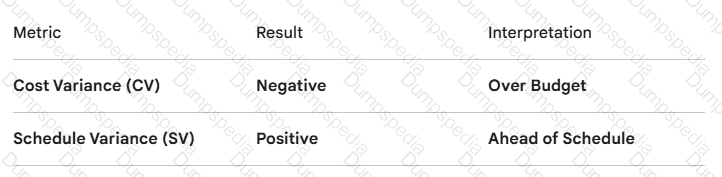
Analysis of Other Options:
A. under budget and behind schedule: This would require a Positive CV and a Negative SV.
C. on schedule: This would require an SV of zero (where $EV = PV$).
D. complete; all planned values have been earned: A project is complete when $EV = BAC$ (Budget at Completion). While a positive SV suggests progress, it does not inherently mean the project is finished; it just means it is moving faster than planned.
At the end of the third iteration, the project team gathers to discuss the stories to be implemented in the next iteration. What should the team do during this session?
Run a spike to ensure all information available is correct and then decide which stories to implement.
Develop a user story analysis based on the work done, depicting the current status, S-curve, schedule variance (SV), and planned value (PV).
Plan the backlog by estimating and reprioritizing the user stories as new information becomes available.
Bring up all risks for implementing the user stories and discuss possible solutions.
According to the Agile Practice Guide and the PMBOK® Guide, specifically regarding Backlog Refinement and Sprint Planning, Agile projects rely on continuous grooming of the work.
Backlog Refinement (Grooming): As the team prepares for the next iteration, they must ensure the Product Backlog is " Ready. " This involves Reprioritizing stories based on the value delivered in the previous three iterations and any new information or feedback received from stakeholders.
Estimation: During these sessions, the team provides or updates estimates (often in Story Points) for the upcoming work. Since Agile environments are change-driven, a story that was estimated two months ago may need a new estimate based on what the team learned during the first three iterations.
Progressive Elaboration: Agile planning is not a one-time event. It happens at the beginning of every iteration. This ensures the team is always working on the highest-priority items that provide the most business value.
Analysis of other options:
Option A: A Spike is a specialized task used to research a technical issue or reduce risk. While useful, it is not the standard activity for a general session discussing the next iteration ' s stories unless a specific unknown was identified.
Option B: Terms like S-curve, SV, and PV are artifacts of Earned Value Management (EVM), which is primarily used in Predictive (Waterfall) project management. In an Agile iteration meeting, the focus is on the backlog and flow, not traditional variance analysis.
Option D: While risks are discussed during planning, simply " bringing up all risks " is only one part of the process. The core objective of the session described (discussing stories for the next iteration) is the broader act of Backlog Planning and Refinement.
Per PMI standards, the project team must maintain a dynamic and prioritized backlog. By estimating and reprioritizing user stories at the end of an iteration, the team ensures the next iteration is aligned with the most current project goals and technical realities.
Which of the following is contained within the communications management plan?
An organizational chart
Glossary of common terminology
Organizational process assets
Enterprise environmental factors
According to the PMBOK® Guide, specifically within the Plan Communications Management process, the Communications Management Plan is a component of the project management plan that describes how, when, and by whom information about the project will be administered and disseminated.
Key Contents: The communications management plan typically includes:
Stakeholder communication requirements: Who needs what information.
Information to be communicated: Including language, format, content, and level of detail.
Reason for the distribution of that information.
Time frame and frequency for the distribution of required information and receipt of acknowledgment or response.
Person responsible for communicating the information.
Glossary of common terminology: This is essential to ensure that all stakeholders have a common understanding of the terms used in the project, which minimizes misunderstandings and communication barriers.
Methods or technologies used to convey the information (e.g., memes, emails, press releases).
Resources allocated for communication activities.
Escalation process for resolving issues that cannot be resolved at a lower staff level.
Comparison with other options:
A. An organizational chart: This is a graphic display of project team members and their reporting relationships. It is typically a component of the Resource Management Plan, not the communications plan, although the communications plan may reference it to determine reporting lines.
C. Organizational process assets (OPAs): OPAs (such as communication templates or historical data) are inputs to the process of creating the communications management plan. They are not " contained within " the plan itself; rather, the plan is developed using them.
D. Enterprise environmental factors (EEFs): Like OPAs, EEFs (such as the organization ' s existing communication infrastructure or regional culture) are inputs that influence the plan. They are external constraints or enablers, not a part of the plan ' s internal documentation.
An output of the Perform Integrated Change Control process is:
Deliverables.
Validated changes.
The change log.
The requirements traceability matrix.
According to the PMBOK® Guide (Project Management Body of Knowledge), the Perform Integrated Change Control process is the process of reviewing all change requests, approving changes, and managing changes to deliverables, organizational process assets, project documents, and the project management plan.
The Change Log (Option C): This is a primary output of this process. The change log is used to document changes that occur during a project. It contains the status of all change requests (approved, deferred, or rejected) and is updated continuously as the Change Control Board (CCB) or Project Manager makes decisions.
Deliverables (Option A): These are an output of the Direct and Manage Project Work process, not change control. While a change request might result in a modified deliverable later, the deliverable itself is not an output of the change control process.
Validated Changes (Option B): These are an output of the Control Quality process. Once a change is approved in Integrated Change Control, it is implemented, and then Control Quality " validates " that the change was implemented correctly.
Requirements Traceability Matrix (Option D): This is an output of the Collect Requirements process. While it may be updated as a result of a change (as part of Project Document Updates), it is not a primary output unique to the Perform Integrated Change Control process.
Other key outputs of this process include Approved Change Requests, Project Management Plan Updates, and Project Documents Updates.
Which tool or technique is used in the Plan Scope Management process?
Document analysis
Observations
Product analysis
Expert judgment
According to the PMBOK® Guide, the Plan Scope Management process is the process of creating a scope management plan that documents how the project and product scope will be defined, validated, and controlled. This process occurs early in the Planning Process Group.
Expert Judgment: This is a standard tool and technique for the Plan Scope Management process. It involves input from individuals or groups with specialized knowledge or training in similar projects, the specific industry, or the technical area. Experts help define how the scope will be managed based on organizational culture, complexity, and historical information.
Other Tools for this Process: In addition to Expert Judgment, this process utilizes Data Analysis (specifically alternatives analysis) and Meetings.
Why the other options are incorrect:
A. Document analysis: This is a tool and technique used in the Collect Requirements process, not Plan Scope Management. It involves reviewing existing documentation to identify requirements.
B. Observations: Also known as " job shadowing, " this is a tool and technique used in Collect Requirements to understand business processes or requirements that users may find difficult to articulate.
C. Product analysis: This is a tool and technique used in the Define Scope process. It involves defining the product and its requirements in more detail through techniques like systems engineering or value engineering.
An adaptive project team is grooming the backlog for the next iteration. What does the team need to document in the user stories to determine the work needed to complete each story?
Team velocity in past iterations
Related epics of each story
Product owner ' s priorities
Detailed acceptance criteria
According to the Agile Practice Guide and the PMBOK® Guide, specifically during Backlog Refinement (Grooming), user stories must be refined until they are " Ready " for the team to pull into an iteration.
Definition of Ready (DoR): For a team to understand the work needed to complete a story, the story must contain Detailed Acceptance Criteria. These criteria define the boundaries of the user story and provide a specific checklist that must be met for the story to be considered " Done. "
Determining Effort: Acceptance criteria are essential for the team to estimate the effort (Story Points) required. Without these details, the team cannot know if a story is a simple task or a complex endeavor. They act as the " test cases " that verify the functional requirements from the user ' s perspective.
Eliminating Ambiguity: During grooming, the team discusses the story with the Product Owner to clarify " what " success looks like. These clarifications are documented as acceptance criteria, which directly inform the technical tasks the team will perform during the iteration.
Analysis of other options:
Team velocity (Option A): Velocity is a metric used to plan how many stories the team can take on in an iteration, but it does not describe the specific work needed to complete an individual story.
Related epics (Option B): Knowing the parent Epic provides context and the " big picture, " but it does not provide the granular detail required to execute the specific tasks of a single story.
Product owner ' s priorities (Option C): Priorities determine the order in which work is done (sequence), but they do not define the technical or functional requirements needed to fulfill the story itself.
Per PMI standards, Acceptance Criteria are the primary source of detail in an adaptive environment that ensures the team has a shared understanding of the work requirements, allowing for accurate estimation and successful delivery.
What is the probability of occurrence if the risk rating is 0.56 and the impact if the risk does occur is very high (0.80)?
0.45
0.56
0.70
1.36
According to the PMBOK® Guide, specifically within the Perform Qualitative Risk Analysis process, the risk rating (also known as the Risk Score) is determined by the combination of a risk ' s probability of occurrence and its impact on the project objectives if it does occur.
The Risk Formula: The standard formula used to calculate the risk rating is:
$$\text{Risk Rating} = \text{Probability} \times \text{Impact}$$
The Calculation:
Given Risk Rating = $0.56$
Given Impact = $0.80$ (Very High)
To find the Probability ($P$):
$$0.56 = P \times 0.80$$
$$P = \frac{0.56}{0.80}$$
$$P = 0.70$$
Application: This mathematical approach allows project managers to prioritize risks on a numerical scale. In a Probability and Impact Matrix, a risk with a probability of $0.70$ and an impact of $0.80$ would typically fall into the " High Risk " (red) zone, requiring aggressive response strategies and proactive monitoring.
Comparison with other options:
A. 0.45: This value is incorrect. Multiplying $0.45$ by $0.80$ would result in a risk rating of $0.36$.
B. 0.56: This is the risk rating itself, not the probability.
D. 1.36: This value is mathematically incorrect and impossible for a probability. In project management risk scales, probability is always expressed as a value between $0.0$ and $1.0$ (or $0\%$ to $100\%$). A value of $1.36$ would imply a likelihood greater than $100\%$.
Which quality tool incorporates the upper and lower specification limits allowed within an agreement?
Control chart
Flowchart
Checksheet
Pareto diagram
According to the PMBOK® Guide, specifically within the Control Quality process, a Control Chart is a graphic display of process data over time and against established control limits.
Specification Limits: These are based on the requirements of the agreement (contract) or the customer ' s needs. They represent the maximum and minimum values allowed. If a product or service falls outside these limits, it is considered nonconforming (a defect).
Control Limits vs. Specification Limits:
Control Limits (Upper and Lower Control Limits - UCL/LCL) are calculated statistically (usually $\pm3$ sigma) and show the natural variation of the process. They determine if the process is " in control. "
Specification Limits (Upper and Lower Specification Limits - USL/LSL) are provided by the customer or contract. A process can be " in control " (statistically stable) but still " out of spec " if the control limits fall outside the specification limits.
Purpose: The control chart allows the project manager to identify when a process is behaving unpredictably (out of control) or when it is in danger of violating the contractual specification limits.
Comparison with other options:
B. Flowchart: This is a graphical representation of a process showing how various elements of a system relate. It is used to identify where quality problems might occur but does not track data against specification limits.
C. Checksheet: Also known as a tally sheet, this is used to organize facts in a manner that will facilitate the effective collection of useful data about a potential quality problem. It is a data collection tool, not an analytical chart for limits.
D. Pareto diagram: This is a specific type of vertical bar chart used to identify the vital few sources that are responsible for causing most of a problem ' s effects. It follows the 80/20 rule and does not incorporate upper or lower specification limits.
A project team is working on a new driverless vehicle and is organizing a workshop with experts to analyze the data received from the prototype. Who should the project manager invite to provide expert advice?
The subject matter experts (SMEs) identified in the stakeholder register
The senior experts with high status in the academic community
The major stakeholders nominated by the project sponsor
The usual review participants holding recognized certifications
According to the PMBOK® Guide (specifically the Identify Stakeholders and Develop Project Management Plan processes), the Stakeholder Register is the primary project document used to record all individuals, groups, or organizations that have an interest in, or can influence, the project.
Why Choice A is correct: During the planning phase, the Project Manager performs a stakeholder analysis to identify who possesses the specialized knowledge or expertise (Expert Judgment) required for specific project activities. In the case of a highly technical project like a " driverless vehicle, " the specific SMEs needed for data analysis should have already been identified, categorized, and documented in the Stakeholder Register with their specific roles and areas of expertise noted. This ensures that the workshop is populated by people whose skills have been vetted as relevant to the project ' s unique technical requirements.
Analysis of other options:
B (Senior experts with high status): Academic status does not always equate to project-specific relevance. While they may be experts, if they are not relevant to the specific prototype ' s data or the organization ' s goals, they may not be the right fit.
C (Major stakeholders nominated by the sponsor): Sponsors often nominate high-level stakeholders (executives), but these individuals may lack the deep technical expertise required to " analyze data received from the prototype. "
D (Usual review participants with certifications): Having a certification does not automatically make one a Subject Matter Expert in driverless vehicle data. Relying on " usual " participants ignores the specialized nature of this specific project.
The PMI Standard for Project Management emphasizes that " Expert Judgment " should be sought from individuals or groups with specialized training or knowledge. By referring to the Stakeholder Register, the Project Manager ensures a structured and documented approach to engaging the correct expertise.
When does Monitor and Control Risks occur?
At project initiation
During work performance analysis
Throughout the life of the project
At project milestones
According to the PMBOK® Guide, specifically within the Project Risk Management Knowledge Area, Monitor Risks (formerly Monitor and Control Risks) is the process of monitoring the implementation of agreed-upon risk response plans, tracking identified risks, identifying and analyzing new risks, and evaluating risk process effectiveness.
Continuous Process: Risk management is not a one-time event. Because the project environment is dynamic, new risks can emerge at any time, and existing risks can change in probability or impact. Therefore, this process is performed throughout the life of the project.
Integration with Execution: As project work is executed, the team gathers work performance data. This data is used to determine if:
Assumptions are still valid.
Risk contingency reserves are adequate.
Project policies and procedures are being followed.
Risk responses are as effective as expected.
Lifecycle Persistence: From the moment the project is authorized until the final administrative closure, the project manager and team must remain vigilant. While the intensity of risk monitoring might peak during high-complexity phases, the process itself never stops until the project ends.
Analysis of other choices:
Choice A (At project initiation): While high-level risks are identified in the Project Charter during initiation, the monitoring and controlling of those risks cannot happen until there is a plan to monitor and work being performed to control.
Choice B (During work performance analysis): Work performance analysis is a tool/technique and an input used within the process of monitoring risks, but it does not define when the process occurs.
Choice D (At project milestones): While formal risk audits or reviews often take place at major milestones or phase gates, limiting risk monitoring only to these points would leave the project vulnerable to risks that emerge between milestones.
Which is an aspect of the requirements management plan?
Detailed project scope statement
Creation of work breakdown strucure (WBS)
Impact analysis
Duration for implementation
According to the PMBOK® Guide, the Requirements Management Plan is a component of the project management plan that describes how project and product requirements will be analyzed, documented, and managed.
One of the essential aspects of this plan is defining how changes to requirements will be handled. This includes:
Impact Analysis: The plan must specify how a proposed change to a requirement will be evaluated for its impact on the project ' s scope, schedule, budget, and quality. This ensures that no change is made without a full understanding of its consequences.
Traceability: It also defines the Requirements Traceability Matrix (RTM) structure, which links product requirements from their origin to the deliverables that satisfy them.
Prioritization and Metrics: The plan establishes the criteria for prioritizing requirements and the metrics that will be used to ensure they are met.
Why other options are incorrect:
Detailed Project Scope Statement (Option A): This is an output of the Define Scope process, not an aspect of the Requirements Management Plan. While the scope statement is based on requirements, they are separate documents.
Creation of Work Breakdown Structure (Option B): The WBS is a tool used in the Create WBS process to decompose the scope. It is guided by the Scope Management Plan, not the Requirements Management Plan.
Duration for Implementation (Option D): The timing or duration of activities is handled within the Project Schedule Management knowledge area and documented in the Schedule Management Plan.
A team has been tasked with designing a product to address a problem they have never faced before. The project team is struggling to get traction as the solutions are not clear. What should the project manager do next?
Add the risk to the project risk register, as the lack of solutions could impact how the product is built.
Add the issue to the project issue log, as it will impact the project performance.
Facilitate a brainstorming session for the team to discuss ideas to solve the problem.
Meet with the project sponsor to understand their vision on how to address the problem.
According to the PMBOK® Guide, specifically the Collect Requirements and Develop Team processes, the project manager acts as a facilitator when the team faces technical ambiguity or " wicked problems " that lack clear solutions.
Facilitation and Brainstorming: When a team is " struggling to get traction " on a new problem, the Project Manager should utilize data-gathering techniques like Brainstorming. This creates a collaborative environment where diverse ideas can be surfaced without immediate judgment. It is the most effective way to jump-start the creative process and move from stagnation to action.
The Power of the Team: In both adaptive and predictive environments, the technical experts (the team) are best positioned to develop solutions. The PM’s role is not to provide the answer, but to provide the structure (the session) that allows the answer to emerge.
Divergent Thinking: Brainstorming encourages divergent thinking, which is essential when facing a problem the team has " never faced before. " Once a wide array of ideas is generated, the team can then use tools like Affinity Diagrams or Multicriteria Decision Analysis to narrow them down.
Analysis of other options:
Option A: While it is technically a risk, simply adding it to a Risk Register does nothing to solve the immediate problem of the team being stuck. Documentation is a secondary action to active problem-solving.
Option B: Adding it to the Issue Log tracks the problem but doesn ' t resolve it. The prompt asks what the PM should do next to get the team moving.
Option D: The Project Sponsor provides the " what " (the vision and funding) but generally should not be responsible for the " how " (the technical solution). Meeting with the sponsor for technical direction undermines the team ' s autonomy and expertise.
Per PMI standards, when a project hits a creative or technical roadblock, the project manager should immediately employ interpersonal and team skills to facilitate a Brainstorming session, empowering the team to innovate and find a path forward.
An input to the Estimate Activity Resources process is:
Activity resource requirements.
Published estimating data.
Resource calendars.
Resource breakdown structure (RBS).
According to the PMBOK® Guide, the Estimate Activity Resources process involves estimating the types and quantities of material, human resources, equipment, or supplies required to perform each activity.
To perform this accurately, the project manager must know when specific resources are available.
Resource Calendars: This is a critical input to this process. It identifies the working days and shifts on which each specific resource is available. This includes information on which resources (such as human resources, equipment, and material) are potentially available during a planned activity period.
Other Key Inputs:
Project Management Plan: Specifically the Resource Management Plan.
Project Documents: Such as the Activity List and Activity Attributes.
Enterprise Environmental Factors (EEF): Such as resource location and availability.
Organizational Process Assets (OPA): Such as policies and procedures for staffing.
Analysis of Other Options:
A. Activity resource requirements: This is the primary output of the Estimate Activity Resources process, not an input.
B. Published estimating data: This is a tool and technique (specifically part of Data Analysis or expert judgment sources) used to help determine the estimates, though in some versions it is listed under EEFs. However, it is not a primary process input like the calendar.
D. Resource breakdown structure (RBS): This is an output of this process. It is a hierarchical representation of resources by category and type.
What document gathers all of the lessons learned at the end of a phase or project
Lessons learned register
Lessons learned list
Lessons learned project asset
Lessons learned repository
According to the PMBOK® Guide, the Lessons Learned Register is the primary project document used to record knowledge gained during a project or a phase. This document is created early in the project and is updated throughout the lifecycle as an output of the Manage Project Knowledge process.
The distinction between the choices depends on the timing and the specific document type as defined by PMI:
Lessons Learned Register (Choice A): This is a project document used to record challenges, risks, opportunities, or other content that can be used to improve performance in the current project or future phases. At the end of a project or phase, the information in this register is transferred to the Lessons Learned Repository.
Lessons Learned Repository (Choice D): This is part of the Organizational Process Assets (OPAs). While the repository is where the information is eventually stored for the entire organization ' s long-term use, the specific document that " gathers " and captures these details during the execution and at the conclusion of a project phase is the register.
Choices B and C: These are not standard PMI terms. While " lessons learned " may be referred to as assets or lists informally, they are not formal project management documents recognized in the PMBOK® Guide.
In the Close Project or Phase process, the Lessons Learned Register is finalized and its contents are archived into the Lessons Learned Repository to support continuous improvement across the organization.
Which two of the following can be used as communication tools between the business analyst and the rest of the project team? (Choose two)
Project management plan
Pareto chart
Gantt chart
Responsible, accountable, consult, inform (RACI) matrix
Process flows
The PMBOK® Guide and the PMI Guide to Business Analysis highlight the importance of " bridge " documents—tools that allow the Business Analyst (BA) to translate complex business needs into actionable information for the project team.
Why Choice D is correct (Responsible, accountable, consult, inform (RACI) matrix):
Role Clarification: The RACI matrix is a critical communication tool used to define who does what. Between a BA and the project team, it clarifies who is responsible for eliciting requirements, who must be consulted for technical feasibility, and who needs to be informed when a requirement changes.
Reducing Conflict: It prevents " role creep " and ensures that the team knows exactly who to go to for specific answers regarding the product scope.
Why Choice E is correct (Process flows):
Visual Communication: Process flows (or flowcharts) are one of the most effective ways for a BA to communicate the " As-Is " and " To-Be " states of a business process.
Technical Alignment: They provide a visual map that developers and testers use to understand the logic of the system. It is much easier for a project team to identify gaps in logic or technical constraints by looking at a flow diagram than by reading a dense text document.
Analysis of other options:
A (Project management plan): While this is the " master plan, " it is a high-level management document. It isn ' t a specific communication tool used by the BA to convey detailed requirements or workflows to the team; rather, it defines how communication will happen.
B (Pareto chart): This is a quality tool used for prioritizing defects or causes of problems (the 80/20 rule). While useful for data analysis, it is not a primary communication tool for requirements or team collaboration.
C (Gantt chart): This is a scheduling tool used primarily by the Project Manager to track timelines. While the BA provides input on durations, the Gantt chart does not facilitate the communication of product logic or functional requirements.
Key Concept: The Project Management Institute (PMI) emphasizes that effective communication requires Common Mental Models. By using RACI matrices (Choice D) and Process flows (Choice E), the Business Analyst ensures that the business intent is perfectly aligned with the technical execution, minimizing rework and ensuring the final product meets the stakeholders ' expectations.
The following is a network diagram for a project.
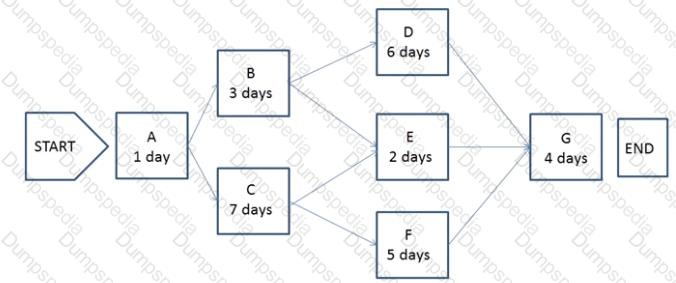
The critical path for the project is how many days in duration?
10
12
14
17
According to the PMBOK® Guide (Project Management Body of Knowledge), specifically the Project Schedule Management knowledge area, the Critical Path is the sequence of activities that represents the longest path through a project, which determines the shortest possible project duration.
To find the duration of the critical path for the provided diagram, we must calculate the sum of the durations for every possible path from START to END:
Path 1: A → B → D → G
Calculation: $1 + 3 + 6 + 4 = 14$ days.
Path 2: A → B → E → G
Calculation: $1 + 3 + 2 + 4 = 10$ days.
Path 3: A → C → E → G
Calculation: $1 + 7 + 2 + 4 = 14$ days.
Path 4: A → C → F → G
Calculation: $1 + 7 + 5 + 4 = 17$ days.
Conclusion:
Comparing the totals (14, 10, 14, and 17), the longest duration is 17 days. Therefore, the sequence A-C-F-G is the Critical Path.
In PMI standards, activities on this path have zero total float. Any delay in an activity on the critical path (such as Activity C or F) will result in a direct delay to the project completion date.
The following is a network diagram for a project.
What is the critical path for the project?
A-B-D-G
A-B-E-G
A-C-F-G
A-C-E-G
According to the PMBOK® Guide, the Critical Path is the sequence of activities that represents the longest path through a project, which determines the shortest possible project duration.
Critical Path Method (CPM): To identify the critical path, the duration of all activities on each possible path from start to finish must be summed. The path with the highest total duration is the critical path.
Analysis of the Paths (Based on standard PMI Network Diagram Question 279):
Path A-B-D-G: $5 + 5 + 8 + 3 = 21$ days.
Path A-B-E-G: $5 + 5 + 4 + 3 = 17$ days.
Path A-C-E-G: $5 + 9 + 4 + 3 = 21$ days.
Path A-C-F-G: $5 + 9 + 10 + 3 = 27$ days.
Determination: Since Path A-C-F-G has the longest duration (27 days), it is the critical path. Any delay in activities A, C, F, or G will result in a direct delay to the project completion date. Activities on this path have zero float.
Comparison with other options:
A, B, and D: These paths have shorter total durations (21, 17, and 21 days respectively). Therefore, these paths have Total Float, meaning the activities on these paths can be delayed to some extent without affecting the overall project finish date. Only the longest path is considered " Critical " in standard CPM.
In which organizational structure would the project manager have most authority?
Matrix-weak
Matrix-balanced
Matrix-strong
Organic or simple
According to the PMBOK® Guide and the PMI organizational theory, the level of authority a project manager possesses is directly tied to the organizational structure. In a Matrix environment, authority is shared between functional managers and project managers, but the balance shifts depending on the specific type of matrix.
Matrix-strong: In this structure, the project manager has a high to almost total level of authority. They often have a full-time staff and a dedicated project administrative staff. The power dynamic favors the project manager over the functional manager, and the project manager often controls the project budget.
Matrix-balanced: The project manager and functional manager share power and authority equally. This can often lead to conflicts regarding resource priority.
Matrix-weak: The project manager ' s role is more akin to a project coordinator or expeditor. They have very limited authority and act more as a facilitator than a manager with decision-making power.
Organic or Simple: Typically found in small businesses or startups, authority is very flexible or resides almost entirely with the owner/founder. The " Project Manager " role is often part-time or non-existent in a formal capacity.
In the hierarchy of authority defined by PMI, the only structure providing more authority than a Strong Matrix would be a Project-Oriented (Projectized) organization, where the project manager has total control. Since " Project-Oriented " is not an option here, Matrix-strong is the correct choice as it offers the highest level of authority among the listed selections.
Which of the following is an output of the Define Activities process?
Activity list
Project plan
Activity duration estimates
Project schedule
According to the PMBOK® Guide, specifically within the Project Schedule Management knowledge area, the Define Activities process is the process of identifying and documenting the specific actions to be performed to produce the project deliverables.
The Activity List: This is a primary output of the process. It is a comprehensive list that includes all schedule activities required on the project. It includes the activity identifier and a scope of work description for each activity in sufficient detail to ensure that project team members understand what work is required to be completed.
Decomposition: The activity list is created by decomposing the Work Packages from the WBS into smaller components called activities. While a work package is a deliverable, an activity is the actual effort/work required to create that deliverable.
Other Key Outputs of Define Activities:
Activity Attributes: These provide additional details for each activity, such as predecessor activities, successor activities, logical relationships, leads and lags, and resource requirements.
Milestone List: A list identifying all project milestones and indicating whether the milestone is mandatory (required by contract) or optional (based on historical information).
Change Requests: As the work is decomposed, the team may discover work that was not previously identified, necessitating a change to the scope baseline.
Comparison with other options:
B. Project plan: The Project Management Plan is a high-level document. While it contains the schedule management plan, the " Project Plan " as a whole is not a direct output of defining individual activities.
C. Activity duration estimates: This is the primary output of the Estimate Activity Durations process. You must first define the activities (this process) before you can estimate how long they will take.
D. Project schedule: The Project Schedule is the final result of several processes, including defining activities, sequencing them, estimating resources, and estimating durations. It is the primary output of the Develop Schedule process.
A functional manager is delegating a key project to a project team without a project manager. Which communication method will be most effective?
Interactive
Push
Verbal
Oral
According to the PMBOK® Guide and the Standard for Project Management, effective communication is a critical pillar of project success, especially when a formal leadership structure (like a dedicated project manager) is missing.
The three primary communication methods recognized by PMI are Interactive, Push, and Pull. In the scenario described:
Interactive Communication: This method involves a multidimensional exchange of information in real-time. It includes meetings, phone calls, video conferencing, and instant messaging. It is the most effective way to ensure a common understanding among all participants on a given topic. Because the team lacks a project manager to coordinate activities, the functional manager must ensure that the delegation is fully understood, expectations are clear, and the team can provide immediate feedback or ask clarifying questions.
Comparison with other options:
Push Communication: This involves sending information to specific recipients who need to know it (e.g., emails, memos, reports). While this ensures the information is distributed, it does not guarantee that it reached or was understood by the intended audience. Without a PM to follow up, " Push " communication risks leaving the team misaligned.
Verbal/Oral Communication: These are types of communication, but they are not categorized as " methods " in the same way Interactive, Push, and Pull are in the Communication Management Plan. Furthermore, " Verbal " and " Oral " are often used interchangeably in general conversation, but in a PMI context, Interactive is the formal method that encompasses these while focusing on the bidirectional flow of information.
In a self-managing team environment (or one where the PM role is absent), Interactive communication is essential to resolve conflicts, foster collaboration, and verify that the project ' s strategic objectives are correctly interpreted by the team members.
Which type of contract is a hybrid of both a cost-reimbursable and a fixed-price contract?
Cost Plus Award Fee Contract (CPAF)
Firm-Fixed -Price Contract (FFP)
Time and Material Contract (TandM)
Cost Plus Incentive Fee Contract (CPIF)
According to the PMBOK® Guide, specifically within the Plan Procurement Management process, Time and Material (TandM) contracts are identified as a hybrid type of contractual arrangement that contains aspects of both cost-reimbursable and fixed-price contracts.
Hybrid Nature:
Cost-Reimbursable Element: They resemble cost-reimbursable contracts because they are " open-ended, " meaning the total value of the agreement is not defined at the time of the award. The buyer pays for the actual hours worked and materials used.
Fixed-Price Element: They resemble fixed-price contracts because the unit rates (e.g., the hourly labor rate for a Senior Engineer or the cost per ton of gravel) are preset and agreed upon by both parties at the start.
Usage: TandM contracts are often used for staff augmentation, acquisition of experts, or any outside support when a precise statement of work cannot be quickly prescribed.
Risk Mitigation: To prevent unlimited cost growth, buyers often include a Not-to-Exceed (NTE) value or a " Time Limit " in the contract to require formal approval if the project exceeds a certain budget.
Analysis of Other Options:
A. Cost Plus Award Fee (CPAF): This is a purely cost-reimbursable contract. The seller is reimbursed for all legitimate costs, but the majority of the fee is earned based on the satisfaction of certain subjective performance criteria.
B. Firm-Fixed-Price (FFP): This is the opposite of a hybrid. It is a pure fixed-price contract where the price for goods or services is set at the beginning and not subject to change based on the seller ' s cost or effort.
D. Cost Plus Incentive Fee (CPIF): This is a cost-reimbursable contract where the seller is reimbursed for allowed costs and receives a predetermined incentive fee based upon achieving certain performance objectives set forth in the contract. While it shares some risk, it is categorized strictly under cost-reimbursable types.
Control charts, flowcharting, histograms, Pareto charts, and scatter diagrams are tools and techniques of which process?
Perform Quality Control
Perform Quality Assurance
Plan Quality
Report Performance
According to the PMBOK® Guide, the tools mentioned (Control charts, flowcharting, histograms, Pareto charts, and scatter diagrams) are part of the Seven Basic Quality Tools (also known as 7QC Tools). These are primarily utilized within the Control Quality process (referred to as Perform Quality Control in older PMI editions).
The Control Quality process is the activity of monitoring and recording results of executing the quality activities to assess performance and recommend necessary changes.
Statistical Process Control: Tools like Control Charts and Scatter Diagrams are used to determine if a process is stable or has predictable performance.
Identifying Variance: Pareto Charts (based on the 80/20 rule) help the team identify the vital few sources that are causing the most defects.
Data Visualization: Histograms and Flowcharts allow the project manager to visualize the distribution of data and the logic of the process to find where failures are occurring.
Output: The use of these tools results in Quality Control Measurements, which are then used as an input to Quality Assurance to verify the project ' s standards.
B. Perform Quality Assurance: While QA (Manage Quality) uses some of these tools, its primary focus is on the process rather than the specific product results. QA typically uses tools like Quality Audits, Process Analysis, and Design for X (DfX).
C. Plan Quality: This process identifies which quality standards are relevant to the project and determines how to satisfy them. While you might plan to use these tools here, the actual application of " Control Charts " and " Histograms " to measure results happens during Control Quality.
D. Report Performance: This is a communications management process. While it might include quality data in a status report, it is not the process where these specific statistical tools are used to analyze quality.
The Control Quality process is focused on the correctness of the deliverables. It is often performed throughout the project to formally demonstrate, with reliable data, that the sponsor’s and customer’s acceptance criteria have been met.
In what type of organizational structure does a project manager develop their role and work with a team assigned by job function?
Matrix - strong
Matrix - balanced
Virtual
Functional
According to the PMBOK® Guide, organizational structures range from functional to projectized, with various matrix arrangements in between. The Functional Organization is the traditional hierarchy where each employee has one clear superior.
Functional Structure: In this environment, the organization is grouped by areas of specialization (e.g., Marketing, Engineering, Finance). The project manager’s role is typically part-time or carries a different title (such as a Project Coordinator or Expediter). The staff are assigned to the project by their job function and continue to report directly to their functional manager. The project manager has little to no formal authority over the team members.
Role Development: In a functional organization, the project manager must often " develop " their role through influence and negotiation, as they lack the budget control and resource authority found in projectized or strong matrix environments.
Analysis of other options:
Matrix - strong (Option A): In a strong matrix, the project manager has high authority and a full-time role. While the team is still technically in departments, the PM functions much like a manager in a projectized organization.
Matrix - balanced (Option B): The project manager has a full-time role and a moderate level of authority, sharing the power with functional managers.
Virtual (Option C): This refers to the geographic distribution of the team (working via electronic media) rather than the reporting structure or how the role is developed relative to job functions.
Per PMI standards, the functional structure is the most common " classic " structure, but it presents the most significant challenges for a project manager regarding resource availability and project priority.
The project leam is brainstorming on approaches to deliver the upcoming product launch for which the project has been chartered. The project manager is laying out hybrid, adaptive, iterative methods. What is the team trying to address?
Co-location
Lite-cycle
Diversity
Management
According to the PMBOK® Guide, the choice between hybrid, adaptive (agile), iterative, and predictive (waterfall) methods refers to the Project Life Cycle. A life cycle is the series of phases that a project passes through from its start to its completion. It provides the basic framework for managing the project.
When a project manager is evaluating these specific methods, they are determining the Development Life Cycle best suited for the product, service, or result:
Predictive (Waterfall): Scope, time, and cost are determined in the early phases of the life cycle.
Iterative: Scope is generally determined early, but time and cost estimates are routinely modified as the team ' s understanding of the product increases.
Adaptive (Agile): Change-driven or agile; the detailed scope is defined and approved before the start of an iteration.
Hybrid: A combination of a predictive and an adaptive life cycle.
Why Option B is correct: The terms " hybrid, " " adaptive, " and " iterative " are the standard classifications used to describe the nature and cadence of the project ' s life cycle. Selecting the correct life cycle ensures the project management approach aligns with the complexity and uncertainty of the project ' s requirements.
Analysis of Distractors:
A (Co-location): This refers to the physical placement of team members (working in the same room or office) to improve communication. It is a resource management technique, not a delivery methodology.
C (Diversity): This usually refers to the composition of the project team or stakeholder group regarding different backgrounds and perspectives. While important for team performance, it does not describe delivery methods.
D (Management): While the project manager " manages " the project, this term is too broad. The specific technical term for the structure of delivery (hybrid/adaptive) is the " Life-cycle. "
The project manager is leading a construction project that has been ongoing for eight years. The project manager needs to calculate the correct static payback period and consults the cash flow statement of the construction project investment.
What equation should the project manager use?
Cash Flow Statement of the Project Investment Unit: US$ Billion
Period: 0, 1, 2, 3, 4, 5, 6, 7, 8
Cash inflow: 0, 0, 0, 0, 1200, 1200, 1200, 1200
Cash outflow: 0, 700, 800, 500, 700, 700, 700, 700, 700
Net cash flow (NCF): 0, -700, -800, 300, 500, 500, 500, 500, 500
Accumulative total of net cash flow: 0, -700, -1500, -1200, -700, -200, 300, 800, 1300
Static payback period = 3 + |-1200| / 500 = 5.4
Static payback period = 6 + |300| / 500 = 6.6
Static payback period = 5 + |-200| / 500 = 5.4
Static payback period = 4 + |-700| / 500 = 5.4
The Static Payback Period is a financial metric used in project management to determine the amount of time it takes for a project to " break even " —the point where the total investment is recovered by the project ' s net cash inflows.
To calculate the payback period when cash flows are uneven (as in this construction project), we use the cumulative cash flow method:
Payback Period=A+C∣B∣
Where:
A is the last period with a negative cumulative cash flow.
B is the cumulative cash flow value at the end of period A.
C is the net cash flow (NCF) of the period following A.
Looking at the Accumulative total of net cash flow provided in the scenario:
Year 4: -700 (Negative)
Year 5: -200 (Negative) — This is ' A ' (the last year with a negative balance).
Year 6: 300 (Positive) — The project breaks even during this year.
Now, we identify the variables:
A = 5 years.
|B| = The absolute value of the balance remaining at the end of Year 5, which is ∣−200∣=200.
C = The cash flow earned during Year 6. We calculate this by subtracting the cumulative total of Year 5 from Year 6: 300−(−200)=500.
Plugging these into the equation:
Payback Period=5+500200
Payback Period=5+0.4=5.4
A, B, and D: These options either use the wrong starting year (A uses 3, D uses 4) or the wrong formula logic (B adds to a positive year). While the mathematical result of 5.4 appears in several options, only Choice C correctly identifies the variables according to the financial principles used in the PMP/Project Management framework.
Key Concept: The Project Management Institute (PMI) emphasizes that the Static Payback Period is a tool for assessing risk; generally, the shorter the payback period, the less risky the project is considered. However, it does not account for the Time Value of Money (unlike NPV or IRR) or cash flows occurring after the payback point, which is why it is often used alongside other financial indicators in a business case.
A project manager is reviewing a past project with similar.... team choosing for tailoring?
A project manager is reviewing a past project with similar requirements to the project that is currently chartered. The project team decided to adopt quality tools, techniques and templates recommended at the organizational level after reviewing the lessons learned of the previous project What specific area of quality, is the project team choosing for tailoring?
Policy compliance and auditing
Standards and compliance
Review of lessons learned
Test and inspection planning
According to the PMBOK® Guide, specifically in the section regarding Tailoring for Project Quality Management, the project manager and the project team must decide which organizational quality policies, standards, and practices are applicable to the project.
Standards and Compliance (Choice B): When a team reviews organizational recommendations and decides which tools, techniques, and templates to adopt, they are tailoring the " Standards and Compliance " aspect of quality. This involves determining which specific quality standards are relevant to the project and how the project will comply with them. Adopting organizational templates ensures that the project aligns with the broader quality framework of the company.
Policy Compliance and Auditing (Choice A): While related, this specifically refers to the verification of whether the project is following the defined policies. The act of choosing which tools to use (as described in the prompt) is a planning/tailoring step that precedes auditing.
Review of Lessons Learned (Choice C): This is the source of the information used to make the decision, but it is not the " specific area of quality " being tailored. Lessons learned are an organizational process asset (OPA) that informs the tailoring process.
Test and Inspection Planning (Choice D): This is a technical area of quality focused on how the product will be physically verified. While tools might be chosen for this, the prompt’s focus on organizational recommendations and templates points toward the broader application of quality standards.
In the Plan Quality Management process, tailoring ensures that the quality approach is " fit for purpose " by balancing the organization ' s standard requirements with the unique needs and constraints of the current project.
What is a deliverable-oriented, hierarchical decomposition of the work to be executed to accomplish the project objectives and create the required deliverables?
Organizational breakdown structure (OBS)
Work performance information
Work package
Work breakdown structure (WBS)
In accordance with the PMBOK® Guide and the Practice Standard for Work Breakdown Structures, the Work Breakdown Structure (WBS) is a fundamental tool used in the Create WBS process within the Scope Management knowledge area.
Definition: The WBS is a deliverable-oriented hierarchical decomposition of the total scope of work to be carried out by the project team. It organizes and defines the total scope of the project.
Hierarchical Structure: Each descending level of the WBS represents an increasingly detailed definition of the project work. The total of the work at the lowest levels must roll up to the higher levels so that nothing is left out and no extra work is performed (the 100% Rule).
Purpose: It provides a structured vision of what has to be delivered. It serves as the framework for subsequent project management processes, including cost estimating, scheduling, and risk planning.
Comparison with Other Options:
Organizational Breakdown Structure (OBS) (A): This is arranged according to an organization ' s existing departments, units, or teams, with the project activities or work packages listed under each department. It shows which department is responsible for which work.
Work Performance Information (B): This is the performance data collected from various controlling processes, analyzed in context and integrated based on relationships across areas.
Work Package (C): This is the lowest level of the WBS. While it is part of the decomposition, it is the component of the WBS, not the hierarchical structure itself.
Howls program success measured?
By delivering the benefit of managing the program ' s projects in a coordinated manner
By the quality, timeliness, cost-etfectiveness. and customer saDstaction of the product or service
By completing the right projects to achieve objectives rather than completing projects the right way
By aggregating the successes of the individual projects in the program
According to the PMBOK® Guide and the Standard for Program Management, there is a distinct difference between how project success and program success are measured. While projects are focused on outputs (deliverables), programs are focused on outcomes and benefits.
Realization of Benefits: The primary measure of program success is the degree to which it satisfies the needs and benefits for which it was initiated. These benefits are the result of managing related projects together. For example, if three separate software projects are managed as a program, the success isn ' t just that three apps were built, but that their integration created a seamless user experience that increased company revenue (the benefit).
Coordinated Management: Program success also hinges on the effectiveness of the coordination. This includes managing shared resources, resolving conflicts between projects, and aligning the program ' s components with the organization’s strategic goals.
Synergy: A program is successful when the collective value of the group of projects is greater than the sum of the individual parts if they were managed independently.
Analysis of Other Options:
B. By the quality, timeliness, cost-effectiveness, and customer satisfaction of the product or service: These are the classic " Triple Constraint " and customer metrics typically used to measure project success. While important at the project level, they do not encompass the high-level benefit-realization focus of a program.
C. By completing the right projects to achieve objectives rather than completing projects the right way: This is the definition of Portfolio success. Portfolios are about " doing the right work " (strategic alignment and ROI), whereas programs and projects are about " doing the work right " to achieve specific benefits or deliverables.
D. By aggregating the successes of the individual projects in the program: This is a common misconception. Even if every individual project finishes on time and on budget, the program could still be a failure if those projects fail to integrate properly or fail to deliver the intended strategic benefit.
The purpose of the Project Communications Management Knowledge Area is to:
Monitor and control communications throughout the entire project life cycle.
Maintain an optimal flow of information among all project participants.
Develop an appropriate approach for project communications.
Ensure timely and appropriate collection of project information.
According to the PMBOK® Guide (Project Management Body of Knowledge), specifically the chapter on Project Communications Management, the overarching purpose of this Knowledge Area is defined by the specific processes it contains to manage the project ' s information needs.
Project Communications Management (Option D): Per the official PMI definition, this Knowledge Area includes the processes required to ensure that the information needs of the project and its stakeholders are met through the development of artifacts and activities designed to achieve effective information exchange. It consists of three parts: Plan, Manage, and Monitor. The core goal is the timely and appropriate generation, collection, distribution, storage, retrieval, management, visualization, monitoring, and ultimate disposition of project information.
Monitor and Control (Option A): While " Monitor Communications " is a process within the Knowledge Area, it is not the sole purpose of the entire Knowledge Area. The Knowledge Area also encompasses planning and execution.
Maintain an Optimal Flow (Option B): This is the goal of the Manage Communications process specifically (the execution phase), where the focus is on ensuring the information reaches the right people at the right time.
Develop an Appropriate Approach (Option C): This is the specific objective of the Plan Communications Management process, which creates the Communications Management Plan.
In the PMI framework, Option D is the most comprehensive answer as it addresses the fundamental lifecycle of project information—from its collection to its eventual disposition—which is the root purpose of the Knowledge Area.
A project manager is working on project cost management. The following information is current.
* Planned value = 30
* Actual cost = 35
* Earned value = 28
Considering this data, which project indicator is correct?
Schedule Variance (SV) = 2
Cost Performance Index (CPI) = 0.80
Schedule Performance Index (SPI) = 1.93
Cost Variance (CV) = 7
According to the PMBOK® Guide, specifically the Control Costs process, Earned Value Analysis (EVA) is used to assess project performance and progress. This involves calculating variances and indices based on Planned Value (PV), Actual Cost (AC), and Earned Value (EV).
To determine which indicator is correct, we must perform the standard calculations:
Cost Performance Index (CPI):
Formula: $CPI = \frac{EV}{AC}$
Calculation: $CPI = \frac{28}{35} = 0.80$
Interpretation: A CPI of 0.80 means the project is only getting 80 cents of value for every dollar spent. Since it is less than 1.0, the project is over budget.
Cost Variance (CV):
Formula: $CV = EV - AC$
Calculation: $CV = 28 - 35 = -7$
Interpretation: A negative CV indicates the project is over budget.
Schedule Variance (SV):
Formula: $SV = EV - PV$
Calculation: $SV = 28 - 30 = -2$
Interpretation: A negative SV indicates the project is behind schedule.
Schedule Performance Index (SPI):
Formula: $SPI = \frac{EV}{PV}$
Calculation: $SPI = \frac{28}{30} \approx 0.93$
Interpretation: An SPI of 0.93 means the project is progressing at 93% of the planned rate (behind schedule).
Why other options are incorrect:
Option A: The SV is actually -2, not 2. A positive 2 would incorrectly suggest the project is ahead of schedule.
Option C: The SPI is 0.93, not 1.93. An SPI of 1.93 would suggest the project is nearly twice as fast as planned.
Option D: The CV is -7, not 7. A positive 7 would incorrectly suggest the project is under budget.
A firm contracted an event management company to conduct the annual sales day event. The agreement states that the event management company will charge the firm for the actuals and receive 8% of the total cost. What type of contract Is this?
Time and material (T8M)
Fixed price incentive fee (FPIF)
Cost plus fixed fee (CPFF)
Cost plus award fee (CPAF)
According to the PMBOK® Guide and PMI Procurement Management standards, this arrangement is a classic example of a Cost Reimbursable contract. Specifically, it aligns with the characteristics of a Cost Plus Fixed Fee (CPFF) contract (or a variation where the " fee " is calculated as a percentage of the initial estimated costs).
Cost Plus Fixed Fee (CPFF): In this contract type, the seller (the event management company) is reimbursed for all allowable actual costs incurred for doing the project work. In addition to the actuals, the seller receives a fixed fee payment.
The 8% Factor: While the question mentions a percentage, in PMI terminology, once a fee is calculated based on the estimated costs and agreed upon, it remains " fixed " relative to the scope of work. It does not change based on the seller ' s actual performance or efficiency, which protects the buyer from the seller unnecessarily inflating costs just to increase the fee (a practice prohibited in many professional standards under " Cost Plus Percentage of Cost " or CPPC, though CPFF remains the standard acceptable structure).
Analysis of other options:
A. Time and Material (TandM): These are hybrid contracts used when the scope cannot be quickly prescribed. They charge per hour or per item (e.g., $\$100$/hour) rather than charging " actuals plus a fee percentage. "
B. Fixed Price Incentive Fee (FPIF): This is a fixed-price contract where the price is set, but the seller can earn an additional reward for hitting specific performance targets (like finishing early). Here, the base is " actuals, " not a fixed price.
D. Cost Plus Award Fee (CPAF): In this type, the majority of the fee is earned based on the satisfaction of certain subjective performance criteria judged by the buyer. An 8% flat charge is a predetermined fee, not a subjective award.
Per PMI standards, the Cost Plus Fixed Fee model is appropriate when the buyer wants the seller to perform the work but the seller is unwilling or unable to assume the financial risk of a fixed-price agreement.
The following chart contains information about the tasks in a project.
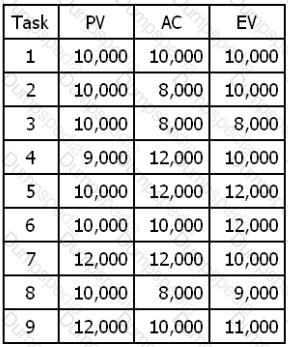
Based on the chart, what is the cost performance index (CPI) for Task 2?
0.8
1
1.25
1.8
According to the PMBOK® Guide (Project Management Body of Knowledge), specifically within the Project Cost Management knowledge area and the Control Costs process, the Cost Performance Index (CPI) is a measure of the cost efficiency of budgeted resources, expressed as the ratio of earned value to actual cost.
To calculate the CPI for Task 2 using the data provided in the table:
Identify the variables for Task 2:
Earned Value (EV) = 10,000
Actual Cost (AC) = 8,000
Apply the CPI Formula:
$$\text{CPI} = \frac{\text{EV}}{\text{AC}}$$
Perform the calculation:
$$\text{CPI} = \frac{10,000}{8,000} = 1.25$$
Option C (1.25): This is the correct calculation. A CPI greater than 1.0 indicates that the project is performing better than planned regarding cost (under budget). In this case, for every dollar spent on Task 2, $1.25$ worth of work was actually accomplished.
Option A (0.8): This would be the result if you incorrectly divided AC by EV ($8,000 / 10,000$). This would represent a project over budget, which is not the case for Task 2.
Option B (1): This would occur if EV and AC were equal (as seen in Task 1 or Task 6), indicating project performance exactly on budget.
Option D (1.8): This is mathematically incorrect based on the provided Task 2 figures.
In the PMI framework, the Cost Performance Index (CPI) is considered the most critical EVM metric. It allows the Project Manager to determine if the project ' s current spending efficiency is sustainable and is used as a primary input for calculating the Estimate at Completion (EAC).
At what stages of project should the identify Stakeholder process be performed?
When beginning each phase of the project
At the beginning of the project only
Only when the project manager is concerned about stakeholder satisfaction
When the project charter is produced, at the beginning of each phase, and when significant changes occur
According to the PMBOK® Guide, the Identify Stakeholders process is not a one-time event. It is a process that is performed periodically throughout the project.
Initial Identification: The process typically first occurs as the project is being authorized (when the Project Charter is produced) to identify those who have a vested interest in the project ' s outcome from the start.
Phase Transitions: Stakeholders can change as the project moves from one phase to another (e.g., from design to construction). Therefore, it should be performed at the beginning of each phase.
Dynamic Environment: Significant changes—such as a change in project leadership, a major scope shift, or a change in the organization ' s structure—can introduce new stakeholders or change the influence level of existing ones.
Why other options are incorrect:
Option A: While identifying stakeholders at the beginning of each phase is correct, it is incomplete because it ignores the initial identification during the chartering process and the need to respond to significant changes.
Option B: Only performing this at the beginning is a major risk. New stakeholders may emerge, or the power/interest of existing stakeholders may shift, leading to project delays or lack of support if they are not managed.
Option C: Stakeholder identification is a formal, proactive project management requirement. It should not be reactive or based solely on the project manager ' s personal level of concern.
A reward can only be effective if it is:
Given immediately after the project is completed.
Something that is tangible.
Formally given during project performance appraisals.
Satisfying a need valued by the individual.
According to the PMBOK® Guide and the Standard for Project Management, specifically within the Develop Team process of the Project Resource Management Knowledge Area, rewards and recognition are used to motivate and reinforce desirable behavior.
As per PMI standards, a reward is only effective if it satisfies a need that is valued by that individual. This concept is rooted in several motivational theories recognized by PMI, such as Vroom’s Expectancy Theory, which posits that individuals are motivated to act in a certain way based on the expectation that the act will be followed by a given outcome and on the attractiveness of that outcome to the individual (valence). Key principles of effective rewards include:
Cultural Sensitivity: Rewards must be appropriate within the cultural context of the team member.
Individual Preference: What motivates one person (e.g., public recognition) might demotivate another (who may prefer a private " thank you " or a flexible work schedule).
Link to Performance: There must be a clear connection between the performance and the reward.
Timeliness: Ideally, rewards should be given throughout the life cycle of the project, not just at the end, to maintain momentum.
The other options are incorrect based on the following PMI human resource management principles:
Given immediately after the project is completed: Waiting until the project is finished is often too late to reinforce behaviors effectively. PMI recommends that recognition and rewards occur throughout the project life cycle.
Something that is tangible: Rewards do not have to be tangible (like money or gifts). Intangible rewards, such as public praise, increased responsibility, or a letter of recommendation, are often equally or more effective.
Formally given during project performance appraisals: While appraisals are a formal time for feedback, effective rewards should be given whenever the desired behavior occurs to be most impactful. Restricting rewards to annual or phase-end appraisals diminishes their motivational value.
As per the PMI Lexicon of Project Management Terms, the goal of the reward and recognition system is to create a positive work environment that encourages the team to achieve project objectives.
Which Project Time Management process includes bottom-up estimating as a tool or technique?
Estimate Activity Resources
Sequence Activities
Estimate Activity Durations
Develop Schedule
According to the PMBOK® Guide (Project Management Body of Knowledge), specifically within the Project Schedule Management knowledge area (historically referred to as Project Time Management):
Estimate Activity Resources (Option A): This is the process of estimating the types and quantities of material, human resources, equipment, or supplies required to perform each activity. Bottom-up estimating is a key tool and technique for this process. It involves estimating the resources for each specific activity or work package and then aggregating (rolling up) those estimates to higher levels of the Work Breakdown Structure (WBS). This is used when an activity cannot be estimated with a reasonable degree of confidence at a high level.
Estimate Activity Durations (Option C): While this process also uses various estimating techniques (Analogous, Parametric, Three-Point), the standard PMI mapping places " Bottom-up estimating " primarily as a tool for Estimate Activity Resources and Estimate Costs. For durations, the aggregation of individual activity estimates into a total is part of the scheduling logic, but the formal " Bottom-up " tool designation is most strictly associated with resources and costs.
Sequence Activities (Option B): This process focuses on identifying and documenting relationships among the project activities using the Precedence Diagramming Method (PDM). It does not involve estimating quantities or values.
Develop Schedule (Option D): This is the process of analyzing activity sequences, durations, resource requirements, and schedule constraints to create the project schedule model. It uses the outputs of the estimating processes rather than performing the bottom-up estimation itself.
In the PMI framework, Bottom-up Estimating provides the greatest level of detail and accuracy, though it is more time-consuming than top-down methods. It ensures that every component of a work package is accounted for before being summarized for the project as a whole.
The project manager is working with some functional managers and stakeholders on the resource management plan Which elements may be included in this plan?
Team values, team agreements, and conflict resolution process
Conflict resolution process, communication guidelines, and meeting schedules
Team roles and responsibilities, team management, and training plan
Resource requirements, resource assignments, and team performance assessments
According to the PMBOK® Guide, the Resource Management Plan is a component of the project management plan that provides guidance on how project resources should be categorized, allocated, managed, and released. It is created during the Plan Resource Management process.
The plan typically includes, but is not limited to:
Identification of Resources: Methods for identifying and quantifying the physical and team resources needed.
Roles and Responsibilities: Defining the Role (the function assumed by a person), Authority (the right to apply resources or make decisions), Responsibility (the assigned duties), and Competency (the skills and capacity required).
Project Organization Charts: A graphic display of project team members and their reporting relationships.
Team Management: Guidance on how team resources should be defined, staffed, managed, and eventually released.
Training Plan/Strategies: If the team lacks the necessary competencies, the plan outlines how that training will be provided.
Recognition and Rewards: The strategy for how team members will be motivated and recognized for their contributions.
Analysis of Other Options:
A. Team values, team agreements, and conflict resolution process: These elements are specifically part of the Team Charter, not the Resource Management Plan. The Team Charter focuses on social norms and behavioral expectations.
B. Conflict resolution process, communication guidelines, and meeting schedules: Communication guidelines and meeting schedules are primary components of the Communications Management Plan.
D. Resource requirements, resource assignments, and team performance assessments: These are Project Documents, not components of the Resource Management Plan. " Resource Requirements " is an output of Estimate Activity Resources, and " Assignments " are an output of Acquire Resources. The Plan describes how to do these things, but does not contain the specific assignments themselves.
Which of the following describes the similarities of the process groups and project life cycle?
The life cycle involves three project management process groups.
Both provide a basic framework to manage the project.
Each project must have a life cycle and all processes in the five process groups.
The project life cycle is managed by executing the processes within the five process groups.
According to the PMBOK® Guide (6th Edition), understanding the relationship between Process Groups and the Project Life Cycle is fundamental to project management. While they are distinct concepts, their primary similarity lies in their purpose: providing structure.
Project Life Cycle: This is the series of phases that a project passes through from its start to its completion. It provides the basic framework for managing the project, regardless of the specific work involved.
Project Management Process Groups: These are logical groupings of project management inputs, tools and techniques, and outputs (Initiating, Planning, Executing, Monitoring and Controlling, and Closing). They also provide a basic framework by defining the " how-to " of managing project activities.
Analysis of Distractors:
A (The life cycle involves three process groups): This is incorrect. There are five process groups (Initiating, Planning, Executing, Monitoring and Controlling, and Closing), and they are all applicable across the project life cycle, not just three.
C (Each project must have all processes in the five process groups): This is incorrect because of tailoring. The PMBOK® Guide emphasizes that project managers should tailor the processes; not every single one of the 49 processes is required for every project.
D (The project life cycle is managed by executing the processes): While this statement is technically a true description of how a project is run, it describes the interaction between the two concepts rather than their similarities. The question asks what they have in common (their nature as structural frameworks).
A project manager held a meeting and listed all team members ' ideas for improving the product on a white board. What data gathering technique did the project manager apply?
Focus groups
Interviews
Brainstorming
Delphi technique
According to the PMBOK® Guide, Brainstorming is a fundamental data gathering technique used to identify a broad list of ideas, risks, or solutions in a short period. It is characterized by an open, non-judgmental environment where team members contribute ideas that are typically recorded for later analysis.
In this scenario, the act of listing all ideas on a whiteboard during a team meeting is the classic application of brainstorming. The process usually involves two parts: generation (getting the ideas out) and analysis (sorting and prioritizing them).
Key Features of Brainstorming:
Quantity over Quality: The initial goal is to gather as many ideas as possible.
Team Synergy: One person ' s idea often triggers another idea from a different team member.
Efficiency: It allows the project manager to tap into the collective knowledge of the group quickly.
Analysis of Distractors:
A (Focus groups): These bring together prequalified stakeholders and subject matter experts to learn about their expectations and attitudes about a proposed product or service. They are more structured than a general team brainstorming session.
B (Interviews): This is a formal or informal approach to elicit information from stakeholders by talking to them directly. It is typically a one-on-one or small group activity, not a collective whiteboard session with the whole team.
D (Delphi technique): This is a specific type of brainstorming/consensus-building where a group of experts answers questionnaires anonymously. The facilitator summarizes the responses and recirculates them for further comment until consensus is reached. The key difference is the anonymity and the lack of a face-to-face whiteboard environment.
A new project was approved by the project management office (PMO), and the scope of the project is to build a new detachable classroom. What delivery method and artifacts should the project manager use to deliver this project?
Linear project management; project schedule and project backlog
Adaptive project management; project schedule and work breakdown structure
Linear project management; project schedule and work breakdown structure (WBS)
Adaptive project management; project schedule and project backlog
According to the PMBOK® Guide and the Agile Practice Guide, the choice of delivery method (development life cycle) depends heavily on the nature of the project deliverables and the stability of the requirements.
Linear (Predictive) Project Management: This method is also known as Waterfall. It is used when the scope is well-defined and the product is a physical deliverable with low levels of change expected. Building a physical structure, such as a detachable classroom, follows a clear, sequential path (design, foundation, assembly, finishing). In construction, changes are costly, so a predictive approach is standard to minimize risk.
Artifacts - Project Schedule and WBS:
Work Breakdown Structure (WBS): This is the foundational artifact for linear projects. It is a deliverable-oriented hierarchical decomposition of the work. For a classroom, the WBS would break the project down into physical components (roof, walls, electrical, etc.).
Project Schedule: In linear management, a detailed schedule (often a Gantt chart) is used to track the sequential activities and dependencies required to reach the completion date.
Why not Adaptive?: Adaptive (Agile) methods are best suited for software or intangible products where requirements evolve. Building a physical classroom requires " Big Up-Front Planning " because you cannot easily change the dimensions of a wall once it has been manufactured and delivered.
Analysis of other options:
Option A: This combines a linear method with a Project Backlog. A backlog is an Agile artifact; linear projects use a WBS and a Scope Baseline instead.
Option B: Adaptive management is typically not the primary choice for standard physical construction. Furthermore, while Adaptive projects can use a WBS, it is much more characteristic of Linear management.
Option D: This is a purely Agile (Adaptive) configuration. It is unsuitable for a construction project with a fixed, physical scope like a detachable classroom.
Per PMI standards, physical engineering and construction projects are typically managed using a Linear (Predictive) delivery method, utilizing a WBS to define scope and a Project Schedule to manage the execution of that scope.
When project requirements are documented in user stones then prioritized and refined just prior to construction, which approach is being used for scheduling?
Iterative scheduling with backlog
On-demand scheduling
Life cycle scheduling with backlog
Defining Iterative activities
According to the PMBOK® Guide (6th and 7th Editions) and the Agile Practice Guide, this scenario describes a hallmark of adaptive or agile environments. When requirements are documented as user stories, they are maintained in a backlog.
The process of prioritizing and refining these stories " just prior to construction " (often referred to as Backlog Refinement or Grooming) is a core component of Iterative scheduling with backlog.
Key elements of this approach include:
User Stories: Requirements are captured from the perspective of the end-user to define the value to be delivered.
Backlog Management: A prioritized list of work to be done. The most important items are at the top, refined with enough detail to be " ready " for the next iteration.
Just-in-Time (JIT) Planning: Instead of detailed planning of the entire project at the start, the team refines requirements incrementally. This allows the team to incorporate feedback and changes late in the project life cycle without significant rework.
Analysis of Distractors:
B (On-demand scheduling): Also known as " pull-based " scheduling (typically used in Kanban), this approach does not rely on iterations. Instead, it pulls work from a backlog as resources become available, focusing on limiting work-in-progress (WIP).
C (Life cycle scheduling with backlog): This is not a standard PMI term. While backlogs exist within a life cycle, " Iterative scheduling " is the specific term used by PMI to describe the scheduling methodology in adaptive environments.
D (Defining Iterative activities): This is a general description of an action within a process, but it is not the name of a formal scheduling approach or methodology recognized in the PMBOK® Guide.
The initial development of a Project Scope Management plan uses which technique?
Alternatives identification
Scope decomposition
Expert judgment
Product analysis
According to the PMBOK® Guide, the Plan Scope Management process is the process of creating a scope management plan that documents how the project scope will be defined, validated, and controlled.
Expert Judgment: This is a primary tool and technique used in the initial development of the Project Scope Management plan. Expert judgment is defined as judgment provided based upon expertise in an application area, Knowledge Area, discipline, industry, etc., as appropriate for the activity being performed.
Application in Scope Planning: For this specific process, expertise should be sought from individuals or groups with specialized knowledge or training in:
Previous similar projects.
Information in the industry, discipline, and application area.
Developing scope management plans and requirements management plans.
Other Tools in Plan Scope Management: In addition to expert judgment, Data Analysis (specifically alternatives analysis) is used to evaluate different ways of creating the scope management plan and managing the scope.
Analysis of Other Options:
A. Alternatives identification: This is a technique used during the Define Scope process to generate different approaches to execute and perform the work of the project.
B. Scope decomposition: This is the primary technique for the Create WBS process, where the project scope and project work are subdivided into smaller, more manageable components.
D. Product analysis: This is a technique used in the Define Scope process for projects that have a product as a deliverable (as opposed to a service or result). It involves asking questions about a product and forming answers to describe the use, characteristics, and other relevant aspects of the product.
An adaptive team is performing the kickoff meeting and planning the project management approach. After defining project events, one team member argues that the artifacts are missing. The project manager coaches the team to complete the planning.
Which two of the following items should be included in the planning? (Choose two)
Daily scrum
Sprint backlog
Sprint review
Increments
Sprint retrospective
In Adaptive (Agile) project management, specifically within the Scrum framework as detailed in the Agile Practice Guide and the Scrum Guide, there is a clear distinction between Events (ceremonies) and Artifacts. The question states that " project events " have already been defined and that " artifacts " are missing.
Why Choice B and D are correct:
Artifacts are designed to maximize transparency of key information. They represent work or value.
B (Sprint Backlog): This is a primary Scrum artifact. It consists of the set of Product Backlog items selected for the Sprint, plus a plan for delivering the product Increment and realizing the Sprint Goal.
D (Increments): An Increment is a concrete stepping stone toward the Product Goal. It is a primary artifact representing the sum of all the Product Backlog items completed during a Sprint and the value of the increments of all previous Sprints.
Analysis of other options:
A, C, and E (Daily Scrum, Sprint Review, Sprint Retrospective): These are Events (ceremonies), not artifacts. Since the team member specifically pointed out that " artifacts are missing " after " events " were defined, these options would be redundant.
Daily Scrum: A 15-minute event for the developers.
Sprint Review: An event held at the end of the sprint to inspect the increment.
Sprint Retrospective: An event to plan ways to increase quality and effectiveness.
Key Concept: The Project Management Institute (PMI) emphasizes the importance of the three pillars of Scrum: transparency, inspection, and adaptation. Artifacts (Choice B and D) provide the transparency needed for the events (Choice A, C, and E) to be effective. Without the artifacts, there would be nothing tangible to inspect or adapt during the defined project events.
What is a tool to improve team performance?
Staffing plan
External feedback
Performance reports
Co-location
According to the PMBOK® Guide, Co-location is a primary tool and technique used within the Develop Project Team process to improve team performance.
Mechanism of Improvement: Co-location involves placing the most active project team members in the same physical location. This " tight matrix " strategy improves the team ' s ability to perform by enhancing communication, facilitating the rapid exchange of information, fostering a sense of community, and reducing technical or interpersonal conflict.
Team Dynamics: By working in the same environment, team members develop trust more quickly and can engage in " osmotic communication, " where they pick up relevant information simply by being near their colleagues. This is a direct contributor to increased synergy and overall team effectiveness.
Analysis of Other Options:
A. Staffing plan: This is a component of the Human Resource Management Plan (now known as the Resource Management Plan). It is a document that describes when and how human resource requirements will be met, rather than a tool used to actively improve performance.
B. External feedback: While feedback is useful, it is not listed as a standard, formal tool/technique for team development in the PMI framework compared to internal strategies like co-location or training.
C. Performance reports: These are an input to the Manage Project Team process, used to compare actual project results against the project management plan. They are used for monitoring and controlling, but they do not inherently " improve " the team ' s performance; they simply report on it.
In which Process Group are lessons learned documented?
Planning
Closing
Executing
Initiating
According to the PMBOK® Guide, specifically within the Close Project or Phase process, the formal documentation and archiving of Lessons Learned is a critical requirement of the Closing Process Group.
The Purpose of Lessons Learned: The objective is to identify project successes and failures, as well as opportunities for improvement. This information is gathered so that the performing organization can improve the management of future projects.
The Lessons Learned Register vs. Repository:
Throughout the project (specifically in the Manage Project Knowledge process within the Executing group), the team creates and updates a Lessons Learned Register.
During the Closing Process Group, this register is finalized and transferred to the Lessons Learned Repository, which is part of the organization ' s Organizational Process Assets (OPAs).
Closing Activities: The closing group involves administrative tasks such as confirming the formal acceptance of deliverables, handovers to operations, and the finalization of the project report. Archiving lessons learned ensures that the knowledge gained during the project is not lost.
Comparison with Other Options:
Planning (A): While you might review historical lessons learned during planning to avoid past mistakes, you do not document the current project ' s final lessons in this group.
Executing (C): In modern PMI standards, knowledge is managed and the register is updated during execution (Manage Project Knowledge). However, the formal, finalized documentation and archival of these lessons as a project-wide completion requirement is the hallmark of the Closing group.
Initiating (D): This group focuses on authorizing the project and identifying stakeholders. It is too early in the project life cycle to document lessons learned for the current endeavor.
During which process does the project team receive bids and proposals?
Conduct Procurements
Plan Procurements
Estimate Costs
Control Budget
According to the PMBOK® Guide (Project Management Body of Knowledge), the process of obtaining seller responses, selecting a seller, and awarding a contract is known as Conduct Procurements.
Conduct Procurements (Option A): This is the execution phase of procurement management. Key activities during this process include advertising the procurement, holding bidder conferences, and—most importantly—receiving bids and proposals from prospective sellers. The outputs of this process include selected sellers and formal agreements (contracts).
Plan Procurement Management (Option B): This is the planning stage where the team decides what to buy, how to buy it, and identifies potential sellers. It involves creating the Procurement Management Plan and the Procurement Statement of Work (SOW), but it does not involve the actual receipt of bids.
Estimate Costs (Option C): This process belongs to the Project Cost Management knowledge area. It involves developing an approximation of the monetary resources needed to complete project work. While seller bids might be an input to refining these estimates, the act of receiving the bids itself happens in Conduct Procurements.
Control Budget (Note: " Determine Budget " or " Control Costs " ): In PMI terminology, Determine Budget aggregates the estimated costs of individual activities to establish a cost baseline. Control Costs is the monitoring and controlling process. Neither process is responsible for the administrative receipt of procurement bids.
In summary, the transition from planning to execution in procurement is marked by the Conduct Procurements process, where the project team actively engages the market to collect and evaluate seller responses.
A new game development process must have three versions. Each version is to be developed in approximately five iteration cycles with a duration of one month each. This will help this small enterprise to have a return on investment (ROI) as the project runs from the first cycle. Which methodology should the project manager adopt and implement in the project?
Feature-driven development (FDD) as it will deliver product segments and the milestones are controlled by the development manager.
Kanban as it will provide flexibility to the team for working at their own pace in the time frame requested.
Scrum as it uses sprints and retrospectives, maximizing time delivery and the value of the product.
Extreme Programming (XP) as it will help deliver more quickly since developers will work in pairs.
According to the Agile Practice Guide and the PMBOK® Guide, the scenario describes a project that requires a high degree of structure within an adaptive environment to ensure early and continuous delivery of value (ROI).
Iterative and Incremental Delivery: The request for " five iteration cycles " of " one month each " perfectly aligns with the Scrum framework’s definition of a Sprint. Sprints are timeboxed to one month or less to create consistency and reduce complexity.
Maximizing ROI: Scrum is specifically designed to deliver a Potentially Shippable Product Increment at the end of every sprint. This allows the small enterprise to release versions of the game early, satisfying the requirement to see a return on investment " as the project runs from the first cycle. "
Empirical Process Control: Through ceremonies like the Sprint Review and Retrospective, the project manager and the team can inspect the product and the process, ensuring that the most valuable features are prioritized (via the Product Backlog) to maximize the product ' s market value.
Analysis of other options:
Option A: While Feature-driven development (FDD) does deliver segments, it is more focused on specific " features " and is often more hierarchical. Scrum is the industry standard for timeboxed, iteration-based game development where ROI is a primary driver.
Option B: Kanban is a flow-based methodology, not necessarily an iteration-based one. It does not natively use the fixed " five iteration cycles " mentioned in the prompt. Kanban focuses on reducing Work in Progress (WIP) rather than fixed-duration cycles.
Option C: Extreme Programming (XP) focuses heavily on engineering practices (like pair programming). While it is fast, the prompt specifically highlights the structure of iterations and the goal of ROI/Value, which are core tenets emphasized in the Scrum framework.
Per PMI standards, Scrum is the most appropriate methodology when a project requires fixed-duration iterations (Sprints) to ensure the frequent delivery of value and the achievement of early ROI for the organization.
Which of the following techniques should a project manager of a large project with virtual teams use to enhance collaboration?
Resource breakdown structure
Physical resources assignment
Team building activities
Integrated Change Control
According to the PMBOK® Guide, specifically within the Develop Team process, the project manager is responsible for improving competencies, team member interaction, and the overall team environment to enhance project performance.
Team Building Activities (Choice C): For large projects, and especially those involving virtual teams, team building is essential to enhance collaboration. Virtual teams often face challenges such as feelings of isolation, lack of trust, and communication gaps. Team building activities—ranging from short items in status meetings to professionally facilitated off-sites—help build trust, establish good working relationships, and foster a collaborative culture. In a virtual context, this might include using technology to facilitate social interaction and shared experiences.
Resource Breakdown Structure (Choice A): This is a hierarchical representation of resources by category and type. While it helps in planning and managing resources, it is a documentation tool, not a technique used to enhance interpersonal collaboration.
Physical Resources Assignment (Choice B): This refers to the documentation of the physical resources (equipment, materials, etc.) that will be used. It does not address the human/social element of collaboration within a virtual team.
Integrated Change Control (Choice D): This is the process of reviewing all change requests and approving/managing changes to deliverables and project documents. It is a governance process and does not directly relate to team collaboration or soft skills.
By focusing on Team Building, the project manager can mitigate the " distance " in virtual teams, ensuring that despite the lack of physical proximity, the team functions as a cohesive unit aligned toward project goals.
The project manager is dividing the project scope into smaller pieces, and repeating this process until no more subdivisions are required. At this point the project manager is able to estimate costs and activities for each element.
What are these elements called?
Project activities
Work packages
Planning packages
Project deliverables
According to the PMBOK® Guide, the process described is Decomposition, which is the primary technique used in the Create WBS (Work Breakdown Structure) process.
Definition of a Work Package: A work package is the lowest level of the Work Breakdown Structure. It is the point at which the cost and duration for the work can be reliably estimated and managed.
The Goal of Decomposition: The project manager subdivides project deliverables into smaller, more manageable components. This process continues until the work is defined at a level of detail that allows for:
Cost Estimation: Assigning a specific budget to the work.
Activity Definition: Breaking the work package further into schedule activities.
Monitoring and Control: Tracking progress against a specific baseline.
The 8/80 Rule: A common heuristic in project management is that a work package should be between 8 and 80 hours of effort. If it is larger, it may need further decomposition; if it is smaller, it might be too granular for the WBS level.
Analysis of Other Options:
A. Project activities: These are even smaller than work packages. Activities are the specific actions required to produce a work package. They are defined during the Define Activities process (part of Schedule Management), not during the creation of the WBS (Scope Management).
C. Planning packages: These are components of the WBS that are below the control account but above the work package level. They have known work content but lack detailed schedule activities. They are used for " Rolling Wave Planning " when details for a specific part of the project are not yet available.
D. Project deliverables: While work packages are deliverables, " deliverables " is a broad term that applies to any unique and verifiable product, result, or capability. The specific " elements " at the lowest level of the WBS resulting from decomposition are strictly defined as work packages.
Which quality control technique illustrates the 80/20 principle?
Ishikawa diagram
Control chart
Run chart
Pareto chart
According to the PMBOK® Guide, specifically within the Control Quality process, the Pareto chart is a specific type of vertical bar chart used to identify the primary sources that are responsible for the majority of issues or defects.
The 80/20 Principle: The Pareto chart is based on Pareto’s Law (the 80/20 rule), which posits that a relatively small number of causes (20%) typically result in the majority (80%) of the problems or defects.
Functionality: In a Pareto chart, categories are ordered by the frequency of occurrence. This helps the project team focus their corrective actions on the " vital few " problems that are having the greatest impact, rather than the " useful many " minor issues.
Visual Representation: It usually displays both bars (representing individual frequencies) and a line graph (representing the cumulative percentage of the total).
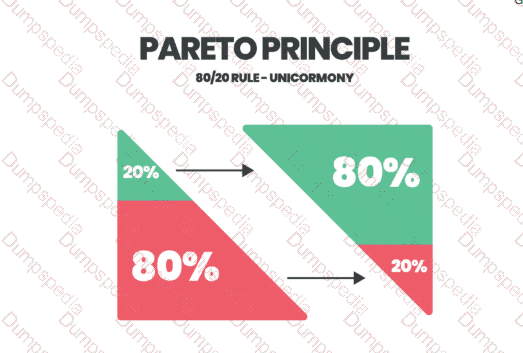
Analysis of Other Options:
A. Ishikawa diagram: Also known as a Fishbone or Cause-and-Effect diagram. It is used to identify the root causes of a problem by mapping out various contributing factors, but it does not rank them by frequency or illustrate the 80/20 rule.
B. Control chart: Used to determine whether or not a process is stable or has predictable performance. It uses " Control Limits " to identify " Special Cause " variation.
C. Run chart: A line graph that shows data points plotted in the order in which they occur. It is used to identify trends and shifts in a process over time but does not categorize or rank causes of defects.
The process of identifying the stakeholders ' information needs is completed during:
Plan Communications.
Manage Stakeholder Expectations.
Stakeholder Analysis.
Identify Stakeholders.
According to the PMBOK® Guide, specifically within the Communications Management knowledge area, the determination of stakeholder information needs is a core activity of the Plan Communications Management process.
Communication Requirements Analysis: This is the primary tool and technique used in this process. It identifies the information needs of the project stakeholders by combining the type and format of information required with an analysis of the value of that information.
Key Considerations: During this process, the project manager identifies:
Who needs what information.
When they will need it.
How it will be delivered (email, meetings, reports).
By whom the information will be delivered.
The Output: These needs are documented in the Communications Management Plan, which becomes a subsidiary part of the Project Management Plan.
Analysis of Other Options:
B. Manage Stakeholder Expectations: This is an execution process (now often part of Manage Stakeholder Engagement) where the project manager communicates and works with stakeholders to meet their needs and address issues; it is not where the initial identification of needs occurs.
C. Stakeholder Analysis: This is a technique used in both Identify Stakeholders and Plan Stakeholder Management to identify their interests, expectations, and influence, but it is not the specific process for mapping out their detailed communication requirements.
D. Identify Stakeholders: This is the initial process of identifying the people, groups, or organizations that could impact or be impacted by a decision, activity, or outcome of the project. While it identifies who they are, the specific information needs are detailed in the planning phase.
Analyzing activity sequences, durations, resource requirements, and schedule constraints for project execution and monitoring and controlling relates to which process?
Develop Schedule
Control Schedule
Estimate Activity Durations
Define Activities
According to the PMBOK® Guide, the process of Develop Schedule is the iterative task of analyzing activity sequences, durations, resource requirements, and schedule constraints to create the project schedule model for project execution and monitoring and controlling.
Purpose: This process integrates all previous time-management data—such as the activity list (Define Activities), the network diagram (Sequence Activities), and resource needs (Estimate Activity Resources) — to generate a schedule model with planned dates for completing project activities.
Key Tools: This process often utilizes techniques like Critical Path Method (CPM), Resource Leveling, and Schedule Compression (Crashing or Fast Tracking) to ensure the schedule is realistic and aligns with project constraints.
Output: The primary output is the Schedule Baseline and the Project Schedule.
Analysis of other options:
B. Control Schedule: This is the process of monitoring the status of the project to update the project schedule and manage changes to the schedule baseline. It happens during execution, not when initially analyzing sequences and durations to build the model.
C. Estimate Activity Durations: This is a prerequisite process where you estimate the number of work periods needed to complete individual activities. It provides data to the Develop Schedule process but does not perform the final integration of constraints and sequences.
D. Define Activities: This is the very first step where you identify and document the specific actions to be performed to produce project deliverables. It does not involve analyzing sequences or constraints.
Per PMI standards, Develop Schedule is the " culmination " of the planning activities for the Schedule Management knowledge area, as it pulls all variables together into a finalized timeline.
A project team for a marketing company is acquiring leaflets and materials from competitors. The team is working on a project to release new products, and they are trying to get ideas on how to most efficiently market these new products.
Which activity is the project team conducting?
Project execution
Benchmarking
Brainstorming
Project initiation
According to the PMBOK® Guide, specifically within the Plan Quality Management and Collect Requirements processes, organizations use various tools to establish a basis for measuring performance and generating ideas.
Why Choice B is correct: Benchmarking involves comparing actual or planned project practices (such as marketing materials and leaflets) to those of comparable organizations—in this case, competitors. The goal is to identify best practices, generate ideas for improvement, and provide a basis for measuring performance. By acquiring and analyzing competitor materials, the team is looking for a " benchmark " of what is currently successful in the market to ensure their own marketing strategy is competitive and efficient.
Analysis of other options:
A (Project execution): While the team is " doing work, " this choice is too broad. The question asks for the specific activity being conducted. Benchmarking is a technique often used during planning or quality management to inform execution.
C (Brainstorming): Brainstorming is an internal technique used to generate a broad set of ideas within a group. While it might follow the analysis of competitor materials, the act of gathering and comparing external data is specifically defined as benchmarking.
D (Project initiation): Initiation involves the formal authorization of a project (e.g., creating the Project Charter). Researching competitors to find marketing efficiencies is a more detailed activity that typically occurs during the planning phase.
In summary, the PMI Standard for Project Management highlights benchmarking as a key tool for continuous improvement and strategic alignment. By looking at competitor leaflets, the team is performing an external comparison to drive their project ' s success.
How can emotional intelligence (EI) be effective in project management?
By preparing a project plan and managing the team members
By planning for user acceptance testing
By establishing project resource allocation
By reducing tension and increasing cooperation among team members
According to the PMBOK® Guide, specifically within the section on Interpersonal and Team Skills, Emotional Intelligence (EI) is a critical competency for project managers to lead teams effectively in complex environments.
Definition and Core Pillars: Emotional Intelligence is the ability to identify, assess, and manage the personal emotions of oneself and others. It is often broken down into four key domains: Self-Awareness, Self-Management, Social Awareness, and Relationship Management.
Conflict Resolution and Synergy: In a project environment, different personalities and high-pressure deadlines often lead to friction. A Project Manager with high EI can recognize early signs of " tension " and intervene with empathy and social skills. This prevents minor disagreements from escalating into project-damaging conflicts.
Increasing Cooperation: By building a culture of psychological safety and mutual respect, the PM fosters an environment where team members feel valued. This directly leads to increased cooperation, as team members are more likely to share information, support one another, and align with the project ' s common goals.
Impact on Performance: High EI helps the PM tailor their leadership style to the needs of individual team members, which improves morale and overall project productivity.
Analysis of other options:
Option A: Preparing a project plan is a technical project management skill (Planning). Managing team members is part of " Direct and Manage Project Work, " but EI is the tool used to do it better, not the act of management itself.
Option B: Planning for User Acceptance Testing (UAT) is a quality and scope management activity. It is a technical process and does not directly utilize the core psychological aspects of emotional intelligence.
Option C: Resource allocation is a logistical and analytical task involving the assignment of people or equipment to specific timeframes. It is handled through the " Estimate Activity Resources " and " Develop Schedule " processes.
Per PMI standards, Emotional Intelligence is a " soft skill " that provides the foundation for effective leadership, specifically by helping the project manager reduce tension and build a cooperative team environment.
An output of the Create WBS process is:
Scope baseline.
Change requests.
Accepted deliverables.
Variance analysis.
In accordance with the PMBOK® Guide (Project Scope Management), the Create WBS process is the process of subdividing project deliverables and project work into smaller, more manageable components. The primary and most significant output of this process is the Scope Baseline.
The Scope Baseline is a component of the project management plan and consists of three specific documents:
Project Scope Statement: Includes the description of the project scope, major deliverables, assumptions, and constraints.
Work Breakdown Structure (WBS): A hierarchical decomposition of the total scope of work to be carried out by the project team.
WBS Dictionary: A document that provides detailed deliverable, activity, and scheduling information about each component in the WBS.
Analysis of Distractors:
B. Change requests: These are typically an output of monitoring and controlling processes (like Control Scope) or execution processes, not a standard output of the initial creation of the WBS.
C. Accepted deliverables: This is the primary output of the Validate Scope process, occurring much later in the project life cycle when the customer formally signs off on completed work.
D. Variance analysis: This is a tool and technique used in the Control Scope and Control Costs processes to compare the actual performance against the baseline; it is not an output of the planning process.
In Project Cost Management, which input is exclusive to the Determine Budget process?
Scope baseline
Organizational process assets
Project schedule
Resource calendars
According to the PMBOK® Guide, specifically within the Determine Budget process, the inputs are categorized to help aggregate the estimated costs of individual activities or work packages to establish an authorized cost baseline.
While many processes share similar inputs, Resource Calendars hold a unique position in this specific context:
Resource Calendars: These identify the working days and shifts on which each specific resource is available. In the Determine Budget process, they are necessary to know when costs will be incurred. For example, if a specialized piece of equipment is only available for two weeks, the budget must account for that specific expenditure during that window.
The Nuance of " Exclusive " : In the context of the Cost Management knowledge area (Plan Cost Management, Estimate Costs, Determine Budget, and Control Costs), Resource Calendars do not appear as an input to Estimate Costs or Control Costs, but they are critical for Determine Budget to map the cost baseline against the project timeline.
Comparison with Other Options:
Scope baseline (A): This is a common input used in Estimate Costs (to understand the deliverables) and Determine Budget (to ensure all work packages are accounted for). Because it is used in multiple processes within the knowledge area, it is not " exclusive. "
Organizational process assets (B): OPAs are standard inputs to almost every project management process, providing templates, historical information, and lessons learned.
Project schedule (C): The schedule is an input to both Estimate Costs (to determine duration-based costs) and Determine Budget (to aggregate those costs over time).
Tools and techniques used for Plan Communications include the communication:
requirements analysis, communication technology, communication models, and communication methods.
methods, stakeholder register, communication technology, and communication models.
requirements, communication technology, communication requirements analysis, and communication methods.
management plan, communication technology, communication models, and communication requirements analysis.
According to the PMBOK® Guide, specifically within the Plan Communications Management process, the project manager identifies the information needs of the stakeholders and defines a communication approach. The specific tools and techniques used to develop this plan are:
Communication Requirements Analysis: This technique determines the specific information needs of project stakeholders. This includes considering the number of potential communication channels using the formula $n(n-1)/2$.
Communication Technology: This refers to the specific tools, systems, or methods used to transfer information among stakeholders (e.g., conversations, written documents, online databases, or websites).
Communication Models: These are descriptions, metaphors, or graphical representations that show how communication processes are performed (e.g., the basic sender-receiver model involving encoding, transmitting, decoding, and noise).
Communication Methods: These are the systematic procedures used to share information. They are categorized into Interactive (multidirectional), Push (sent to specific recipients), and Pull (used for large volumes of information where recipients access content at their own discretion).
Comparison with Other Options:
B. methods, stakeholder register, communication technology, and communication models: The Stakeholder Register is an Input to the process, not a tool or technique.
C. requirements, communication technology, communication requirements analysis, and communication methods: " Communication requirements " is the result or an input factor, but " Communication Requirements Analysis " is the actual technique.
D. management plan, communication technology, communication models, and communication requirements analysis: The Communication Management Plan is the Output of this process, not a tool or technique used to create it.
Which Process Group and Knowledge Area include the Sequence Activities process?
Executing Process Group and Project Time Management
Executing Process Group and Project Cost Management
Planning Process Group and Project Time Management
Planning Process Group and Project Cost Management
In accordance with the PMBOK® Guide (Process Groups and Knowledge Areas Mapping), the Sequence Activities process is the process of identifying and documenting relationships among the project activities.
Knowledge Area: This process belongs to Project Schedule Management (referred to as Project Time Management in earlier versions of the PMBOK® Guide). It focuses on the logical sequencing of work to achieve the greatest efficiency given all project constraints.
Process Group: It is a critical component of the Planning Process Group. After the activities are defined (in the Define Activities process), they must be sequenced using logical relationships (Finish-to-Start, Start-to-Start, etc.) to create a network diagram, which eventually leads to the development of the project schedule.
Key Purpose: The primary benefit of this process is that it defines the logical sequence of work to achieve the greatest efficiency given all project constraints.
Analysis of Distractors:
A and B (Executing Process Group): The Executing Process Group involves carrying out the work defined in the project management plan. Sequencing is a foundational planning activity that must occur before execution begins.
B and D (Project Cost Management): Project Cost Management is concerned with budgeting, estimating, and controlling costs (e.g., Determine Budget, Control Costs). While the sequence of activities affects the cash flow, the process itself is a function of schedule (Time) management.
In Plan Risk Management, which of the management plans determines who will be available to share information on various risks and responses at different times and locations?
Schedule
Quality
Communications
Cost
According to the PMBOK® Guide, the Plan Risk Management process involves deciding how to conduct risk management activities for a project. While the Risk Management Plan itself outlines the methodology, it relies on other subsidiary management plans to facilitate the actual exchange of information.
Communications Management Plan: This plan is the primary document that determines who needs what information, when they will need it, how it will be given to them, and by whom. In the context of risk, it defines the flow of information regarding risk identification, updates to the risk register, and the status of risk responses.
Time and Location: Since projects often involve distributed teams and stakeholders in different time zones, the Communications Management Plan specifically addresses the " times and locations " for meetings, reports, and digital communication protocols to ensure risk information is shared effectively and timely.
Integration: Effective risk management is impossible without a structured communication strategy. The project manager ensures that the risk communication requirements identified during Plan Risk Management are integrated into the overall Communications Management Plan.
Analysis of Other Options:
A. Schedule: The Schedule Management Plan establishes the criteria and activities for developing, monitoring, and controlling the schedule. While it dictates when work happens, it does not define the who and how of information sharing.
B. Quality: The Quality Management Plan describes how the project management team will implement the organization ' s quality policy. It focuses on standards and process improvement, not the logistics of risk information exchange.
D. Cost: The Cost Management Plan defines how the project costs will be planned, structured, and controlled. It focuses on budget and financial reporting rather than the communication of risk-related information among stakeholders.
Product requirements specify a functionality that depends upon expertise that is unavailable internally. What process should be implemented to generate a make-or-buy decision?
Conduct Procurements B Plan Procurement Management
Plan Risk Responses
Plan Risk Management
According to the PMBOK® Guide, specifically the Project Procurement Management knowledge area, the Plan Procurement Management process is the stage where the project team determines whether to acquire goods and services from outside the organization or to perform the work internally.
Make-or-Buy Analysis: This is a key Tool and Technique of the Plan Procurement Management process. It involves evaluating the costs, risks, and organizational capabilities associated with both options.
Trigger for Decision: In this scenario, the " functional requirement depending on unavailable expertise " is a direct trigger for a make-or-buy analysis. Since the expertise is unavailable internally, the analysis will likely lead to a " buy " decision to mitigate the risk of project failure.
Output: The primary output of this process is the Procurement Management Plan and the Make-or-Buy Decisions document, which outlines the strategy for engaging external vendors to provide the missing expertise.
Why other options are incorrect:
Option B (labeled incorrectly as B/Plan Risk Responses): While choosing to " buy " is a way to transfer risk, the specific formal process for generating a make-or-buy decision is Procurement Management, not Risk Response. Risk Response planning follows the decision to procure.
Option C (Conduct Procurements): This process occurs after the plan is finalized. It involves receiving seller responses, selecting a seller, and awarding a contract. You cannot conduct procurements until you have already made the " buy " decision in the planning phase.
Option D (Plan Risk Management): This process defines how to conduct risk management activities for a project. It does not address specific technical gaps or procurement decisions directly.
Why is required in a project?
Because a one-size-fits-all approach avoids complications and saves time.
Because every project is unique and not every tool, technique, input, or output identified in the PMBOK Guide is required.
Because tailoring allows us to identify the techniques, procedures, and system practices used by those in the project.
Project managers should apply every process in the PMBOK Guide to the project, so failoring is not requires.
According to the PMBOK® Guide, Tailoring is a necessary aspect of project management because projects are unique. Not every project will require every process, tool, technique, input, or output described in the standards.
Uniqueness of Projects: Every project exists in a different context, with different levels of complexity, risk, size, and team experience. Therefore, the project manager and the project management team must select only those processes that are appropriate for that specific project.
Competing Constraints: Tailoring ensures that the project manager considers the competing constraints of scope, schedule, cost, resources, quality, and risk. By choosing the right " fit, " the team avoids wasting time and resources on unnecessary documentation or bureaucratic steps that do not add value to the project ' s outcome.
Professional Responsibility: It is the responsibility of the project manager and the project management team to determine which processes are relevant. This decision-making process is based on organizational culture, stakeholder needs, and the specific nature of the work.
Why other options are incorrect:
Option A: A " one-size-fits-all " approach is actually what the PMBOK® Guide warns against. This approach often leads to inefficiency, as small projects might be overwhelmed by heavy processes, and large projects might be under-managed.
Option C: While tailoring involves looking at techniques and procedures, the primary reason for it is to ensure the management approach fits the unique needs of the project, not just to identify what others are doing.
Option D: This is incorrect because applying every single process to every project (sometimes called " over-management " ) is counterproductive and inefficient. The PMBOK® Guide is a framework of best practices, not a rigid set of rules that must be followed in their entirety for every project.
At the beginning of an iteration, the team will work to determine how many of the highest-priority items on the backlog list can be delivered within the next iteration. Which of the following activities is done first?
Create Work Breakdown Structure (WBS)
Create Scope Baseline
Collect Requirements
Define Scope
According to the PMBOK® Guide and the Agile Practice Guide, even in an iterative or agile environment, there is a logical sequence to defining work. Before a team can determine how many items can be delivered in an iteration (Iteration Planning), the requirements must be understood and gathered.
Collect Requirements: This is the process of determining, documenting, and managing stakeholder needs and requirements to meet project objectives. In an agile context, this happens continuously. You cannot " Define Scope " or determine what can be delivered in an iteration until you have collected the requirements from the stakeholders and the Product Owner.
Logical Progression:
Collect Requirements: Understand what the stakeholders need.
Define Scope: Develop a detailed description of the project and product.
Create WBS: Subdivide project deliverables and project work into smaller, more manageable components.
Analysis of other options:
A and B. Create WBS / Scope Baseline: These are primarily components of a Predictive (Waterfall) life cycle. In a pure Agile environment, the " Backlog " serves a similar purpose to the WBS, but the Scope Baseline (which includes the Scope Statement, WBS, and WBS Dictionary) is a formal control tool not typically used in the same way during agile iterations.
D. Define Scope: This occurs after requirements are collected. You define the boundaries of what will be built based on the requirements gathered in the previous step.
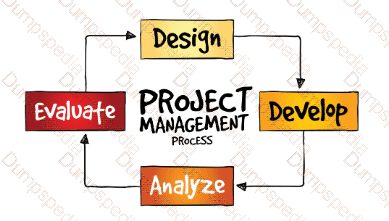
In summary, per PMI standards, Collect Requirements provides the foundation for all subsequent scope and planning activities. Without a clear understanding of the requirements, the team cannot effectively define the scope or estimate their capacity for an iteration.
In which type of contract are the performance targets established at the onset and the final contract price determined after completion of all work based on the sellers performance?
Firm-Fixed-Price (FFP)
Fixed Price with Economic Price Adjustments (FP-EPA)
Fixed-Price-Incentive-Fee (FPIF)
Cost Plus Fixed Fee (CPFF)
According to the PMBOK® Guide, specifically within the Plan Procurement Management process, contract types are categorized by how they share risk between the buyer and the seller.
Fixed-Price-Incentive-Fee (FPIF): This is a type of fixed-price contract that allows for some flexibility in performance. It establishes a target cost, a target profit, and a price ceiling.
Performance Targets: Financial incentives are tied to achieving agreed-upon metrics, such as cost, schedule, or technical performance. These targets are established at the onset of the contract.
Final Price Determination: While the targets are set early, the final contract price is calculated after completion based on the seller ' s actual performance against those targets. If the seller performs well (e.g., finishes under target cost), they may receive a higher fee, subject to the price ceiling.
Analysis of Other Options:
A. Firm-Fixed-Price (FFP): The most common contract type. The price for goods is set at the beginning and is not subject to change unless the scope of work changes. Performance does not alter the final price.
B. Fixed Price with Economic Price Adjustments (FP-EPA): This is used for long-term contracts (multi-year) to protect both parties from external conditions like inflation or changes in the cost of raw materials. It is not based on the seller ' s internal performance.
D. Cost Plus Fixed Fee (CPFF): This is a cost-reimbursable contract. The seller is reimbursed for all allowable costs plus a fixed fee payment (profit) calculated as a percentage of the initial estimated project costs. The fee does not change based on performance unless the scope changes.
Which tool should a project manager use to calculate cost variance for a project?
Contingency analysis
Review lessons learned from similar projects
Expert judgment
Actual cost
According to the PMBOK® Guide, specifically the Control Costs process, Earned Value Analysis (EVA) is the standard method used to assess project performance and progress.
Why Choice D is correct: To calculate Cost Variance (CV), you must have the Actual Cost (AC).
The Formula: Cost Variance is calculated using the formula:
$$CV = EV - AC$$
Components:
EV (Earned Value): The value of the work actually performed expressed in terms of the approved budget.
AC (Actual Cost): The total cost actually incurred and recorded in accomplishing work performed for an activity or WBS component.
Significance: You cannot determine if you are over or under budget without knowing exactly how much money has been spent (Actual Cost). A positive CV indicates the project is under budget, while a negative CV indicates it is over budget.
Analysis of other options:
A (Contingency analysis): This is used to determine the amount of management or contingency reserves needed for a project based on risk. It is a planning and risk management tool, not a performance measurement tool for calculating current variance.
B (Review lessons learned): Historical data from similar projects is used during the Estimate Costs phase (Analogous Estimating). While it helps in setting the baseline, it cannot be used to calculate the real-time variance of the current project ' s spending.
C (Expert judgment): While expert judgment is a tool and technique for almost every process, it is used to interpret data or make estimates. Calculating variance is a mathematical exercise requiring specific data points (EV and AC) rather than an opinion-based assessment.
Key Concept:
The Project Management Institute (PMI) emphasizes that Actual Cost (AC) (Choice D) is one of the three fundamental data points (along with Planned Value and Earned Value) required for Earned Value Management. Without capturing the actual spend, a project manager lacks the " reality " component needed to measure financial performance against the Cost Baseline.
How can a project manager maintain the engagement of stakeholders in a project with a high degree of change?
Monitor project stakeholder relationships using engaging strategies and plans
Send all project documents to stakeholders each time they are modified
Schedule monthly meetings with the stakeholders, including team members
Engage only with the project sponsors
According to the PMBOK® Guide, specifically within the Monitor Stakeholder Engagement process, projects characterized by a high degree of change (such as those using agile or adaptive methodologies) require continuous and proactive management of stakeholder relationships.
Dynamic Engagement: In high-change environments, stakeholder needs, influence, and interest levels can shift rapidly. The project manager must use the Stakeholder Engagement Plan as a living document, constantly monitoring the effectiveness of engagement strategies and adjusting them as the project evolves.
Continuous Feedback Loops: Rather than relying on static communication, the project manager monitors relationships to ensure that stakeholders remain aligned with project goals. This involves using data analysis (such as stakeholder engagement assessment matrices) to identify gaps between desired and actual engagement levels.
Adaptive Strategies: The " Monitor " process ensures that if an engagement strategy is no longer working due to a change in project direction or stakeholder turnover, the project manager can implement a corrective action to bring stakeholders back into the fold.
Analysis of Other Options:
B. Send all project documents to stakeholders each time they are modified: This is an example of information overload. Sending every technical or minor update to all stakeholders can lead to " noise, " causing them to ignore critical communications and decreasing their overall engagement.
C. Schedule monthly meetings with the stakeholders, including team members: In a project with a high degree of change, monthly meetings are likely too infrequent. High-change projects typically require more frequent interaction (such as bi-weekly reviews or daily stand-ups in agile) to ensure stakeholders stay informed.
D. Engage only with the project sponsors: While sponsors are critical, the definition of a stakeholder includes anyone who can affect or be affected by the project. Ignoring other stakeholders (users, customers, functional managers) leads to missed requirements and potential resistance later in the project.
Who provides the inputs for the original estimates of activity durations for tasks on the project plan?
Project sponsor
Project manager
Person responsible for project scheduling
Person who is most familiar with the task
According to the PMBOK® Guide, specifically within the Estimate Activity Durations process, the primary principle for achieving accuracy in scheduling is to involve the individuals who will actually perform the work or those with the greatest expertise in the specific functional area.
In the PMI framework, duration estimates should be provided by the person or group on the project team who is most familiar with the nature of the work in the specific activity.
Expert Judgment: This is a primary Tool and Technique for estimating. The individual with the most familiarity provides " expert judgment " based on historical experience, technical nuances, and potential pitfalls that a generalist might overlook.
Accuracy and Buy-in: When the person responsible for the task provides the estimate, it leads to a more realistic schedule. Furthermore, it creates a sense of commitment and accountability; a team member is more likely to meet a deadline they helped set than one imposed upon them.
Bottom-Up Estimating: This approach is part of the broader " Bottom-Up " philosophy where the granular details are defined by the technical experts and then rolled up into the total project duration.
A. Project sponsor: The sponsor provides the project ' s funding, high-level requirements, and authorization (Project Charter). They generally do not have the granular, technical knowledge required to estimate specific task durations.
B. Project manager: While the Project Manager facilitates the estimating process and " owns " the final project schedule, they are often a generalist. They should not provide the original estimates themselves unless they are also the primary subject matter expert for that specific task.
C. Person responsible for project scheduling: A scheduler or " Project Scheduler " is responsible for the mechanical act of building the schedule model using software. They take the duration data provided by the team and input it into the tool; they do not typically generate the original duration data themselves.
The Estimate Activity Durations process utilizes several techniques to refine the inputs provided by the person most familiar with the task, including:
Analogous Estimating: Using a similar previous project.
Parametric Estimating: Using a statistical relationship (e.g., hours per square foot).
Three-Point Estimating: Using Optimistic, Pessimistic, and Most Likely values to account for uncertainty.
Regardless of the technique used, the Subject Matter Expert (SME) remains the foundational source of the raw data.
A project manager is leading a technology project that is about to enter the execution phase. The project requires the procurement of certain key components from an external vendor. The project manager has been notified that because of a government regulation, some parts can no longer be used in the country and the vendor will be unable to deliver them.
What should the project manager do?
Identify the impact and follow the procurement plan.
Identify the impact and follow the project management plan.
Identify the impact and follow the risk management plan.
Identify the impact and follow the change control plan.
In the PMBOK® Guide, when an external event—such as a new government regulation—occurs that threatens the project ' s objectives, it is classified as a Risk (specifically an external threat). Since the project is just about to enter the execution phase, the project manager must handle this uncertainty systematically.
Why Choice C is correct:
Risk Identification and Assessment: The first step when a problem or change in the environment is " notified " is to identify the specific impact on the project (Schedule, Cost, Quality).
Risk Management Plan: This plan outlines how the team should respond to risks. It contains the processes for updating the Risk Register, performing qualitative/quantitative analysis, and selecting a Risk Response Strategy (such as Mitigation by finding an alternative component or Avoidance by changing the project design).
Proactive vs. Reactive: Even though the regulation is a current reality, the " impact " on the project ' s future execution is still a risk that needs to be managed according to the predefined risk protocols before jumping into formal change requests.
Analysis of other options:
A (Procurement plan): While the issue involves a vendor, the procurement plan describes how to buy items (bidding, types of contracts), not how to handle a major strategic roadblock caused by legal changes.
B (Project management plan): This is too broad. The project management plan is the " parent " document for all other plans. While technically true, PMI questions always look for the most specific subsidiary plan that addresses the situation.
D (Change control plan): You follow the change control plan only after you have assessed the impact and decided on a specific response. You don ' t " follow the plan " to solve the problem; you follow it to formally document and approve a solution once the risk management process has identified what that solution should be.
Key Concept: The Project Management Institute (PMI) emphasizes that Risk Management (Choice C) is the primary tool for dealing with Enterprise Environmental Factors (EEFs). By following the risk management plan, the project manager ensures that the impact of the regulation is fully understood and that a validated strategy is in place before the project’s scope, schedule, or budget is officially altered.
Which item is an output of Plan Quality Management and an input to Perform Quality Assurance?
Organizational process updates
Quality metrics
Change requests
Quality control measurements
According to the PMBOK® Guide (Project Quality Management), specifically within the Plan Quality Management process, Quality Metrics are a key output. A quality metric specifically describes a project or product attribute and how the Control Quality process will measure it.
Output of Plan Quality Management: During the planning phase, the team identifies which quality standards are relevant to the project and determines how to satisfy them. The specific, measurable thresholds (e.g., percentage of tasks completed on time, failure rate, number of defects identified per day) are documented as Quality Metrics.
Input to Manage Quality (Perform Quality Assurance): The process of Manage Quality (often referred to as Quality Assurance) uses these metrics as a basis for auditing the quality requirements and the results from quality control measurements. It ensures that the project is using appropriate quality standards and operational definitions to meet the stakeholder ' s expectations.
Examples of Metrics: These can include reliability, availability, test coverage, number of bugs per line of code, or customer satisfaction scores.
Analysis of Distractors:
A. Organizational process updates: While these can be an output of various processes (including Manage Quality), they are not the primary functional input used to perform quality assurance audits.
C. Change requests: These are typically an output of the Manage Quality or Control Quality processes when variations are found that require corrective action.
D. Quality control measurements: These are an output of Control Quality and an input to Manage Quality. While they are an input to the assurance process, they are not an output of Plan Quality Management (which is a planning process, not an execution/control process).
The individual or group that provides resources and support for a project and is accountable for success is the:
sponsor
customer
business partners
functional managers
According to the PMBOK® Guide, specifically the section on Project Stakeholders and Governance, the Sponsor plays a critical role in the project ' s lifecycle from initiation to closure.
Definition and Role: The sponsor is the person or group that provides resources and support for the project and is accountable for enabling success. They lead the project through the initiating process until it is formally authorized and serve as a primary advocate for the project within the organization.
Key Responsibilities:
Authorization: They sign the Project Charter, formally authorizing the project ' s existence.
Funding: They are responsible for ensuring the project has the necessary financial resources.
Conflict Resolution: They assist in resolving issues and or conflicts that are beyond the project manager ' s level of authority.
Strategic Alignment: They ensure the project remains aligned with the organization ' s business objectives.
Accountability: While the project manager is responsible for the day-to-day management of the project, the sponsor is ultimately accountable for the project achieving its intended business value and benefits.
Comparison with other options:
B. Customer: The customer (or user) is the individual or organization that will approve and manage the project ' s product, service, or result. While they provide requirements and feedback, they are not typically accountable for the internal project success or resource provision in the same way the sponsor is.
C. Business partners: These are external organizations that have a special relationship with the enterprise, such as providers of expertise or specific services. They support the project but do not hold the accountability for the project ' s overall success.
D. Functional managers: These individuals have management authority over an organizational unit (e.g., Department Heads). While they provide resources (staff) to the project, their primary accountability is to their own department ' s functional goals, not the specific success of an individual project.
A newly developed project team is working together, building trust and adjusting its work habits to support the team What stage of the Tuckman ladder does this describe?
Forming
Norming
Storming
Performing
According to the PMBOK® Guide and the Tuckman Ladder model of team development, teams go through a predictable series of stages as they grow, face challenges, and deliver results.
Norming: This stage is characterized by team members beginning to work together, building trust, and adjusting their work habits and behaviors to support the team. During this phase, team members resolve their differences, appreciate colleagues ' strengths, and respect the authority of the leader. The team develops a sense of cohesion and a common goal.
Focus on Collaboration: In the Norming stage, communication becomes more open and constructive. The team establishes " norms " (internal rules and expectations) for how they will function, which leads to increased productivity compared to previous stages.
Why other options are incorrect:
Option A: Forming: This is the initial stage where the team meets and learns about the project and their formal roles. Team members tend to be independent and not very open. Trust has not yet been established.
Option C: Storming: In this stage, the team begins to address the work, but there is often conflict or competition as individual personalities and work styles clash. If the team cannot resolve these conflicts, they remain stuck in this stage.
Option D: Performing: Teams that reach this stage function as a well-organized unit. They are interdependent and work through issues smoothly and effectively. In " Performing, " the focus is on over-achieving goals rather than the " habit-adjusting " and " trust-building " found in Norming.
Enterprise environmental factors are an input to which process?
Control Scope
Define Scope
Plan Scope Management
Collect Requirements
According to the PMBOK® Guide, specifically the mapping of inputs, tools, techniques, and outputs (ITTOs), Enterprise Environmental Factors (EEFs) serve as a formal input to the Plan Scope Management process.
Plan Scope Management: This is the process of creating a scope management plan that documents how the project and product scope will be defined, validated, and controlled.
Role of EEFs: Because this process sets the framework for all other scope activities, it must account for external and internal factors such as the organization ' s culture, infrastructure, personnel administration, and marketplace conditions. These factors influence how scope will be managed (e.g., a highly bureaucratic organization will require more formal scope change procedures than a startup).
Consistency across Planning: In PMI methodology, EEFs are standard inputs to almost all Planning processes across different Knowledge Areas, as they provide the context and constraints within which the plans must be developed.
Why the other options are incorrect:
A. Control Scope: This is a Monitoring and Controlling process. The inputs here are typically the Project Management Plan, project documents, work performance data, and Organizational Process Assets (OPAs). EEFs are generally not an input to the " Control " phase of scope.
B. Define Scope: The inputs for this process include the Project Charter, Project Management Plan, and various project documents (like the Requirements Documentation). While EEFs influence the project, they are not listed as a standard formal input for the specific process of writing the Project Scope Statement.
D. Collect Requirements: Similar to Define Scope, this process relies on the Project Charter, Project Management Plan, and Project Documents. It focuses on gathering stakeholder needs rather than the environmental constraints provided by EEFs.
During the execution of a project, a stakeholder asks a project manager whether the project is falling behind or ahead of its baseline schedule. The project manager calculates the earned value analysis (EVA) schedule variance and it comes out to be zero. Which of the following is correct about the EVA schedule variance?
It is calculated incorrectly, as it cannot be zero for an in-flight project; otherwise the project is completed.
Change it to a negative value to show that the project is falling behind.
Zero is a perfectly valid value for an in-flight project; hence share the zero value with the stakeholder.
Change it to a positive value to show that the project is ahead of its baseline schedule.
According to the PMBOK® Guide, specifically the Monitor and Control Project Work process and Earned Value Management (EVM), the Schedule Variance (SV) is a mathematical indicator of a project ' s performance relative to its timeline.
The Formula: Schedule Variance is calculated as:
$$SV = EV - PV$$
(Where $EV$ is Earned Value and $PV$ is Planned Value).
Interpreting a Zero Value: An $SV$ of zero indicates that the Earned Value (the work actually performed) is exactly equal to the Planned Value (the work scheduled to be performed). In practical terms, this means the project is exactly on schedule.
In-Flight Validity: While it is rare for a project to be precisely on schedule to the cent, it is statistically and methodologically possible at any point during the project life cycle. It simply means the team has completed 100% of the work that was planned for that specific measurement date.
Stakeholder Reporting: Per the Communication Management Plan and the principle of transparency, the project manager must report the facts. If the analysis shows the project is on track, the " zero " value is the accurate metric to share with the stakeholder.
Analysis of other options:
Option A: This is a common misconception. While $SV$ must be zero at the end of a project (because all planned work is eventually earned), it is perfectly valid for it to be zero during execution if the project is tracking perfectly to the baseline.
Option B: Changing a zero value to a negative value is unethical and a violation of the PMI Code of Ethics and Professional Conduct (specifically regarding Honesty). It provides a false status to stakeholders.
Option D: Similarly, changing the value to positive to " look good " is a falsification of project data. It misleads stakeholders into believing there is a schedule buffer that does not actually exist.
Per PMI standards, Schedule Variance (SV) is a factual metric. A value of zero indicates the project is performing exactly according to the schedule baseline, and this information should be communicated clearly and honestly to the requesting stakeholder.
The organization ' s perceived balance between risk taking and risk avoidance is reflected in the risk:
Responses
Appetite
Tolerance
Attitude
According to the PMBOK® Guide (Project Risk Management), the term Risk Attitude is defined as the organization ' s or individual ' s disposition toward uncertainty, which in turn influences the way they respond to that risk. It is the most comprehensive term that describes the perceived balance between risk-taking and risk-avoidance.
Risk attitude is influenced by three primary factors:
Risk Appetite: The degree of uncertainty an organization or individual is willing to accept in anticipation of a reward.
Risk Tolerance: The specified range of acceptable variation around an objective.
Risk Threshold: The level of risk exposure above which risks are addressed and below which risks may be accepted.
The PMBOK® Guide notes that the project team must understand the risk attitude of the organization and stakeholders to ensure that the Risk Management Plan aligns with the corporate culture.
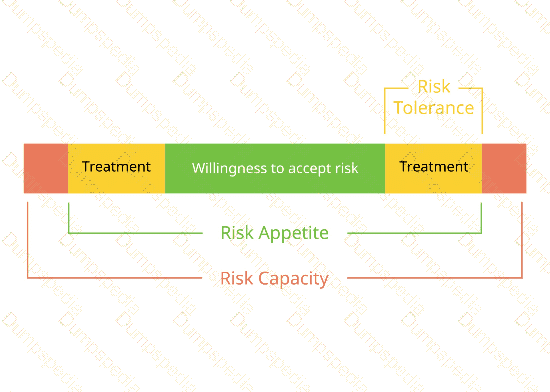
Analysis of Distractors: A. Responses: These are the specific actions determined to address threats or opportunities (e.g., Avoid, Mitigate, Transfer). Responses are the result of the risk attitude, not the reflection of the balance itself.
B. Appetite: While related, " Appetite " specifically refers to the amount of risk an entity is willing to take. " Attitude " is the broader descriptor of how the organization perceives and acts upon that balance.
C. Tolerance: This refers to the measurable, granular levels of acceptable deviation (e.g., " We can tolerate a 5% budget overrun " ). It is a specific metric rather than a general reflection of the perceived balance between taking and avoiding risk.
A Scrum team has a product backlog and a sprint backlog. Which of the following is a correct statement related to these artifacts?
The product backlog does not contain a prioritized list of requirements.
The sprint backlog contains items to be completed during the current sprint.
The sprint backlog contains the list of items prioritized by the product owner.
The product backlog is a subset of the sprint backlog.
According to the Agile Practice Guide and the Scrum Guide, Scrum artifacts are designed to provide transparency and opportunities for inspection and adaptation.
The Sprint Backlog: This is a set of Product Backlog items selected for the Sprint, plus a plan for delivering the product Increment and realizing the Sprint Goal. It is highly specific to the current iteration (Sprint). Only the items the team commits to finishing within the timebox are included here.
Ownership: While the Product Owner prioritizes the Product Backlog, the Developers (the Team) own the Sprint Backlog. They decide how much work they can realistically pull into the sprint and how that work will be accomplished.
Analysis of other options:
Option A: This is incorrect. The Product Backlog is, by definition, an ordered (prioritized) list of everything that is known to be needed in the product.
Option C: This is a common distractor. The Product Owner prioritizes the Product Backlog. However, the Sprint Backlog is created by the team during Sprint Planning. While it contains items the Product Owner has prioritized, it is defined by its focus on the " current sprint, " making Option B a more precise definition of the artifact ' s purpose.
Option D: This is backwards. The Sprint Backlog is a subset of the Product Backlog, not the other way around. The Product Backlog represents the " Big Picture, " while the Sprint Backlog is the " Immediate Work. "
Key Differences at a Glance:
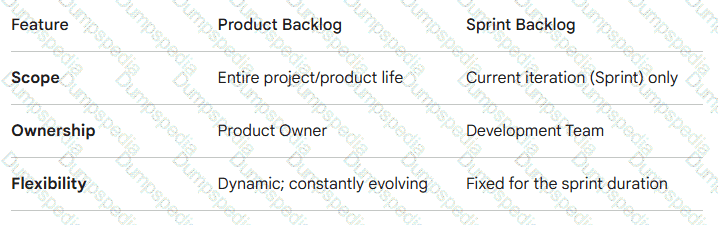
Per PMI standards and Scrum principles, the Sprint Backlog serves as a visible, real-time picture of the work that the Developers plan to accomplish during the Sprint to achieve the Sprint Goal.
An output of the Validate Scope process is:
A requirements traceability matrix.
The scope management plan.
Work performance reports.
Change requests.
According to the PMBOK® Guide and the Standard for Project Management, the Validate Scope process is the process of formalizing acceptance of the completed project deliverables. It belongs to the Monitoring and Controlling Process Group.
While the primary goal of this process is to obtain Accepted Deliverables, it frequently results in Change Requests. According to PMI standards, if deliverables are inspected and do not meet the acceptance criteria established in the scope documentation, change requests are created for defect repair or enhancement. These requests are then processed through the Perform Integrated Change Control process.
The outputs of Validate Scope include:
Accepted Deliverables: Deliverables that meet acceptance criteria and are formally signed off by the customer or sponsor.
Change Requests: Requests for modifications or repairs to deliverables that were not accepted.
Work Performance Information: Includes data on which deliverables have been started, their progress, or which have been finished and accepted.
Project Documents Updates: Updates to documents such as the Requirements Traceability Matrix or Lessons Learned Register.
The other options are incorrect based on their classification in the PMI framework:
A requirements traceability matrix: This is an input to the Validate Scope process, used to compare requirements against the actual results. It is an output of the Collect Requirements process.
The scope management plan: This is an input to Validate Scope, as it contains the procedures for formalizing acceptance. It is an output of the Plan Scope Management process.
Work performance reports: These are outputs of the Monitor and Control Project Work process and serve as inputs to several other processes; they are not generated by Validate Scope.
As per the PMI Lexicon of Project Management Terms, the Validate Scope process is primarily concerned with the acceptance of the deliverables, whereas Quality Control is concerned with the correctness of the deliverables.
During which process group is the quality policy determined?
Initiating
Executing
Planning
Controlling
According to the PMBOK® Guide, the quality policy is primarily addressed and integrated into the project during the Planning Process Group, specifically within the Plan Quality Management process.
Definition of Quality Policy: The quality policy is the formal statement by top management of an organization ' s commitment to quality. it provides the overall intentions and direction of the performing organization regarding quality.
Role in Planning: During the Plan Quality Management process, the project management team identifies the quality requirements and/or standards for the project and its deliverables, and documents how the project will demonstrate compliance with these standards.
Organizational Process Assets (OPAs): In many cases, the quality policy is an input to the planning process, provided by the performing organization. However, if the performing organization lacks a formal quality policy, or if the project involves multiple performing organizations (like a joint venture), the project management team must develop a quality policy for the project during the planning phase.
Output Consistency: The quality policy serves as the foundation for the Quality Management Plan, which is a key output of the planning process and a component of the Project Management Plan.
Comparison with other options:
A. Initiating: The Initiating Process Group focuses on defining a new project or a new phase by obtaining authorization (Project Charter). While high-level goals are set here, specific policies like quality are detailed during planning.
B. Executing: The Executing Process Group (specifically Manage Quality) is where the quality policy is implemented and turned into actionable quality activities. It is not where the policy is determined.
D. Controlling: The Monitoring and Controlling Process Group (specifically Control Quality) is where the results of executing the quality activities are monitored and recorded to assess performance and recommend necessary changes. It ensures the policy is being followed, rather than defining it.
Who, along with the project manager, is supposed to direct the performance of the planned project activities and manage the various technical and organizational interfaces that exist within the project?
The customer and functional managers
The risk owners and stakeholders
The sponsors and stakeholders
The project management team
According to the PMBOK® Guide, specifically within the Direct and Manage Project Work process, the execution of the project is a collaborative effort led by the Project Manager but supported by a specific core group.
The Project Management Team: This is a subset of the overall project team. It includes the Project Manager and any individuals who assist the PM in management activities, such as scheduling, budgeting, and technical leadership.
Directing Performance: While the Project Manager is ultimately accountable, the Project Management Team shares the responsibility for directing the performance of planned activities. They ensure that the technical work meets the project requirements and that the organizational interfaces (the " touchpoints " between different departments or groups) are managed smoothly.
Management of Interfaces:
Technical Interfaces: Coordination between different technical disciplines (e.g., ensuring the software team and hardware team are aligned).
Organizational Interfaces: Coordination between different units within the performing organization (e.g., Finance, HR, and Legal).
Process Context: This activity occurs during the Executing Process Group. The inputs are the Project Management Plan and approved change requests, and the primary focus is on performing the work defined in the plan to achieve the project ' s objectives.
Comparison with other options:
A. The customer and functional managers: While functional managers provide resources and customers provide requirements, they do not " direct the performance of planned project activities " on a day-to-day basis. That is an internal management function.
B. The risk owners and stakeholders: Risk owners are responsible for specific risk responses, and stakeholders are anyone affected by the project. They do not collectively manage the technical and organizational interfaces of the project execution.
C. The sponsors and stakeholders: The sponsor provides financial resources and support (and may help resolve high-level " political " interfaces), but they are not involved in the direct management of technical project activities.
How can a project manager ensure effective project stakeholder engagement?
Build a stakeholder responsibility matrix
Hold weekly project staff meetings
Improve interpersonal and team leadership skills
Create detailed project reports for stakeholders
According to the PMBOK® Guide, specifically the Manage Stakeholder Engagement process, the ability to influence and engage stakeholders effectively relies heavily on the project manager ' s " soft skills. "
Interpersonal and Team Leadership Skills (Choice C): This is the primary Tool and Technique used to foster engagement. Stakeholder engagement is about building relationships and trust. To do this, a project manager must utilize:
Conflict Management: To resolve divergent interests between stakeholders.
Cultural Awareness: To tailor communication styles to diverse backgrounds.
Negotiation: To find common ground on project objectives.
Observation/Conversation: To stay in touch with the work and the attitudes of project members and other stakeholders. While technical tools exist, engagement is a human-centric activity that cannot be fully achieved without strong leadership and interpersonal competence.
Stakeholder Responsibility Matrix (Choice A): While a RAM (Responsibility Assignment Matrix) or a RACI chart clarifies who does what, it is a tool for resource management and accountability. It does not necessarily ensure that a stakeholder is engaged or supportive of the project ' s goals.
Weekly Project Staff Meetings (Choice B): Meetings are a communication tool, but frequency does not equate to effectiveness. Without the interpersonal skills to facilitate those meetings properly, they can actually lead to stakeholder fatigue or disengagement.
Detailed Project Reports (Choice D): Reports are part of Manage Communications. Providing information is a prerequisite for engagement, but it is passive. Engagement is active; a stakeholder might receive every report and still be resistant to the project.
By focusing on Interpersonal and Team Skills, the project manager can navigate the complex political and emotional landscape of a project, turning resistant or neutral stakeholders into supportive advocates for the project ' s success.
Project Stakeholder Management focuses on:
project staff assignments
project tea m acquisition
managing conflicting interests
communication methods
According to the PMBOK® Guide (Project Management Body of Knowledge), specifically within the Project Stakeholder Management knowledge area:
Managing Conflicting Interests (Option C): This is a core focus of stakeholder management. Every project has multiple stakeholders (customers, sponsors, the performing organization, and the public) who often have different and conflicting expectations or interests. The project manager must identify these stakeholders, analyze their impact and expectations, and develop strategies to engage them effectively while balancing these competing interests to ensure project success.
Project Staff Assignments (Option A): This is a specific output of the Resource Management knowledge area, specifically the Acquire Resources process. It refers to the individuals who are assigned to work on the project.
Project Team Acquisition (Option B): This is the process of confirming resource availability and obtaining the team necessary to complete project activities, which is also part of Project Resource Management.
Communication Methods (Option D): While communication is the primary tool used to manage stakeholders, " Communication Methods " is a technical component of the Project Communications Management knowledge area. Stakeholder management focuses on the relationships and the engagement of the people, whereas Communications Management focuses on the information and how it is distributed.
In the PMI framework, Project Stakeholder Management is about more than just communication; it is about the proactive identification and management of the people, groups, or organizations that could impact or be impacted by the project to ensure that conflicting interests do not derail the project objectives.
Responsible, accountable, consult and inform (RACI) is an example of which of the following?
Text-oriented formal
Resource management plan
Organization chart
Responsibility assignment matrix (RAM)
According to the PMBOK® Guide (6th Edition), the RACI chart is a common type of Responsibility Assignment Matrix (RAM). A RAM uses a matrix format to show the relationship between work packages (or activities) and project team members.
The RACI model is specifically designed to ensure clear division of roles and responsibilities by using the following four statuses:
Responsible: The person who performs the work.
Accountable: The person ultimately answerable for the correct and thorough completion of the deliverable or task (only one person can be accountable for each task).
Consult: The people whose opinions are sought (two-way communication).
Inform: The people who are kept up-to-date on progress (one-way communication).
Analysis of Distractors:
A (Text-oriented format): These are used for documenting team member responsibilities that require detailed descriptions. Usually in paragraph form, they provide information such as responsibilities, authority, and qualifications. A RACI is a matrix, not text-oriented.
B (Resource management plan): The RACI chart is a component or an output used to help develop the Resource Management Plan, but it is not the plan itself. The plan is the broader document describing how all resources will be acquired and managed.
C (Organization chart): This is a hierarchical graphic display of project team members and their reporting relationships (e.g., an Organizational Breakdown Structure - OBS). It shows who reports to whom, but it does not map individuals to specific work activities like a RAM/RACI does.
Which characteristic defines the Delphi technique of group decision-making?
The participants must use their expertise to determine the best option.
The decision is based on eliminating the options that are too expensive.
The decision is based on a predefined algorithm and the highest score.
The participants must create a list of options, rank them, and then vote.
According to the PMBOK® Guide, the Delphi technique is a specialized information-gathering and group decision-making technique used to reach a consensus among a panel of independent experts.
Expert Judgment: The defining characteristic of the Delphi technique is the reliance on individuals with specific expertise. These experts provide their input anonymously to avoid the " bandwagon effect " or " groupthink, " where individuals might be influenced by more dominant personalities in a face-to-face meeting.
Iterative Process: A facilitator uses a questionnaire to solicit ideas or forecasts from the experts. The responses are summarized and then recirculated to the experts for further comment. This process is repeated through several rounds until a consensus—the " best option " —is reached.
Anonymity and Independence: Unlike a standard workshop, the participants often do not know who the other experts are. This ensures that the final decision is based purely on the technical or professional merit of the arguments rather than social pressure.
Analysis of other options:
Option B: This describes a simple screening or elimination process based on cost constraints. While cost is a factor in many decisions, it is not the defining procedural characteristic of the Delphi method.
Option C: This describes a Multicriteria Decision Analysis or a weighted scoring model. The Delphi technique relies on expert consensus and subjective professional judgment rather than a purely automated or predefined algorithm.
Option D: This describes the Nominal Group Technique (NGT). NGT involves brainstorming (listing), followed by ranking and voting. While similar to Delphi in that it seeks consensus, NGT is typically done in person and involves a voting tally rather than anonymous iterative rounds of expert feedback.
Per PMI standards, the Delphi technique is a powerful tool for reducing bias in data collection and ensuring that project estimates or strategic decisions are grounded in the collective expertise of a specialized group.
The risk shared between the buyer and seller is determined by the:
assumption log.
quality checklist.
risk register.
contract type.
According to the PMBOK® Guide, specifically within Project Procurement Management, the selection of the contract type is the primary mechanism for determining how risk is allocated between the buyer and the seller.
Contract Type and Risk Allocation: Different contract types place different levels of risk on either party.
Fixed-Price Contracts (FP): The seller carries the highest risk. If the costs of production increase, the seller ' s profit decreases, as the price is set.
Cost-Reimbursable Contracts (CR): The buyer carries the highest risk. The buyer must pay the seller for all legitimate actual costs, meaning if costs overrun, the buyer pays more.
Time and Material Contracts (TandM): The risk is shared more evenly, though often favoring the seller for small-scale efforts. The buyer risks cost overruns on hours, while the seller risks being unable to complete the work if the buyer stops the contract.
The Incentive Mechanism: Many contracts include incentives (like Fixed Price Incentive Fee or Cost Plus Incentive Fee) specifically designed to share the risks and rewards of performance, schedule, and cost control between both parties.
Analysis of Other Options:
A. assumption log: This document records high-level assumptions and constraints. While it may contain information about external risks, it does not legally define the sharing of financial or performance risk between two parties.
B. quality checklist: This is a tool used in Quality Control to verify that a set of required steps has been performed. It has no bearing on risk sharing or procurement structures.
C. risk register: While the Risk Register identifies and analyzes risks, and may note that a risk is " transferred " via a contract, the actual determination and legal enforcement of how that risk is shared is established by the Contract Type itself.
The zero duration of milestones in project planning occurs because milestones:
Are unpredictable and challenge the Plan Schedule Management process.
Occur at random times in the project plans.
Represent a moment in time such as a significant project point or event.
Represent both significant and insignificant points in the project and are difficult to anticipate.
According to the PMBOK® Guide (Project Management Body of Knowledge), specifically within the Project Schedule Management knowledge area and the Define Activities process:
Milestones (Option C): A milestone is defined as a significant point or event in a project. Unlike regular activities, which have a duration (work performed over time), a milestone is a reference point that marks a specific achievement or a branch in the project logic. Because it represents a specific moment in time (the " instant " a goal is reached), it is assigned a zero duration in the project schedule. Examples include the signing of a contract, the completion of a major deliverable, or a phase gate approval.
Unpredictable (Option A): This is incorrect. Milestones are planned and deliberate. They are a key output of the Define Activities process and are recorded in the Milestone List, which is used to track progress against the schedule.
Random Times (Option B): Milestones do not occur at random. They are strategically placed at the end of phases or significant work packages to provide a " check-point " for the project team and stakeholders.
Significant and Insignificant (Option D): While some milestones may be more critical than others (e.g., a " Major Milestone " vs. a " Minor Milestone " ), they are never described as " insignificant " or " difficult to anticipate " in PMI standards. By definition, if a point is worth tracking as a milestone, it is significant to the project ' s monitoring and controlling.
In the PMI framework, the Milestone List is a primary output of the Define Activities process. It identifies all project milestones and indicates whether the milestone is mandatory (required by contract) or optional (based on project requirements or historical information).
A project manager builds consensus and overcomes obstacles by employing which communication technique?
Listening
Facilitation
Meeting management
Presentation
According to the PMBOK® Guide (Project Communications Management and Project Resource Management), Facilitation is a key communication and interpersonal skill used to lead a group toward a successful decision, solution, or conclusion.
A facilitator acts as a neutral party to ensure that there is effective communication among participants, that all sides of an issue are heard, and that the group works together to reach a common goal. In the context of project management, facilitation is specifically used to:
Build Consensus: By ensuring that all stakeholders ' requirements and concerns are considered, a facilitator helps the team reach a " win-win " agreement or a collective decision.
Overcome Obstacles: Facilitation techniques help resolve conflicts and remove roadblocks by focusing the team on the project objectives rather than personal disagreements.
Support Processes: It is a critical tool in processes like Develop Project Charter, Collect Requirements, and Plan Risk Responses.
Analysis of Distractors:
A. Listening: While active listening is a vital component of communication, it is a passive-receptive skill. Facilitation is the active application of listening and other skills to drive a group toward a specific outcome.
C. Meeting management: This involves the logistics of a meeting (preparing an agenda, inviting the right people, and keeping time). While good meeting management helps, it does not inherently guarantee consensus-building or the overcoming of complex obstacles like facilitation does.
D. Presentation: This is a formal delivery of information to an audience. It is generally a one-way communication flow and is less effective for building consensus or solving interactive team obstacles.
What should a project manager use to determine how much money is needed to complete a project?
Earned value management (EVM)
Estimate at completion (EAC)
Earned value analysis (EVA)
Budget at completion (BAG)
According to the PMBOK® Guide (6th Edition), the Estimate at Completion (EAC) is the specific forecasting metric used to determine the total expected cost of finishing all the project work. It is a vital component of Earned Value Management (EVM) that projects the final cost based on current performance and the work remaining.
The EAC is typically determined by adding the actual costs incurred to date (AC) to the Estimate to Complete (ETC), which represents the expected cost to finish the remaining work.
Why EAC is the correct tool for this determination:
Forecasting: Unlike the original budget, the EAC is dynamic. It accounts for variances that have occurred during execution, providing a realistic view of how much money will ultimately be needed.
Accuracy: It allows the project manager to communicate to stakeholders whether the project will require more or less funding than originally authorized.
Analysis of Distractors:
A (Earned value management - EVM): This is the overarching methodology that combines scope, schedule, and resource measurements. While EAC is a part of EVM, " EVM " itself is the system, not the specific value that tells you the total money needed.
C (Earned value analysis - EVA): This is the activity of comparing the planned amount of work with what has actually been completed. It is the process of calculating variances, but the " answer " to how much money is needed is the EAC.
D (Budget at completion - BAC): This is the original total budget established during the planning phase. While it was the initial estimate of how much money was needed, it does not reflect the current reality of the project if there have been any performance deviations or changes.
The following is a network diagram for a project.
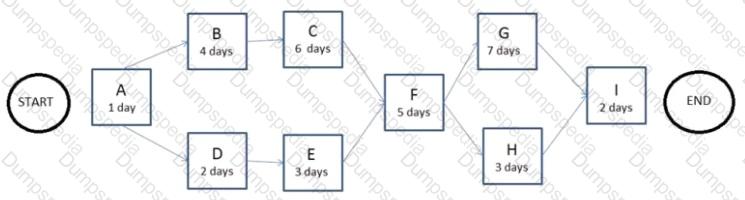
What is the critical path for the project?
A-B-C-F-G-I
A-B-C-F-H-I
A-D-E-F-G-I
A-D-E-F-H-I
The Critical Path Method (CPM) is used to estimate the minimum project duration and determine the amount of scheduling flexibility on the logical network paths within the schedule model.
Definition of Critical Path: According to PMI, the critical path is the longest sequence of activities through a project network diagram that determines the shortest possible project duration.
Total Float: Activities on the critical path have zero total float. Any delay in a critical path activity will delay the project finish date.
Calculation Steps:
Identify all possible paths from the start node (A) to the finish node (I).
Sum the durations of the activities along each specific path.
The path with the highest numerical total is the Critical Path.
How to solve this specific question:
Path A: A + B + C + F + G + I
Path B: A + B + C + F + H + I
Path C: A + D + E + F + G + I
Path D: A + D + E + F + H + I
To verify the answer, simply add the numbers associated with each letter in your diagram. The option (A, B, C, or D) that results in the largest sum is the verified critical path.
While working in an adaptive environment, a business analyst is collaborating with other roles in drafting a product roadmap. Which three roles are involved in establishing the product roadmap? (Choose three)
Project sponsor
Portfolio manager
End user
Program manager
Internal inspector
According to the Agile Practice Guide and the Standard for Portfolio Management, establishing a product roadmap in an adaptive environment is a strategic activity that requires alignment across different levels of the organization ' s hierarchy.
Project Sponsor (A): The sponsor provides the vision and the funding for the project. In an adaptive environment, they are essential for ensuring the roadmap aligns with the business case and that the high-level milestones provide the expected return on investment (ROI).
Portfolio Manager (B): The portfolio manager ensures that the product roadmap is aligned with the organization ' s strategic objectives and that it does not conflict with other initiatives within the portfolio. They provide the " big picture " context needed to prioritize the roadmap ' s themes.
Program Manager (D): The program manager coordinates the dependencies between different projects or components that contribute to the product. They are instrumental in mapping out the timeline and ensuring that the roadmap is realistic given the shared resources and interdependencies across the program.
Analysis of other options:
End user (C): While the end user is critical for providing feedback and helping refine User Stories or the Product Backlog, they are typically not involved in " establishing " the high-level strategic roadmap. Their needs are represented by the Product Owner or Business Analyst.
Internal inspector (E): This role is focused on compliance and quality control. While they may review the results of the work, they do not participate in the strategic planning or the drafting of the product roadmap.
Per PMI standards, the product roadmap serves as a high-level visual summary that maps out the vision and direction of the product offering over time. It requires the collaboration of the Sponsor, Portfolio Manager, and Program Manager to ensure financial, strategic, and operational alignment.
Which is a method of prototyping that creates a functioning representation of the final finished product to the user?
Low-fidelity prototyping
High-fidelity prototyping
Data prototyping
Report prototyping
According to the PMI Guide to Business Analysis and the PMBOK® Guide, prototyping is a method of obtaining early feedback on requirements by providing a working model of the expected product before actually building it.
High-Fidelity Prototyping: This method creates a version of the product that looks and functions as closely as possible to the final finished product. It includes functional elements, realistic navigation, and polished UI/UX designs. The goal is to allow the user to interact with the system in a way that mimics real-world use, providing the most accurate feedback possible.
User Validation: Because it is a " functioning representation, " high-fidelity prototypes are excellent for usability testing. They help stakeholders confirm that the solution will meet their needs and intentions before the organization commits to full-scale development costs.
Risk Reduction: While more expensive and time-consuming to create than low-fidelity versions, high-fidelity prototypes significantly reduce the risk of a " mismatch " between stakeholder expectations and the final deliverable.
Analysis of other options:
Option A: Low-fidelity prototyping involves simple sketches, storyboards, or paper mockups (like wireframes). While they represent the concept, they are not " functioning representations " and do not look like the finished product.
Option C: Data prototyping (or data modeling) focuses on the structure, relationships, and flow of data within a system. It is a back-end technical activity and does not provide a functioning representation of the finished product for the end-user.
Option D: Report prototyping specifically focuses on the layout and data visualization of output reports. It is a subset of prototyping but does not represent the entire " finished product. "
Per PMI standards, when the objective is to provide users with a functioning, realistic model of the end result, High-fidelity prototyping is the appropriate technique to employ.
A project manager is monitoring and recording results of executing the quality management activities to assess performance and ensure the project outputs are complete, correct, and meet customer expectations. Which output is the project manager using?
Approved change requests
Verified deliverables
Lessons learned
Work performance data
According to the PMBOK® Guide, the process described is Control Quality. This process is focused on the technical correctness of the deliverables and ensuring they meet the requirements specified by the stakeholders.
Verified Deliverables (The Output): When the project manager monitors and records results to ensure outputs are complete and correct, the successful result is a Verified Deliverable. This means the deliverable has been internally inspected and meets the quality standards and technical requirements.
The Workflow: Once a deliverable is " Verified " in the Control Quality process, it then becomes a primary input to the Validate Scope process, where the customer or sponsor provides formal acceptance.
Analysis of other options:
A. Approved change requests: These are an input to the Control Quality process. The project manager uses them to ensure that any changes previously approved have been correctly implemented in the deliverable.
C. Lessons learned: While " Lessons Learned " are documented throughout the project, they are a broader organizational output and not the specific measure of whether a deliverable is " complete and correct. "
D. Work performance data: This is an input to many monitoring and controlling processes. It represents the raw observations and measurements identified during activities being performed (e.g., actual number of defects found), rather than the completed and checked output itself.
Per PMI standards, the goal of the Control Quality process is to produce Verified Deliverables to provide a high level of confidence that the product is ready for the final customer sign-off.
Which project documents can determine the budget?
Procurement documents, contracts, requirements documentation, and basis of estimates
Basis of estimates, cost estimates, project schedule, and risk register
Business case, project charter, statement of work, and cost estimates
Scope baseline, resource management plan, activity list, and assumption log
According to the PMBOK® Guide, the Determine Budget process involves aggregating the estimated costs of individual activities or work packages to establish an authorized cost baseline. To do this accurately, the project manager must review specific project documents that provide the necessary data and context for those costs.
Basis of Estimates, Cost Estimates, Project Schedule, and Risk Register (Choice B): These are all primary Inputs to the Determine Budget process:
Cost Estimates: These provide the direct monetary requirements for each activity within a work package.
Basis of Estimates: This document provides the supporting detail behind the cost estimates, explaining how they were derived and what assumptions were made (e.g., current exchange rates, labor categories).
Project Schedule: The budget must be time-phased. The schedule contains the planned start and finish dates for activities, which determines when the funds will be expended.
Risk Register: This is reviewed to determine the necessary Contingency Reserves. Identified risks and their planned responses have associated costs that must be factored into the total budget.
Choice A: While Contracts and Procurement Documents are inputs, " Requirements Documentation " is a more indirect input. Choice B is more comprehensive regarding the core data needed to build the mathematical baseline.
Choice B: The Business Case and Project Charter are higher-level documents usually used during project initiation. While they provide the " ceiling " for the budget, they do not provide the granular data required to determine the detailed budget during the planning phase.
Choice D: The Scope Baseline is a critical input, but the Resource Management Plan and Activity List are typically used to create the cost estimates in the previous process (Estimate Costs). By the time you are determining the budget, you are using the outputs of those earlier steps.
By aggregating these specific documents, the project manager creates the Cost Baseline, which is the approved version of the time-phased project budget, excluding any management reserves.
Stakeholders can be identified in later stages of the project because the Identify Stakeholders process should be:
Continuous
Discrete
Regulated
Arbitrary
According to the PMBOK® Guide (Project Management Body of Knowledge), specifically within the Project Stakeholder Management knowledge area, the nature of stakeholder identification is a dynamic and evolving activity throughout the project life cycle.
Continuous (Option A): The Identify Stakeholders process is defined by PMI as a process that is performed periodically throughout the project as needed. Stakeholders may change, or new stakeholders may be identified, as the project moves through its different phases (e.g., transitioning from design to construction or from development to testing). Therefore, the process must be continuous and iterative to ensure that all individuals, groups, or organizations that could impact or be impacted by the project are captured in the Stakeholder Register.
Discrete (Option B): A discrete process would imply that stakeholder identification happens once (likely at the beginning) and is then finished. This is incorrect in the PMI framework, as missing a stakeholder who emerges mid-project can lead to significant risks or scope creep.
Regulated (Option C): While the process follows specific standards and organizational process assets (OPAs), " regulated " does not describe the timing or frequency of the activity in the way that " continuous " does.
Arbitrary (Option D): This implies that the process is based on random choice or personal whim rather than a systematic approach. PMI processes are structured and deliberate, never arbitrary.
In the PMI framework, the Stakeholder Register is a living document. By treating identification as a continuous process, the Project Manager can adjust engagement strategies to account for the shifting landscape of project influence and interest.
Which of the in an adaptive project environment, which action helps the project manager?
Project charter and project management plan
Communications management plan and scope management plan
Quality management plan and risk management plan
Project scope statement and communications management plan
According to the PMBOK® Guide and the Agile Practice Guide, even in an Adaptive (Agile) environment, the fundamental governance and direction of a project must be established. While the level of detail in these documents evolves, their presence is essential to help the project manager align the team and stakeholders.
Project Charter and Project Management Plan (Choice A): * Project Charter: This is the document that formally authorizes the existence of a project and provides the project manager with the authority to apply organizational resources to project activities. In adaptive environments, the charter provides the high-level vision and " north star " that keeps the team focused as specific requirements change.
Project Management Plan: While agile teams don ' t create a massive, 200-page static plan, they do have a project management plan that describes how the project will be executed, monitored, and controlled. In an adaptive context, this plan outlines the cadence (sprints/iterations), the definition of done, and the governance framework the team will use to manage changes.
Scope and Communications Management Plans (Choice B): While important, these are subsidiary components of the Project Management Plan. The question asks what " helps the project manager " in a broad sense; the overarching plan and charter provide the foundational authority and strategy required to implement these subsidiary plans.
Quality and Risk Management Plans (Choice C): Like Choice B, these are specific focus areas. In agile, quality is often handled through " Definition of Done " and risks through " Risk-Adjusted Backlogs, " but these are managed under the umbrella of the Project Management Plan.
Project Scope Statement and Communications Plan (Choice D): In an adaptive environment, a detailed Project Scope Statement is often avoided early on because the scope is expected to be refined iteratively. Instead, a Product Vision or Backlog is used.
By having a Project Charter, the project manager ensures there is an agreement on the project’s value proposition. By utilizing a Project Management Plan, the PM establishes the rules of engagement (such as how often the team meets and how they measure progress), which is vital for the self-organizing nature of adaptive teams.
A Project manager is failing to secure critical equipment on time, and this resulting in delays in the manufacturing of the final product. Which knowledge area is the project manager handling?
Project Resource Management
Project Quality Management
Project Schedule Management
Project integration Management
According to the PMBOK® Guide, the management of physical resources—including equipment, materials, facilities, and infrastructure—is a core function of Project Resource Management.
Physical Resource Management: While many people associate " resources " only with team members (human resources), the Resource Management knowledge area specifically covers the identification, acquisition, and management of the physical resources necessary for project completion.
Acquire Resources Process: The scenario describes a failure in the Acquire Resources process. This process involves securing the physical resources (equipment) needed to complete project work. Failure to secure these on time directly impacts the project ' s ability to proceed with manufacturing.
Control Resources: The project manager is also responsible for the Control Resources process, which ensures that the physical resources assigned and allocated to the project are available as planned, and monitoring the planned versus actual utilization of those resources.
Why other options are incorrect:
Option B: Project Quality Management: This knowledge area focuses on the standards and criteria the product must meet. While faulty equipment might affect quality, the act of securing the equipment is a resource logistics issue.
Option C: Project Schedule Management: While the failure results in a delay (a schedule impact), the root cause of the problem lies in the management of resources. Schedule management is where the impact is felt, but Resource Management is the area being " handled " (or mishandled) in this context.
Option D: Project Integration Management: This area involves coordinating all other knowledge areas. While everything eventually rolls up to integration, the specific task of securing equipment is a specialized function of the Resource Management knowledge area.
One of the key benefits of the Plan Human Resource Management process is that it:
outlines team selection guidelines and team member responsibilities.
establishes project roles and responsibilities.
improves teamwork, interpersonal skills, and competencies.
provides an accurate appraisal of team member performance.
According to the PMBOK® Guide (Project Management Body of Knowledge), specifically within the Project Resource Management knowledge area (formerly Human Resource Management):
Project Roles and Responsibilities (Option B): This is the primary output and key benefit of the Plan Resource Management process. This process identifies and documents project roles, responsibilities, required skills, and reporting relationships. It results in the creation of the Resource Management Plan, which ensures that the project has the necessary human resources with the appropriate skill sets to complete the work.
Team Selection Guidelines (Option A): While the plan might touch on how resources are acquired, " selection guidelines " are more specifically detailed in the Acquire Resources process, where the actual negotiation and assignment of staff occur.
Improving Teamwork and Competencies (Option C): This is the key benefit of the Develop Team process, not the planning process. Development focuses on enhancing the abilities of the team members once they have been assigned to the project.
Performance Appraisal (Option D): This is a tool and technique used in the Manage Team process. It involves tracking team member performance, providing feedback, and resolving issues to optimize project performance.
In the PMI framework, Plan Resource Management provides the necessary structure to ensure that every task in the Work Breakdown Structure (WBS) has an assigned owner. By clearly defining roles and responsibilities early, the Project Manager reduces the risk of overlapping duties or neglected tasks, which is essential for maintaining project accountability.
Which process uses occurrence probability and impact on project objectives to assess the priority of identified risks?
Identify Risks
Perform Qualitative Risk Analysis
Plan Risk Management
Perform Quantitative Risk Analysis
According to the PMBOK® Guide, specifically within the Project Risk Management knowledge area, Perform Qualitative Risk Analysis is the process of prioritizing individual project risks for further analysis or action by assessing their probability of occurrence and impact.
The Probability and Impact Matrix: This is the primary tool used in this process. Each identified risk is evaluated against a scale (e.g., 0.1 to 1.0 for probability and low-to-high for impact). By multiplying these two factors, the project manager determines a Risk Score, which dictates the priority of the risk.
Subjective Assessment: Unlike quantitative analysis, which uses hard data and modeling, qualitative analysis is often faster and relies on the subjective perceptions of the project team and stakeholders. It is used to quickly filter out low-priority risks so the team can focus on the " high-threat " or " high-opportunity " items.
Data Quality Assessment: A critical component of this process is evaluating the quality of the data available about the risks. If the data is unreliable, the qualitative assessment may be flawed, requiring further research.
Urgency and Risk Categorization: Beyond probability and impact, this process also looks at Risk Urgency (how soon a response is needed) and categorizes risks by their source (using the Risk Breakdown Structure) to identify patterns or common causes.
Comparison with other options:
A. Identify Risks: This is the initial process of determining which risks may affect the project and documenting their characteristics in the Risk Register. It does not involve the formal scoring or prioritization of those risks.
C. Plan Risk Management: This is a Planning process that defines how to conduct risk management activities. It creates the framework and the scales for probability and impact but does not actually perform the assessment on specific risks.
D. Perform Quantitative Risk Analysis: This process follows qualitative analysis and uses numerical analysis (like Monte Carlo simulation or Decision Tree analysis) to provide a combined effect of identified risks on overall project objectives. While it uses probability, it is a much more complex, data-driven mathematical approach rather than a simple prioritization method.
Which process is conducted from project inception through completion and is ultimately the responsibility of the project manager?
Control Quality
Monitor and Control Project Work
Control Scope
Perform Integrated Change Control
According to the PMBOK® Guide (Project Management Body of Knowledge), specifically within the Project Integration Management knowledge area:
Perform Integrated Change Control (Option D): This is the process of reviewing all change requests; approving changes and managing changes to deliverables, organizational process assets, project documents, and the project management plan; and communicating their disposition. PMI explicitly states that this process is conducted from project inception through completion and is ultimately the responsibility of the project manager. While a Change Control Board (CCB) may be responsible for approving or rejecting changes, the project manager oversees the entire integrated process to ensure that no change is made in isolation without considering its impact on all project constraints.
Monitor and Control Project Work (Option B): While also performed throughout the project, this process is focused on tracking, reviewing, and reporting the overall progress to meet the performance objectives defined in the project management plan. It is the " parent " process that identifies the need for a change, but the formal management of that change happens in Perform Integrated Change Control.
Control Quality (Option A): This process is focused on monitoring and recording results of executing the quality management activities to assess performance and ensure the project outputs are complete, correct, and meet customer expectations.
Control Scope (Option C): This is the process of monitoring the status of the project and product scope and managing changes to the scope baseline. It is a specialized control process, whereas Integrated Change Control covers all baselines.
In the PMI framework, Perform Integrated Change Control is the central " funnel " through which all change requests must pass, ensuring the integrity of the project ' s baselines from the day the project is chartered until the day it is closed.
Funding limit reconciliation is a tool and technique of which Project Cost Management process?
Estimate Costs
Control Costs
Plan Cost Management
Determine Budget
According to the PMBOK® Guide, specifically within the Project Cost Management knowledge area, Funding Limit Reconciliation is a key tool and technique of the Determine Budget process.
Definition: Funding limit reconciliation is the process of comparing the planned expenditure of project funds against any limits on the commitment of funds for the project.
The Constraint: Organizations often have limits on the disbursement of funds at specific intervals (e.g., quarterly or annually). This can create a " funding gap " if the project ' s planned expenditures exceed the available cash flow at a given time.
The Reconciling Action: If a variance is found between the funding limits and the planned expenditures, the project manager may need to reschedule work to level out the rate of expenditures. This is often achieved by placing imposed date constraints for work packages or milestones into the project schedule to ensure the spend remains within the authorized funding limits.
Comparison with other options:
A. Estimate Costs: This process focuses on developing an approximation of the monetary resources needed to complete project activities. Its tools include Analogous, Parametric, and Bottom-up estimating.
B. Control Costs: This process monitors the status of the project to update costs and manage changes to the cost baseline. Its primary tools include Earned Value Analysis (EVA) and To-Complete Performance Index (TCPI).
C. Plan Cost Management: This is the initial planning process that establishes the policies and procedures for managing costs. It primarily uses Expert Judgment, Data Analysis, and Meetings.
Which Process Group includes the Manage Stakeholder Engagement process?
Executing
Planning
Monitoring and Controlling
Initiating
According to the PMBOK® Guide, specifically the Process Group and Knowledge Area Mapping, the Manage Stakeholder Engagement process is a core component of the Executing Process Group.
Definition: Manage Stakeholder Engagement is the process of communicating and working with stakeholders to meet their needs and expectations, address issues, and foster appropriate stakeholder involvement in project activities throughout the project life cycle.
Purpose: The primary benefit of this process is that it allows the project manager to increase support and minimize resistance from stakeholders. Since this involves the actual " doing " and interpersonal interaction required to move the project forward, it is classified under Executing.
Key Activities:
Engaging stakeholders at appropriate project stages.
Managing stakeholder expectations through negotiation and communication.
Addressing any risks or potential concerns related to stakeholder management and anticipating future issues.
Clarifying and resolving issues that have been identified.
Comparison with other options:
B. Planning: This group includes the Plan Stakeholder Engagement process, where the strategies for involvement are developed, rather than executed.
C. Monitoring and Controlling: This group includes the Monitor Stakeholder Engagement process, which focuses on monitoring project stakeholder relationships and tailoring strategies for engaging stakeholders through modification of engagement plans.
D. Initiating: This group includes the Identify Stakeholders process, which occurs at the very beginning of the project or phase to identify the people, groups, or organizations that could impact or be impacted by the project.
The Define Scope process is in which of the following Process Groups?
Initiating
Planning
Monitoring and Controlling
Executing
According to the PMBOK® Guide, the Define Scope process is a critical component of the Planning Process Group within the Project Scope Management knowledge area.
Purpose: The primary objective of the Define Scope process is to develop a detailed description of the project and product. This process is essential because it describes the project, service, or result boundaries and acceptance criteria.
The Planning Process Group: This group consists of those processes required to establish the scope of the effort, refine the objectives, and define the course of action required to attain the objectives that the project was undertaken to achieve. Since Define Scope is where the project boundaries are solidified, it naturally sits within the Planning phase.
Key Output: The major output of this process is the Project Scope Statement. This document provides a common understanding of the project scope among project stakeholders and contains the detailed project scope, major deliverables, assumptions, and constraints.
Context: It follows the Collect Requirements process (where all stakeholder needs are gathered) and precedes the Create WBS process (where the scope is broken down into manageable work packages).
Comparison with other options:
A. Initiating: This group includes the Develop Project Charter process. While the Charter contains a high-level project description, the detailed " Define Scope " work happens later during planning.
C. Monitoring and Controlling: This group includes Validate Scope and Control Scope. These processes are concerned with formalizing acceptance of deliverables and monitoring the status of the project scope, rather than defining it.
D. Executing: There are no Scope Management processes in the Executing Process Group. Execution focuses on " Direct and Manage Project Work " based on the scope defined during the Planning phase.
What Knowledge Area must be led by the project manager and cannot be delegated to other specialists?
Project Cost Management
Project Integration Management
Project Risk Management
Project Schedule Management
According to the PMBOK® Guide, specifically in the section describing the Project Manager ' s Role, there is a fundamental distinction between Integration Management and all other Knowledge Areas.
The Responsibility of Integration: Project Integration Management is the core of the project manager’s role. It involves coordinating all other knowledge areas, making trade-offs among competing objectives, and managing the interdependencies among the project management processes.
Why it Cannot be Delegated: While a project manager may delegate specific tasks to specialists—such as a Scheduler for Schedule Management, a Cost Estimator for Cost Management, or a Risk Officer for Risk Management—the responsibility for Integration belongs solely to the project manager. Only the project manager has the " big picture " view necessary to combine the results from all other areas into a cohesive whole and ensure the project remains aligned with the Project Charter and organizational objectives.
Analysis of other options:
Project Cost Management (Option A): In large organizations, this is often handled or heavily supported by financial analysts, accountants, or cost engineers.
Project Risk Management (Option C): On large, complex projects, a dedicated Risk Manager or a risk specialist may be appointed to lead the identification and analysis of project risks.
Project Schedule Management (Option D): It is very common for a project manager to delegate the detailed creation and maintenance of the project schedule to a professional Scheduler or a Project Management Office (PMO) specialist.
Per PMI standards, the project manager is the integrator. They are the only person responsible for the project as a whole, meaning they must be the ones to lead the integration of the various pieces of work into a unified project management plan.
A project manager is assigned to a strategic project Senior management asks the project manager to give a presentation in order to request support that will ensure the success of the project.
Which entities will the project manager attempt to influence?
The project and the organization
The organization and the industry
The subject matter experts and the project
The change control board and the organization
According to the PMBOK® Guide (7th Edition) and the Standard for Project Management, one of the key leadership roles of a project manager is to exert influence across various spheres to ensure project success. When senior management requests a presentation to secure support, the project manager is operating within the " Sphere of Influence. "
The project manager ' s influence is categorized as follows:
The Project: The project manager leads the project team to meet project objectives and satisfy stakeholder needs. This involves managing internal resources, communication, and team dynamics.
The Organization: Project managers must proactively interact with other project managers and functional managers within the organization. Influencing the organization is critical for securing resources, advocating for the project ' s strategic value, and ensuring alignment with organizational goals.
Analysis of Distractors:
B (Industry): While project managers stay informed about industry trends, they rarely have the direct objective to " influence the industry " in order to secure support for a specific internal strategic project.
C (Subject Matter Experts and the Project): Subject Matter Experts (SMEs) are considered part of the project team or stakeholders within the project/organization sphere. This option is too narrow and misses the broader organizational support requested by senior management.
D (Change Control Board and the Organization): The Change Control Board (CCB) is a specific governance body. While important, the request for support to " ensure success " of a strategic project typically involves broader organizational influence (such as resource owners and executive sponsors) rather than just the board that approves scope changes.
An effective technique for resolving conflict that incorporates multiple viewpoints from differing perspectives to achieve consensus and commitment is:
smooth/accommodate.
force/direct,
collaborate/problem solve,
compromise/reconcile.
In accordance with the PMBOK® Guide (Project Resource Management), specifically within the Manage Team process, there are five general techniques for resolving conflict. The Collaborate/Problem Solve approach is considered the most effective for long-term project success.
Mechanism: This technique involves incorporating multiple viewpoints and insights from differing perspectives. it requires a cooperative attitude and open dialogue that typically leads to consensus and commitment.
Outcome: Because this approach addresses the root cause of the conflict and allows all parties to contribute to the solution, it results in a " win-win " situation.
When to use: It is best used when the relationship between parties is important, when the interests of both parties are too significant to be compromised, or when you need to gain commitment by incorporating concerns into a consensus.
Analysis of Distractors:
A. Smooth/Accommodate: This technique emphasizes areas of agreement rather than areas of difference, or conceding one ' s position to the needs of others to maintain harmony. This is a " lose-win " approach and often provides only a temporary solution.
B. Force/Direct: This involves pushing one ' s viewpoint at the expense of others, offering only " win-lose " solutions. It is often enforced through a power position and can lead to resentment.
D. Compromise/Reconcile: This involves searching for solutions that bring some degree of satisfaction to all parties in order to temporarily or partially resolve the conflict. It is often a " lose-lose " or " neutral-neutral " approach because both parties must give something up, which rarely leads to true consensus or long-term commitment.
In a functional organization, the director of an important stakeholder business group expressed concern to a line manager about the progress of the project. What should the line manager do next?
Hold a face-to-face meeting with the project manager and warn them.
Point the director to a link where they can take a look at the reports.
Invite stakeholders to attend monthly progress review meetings.
Ask the project manager to update the monthly status report distribution list.
According to the PMBOK® Guide, specifically regarding the Monitor Communications and Manage Stakeholder Engagement processes, the goal is to ensure that information needs are met efficiently and transparently.
Self-Service Information (Pull Communication): In a functional organization, where lines of authority are often rigid, providing a director with direct access to existing reports is the most efficient and professional first step. This utilizes Pull Communication, which allows stakeholders to access information at their own discretion.
Transparency and Professionalism: Directing the stakeholder to the official project reports ensures they are receiving the same verified data as everyone else. This addresses their concern with facts rather than hearsay or emotional escalation.
Organizational Context: In a functional structure, the project manager often has limited authority. By providing a link to reports, the line manager supports the project ' s visibility without overstepping or causing unnecessary friction between departments.
Analysis of other options:
A. Hold a face-to-face meeting and warn them: This is an aggressive and reactive approach. A " warning " assumes the project manager is at fault before the data (the reports) has even been reviewed. It bypasses formal communication channels.
C. Invite stakeholders to attend monthly meetings: While engagement is good, this is a future-dated solution. It does not address the director ' s immediate concern about current progress.
D. Ask the project manager to update the distribution list: This is a Push Communication fix. While helpful for the future, the director expressed a concern now. Simply adding them to a list for next month does not provide them with the immediate clarity they are seeking.
Per PMI standards, the most effective way to manage stakeholder expectations and concerns is to ensure they have immediate access to the appropriate project performance data.
Which is used to solicit proposals from prospective sellers?
Procurement statement of work
Resource calendars
Procurement document
Independent estimates
According to the PMBOK® Guide, specifically within the Plan Procurement Management process, the project manager and the procurement department create specific documents to communicate project needs to the market.
" Procurement documents " is a collective term used in the PMI framework to describe the formal instruments used to solicit proposals from prospective sellers. Depending on the complexity and nature of the requirement, these may include:
Request for Proposal (RFP): Used when there is a problem in the project and the solution is not clear. It solicits the seller ' s methodology and ideas.
Request for Quotation (RFQ): Used when the deliverables are standard or commodities, and the primary focus is on price.
Invitation for Bid (IFB): Often used in government procurement for highly standardized work.
These documents ensure that all prospective sellers have a clear and consistent understanding of the work to be performed, the terms and conditions, and the criteria by which they will be evaluated.
A. Procurement statement of work (SOW): While the SOW is a critical part of the procurement document, it is not the solicitation instrument itself. The SOW defines the portion of the project scope to be included within a related contract, providing enough detail for prospective sellers to determine if they are capable of providing the products or services.
B. Resource calendars: These are documents that identify the working days and shifts on which each specific resource is available. They are an input to several processes but are not used to solicit external sellers.
C. Procurement document: As stated, this is the overarching term for the solicitation packages (RFP, RFQ, etc.) sent to providers.
D. Independent estimates: These are often developed by the procuring organization or an outside professional to serve as a " benchmark " or " sanity check " to evaluate the reasonableness of the bids or proposals submitted by sellers. They are a Tool and Technique of Conduct Procurements, not a solicitation document.
In the PMI standard, the flow generally follows:
Requirement $\rightarrow$
Procurement SOW $\rightarrow$
Procurement Documents (Solicitation) $\rightarrow$
Seller Proposals.
Which input to Collect Requirements is used to identify stakeholders who can provide information on requirements?
Stakeholder register
Scope management plan
Stakeholder management plan
Project charter
According to the PMBOK® Guide and the Standard for Project Management, the Stakeholder Register is the specific input to the Collect Requirements process used to identify which stakeholders are capable of providing detailed information regarding project and product requirements.
As per PMI standards, the Collect Requirements process is the process of determining, documenting, and managing stakeholder needs and requirements to meet project objectives. The Stakeholder Register is essential here because:
Identification: It contains the list of all identified stakeholders who may have an interest in or impact on the project.
Requirement Sources: It helps the project team identify " key " stakeholders who can provide information about specific requirements, including their expectations and their level of influence.
Categorization: It allows the project manager to target specific groups (e.g., end-users, sponsors, or regulators) for requirement-gathering sessions like interviews or focus groups.
The other options are incorrect based on the following PMI document definitions:
Scope management plan: This is a Planning document that describes how the scope will be defined, developed, monitored, controlled, and verified. It provides the process for collecting requirements but does not list the people (stakeholders) themselves.
Stakeholder management plan: (Now often called the Stakeholder Engagement Plan) This document identifies the management strategies and actions required to effectively engage stakeholders. While it uses the register as an input, its focus is on engagement strategy rather than being the primary list used to pull requirement sources.
Project charter: The charter is an input to Collect Requirements because it provides the high-level project description and high-level requirements. However, it does not provide the granular list of stakeholders needed to extract detailed functional or technical requirements.
As per the PMI Lexicon of Project Management Terms, the Stakeholder Register is a living document that ensures the project team remains aligned with the individuals whose needs define the project ' s success.
Agile release planning provides a high-level summary timeline of the release schedule based on.
Activities and story points
Iteration and prioritization plans
Product roadmap and the product vision
Tasks and user stories
According to the PMBOK® Guide and the Agile Practice Guide, Agile Release Planning is a collaborative process used to determine how many iterations (sprints) will be required to deliver a functional product increment. This planning provides a high-level summary timeline that is driven by the broader strategic goals of the project.
Product Vision: The product vision is the " north star " of the project. It defines the long-term goal and the " why " behind the project. Every release must align with this vision to ensure the team is building the right product.
Product Roadmap: The roadmap is a high-level visual summary that maps out the evolution of a product over time. It shows the sequence of features and major milestones. Agile release planning takes the goals defined in the roadmap and breaks them down into specific releases.
Strategic Alignment: While iterations and story points are used to measure progress during the planning session, the basis or foundation of the release schedule itself is derived from the high-level roadmap and the overarching vision established by the Product Owner and stakeholders.
Why other options are incorrect:
Option A: Activities and story points: Story points are a unit of measure for effort, and activities are more common in predictive scheduling. While story points help determine velocity, they do not provide the high-level " summary timeline " logic that the roadmap provides.
Option B: Iteration and prioritization plans: Iteration planning (sprint planning) is a low-level, detail-oriented ceremony that happens at the start of each sprint. Release planning is at a higher level and encompasses multiple iterations.
Option D: Tasks and user stories: Tasks are the most granular level of work (often tracked on a Kanban board). User stories are the backlog items. Planning a release timeline based only on individual tasks would be too " bottom-up " and would lack the strategic context provided by the roadmap.
A projects purpose or justification, measurable project objectives and related success criteria, a summary milestone schedule, and a summary budget are all components of which document?
Work breakdown structure
Requirements document
Project charter
Project management plan
According to the PMBOK® Guide (Project Management Body of Knowledge), specifically within the Project Integration Management knowledge area and the Develop Project Charter process:
Project Charter (Option C): This is the document issued by the project initiator or sponsor that formally authorizes the existence of a project and provides the project manager with the authority to apply organizational resources to project activities. Per PMI standards, a standard Project Charter includes high-level information such as the project purpose or justification, measurable project objectives, success criteria, a summary milestone schedule, and a summary budget. It also identifies the high-level risks and the assigned project manager.
Work Breakdown Structure (WBS) (Option A): This is a hierarchical decomposition of the total scope of work. It focuses on deliverables and work packages, not on project justification, budgets, or milestone schedules.
Requirements Document (Option B): This document describes how individual requirements meet the business need for the project. While it includes measurable criteria for the product, it does not contain the project ' s financial authorization or the milestone schedule.
Project Management Plan (Option D): This is a comprehensive document that describes how the project will be executed, monitored, and controlled. While it incorporates high-level information from the charter, the charter is the specific, formal starting document where these summary-level components are first established and authorized.
In the PMI framework, the Project Charter serves as a bridge between the organization ' s strategic objectives and the project ' s tactical execution. By documenting the summary budget and milestone schedule at this early stage, the sponsor set the boundaries within which the Project Manager must plan the detailed project activities.
A project manager is searching for solutions that bring some degree of satisfaction to all parties in order to temporarily resolve a conflict. What conflict management technique is described in this situation?
Withdraw/avoid
Smooth /accommodate
Collaborate/problem solve
Compromise/ reconcile
According to the PMBOK® Guide, there are five general techniques used to resolve conflict. The scenario described—searching for a solution that brings " some degree of satisfaction to all parties " and is often a " temporary " fix—perfectly defines Compromise/Reconcile.
Compromise/Reconcile: This technique involves searching for solutions that bring some degree of satisfaction to all parties in order to temporarily or partially resolve the conflict. It often results in a lose-lose situation because both parties are required to give something up to reach an agreement.
Key Indicators:
" Some degree of satisfaction " (Middle ground).
" Temporary " resolution.
Adjusting positions or searching for a bargain.
Analysis of other options:
A. Withdraw/avoid: This involves retreating from an actual or potential conflict situation or postponing the issue to be better prepared or to be resolved by others. It does not seek to provide satisfaction to the parties involved.
B. Smooth/accommodate: This emphasizes areas of agreement rather than areas of difference. It involves conceding one ' s position to the needs of others to maintain harmony. It is often a " lose-win " approach.
C. Collaborate/problem solve: This is considered the best approach by PMI. It involves incorporating multiple viewpoints and insights from different perspectives. It requires a cooperative attitude and open dialogue that typically leads to consensus and commitment (win-win). It is a permanent, not temporary solution.
Per PMI standards, while Compromise/Reconcile is useful for reaching a quick middle ground, the project manager should ideally strive for Collaborate/Problem Solve whenever time and resources permit to ensure a long-term, sustainable resolution.
Which process should be conducted from the project inception through completion?
Monitor and Control Project Work
Perform Quality Control
Perform Integrated Change Control
Monitor and Control Risks
According to the PMBOK® Guide, the process of Perform Integrated Change Control is uniquely identified as the process that is conducted from project inception through completion.
The Continuous Nature of Change: Change can happen at any time during a project ' s life cycle. Whether it is a change to a high-level requirement in the Project Charter (Inception) or a change to the final administrative closing procedures (Completion), every change must be processed through this specific framework.
Ultimate Accountability: The Project Manager is responsible for ensuring that no changes are made to the project baselines (Scope, Schedule, or Cost) without going through this formal process. This maintains the integrity of the " Performance Measurement Baseline. "
Relationship with Other Processes: While other monitoring and controlling processes (like Monitor and Control Project Work) are also ongoing, the PMBOK® specifically highlights Perform Integrated Change Control as the " inception to completion " process because it is the gatekeeper for all project modifications. It ensures that every change is reviewed, approved, or rejected in a coordinated fashion.
The Change Control Board (CCB): This process often involves a CCB, which is a formally chartered group responsible for reviewing, evaluating, approving, delaying, or rejecting changes to the project.
Comparison with Other Options:
Monitor and Control Project Work (A): This process focuses on tracking, reviewing, and reporting the overall progress to meet the performance objectives defined in the project management plan. While it occurs throughout the project, the " inception to completion " phrasing in PMI literature is most strictly associated with Change Control.
Perform Quality Control (B): This process (now Control Quality) is focused on monitoring and recording results of executing the quality activities to assess performance. It generally starts once the first deliverables are being produced, not necessarily at the absolute moment of inception.
Monitor and Control Risks (D): While risk management is continuous, it technically begins once the Identify Risks process is first executed during planning. Perform Integrated Change Control is viewed as the fundamental backbone that exists as soon as a project is authorized.
Which type of analysis is used to determine the cause and degree of difference between the baseline and actual performance?
Schedule network analysis
Reserve analysis
Alternative analysis
Variance analysis
According to the PMBOK® Guide (Project Management Body of Knowledge), specifically within the Monitor and Control Project Work process and the Project Cost and Schedule Management knowledge areas:
Variance Analysis (Option D): This is the specific technique used to determine the cause and degree of difference between the established baseline (Scope, Schedule, or Cost) and the actual performance. By performing variance analysis, a project manager can evaluate the magnitude of a deviation and determine if corrective or preventive action is required to bring the project back in line with the plan. Common examples include Schedule Variance (SV) and Cost Variance (CV).
Schedule Network Analysis (Option A): This is a technique used during the Develop Schedule process to generate the project schedule model. it employs various analytical techniques, such as Critical Path Method (CPM) and Resource Leveling, to calculate the early and late start and finish dates.
Reserve Analysis (Option B): This is used to determine the amount of contingency and management reserves needed for a project. It is performed during Estimate Costs and Determine Budget to account for uncertainty. While it is monitored during execution, its primary purpose is not the measurement of performance against a baseline.
Alternative Analysis (Option C): This is a data analysis technique used to evaluate identified options in order to select which options or approaches to use to execute and perform the work of the project. It is often used in Plan Resource Management or Define Scope.
In the PMI framework, Variance Analysis is a critical component of Earned Value Management (EVM). It provides the necessary data for the Project Manager to report project status to stakeholders and to justify any requests for changes to the project baselines.
A logical relationship in which a successor activity cannot start until a predecessor activity has finished is known as:
Start-to-start (SS).
Start-to-finish (SF).
Finish-to-start (FS).
Finish-to-finish (FF).
In accordance with the PMBOK® Guide (Project Schedule Management), specifically regarding the Precedence Diagramming Method (PDM), there are four types of logical relationships or dependencies used to sequence activities.
The Finish-to-start (FS) relationship is defined as:
Definition: A logical relationship in which a successor activity cannot start until a predecessor activity has finished.
Usage: This is the most commonly used logical relationship in project scheduling.
Example: In a construction project, the activity " Level Concrete " (Successor) cannot start until the activity " Pour Concrete " (Predecessor) has finished.
Analysis of Distractors:
A. Start-to-start (SS): A logical relationship in which a successor activity cannot start until a predecessor activity has started. (e.g., Leveling concrete cannot start until pouring concrete has started).
B. Start-to-finish (SF): A logical relationship in which a successor activity cannot finish until a predecessor activity has started. This is the rarest type of relationship used in project management.
D. Finish-to-finish (FF): A logical relationship in which a successor activity cannot finish until a predecessor activity has finished. (e.g., Writing a document must be finished before the editing of that document can be finished).
In addition to the project charter, what other artifact is produced as a result of the Develop Project Charter process ' ?
Assumption log
Milestone list
Business case
Risk register
According to the PMBOK® Guide (specifically the 6th and 7th Editions), the Develop Project Charter process is the very first step in the project life cycle. While the primary output is the Project Charter itself, there is a second, critical output that is often overlooked in study.
The Assumption Log: This is the secondary output of the Develop Project Charter process. Strategic and high-level business assumptions and constraints are typically identified in the business case before the project is initiated and will flow into the project charter. Throughout the process of creating the charter, the project manager uses the Assumption Log to document all high-level technical and operational assumptions and constraints that will affect the project.
Purpose: It serves as a repository for any factor that is considered to be true, real, or certain without proof or demonstration. Because these assumptions are not yet proven, they represent potential risks that must be validated during the planning phase.
Why other options are incorrect:
Option B: Milestone list: While a high-level summary of milestones is contained within the Project Charter, the formal " Milestone List " is an output of the Define Activities process in the Planning process group.
Option C: Business case: The Business Case is an input to the Develop Project Charter process, not an output. It is a business document created by the sponsor or organization to justify the investment before the project manager even starts the charter.
Option D: Risk register: The Risk Register is an output of the Identify Risks process. While the Project Charter contains " high-level overall project risks, " the detailed register is not created until the planning phase.
Which tasks should a project manager accomplish in order to manage project scope correctly?
Define. Validate, and Control Scope. Control Schedule; Control Costs and Manage Stakeholder Engagement
Collect Requirements. Define Scope. Create WBS. Develop Schedule, and Manage Stakeholder Engagement
Plan Scope Management; Collect Requirements; Define. Validate, and Control Scope; and Create WBS
Define. Validate, and Control Scope. Control Costs. Manage Stakeholder Engagement, and keep budget under control
According to the PMBOK® Guide, Project Scope Management includes the processes required to ensure that the project includes all the work required, and only the work required, to complete the project successfully. To manage scope correctly, a project manager must follow the specific sequence of processes defined within the Scope Management Knowledge Area.
The six core processes are:
Plan Scope Management: Creating a scope management plan that documents how the project and product scope will be defined, validated, and controlled.
Collect Requirements: Determining, documenting, and managing stakeholder needs and requirements to meet project objectives.
Define Scope: Developing a detailed description of the project and product.
Create WBS: Subdividing project deliverables and project work into smaller, more manageable components.
Validate Scope: Formalizing acceptance of the completed project deliverables.
Control Scope: Monitoring the status of the project and product scope and managing changes to the scope baseline.
Analysis of Other Options:
A. Control Schedule; Control Costs: These belong to the Schedule Management and Cost Management Knowledge Areas, respectively. While related to overall project health, they are not tasks used to manage scope specifically.
B. Develop Schedule: This is a Schedule Management process. Managing scope is the precursor to developing a schedule, but the schedule itself is not a scope management task.
D. Control Costs; Manage Stakeholder Engagement: These are processes from other Knowledge Areas. " Keeping budget under control " is a goal of Cost Management, not a defined process for managing Scope.
What is one reason why stakeholders must be identified when performing business analysis?
To identify project timelines through business reviews
To allow the business analyst to determine the project budget
To identify who should define the business requirements for the project
To determine a cost-benefit analysis for the project
According to the PMI Guide to Business Analysis and the PMBOK® Guide, identifying stakeholders is one of the most critical initial steps in any project or business analysis effort.
Defining the " Who " : Requirements do not exist in a vacuum; they belong to people, groups, or organizations. By identifying stakeholders early, the business analyst determines exactly whose needs, expectations, and constraints must be captured to define the project ' s scope.
Requirements Ownership: Different stakeholders provide different types of requirements. For example, a department head might define high-level Business Requirements, while an end-user defines User Requirements. Without identifying these individuals, the business analyst would not know whom to interview, observe, or invite to workshops, leading to critical gaps in the final solution.
Stakeholder Influence: Identifying stakeholders also allows the business analyst to understand their level of influence and impact. This ensures that the requirements defined are not only comprehensive but also prioritized based on the stakeholders ' roles and their ability to affect the project ' s success.
Analysis of other options:
Option A: Identifying project timelines is a function of the Develop Schedule process. While stakeholders provide input on constraints, the primary reason for identifying them in a business analysis context is related to requirements, not schedule creation.
Option B: Determining the project budget is the responsibility of the Project Manager and the Sponsor during the Determine Budget process. A business analyst uses the budget as a constraint but does not identify stakeholders specifically to set the project ' s total funding.
Option D: A Cost-benefit analysis is typically part of the Business Case, which is often created before or alongside stakeholder identification. While stakeholders provide the data for the analysis, the fundamental reason for identifying them is to extract the requirements that the project must fulfill.
Per PMI standards, the core purpose of stakeholder identification in business analysis is to ensure that all relevant voices are heard so that the Business Requirements accurately reflect the problem to be solved or the opportunity to be seized.
During what project management process does the project team begin identifying risks?
Initiating
Planning
Executing
Monitoring and Controlling
According to the PMBOK® Guide, specifically the Project Risk Management knowledge area, formal risk identification occurs within the Planning Process Group.
The process is titled Identify Risks, which is the process of identifying individual project risks as well as sources of overall project risk, and documenting their characteristics. While high-level risks may be noted in the Project Charter during the Initiating phase, the systematic process of identifying, categorizing, and documenting risks into the Risk Register is a core planning activity.
Planning (Identify Risks): This is where the team uses tools such as brainstorming, checklists, interviews, and SWOT analysis to create the initial Risk Register.
Initiating: This process group produces the Project Charter, which may contain high-level " key risks " or assumptions, but the " project team " as a whole typically begins the detailed identification process once the project is authorized and planning begins.
Executing: During this phase, the team implements risk responses. While new risks can be identified at any time (as risk management is iterative), the initial identification is a planning function.
Monitoring and Controlling: This involves Monitor Risks, where the team tracks existing risks and identifies new risks that emerge during the project.
Per PMI standards, the Identify Risks process should be performed as early as possible in the planning phase and continue throughout the project life cycle because new risks may evolve or become known as the project progresses through its life cycle.
What is the project manager ' s responsibility in Project Integration Management?
Ensuring that requirements-related work is clarified in the project management plan
Investing sufficient effort in acquiring, managing, motivating, and empowering the project team
Combining the results in all other knowledge areas, and overseeing the project as a whole
Developing a strategy to ensure effective stakeholder communication
According to the PMBOK® Guide (6th and 7th Editions), Project Integration Management is the core responsibility of the project manager. While other knowledge areas (like Scope, Schedule, or Cost) can be managed by specialists or functional leads, Integration cannot be delegated. It is the specific function where the project manager acts as the " integrator " of the project.
Key responsibilities within this domain include:
Unification and Consolidation: The project manager must pull together the outputs of all other Knowledge Areas (the subsidiary plans) to create a cohesive Project Management Plan.
Managing Interdependencies: Overseeing how a change in one area (e.g., a scope increase) impacts other areas (e.g., budget and schedule).
Resource and Objective Alignment: Ensuring that all project activities are aligned with the overall strategic goals and the Project Charter.
Balancing Competing Constraints: Making trade-offs among competing objectives and alternatives to ensure the project as a whole is successful.
Analysis of Distractors:
A (Requirements): This is the primary focus of Project Scope Management. While requirements are eventually integrated, clarifying them is a specialized task within the Scope domain.
B (Team Motivation): This is the primary focus of Project Resource Management. While vital, it describes the " people " side of management rather than the " integration " of the project ' s technical and administrative components.
D (Stakeholder Communication): This is the primary focus of Project Management. Like the other distractors, this is a specialized area that feeds into Integration but does not define the overarching integrative role of the project manager.
During the execution phase of a project a detect is found. The project manager takes responsibility and with the correct documentation, begins the task necessary to repair the defect. What process was applied?
Change request
Risk response
Risk management plan
Lessons learned
According to the PMBOK® Guide, specifically within the Direct and Manage Project Work and Perform Integrated Change Control processes, the formal mechanism used to address a defect is a Change Request.
Defect Repair: This is a specific type of change request. It is an intentional activity to modify a nonconforming product or product component.
The Process Flow: When a defect is identified during execution, it must be documented. Even though the project manager is taking responsibility and the action is necessary, it must still pass through the change control system to ensure the impact on scope, schedule, and cost is assessed.
Documentation: The " correct documentation " mentioned in the question refers to the formal change request form and the subsequent update to the Change Log once the repair is approved and initiated.
Analysis of other options:
B and C. Risk response / Risk management plan: Risk management deals with uncertain future events (threats or opportunities). A defect is an issue that has already occurred (a " fact " in the present). While a risk response plan might have anticipated the possibility of defects, the actual act of repairing one that has been found is handled through change control.
D. Lessons learned: While the project manager should document the defect and how it was handled in the Lessons Learned Register to prevent future occurrences, " Lessons Learned " is a knowledge management activity, not the process used to physically perform the repair during execution.
Per PMI standards, all Defect Repairs, Corrective Actions, and Preventive Actions must be processed as Change Requests to maintain the integrity of the project baselines.
Which of the following is a category of organizational process assets?
Government standards
Organizational culture
Employee capabilities
Organizational knowledge bases
According to the PMBOK® Guide, Organizational Process Assets (OPAs) are the plans, processes, policies, procedures, and knowledge bases specific to and used by the performing organization. These assets influence the management of the project and are grouped into two primary categories:
Processes, Policies, and Procedures: These are usually established by the Project Management Office (PMO) or another function outside of the project. They include things like standard templates, quality policies, and change control procedures.
Organizational Knowledge Bases: These are the repositories used for storing and retrieving information. They include:
Lessons learned repositories and historical information.
Project files from previous projects (baselines, calendars, etc.).
Financial data repositories (labor hours, costs, budgets).
Configuration management knowledge bases (versions of software/hardware standards).
Issue and defect management databases.
OPAs are internal to the organization and represent a " storehouse " of experience that project managers can leverage to avoid " reinventing the wheel. "
Analysis of Other Options:
A. Government standards: These are Enterprise Environmental Factors (EEFs). They are external to the project and often the organization, representing " rules " that the project must follow rather than assets it can use.
B. Organizational culture: This is an internal Enterprise Environmental Factors (EEF). While it exists within the organization, it is considered a " condition " or " constraint " the project manager must navigate, rather than a documented process or knowledge base asset.
C. Employee capabilities: This is also an internal EEF. It refers to the existing human resources ' skills, knowledge, and specialized expertise available to the project. It is a " factor " the PM must work within.
Which input to the Plan Risk Management process provides information on high-level risks?
Project charter
Enterprise environmental factors
Stakeholder register
Organizational process assets
According to the PMBOK® Guide and the Standard for Project Management, the Project Charter is a primary input to the Plan Risk Management process because it establishes the high-level boundaries and context for the project.
Specifically, the Project Charter contains high-level project requirements, a high-level project description, and high-level risks. These initial risks are identified during the initiation phase and serve as the starting point for the more detailed risk management planning that occurs during the planning phase.
The other options are incorrect based on their specific roles as defined by PMI:
Enterprise Environmental Factors (EEF): These are external or internal factors that surround or influence the project ' s success, such as risk attitudes, thresholds, and tolerances of the organization or stakeholders. While they influence risk management, they do not provide a list of project-specific high-level risks.
Stakeholder Register: This document is an input that provides a list of project stakeholders and details regarding their interests and involvement. It helps identify who may be affected by risks or who may have a high risk tolerance, but it is not the source of high-level project risks.
Organizational Process Assets (OPA): These include the organization ' s plans, processes, policies, procedures, and knowledge bases. They provide templates and historical information from previous projects (lessons learned) rather than current project-specific risks.
As per the PMI Standard for Project Risk Management, the Project Charter provides the necessary high-level information that allows the project team to define how risk management activities will be structured and performed.
An element of the project scope statement is:
Acceptance criteria.
A stakeholder list.
A summary budget,
High-level risks.
According to the PMBOK® Guide (specifically within the Define Scope process), the Project Scope Statement is the document that describes the project scope, major deliverables, assumptions, and constraints. One of its primary components is Acceptance Criteria, which defines the conditions that must be met before deliverables are accepted.
The detailed elements of a Project Scope Statement typically include:
Product scope description: Progressively elaborates the characteristics of the product, service, or result.
Deliverables: Any unique and verifiable product, result, or capability.
Acceptance criteria: A set of conditions that is required to be met before deliverables are accepted.
Project exclusions: Explicitly states what is excluded from the project to manage stakeholder expectations.
The other options are incorrect because they belong to different project documents as per PMI standards:
A stakeholder list: This is part of the Stakeholder Register, which is an output of the Identify Stakeholders process.
A summary budget: This is typically found in the Project Charter, which contains high-level financial information before the detailed budget is determined during planning.
High-level risks: These are also documented in the Project Charter and later expanded upon in the Risk Register during the Identify Risks process.
As per the PMI Standard for Project Management, the project scope statement provides a common understanding of the project scope among project stakeholders.
Which tool or technique of the Define Activities process allows for work to exist at various levels of detail depending on where it is in the project life cycle?
Historical relationships
Dependency determination
Bottom-up estimating
Rolling wave planning
In accordance with the PMBOK® Guide (Project Schedule Management), specifically within the Define Activities process, Rolling Wave Planning is a form of progressive elaboration where the work to be accomplished in the near term is planned in detail, while the work in the future is planned at a higher level.
Function: This technique allows for work to exist at various levels of detail depending on its position in the project life cycle. During early strategic planning, when information is less defined, work packages may be decomposed only to a certain level. As the project progresses and more information becomes available, those high-level components are decomposed into detailed activities.
Application: It is particularly useful in projects with high levels of uncertainty or those using an adaptive (agile) or hybrid life cycle, where the final product is not fully defined at the start.
Relationship to WBS: While the WBS provides the structural framework, Rolling Wave Planning is the specific scheduling technique used to manage the timing of that detail ' s emergence.
Analysis of Distractors:
A. Historical relationships: This is a tool/technique used in Estimate Activity Durations or Estimate Costs (Parametric Estimating) to predict future results based on past data. It does not dictate the level of detail in the plan based on the life cycle.
B. Dependency determination: This is used in the Sequence Activities process to define the relationship between tasks (e.g., Mandatory, Discretionary, External, or Internal). It determines the order of work, not the level of detail.
C. Bottom-up estimating: This is a technique for estimating duration or cost by aggregating the estimates of lower-level components. It requires a high level of detail to be present before the estimate can be made, rather than allowing for various levels of detail.
After Define Activities and Sequence Activities, the next process is:
Estimate Activity Resources.
Estimate Activity Durations,
Develop Schedule.
Control Schedule.
According to the PMBOK® Guide, specifically within the Project Schedule Management knowledge area, the processes generally follow a logical sequence to build the project schedule.
The Sequence of Processes:
Plan Schedule Management: Establishing the policies and procedures.
Define Activities: Identifying the specific actions to be performed.
Sequence Activities: Identifying and documenting relationships between activities.
Estimate Activity Resources: Identifying the types and quantities of material, human resources, equipment, or supplies required.
Estimate Activity Durations: Estimating the number of work periods needed.
Develop Schedule: Analyzing sequences, durations, resource requirements, and constraints to create the schedule model.
Why Resources First?: In the standard PMI process flow, you must determine who and what is available to do the work (Estimate Activity Resources) before you can accurately determine how long that work will take (Estimate Activity Durations). For example, a task will take less time if two senior engineers are assigned compared to one junior technician.
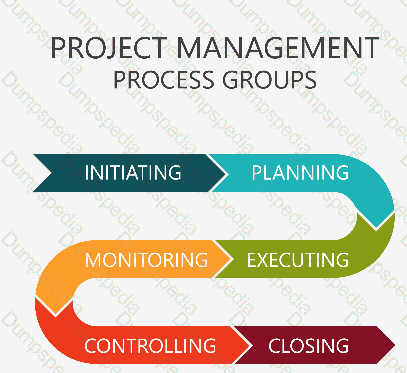
Analysis of Other Options:
B. Estimate Activity Durations: This is the process that typically follows Estimate Activity Resources. You need to know the resource capability and quantity to determine the duration.
C. Develop Schedule: This process occurs after durations and resources have been estimated. It is the culmination of the previous planning processes.
D. Control Schedule: This is a Monitoring and Controlling process. It happens during the execution of the project, not during the initial planning sequence of defining and estimating activities.
The planned work contained in the lowest level of work breakdown structure (WBS) components is known as:
Work packages.
Accepted deliverables.
The WBS dictionary.
The scope baseline.
According to the PMBOK® Guide and the Standard for Project Management, specifically within the Create WBS process of the Project Scope Management Knowledge Area, the planned work contained in the lowest-level components of the Work Breakdown Structure (WBS) is known as Work packages.
As per PMI standards, a WBS is a hierarchical decomposition of the total scope of work to be carried out by the project team to accomplish the project objectives and create the required deliverables. A Work package is unique because:
Estimating and Managing: It represents the level at which cost and duration can be reliably estimated and managed.
Accountability: It can be assigned to a specific individual or organizational unit for execution.
Control Accounts: Work packages are grouped into " Control Accounts, " which are management control points where scope, budget, and schedule are integrated and compared to the earned value for performance measurement.
Decomposition: While a WBS can have many levels, the " Work Package " is the terminal point of that decomposition.
The other options are incorrect based on the following PMI definitions:
Accepted deliverables: These are the outputs of the Validate Scope process that have been formally signed off by the customer or sponsor. They are results, not the " planned work components " of the WBS itself.
The WBS dictionary: This is a Project Document that provides detailed deliverable, activity, and scheduling information about each component in the WBS. It supports the WBS but is not the component itself.
The scope baseline: This is an integrated component of the project management plan that includes the Project Scope Statement, the WBS, and the WBS Dictionary. It is the " parent " container of the WBS, not the lowest-level component.
As per the PMI Lexicon of Project Management Terms, the work package is the smallest unit of the WBS and serves as the foundation for defining activities in the Define Activities process.
What is the function of a Project Management Office (PMO)?
To focus on the coordinated planning, prioritization, and execution of projects and subprojects that are tied to the parent organizations or the client ' s overall business objectives.
To coordinate and manage the procurement of projects relevant to the parent organization ' s business objectives and to administer the project charters accordingly.
To administer performance reviews for the project manager and the project team members and to handle any personnel and payroll issues.
To focus on the specified project objectives and to manage the scope, schedule, cost, and quality of the work packages.
According to the PMBOK® Guide, a Project Management Office (PMO) is an organizational structure that standardizes the project-related governance processes and facilitates the sharing of resources, methodologies, tools, and techniques.
Strategic Alignment: The primary function of a PMO is to ensure that projects are not just completed, but that they are the right projects to meet the organization ' s strategic goals. This involves high-level prioritization and ensuring that the portfolio of projects aligns with business objectives.
Types of PMOs:
Supportive: Provides templates, best practices, and training (Low control).
Controlling: Provides support and requires compliance with frameworks and tools (Moderate control).
Directive: Actually manages the projects; project managers report directly to the PMO (High control).
Coordinated Management: The PMO facilitates the " big picture " view of resources. For example, if two projects need the same specialized engineer, the PMO coordinates that resource to prevent bottlenecks.
Knowledge Management: PMOs act as a central repository for " Lessons Learned, " ensuring that mistakes made on one project are not repeated on others within the organization.
Comparison with other options:
B. To coordinate and manage the procurement...: While a PMO might provide procurement templates or oversight, the actual administration of procurement and charters is usually handled by the Project Manager or the Legal/Procurement department.
C. To administer performance reviews...: This describes a Functional Manager or HR Department role. While a Directive PMO might review a PM, a PMO is not typically a payroll or general personnel office.
D. To focus on the specified project objectives...: This is the primary function of a Project Manager. The PMO focuses on the system of projects and the standardization of management, whereas the PM focuses on the specific scope, schedule, and cost of their assigned project.
An adaptive team schedules 20 story points in the upcoming sprint. Historically, the team completes 25 story points on average per sprint. Each sprint is two weeks, and there is one day of float.
What is the likelihood the team will complete all 20 story points in the upcoming sprint?
50-75%
25-50%
75-100%
0-25%
In Agile and Scrum methodologies, specifically regarding Empirical Process Control, a team ' s historical performance is the most reliable predictor of future performance. This is primarily measured through Velocity.
Why Choice C is correct:
Velocity Comparison: The team ' s average velocity is 25 story points. They have only planned 20 story points for the upcoming sprint. Since 20 is significantly less than their historical average (80% of their typical capacity), the team is working with a " buffer. "
Confidence Levels: In Agile estimation, if a team takes on work that is well below their average velocity, the probability of completion is very high. Statistically, since they usually finish 25, the likelihood of finishing 20—barring a major impediment—is extremely high (near certain).
Capacity and Float: The mention of " one day of float " further supports a high completion rate, as it indicates the team has built-in time to handle unexpected issues or administrative tasks without impacting the delivery of the 20 points.
Analysis of other options:
A and B (25-75%): These ranges would be more applicable if the team had scheduled exactly 25 points (their average) or slightly more. When a team schedules at their exact average, the probability of finishing everything is typically closer to 50% (since an average implies they sometimes do more and sometimes do less).
D (0-25%): This would only be the case if the team scheduled significantly more than their average velocity (e.g., scheduling 40 points when they usually only finish 25).
Key Concept: The Project Management Institute (PMI) and the Agile Practice Guide emphasize that Velocity (Choice C) is a measure of a team’s capacity. By scheduling work below their demonstrated capacity, the team increases the " probability of success " and ensures a sustainable pace, which is one of the core principles of the Agile Manifesto. This approach reduces the risk of carrying over unfinished stories to the next sprint.
Which enterprise environmental factors are considered during Estimate Costs?
Market conditions and published commercial information
Company structure and market conditions
Commercial information and company structure
Existing human resources and market conditions
According to the PMBOK® Guide, the Estimate Costs process involves developing an approximation of the monetary resources needed to complete project work. This process is heavily influenced by external variables that the project team cannot directly control, classified as Enterprise Environmental Factors (EEFs).
Market Conditions: This is a critical EEF for cost estimation. It describes what products, services, and results are available in the regional and global marketplace, who the suppliers are, and what the typical terms and conditions are. Fluctuations in supply and demand directly impact the estimated cost of resources.
Published Commercial Information: This refers to information often available from commercial databases that track resource cost rates. It includes seller price lists, assembly cost manuals, and standard hardware/software costs. Project managers use these external benchmarks to ensure their estimates are grounded in current economic reality.
Relevance to the Process: During estimation, the project manager must look outside the organization to see if inflation, exchange rates, or industry-specific price spikes (like fuel or raw materials) will affect the budget. Without considering these two factors, a cost estimate may be mathematically sound but realistically unattainable.
Comparison with other options:
B. Company structure and market conditions: While company structure is an EEF, it is more relevant to the Develop Project Charter or Plan Resource Management processes (defining authority and reporting) rather than providing specific data for calculating the monetary cost of activities.
C. Commercial information and company structure: Similar to option B, company structure is not a primary driver of activity cost estimation compared to the external pricing data found in market conditions.
D. Existing human resources and market conditions: " Existing human resources " is typically considered an Organizational Process Asset or an input to Estimate Activity Resources. While the cost of those resources is needed, the standard EEF category cited by PMI for the Estimate Costs process specifically emphasizes published commercial data and market conditions.
An input to the Perform Quantitative Risk Analysis process is the:
quality management plan.
project management plan.
communications management plan.
schedule management plan.
According to the PMBOK® Guide, specifically within the Project Risk Management knowledge area, the Schedule Management Plan is a vital input to the Perform Quantitative Risk Analysis process.
Process Context: Perform Quantitative Risk Analysis is the process of numerically analyzing the combined effect of identified individual project risks and other sources of uncertainty on overall project objectives.
The Role of the Schedule Management Plan: This plan provides the necessary guidance and criteria for developing and maintaining the project schedule. Quantitative analysis often involves Monte Carlo simulations to predict the probability of finishing on a specific date. To do this, the process requires the schedule management plan to understand how schedule contingencies are reported and how the schedule model is constructed.
Other Key Inputs:
Cost Management Plan: Provides the framework for how costs are structured and how quantitative analysis will be applied to the budget.
Risk Management Plan: Sets the " rules of engagement " for how risk analysis is conducted and what numerical thresholds are used.
Risk Register and Risk Report: Provides the specific list of individual risks and the current status of the overall project risk profile.
Project Schedule: The actual model used to run simulations against.
Comparison with Other Options:
Quality management plan (A): This plan describes how the team will implement the organization ' s quality policy. While quality risks exist, the plan itself is not a primary input for the numerical calculation of total project risk exposure.
Project management plan (B): This is technically incorrect in the context of specific PMI exam questions. While the Schedule Management Plan is part of the Project Management Plan, the PMBOK® Guide specifically lists the component plans (Schedule, Cost, Risk) as individual inputs to this process to highlight their specific roles.
Communications management plan (C): This describes how project information will be distributed. It does not provide the numerical data or the structural framework required to perform a statistical risk simulation.
The project manager released a report A few stakeholders express the view that report should
have been directed to them
Which of the 5Cs of written communications does the project manager need to address?
Correct grammar and spelling
Concise expression and elimination of excess words
Clear purpose and expression directed to the needs of the reader
Coherent logical flow of ideas
According to the PMBOK® Guide, specifically the section on Project Communications Management, project managers should follow the 5Cs of written communication to ensure that information is effective and well-received.
Clear Purpose and Expression Directed to the Reader (Choice C): This specific " C " addresses the audience ' s needs and the intent of the message. When stakeholders feel a report " should have been directed to them, " it indicates a failure in identifying the correct audience or failing to tailor the communication to those who have a vested interest in the information. A " clear purpose " ensures the right people are included in the communication loop based on their information requirements defined in the Communications Management Plan.
Correct Grammar and Spelling (Choice A): This refers to the technical accuracy of the writing. While poor grammar can diminish a project manager ' s credibility, it is not the reason stakeholders feel they were excluded from a distribution list.
Concise Expression (Choice B): This refers to eliminating " fluff " and excess words to save the reader time. Again, while helpful, being concise does not solve the problem of targeting the wrong audience.
Coherent Logical Flow (Choice D): This refers to the internal structure of the document (using " builder " words and logical transitions). A document can be perfectly coherent but still be sent to the wrong person.
The 5Cs (Correct, Concise, Clear, Coherent, and Controlled) are essential for managing stakeholder expectations. In this scenario, the project manager must revisit the Stakeholder Engagement Assessment Matrix and the Communications Management Plan to ensure that " Clear Purpose " includes a refined distribution list that meets the needs of all relevant readers.
What can the project manager find among the factors that could lead a project to be tailored
Company Culture
Return on investment
Earned Value
Schedule Performance Index
According to the PMBOK® Guide, tailoring is the deliberate adaptation of the project management approach, governance, and processes to make them more suitable for the specific environment and the work at hand.
Company Culture (Choice A): This is a significant Enterprise Environmental Factor (EEF) that directly influences how a project is tailored. The project manager must consider the organization’s culture, structure, and governance when deciding which processes to use and how to implement them. For example, a highly bureaucratic culture might require more formal documentation and rigorous change control, whereas a startup culture might lean toward agile, lightweight processes.
Return on Investment (ROI) (Choice B): ROI is a financial metric used in the Business Case to justify the project ' s existence. While it informs whether a project should be initiated, it is not a direct factor used to decide how to tailor project management processes.
Earned Value (Choice C) and Schedule Performance Index (Choice D): These are performance measurement metrics used in the Monitor and Control Project Work and Control Costs/Schedule processes. They reflect the current status of the project but do not serve as inputs for the initial or ongoing tailoring of the project management methodology.
In the section on Tailoring, the PMBOK® Guide emphasizes that " because each project is unique, not every process, tool, technique, input, or output identified in the PMBOK® Guide is required on every project. " Factors such as Company Culture, stakeholder needs, and project complexity are the primary drivers for these adjustments.
Retreating from an actual or potential conflict or postponing the issue to be better prepared or to be resolved by others describes which of the five general techniques for managing conflict?
Smooth/accommodate
Withdraw/avoid
Compromise/reconcile
Force/direct
According to the PMBOK® Guide (Project Management Body of Knowledge), specifically within the Project Resource Management knowledge area and the Manage Team process, there are five general techniques used to resolve conflict. The description provided matches the following:
Withdraw/Avoid (Option B): This technique involves retreating from an actual or potential conflict situation or postponing the issue to be better prepared or to be resolved by others. It is often used when the issue is trivial, when the project manager has no chance of winning, or to allow a " cooling off " period.
Smooth/Accommodate (Option A): This involves emphasizing areas of agreement rather than areas of difference and conceding one’s position to the needs of others to maintain harmony and relationships.
Compromise/Reconcile (Option C): This involves searching for solutions that bring some degree of satisfaction to all parties in order to temporarily or partially resolve the conflict. This is a " lose-lose " or " give-and-take " approach.
Force/Direct (Option D): This involves pushing one’s viewpoint at the expense of others; offering only win-lose solutions, usually enforced through a power position to resolve an emergency.
Collaborate/Problem Solve (Not listed): This involves incorporating multiple viewpoints and insights from differing perspectives; it requires a cooperative attitude and open dialogue that typically leads to consensus and commitment (Win-Win).
In the PMI framework, Withdraw/Avoid is considered a passive technique that does not solve the underlying problem but manages the immediate tension by removing oneself from the situation or delaying the confrontation.
A project lifecycle is defined as:
a collection of generally sequential and sometimes overlapping project phases.
a process required to ensure that the project includes all the work required, and only the work required, to complete the project successfully.
a recognized standard for the project management profession.
the application of knowledge, skills, tools, and techniques to project activities to meet the project requirements.
According to the PMBOK® Guide, the Project Life Cycle is the series of phases that a project passes through from its start to its completion.
Structure: It provides the basic framework for managing the project. These phases are generally sequential, meaning one starts after the previous one finishes, but they can be overlapping (a technique known as " fast-tracking " ) to compress the project schedule.
Phase Characteristics: Each phase is a collection of logically related project activities that culminates in the completion of one or more deliverables. Common phase names include Feasibility, Design, Build, Test, and Deploy.
Consistency: While every project has a start and an end, the specific life cycle used (Predictive, Iterative, Incremental, or Agile) will vary depending on the industry, the organization, and the nature of the project itself.
Analysis of Other Options:
B. a process required to ensure that the project includes all the work required...: This is the formal definition of Project Scope Management, not the project life cycle.
C. a recognized standard for the project management profession: This describes the PMBOK® Guide itself or other PMI standards, which document the " generally recognized " good practices in the field.
D. the application of knowledge, skills, tools, and techniques...: This is the formal definition of Project Management as a discipline.
The project manager implemented the stakeholder engagement plan and realized that some uploads should be made. Which components of the project management plan should be modified?
Project charter and stakeholder engagement plan
Risk management plan and stakeholder engagement plan
Communications management plan and stakeholder engagement plan
Project charter and communications management plan
According to the PMBOK® Guide, when a project manager implements the Stakeholder Engagement Plan and identifies that specific information (such as " uploads " or status reports) needs to be shared or handled differently, it directly affects how information is distributed and how stakeholders are kept informed.
Communications Management Plan: This document defines the " who, what, when, where, and how " of project information. If " uploads " (a form of information distribution) need to be modified, this plan must be updated to reflect the new requirements for data transfer, storage, or distribution methods.
Stakeholder Engagement Plan: This document identifies the strategies and actions required to promote productive involvement of stakeholders. If the project manager realizes that the current engagement approach is not meeting the needs (evidenced by the need for new uploads), this plan must be updated to align with the revised engagement strategy.
Why other options are incorrect:
The Project Charter (Options A and D) is a high-level document that authorizes the project. It is not modified for tactical changes in communication or stakeholder engagement during the execution or monitoring and controlling phases.
The Risk Management Plan (Option B) deals with how risks will be structured and performed. While communication can be a risk, the primary documents governing " uploads " and stakeholder needs are the Communications and Stakeholder plans.
These updates are typically processed through a Change Request that, once approved, results in updates to these specific components of the Project Management Plan.
Which Knowledge Area involves identifying the people, groups, or organizations that may be impacted by or impact a project?
Project Risk Management
Project Human Resource Management
Project Scope Management
Project Stakeholder Management
According to the PMBOK® Guide and the Standard for Project Management, the Knowledge Area that involves identifying the people, groups, or organizations that could impact or be impacted by a decision, activity, or outcome of the project is Project Stakeholder Management.
As per PMI standards, this Knowledge Area was formally introduced to emphasize the importance of engaging stakeholders to ensure project success. The process specifically referred to in the question is Identify Stakeholders, which is the first process in this Knowledge Area and occurs within the Initiating Process Group. Key elements of this Knowledge Area include:
Stakeholder Identification: Analyzing and documenting relevant information regarding stakeholder interests, involvement, interdependencies, influence, and potential impact on project success.
Stakeholder Analysis: A technique used to systematically gather and analyze quantitative and qualitative information to determine whose interests should be taken into account throughout the project.
Engagement Mapping: Using tools like the Power/Interest Grid, Stakeholder Cube, or Salience Model to categorize stakeholders and determine the appropriate communication and engagement strategy.
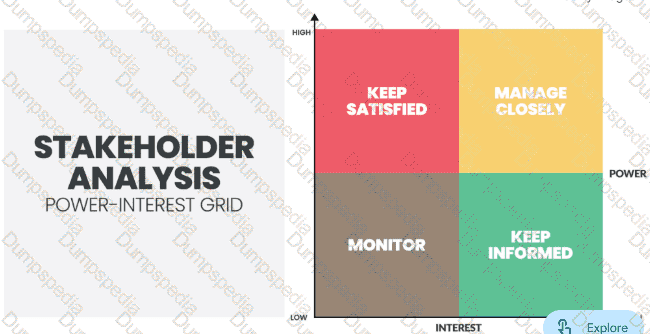
The other options are incorrect based on the following PMI Knowledge Area definitions:
Project Risk Management: Focuses on identifying, analyzing, and responding to project risks (uncertainties). While stakeholders are involved in risk, this area manages the events, not the people.
Project Human Resource Management: (Now referred to as Project Resource Management) Focuses on the internal team—organizing, managing, and leading the project team members. It does not encompass the external entities or organizations impacted by the project.
Project Scope Management: Focuses on ensuring the project includes all the work required, and only the work required, to complete the project successfully. It defines what is being built, not who is affected by it.
As per the PMI Lexicon of Project Management Terms, Project Stakeholder Management is essential for managing expectations and building the necessary support to achieve project objectives.
A technical project manager uses a directive approach with the team. Some team members are growing increasingly frustrated when their recommendations are not adopted by the project manager. What should the project manager do to address this issue?
Encourage the team to follow the project plan that was developed with team input.
Apply emotional intelligence (EI) skills, such as active listening, to understand the team ' s issues.
Instruct the team members to self-organize and resolve any outstanding issues.
Ask the team members to record their concerns in the lessons learned log for future action.
According to the PMBOK® Guide, specifically within the Manage Team and Develop Team processes, a project manager must balance their leadership style based on the project environment and team dynamics.
The Shift from Directive to Collaborative: While a directive style (Command and Control) might be necessary in crises or with inexperienced teams, persistent use of this style with skilled team members can lead to decreased morale and frustration. The prompt indicates that the team is providing recommendations, suggesting they are knowledgeable and engaged.
The Role of Emotional Intelligence (EI): Emotional intelligence involves self-awareness, self-regulation, motivation, empathy, and social skills. By applying EI skills—specifically active listening—the project manager can acknowledge the team ' s contributions, validate their expertise, and understand the root cause of their frustration. This does not necessarily mean the project manager must adopt every recommendation, but the team must feel that their input was heard and considered.
Impact on Team Performance: High EI in a project manager leads to improved team synergy, higher levels of trust, and better conflict resolution. Moving from a strictly directive approach to one that incorporates empathy and open communication helps transition the team through the stages of team development (Tuckman Ladder).
Analysis of other options:
Option A: While following the plan is important, this response is " dismissive. " It reinforces the directive behavior that caused the frustration in the first place rather than addressing the interpersonal conflict.
Option C: Simply telling a frustrated team to " self-organize " without first addressing the leadership friction or providing a framework for that autonomy is likely to lead to further chaos or " storming. "
Option D: The lessons learned log is for documenting organizational knowledge, not for avoiding immediate interpersonal issues or team conflict. Recording issues there for " future action " ignores the current threat to team productivity.
Per PMI standards, the project manager serves as a leader and a facilitator. Using Emotional Intelligence is a critical " Power Skill " that allows the project manager to adapt their style to maintain team motivation and project momentum.
Sensitivity analysis is typically displayed as a/an:
Decision tree diagram.
Tornado diagram.
Pareto diagram.
Ishikawa diagram.
According to the PMBOK® Guide (Project Risk Management), specifically within the Perform Quantitative Risk Analysis process, Sensitivity Analysis is a data analysis technique used to determine which individual project risks or other sources of uncertainty have the most potential impact on project outcomes.
The typical display for this analysis is a Tornado Diagram.
How it works: Sensitivity analysis correlates variations in project outcomes with variations in elements of the quantitative risk analysis model. It involves changing one uncertain variable at a time while holding all other uncertain variables at their baseline values to see how much the outcome changes.
The Tornado Diagram: This is a special type of bar chart used in sensitivity analysis for comparing the relative importance of variables. In a tornado diagram, the Y-axis contains each type of uncertainty (risks), and the X-axis represents the spread or correlation to the studied objective (e.g., cost or schedule).
Visual Structure: The bars are ordered by the width of their impact, with the largest impact at the top and the smallest at the bottom, giving the chart a funnel or " tornado " appearance. This allows the project manager to quickly identify the " critical " variables that require the most attention.
Analysis of Distractors:
A. Decision tree diagram: This is a tool used in Decision Tree Analysis (another quantitative risk technique) to calculate the Expected Monetary Value (EMV) of different decision paths. It is not the standard display for sensitivity.
C. Pareto diagram: This is a vertical bar chart used in Quality Management to identify the " vital few " sources of problems (based on the 80/20 rule). It ranks causes from most frequent to least frequent.
D. Ishikawa diagram: Also known as a Fishbone or Cause-and-Effect diagram, this is used to identify the root causes of a problem. It is used in Quality Management and the Identify Risks process, but not for numerical sensitivity analysis.
What process is performed periodically throughout the project as needed?
Plan Risk Management
Plan Communications Management
Plan Resource Management
Plan Cost Management
According to the PMBOK® Guide, the process of Plan Risk Management—and the overall management of risks—is not a one-time event during the planning phase. Instead, it is a process that is performed periodically throughout the project as needed.
Continuous Nature of Risk: Risks are dynamic. New risks may emerge, and existing risks may change or disappear as the project progresses through different phases. Therefore, the approach to managing risk must be revisited to ensure it remains appropriate for the project ' s current context.
Process Frequency: While many planning processes are primarily focused at the start of a phase, the PMI framework explicitly identifies Risk Management processes as being iterative. The Plan Risk Management process defines how risk management activities will be structured and performed; as the project ' s complexity or stakeholder risk appetite changes, this plan may need adjustment.
Integration with Project Life Cycle: During phase transitions or after significant changes (such as a major scope change), the project manager must re-evaluate the risk management framework to ensure it is still robust enough to protect the project’s objectives.
Why other options are incorrect:
Option B: Plan Communications Management: This process is primarily performed at predefined points in the project (usually at the beginning or during phase starts). While it is updated if communication needs change, it is not characterized in the PMBOK® Guide as a process performed " periodically as needed " in the same iterative sense as risk management.
Option C: Plan Resource Management: Similar to communications, resource planning is typically focused at the start of the project or phase to establish the " how-to " for acquiring and managing the team.
Option D: Plan Cost Management: This is a foundational planning process performed at a discrete point early in the project to establish the policies for estimating, budgeting, and controlling costs. It is rarely revisited " periodically " unless there is a fundamental shift in the organization ' s financial policies or a total project re-baselining.
Which is one of the major outputs of Sequence Activities?
Responsibility assignment matrix (RAM)
Work breakdown structure (WBS) update
Project schedule network diagram
Mandatory dependencies list
According to the PMBOK® Guide, the Sequence Activities process is the process of identifying and documenting relationships among the project activities. The primary purpose of this process is to define the logical sequence of work to obtain the highest efficiency given all project constraints.
The key output of this process is the Project Schedule Network Diagram.
Definition: A Project Schedule Network Diagram is a graphical representation of the logical relationships (also referred to as dependencies) among the project schedule activities.
Methodology: It is produced using the Precedence Diagramming Method (PDM), which uses boxes (nodes) to represent activities and arrows to show the dependencies between them (Finish-to-Start, Finish-to-Finish, Start-to-Start, and Start-to-Finish).
Utility: This diagram is essential for performing Critical Path Method (CPM) analysis later in the planning process. It allows the project manager to visualize the flow of work and identify which paths through the network have the least amount of scheduling flexibility (float).
Analysis of other choices:
Choice A (Responsibility assignment matrix - RAM): This is a tool used in Plan Resource Management to illustrate the connections between work packages or activities and project team members. It is not an output of sequencing work.
Choice B (Work breakdown structure - WBS update): While project document updates are a common output, a " WBS update " is not a major or primary output of sequencing. The WBS is generally a stable input used to identify the activities that need to be sequenced.
Choice D (Mandatory dependencies list): Mandatory dependencies (also known as " hard logic " ) are an input or a factor considered during the process of sequencing, rather than a standalone output. They are integrated into the network diagram itself.
Stakeholder identification and engagement should begin during what phase of the project?
After the project management plan is completed
After the stakeholder engagement plan is completed
As soon as the project charter has been approved
After the communications management plan is completed
According to the PMBOK® Guide, the process of Identify Stakeholders belongs to the Initiating Process Group. This signifies that stakeholder identification and engagement must occur at the very beginning of the project life cycle.
Timing of Identification: The project charter is the document that formally authorizes the existence of a project. Once the charter is approved, the project manager is assigned and must immediately begin identifying the people, groups, or organizations that could impact or be impacted by the project.
Early Engagement: Engaging stakeholders early is critical for project success. It helps in uncovering requirements, identifying potential risks, and building the necessary support and buy-in before significant planning or execution occurs.
Iterative Nature: While it starts as soon as the charter is approved, PMI emphasizes that stakeholder identification is an iterative process. It should be revisited throughout the project as new stakeholders emerge or the project environment changes.
Analysis of other options:
A. After the project management plan is completed: This is much too late. Stakeholder requirements and expectations are essential inputs to the project management plan itself.
B. After the stakeholder engagement plan is completed: This creates a logical paradox. You cannot create a plan for how to engage stakeholders until you have first identified who those stakeholders are.
D. After the communications management plan is completed: Similar to the other planning options, communication requirements are derived from knowing who the stakeholders are. Identification must precede the creation of communication or engagement plans.
Per PMI standards, identifying and engaging stakeholders as early as possible ensures that their influence is channeled positively and that the project remains aligned with their needs from day one.
A project manager has just completed several brainstorming sessions and has gathered the data to show commonality and differences in one single place. What technique was followed?
Collective decision making
Multicriteria decision analysis
Mind mapping
Affinity diagram
According to the PMBOK® Guide, the Affinity Diagram is a key data representation technique used in the Collect Requirements and Manage Quality processes. It is specifically designed to organize a large number of ideas or data points generated during brainstorming into logical groups for review and analysis.
Organizing Brainstorming Data: After a brainstorming session, teams are often left with a massive, disorganized list of ideas. The affinity diagram allows the project manager to map these ideas based on their " affinities " or relationships.
Finding Commonality and Differences: By grouping related ideas together, the project manager can see which themes are most common (large groups) and which are unique or outliers (differences). This " single place " view makes complex data sets much easier to digest and prioritize.
Process Application: It is highly effective when the team needs to move from a divergent thinking phase (generating many ideas) to a convergent thinking phase (organizing and selecting ideas).
Analysis of other options:
A. Collective decision making: This refers to the process of reaching a conclusion or agreement (such as unanimity, majority, or plurality) rather than a visual technique used to organize and show relationships between data points.
B. Multicriteria decision analysis: This technique uses a decision matrix to provide a systematic analytical approach for establishing criteria (such as risk levels, uncertainty, and valuation) to evaluate and rank many ideas. It is about scoring ideas, not just showing their commonalities.
C. Mind mapping: While mind mapping also organizes data visually, it typically radiates from a single central concept. An affinity diagram is better suited for taking a large, existing set of disparate ideas from a brainstorming session and sorting them into categories from the bottom up.
Per PMI standards, the Affinity Diagram is the preferred tool for sorting large amounts of data into categories to reveal patterns and structure.
At the end of the project, what will be the value of SV?
Positive
Zero
Negative
Greater than one
According to the PMBOK® Guide, specifically within the Earned Value Management (EVM) framework used in the Control Costs and Control Schedule processes, the Schedule Variance (SV) is a measure of schedule performance expressed as the difference between the earned value and the planned value.
The Formula:
$$SV = EV - PV$$
Behavior at Project Completion:
Planned Value (PV): This is the authorized budget assigned to scheduled work. At the end of the project, all work is scheduled to be finished, so the $PV$ equals the Budget at Completion (BAC).
Earned Value (EV): This is the measure of work actually performed. At the end of the project, all work has been completed, so the $EV$ also equals the Budget at Completion (BAC).
The Result: Because both $EV$ and $PV$ equal the total budget ($BAC$) when the project is finished, the calculation becomes $BAC - BAC = 0$.
Analysis of Other Options:
A. Positive: A positive $SV$ during the project indicates that the project is ahead of schedule. However, once the project is closed, the " ahead " status is reconciled because no more work is planned.
C. Negative: A negative $SV$ during the project indicates that the project is behind schedule. Similar to a positive $SV$, this value resets to zero once all planned work is eventually completed.
D. Greater than one: This describes a Schedule Performance Index (SPI) ($EV / PV$), not the Schedule Variance ($SV$). While an $SPI$ of 1.0 is achieved at the end of a project, $SV$ is a numerical value (currency or hours), not a ratio.
The project management processes are usually presented as discrete processes with defined interfaces, while in practice they:
operate separately.
move together in batches,
overlap and interact.
move in a sequence.
According to the PMBOK® Guide, project management is an integrative endeavor. Although the processes are presented as discrete elements with well-defined requirements and interfaces for the purpose of study and organization, they rarely function as independent or linear events in a real-world project environment.
Overlapping and Interaction: Most experienced practitioners recognize that process groups and individual processes overlap and interact throughout the project. For example, the Planning process group is not " finished " before Executing begins; instead, as work is executed, new information often requires further planning (progressive elaboration).
Integrative Nature: The output of one process generally becomes an input to another process or is a deliverable of the project. This creates a continuous " web " of activity rather than a simple checklist.
Monitoring and Controlling: This process group specifically interacts with every other process group. It runs concurrently with Planning, Executing, and even Closing to ensure the project remains aligned with the management plan.
Analysis of Other Options:
A. operate separately: This is incorrect because project management is integrated. Decisions made in one area (e.g., Scope) directly affect others (e.g., Cost and Schedule).
B. move together in batches: This is not a standard PMBOK® term. Processes are triggered by specific inputs or events, not necessarily in arbitrary batches.
D. move in a sequence: While there is a logical flow (you generally need a Charter before a detailed WBS), the processes do not strictly follow a " waterfall " sequence where one must 100% finish before the next begins. They are often performed iteratively.
The methodology that combines scope, schedule, and resource measurements to assess project performance and progress is known as:
Earned value management.
Forecasting.
Critical chain methodology.
Critical path methodology.
According to the PMBOK® Guide (Project Management Body of Knowledge), specifically within the Project Cost Management and Project Schedule Management knowledge areas:
Earned Value Management (EVM) (Option A): This is the specific methodology that integrates scope, schedule, and resource (cost) measurements to provide a comprehensive assessment of project performance and progress. EVM uses three key metrics—Planned Value (PV), Earned Value (EV), and Actual Cost (AC)—to calculate variances and performance indices (such as SV, CV, SPI, and CPI). It is the industry standard for measuring " work performed " against the " plan. "
Forecasting (Option B): While EVM data is used to create forecasts (like Estimate at Completion - EAC), forecasting itself is the act of predicting future project performance based on current information and knowledge. It is a result of performance analysis, not the methodology that combines the three constraints.
Critical Chain Methodology (Option C): This is a schedule network analysis technique that modifies the project schedule to account for limited resources. It focuses on managing " buffers " to protect the project finish date, rather than providing a holistic measurement of scope, cost, and schedule performance.
Critical Path Methodology (Option D): This is a method used to estimate the minimum project duration and determine the amount of scheduling flexibility (float) on the logical network paths. It primarily focuses on schedule and does not inherently integrate cost or resource performance measurement in the way EVM does.
In the PMI framework, Earned Value Management is considered one of the most powerful tools for a Project Manager. By combining the three critical project constraints, EVM allows for the early detection of performance trends, enabling the project team to take proactive corrective actions before minor variances become major project failures.
Which of the following are components of the technical project management skill?
Ability to explain business aspects of the project, business strategy, goals and objectives, and business value.
Ability to deal with people, to be collaborative, and to apply persuasion and negotiation.
Ability to focus on relationships with people, inspire trust, and implement decisions and actions that support the business strategy.
Ability to plan and prioritize, gather the right artifacts available for each project, and focus on critical success factors.
According to the PMBOK® Guide (6th Edition) and the PMI Talent Triangle®, Technical Project Management refers to the skills to effectively apply project management knowledge to deliver the desired outcomes for programs or projects. It is the " domain-specific " leg of the triangle that focuses on the mechanics of the role.
Key components of the Technical Project Management skill set include:
Focus on Critical Success Factors: Identifying the specific elements that must go right for the project to succeed.
Artifact Management: Knowing which documents (charter, WBS, logs) are necessary for the specific project and tailoring them accordingly.
Planning and Prioritization: The ability to organize work, manage schedules, and ensure that the team is working on the most valuable tasks at the right time.
Technical Tools: Mastery of specific techniques like Earned Value Management (EVM), critical path, and decomposition.
Analysis of Distractors:
A (Business Strategy/Value): This describes the Strategic and Business Management skill set. It involves understanding the organizational overview and how the project aligns with high-level goals.
B (Persuasion and Negotiation): This describes the Leadership skill set. These are interpersonal or " soft skills " used to guide and motivate a team.
C (Inspiring Trust/Relationships): This is another core component of Leadership. While technical skills get the work organized, leadership skills get the people moving toward the goal.
Key Document Reference: Section 3.4 of the PMBOK® Guide details that while all three legs of the Talent Triangle are necessary, the Technical Project Management leg is what allows a project manager to " plan and prioritize " the actual project work effectively.
The process of identifying and documenting project roles, responsibilities, required skills, and reporting relationships and creating a staffing management plan is known as:
Develop Project Team.
Manage Project Team.
Acquire Project Team.
Plan Human Resource Management.
According to the PMBOK® Guide (specifically within the Project Resource Management knowledge area, formerly known as Human Resource Management), Plan Human Resource Management is the process of identifying and documenting project roles, responsibilities, required skills, reporting relationships, and creating a staffing management plan.
Core Function: This process provides guidance on how project human resources should be defined, staffed, managed, and eventually released. It ensures that the project has sufficient human resources with the necessary skills for project success.
Key Outputs: The primary output is the Human Resource Management Plan (or Resource Management Plan), which includes:
Roles and Responsibilities: Defining who does what (often using a RACI chart).
Project Organization Charts: A visual display of project team members and their reporting relationships.
Staffing Management Plan: A document describing when and how team members will be acquired and how long they will be needed.
Why the other options are incorrect:
A. Develop Project Team: This is the process of improving competencies, team member interaction, and the overall team environment to enhance project performance. It happens during Execution after the team is already hired.
B. Manage Project Team: This is the process of tracking team member performance, providing feedback, resolving issues, and managing team changes to optimize project performance.
C. Acquire Project Team: This is the process of confirming human resource availability and obtaining the team necessary to complete project activities. This is the " hiring " or " assignment " phase, not the " planning " phase.
A project manager is assigned to a project, and the sponsor signals to perform first actions. However, the project manager is unsure how to apply organizational resources into project activities before a formal authorization. Which document should be used in this case?
Project plan
Business case
Budget requirement
Project charter
According to the PMBOK® Guide, specifically the Develop Project Charter process, the Project Charter is the foundational document that bridges the gap between organizational strategy and project execution.
Formal Authorization: The Project Charter is the document that formally authorizes the existence of a project. Without a signed charter, a project does not officially exist in the eyes of the organization, and the project manager lacks the legal or administrative standing to proceed.
Empowerment of the PM: The most critical function of the charter in this specific scenario is that it provides the project manager with the authority to apply organizational resources to project activities. Until the charter is approved by the sponsor or the initiating entity, the project manager cannot officially assign staff, spend budget, or utilize company equipment.
High-Level Scope: It establishes the high-level objectives and boundaries of the project. This ensures that when the PM does start applying resources, they are doing so in alignment with the goals the sponsor has officially sanctioned.
Analysis of other options:
Option A: The Project Management Plan is a detailed document created after the charter has been signed. You cannot effectively build a project plan without the authority and high-level direction provided by the charter.
Option B: The Business Case provides the economic justification for the project. While it explains why the project should happen, it does not grant the project manager the authority to manage resources.
Option C: Budget requirements are specific financial needs identified during the planning phase. Like the project plan, a budget cannot be officially executed or managed until the PM is authorized via the charter.
Per PMI standards, the Project Charter is the only document that solves the project manager ' s dilemma by providing the formal authorization necessary to move from a conceptual idea to an active project with assigned organizational resources.
Perform Quantitative Analysis focuses on:
compiling a lsit of known risks and preparing responses to them
assessing the probability of occurrence and impact for every risk in the risk register
evaluating the contingency and management reserves required for the project
analyzing numerically the impact of individual risks on the overall project ' s time and cost objectives
According to the PMBOK® Guide, the Perform Quantitative Risk Analysis process is the process of numerically analyzing the combined effect of identified individual project risks and other sources of uncertainty on overall project objectives.
Numerical Analysis: Unlike Qualitative analysis, which uses subjective scales (like High/Medium/Low), Quantitative analysis uses mathematical modeling and data to provide a statistical approach to uncertainty.
Impact on Objectives: It specifically quantifies the potential project outcomes and their probabilities. It is used to estimate the likelihood of achieving specific project targets, such as finishing on a certain date or within a certain budget.
Tools and Techniques: Common techniques used in this process include Monte Carlo simulations, Decision Tree analysis, and Sensitivity Analysis.
Why other options are incorrect:
Option A: Compiling a list of known risks is the output of the Identify Risks process. Preparing responses is part of the Plan Risk Responses process.
Option B: Assessing probability and impact for every risk in the register is a characteristic of Perform Qualitative Risk Analysis. Quantitative analysis is often only performed on high-priority risks that have already been vetted qualitatively.
Option C: While Quantitative analysis provides the data needed to justify Contingency Reserves, the actual evaluation and allocation of reserves is an output of the Determine Budget and Develop Schedule processes. Quantitative analysis is the input that informs those calculations.
Deciding the phases of a project life cycle would be considered a part of which of these knowledge areas?
Project Schedule Management
Project Scope Management
Project Resource Management
Project Integration Management
According to the PMBOK® Guide, deciding on the project life cycle and the phases that will make up that cycle is a fundamental task of Project Integration Management.
While phases naturally impact the schedule and the scope, the high-level decision regarding the " framework " of the project belongs to Integration because:
The Big Picture: Integration Management is responsible for the coordination of all other knowledge areas. Determining the life cycle (Predictive, Adaptive, or Hybrid) sets the stage for how all other processes (Scope, Schedule, Cost, etc.) will be managed.
Develop Project Management Plan: The selection of the project life cycle is a primary output of the tailoring process and is documented within the Project Management Plan. This plan is the central deliverable of the Integration Management knowledge area.
Phase Transitions: Integration Management involves managing the transition between phases (Phase Gates or Kill Points), ensuring that the project remains aligned with business objectives before moving from one phase to the next.
Analysis of other options:
A. Project Schedule Management: This area focuses on the specific timing of activities and milestones within the phases, but it does not define the overarching life cycle itself.
B. Project Scope Management: This area defines the work required to complete the project, but the phases represent the management structure around that work.
C. Project Resource Management: This area focuses on acquiring and managing the team and physical resources, which are utilized within the phases but do not define them.
Per PMI standards, the project manager acts as the primary integrator to ensure that the chosen Project Life Cycle is appropriate for the project ' s complexity, risk, and delivery requirements.
A project manager is reviewing the change requests, deliverables, and the project plan in Which project management process does this review belong?
Monitor and Control Project Work
Direct and Manage Project Work
Closes Project or Phase
Perform itegrated Change Control
According to the PMBOK® Guide, the review of change requests, deliverables, and the project management plan occurs within the Monitor and Control Project Work process. This process is concerned with tracking, reviewing, and reporting the overall progress to meet the performance objectives defined in the project management plan.
Reviewing Change Requests: During this process, the project manager monitors the status of change requests and ensures that only approved changes are implemented.
Reviewing Deliverables: The project manager compares actual project performance (deliverables produced) against the project management plan to see if any variances exist.
Context within Integration Management: This process provides the project management team with insight into the health of the project and identifies any areas requiring special attention. It is the " big picture " monitoring process that looks across all knowledge areas.
Why other options are incorrect:
Direct and Manage Project Work (Option B): This is the Executing process where the work is actually performed and deliverables are created. While it involves " Work Performance Data, " the high-level review against the plan happens in Monitoring and Controlling.
Close Project or Phase (Option C): This process happens at the end of a project or phase. While it involves a final review of deliverables, it does not focus on the ongoing monitoring of change requests and plan performance throughout the project lifecycle.
Perform Integrated Change Control (Option D): This process is specifically focused on approving or rejecting change requests. While it involves reviewing change requests, it does not encompass the broad review of all project deliverables and overall plan performance that characterizes " Monitor and Control Project Work. "
Which Plan Schedule Management tool or technique may involve choosing strategic options to estimate and schedule the project?
Facilitation techniques
Expert judgment
Analytical techniques
Variance analysis
According to the PMBOK® Guide and the Standard for Project Management, Analytical techniques are used in the Plan Schedule Management process to define the strategic approach for the project schedule.
As per PMI standards, these techniques involve choosing between strategic options to estimate and schedule the project. This is a critical step in determining how the project ' s timeline will be developed and managed. Specific analytical techniques used in this process include:
Scheduling methodology: Choosing between various methods such as the Critical Path Method (CPM), Critical Chain, or Agile/Adaptive approaches.
Scheduling tools: Deciding on the specific software or manual systems to be used.
Estimating techniques: Determining if the project will use Analogous, Parametric, Three-point, or Bottom-up estimating.
Fast tracking or crashing: Deciding on the strategic use of schedule compression techniques if needed.
The other options are incorrect based on the following PMI definitions:
Facilitation techniques: These are used to bring stakeholders together to reach a consensus. While they are used during the Planning meetings, they are the means of communication rather than the analysis of strategic scheduling options.
Expert judgment: This refers to providing input from individuals or groups with specialized knowledge or training in previous similar projects. While experts provide advice, the " analytical technique " is the formal category for the logical process of selecting strategic options.
Variance analysis: This is a tool and technique used in the Control Schedule process (Monitoring and Controlling), not in Plan Schedule Management (Planning). It is used to compare actual progress against the baseline to identify deviations.
As per the PMI Lexicon of Project Management Terms, analytical techniques allow the project manager to evaluate the implications of different scheduling scenarios and choose the one that best fits the project ' s constraints and organizational environment.
Which is an example of leveraging evolving trends and emerging practices in Project Integration Management?
Hybrid methodologies
Risk register updates
Outsourced project resources
Reliance on lessons learned documents
According to the PMBOK® Guide, Project Integration Management is evolving to accommodate new ways of working. The guide explicitly identifies several Trends and Emerging Practices in this knowledge area:
Use of Automated Tools: Using Project Management Information Systems (PMIS) to collect, analyze, and use data.
Visual Management Tools: Using visual elements (like Kanban boards) to capture and see the project elements rather than just documented text.
Project Knowledge Management: A focus on the " human " side of knowledge—ensuring that the team and stakeholders share and create knowledge throughout the project.
Hybrid Methodologies: This is the practice of combining different development approaches (e.g., Predictive/Waterfall for parts of the project that are well-understood and Adaptive/Agile for parts that are complex or evolving). Organizations are increasingly leveraging hybrid models to balance the need for control with the need for flexibility.
Expanding the Project Manager’s Responsibilities: Moving beyond just task management to include strategic and business management.
Analysis of Other Options:
B. Risk register updates: This is a standard project management activity that has been a core part of the Project Risk Management knowledge area for decades. It is not considered an " emerging practice. "
C. Outsourced project resources: Outsourcing is a standard practice within Project Procurement Management. While the methods of managing remote or distributed teams are evolving, outsourcing itself is a traditional business model.
D. Reliance on lessons learned documents: While lessons learned are vital, the traditional reliance on static " documents " is actually what emerging practices (like Project Knowledge Management) are trying to move away from, favoring instead more interactive and continuous knowledge-sharing environments.
Which of the following is used to classify stakeholders based on their assessments of power, urgency, and legitimacy?
Power interest grid
Stakeholder cube
Salience model
Directions of influence
According to the PMBOK® Guide (6th Edition), the Salience Model is a specific tool used for stakeholder analysis that categorizes stakeholders based on three distinct attributes:
Power: The level of authority or ability a stakeholder has to influence the project outcome.
Urgency: The degree to which a stakeholder ' s claims require immediate attention (based on time constraints or the stakeholder ' s high stake in the outcome).
Legitimacy: The perceived validity or appropriateness of the stakeholder ' s involvement or claim.
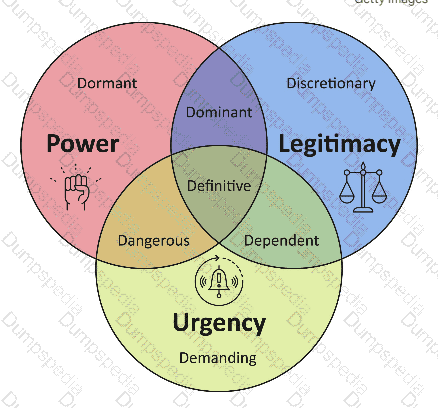
Why the Salience Model is used: This model is particularly useful in large, complex projects or where there are vast networks of stakeholders. By identifying where stakeholders overlap in these three areas (e.g., " Definitive " stakeholders possess all three), project managers can prioritize their engagement efforts and determine which stakeholders require the most proactive management.
Analysis of Distractors:
A (Power/interest grid): This is a simpler classification tool that groups stakeholders based on their level of authority (power) and their level of concern (interest) regarding the project. It does not account for urgency or legitimacy.
B (Stakeholder cube): This is a three-dimensional model that combines the grid elements into a multi-dimensional representation (e.g., Power, Interest, and Attitude). While more complex than a grid, it is not the specific model defined by power, urgency, and legitimacy.
D (Directions of influence): As discussed in previous questions, this classifies stakeholders by their relationship to the project team (Upward, Downward, Outward, Sideward) rather than by their inherent attributes of power or urgency.
The Identify Stakeholders process is found in which Process Group?
Initiating
Monitoring and Controlling
Planning
Executing
According to the PMBOK® Guide and the Standard for Project Management, the Identify Stakeholders process is one of only two processes located within the Initiating Process Group (the other being Develop Project Charter).
As per PMI standards, identifying stakeholders as early as possible is critical for project success. This process involves identifying all people, groups, or organizations that could impact or be impacted by a decision, activity, or outcome of the project. By placing this in the Initiating Phase, the project manager can:
Analyze and document relevant information regarding stakeholder interests, involvement, interdependencies, influence, and potential impact on project success.
Establish the foundation for the subsequent Planning process, " Plan Stakeholder Engagement. "
Ensure alignment between the project ' s goals and the expectations of key influencers from the very start.
The other options are incorrect based on the PMI Process Group and Knowledge Area Mapping:
Planning: This group contains the Plan Stakeholder Engagement process, where the strategies for managing stakeholders are developed.
Executing: This group contains the Manage Stakeholder Engagement process, where the project manager communicates and works with stakeholders to meet their needs.
Monitoring and Controlling: This group contains the Monitor Stakeholder Engagement process, which involves monitoring overall project stakeholder relationships and tailoring strategies for engaging stakeholders.
As per the PMI Lexicon of Project Management Terms, the Initiating Process Group consists of those processes performed to define a new project or a new phase of an existing project by obtaining authorization to start the project or phase.
Which set of tools and techniques is useful for estimating activity durations for the project schedule?
Brainstorming, Monte Carlo simulation, analogous estimation
Three-point estimation, resources leveling, iteration burndown chart
Milestone charts, parametric estimation, schedule baseline
Parametric estimation, three-point estimation, meetings
According to the PMBOK® Guide, the Estimate Activity Durations process utilizes several specific tools and techniques to determine the amount of time required to complete individual activities.
Parametric Estimating: An estimating technique in which an algorithm is used to calculate cost or duration based on historical data and project parameters (e.g., square footage in construction or lines of code in software development).
Three-Point Estimating: This technique improves accuracy by considering uncertainty and risk. it uses three estimates: Optimistic, Most Likely, and Pessimistic (using either Triangular or Beta/PERT distributions).
Meetings: Project teams hold meetings to estimate activity durations. Attendees may include the project manager, the project sponsor, selected team members, selected stakeholders, and subject matter experts (SMEs).
Why other options are incorrect:
Option A: While " Analogous estimation " is a valid tool for this process, Brainstorming is more commonly used in data gathering (like Identify Risks), and Monte Carlo simulation is a technique used in Develop Schedule or Quantitative Risk Analysis, not for estimating individual activity durations.
Option B: Resource leveling and Iteration burndown charts are tools used in the Develop Schedule and Control Schedule processes, respectively. They are used to adjust the schedule once durations are already estimated.
Option C: Milestone charts and the Schedule baseline are outputs of the Develop Schedule process. They are used to represent and track the schedule, not to calculate the initial duration estimates of activities.
Which process uses expert judgment to manage project resources?
Plan Resource Management
Estimate Activity Resources
Manage Team
Both A and B
According to the PMBOK® Guide, Expert Judgment is a primary tool and technique used across multiple processes within the Project Resource Management knowledge area to ensure that resource planning and estimation are based on specialized knowledge and historical experience.
Plan Resource Management (Choice A): Expert judgment is used here to determine the best approach for identifying and managing resources. Experts provide insight into the organizational culture, the need for specialized skills, the legal requirements for labor, and the most effective ways to structure the Resource Management Plan.
Estimate Activity Resources (Choice B): Expert judgment is critical in this process to determine the specific types and quantities of material, human resources, equipment, or supplies required for each activity. Experts with experience in similar technical work can accurately predict how many resources are needed and what specific competencies are required to complete a task successfully.
Manage Team (Choice C): While a project manager uses interpersonal skills to manage a team, Expert Judgment is not formally listed as a primary tool/technique for the Manage Team process in the same way it is for the planning and estimation phases. Manage Team focuses more on Interpersonal and Team Skills (like conflict management and leadership).
Since both Plan Resource Management and Estimate Activity Resources officially utilize Expert Judgment as a defined Tool and Technique in the PMI framework, Choice D is the most accurate and comprehensive answer.
DRAG DROP
Match the praxes manager ' s sphere of influence with the associated primary role:
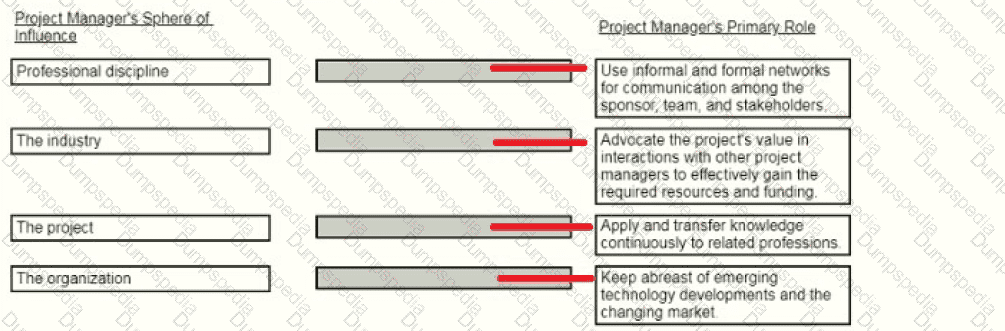
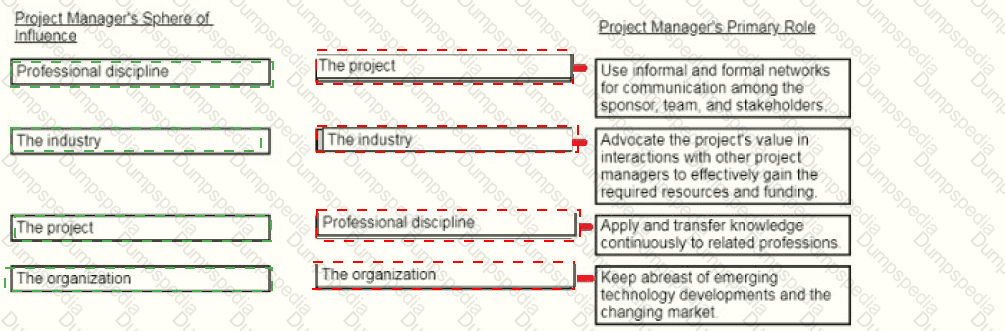
Professional discipline: Apply and transfer knowledge continuously to related professions.
The industry: Advocate the project ' s value in interactions with other project managers to effectively gain the required resources and funding.
The project: Use informal and formal networks for communication among the sponsor, team, and stakeholders.
The organization: Keep abreast of emerging technology developments and the changing market.
The PMBOK® Guide describes the Project Manager as the center of a series of influence circles. Their effectiveness depends on how well they navigate these different levels:
The Project: At the core, the PM leads the project team. Their primary role here is integration and communication. They act as the " hub " connecting the sponsor, the team, and various stakeholders to ensure everyone is aligned with the project ' s goals.
The Organization: Beyond the immediate team, the PM interacts with other project managers, functional managers, and executive leadership. A key role in this sphere is competing for or negotiating for shared resources and funding, often by demonstrating how their project supports the organization ' s strategic goals.
Professional Discipline: PMs have a responsibility to the project management community. This involves contributing to the profession by sharing lessons learned, mentoring others, and transferring knowledge across related fields (such as engineering, IT, or finance).
The Industry: The outermost layer involves the broader market. A top PM must stay informed about industry trends, regulatory changes, and technological advancements to ensure their project doesn ' t become obsolete or non-compliant before it is even finished.
When matching these, look for keywords:
Project = Communication with the Team/Sponsor.
Organization = Resources/Funding/Advocacy.
Professional Discipline = Knowledge transfer/Mentoring.
Industry = Market trends/New technology.
What purpose does the hierarchical locus of stakeholder communications serve?
Maintains the focus on project and organizational stakeholders
Preserves the tocus on external stakeholders—such as customers and vendors—as well as on other projects
Sustains the focus on general communication activities using email, social media, and websites
Keeps the focus on the position of the stakeholder or group with respect to the project team
According to the PMBOK® Guide (6th Edition), specifically within the Project Communications Management knowledge area, communication must be tailored based on the direction and position of the stakeholders. The term " hierarchical locus " refers to the position or " place " a stakeholder occupies in relation to the project team within the organizational or project hierarchy.
Effective communication management requires the project manager to recognize these different directions to ensure the tone, level of detail, and delivery method are appropriate. These directions include:
Upward: Communication with senior management, sponsors, and steering committees.
Downward: Communication with the team members and experts who are contributing to the project.
Outward: Communication with stakeholders outside the project team, such as customers, vendors, and regulators.
Sideward: Communication with the project manager’s peers or middle management who are competing for the same resources.
Why Answer D is correct: The " hierarchical locus " is essentially a mapping of where the stakeholder sits. By keeping the focus on the position of the stakeholder or group with respect to the project team, the project manager can adjust their communication strategy to be more effective (e.g., providing high-level summaries for upward communication vs. detailed technical tasks for downward communication).
Analysis of Distractors:
A and B: These describe specific subsets of stakeholders (internal vs. external). While the hierarchical locus includes these, the purpose of the locus itself is the broader classification of their position/direction relative to the team, not just focusing on one group.
C: This describes communication channels or media (social media, websites). These are the methods used to communicate, but they do not define the hierarchical relationship or " locus " of the stakeholder.
An important project stakeholder has low risk tolerance. Which type ot communication should a project manager use to provide this stakeholder with a difficult update?
Informal conversation
Face-to-face meeting
Short email update
Written report
According to the PMBOK® Guide (6th Edition), specifically within the Project Communications Management and Project Stakeholder Management knowledge areas, the choice of communication technology and method must be tailored to the stakeholder ' s needs, risk tolerance, and the nature of the information being delivered.
When dealing with a stakeholder who has low risk tolerance and needs to receive difficult news (such as a project delay, a cost overrun, or a major risk realization), a Face-to-face meeting is the most effective approach for the following reasons:
Nonverbal Cues: A significant portion of communication is nonverbal (body language, facial expressions, and tone of voice). Face-to-face interaction allows the project manager to sense the stakeholder ' s reaction in real-time and adjust the delivery to provide reassurance.
Immediate Feedback: It allows the stakeholder to ask questions immediately, which is critical for someone with low risk tolerance who may otherwise escalate their anxiety while waiting for a reply to an email or report.
Relationship Building: Difficult updates can damage trust. Face-to-face meetings demonstrate transparency and accountability, which are essential for maintaining engagement with sensitive stakeholders.
Complex Information: Difficult updates often involve nuance that can be easily misinterpreted in written form.
Analysis of Distractors:
A (Informal conversation): While personal, an informal conversation may lack the professional weight required for a " difficult update. " For major issues, stakeholders expect a degree of formality to show the project manager is taking the problem seriously.
C (Short email update): This is a form of Push Communication. It is the least effective for difficult news because it provides no opportunity for immediate clarification and can often lead to " fear of the unknown " for a low-risk-tolerance stakeholder.
D (Written report): While a report provides data, it is a cold medium. For a stakeholder who is already sensitive to risk, receiving a report with bad news without a verbal explanation can lead to a loss of confidence in the project ' s leadership.
External organizations that have a special relationship with the enterprise and provide specialized expertise are called:
Customers.
Business partners.
Sellers.
Functional managers.
In accordance with the PMBOK® Guide (Foundational Concepts), specifically regarding Project Stakeholders and Governance, organizations categorize external entities based on their relationship to the enterprise. Business partners are defined as external organizations that have a special relationship with the enterprise, often established through a certification or partnership process.
Role and Expertise: Business partners provide specialized expertise or fill a specified role such as installation, customization, training, or support.
Nature of Relationship: Unlike a simple buyer-seller transaction, a partnership implies a more integrated or long-term collaborative relationship aimed at mutual goals or supporting the enterprise ' s core value chain.
Stakeholder Impact: As stakeholders, business partners can influence the project’s success by providing technical insights, resources, or specialized components that the performing organization does not possess internally.
Analysis of Distractors:
A. Customers: These are the individuals or organizations who will approve and manage the project ' s product, service, or result. While they are external, their role is to define requirements and accept deliverables, not necessarily to provide " specialized expertise " as a partner to the performing enterprise.
C. Sellers: Also referred to as vendors, suppliers, or contractors; sellers are external companies that enter into a contractual agreement to provide components or services necessary for the project. While they provide expertise, the term " special relationship with the enterprise " specifically distinguishes Business Partners in PMI terminology.
D. Functional managers: These are internal stakeholders who are individuals with management authority over an organizational unit within a functional area (such as human resources, finance, or engineering). They are not external organizations.
During a sprint demo, the customer says that one of the user stories is not ready for customer use. Which checklist should the team look at to find out what has been missed for the user story?
Burndown chart
Velocity chart
Definition of ready (DoR)
Definition of done (DoD)
In Agile/Scrum methodologies, as described in the Agile Practice Guide and the Scrum Guide, there is a critical distinction between getting a story " ready " to start and getting it " ready " for the customer (Done).
Why Choice D is correct:
The Definition of Done (DoD): This is a formal description of the state of the Increment when it meets the quality measures required for the product. It is a checklist of all the technical and quality criteria that a user story must meet before it can be considered complete (e.g., coded, unit tested, integrated, documented, and bug-free).
Customer Use: When a customer claims a story is " not ready for use " during a demo, it usually means a quality standard or a functional requirement was missed. The team reviews the DoD to see if they skipped a mandatory step (like security testing or user documentation) that would have caught the issue before the demo.
Transparency: The DoD ensures that everyone (the team and the stakeholders) has a shared understanding of what " complete " work means.
Analysis of other options:
A (Burndown chart): This is a trend tool that shows how much work is remaining in a sprint. It tracks progress over time but does not contain quality criteria or checklists for individual user stories.
B (Velocity chart): This tracks the amount of work (usually in story points) a team completes in each sprint. It is a capacity planning tool, not a quality or requirements checklist.
C (Definition of Ready - DoR): This is the checklist used to determine if a user story is well-defined enough to be taken into a sprint (e.g., it has clear acceptance criteria and dependencies are removed). Since the story in the question is already being demoed, it had already passed the DoR. The issue now is whether it was finished correctly, which is the role of the DoD.
Key Concept: The Project Management Institute (PMI) emphasizes that the Definition of Done is the primary tool for maintaining quality in an adaptive environment. If an increment is not " Ready for Customer Use, " it means it failed to meet the DoD, and therefore, cannot be considered part of the Increment or contribute to the team ' s Velocity for that sprint. Choice D is the governing document for this situation.
Which tool within the Perform Quality Control process identifies whether or not a process has a predictable performance?
Cause and effect diagram
Control charts
Pareto chart
Histogram
According to the PMBOK® Guide, Control charts are the primary tool and technique used within the Control Quality (formerly Perform Quality Control) process to determine whether or not a process is stable or has predictable performance.
How it Works: A control chart displays process data over time and against established control limits, which consist of a centerline (the mean), an upper control limit (UCL), and a lower control limit (LCL).
Predictability and Stability: A process is considered " in control " and predictable if the data points fall within the control limits and do not exhibit non-random patterns (such as the " Rule of Seven " ). If points fall outside the limits or show erratic trends, the process is considered " out of control " and unpredictable, requiring investigation into " special cause " variation.
Analysis of Other Options:
A. Cause and effect diagram (Ishikawa/Fishbone): Used to identify the potential root causes of a specific problem or effect, not to measure process stability over time.
C. Pareto chart: A specific type of histogram ordered by frequency of occurrence. it is used to identify the " vital few " sources that are responsible for causing the most defects (the 80/20 rule).
D. Histogram: A bar chart showing a graphical representation of numerical data distribution. While it shows the central tendency and dispersion, it does not show the data over time to determine process stability or predictability.
The following is a network diagram for a project.
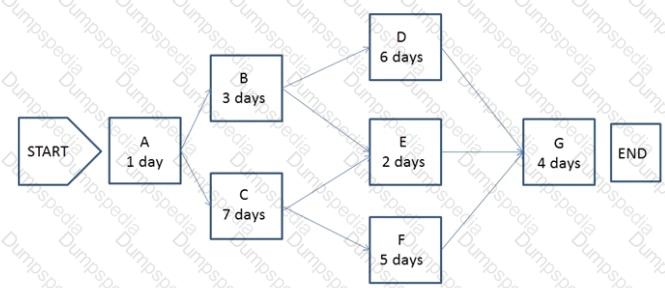
The shortest non-critical path for the project is how many days in duration?
10
12
14
16
According to the PMBOK® Guide (Project Management Body of Knowledge), specifically the Project Schedule Management knowledge area and the Critical Path Method (CPM), we must calculate the duration of every possible path from " Start " to " End " to distinguish between the critical and non-critical paths.
Based on the network diagram provided in the previous sequence (Questions 163-164):
Analyze all Network Paths:
Path 1: A (1) → B (4) → C (6) → F (5) → G (7) → I (2) = 25 days (Critical Path)
Path 2: A (1) → B (4) → C (6) → F (5) → H (3) → I (2) = 21 days (Non-critical)
Path 3: A (1) → D (2) → E (3) → F (5) → G (7) → I (2) = 20 days (Non-critical)
Path 4: A (1) → D (2) → E (3) → F (5) → H (3) → I (2) = 16 days (Non-critical)
Identify the Shortest Non-Critical Path:
The Critical Path is the longest path (25 days).
Any path with a duration less than the Critical Path is a Non-Critical Path.
Comparing the non-critical durations (21, 20, and 16), the path with the minimum value is Path 4, which totals 16 days.
In the PMI framework, identifying the shortest path helps the Project Manager understand which sequences of activities have the most Total Float. In this specific network, the path A-D-E-F-H-I has the most flexibility, with a total float of $25 - 16 = 9$ days.
Which process determines the correctness of deliverables?
Verify Deliverables
Validate Deliverables
Review Deliverables
Analyze Deliverables
According to the PMBOK® Guide, the process that deals specifically with the correctness of deliverables is Control Quality. Within this process, the internal inspection and measurement of work results lead to " Verified Deliverables. "
Correctness vs. Acceptance: It is crucial to distinguish between " correctness " and " acceptance. "
Correctness (Control Quality): This is an internal process performed by the project team or quality department. It uses quality standards to ensure the deliverable meets the technical specifications and requirements. When a deliverable is found to be correct, it becomes a Verified Deliverable.
Acceptance (Validate Scope): This is an external process performed with the customer or sponsor. They review the Verified Deliverables to formally sign off on them. This process is about completeness and meeting the customer ' s expectations, resulting in Accepted Deliverables.
Why other options are incorrect:
Option B: Validate Deliverables (often associated with the process Validate Scope) is focused on the acceptance of the deliverable by the customer, not the internal technical correctness.
Option C: " Review Deliverables " is a general activity that can occur in many processes, but it is not a formal PMI-defined process for determining correctness.
Option D: " Analyze Deliverables " is not a formal process name in the PMBOK Guide. While data analysis occurs during quality control, the specific goal of determining correctness is summarized in the " Verification " of the deliverable.
An intentional activity to modify a nonconforming product or product component is called:
defect repair
work repair
corrective action
preventive action
According to the PMBOK® Guide, specifically within the Perform Integrated Change Control and Direct and Manage Project Work processes, change requests are categorized into four types. The specific activity described is a defect repair.
Defect Repair: This is a formal, intentional activity to modify a nonconforming product or product component. It addresses a specific failure in quality where the deliverable does not meet the requirements or specifications.
The Change Process: Defect repairs typically result from the Control Quality process, where inspections identify that a result is incorrect. To fix the issue, a change request is issued and processed through the change control system.
Purpose: The goal of defect repair is to bring the nonconforming component into compliance with the original requirements.
Comparison with other options:
B. Work repair: This is not a formal term used in PMI standards; " defect repair " is the specific terminology for nonconforming products.
C. Corrective action: This is an intentional activity that realigns the performance of the project work with the project management plan. While similar, corrective action usually refers to fixing a process or a trend (e.g., getting the schedule back on track) rather than a physical nonconforming product.
D. Preventive action: This is an intentional activity that ensures the future performance of the project work is aligned with the project management plan. It is proactive and happens before a nonconformance occurs.
Co-location is a tool and technique of:
Develop Human Resource Plan.
Manage Project Team.
Develop Project Team.
Acquire Project Team.
According to the PMBOK® Guide, Co-location (also referred to as " tight matrix " ) is a specific tool and technique used in the Develop Project Team process.
The rationale is as follows:
Definition: Co-location involves placing many or all of the most active project team members in the same physical location to enhance their ability to perform as a team.
Purpose: The primary goal is to improve communication, reduce conflict, and help build a sense of community. By being in the same room, team members can utilize informal communication channels and develop stronger working relationships, which is the core objective of the " Develop Project Team " process.
Distinction from other processes:
Develop Human Resource Plan (Planning): Focuses on identifying roles, responsibilities, and reporting relationships.
Acquire Project Team (Executing): Focuses on gaining the human resources necessary to complete project assignments.
Manage Project Team (Executing): Focuses on tracking team member performance, providing feedback, and managing changes to optimize project performance.
While co-location may influence how a team is managed, the act of physically bringing the team together to foster development is explicitly categorized under Develop Project Team.
A project manager was assigned to a project to implement a manufacturing system in a food factory. The main project objective is to deliver machines that are ready to process food. The project manager decides that this particular project does not require the use of timeboxed iterations.
Which method should the project manager adopt?
SAFe®
Kanban
Feature-driven development (FDD)
Scrum
According to the Agile Practice Guide and the PMBOK® Guide, Agile methodologies are generally divided into two main categories: Iteration-based Agile (such as Scrum) and Flow-based Agile (such as Kanban).
Flow-Based Agile: Unlike Scrum, which uses fixed-length, timeboxed iterations (Sprints), Kanban focuses on the continuous flow of work. In a manufacturing or installation context, where tasks might have highly variable durations or depend on physical dependencies (like machine arrival), a flow-based approach is often more practical.
WIP Limits: Instead of timeboxing, Kanban manages the project by limiting Work in Progress (WIP). This ensures the team only takes on new tasks (like installing a specific machine component) when there is capacity, preventing bottlenecks in the factory setup.
Continuous Delivery: In this scenario, the project manager has explicitly decided against timeboxed iterations. Kanban is the most appropriate choice because it allows for the delivery of value as soon as a work item is completed, rather than waiting for the end of a predefined cycle.
Analysis of other options:
Option A: SAFe® (Scaled Agile Framework) is a framework for scaling Agile across large organizations. It is highly structured and typically utilizes PI Planning, which relies on synchronized timeboxed iterations across multiple teams.
Option C: Feature-driven development (FDD) is an iterative approach that, while focused on features, still typically utilizes timeboxes for its design and build cycles.
Option D: Scrum is the definition of a timeboxed iteration methodology. It relies entirely on Sprints (usually 1–4 weeks), which the project manager has specifically stated they do not want to use.
Per PMI standards, when a project requires an adaptive approach but fixed-duration timeboxes are not suitable or desired, Kanban is the recommended methodology to manage the continuous flow of work and optimize delivery efficiency.
Which action should a project manager take to ensure that the project management plan is effective and current?
Conduct periodic project performance reviews.
Identify quality project standards.
Follow ISO 9000 quality standards.
Complete the quality control checklist.
According to the PMBOK® Guide, specifically within the Monitor and Control Project Work process, the project manager is responsible for tracking, reviewing, and reporting the overall progress to meet the performance objectives defined in the project management plan.
Performance Reviews: These reviews compare actual performance against the performance measurement baseline (scope, schedule, and cost baselines). By conducting these periodically, the project manager can determine if the project is " on track " or if variances exist that require corrective or preventive actions.
Keeping the Plan Current: The project management plan is a " living document. " When performance reviews identify significant deviations, the project manager initiates Change Requests through the Perform Integrated Change Control process. Once approved, these changes are incorporated into the plan, ensuring it remains a realistic and effective guide for the remainder of the project.
Continuous Improvement: Periodic reviews allow the team to analyze trends (Trend Analysis) and forecast future performance (Variance Analysis), which are essential for proactive management and keeping the plan aligned with the project ' s evolving environment.
Comparison with other options:
B. Identify quality project standards: This is a specific activity within the Plan Quality Management process. While important for quality, it does not address the broader effectiveness or " currency " of the entire integrated project management plan.
C. Follow ISO 9000 quality standards: ISO 9000 is an external international standard for quality management systems. While an organization might adopt these, " following " them is a general compliance activity rather than a specific project management mechanism for updating and maintaining a project-specific plan.
D. Complete the quality control checklist: This is a tool used in the Control Quality process to verify that a set of required steps has been performed. It is a tactical task used for deliverables, not a strategic tool for ensuring the project management plan is effective and current.
A project manager should document the escalation path for unresolved project risks in the:
Change control plan
Stakeholder register
Risk log
Communications management plan
According to the PMBOK® Guide and the Standard for Project Management, the Communications Management Plan is the formal document that defines how project information will be distributed, including the escalation process.
As per PMI standards, while risks are identified in the Risk Register and tracked in a Risk Log, the procedure for moving an unresolved issue or risk up the chain of command belongs to the Communications Management Plan. This plan ensures that stakeholders receive the right information at the right time. Key components of this plan regarding escalation include:
Escalation processes: Clear definitions of the time frames and the names/roles of people (management or sponsors) to whom unresolved issues or risks should be elevated.
Person responsible for communicating the information: Identifying who has the authority to trigger the escalation.
Flowcharts of information: Visual representations of how data and issues move through the organization.
The other options are incorrect based on the following PMI definitions:
Change control plan: (Part of the Change Management Plan) This describes how change requests will be formally authorized and incorporated. It focuses on modifications to baselines, not the hierarchical elevation of unresolved risks.
Stakeholder register: This is a document that identifies stakeholders and their interests/impact. It does not contain procedural paths for risk or issue management.
Risk log: (Often referred to as the Risk Register) This is used to identify, analyze, and plan responses to risks. While it records the status of a risk, it does not typically house the organizational communication policy for escalation.
As per the PMI Lexicon of Project Management Terms, the Communications Management Plan is vital for managing stakeholder expectations and ensuring that critical bottlenecks—such as unresolved risks—are addressed by the appropriate level of leadership through a predefined escalation path.
Which type of analysis is used as a general management technique within the Plan Procurements process?
Risk assessment analysis
Make or buy analysis
Contract value analysis
Cost impact analysis
In accordance with the PMBOK® Guide, specifically within the Plan Procurement Management process, Make-or-buy analysis is the primary general management technique used to determine whether particular work can best be accomplished by the project team or should be purchased from outside sources.
Core Objective: This analysis is used to reach a decision on whether the organization should produce the product or service itself (Make) or purchase it from an external vendor (Buy).
Factors Considered:
Cost: Comparing the direct and indirect costs of internal production versus the purchase price and ongoing support costs of a vendor.
Capacity and Capability: Evaluating if the internal team has the skills, tools, and time available to perform the work.
Strategic Alignment: Determining if the work is a core competency that should remain in-house or if it is a commodity better handled by specialists.
Risk: Assessing the risks associated with internal execution versus the risks of relying on a third-party provider.
The Output: The primary result of this analysis is the Make-or-Buy Decisions, which are documented and used to move forward with the procurement process if a " buy " decision is reached.
Comparison with Other Options:
Risk assessment analysis (A): While risk is a factor in procurement, " Risk Assessment " is a broader set of processes (Identify Risks, etc.) and not the specific management technique defined for making the initial procurement choice.
Contract value analysis (C): This is a distractor term. While the value is analyzed, it falls under cost analysis or price evaluation during the " Conduct Procurements " phase.
Cost impact analysis (D): This is a general term often used in change management to see how a change affects the budget, but it is not the specific technique used in the Plan Procurements process to decide between internal and external work.
Which tool and technique identifies inefficient and ineffective policies, processes, and procedures?
Scope audits
Scope reviews
Quality audits
Control chart
According to the PMBOK® Guide, specifically within the Manage Quality process (Executing Process Group), a Quality Audit is a structured, independent process used to determine if project activities comply with organizational and project policies, processes, and procedures.
Identifying Inefficiencies: The primary objective of a quality audit is to identify inefficient and ineffective policies, processes, and procedures being used on the project. It looks for " non-conformance " and " gaps " in how the work is being performed.
Process Improvement: By identifying these inefficiencies, the audit provides the necessary data to recommend Corrective Actions or Preventive Actions. It aims to share good practices used in other projects and improve the implementation of processes to help the team raise productivity.
Reduced Cost of Quality: Regular quality audits help reduce the overall cost of quality by catching process errors early, thereby reducing rework and increasing the probability of stakeholder acceptance of the final product.
Independent Review: These audits are usually conducted by an external party (such as the internal audit department, a Project Management Office (PMO), or a third-party consultant) to ensure objectivity and technical compliance.
Comparison with other options:
A. Scope audits: This is not a standard PMI term for identifying process inefficiencies. While " audits " exist in procurement or risk, " scope audits " generally refer to verifying deliverables (Validate Scope) rather than analyzing organizational procedures.
B. Scope reviews: These are meetings held during Validate Scope to obtain formal acceptance of completed deliverables from the customer. They focus on the product, not the internal processes of the organization.
D. Control chart: This is a tool used in Control Quality to determine whether or not a process is stable or has predictable performance. While it tracks variance in data, it is a mathematical tool for monitoring stability, not a qualitative review of " ineffective policies. "
Which process in Project Time Management includes reserve analysis as a tool or technique?
Estimate Activity Resources
Sequence Activities
Estimate Activity Durations
Develop Schedule
According to the PMBOK® Guide and the Standard for Project Management, Reserve Analysis is a specific tool and technique used in the Estimate Activity Durations process (within the Project Schedule Management Knowledge Area, formerly Project Time Management).
As per PMI standards, reserve analysis is used to determine the amount of contingency and management reserves needed for the project. In the context of duration estimation, it involves:
Contingency Reserves: Also known as " Schedule Reserves, " these are buffers added to the schedule to account for " known-unknowns " (identified risks). These are part of the schedule baseline.
Management Reserves: Amounts of time withheld for management control purposes for " unknown-unknowns " (unforeseen risks). These are not part of the schedule baseline but are part of the overall project duration.
Progressive Elaboration: As more precise information about the project becomes available, the reserve may be used, reduced, or eliminated.
The other options are incorrect based on their specific tools and techniques within the PMI framework:
Estimate Activity Resources: This process uses tools like expert judgment, bottom-up estimating, and data analysis (specifically alternative analysis), but reserve analysis is specifically tied to the duration or cost of those resources.
Sequence Activities: This process focuses on identifying and documenting relationships among the project activities. Its primary tools are the Precedence Diagramming Method (PDM) and Dependency Determination.
Develop Schedule: This process uses tools like Schedule Network Analysis, Critical Path Method, and Resource Optimization. While it aggregates the durations (including reserves), the analysis to determine those reserves happens during the estimation processes.
As per the PMI Lexicon of Project Management Terms, Reserve Analysis ensures that the project schedule is realistic and contains enough flexibility to handle the inherent uncertainties of project work.
Due to today ' s competitive global market, organizations require more than technical project management skills. Which of the following skills can support long-range strategic objectives that contribute to the bottom line?
Planning and risk management skills
Communication and time management skills
Business intelligence and leadership skills
Strategic and business management skills
According to the PMBOK® Guide, specifically within the framework of the PMI Talent Triangle®, project managers need a balanced skillset to be effective in a modern, competitive environment. While technical skills are the " core " of the role, they are no longer sufficient on their own to drive organizational success.
The PMI Talent Triangle consists of:
Ways of Working (formerly Technical Project Management): The knowledge and skills related to specific domains of project, program, and portfolio management.
Power Skills (formerly Leadership): The ability to guide, motivate, and direct a team.
Business Acumen (formerly Strategic and Business Management): The " knowledge of and expertise in the industry and organization that enhances performance and better delivers business outcomes. "
Strategic and Business Management skills (Business Acumen) are specifically highlighted as the skills that support long-range objectives. They involve:
Understanding the business functions (finance, marketing, operations).
Aligning project deliverables with the strategic goals of the organization.
Developing the ability to make decisions that contribute to the bottom line (profitability and ROI).
Knowing the competitive landscape and industry trends.
Analysis of Other Options:
A. Planning and risk management skills: These are considered " Ways of Working " or technical skills. While vital for project execution, they focus on the " how " of the project rather than the " why " of the organizational strategy.
B. Communication and time management skills: These are essential " Power Skills " and technical attributes. They help in managing the project day-to-day but don ' t inherently address the high-level business strategy or long-range market competitiveness.
C. Business intelligence and leadership skills: While leadership is part of the triangle, " Business Intelligence " is often a technical data tool rather than the broad " Strategic and Business Management " skillset required by PMI ' s standards to influence the organization ' s long-term direction.
Match the life cycle type to when its requirements are defined.


 A screenshot of a login box Description automatically generated
According to PMI standards, the choice of life cycle determines how the project scope is managed and when the " What " of the project is finalized.
Predictive (Waterfall): This lifecycle is used when the product is well understood. Requirements are locked in during the planning phase. Any changes later usually require a formal change request. This provides high predictability but low flexibility.
Iterative: The goal here is to arrive at the correct solution through successive prototypes or versions. Requirements are revisited and refined based on feedback from the previous iteration. It focuses on the " correctness " of the solution.
Incremental: This life cycle delivers a finished, usable portion of the product in each interval. Requirements for a specific " slice " of the project are defined and delivered, with subsequent increments adding more features until the total scope is met.
Adaptive (Agile): In highly uncertain environments, requirements are never " finished " until the project is. They are maintained in a Product Backlog and refined/prioritized just before the start of a sprint or iteration. This allows the team to respond to change and deliver value quickly.
Understanding these distinctions is crucial for the Project Integration Management knowledge area. The Project Manager must choose the life cycle that best fits the project ' s level of uncertainty, complexity, and the need for frequent delivery.
A project manager is updating their CV or resume and realizes that they need to improve skills related to expertise in the industry and organizational knowledge. Which dimension of PMI’s Talent Triangle best relates to this need to improve?
Strategic and business management skills
Leadership skills
Technical project management
Organizational management
The PMI Talent Triangle® was developed by the Project Management Institute to define the ideal skill set of a project manager. It consists of three primary dimensions that ensure a practitioner is well-rounded and effective in a modern business environment.
Strategic and Business Management Skills (Choice A): This dimension involves the " expertise in the industry and organizational knowledge " mentioned in the question. It includes the ability to see the high-level overview of the organization and effectively negotiate and implement decisions and actions that support strategic alignment and innovation. Key components include:
Business Acumen: Understanding the business environment and industry-specific functions.
Market awareness: Knowing the competition and industry trends.
Operational functions: Understanding how the organization works (e.g., finance, marketing, legal).
Strategic alignment: Ensuring the project supports the broader goals of the business.
Leadership Skills (Choice B): This dimension focuses on the ability to guide, motivate, and direct a team. It includes competencies like brainstorming, coaching, mentoring, emotional intelligence, and conflict resolution. While essential, it is about " people " rather than " industry/organizational knowledge. "
Technical Project Management (Choice C): This focuses on the specific domain knowledge and technical aspects of performing one ' s role. For a project manager, this means knowing how to use a WBS, manage a schedule, or perform Earned Value Analysis. (Note: In the updated Talent Triangle, this is often referred to as " Ways of Working " ).
Organizational Management (Choice D): This is not one of the three official sides of the PMI Talent Triangle.
By improving Strategic and Business Management Skills, a project manager becomes a more valuable asset to their organization because they understand not just how to manage a project, but why the project is being done and how it fits into the global industry landscape.
During a virtual kick-off session, the project sponsor highlights the significance of the project to the company. What message should be conveyed to the team in this meeting?
Bonuses based on accomplishment criteria
New working contract with more benefits
Promotion opportunities with this project
Assignment of key roles and responsibilities
According to the PMBOK® Guide and the PMI Standard for Project Management, the Kick-off Meeting is a vital event that typically occurs at the end of planning and the start of execution. Its primary purpose is to communicate the project objectives, gain team commitment, and explain the roles and responsibilities of each stakeholder.
Why Choice D is correct: While the sponsor provides the " big picture " (strategic significance), the team needs functional clarity to begin work. The Assignment of key roles and responsibilities ensures that every team member understands their expectations and how they contribute to the significant goals mentioned by the sponsor. This is often documented in a Responsibility Assignment Matrix (RAM), such as a RACI chart. Defining " who does what " prevents duplication of effort and ensures accountability from day one.
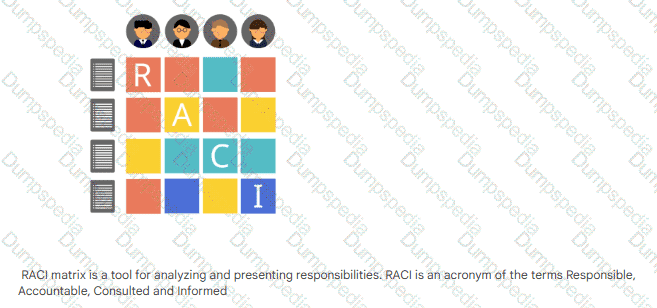
Analysis of other options:
A, B, and C: While bonuses, contracts, and promotions (Rewards and Recognition) are part of Resource Management, they are generally handled through HR or private 1-on-1 discussions between the Project Manager and functional managers. Discussing individual personal gain (bonuses or promotions) as the primary message during a kick-off meeting can distract from the project ' s collective mission and goals.
The Project Management Institute (PMI) emphasizes that a successful kick-off session should align the team around a common vision. Assigning roles (Choice D) provides the structure necessary to transform that vision into actionable results.
What process is included in Project Integration Management?
Monitor and Control Project Work
Control Scope
Control Schedule
Develop Team
According to the PMBOK® Guide, Project Integration Management includes the processes and activities to identify, define, combine, unify, and coordinate the various processes and project management activities within the Project Management Process Groups.
There are seven processes within this knowledge area, and Monitor and Control Project Work is one of them. Its primary function is to track, review, and report the overall progress to meet the performance objectives defined in the project management plan. It is a high-level integration process that looks across all other knowledge areas to ensure the project is on track.
Analysis of other options:
Control Scope (Option B): This process belongs to the Project Scope Management knowledge area. It focuses specifically on monitoring the status of the project and product scope and managing changes to the scope baseline.
Control Schedule (Option C): This process is part of Project Schedule Management. Its focus is strictly on monitoring the status of project activities to update project progress and manage changes to the schedule baseline.
Develop Team (Option D): This process belongs to Project Resource Management. It involves improving competencies, team member interaction, and the overall team environment to enhance project performance.
Per PMI standards, Integration Management is the unique responsibility of the project manager and cannot be delegated or departmentalized, as it provides the cohesive " glue " that links the entire project together.
The process of defining how the project scope will be validated and controlled is known as:
Define Scope.
Develop Project Management Plan.
Plan Scope Management.
Plan Quality Management.
According to the PMBOK® Guide (Project Management Body of Knowledge), specifically within the Project Scope Management knowledge area and the Plan Scope Management process:
Plan Scope Management (Option C): This is the process of creating a scope management plan that documents how the project and product scope will be defined, validated, and controlled. The key benefit of this process is that it provides guidance and direction on how scope will be managed throughout the project. It explicitly outlines the procedures for preparing the scope statement, creating the WBS, formalizing the acceptance of completed deliverables (Validate Scope), and processing change requests to the scope baseline (Control Scope).
Define Scope (Option A): This is the process of developing a detailed description of the project and product. Its primary output is the Project Scope Statement. While it defines what is in scope, it does not define the administrative process for how that scope will be validated or controlled.
Develop Project Management Plan (Option B): This is a high-level integration process that defines, prepares, and coordinates all plan components. While the Scope Management Plan eventually becomes a subsidiary part of this larger plan, the specific act of defining scope validation and control happens within the Plan Scope Management process.
Plan Quality Management (Option D): This process identifies quality requirements and/or standards for the project and its deliverables, and documents how the project will demonstrate compliance. It focuses on correctness and " fit for use " rather than the formal acceptance and boundary management of the scope.
In the PMI framework, the Scope Management Plan acts as a roadmap. By defining how the project scope will be validated (through the Validate Scope process) and controlled (through the Control Scope process), the Project Manager ensures that there is a clear, pre-approved methodology for handling scope creep and securing formal sign-off from the customer.
A project manager is working in an environment where requirements are not very clear and may change during the project. In addition, the project has several stakeholders and is technically complex.
Which strategies should the project manager take into account for risk management in this environment?
Occasionally identify, evaluate, and classify risks.
Review requirements and cross-functional project teams.
Include contingency reserves and update the project management plan frequently.
Frequently review incremental work products and update the requirements for proper prioritization.
In environments characterized by unclear requirements, high stakeholder density, and technical complexity, the PMBOK® Guide and the Agile Practice Guide recommend an adaptive or iterative approach to risk management.
Risk Reduction through Increments: In complex projects, the greatest risk is building the wrong product or failing to meet stakeholder expectations. By " frequently reviewing incremental work products " (e.g., through Sprint Reviews or Demos), the project manager uncovers risks related to technical feasibility and requirement alignment early.
Dynamic Prioritization: Risks in these environments are often tied to the product backlog. Constant " proper prioritization " ensures that the team addresses high-risk, high-value items first (often called a Risk-Adjusted Backlog). This allows the team to fail fast or pivot before significant resources are spent.
Stakeholder Feedback Loops: Frequent reviews engage stakeholders directly, reducing the risk of " expectation gap " and ensuring that the technical complexity is being managed in a way that provides actual business value.
Analysis of Other Options:
A. Occasionally identify, evaluate, and classify risks: In a highly complex and changing environment, " occasional " reviews are insufficient. Risk management must be continuous and integrated into every iteration.
B. Review requirements and cross-functional project teams: While having a cross-functional team is a good practice, simply " reviewing " them does not constitute a risk management strategy that addresses technical complexity or shifting requirements as effectively as incremental delivery does.
C. Include contingency reserves and update the project management plan frequently: This is a more traditional/predictive response to risk. While reserves are important, they are a reactive measure (Acceptance). In a complex/adaptive environment, the proactive strategy is to reduce uncertainty through incremental validation (Option D).
Define Activities and Estimate Activity Resources are processes in which project management Knowledge Area?
Project Time Management
Project Cost Management
Project Scope Management
Project Human Resource Management
According to the PMBOK® Guide (specifically the 4th and 5th editions, which use these specific process names), Define Activities and Estimate Activity Resources are core processes within the Project Time Management knowledge area (renamed to Project Schedule Management in later editions).
Define Activities: This process involves identifying and documenting the specific actions to be performed to produce the project deliverables. It takes the work packages from the WBS and breaks them down into schedule activities that provide a basis for estimating, scheduling, executing, monitoring, and controlling the project work.
Estimate Activity Resources: This process involves estimating the types and quantities of material, human resources, equipment, or supplies required to perform each activity. This is a critical step because the availability and type of resources directly impact the duration of the activities.
Knowledge Area Context: In the standard process mapping, Project Time/Schedule Management includes:
Plan Schedule Management
Define Activities
Sequence Activities
Estimate Activity Resources
Estimate Activity Durations
Develop Schedule
Control Schedule
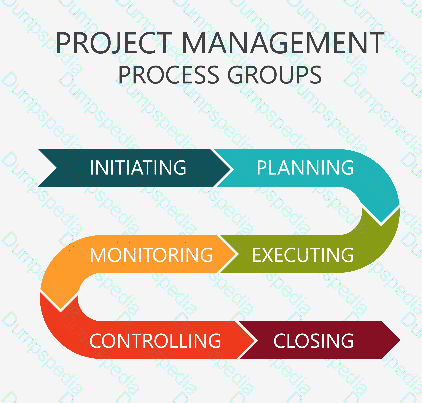
Comparison with Other Domains:
Project Cost Management (B): Focuses on Estimate Costs, Determine Budget, and Control Costs.
Project Scope Management (C): Focuses on Collect Requirements, Define Scope, and Create WBS.
Project Human Resource Management (D): While this area (now Resource Management) deals with managing the team, the initial estimation of which resources are needed for specific tasks is traditionally housed within the Time/Schedule management processes to build the project timeline.
The table represents the possible durations of a specific project task.
Using the three-point estimating technique what is the expected number of days it should take to complete the task?
2
3
4
6
In Project Management, when we are given a range of possible durations, we use the Three-Point Estimating formula to determine the expected duration ($t_E$).
While there are two formulas, the standard calculation for this problem (Triangular Distribution) is:
$$t_E = \frac{O + M + P}{3}$$
Where:
$O$ (Optimistic): 2 days
$M$ (Most Likely): 3 days
$P$ (Pessimistic): 7 days
Calculation:
$$t_E = \frac{2 + 3 + 7}{3}$$
$$t_E = \frac{12}{3}$$
$$t_E = 4$$
Why this matters:
Reduces Bias: Relying on a single " Most Likely " estimate can be risky. Three-point estimating forces the team to consider risks (Pessimistic) and opportunities (Optimistic).
Accuracy: It provides a more mathematically sound average than a simple guess, helping the Project Manager create a more realistic Schedule Baseline.
Note on PERT (Beta Distribution):
If the question specifically asked for PERT or a Weighted Average, the formula would be $t_E = \frac{O + 4M + P}{6}$. Using PERT for these numbers would result in $3.5$ days. Since $4$ is the available choice that aligns with the simple triangular average, Option C is the correct answer.
Per PMI standards, this technique is used within the Estimate Activity Durations process to improve the accuracy of time estimates when there is uncertainty associated with the activity.
What does leadership involve?
Working with others through discussion or debate to guide them from one point to another
Directing another person from one point to another using a known set of expected behaviors
Working with a person using expert judgment to develop the technical deliverables
Directing another person to develop the necessary expertise to establish technical deliverables
According to the PMBOK® Guide and the PMI Talent Triangle®, leadership is defined as the ability to guide, influence, and direct a team to achieve a goal. It is distinct from management, which focuses on the " known set of expected behaviors " and processes.
Guidance through Influence: Leadership involves the use of interpersonal skills to move a team toward a vision. This often requires discussion, debate, and negotiation to align diverse stakeholders and team members. It is about " guiding " rather than " directing " by command.
Developing Consensus: Effective leadership in a project environment requires the project manager to facilitate communication and collaborate with others to navigate through complex interpersonal dynamics.
Analysis of other options:
Option B: Describes Management. Management is more about maintaining the status quo and using a " known set of expected behaviors " (policies, procedures, and controls) to ensure tasks are completed.
Option C and D: These focus on Technical Project Management and Expert Judgment. While a project manager needs these skills to ensure deliverables are met, they are functional or technical competencies rather than the interpersonal essence of leadership.
As per the PMI Lexicon of Project Management Terms, leadership is a " soft skill " that focuses on the long-term vision and the people involved, utilizing communication and conflict resolution to guide the project to success.
What is a hierarchically organized depiction of the identified project risks arranged by risk category?
Risk register
Risk breakdown structure (RBS)
Risk management plan
Risk category
According to the PMBOK® Guide, specifically within the Plan Risk Management process, the Risk Breakdown Structure (RBS) is a critical tool for ensuring all potential risks are identified and categorized systematically.
Definition: An RBS is a hierarchically organized depiction of identified project risks. It is arranged by risk category and subcategory, which identifies the various areas and causes of potential risks.
Structure: Similar to a Work Breakdown Structure (WBS), the RBS starts at a high level (e.g., Technical, External, Organizational, Project Management) and decomposes into more specific levels.
Level 0: All Project Risks.
Level 1: Broad categories (e.g., Technical Risk).
Level 2: Specific subcategories (e.g., Requirements, Technology, Complexity).
Purpose: The primary benefit of the RBS is that it helps the project team to look at the project from different perspectives during the Identify Risks process. It prevents " tunnel vision " by forcing the team to consider risks across all domains of the project environment. It also provides a framework for summarizing and reporting risk data.
Comparison with other options:
A. Risk register: This is a document that captures the details of individual identified risks, including their description, owner, probability, impact, and planned responses. While it uses the categories defined in the RBS, the register is a list/database, not a hierarchical depiction of categories.
C. Risk management plan: This is the overarching plan that describes how risk management activities will be structured and performed. While the RBS is often included as a component of the Risk Management Plan, the plan itself is a narrative and procedural document, not the specific hierarchical chart.
D. Risk category: This is a singular classification (e.g., " External Risk " ). While the RBS is made of risk categories, a single category does not represent the entire hierarchical depiction asked for in the question.
Monte Carlo is which type of risk analysis technique?
Probability
Quantitative
Qualitative
Sensitivity
According to the PMBOK® Guide, specifically within the Perform Quantitative Risk Analysis process, Monte Carlo simulation is a primary tool and technique used to numerically analyze the combined effect of individual project risks and other sources of uncertainty on overall project objectives.
In the PMI framework, risk analysis is divided into two main stages:
Perform Qualitative Risk Analysis: The process of prioritizing individual project risks by assessing their probability of occurrence and impact. This is subjective and uses descriptors like " High, " " Medium, " or " Low. "
Perform Quantitative Risk Analysis: The process of numerically analyzing the effect of identified risks on overall project objectives. This is where Monte Carlo simulation resides.
Simulation: It uses a computer model to simulate the project many times (often thousands of iterations) using random values for variable inputs (like cost or duration) based on probability distributions (e.g., triangular, normal, or beta).
Output: The result is a probability distribution of the total project cost or completion date. It helps the project manager determine the " probability of success " (e.g., " There is an 80% chance we will finish the project for $500,000 or less " ).
S-Curve: The results are often plotted on a cumulative frequency distribution, known as an S-curve.
A. Probability: While Monte Carlo uses probability distributions as inputs, " Probability " is a component of risk, not the category of the analysis technique itself.
C. Qualitative: This is the earlier stage of risk management. Qualitative analysis is used to quickly filter and prioritize risks, whereas Monte Carlo is used for a deep-dive, data-driven numerical assessment.
D. Sensitivity: Sensitivity analysis is another tool within the Perform Quantitative Risk Analysis process (often visualized with a Tornado Diagram). While it is related, Monte Carlo is a simulation technique, while Sensitivity analysis looks at the impact of changing one variable at a time.
The primary benefit of using a Monte Carlo simulation is that it quantifies the overall project risk rather than just looking at individual risks in isolation. This allows for more accurate contingency reserve planning and realistic communication with stakeholders regarding project deadlines and budgets.
A project manager has the task of determining the deliverables for a six-month project using a predictive approach. How should the project manager determine which processes to include in the project management plan?
Follow organizational methodology and produce all required deliverables.
Discuss the processes and deliverables needed to meet the project objectives with the team.
Identify the processes and deliverables for only the current phase first.
Integrate hybrid approach processes and deliverables to meet the short delivery timeline.
According to the PMBOK® Guide, specifically within the Develop Project Management Plan and Plan Scope Management processes, determining the right " fit " for a project is a collaborative effort known as Tailoring.
The Importance of Tailoring: Even in a predictive (waterfall) approach, project management is not a " one size fits all " endeavor. The project manager should not blindly follow every possible process. Instead, they must determine which processes, inputs, tools, techniques, and outputs are necessary to manage the specific project at hand.
Team Collaboration: The project manager works with the project team to determine the work required and the deliverables needed to meet the project objectives. Because the team members are the subject matter experts (SMEs) who will actually perform the work, their input is vital to ensuring that the deliverables are realistic and that the processes selected add value rather than unnecessary bureaucracy.
Meeting Objectives: The ultimate goal of the project management plan is to define how the project will be executed, monitored, and controlled to achieve its specific goals. Discussing this with the team ensures alignment and commitment to the project’s success.
Analysis of other options:
Option A: While following organizational methodology is important, simply producing " all required deliverables " without tailoring can lead to inefficiency. The project manager must first determine which deliverables are truly required for this specific six-month scope.
Option C: This describes Rolling Wave Planning or a multi-phase approach. While useful for long-term projects, the prompt asks how to determine processes for the project management plan (which typically covers the entire project scope in a predictive approach), not just the immediate phase.
Option D: The prompt explicitly states the project is using a predictive approach. Forcing a hybrid approach solely because of a " short delivery timeline " (six months is often a standard duration for predictive projects) contradicts the premise of the question.
Per PMI standards, the project manager is responsible for Tailoring the project management processes. This is best done by leveraging the expertise of the project team to ensure the most efficient path toward meeting the project ' s strategic objectives.
Which items are components of a project management plan?
Change management plan, process improvement plan, and scope management plan
Agreements, procurement management plan, and work performance information
Schedule management plan, project schedule, and resource calendars
Scope baseline, project statement of work, and requirements traceability matrix
According to the PMBOK® Guide (Project Management Body of Knowledge), specifically within the Project Integration Management knowledge area and the Develop Project Management Plan process:
Components of the Project Management Plan (Option A): This option correctly identifies three subsidiary plans that are integral parts of the comprehensive Project Management Plan. The Change Management Plan describes how changes will be formally authorized and incorporated; the Process Improvement Plan (in earlier PMBOK versions) or Quality Management Plan details how processes will be analyzed for efficiency; and the Scope Management Plan establishes how the scope will be defined and controlled.
Agreements and Work Performance Information (Option B): These are not components of the plan. Agreements are typically inputs to various processes (like Develop Project Charter or Conduct Procurements), and Work Performance Information is data that has been collected and analyzed during project execution (an output of the Monitor and Control processes).
Project Schedule and Resource Calendars (Option C): While the Schedule Management Plan is part of the project management plan, the Project Schedule and Resource Calendars are considered Project Documents, not components of the Project Management Plan itself. There is a strict distinction in PMI standards between " The Plan " (the " how-to " and baselines) and " Project Documents " (the records and data used to support the plan).
Project Statement of Work and Requirements Traceability Matrix (Option D): The Scope Baseline is indeed part of the plan. However, the Project Statement of Work (SOW) is an input to the charter, and the Requirements Traceability Matrix is a project document.
In the PMI framework, the Project Management Plan is a single, formal, approved document that defines how the project is executed, monitored, and controlled. It is composed of multiple subsidiary plans and baselines (Scope, Schedule, and Cost) that guide the project team throughout the life cycle.
One of the objectives of a quality audit is to:
highlight the need for root cause analysis.
share the process documentation among stakeholders.
offer assistance with non-value-added activities.
identify all of the gaps or shortcomings.
According to the PMBOK® Guide, a Quality Audit is a structured, independent process used to determine if project activities comply with organizational and project policies, processes, and procedures. It is a key tool and technique of the Manage Quality process (formerly Perform Quality Assurance).
Objectives of a Quality Audit: The primary goal is to identify inefficient and ineffective policies, manuals, and procedures being used on the project. By identifying all of the gaps or shortcomings, the audit ensures that the project team is following the required standards and that any non-compliance is documented.
Continuous Improvement: Beyond just finding gaps, quality audits aim to:
Identify all good and best practices being implemented.
Share best practices introduced or implemented in similar projects in the organization and/or industry.
Proactively offer assistance in a positive manner to improve the implementation of processes to help raise team productivity.
Highlight the need for Corrective Actions or Preventive Actions to bridge the identified gaps.
Analysis of Other Options:
A. highlight the need for root cause analysis: While an audit might uncover a problem that eventually requires a Root Cause Analysis (RCA), the audit ' s direct objective is to find the gap (non-compliance), whereas RCA is a separate technique used to understand why the gap occurred.
B. share the process documentation among stakeholders: This is a function of the Communications Management Plan or general project transparency, rather than a specific objective of a formal Quality Audit.
C. offer assistance with non-value-added activities: This is a distractor. The objective of an audit is actually to identify non-value-added activities so they can be eliminated, not to assist with them. Quality audits help " lean " the process by removing waste.
Whose approval may be required for change requests after change control board (CCB) approval?
Functional managers
Business partners
Customers or sponsors
Subject matter experts
According to the PMBOK® Guide, specifically within the Perform Integrated Change Control process, the Change Control Board (CCB) is a formally chartered group responsible for reviewing, evaluating, approving, delaying, or rejecting changes to the project.
Hierarchy of Approval: While the CCB has the authority to approve or reject changes within the scope of the project ' s baselines, certain changes may exceed the CCB ' s authority or have significant impacts on the project ' s strategic goals, funding, or contractual obligations.
Final Authorization: In many organizational frameworks, after the CCB provides its technical and impact-based approval, the customer (especially in external projects) or the sponsor (the person providing the financial resources) must provide the final sign-off. This is particularly true if the change requires additional funding from management reserves or alters the high-level requirements defined in the Project Charter.
Communication of Results: Once all required approvals are obtained, the Change Log is updated, and the project manager ensures that the changes are incorporated into the Project Management Plan and communicated to all stakeholders.
Comparison with other options:
A. Functional managers: While they may be consulted during the impact analysis (especially regarding resource availability), they do not typically sit above the CCB or the Sponsor for final project-level change approval.
B. Business partners: While they are stakeholders, they generally do not have formal approval authority over project change requests unless specifically stated in a joint venture agreement.
D. Subject matter experts (SMEs): SMEs provide the technical expertise needed to evaluate the change request, but they do not have the formal authority to approve it.
The links between the processes in the Process Groups are often:
Intuitive
Iterative
Measured
Monitored
According to the PMBOK® Guide, the Project Management Process Groups are not one-time, linear events that happen in isolation. Instead, they are highly interrelated and the links between them are iterative.
The Nature of Iteration: Project management is a " progressive elaboration " of the project management plan. This means that as more information or better estimates become available, the project team must often return to previous process groups to refine the project ' s direction.
Process Links: The output of one process generally becomes an input to another process or is a deliverable of the project. For example:
The Planning group provides the Executing group with the project management plan.
As work is executed, Work Performance Data is generated and sent to the Monitoring and Controlling group.
If the controlling processes identify a significant variance, the team may need to trigger the Planning group again to update the schedule or budget.
Cyclical Interaction: This iterative nature ensures that the project remains aligned with business objectives. It allows for continuous improvement and adjustment throughout the project life cycle until the final objectives are met in the Closing process group.
Comparison with other options:
A. Intuitive: While experienced project managers develop intuition, the formal framework of the PMBOK® Guide is based on structured, documented processes rather than " gut feeling. "
C. Measured: While performance within the process groups is measured (specifically in Monitoring and Controlling), " measured " does not describe the link or relationship between the groups themselves.
D. Monitored: Monitoring is a specific process group (Monitoring and Controlling), but it is not the term used to describe the fundamental, repetitive, and refining relationship that exists between all the groups.
Which set of competencies should a project manager have?
Leadership, strategic and business management, and technical project management
Expertise in the Industry, leadership and business management, and bilingual skills
Technical project management, expertise in every role, and PMP certification
Expertise in every detail on project activities. PMP certification, and leadership
According to the PMBOK® Guide, the core competencies required of a project manager are represented by the PMI Talent Triangle®. This framework ensures that project managers possess a balanced mix of skills to navigate the complexities of modern project environments.
Technical Project Management (Ways of Working): The knowledge, skills, and behaviors related to specific domains of project, program, and portfolio management. This includes the technical aspects of performing one’s role, such as schedule management, cost estimation, and risk analysis.
Leadership (Power Skills): The knowledge, skills, and behaviors needed to guide, motivate, and direct a team to help an organization achieve its business goals. This includes emotional intelligence, conflict resolution, and communication.
Strategic and Business Management (Business Acumen): The performance-enhancing knowledge of the industry and organization. It involves understanding the " big picture " of how a project aligns with the organization ' s strategic goals and its impact on the business ' s bottom line.
Analysis of Other Options:
B. Expertise in the Industry, leadership and business management, and bilingual skills: While industry expertise and bilingual skills are valuable assets in specific contexts, they are not defined by PMI as the universal " core " competencies required for all project managers.
C. Technical project management, expertise in every role, and PMP certification: A project manager does not need to be an expert in every technical role (e.g., they don ' t need to be the best coder and the best accountant). Their role is to manage those experts. Furthermore, while the PMP certification is a professional credential, it is not listed as a " competency " itself in the PMBOK Guide.
D. Expertise in every detail on project activities, PMP certification, and leadership: Focusing on " every detail " can lead to micro-management. Effective project managers focus on the integration of the project rather than getting lost in every minor technical task.
Tools and techniques used in Direct and Manage Project Work include:
Process analysis and expert judgment
Analytical techniques and a project management information system
Performance reviews and meetings
Expert judgment and meetings
According to the PMBOK® Guide, the Direct and Manage Project Work process is the process of leading and performing the work defined in the project management plan and implementing approved changes to achieve the project’s objectives.
Tools and Techniques: The formal tools and techniques for this process are:
Expert Judgment: Used to evaluate the inputs and the execution of the project work. This includes technical knowledge of the industry, specialized skills for the product, and management expertise.
Project Management Information System (PMIS): An automated tool (such as scheduling software, configuration management systems, or information collection and distribution systems) used to support all aspects of the project.
Meetings: Used to discuss and address pertinent topics when directing and managing the project work. These include kickoff meetings, technical meetings, and progress updates.
Comparison with other options:
A. Process analysis: This is a tool and technique for Manage Quality (specifically identifying improvements in the process), not Direct and Manage Project Work.
B. Analytical techniques: While a PMIS is used, " Analytical Techniques " is specifically listed as a tool for Plan Procurement Management or Monitor and Control Project Work, but it is not a primary tool for the execution of the work itself in this specific process.
C. Performance reviews: These are tools used in Monitor and Control Project Work and Control Procurements to compare actual performance against the baseline, rather than the act of performing the work.
The purpose of developing a project scope management plan is to:
Manage the timely completion of the project.
Ensure that the project includes all of the work required.
Make sure the project will satisfy the needs for which it was begun.
Reduce the risk of negative events in the project.
According to the PMBOK® Guide (Project Management Body of Knowledge), specifically within the Project Scope Management knowledge area:
Ensure all work is included (Option B): The primary purpose of Project Scope Management is to ensure that the project includes all the work required, and only the work required, to complete the project successfully. The Scope Management Plan is a component of the project management plan that describes how the scope will be defined, developed, monitored, controlled, and validated. Its fundamental goal is to manage what is and is not included in the project to prevent " scope creep. "
Timely Completion (Option A): This is the primary purpose of the Project Schedule Management knowledge area. While scope affects the schedule, the management of time is a distinct process.
Satisfy Needs (Option C): This is the primary focus of Project Quality Management. Quality management ensures that the project deliverables meet the requirements and satisfy the needs for which the project was undertaken (fitness for use).
Reduce Risk (Option D): This is the primary focus of the Project Risk Management knowledge area. While a well-defined scope reduces ambiguity and thus risk, the specific objective of " reducing negative events " belongs to the risk processes.
In the PMI framework, the Scope Management Plan acts as the guidebook for the project team, providing the necessary processes to document the project ' s boundaries and ensure that the final product meets the stakeholders ' initial requirements without unnecessary additions.
Which document describes the necessary information to determine if a project is worth the required investment?
Cost baseline
Service level agreement
Memorandum of understanding
Business case
According to the PMBOK® Guide and the Standard for Project Management, the Business Case is the primary economic feasibility study used to establish the validity of the benefits of a selected component which is used as a basis for the authorization of further project management activities.
The Business Case describes the necessary information from a business standpoint to determine whether the expected outcomes of the project justify the required investment. It typically includes:
Business Need: The reason why the project is being undertaken (e.g., market demand, legal requirement, or organizational need).
Analysis of the Situation: Identifying organizational goals, strategies, and objectives.
Recommendation: A statement of the recommended solution.
Evaluation: A statement describing the plan for measuring the benefits the project will deliver.
The other options are incorrect based on the following PMI definitions:
Cost Baseline: This is the approved version of the time-phased project budget, excluding any management reserves, which can be changed only through formal change control procedures. It is used as a basis for comparison to actual results.
Service Level Agreement (SLA): A contract between a service provider and a customer that defines the level of service expected. It is a functional document rather than a feasibility document.
Memorandum of Understanding (MOU): This is an agreement between two or more parties outlined in a formal document. It is not a financial justification document for investment.
As per the PMI Standard for Portfolio Management, the Business Case is a key input to the Develop Project Charter process, ensuring that the project aligns with the organization ' s strategic goals and financial capabilities.
Which group is formally chartered and responsible for reviewing, evaluating, approving, delaying, or rejecting changes to the project and for recording and communicating decisions?
Project team
Focus group
Change control board
Project stakeholders
According to the PMBOK® Guide and the Standard for Project Management, the entity described is the Change Control Board (CCB). This body is a formally constituted group responsible for the Perform Integrated Change Control process.
The specific roles and responsibilities of the CCB as defined in PMI study guides include:
Reviewing and Evaluating: Analyzing Change Requests (CRs) for their impact on project constraints such as scope, schedule, cost, and quality.
Decision Making: Approving, delaying (deferring), or rejecting changes to the project.
Recording and Communicating: Ensuring that all decisions are documented in the Change Log and communicated to the relevant stakeholders to ensure alignment.
The other options are incorrect based on the following PMI definitions:
Project Team: This group is responsible for performing the project work to achieve project objectives. While they may request changes or provide technical input on a change ' s impact, they do not hold the formal authority to approve or reject them against the baseline.
Focus Group: This is a data-gathering technique used in the Collect Requirements process. It brings together prequalified stakeholders and subject matter experts to learn about their expectations and attitudes about a proposed product or service.
Project Stakeholders: This is a broad term for any individual, group, or organization that may affect, be affected by, or perceive itself to be affected by a decision, activity, or outcome of a project. While the CCB is composed of stakeholders, the general stakeholder population does not manage the formal change control process.
As per the PMI Lexicon of Project Management Terms, the CCB’s authority is defined within the Change Management Plan, which is a subsidiary component of the Project Management Plan.
Stakeholder satisfaction should be managed as a key project:
Benefit
Initiative
Objective
Process
In accordance with the PMBOK® Guide (Project Stakeholder Management), the success of a project is measured not only by the completion of the scope within time and budget but also by the satisfaction of the stakeholders. Therefore, stakeholder satisfaction is managed as a key project objective.
Strategic Alignment: Managing stakeholder satisfaction as an objective ensures that the project team remains focused on the needs, expectations, and requirements of those impacted by the project.
Success Criteria: Modern project management standards (including the PMI Standard for Project Management) explicitly state that a project can meet all technical requirements (the " iron triangle " of scope, time, and cost) and still be considered a failure if the key stakeholders are not satisfied with the end result.
Measurement: Because it is an objective, it should be clearly defined during the planning phase, and metrics (such as surveys, feedback loops, or Net Promoter Scores) should be used to track progress toward this goal throughout the project life cycle.
Analysis of Distractors:
A. Benefit: While stakeholder satisfaction is a positive outcome, a " Benefit " in PMI terms (specifically in Program Management) is typically a gain realized by the organization (e.g., increased revenue or reduced risk). Satisfaction is the goal or objective that leads to those benefits.
B. Initiative: An initiative usually refers to a specific project or a group of tasks designed to achieve a goal. Stakeholder satisfaction is the aim of the initiative, not the initiative itself.
D. Process: While there are processes used to manage stakeholders (e.g., Identify Stakeholders, Plan Stakeholder Engagement), the satisfaction itself is the end state or objective the project strives to reach.
Technical capability, past performance, and intellectual property rights are examples of:
performance measurement criteria
source selection criteria
product acceptance criteria
phase exit criteria
According to the PMBOK® Guide (Project Management Body of Knowledge), specifically within the Project Procurement Management knowledge area and the Plan Procurement Management process:
Source Selection Criteria (Option B): These are the specific standards used to rate or score seller proposals. During the procurement planning phase, the buyer identifies the requirements that a seller must meet to be considered for the contract. Examples of these criteria include technical capability (does the seller have the skills?), past performance (have they done this successfully before?), intellectual property rights (who owns the work produced?), as well as financial capacity, cost, and delivery dates.
Performance Measurement Criteria (Option A): These are used during the Control Procurements process to evaluate the seller ' s actual performance against the contract. While related, these are the " KPIs " used after a contract is signed, rather than the " selection " criteria used to choose a vendor.
Product Acceptance Criteria (Option C): These are defined in the Project Scope Statement and the Quality Management Plan. They represent the specific conditions or attributes that a deliverable must meet before the customer or sponsor will formally accept it.
Phase Exit Criteria (Option D): These are the requirements that must be met to successfully complete a project phase and move to the next. They are defined at the project governance level, not specifically for vendor selection.
In the PMI framework, Source Selection Criteria are a critical output of the Plan Procurement Management process. By clearly defining these criteria in the procurement documents (such as an RFP), the Project Manager ensures a fair, transparent, and objective evaluation of all potential sellers, ultimately reducing the risk of project failure due to an unqualified vendor.
Which format can a network diagram take?
Flow chart
Control chart
Affinity diagram
Cause-and-effect diagram
According to the PMBOK® Guide, a project schedule network diagram is a graphical representation of the logical relationships (dependencies) among the project schedule activities.
Logical Flow: The network diagram is essentially a specialized flow chart that moves from left to right, showing the sequence of work. It uses nodes (representing activities) and arrows (representing logical dependencies) to illustrate how the project " flows " from initiation to completion.
Precedence Diagramming Method (PDM): This is the most common flow chart format used in network diagrams today. It depicts four types of dependencies: Finish-to-Start (FS), Finish-to-Finish (FF), Start-to-Start (SS), and Start-to-Finish (SF).
Purpose: Unlike a standard business flow chart that might show decision loops, a project network flow chart is typically " acyclic " (no loops), focusing on the path required to reach the project finish.
Analysis of Other Options:
B. Control chart: This is a Quality Management tool used to determine whether a process is stable or has predictable performance. It tracks data over time against mean and control limits; it does not show activity sequences or dependencies.
C. Affinity diagram: This is a Data Representation technique used to organize large numbers of ideas into groups for review and analysis (often used after a brainstorming session). It is not used for scheduling or sequencing.
D. Cause-and-effect diagram: Also known as a Fishbone or Ishikawa diagram, this is a root-cause analysis tool used in Quality Management to identify the potential causes of a specific problem. It does not map the chronological flow of project work.
An adaptive project manager is told that a new industry regulation will affect an upcoming deliverable. Where should this be recorded?
Risk register
Sprint board
Sprint planning
User story
In both Adaptive (Agile) and Predictive (Waterfall) environments, a new external factor—such as a government or industry regulation—represents an uncertainty that could impact the project ' s objectives, timeline, or cost.
Why Choice A is correct:
Enterprise Environmental Factors (EEF): New regulations are classic examples of EEFs. Because the regulation is " upcoming " and its full impact may not be immediately known, it is initially treated as a Risk.
Risk Register Function: The Risk Register is the primary document for recording all identified risks. Even in Agile, the project manager (or the team) must document the threat, assess its probability and impact on the deliverables, and plan a response (e.g., updating the definition of done or adding specific compliance tasks to the backlog).
Visibility: Recording it here ensures it is monitored during daily stand-ups or risk-adjusted backlog refinement sessions, rather than being forgotten in a specific sprint.
Analysis of other options:
B (Sprint board): The sprint board (or Task board) is used to track the status of work items already committed to the current sprint. A new regulation is a high-level concern that needs analysis before specific tasks can be placed on a board.
C (Sprint planning): This is an event, not a documentation location. While the regulation would certainly be discussed during the next sprint planning session to determine how it affects the upcoming work, the regulation itself must be officially recorded in a tracking document like the risk register first.
D (User story): A user story describes a specific piece of functionality from an end-user perspective. While the regulation might eventually result in new user stories (e.g., " As a user, I want my data handled according to Regulation X " ), the regulation itself is a constraint or a risk, not a user story.
Key Concept: The Project Management Institute (PMI) emphasizes that while Agile teams focus on the Product Backlog, the Risk Register (Choice A) remains a vital tool for transparently managing threats. By identifying the regulation as a risk, the team can proactively decide whether to " Mitigate " it by changing the design or " Avoid " it by adjusting the project scope, ensuring the deliverable remains compliant.
Change request status updates are an output of which process?
Perform Integrated Change Control
Direct and Manage Project Execution
Close Project or Phase
Monitor and Control Project Work
According to the PMBOK® Guide, the process of Perform Integrated Change Control is the central point where all change requests are reviewed, approved, or rejected.
Process Definition: This process is conducted from the project ' s inception through to completion. It is the only process responsible for managing changes to deliverables, project documents, and the project management plan.
The Output: When a change request is submitted (typically as an output from various Monitoring and Controlling processes), it is processed here. The Change Request Status Updates are the formal output indicating whether the request was:
Approved: The change is authorized and will be implemented.
Deferred: The change is postponed for a later phase or version.
Rejected: The change is denied.
Communication: These status updates are then communicated to the stakeholders and used to update the Change Log, which tracks the progress and final disposition of all changes throughout the project life cycle.
Comparison with Other Options:
Direct and Manage Project Execution (B): This process (now called Direct and Manage Project Work) is where approved changes are actually implemented. It provides " Change Requests " as an output when the team identifies a need for a change, but it does not update the " status " of the request itself.
Close Project or Phase (C): This process involves finalizing all activities across all Process Groups to formally complete the project or phase. While it ensures all changes are closed out, it is not the process that generates status updates for active requests.
Monitor and Control Project Work (D): This process is focused on tracking, reviewing, and reporting the overall progress to meet the performance objectives defined in the project management plan. It generates " Change Requests " as an output when variances are detected, but the decision and status update happen in Integrated Change Control.
Which of the following is an input to the Direct and Manage Project Execution process?
Approved change requests
Approved contract documentation
Work performance information
Rejected change requests
According to the PMBOK® Guide, the Direct and Manage Project Work process (historically referred to as Direct and Manage Project Execution) is the process of leading and performing the work defined in the project management plan and implementing approved changes to achieve the project ' s objectives.
Role of Approved Change Requests: These are a critical input to this process. Once a change request is processed and approved through the Perform Integrated Change Control process, it is sent back to the project team to be implemented.
Implementation: This implementation may include a corrective action, a preventive action, or a defect repair. Without the " Approved " status, the project team should not be executing the requested change.
Process Flow:
Direct and Manage Project Work (Execution) identifies a need for change.
Perform Integrated Change Control (Monitoring and Controlling) reviews and approves the change.
Approved Change Requests flow back into Direct and Manage Project Work for actual implementation.
Comparison with Other Options:
Approved contract documentation (B): While contracts exist, they are generally part of the project management plan or procurement documentation, not a specific primary input named for the daily direction of work in the same way change requests are.
Work performance information (C): This is typically an Output of the monitoring and controlling processes (like Control Scope or Control Schedule), which is derived from Work Performance Data (an output of Execution).
Rejected change requests (D): These are recorded in the change log but are not acted upon or " executed " by the project team.
When is a Salience Model used?
In a work breakdown structure (WBS)
During quality assurance
In stakeholder analysis
During quality control (QC)
According to the PMBOK® Guide, specifically within the Identify Stakeholders process, the Salience Model is a classification tool used during Stakeholder Analysis.
Definition and Purpose: The Salience Model is used to describe classes of stakeholders based on their assessments of three specific attributes:
Power: The level of authority or ability to influence the project outcome.
Urgency: The need for immediate attention or the time-sensitivity of the stakeholder ' s claim on the project.
Legitimacy: The perceived validity or appropriateness of the stakeholder’s involvement.
Application: This model is particularly useful in large, complex projects or where there are a vast number of stakeholders and complex networks of relationships. By mapping these three attributes, the project manager can identify which stakeholders have the highest priority ( " Definitive Stakeholders " ) and require the most engagement.
Classification: Stakeholders are grouped into categories such as Latent, Expectant, or Definitive, depending on which of the three attributes they possess. This helps the project manager tailor the Stakeholder Engagement Plan effectively.
Comparison with other options:
A. In a work breakdown structure (WBS): The WBS is a tool for scope management used to decompose project deliverables into smaller, manageable work packages. It does not involve stakeholder classification.
B. During quality assurance: Quality assurance (now called Manage Quality) is focused on the project ' s processes and ensuring that the project will satisfy the quality standards. It does not utilize stakeholder salience modeling.
D. During quality control (QC): Control Quality is the process of monitoring and recording results of executing the quality activities to assess performance. It is an inspection-driven process, not a stakeholder analysis process.
A project manager has joined the sponsor to verify the last deliverable of the project. The sponsor is measuring and examining the deliverable to determine whether it meets the requirements and product acceptance criteria. Which activity is being performed?
Inspection
Prototyping
Decision making
Brainstorming
According to the PMBOK® Guide, specifically within the Validate Scope process, Inspection is the primary tool and technique used to ensure that deliverables meet the documented requirements and acceptance criteria.
Definition of Inspection: Inspection includes activities such as measuring, examining, and validating to determine whether work and deliverables meet requirements and product acceptance criteria.
The Validate Scope Process: This process is the formal acceptance of the completed project deliverables by the customer or sponsor. It differs from Control Quality because while quality control is about " correctness, " Validate Scope is about " acceptance. "
Alternative Names: Depending on the industry and the nature of the work, inspections may also be called reviews, product reviews, audits, or walkthroughs. In this scenario, the sponsor ' s act of " measuring and examining " is a textbook definition of an inspection to confirm the deliverable is ready for formal sign-off.
Analysis of other options:
Prototyping (Option B): This is a tool used during the Collect Requirements process to obtain early feedback on requirements by providing a working model of the expected product. It occurs at the beginning of development, not at the final verification stage.
Decision making (Option C): While a decision (accept or reject) will be made based on the inspection, the specific activity of examining the deliverable is called inspection. Decision-making techniques (like voting or multicriteria decision analysis) are the methods used to reach a conclusion.
Brainstorming (Option D): This is a data-gathering technique used to generate and collect multiple ideas related to project and product requirements. It is not used for verifying technical deliverables against criteria.
Per PMI standards, Inspection is critical to the Validate Scope process as it provides the objective evidence needed for the sponsor to formally accept the project ' s output, leading toward project closure.
Which of the following lists represents the outputs of the Monitor Communications process?
Project communications, project management plan updates, project documents updates, and organizational process assets updates
Work performance information, change requests, project management plan updates, and project documents updates
Communications management plan, project management plan updates, work performance report, and project documents update
Stakeholder engagement plan, change requests, project management plan updates, and project documents updates
According to the PMBOK® Guide (6th Edition), the Monitor Communications process is the process of ensuring the information needs of the project and its stakeholders are met. This process is part of the Monitoring and Controlling process group.
The outputs of this process are standardized to reflect the transition of raw data into actionable information and the resulting adjustments needed for the project. The specific outputs are:
Work Performance Information (WPI): This compares the actual communications that have taken place against the planned communications. it includes performance indicators such as how stakeholders are responding to the communication.
Change Requests: If the monitoring process reveals that the communication is not effective, change requests are generated to adjust the Communication Management Plan or other project processes.
Project Management Plan Updates: Specifically, the Communications Management Plan and the Stakeholder Engagement Plan may need to be updated based on what was learned during monitoring.
Project Documents Updates: Documents like the Issue Log, Lessons Learned Register, and Stakeholder Register are frequently updated as a result of this process.
Analysis of Distractors:
A: " Project communications " is an Output of the Manage Communications process (the execution phase), not Monitor Communications.
C: The " Communications management plan " is the primary Output of the Plan Communications Management process. While it can be updated in Monitor Communications, it is not a new output created here. " Work performance reports " are an Input to Monitor Communications, not an output.
D: The " Stakeholder engagement plan " is an Output of the Plan Stakeholder Engagement process. While it is listed as an update, the absence of " Work performance information " makes this list incomplete compared to Option B.
What tool or technique is used in the Collect Requirements process?
Inspection
Decomposition
Product analysis
Prototypes
According to the PMBOK® Guide, the Collect Requirements process is the stage where the project team determines, documents, and manages stakeholder needs and requirements. Because requirements can often be difficult for stakeholders to articulate, specific tools are used to extract this information.
Prototypes: This is a key Tool and Technique of the Collect Requirements process. A prototype is a working model of the expected product before actually building it. It allows stakeholders to interact with a " mock-up " of the final product, which helps them identify missing requirements, clarify expectations, and uncover potential risks early in the project life cycle.
Progressive Elaboration: Prototyping supports the concept of progressive elaboration because it follows an iterative cycle of mock-up creation, user review, feedback generation, and prototype revision.
Visual Confirmation: For many stakeholders, seeing a visual representation (like a wireframe for software or a small-scale model for a building) is much more effective than reading a technical document. This ensures that the final " Requirement Documentation " is accurate and agreed upon.
Why other options are incorrect:
Option A: Inspection: This is a tool and technique used in Validate Scope and Control Quality. It involves examining a work product to determine if it conforms to standards. It happens after the work is done, not during the collection of requirements.
Option B: Decomposition: This is a tool and technique used in the Create WBS process. It involves breaking down the project scope and project deliverables into smaller, more manageable components.
Option C: Product analysis: This is a tool and technique used in Define Scope. It is used to translate high-level product descriptions into meaningful deliverables by asking questions about the product ' s function and purpose.
Based on a previous project that has been completed, a project manager decides the best way to estimate costs is through historical data. What kind of estimating is this?
Three-point
Bottom-up
Parametric
Analogous
According to the PMBOK® Guide, specifically the Estimate Costs and Estimate Activity Durations processes, project managers have several techniques at their disposal to predict the resources required for a project.
Why Choice D is correct: Analogous Estimating (also known as top-down estimating) uses the actual values (such as cost, budget, duration, or size) from a previous, similar project as the basis for estimating the same parameter for the current project.
Historical Data: It relies heavily on historical information and expert judgment.
Speed and Cost: It is generally less costly and time-consuming than other techniques, making it ideal for the early phases of a project when there is a limited amount of detailed information.
Accuracy: While faster, it is typically less accurate than bottom-up estimating and is most reliable when the previous projects are truly similar in nature and not just in appearance.
Analysis of other options:
A (Three-point): This technique improves accuracy by considering uncertainty and risk. It uses three estimates: Most Likely ($cM$), Optimistic ($cO$), and Pessimistic ($cP$). It does not rely solely on a single historical project ' s data.
B (Bottom-up): This involves estimating the cost of individual work packages or activities and then " rolling them up " to higher levels. It is the most accurate but also the most time-consuming and requires a fully decomposed WBS.
C (Parametric): This uses a statistical relationship between historical data and other variables (e.g., square footage in construction, lines of code in software) to calculate an estimate. For example, if it cost $100 per square foot in a previous project, and the current project is 1,000 square feet, the estimate is $100,000. It is a calculation-based method rather than just a direct comparison.
Key Concept:
The Project Management Institute (PMI) emphasizes that Analogous Estimating (Choice D) is a form of expert judgment. It is the go-to method when the project manager needs a quick " ballpark " figure based on organizational process assets (historical project files) before more granular data is available for a bottom-up approach.
Which term refers to the work performed to deliver results with specified features and functions?
Project scope
Product scope
Change request
Acceptance criteria
According to the PMBOK® Guide and the Standard for Project Management, it is vital to distinguish between " Project Scope " and " Product Scope, " as they represent different dimensions of the work.
Product Scope: This refers specifically to the features and functions that characterize a product, service, or result. It is measured against the product requirements to determine if the result meets the intended design and utility.
Project Scope: This refers to the work performed to deliver a product, service, or result with the specified features and functions. It includes the administrative and management work required to ensure the product scope is successfully completed.
Analysis of other options:
A. Project Scope: While closely related, the " Project Scope " focuses on the effort and processes (the " how " ), whereas the question specifically asks about the results defined by " features and functions " (the " what " ).
C. Change Request: This is a formal proposal to modify any document, deliverable, or baseline. While it may impact the scope, it is not a definition of the scope itself.
D. Acceptance Criteria: These are a set of conditions that must be met before deliverables are accepted. They are used to verify the product scope but do not define the work/features themselves.
In PMI standards, " Product Scope " is considered the subset of the overall project that defines the technical and functional requirements of the final deliverable. Evaluation of the completion of the product scope is measured against the product requirements, while completion of the project scope is measured against the project management plan.
Which item is a cost of conformance?
Training
Liabilities
Lost business
Scrap
According to the PMBOK® Guide (Project Management Body of Knowledge), specifically within the Project Quality Management knowledge area and the Cost of Quality (COQ) framework, costs are divided into Cost of Conformance and Cost of Nonconformance.
Cost of Conformance (Option A): This represents the money spent during the project to avoid failures. It is subdivided into Prevention Costs (building a quality product) and Appraisal Costs (assessing quality). Training is a primary example of a Prevention Cost. By educating the team on the correct processes and standards, the project reduces the likelihood of errors occurring in the first place. Other examples include document processes, equipment maintenance, and quality audits.
Scrap (Option D): This is a Cost of Nonconformance (specifically an Internal Failure Cost). It represents the cost of work that must be discarded because it does not meet quality standards before it reaches the customer.
Liabilities (Option B) and Lost Business (Option C): These are Costs of Nonconformance (specifically External Failure Costs). These are costs incurred after the product has reached the customer, such as warranty work, legal penalties (liabilities), and damage to the organization ' s reputation resulting in lost future revenue.
In the PMI framework, it is generally considered more cost-effective to invest in the Cost of Conformance (like Training) early in the project to minimize the much higher and more damaging Costs of Nonconformance later on.
The degree, amount, or volume of risk that an organization or individual will withstand is called risk:
appetite
tolerance
threshold
management
According to the PMBOK® Guide and the Standard for Risk Management in Portfolios, Programs, and Projects, it is essential to distinguish between the different ways an organization views and handles risk.
Risk Tolerance: This is defined as the specified range of acceptable results. It represents the measurable degree, amount, or volume of risk that an organization or individual is willing to withstand. For example, a project might have a budget tolerance of ±5%. If the risk exceeds this specific " withstand " level, action must be taken.
Relationship to Performance: Tolerance is often expressed in terms of measurable units (time, cost, quality, or scope) and provides a clear boundary for the project manager to operate within before escalating a risk issue.
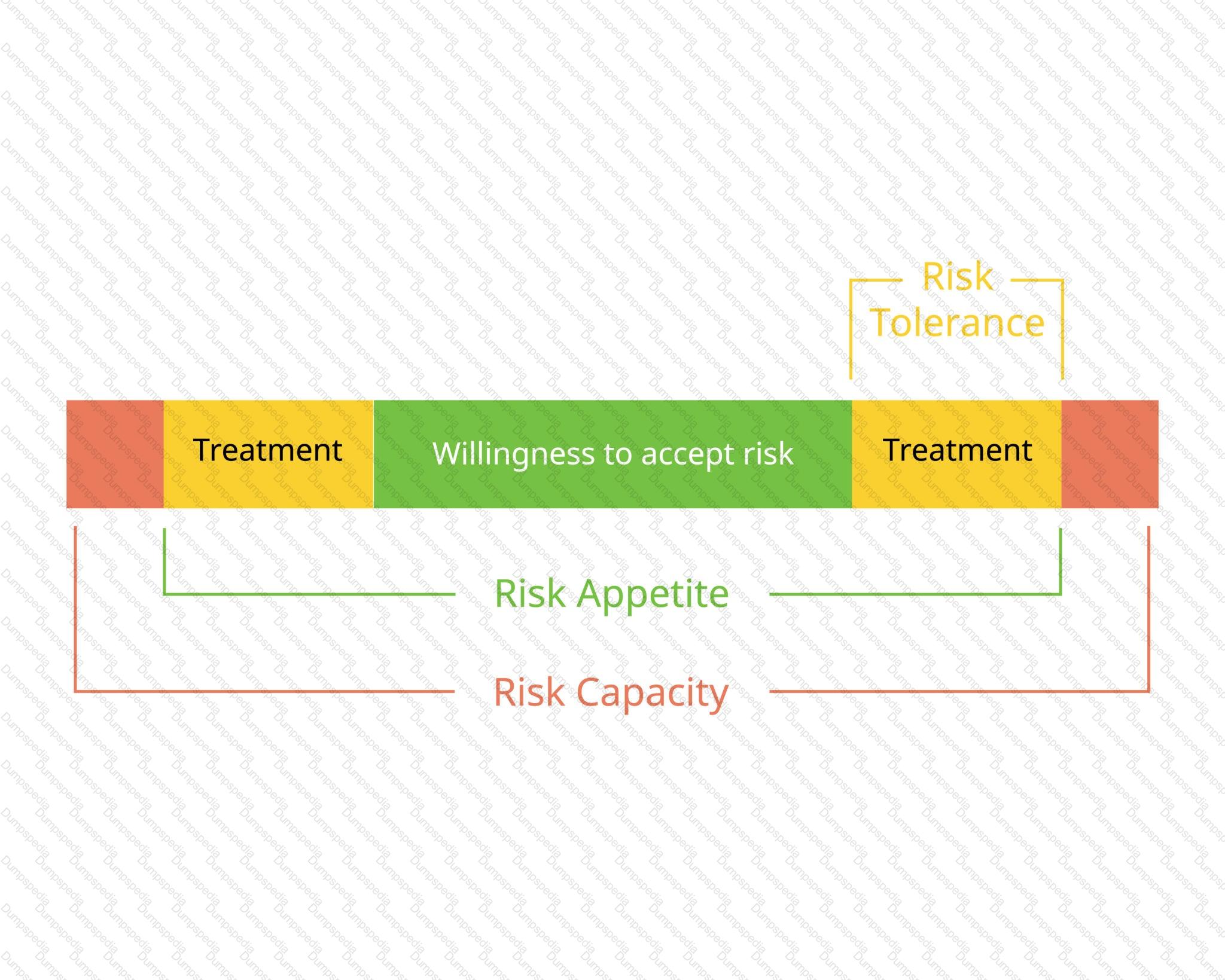
Getty Images
Comparison with other options:
A. Risk appetite: This is a higher-level, more qualitative description of the degree of uncertainty an organization is willing to take on in anticipation of a reward. It is a " tendency " or " desire " for risk, rather than the specific measurable amount they can " withstand. "
C. Risk threshold: This refers to the specific point at which a risk becomes unacceptable. While closely related to tolerance, the threshold is the " tripwire " or the level of impact at which a stakeholder may have a specific interest. If the risk exposure is below the threshold, the organization will accept the risk; if it is above, they will not.
D. Risk management: This is the overarching Knowledge Area and process of conducting risk management planning, identification, analysis, response planning, and monitoring. It is the framework, not the measurement of the risk itself.
At the completion of a project, a report is prepared that details the outcome of the research conducted on a global trend during the project. Which item did this project create?
Result
Product
Service
Improvement
According to the PMBOK® Guide (Project Management Body of Knowledge), a project is defined as a temporary endeavor undertaken to create a unique product, service, or result. These outputs are categorized as follows:
Result (Option A): A result is an outcome, such as a set of findings, a document, or a conclusion. In this specific scenario, the " report that details the outcome of research conducted on a global trend " is a classic example of a result. It is the knowledge or information produced by the project ' s activities.
Product (Option B): A product is an artifact that is produced, is quantifiable, and can be either an end item in itself or a component item. Examples include a building, a software application, or a physical piece of hardware.
Service (Option C): A service is the capability to perform a function. Examples include a business function that supports production or distribution, or a support desk.
Improvement (Option D): An improvement is a change made to an existing product, service, or result to enhance its performance, quality, or efficiency. While research might lead to an improvement later, the report itself is the primary result of the research project.
In PMI standards, projects are categorized by these outputs to help define the scope and the nature of the deliverables. When the objective is to gain knowledge or information, the deliverable is formally classified as a Result.
Which can be used to determine whether a process is stable or has predictable performance?
Matrix diagram
Histogram
Control chart
Flowchart
According to the PMBOK® Guide, specifically within the Control Quality process, a Control chart is the primary tool used to determine whether a process is stable or has predictable performance.
Control charts are graphic displays of process data over time and against established control limits, which have a centerline (the mean), an upper control limit (UCL), and a lower control limit (LCL).
Stability and Predictability: If the process data points stay within the control limits and do not exhibit non-random patterns, the process is considered " in control " and stable.
The Rule of Seven: A process is considered out of control if a single point exceeds a control limit or if seven consecutive points fall on one side of the mean, even if they are within the limits. This indicates a shift in the process that requires investigation.
Application: These are used in both manufacturing and management to monitor repetitive activities to ensure the results remain within acceptable statistical boundaries.
A. Matrix diagram: This is a quality management and planning tool used to perform data analysis within the organizational structure created in the matrix. it is used to show the strength of relationships between factors, causes, and objectives, not process stability.
B. Histogram: A histogram is a special form of bar chart used to describe the central tendency, dispersion, and shape of a statistical distribution. While it shows the frequency of occurrences, it does not show trends over time or process stability.
D. Flowchart: Also known as process maps, flowcharts display the sequence of steps and the branching possibilities that exist for a process that transforms one or more inputs into one or more outputs. They are used for identifying where quality problems might occur but not for measuring statistical stability.
In PMI standards, the Control Chart helps distinguish between Common Cause Variation (inherent to the process) and Special Cause Variation (caused by specific, unusual events). Identifying special causes is the first step in bringing a process back into a stable, predictable state.
An example of a group decision-making technique is:
nominal group technique
majority
affinity diagram
multi-criteria decision analysis
According to the PMBOK® Guide (Project Management Body of Knowledge), specifically within the Collect Requirements and Develop Schedule processes, PMI distinguishes between Group Decision-Making Techniques and Data Representation/Data Gathering tools.
Majority (Option B): This is a specific Group Decision-Making Technique. PMI defines these techniques as assessment processes having multiple alternatives with an expected outcome in the form of future actions. Majority is a decision reached with support from more than 50% of the members of the group. Other techniques in this specific category include Unanimity (everyone agrees), Plurality (the largest block decides even if not a majority), and Autocracy (one individual decides for the group).
Nominal Group Technique (Option A): While often used in group settings, PMI classifies this as a Data Gathering technique. It enhances brainstorming with a voting process used to rank the most useful ideas for further brainstorming or for prioritization.
Affinity Diagram (Option C): This is a Data Representation technique. it allows large numbers of ideas to be classified into groups for review and analysis. It is a way to organize data, not a rule for making a final decision.
Multi-criteria Decision Analysis (Option D): This is a Data Analysis technique. It uses a decision matrix to provide a systematic analytical approach for establishing criteria, such as risk levels, uncertainty, and valuation, to evaluate and rank many ideas.
In the PMI framework, the Majority rule is one of the four primary methods used by a group to reach a conclusion when evaluating requirements or project alternatives.
Which is the best way for a project manager to ensure efficient and frequent communication with management and stakeholders in an agile/adaptive environment?
Post project artifacts in a transparent fashion and engage stakeholders on a regular basis.
Make surveys among the stakeholders and meet with the team once a month.
Create a social network and post news there.
Create personalized emails for each stakeholder, asking for requests and reviewing objectives with them periodically.
According to the PMBOK® Guide and the Agile Practice Guide, communication in agile/adaptive environments prioritizes transparency and high-frequency interaction over formal, siloed documentation.
Information Radiators: Agile teams use " information radiators " (like physical or digital Kanban boards, Burndown charts, and Impediment logs). By posting these project artifacts in a transparent fashion—often in a shared space or accessible digital dashboard—stakeholders can see the real-time status of the project without waiting for a scheduled report.
Frequent Engagement: Rather than relying on periodic status meetings, agile project managers facilitate constant engagement through ceremonies such as Sprint Reviews and Demos. This allows stakeholders to see the actual product increment and provide immediate feedback, ensuring the project remains aligned with business value.
Empirical Process Control: Transparency is one of the three pillars of Scrum (alongside Inspection and Adaptation). Efficient communication is achieved when there is a " single version of the truth " accessible to everyone involved, reducing the time spent on manual status updates.
Analysis of Other Options:
B. Make surveys among the stakeholders and meet with the team once a month: Monthly meetings are far too infrequent for an agile environment, where change happens rapidly. Surveys are a passive form of communication that does not provide the real-time, two-way interaction required for adaptive projects.
C. Create a social network and post news there: While " social " tools can be part of a communication strategy, they often lack the structure and focus of formal project artifacts. Posting " news " is a one-way communication method (push communication) that doesn ' t necessarily ensure stakeholders are engaged with the specific progress of deliverables.
D. Create personalized emails for each stakeholder: While personalized communication is valuable, this approach is highly inefficient and difficult to scale. It creates communication silos and consumes excessive time for the project manager. Agile favors " pull " communication (stakeholders accessing transparent data) and collaborative meetings over individual email chains.
What is one of the main purposes of the project charter?
Formal authorization of the existence of the project
Formal acceptance of the project management plan
Formal approval of the detailed project budget
Formal definilion of stakeholder roles and responsibilities
According to the PMBOK® Guide, the Develop Project Charter process is the first formal step in the Initiating Process Group. The Project Charter is the document issued by the project initiator or sponsor that formally authorizes the existence of a project and provides the project manager with the authority to apply organizational resources to project activities.
Establishing the Project: Without an approved charter, a project does not officially exist in the eyes of the organization. It serves as the " birth certificate " of the project.
Authority of the Project Manager: It is the document that names the Project Manager and explicitly defines their level of authority. This allows the PM to start acquiring resources and spending money on project-related tasks.
High-Level Alignment: The charter links the project to the strategic objectives of the organization. It contains high-level information such as the project purpose, measurable objectives, high-level requirements, and a summary milestone schedule.
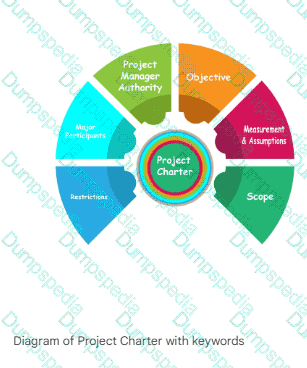
Analysis of other options:
B. Formal acceptance of the project management plan: This occurs much later in the Planning Process Group. The charter is the input used to start planning; it is not the approval of the plan itself.
C. Formal approval of the detailed project budget: The charter only contains a summary budget. The detailed, itemized budget is developed during the planning phase and is formalized in the Cost Baseline.
D. Formal definition of stakeholder roles and responsibilities: While some key stakeholders may be mentioned, the detailed definition of roles and responsibilities (such as a RACI matrix) is a planning activity (part of Resource Management), not the primary purpose of the charter.
Per PMI standards, the Project Charter is essential because it creates a direct link between the project and the strategic goals of the organization, ensuring that the project has the necessary formal authorization to proceed.
An adaptive team ' s velocity dropped significantly in the last sprint due to the planned vacation of two team members. The project sponsor wants to know how many more sprints it would take to complete the remaining project.
How should the project manager calculate the anticipated velocity for future sprints?
Use the velocity of the last sprint, as it is the most recent one to share.
Add a 30% buffer to the velocity to calculate future velocity.
Calculate the average of the past five sprints to predict future velocity.
Change the adaptive tool that the team is using to calculate velocity.
In Agile and Adaptive environments, Velocity is the measure of the amount of work a team can tackle during a single sprint and is the primary metric used for long-term planning.
Why Choice C is correct:
Stabilization: Velocity often fluctuates due to external factors like holidays, sick leave, or planned vacations (as seen in this scenario). Using a single outlier—like a sprint where two people were missing—would result in a pessimistic and inaccurate forecast.
Historical Averaging: The Agile Practice Guide recommends using an average of past performance (typically the last 3 to 5 sprints) to smooth out anomalies. This " Average Velocity " provides a more stable and realistic predictor of what the team can achieve in a normal capacity.
Forecasting: To answer the sponsor ' s question about " how many more sprints, " the project manager would take the remaining points in the Product Backlog and divide them by this average velocity.
Analysis of other options:
A (Use the velocity of the last sprint): This is incorrect because the last sprint was an anomaly. Two team members were on vacation, making that velocity significantly lower than the team ' s actual capacity. Predicting the entire project ' s future based on a temporary staffing shortage would lead to an unnecessarily long and inaccurate timeline.
B (Add a 30% buffer): While buffers are used in traditional project management for risk, Agile relies on empirical data. Arbitrarily adding a percentage (like 30%) is " guesswork " and does not reflect the team’s demonstrated historical performance.
D (Change the adaptive tool): The problem is not the tool; it is the data being used. Changing software (like Jira or ADO) will not change the fact that people were on vacation. Velocity is a human metric, not a software problem.
Key Concept: The Project Management Institute (PMI) emphasizes Empirical Process Control. Velocity is a tool for the team to measure its own capacity. By calculating the average (Choice C), the project manager accounts for both high-productivity and low-productivity periods, providing the sponsor with a forecast based on the team ' s " true " long-term cadence rather than a temporary dip.
Which of the following is an example of schedule compression?
Activity sequencing
Resource leveling
Lead and lag adjusting
Crashing
According to the PMBOK® Guide, specifically within the Develop Schedule process, Schedule Compression techniques are used to shorten the project schedule duration without reducing the project scope. There are two primary techniques recognized by PMI: Crashing and Fast Tracking.
Crashing is a technique used to shorten the schedule duration for the least incremental cost by adding resources.
Adding Resources: Examples include approving overtime, bringing in additional vendors, or adding more team members to activities on the critical path.
Cost-Schedule Trade-off: Crashing almost always results in increased costs. It is only effective for activities on the Critical Path where additional resources will actually shorten the duration.
Risk: While it shortens the timeline, it may increase risk or lead to diminishing returns if too many resources are added to a single task (the Law of Diminishing Returns).
A. Activity sequencing: This is the process of identifying and documenting relationships among the project activities. It defines the logical order of work but is not a technique used to " compress " or shorten an established duration.
B. Resource leveling: This is a resource optimization technique in which start and finish dates are adjusted based on resource constraints. Resource leveling often causes the original critical path to increase (lengthen), which is the opposite of compression.
C. Lead and lag adjusting: While adjusting leads (advancing an activity) can sometimes help overlapping, " Lead and lag adjusting " is a general refinement of dependencies. Fast Tracking is the specific compression technique that involves overlapping phases or activities that are normally done in sequence.
Crashing: Adds resources to shorten duration. Increases Cost.
Fast Tracking: Performs activities in parallel that were originally planned in sequence. Increases Risk.
Which process determines the risks that may affect the project and documents their characteristics?
Control Risks
Plan Risk Management
Plan Risk Responses
Identify Risks
According to the PMBOK® Guide and the Standard for Project Management, the process of determining which risks may affect the project and documenting their characteristics is Identify Risks.
As per PMI standards, this process is part of the Project Risk Management Knowledge Area and occurs within the Planning Process Group. The key benefit of this process is the documentation of existing risks and the knowledge and ability it provides to the project team to anticipate events. Important aspects of this process include:
Iterative Nature: Identify Risks is an iterative process because new risks may evolve or become known as the project progresses through its life cycle.
Participants: The process should involve the project manager, project team members, risk management team (if assigned), customers, subject matter experts, end users, and other stakeholders.
Risk Register: The primary output of this process is the Risk Register, which initially contains the list of identified risks and a list of potential responses.
The other options are incorrect based on the following PMI definitions:
Control Risks: (Now referred to as Monitor Risks) This is the process of monitoring the implementation of agreed-upon risk response plans, tracking identified risks, and identifying and analyzing new risks. It is a Monitoring and Controlling process, not the initial identification process.
Plan Risk Management: This is the process of defining how to conduct risk management activities for a project. It establishes the " roadmap " or strategy but does not identify the specific risks themselves.
Plan Risk Responses: This is the process of developing options and actions to enhance opportunities and to reduce threats to project objectives. This happens after risks have been identified and analyzed.
As per the PMI Lexicon of Project Management Terms, the Identify Risks process ensures that the team has a comprehensive understanding of the uncertainties that could impact the project ' s scope, schedule, cost, or quality.
Which process determines the risks that might affect the project?
Perform Qualitative Risk Analysis
Identify Risks
Plan Risk Management
Perform Quantitative Risk Analysis
According to the PMBOK® Guide and the Practice Standard for Project Risk Management, the process specifically designed to determine which risks may affect the project and to document their characteristics is Identify Risks.
Objective: The primary goal of this process is to uncover both individual project risks and sources of overall project risk. It is an iterative process because new risks may evolve or become known as the project progresses through its life cycle.
Documentation: The key output of this process is the Risk Register, which initially captures the list of identified risks, potential risk owners, and a list of potential risk responses. It also results in updates to the Risk Report.
Tools and Techniques: To determine these risks, project managers use techniques such as:
Brainstorming and Checklists.
SWOT Analysis (Strengths, Weaknesses, Opportunities, and Threats).
Prompt Lists (e.g., PESTLE, TECOP).
Root Cause Analysis.
Comparison with Other Options:
Plan Risk Management (C): This process defines how to conduct risk management activities; it does not identify the specific risks themselves.
Perform Qualitative Risk Analysis (A): This process takes the risks already identified and prioritizes them by assessing their probability and impact.
Perform Quantitative Risk Analysis (D): This process numerically analyzes the combined effect of identified individual project risks on overall project objectives.
To please the customer, a project team member delivers a requirement which is uncontrolled. This is not part of the plan. This describes:
scope creep.
a change request.
work performance information.
deliverables.
According to the PMBOK® Guide (Project Management Body of Knowledge) and standard PMI methodology, the scenario described is the quintessential definition of scope creep.
Scope creep refers to the uncontrolled expansion of product or project scope without adjustments to time, cost, and resources. In this specific case, the team member added a requirement that was " uncontrolled " and " not part of the plan. " Even if the intention was " to please the customer, " adding features or functions outside of the established scope baseline without following the formal Perform Integrated Change Control process constitutes scope creep.
B. A change request: This is incorrect because a change request is a formal proposal to modify any document, deliverable, or baseline. If the team member had submitted a change request, the requirement would have been reviewed and either approved or rejected, making it " controlled. "
C. Work performance information: This refers to the performance data collected from various controlling processes, analyzed in context and integrated based on relationships across areas. It is a status-related output, not a term for unauthorized work.
D. Deliverables: While the team member technically delivered something, " deliverables " refers to any unique and verifiable product, result, or capability that is required to be produced to complete a process, phase, or project. Since this was not part of the plan, it is considered an unauthorized extra rather than a planned project deliverable.
The Scope Baseline: Consists of the Project Scope Statement, WBS, and WBS Dictionary. Anything not in these documents is outside the project scope.
Gold Plating: This is a related concept often confused with scope creep. While scope creep is often requested by the customer (but not processed), gold plating is when the project team adds extra features they think the customer will like. Both are discouraged in PMI standards because they consume resources and can introduce new risks without official approval.
Project managers who lead by example and follow through on the commitments they make demonstrate the key interpersonal skill of:
influencing
leadership
motivation
coaching
According to the PMBOK® Guide (Project Management Body of Knowledge), specifically within the Project Resource Management knowledge area and the section on Interpersonal and Team Skills:
Leadership (Option B): This is the ability to guide, motivate, and direct a team to achieve the project ' s objectives. A core component of effective leadership in a PMI context is leading by example and establishing trust through integrity and follow-through on commitments. Leadership involves communicating the vision and inspiring the project team to perform high-quality work.
Influencing (Option A): While related to leadership, influencing is specifically the practice of sharing power and relying on interpersonal skills to get others to cooperate toward common goals. It is often used when a Project Manager has little or no direct authority over team members (matrix environments).
Motivation (Option C): This refers to the process of providing a reason for someone to act. While leaders motivate their teams, " Motivation " as a skill focuses more on understanding what drives individual team members (using theories like Maslow or Herzberg) to keep them engaged.
Coaching (Option D): This is a specific development technique used to help team members improve their skills and competencies. It is a more targeted, one-on-one pedagogical approach rather than the broad, project-wide behavioral standard of leading by example.
In the PMI framework, Leadership is considered one of the three pillars of the PMI Talent Triangle® (alongside Technical Project Management and Strategic and Business Management). By demonstrating consistency and commitment, the Project Manager builds the necessary " referent power " to guide the team through the complexities of the project life cycle.
A project team conducts regular standup meetings to keep everyone updated on what each one of them is working on. What type of communication is this?
Informal
Unofficial
Formal
Hierarchical
According to the PMBOK® Guide (6th and 7th Editions), communications are categorized by their level of structure and the nature of the interaction. While a standup meeting is a " scheduled " event, it is classified as Informal Communication because of its nature and intent.
In Agile and adaptive environments, standup meetings (Daily Scrums) are designed to be quick, high-frequency, and low-overhead. Unlike a " Formal " meeting which requires detailed minutes, a structured agenda, and official distribution to all stakeholders, a standup is a peer-to-peer coordination session.
Why Standup Meetings are considered Informal:
Ad-hoc/Minimal Documentation: These meetings typically do not result in formal minutes or official project records.
Peer-to-Peer Focus: The primary goal is coordination among the project team, rather than official reporting to management or external stakeholders.
Communication Style: They often involve verbal exchange and whiteboard/digital board updates rather than formal presentations.
Analysis of Distractors:
B (Unofficial): This is not a standard term used by PMI to classify communication types. Communication is generally classified as Formal/Informal or Internal/External.
C (Formal): Formal communication is reserved for official reports, briefings, formal meetings with clients, and documented legal or contract-related exchanges. These require a higher level of preparation and audit trails than a daily standup.
D (Hierarchical): This refers to the direction of communication (upward or downward through the organization ' s chain of command). A standup is typically horizontal or " flat " because it involves the team coordinating with one another, rather than a superior issuing orders to subordinates.
What tools or techniques can be used in all cost management processes ' ?
Decision making and expert judgment
Expert judgment and data analysis
Data analysis and meetings
Meetings and cost aggregation
According to the PMBOK® Guide, specifically within the Project Cost Management knowledge area, there are four primary processes: Plan Cost Management, Estimate Costs, Determine Budget, and Control Costs.
To identify tools and techniques that span the entire lifecycle of cost management, we look at the commonalities across these processes:
Expert Judgment: This is a fundamental tool used in every cost process. It involves input from individuals or groups with specialized knowledge in finance, accounting, industry-specific cost estimation, or previous similar projects. It is required to establish the plan, validate estimates, finalize the budget, and interpret variances during control.
Data Analysis: This is a broad category of techniques that appears in all cost processes. In Plan Cost Management, it includes alternative analysis; in Estimate Costs, it involves reserve analysis and cost of quality; in Determine Budget, it includes reserve analysis; and in Control Costs, it is critical for Earned Value Analysis (EVA), trend analysis, and variance analysis.
Analysis of other options:
Decision making: While used in planning and estimating, it is not a primary tool listed for every single process in the cost management suite (specifically within the standard Determine Budget process).
Meetings: While meetings occur frequently, they are formally listed as a tool for planning and control, but the core technical work of " Estimating " and " Determining Budget " relies more heavily on analytical tools.
Cost aggregation: This is a specific tool used only in the Determine Budget process to roll up activity cost estimates into work packages and eventually the cost baseline. It is not used in Plan Cost Management or Control Costs.
Therefore, per PMI standards, Expert Judgment and Data Analysis are the most pervasive tools that support the integrity of cost management from inception through completion.
How is the Project Scope Management process different in agile and adaptive projects then in traditional projects?
Less time spent on defining scope early on
More time spent on defining scope early on
Less time spent on scope management process
Project scope management is the same in all projects
According to the PMBOK® Guide and the Agile Practice Guide, the primary difference in scope management between these methodologies lies in the timing and the level of detail of scope definition.
Traditional (Predictive) Projects: These projects aim to define the entire scope as early as possible (during the planning phase) to create a fixed Scope Baseline. The goal is to minimize changes once execution begins. This requires a significant upfront investment of time in Requirement Collection and Scope Definition.
Agile/Adaptive Projects: These projects recognize that requirements are likely to evolve or that the final solution is not fully understood at the start. Therefore, less time is spent on defining scope early on. Instead, the scope is refined incrementally throughout the project life cycle.
Backlog Management: In agile, the scope is maintained in a Product Backlog. High-level requirements are identified at the start, but detailed specifications are only developed " just-in-time " for the iteration in which they will be built. This is often referred to as Rolling Wave Planning.
Evolutionary Discovery: This approach allows the project team and stakeholders to spend their time refining scope based on actual prototypes and feedback rather than hypothetical requirements at the project ' s inception.
Analysis of Other Options:
B. More time spent on defining scope early on: This is characteristic of traditional/waterfall projects, where " Scope Creep " is avoided by attempting to lock down all details at the beginning.
C. Less time spent on scope management process: This is incorrect. The total time spent on scope management may be the same or even more in agile, but it is distributed throughout the project (during backlog grooming, sprint planning, and reviews) rather than being front-loaded.
D. Project scope management is the same in all projects: This is fundamentally incorrect. The PMBOK® Guide explicitly provides " Tailoring Considerations " for different environments, highlighting that scope management must adapt to the project ' s level of uncertainty.
How can you describe the role of the project.... of influence concept?
The proiect manager proactivnly interacfS with other project managers creating a positive influence Km fulfilling project needs, working with other managers and sponsor to address internal political and strategic issues and ensunng that the project managemenl plan aligns with the portfolio or program plan
The project manager leads the team, performs communication roles between stakeholders, and uses interpersonal sills to balance conflicting goals
The proiect manager stays informed about current technology developments lakes into account new quality management standards, and uses relevant technical support tools
The proiect manager participates in project management trainings, contributes to the organization professional community sharing knowledge, and maintains subied matter expertise
According to the PMBOK® Guide, the Project Manager ' s Sphere of Influence describes the various groups and entities with which the project manager interacts and the reach of their influence within the organization and the industry.
The Sphere of Influence (Choice A): This choice accurately summarizes the multi-layered influence of a project manager. Beyond leading the immediate project team, the PM operates within a broader organizational context. This includes:
Other Project Managers: Interacting to share or compete for limited resources and to coordinate dependencies between projects.
Sponsors and Governance: Working with the project sponsor and steering committees to navigate internal politics, secure support, and address strategic hurdles.
Portfolio/Program Alignment: Ensuring that the project ' s tactical execution remains aligned with the higher-level strategic goals of the program or portfolio to which it belongs.
Team Leadership and Communication (Choice B): While these are core activities of a project manager, this description is limited primarily to the " Project Team " and " Stakeholders " layers of the sphere. It does not fully capture the organizational and strategic " influence " aspect described in Choice A.
Technology and Standards (Choice C): This refers to the Technical Project Management and Continuous Improvement aspects of the role. While a PM should stay informed, this is more about personal competency than the " Sphere of Influence " concept.
Professional Development (Choice D): This relates to the Industry and Professional Discipline layers of the sphere of influence. While important, it represents only the outermost layer and ignores the critical internal organizational influence required to manage a project successfully.
By understanding and navigating this sphere, the project manager acts as an integrator, ensuring that the project does not exist in a vacuum but is supported by and aligned with the entire organization.
A project manager has created an issue log to document issues communicated by project team members during weekly team meetings. This is an input of:
Manage Stakeholder Expectations.
Monitor and Control Risks.
Plan Risk Management.
Report Performance.
According to the PMBOK® Guide, the Issue Log is a project document where all the issues are recorded and tracked. While it is created as an output of the Direct and Manage Project Work process, it serves as a critical input for several other processes, most notably Manage Stakeholder Engagement (often referred to in older exam versions as Manage Stakeholder Expectations).
The Role of the Issue Log: An issue is defined as a point or matter in question or in dispute, or a point that is under discussion. The log ensures that these concerns are documented, assigned to an owner, and tracked until resolution.
Input to Stakeholder Management: To effectively manage stakeholder expectations and engagement, a project manager must address the concerns and issues that have been raised. By using the issue log as an input, the project manager ensures that stakeholders ' concerns are not overlooked, which helps in maintaining their support and managing their influence on the project.
Integration: Resolving issues helps in reducing project risks and increases the likelihood of meeting project objectives.
Analysis of Other Options:
B. Monitor and Control Risks: While issues and risks are related, the primary input here is the Risk Register. Risks are uncertain events that might happen, whereas issues are events that have happened.
C. Plan Risk Management: This process defines how to conduct risk management activities. It happens early in the project (Planning) and focuses on the methodology, not on the specific issues log created during execution.
D. Report Performance: This process (often part of Monitor and Control Project Work or Manage Communications) focuses on collecting and distributing performance information, including status reports and progress measurements. While an issue log might be referenced in a report, it is not formally listed as a primary input to the process of performance reporting in the same way it is for managing stakeholder engagement.
The process of obtaining seller responses, selecting a seller, and awarding a contract is called:
Close Procurements.
Control Procurements.
Plan Procurements.
Conduct Procurements.
According to the PMBOK® Guide, the Project Procurement Management knowledge area consists of three main processes (in the 6th and 7th editions). The specific activities of obtaining seller responses, selecting a seller, and awarding a contract define the Conduct Procurements process.
Execution Phase: Conduct Procurements is an Executing process. Its primary purpose is to receive bids or proposals and apply selection criteria to select one or more sellers who are qualified to perform the work and with whom a contract can be signed.
Key Tools and Techniques:
Bidder Conferences: Meetings between the buyer and all prospective sellers prior to submittal of a bid or proposal.
Proposal Evaluation Techniques: Formal procedures used to score and rank proposals based on weighted criteria.
Advertising: Communicating the procurement opportunity to the public or specific vendor lists.
Procurement Negotiations: Clarifying requirements and terms to reach a mutual agreement before signing the contract.
Key Outputs: The primary outputs of this process are Selected Sellers, Agreements (contracts), and Change Requests.
Comparison with other options:
A. Close Procurements: In earlier editions of the PMBOK® Guide, this was a standalone process. In current standards, administrative closure of a procurement is part of Control Procurements. It involves verifying that all work and deliverables are acceptable and finalizing open claims.
B. Control Procurements: This is the Monitoring and Controlling process. It focuses on managing procurement relationships, monitoring contract performance, and making changes and corrections as appropriate. It happens after the contract is awarded.
C. Plan Procurements: This is the Planning process where the team decides what to buy, how to buy it, identifies potential sellers, and creates the Procurement Management Plan and Source Selection Criteria. It happens before seller responses are obtained.
The project has a current cost performance index of 0.80. Assuming this performance wi continue, the new estimate at completion is $1000. What was the original budget at completion for the project?
$800
$1000
$1250
$1800
According to the PMBOK® Guide, specifically within the Control Costs process, Earned Value Management (EVM) is used to forecast the project ' s financial outcome based on current performance.
The Scenario: The question provides a Cost Performance Index (CPI) and an Estimate at Completion (EAC), while stating that the current performance is expected to continue for the remainder of the project.
The Formula: When the current $CPI$ is expected to continue, the formula for $EAC$ is:
$$EAC = \frac{BAC}{CPI}$$
Solving for BAC: To find the original budget (Budget at Completion or $BAC$), we must rearrange the formula:
$$BAC = EAC \times CPI$$
The Calculation:
$$BAC = \$1000 \times 0.80$$
$$BAC = \$800$$
This result indicates that the project was originally budgeted for $\$800$, but because it is performing inefficiently (spending $\$1.00$ to get $\$0.80$ worth of work), it is now expected to cost $\$1000$ to complete.
Analysis of Other Options:
B. $1000: This is the $EAC$ (the forecasted total cost), not the $BAC$ (the original budget).
C. $1250: This would be the result if you incorrectly divided $EAC$ by $CPI$ ($\$1000 / 0.80 = \$1250$), which does not align with the standard EVM mathematical relationships for this scenario.
D. $1800: This number has no mathematical basis in the provided EVM data.
When a backward pass is calculated from a schedule constraint that is later than the early finish date that has been calculated during a forward pass calculation, this causes which type of total float?
Negative
Zero
Positive
Free
According to the PMBOK® Guide and the Standard for Project Management, specifically within the Develop Schedule process using the Critical Path Method (CPM), the relationship between the forward pass and the backward pass determines the amount of Total Float.
As per PMI standards, Total Float is the amount of time that a schedule activity can be delayed or extended from its early start date without delaying the project finish date or violating a schedule constraint. The calculation for Total Float is:
$$\text{Total Float} = \text{Late Finish (LF)} - \text{Early Finish (EF)}$$
or
$$\text{Total Float} = \text{Late Start (LS)} - \text{Early Start (ES)}$$
In the scenario described:
Forward Pass: Calculates the Early Finish (EF) date.
Backward Pass: Starts from a Schedule Constraint (the required completion date).
The Condition: The constraint (LF) is later (further in the future) than the calculated EF.
Because the Late Finish is greater than the Early Finish, the result of the subtraction is a Positive value. This indicates that the project or activity has " extra " time or a buffer before it would impact the mandatory constraint.
The other options are incorrect based on the following PMI scheduling logic:
Negative: This occurs when a schedule constraint is earlier than the calculated early finish date ($LF < EF$), indicating the project is already behind the required deadline.
Zero: This occurs when the late finish is equal to the early finish ($LF = EF$), which is typical for activities on the Critical Path.
Free: This is the amount of time an activity can be delayed without delaying the Early Start of any successor activity. It is a relationship between activities, whereas the question describes a relationship between a pass calculation and a project-level constraint.
As per the PMI Lexicon of Project Management Terms, understanding positive float is essential for resource leveling, as it identifies which activities have flexibility to be shifted without jeopardizing the final deadline.
Which tool or technique used in the Control Procurements process can be conducted during the execution of the project to verify compliance with deliverables?
Procurement documents
Inspection and audits
Estimate budget
Risk register
According to the PMBOK® Guide (Project Management Body of Knowledge), specifically within the Project Procurement Management knowledge area and the Control Procurements process:
Inspection and Audits (Option B): This is a key tool and technique used to verify compliance in the seller’s work. While " Inspections " focus on the product or deliverable itself (physically verifying that the work meets requirements), " Audits " focus on the procurement process and the seller ' s adherence to the agreed-upon procedures. Both are conducted during the project ' s execution and monitoring phases to identify any non-compliance before the final handover.
Procurement Documents (Option A): These are considered Inputs to the Control Procurements process (such as the contract, statement of work, and bid documents). They provide the basis for the requirements but are not the " tool " used to perform the verification itself.
Estimate Budget (Option C): This is part of the Project Cost Management knowledge area (specifically the Determine Budget process). While costs are monitored during procurement, " estimating " the budget is a planning activity, not a compliance verification tool.
Risk Register (Option D): This is a project document (Input) that contains information on identified risks. While procurement involves significant risk, the register is used to track and monitor those risks, not to verify the physical compliance of a vendor ' s deliverables.
In the PMI framework, Control Procurements is the process of managing procurement relationships, monitoring contract performance, and making changes and corrections as appropriate. Inspections and audits are the primary mechanisms for the buyer to ensure the seller is fulfilling their contractual obligations regarding quality and process.
What is the primary benefit of the Manage Quality process?
Increases the probability of meeting quality objectives
Enhances the performance of the product berg created
Defines quality roles and responsibilities
Ensures that the project is completed as originally planned
According to the PMBOK® Guide, Manage Quality (sometimes called Quality Assurance) is the process of translating the quality management plan into executable quality activities that incorporate the organization’s quality policies into the project.
Primary Benefit: The key benefit of this process is that it increases the probability of meeting the quality objectives as well as identifying ineffective processes and causes of poor quality. It uses the data and results from the Control Quality process to reflect the overall quality status to stakeholders and ensures that the final product will meet their needs and expectations.
How it Works: While Control Quality is focused on the deliverables (outputs), Manage Quality is focused on the processes used to create those deliverables. By ensuring the processes are efficient and followed correctly, the project is much more likely to hit its quality targets.
Key Activities: This process involves quality audits, process analysis, and the use of design for excellence (DfX) to improve the overall quality of the project work.
Analysis of other options:
Option B: While Manage Quality can lead to a better product, its primary goal is to meet the defined objectives and requirements, not necessarily to " enhance " performance beyond what was agreed upon in the baseline.
Option C: Defining roles and responsibilities is a primary benefit of the Plan Quality Management process, where the Quality Management Plan is first created.
Option D: This is a very broad statement that describes the general goal of all project management processes combined. Specifically, managing changes to keep the project on plan is the role of Perform Integrated Change Control and Monitor and Control Project Work.
Per PMI standards, Manage Quality is considered the work of everybody—the project manager, the project team, the selected management, and even the customer—but the primary benefit remains the systematic increase in the likelihood of reaching the quality goals set during the planning phase.
A special type of bar chart used in sensitivity analysis for comparing the relative importance of the variables is called a:
triangular distribution
tornado diagram
beta distribution
fishbone diagram
According to the PMBOK® Guide (Project Management Body of Knowledge), specifically within the Project Risk Management knowledge area and the Perform Quantitative Risk Analysis process:
Tornado Diagram (Option B): This is a special type of bar chart used in sensitivity analysis to compare the relative importance and impact of variables that have a high degree of uncertainty. In this diagram, the Y-axis contains the various uncertain variables, and the X-axis represents the correlation to the project outcome (such as cost or schedule). The bars are ordered by the size of the impact, with the largest impact at the top and the smallest at the bottom, giving the chart a " tornado " shape. It allows the project manager to quickly identify which risks have the most significant potential effect on the project ' s success.
Triangular Distribution (Option A): This is a type of continuous probability distribution often used in three-point estimating (Optimistic, Pessimistic, and Most Likely). It is a mathematical model for uncertainty, not a chart used for comparing the relative importance of variables.
Beta Distribution (Option C): Similar to the triangular distribution, the Beta distribution (often associated with PERT) is a probability distribution used to provide a weighted average for activity duration or cost estimates. It is an input to analysis, not the output chart for sensitivity.
Fishbone Diagram (Option D): Also known as an Ishikawa or Cause-and-Effect diagram, this is a tool used in Project Quality Management to identify the root causes of a problem. It does not measure the relative sensitivity of variables to a project objective.
In the PMI framework, the Tornado Diagram is an essential tool for quantitative analysis because it visually communicates where the project team should focus their risk response efforts. By highlighting the variables with the greatest " swing " or impact, the Project Manager can prioritize management of the most volatile elements of the project plan.
Which process requires implementation of approved changes?
Direct and Manage Project Execution
Monitor and Control Project Work
Perform Integrated Change Control
Close Project or Phase
According to the PMBOK® Guide, the process of Direct and Manage Project Execution (referred to as Direct and Manage Project Work in newer editions) is where the actual work defined in the project management plan is performed to achieve the project ' s objectives.
Implementation of Changes: A key responsibility of this process is the implementation of approved changes. These changes can include:
Corrective Actions: To realign the performance of the project work with the project management plan.
Preventive Actions: To ensure the future performance of the project work is aligned with the project management plan.
Defect Repairs: To modify a nonconforming product or product component.
The Flow of Changes: Changes are identified in various monitoring and controlling processes, then they are reviewed and either approved or rejected in the Perform Integrated Change Control process. Once approved, they are sent back to the Direct and Manage Project Execution process to be physically carried out by the team.
Analysis of Other Options:
B. Monitor and Control Project Work: This process is concerned with tracking, reviewing, and reporting the overall progress of the project. It identifies the need for change but does not implement the work itself.
C. Perform Integrated Change Control: This is the " decision-making " process. This is where changes are approved or rejected. The act of approving happens here, but the implementation (the physical work) happens in Execution.
D. Close Project or Phase: This process involves finalizing all activities across all Project Management Process Groups to formally complete the project or phase. It is not the stage for implementing new changes to project deliverables.
In which Knowledge Area is the project charter developed?
Project Cost Management
Project Scope Management
Project Time Management
Project Integration Management
According to the PMBOK® Guide and the Standard for Project Management, the project charter is developed within the Project Integration Management Knowledge Area. Specifically, this occurs during the Develop Project Charter process, which is the very first process in the Initiating Process Group.
As per PMI standards, Project Integration Management includes the processes and activities to identify, define, combine, unify, and coordinate the various processes and project management activities. The Project Charter is a critical element of this Knowledge Area because:
Authorization: It is the document issued by the project initiator or sponsor that formally authorizes the existence of a project and provides the project manager with the authority to apply organizational resources to project activities.
Alignment: It establishes a direct link between the project and the strategic objectives of the organization.
High-Level Boundaries: It documents high-level information such as the project purpose, measurable objectives, high-level requirements, overall project risk, and summary milestone schedule.
The other options are incorrect based on the following PMI Knowledge Area definitions:
Project Cost Management: This Knowledge Area is concerned with planning, estimating, budgeting, financing, funding, managing, and controlling costs so that the project can be completed within the approved budget. It uses the charter as an input, but does not create it.
Project Scope Management: This area focuses on ensuring the project includes all the work required, and only the work required. Like Cost Management, it uses the high-level boundaries defined in the charter to begin the Plan Scope Management and Collect Requirements processes.
Project Time Management: (Now referred to as Project Schedule Management) This area focuses on the timely completion of the project. It relies on the summary milestone schedule found in the project charter to develop the detailed schedule.
As per the PMI Lexicon of Project Management Terms, the Develop Project Charter process is essential for ensuring that the project manager and the performing organization are officially recognized and empowered to begin the planning phase.
Who defines the scope of the product
The client
The project manager
The team
The program manager
In accordance with the PMBOK® Guide, particularly within the Collect Requirements and Define Scope processes, the definition of the product scope is fundamentally driven by the customer ' s needs and expectations.
The Client/Customer (Choice A): The client is the primary stakeholder who defines the requirements and the ultimate scope of the product. They provide the business need and the functional/non-functional requirements that the project is intended to fulfill. While the project team facilitates the discovery and documentation of these requirements, the " what " of the product—its features and functions—is defined by the client.
The Project Manager (Choice B): The PM is responsible for managing the project scope (the work required to deliver the product). While the PM facilitates the Define Scope process and ensures the scope statement is documented, they do not " define " the product features; they translate the client ' s needs into a manageable plan.
The Team (Choice C): The project team (or technical experts) provides input on the technical feasibility and the " how " of the product. In Agile environments, the team may help refine the backlog, but the direction of the product scope remains with the customer or their representative (the Product Owner).
The Program Manager (Choice D): A program manager provides high-level oversight and ensures strategic alignment across multiple related projects. They are too far removed from individual project deliverables to define the specific product scope.
The Product Scope refers to the features and functions that characterize a product, service, or result. Its successful completion is measured against the product requirements, which are owned and defined by the Client.
The process of formalizing acceptance of the completed project deliverables is known as:
Validate Scope.
Close Project or Phase.
Control Quality.
Verify Scope.
According to the PMBOK® Guide, Validate Scope is the process of formalizing acceptance of the completed project deliverables. This process is primarily concerned with the customer or sponsor ' s acceptance of the work that has been performed.
Key Inputs: The most critical input for this process is Verified Deliverables. These are deliverables that have already been internally inspected and confirmed to be correct through the Control Quality process.
Process Flow:
The project team completes a deliverable.
Control Quality (Internal) happens first to ensure the deliverable is " correct " and meets technical specifications.
Validate Scope (External/Sponsor) follows, where the customer reviews the work to ensure it meets their requirements.
Key Output: The primary output of this process is Accepted Deliverables. These are formally signed off by the customer or sponsor. If a deliverable is not accepted, change requests are generated to bring the deliverable into alignment with the requirements.
Comparison with other options:
B. Close Project or Phase: This is the process of finalizing all activities for the project, phase, or contract. While it involves checking that all scope was completed, the specific act of formalizing acceptance for individual deliverables occurs in Validate Scope.
C. Control Quality: This process is concerned with the correctness of the deliverables and meeting the quality requirements. It is an internal process performed by the project team, whereas Validate Scope is focused on acceptance by the customer.
D. Verify Scope: This was the name of the process in older versions of the PMBOK® Guide (4th Edition and earlier). In modern PMI standards (5th Edition onwards), this process was renamed to Validate Scope to better reflect its purpose of gaining formal validation/acceptance from stakeholders.
Which is the correct formula for calculating expected activity cost for three-point estimating?
Ce = (C0 + 6Cm + Cp)/4
Ce = (6C0 + Cm + Cp)/4
Ce = (C0 + 4Cm + Cp)/6
Ce = (C0 + C„, + 4Cp) / 6
According to the PMBOK® Guide, specifically within the Estimate Costs process, Three-point estimating is used to define an approximate range for an activity ' s cost, thereby improving the accuracy of the estimate by factoring in uncertainty and risk.
The formula provided in option C is the Beta Distribution, which is historically derived from the Program Evaluation and Review Technique (PERT). This is the most commonly used formula in PMI-based exams when " Three-point estimating " is mentioned without specifying a simple average.
The variables are defined as:
$C_e$ (Expected Cost): The calculated " weighted " average.
$C_o$ (Optimistic Cost): The cost based on a best-case scenario.
$C_m$ (Most Likely Cost): The cost based on a realistic appraisal of the work and expenses.
$C_p$ (Pessimistic Cost): The cost based on a worst-case scenario.
In the Beta Distribution, the Most Likely ($C_m$) estimate is given a weight of 4, while the Optimistic and Pessimistic estimates are given a weight of 1 each. The total weight is 6 ($1 + 4 + 1$), which is why the sum is divided by 6. This " weights " the result toward the most realistic outcome while still allowing the risks (pessimistic) and opportunities (optimistic) to influence the final number.
A, B, and D: These represent mathematically incorrect weightings that do not align with the standard Beta (PERT) or Triangular distribution formulas recognized by PMI.
Triangular Distribution (Alternative): While not listed as an option here, the other common three-point formula is the simple average: $C_e = (C_o + C_m + C_p) / 3$. This is used when there is less historical data available.
This formula is identical to the one used for Three-point Duration Estimating, simply swapping " Time " ($t$) for " Cost " ($c$). It is a primary tool for reducing the bias that often occurs with single-point estimates.
Which defines the portion of work included in a contract for items being purchased or acquired?
Procurement management plan
Evaluation criteria
Work breakdown structure
Procurement statement of work
According to the PMBOK® Guide, specifically within the Plan Procurement Management process, the Procurement Statement of Work (SOW) is the document that describes the procurement item in sufficient detail to allow prospective sellers to determine if they are capable of providing the products, services, or results.
Definition: The Procurement SOW defines the portion of the project scope that is to be included within the related contract. It is developed from the project scope baseline and defines only that portion of the project scope that is to be included within the related contract.
Content: It typically includes specifications, quantity desired, quality levels, performance data, period of performance, work location, and other requirements.
Purpose: Its primary goal is to provide a clear and concise description of the work to be performed by the contractor, which helps in reducing risks and misunderstandings during the bidding process and contract execution.
Analysis of other choices:
Choice A (Procurement management plan): This is a subsidiary plan that describes how the procurement process will be managed, from developing procurement documents through contract closure. It does not define the specific technical work included in a single contract.
Choice B (Evaluation criteria): These are used to rate or score seller proposals to ensure they meet the requirements. They are used to select the seller, not to define the work itself.
Choice C (Work breakdown structure): While the WBS provides the framework for the project scope, the Procurement SOW is the specific document derived from the WBS that is handed to a seller to define the contractual work package.
Which of the following is provided by the critical path method?
Schedule float
Earned value (EV)
Total float
Schedule value
The Critical Path Method (CPM) is a fundamental technique used in the Develop Schedule process of the PMBOK® Guide. It calculates the theoretical start and finish dates for all activities without considering resource limitations.
Why Choice C is correct:
Definition of Total Float: Total float is the amount of time an activity can be delayed from its early start date without delaying the project finish date or violating a schedule constraint.
The Calculation: The CPM uses a " Forward Pass " to determine early dates and a " Backward Pass " to determine late dates. The difference between these dates ($Late Start - Early Start$ or $Late Finish - Early Finish$) is the Total Float.
Identifying the Critical Path: Activities with zero total float are on the Critical Path. Any delay to these activities will directly delay the project ' s completion date.
Management Value: By providing the total float for non-critical activities, the project manager knows how much " flexibility " or " slack " they have before a task starts affecting the final deadline.
Analysis of other options:
A (Schedule float): While " float " is the correct concept, " Schedule Float " is not the standard technical term used in the PMBOK® Guide. The two specific types of float identified by CPM are Total Float and Free Float.
B (Earned value): Earned Value (EV) is a metric used in Earned Value Management (EVM) to measure project performance in terms of scope and cost. It is not a product of the Critical Path Method, which focuses strictly on time and logic.
D (Schedule value): This is not a standard project management term. You may be thinking of Planned Value (PV) or Schedule Variance (SV), both of which are part of EVM, not CPM.
Key Concept:
The Project Management Institute (PMI) emphasizes that the Critical Path Method (Choice C) is essential for prioritizing resources. By identifying which tasks have Total Float and which do not, the project manager can focus their attention on the " Critical " tasks that have the highest impact on the project ' s success.
Which of the following does a portfolio combine?
Projects, programs, and operations
Operations, strategies, and business continuity
Projects, programs, and risks
Projects, change management, and operations
According to the PMBOK® Guide and The Standard for Portfolio Management, a portfolio is defined by its relationship to the organization ' s strategic goals rather than just the shared work between individual components.
Why Choice A is correct:
The Definition: A Portfolio is a collection of projects, programs, subsidiary portfolios, and operations managed as a group to achieve strategic objectives.
Strategic Alignment: While projects and programs focus on " doing things right " (execution), portfolio management focuses on " doing the right things " (selection).
Inclusion of Operations: Unlike programs, which generally consist of related projects, a portfolio includes ongoing operations (such as maintenance or recurring business activities) to ensure that the organization’s total resource capacity is balanced between new initiatives and sustaining the business.
Analysis of other options:
B (Operations, strategies, and business continuity): While a portfolio is guided by strategy, " strategy " and " business continuity " are organizational functions or goals, not the components that make up the portfolio itself. A portfolio is the container for the work that realizes those strategies.
C (Projects, programs, and risks): Risk management is a process applied to all levels of management, but " risks " are not a constituent component of a portfolio in the same way that projects or programs are.
D (Projects, change management, and operations): Change management is a critical discipline used within projects and portfolios to ensure transitions are successful, but it is not a structural component (like a program or project) that a portfolio " combines. "
Key Concept: The Project Management Institute (PMI) emphasizes that the purpose of a Portfolio (Choice A) is to provide high-level visibility. By combining Projects, Programs, and Operations, senior leadership can see how all organizational resources are being used and make informed decisions about where to invest to best achieve the company ' s long-term vision.
A project team has completed the first iteration and the testing manager approved the test report, indicating that the acceptance criteria have been met. The manager of the business unit that will use the new product is asking for additional functionality before approving the rollout for their team.
What should the project manager do next?
Escalate this issue to the project sponsor.
Reschedule the rollout to start with another business unit.
Reschedule the rollout to include the new requirements.
Escalate this issue to the project management office (PMO).
According to the PMBOK® Guide and the PMI Guide to Business Analysis, this situation involves a conflict between " Technical Acceptance " and " Business Approval " at the end of an iteration.
Conflict Resolution and Governance: The project team has successfully met the pre-defined Acceptance Criteria, as verified by the testing manager. However, a high-level stakeholder (the Business Unit Manager) is now adding new requirements as a prerequisite for rollout. Since the iteration is already complete and the original goals were met, this represents a significant change in stakeholder expectations and project scope.
Role of the Project Sponsor: The Project Sponsor is the individual who provides resources and support for the project and is accountable for enabling success. They are the ultimate authority when there is a disagreement between the project ' s output and a business unit ' s needs. The Project Manager should escalate this to the sponsor to decide whether to stick to the original rollout plan or to fund and authorize the additional functionality.
Scope Control: Accepting the requirements immediately (Option C) would lead to scope creep and schedule delays without proper authorization. Escalating to the sponsor ensures that the business value of the new request is weighed against the project ' s constraints by the person holding the budget.
Analysis of other options:
Option B: Rescheduling the rollout to another unit is a premature move that avoids the root problem. The project manager does not yet have the authority to change the rollout strategy without consulting the sponsor or the steering committee.
Option C: Including new requirements at this stage without a formal evaluation and approval process is a violation of Change Control principles. It would delay the project and could potentially impact the quality of the current iteration ' s deliverables.
Option D: The PMO typically provides templates, best practices, and oversight. While they might offer advice on how to handle the situation, they do not usually have the authority to resolve business-unit-specific scope disputes; that is the role of the Project Sponsor.
Per PMI standards, when a major stakeholder demands additional scope after the agreed-upon criteria have been met, the project manager must escalate to the Project Sponsor to determine the strategic direction and the impact on the project ' s business case.
Which tools or techniques will a project manager use for Develop Project Team?
Negotiation
Roles and responsibilities
Recognition and rewards
Prizing and promoting
According to the PMBOK® Guide, the Develop Team process (formerly Develop Project Team) uses several specific tools and techniques to improve the competencies, team member interaction, and overall team environment.
Recognition and Rewards: This is a formal tool and technique used to promote and reinforce desirable behavior. The process involves recognizing and rewarding people for their performance and contributions to the project.
Application: To be effective, rewards must be based on activities and performance under a person ' s control. For example, rewarding a team member for meeting a challenge or reaching a specific milestone encourages continued high performance.
Cultural Sensitivity: The project manager must consider cultural differences when determining rewards (e.g., some cultures value individual praise, while others prefer team-based recognition).
Other Tools and Techniques for Develop Team:
Colocation (Tight Matrix): Placing team members in the same physical location.
Virtual Teams: Using technology to bring together people in different locations.
Communication Technology: Tools like email, portals, and video conferencing.
Interpersonal and Team Skills: Including conflict management, influence, motivation, negotiation, and team building.
Individual and Team Assessments: Tools like surveys or structured interviews to understand team strengths and weaknesses.
Training: Activities designed to enhance the competencies of the project team members.
Comparison with other options:
A. Negotiation: While negotiation is an interpersonal skill used in many processes, it is a primary tool and technique for the Acquire Resources process (used to " negotiate " for staff from functional managers or other teams).
B. Roles and responsibilities: This is an output of the Plan Resource Management process (documented in the Resource Management Plan). It is a definition of what people do, not a technique used to develop the team ' s capabilities or cohesion.
D. Prizing and promoting: These are not formal terms used in the PMBOK® Guide. While " promoting " might happen in a general business sense, the specific PMI-standard term for reinforcing behavior within a project is Recognition and Rewards.
What is the key benefit of the Monitor Stakeholder Engagement process?
Ensures that the informational needs of the project and its stakeholders are met through implementation and the development of artifacts
Ensures that the project includes all the work required and only the work required—to complete the project successfully
Increases the probability and/or impact of positive risks, and decreases the probability and/or Impact of negative risks or issues
Maintains or increases the efficiency and effectiveness of stakeholder engagement activities as the project evolves
According to the PMBOK® Guide, Monitor Stakeholder Engagement is the process of monitoring project stakeholder relationships and tailoring strategies for engaging stakeholders through the modification of engagement strategies and plans.
The Key Benefit: The primary value of this process is that it allows the project manager to maintain or increase the efficiency and effectiveness of stakeholder engagement activities. As a project progresses through its lifecycle, the stakeholder community changes, and their interest or influence may shift. This process ensures that the engagement strategies remain relevant and effective in the face of these changes.
Process Nature: This is a Monitoring and Controlling process. It involves comparing actual stakeholder engagement against the planned engagement (as documented in the Stakeholder Engagement Plan) and taking corrective action if there is a variance.
Analysis of other options:
Option A: This describes the key benefit of the Manage Communications or Monitor Communications process, which focuses specifically on the flow of information and meeting informational needs.
Option B: This is the definition of the key benefit of Project Scope Management. It focuses on work containment, not stakeholder relationships.
Option C: This describes the key benefit of Project Risk Management, specifically the Plan Risk Responses and Implement Risk Responses processes.
Per PMI standards, while " Managing " engagement is about doing the activities, " Monitoring " engagement is about evaluating the results of those activities and adjusting the approach to ensure stakeholders remain supportive and project-aligned.
Which is an output of the Collect Requirements process?
Requirements traceability matrix
Project scope statement
WBS dictionary
Work performance measurements
Comprehensive and Detailed Explanation with all Project Management documents: = According to the PMBOK® Guide, the Collect Requirements process is the process of determining, documenting, and managing stakeholder needs and requirements to meet project objectives.
Requirements Traceability Matrix (RTM): This is a primary output of this process. It is a grid that links product requirements from their origin to the deliverables that satisfy them. It ensures that each requirement adds business value by linking it to the business and project objectives and provides a means to track requirements throughout the project life cycle.
Requirements Documentation: This is the other major output, which describes how individual requirements meet the business need for the project.
The Importance of the RTM: It helps ensure that requirements approved in the requirements documentation are delivered at the end of the project and that they are not " lost " during the execution and testing phases.
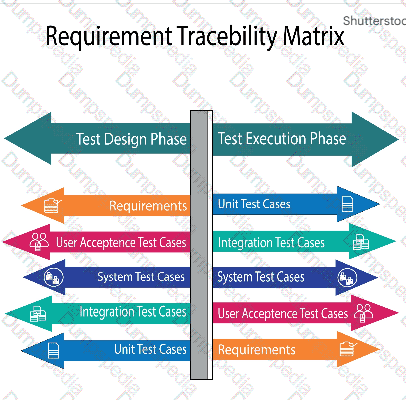
Analysis of Other Options:
B. Project scope statement: This is the primary output of the Define Scope process, not Collect Requirements. While requirements are an input to defining scope, the formal statement is produced later.
C. WBS dictionary: This is an output of the Create WBS process. It provides detailed information about the work packages after the scope has already been defined and decomposed.
D. Work performance measurements: These are typically associated with the Control processes (like Control Schedule or Control Costs). In the Collect Requirements phase, which is part of Planning, no actual work has been performed yet to measure.
Which is an enterprise environmental factor?
Marketplace conditions
Policies and procedures
Project files from previous projects
Lessons learned from previous projects
According to the PMBOK® Guide (Project Management Body of Knowledge), specifically in the chapter regarding the Environment in which Projects Operate, there is a clear distinction between Enterprise Environmental Factors (EEFs) and Organizational Process Assets (OPAs):
Marketplace Conditions (Option A): This is a classic example of an External EEF. EEFs refer to conditions, not under the control of the project team, that influence, constrain, or direct the project. Marketplace conditions include brand recognition, market share, and competitors ' products/services. Other EEFs include organizational culture, infrastructure, and resource availability.
Policies and Procedures (Option B): These are OPAs. Specifically, they fall under the category of " Processes, Policies, and Procedures. " They are internal to the organization and are used to conduct the work of the project.
Project Files from Previous Projects (Option C): These are OPAs that fall under the " Organizational Knowledge Bases " category. They are kept for historical reference and to help with current project planning.
Lessons Learned from Previous Projects (Option D): These are also OPAs (specifically, historical information). They are considered a key asset that the organization gains from its experience in project management.
In the PMI framework, identifying Enterprise Environmental Factors is essential during the Initiating and Planning phases, as these factors often act as constraints that the Project Manager must navigate to ensure project success.
The only Process Group that comprises processes that typically occur from the beginning to the end of the project life cycle is:
Planning.
Executing,
Monitoring and Controlling.
Closing.
According to the PMBOK® Guide, the Monitoring and Controlling Process Group consists of those processes required to track, review, and regulate the progress and performance of the project; identify any areas in which changes to the plan are required; and initiate the corresponding changes.
Continuous Nature: Unlike other process groups that have a clear peak or primary focus at specific stages (e.g., Planning at the beginning, Executing in the middle, Closing at the end), Monitoring and Controlling occurs concurrently with all other process groups.
Beginning to End: Monitoring starts as soon as the project is initiated (e.g., monitoring the development of the Charter) and continues through Planning, Execution, and even during the Closing processes to ensure all requirements are met before formal sign-off.
Feedback Loop: It serves as the " checks and balances " system. It provides the project team with insight into the health of the project and allows for proactive adjustments throughout the entire project life cycle.
Why the other options are incorrect:
A. Planning: While planning is iterative (Rolling Wave Planning), the bulk of formal planning occurs early in the project or phase. It does not typically " occur " in the same capacity during the final closing activities.
B. Executing: This group is focused on performing the work to satisfy project specifications. It typically begins after some planning is completed and ends once the deliverables are produced, well before the final administrative closure of the project.
D. Closing: These processes are specifically designed to be performed at the end of a project or a project phase to formally complete the work. They do not occur at the beginning of the project.
Which roles does the project manager resemble best?
Orchestra conductor
Facilities supervisor
Functional manager
School principal
According to the PMBOK® Guide, specifically in the section regarding The Role of the Project Manager, PMI uses a very specific analogy to describe the multifaceted nature of project leadership and integration.
Orchestra Conductor (Choice A): This is the primary analogy used by PMI. Like a conductor, a project manager does not need to be an expert in every " instrument " (technical skill) represented in the team. Instead, their role is to provide leadership, direction, and coordination. They ensure that all individual contributors (musicians) work together in harmony, follow the same " score " (the Project Management Plan), and deliver a successful performance (the project outcome) for the audience (stakeholders).
Facilities Supervisor (Choice B): This role is primarily focused on maintenance and ongoing operations rather than leading a temporary, unique endeavor. It lacks the leadership and integration complexity inherent in project management.
Functional Manager (Choice C): A functional manager focuses on providing management oversight for a specific department or functional area (e.g., Human Resources or Engineering). While they manage people, they do not manage the cross-functional integration required to complete a project.
School Principal (Choice D): While a principal manages a school, the role is heavily rooted in ongoing administration, policy enforcement, and operational stability, which differs from the temporary and change-oriented nature of a project.
The Orchestra Conductor analogy highlights the project manager’s responsibility for Integration Management—the process of making sure that various project elements and team members are synchronized to achieve the final goal.
Which process involves aggregating the estimated costs of the individual schedule activities or work packages?
Estimate Costs
Estimate Activity Resources
Control Costs
Determine Budget
According to the PMBOK® Guide, the process of Determine Budget is defined as the process of aggregating the estimated costs of individual activities or work packages to establish an authorized cost baseline.
Mechanism of Aggregation: This process takes the Cost Estimates (which are an output of the Estimate Costs process) and rolls them up. First, activity costs are aggregated into work packages. Then, work package costs are aggregated into higher-level components of the WBS (such as control accounts), and finally, these are aggregated for the entire project.
Purpose: The goal of this aggregation is to determine the total cost required to complete the project and to produce the Cost Baseline.
Inclusion of Contingency: The process also involves adding Contingency Reserves (for " known-unknowns " ) to the cost estimates. When the cost baseline is combined with Management Reserves (for " unknown-unknowns " ), it results in the total Project Budget.
Analysis of other choices:
Choice A (Estimate Costs): This process involves developing an approximation of the monetary resources needed for each individual activity. It is the precursor to aggregation but is not the act of aggregating them into a total budget.
Choice B (Estimate Activity Resources): This process focuses on identifying the types and quantities of resources (people, equipment, materials) required, rather than the monetary value or the aggregation of those values into a budget.
Choice C (Control Costs): This is a monitoring and controlling process. It focuses on monitoring the status of the project to update the project costs and managing changes to the cost baseline. It uses the budget as a reference but does not create it through aggregation.
The following is a network diagram for a project.
The total float for the project is how many days?
3
5
7
9
According to the PMBOK® Guide, Total Float (TF) is the amount of time that a schedule activity can be delayed or extended from its early start date without delaying the project finish date or violating a schedule constraint.
Calculating Total Float: Total Float is calculated using the formula:
$$TF = LS - ES$$
or
$$TF = LF - EF$$
(Where $LS$ = Late Start, $ES$ = Early Start, $LF$ = Late Finish, and $EF$ = Early Finish).
Analysis of the Network Diagram (Standard PMI Question Set 279-280):
Based on the previous analysis of this network, the Critical Path is A-C-F-G with a total duration of 27 days.
To find the total float for the project ' s non-critical paths, we compare them to the critical path duration.
Consider Path A-B-D-G, which has a duration of 22 days.
The float for this path is calculated as the difference between the Critical Path and this specific path: $27 - 22 = 5$ days.
Interpretation: This means the activities on the non-critical path (B and D) can collectively slip by up to 5 days without pushing the final completion date of Activity G beyond day 27.
Comparison with other options:
A. 3: This value often represents a specific activity duration or a " Free Float " value for a single segment of the diagram rather than the total path buffer.
C and D. 7 or 9: These values would correspond to paths with durations of 20 or 18 days. Based on the standard durations provided in this diagram set (A=5, B=5, C=9, D=8, E=4, F=10, G=3), no path results in a gap of 7 or 9 days relative to the 27-day critical path.
When can pre-assignment of project team members occur?
When the project uses capital expenditures
When the required staff can be acquired from outside sources
When the project would be ignored due to travel expenses
When the project is the result of specific people being promised as part of a competitive proposal
According to the PMBOK® Guide, specifically within the Acquire Resources (formerly Acquire Project Team) process, Pre-assignment occurs when project team members are identified in advance.
Definition and Context: Pre-assignment is a tool and technique used when specific physical or team resources are defined before the project starts or before the formal resource acquisition process begins.
Common Scenarios:
Competitive Proposals: As noted in Choice D, if a project is awarded based on a proposal that promised the expertise of specific individuals, those people are considered pre-assigned.
Project Charter: Specific resources may be designated within the Project Charter itself.
Internal Expertise: A project might be dependent on the unique expertise of a particular staff member within the organization.
Impact on Planning: When pre-assignment occurs, the project manager must account for these resources in the resource management plan and schedule, ensuring their availability aligns with the project’s needs.
Analysis of other choices:
Choice A (Capital expenditures): The financial accounting method (CapEx vs. OpEx) does not dictate whether staff are assigned to a project in advance.
Choice B (Outside sources): Acquiring staff from outside sources is generally known as Acquisition (e.g., hiring or contracting), which is the opposite of having them already pre-identified and assigned.
Choice C (Travel expenses): While travel expenses might influence where a team works (e.g., a virtual team), they are not a standard justification or trigger for the pre-assignment of specific personnel in PMI methodologies.
Which process involves subdividing project deliverables and project work into smaller, more manageable portions?
Develop Schedule
Create VVBS
Estimate Activity Resources
Define Scope
In accordance with the PMBOK® Guide (Project Scope Management), the process of Create WBS (Work Breakdown Structure) is the process of subdividing project deliverables and project work into smaller, more manageable components.
The key technique used in this process is Decomposition. This involves breaking down the project scope and project deliverables into smaller, more functional parts until the work is defined at the Work Package level.
Work Package: This is the lowest level of the WBS and is the point at which cost and duration can be reliably estimated and managed.
Purpose: It provides a structured vision of what has to be delivered. It organizes and defines the total scope of the project and represents the work specified in the current approved version of the project scope statement.
Output: The primary output of this process is the Scope Baseline, which includes the approved version of the scope statement, the WBS, and the associated WBS dictionary.
Analysis of Distractors:
A. Develop Schedule: This is the process of analyzing activity sequences, durations, resource requirements, and schedule constraints to create the project schedule model. It uses the work packages defined in the WBS but does not create them.
C. Estimate Activity Resources: This process involves estimating the team resources and the type and quantities of materials, equipment, and supplies necessary to perform project work.
D. Define Scope: This is the process of developing a detailed description of the project and product. While it defines what will be done, the Create WBS process is the specific step where that scope is subdivided into manageable portions.
Due to organizational changes, a new product owner joins a project The product owner wants to review the process used to obtain team members, facilities, equipment, materials, supplies, and other resources necessary to complete project work.
What process should the project manager review with the product owner?
Acquire Resources
Plan Resource Management
Estimate Activity Resources
Control Resources
According to the PMBOK® Guide, when a stakeholder (like a new Product Owner) wants to understand the process or the " how-to " behind project activities, the project manager should refer to the relevant Planning process.
Plan Resource Management: This is the process of defining how to estimate, acquire, manage, and use physical and team resources. It results in the Resource Management Plan, which is the primary document that outlines the specific procedures for obtaining team members, equipment, and materials.
Process Guidance: The Resource Management Plan contains information on:
Acquiring Resources: Guidance on how to acquire both human and physical resources from internal and external sources.
Roles and Responsibilities: Who is responsible for what in the procurement or assignment of resources.
Project Organization Charts: A visual display of project team members and their reporting relationships.
Why other options are incorrect:
Option A: Acquire Resources: This is the Executing process where the team actually obtains the resources. While it is the " action " part, it is not the " process description " that the product owner is looking to review to understand the methodology.
Option C: Estimate Activity Resources: This process is strictly focused on the quantification—identifying the types and quantities of materials, human resources, or equipment required to perform a specific activity.
Option D: Control Resources: This is a Monitoring and Controlling process. It focuses on ensuring that the physical resources assigned and allocated to the project are available as planned, and monitoring the actual vs. planned utilization. It does not define the original process for obtaining them.
Which of these is true project integration management?
Project Integration Management is mandatory and more effective in larger projects
Project Integration Management and Expert Judgement are mutually exclusive
Project Integration Management is the responsibility of the project manager
Project Integration Management excludes the triple constraints if cost performance index (CPI) equals zero
According to the PMBOK® Guide, specifically the chapter on Project Integration Management, this knowledge area is unique because it is the core responsibility of the project manager.
Responsibility of the Project Manager (Choice C): Unlike other knowledge areas (such as Schedule or Cost) which may be delegated to specialists or team members, Project Integration Management cannot be delegated. The project manager is the only one who has the holistic view of the project and is responsible for " tying it all together. " This involves balancing competing objectives, managing dependencies between different knowledge areas, and ensuring that the project remains aligned with the organizational strategy.
Mandatory Status (Choice A): While Integration Management is critical for all projects, the PMBOK® Guide states that it is necessary for all projects regardless of size, not just larger ones. The degree of formality may change, but the need for integration is constant.
Expert Judgment (Choice B): This is incorrect because Project Integration Management and Expert Judgment are not mutually exclusive; in fact, Expert Judgment is one of the most frequently used Tools and Techniques across all seven processes within Integration Management.
Triple Constraints (Choice D): Project Integration Management never excludes the triple constraints (Scope, Schedule, Cost). Furthermore, if the Cost Performance Index (CPI) equals zero, it usually indicates a lack of progress or a severe data error, which would actually require more integration and management attention, not less.
In the PMI Talent Triangle®, the ability to perform integration is a key component of technical project management, emphasizing that the project manager must orchestrate all moving parts of the project to ensure successful delivery.
In the last two iterations, a project team failed to deliver all of the stories on time. What should the project manager do first in order to prevent this from recurring?
Extend the delivery time for the product since the management reserve allows it.
Temporarily use another team for the next iteration and evaluate their performance.
Observe the project team ' s performance for the next two iterations before taking any action.
Identify possible reasons for the delay and consult the risk register for corrective actions.
In an adaptive (Agile) environment, failing to complete stories within an iteration is a signal that there is a gap between the team ' s planned Velocity and their actual capacity, or that external blockers are impeding progress. According to the Agile Practice Guide and the PMBOK® Guide, the Project Manager must act as a servant leader to remove impediments.
Why Choice D is correct: The first step in addressing any performance trend is Root Cause Analysis. The Project Manager must work with the team (typically during a Retrospective) to identify why the stories were not finished. Was the work too complex? Were there technical dependencies? Once the cause is identified, the PM should consult the Risk Register to see if this was a known risk with a pre-planned contingency, or update it with a new Corrective Action. This follows the Monitor and Control Project Work process, ensuring that decisions are data-driven rather than reactive.
Analysis of other options:
A (Extend delivery time): This is a last resort and violates the principle of fixed-time iterations. Using the management reserve to solve a recurring performance issue without fixing the root cause is poor governance.
B (Use another team): This is impractical and ignores the " Tuckman ' s Stages of Group Development. " A new team would likely perform even worse initially (the " Storming " phase) and doesn ' t solve the underlying issues of the project environment.
C (Observe for two more iterations): While observing is part of monitoring, " doing nothing " after two consecutive failures allows the project to slip further behind. The team needs immediate support to realign their commitments with their actual velocity.
By identifying the reasons for the delay (Choice D), the Project Manager facilitates a Continuous Improvement mindset. Common outcomes might include refining the " Definition of Ready, " reducing the amount of work taken into a sprint, or addressing technical debt that is slowing the team down.
The primary benefit of the Plan Schedule Management process is that it:
provides guidance to identify time or schedule challenges within the project.
tightly links processes to create a seamless project schedule.
guides how the project schedule will be managed throughout the project.
creates an overview of all activities broken down into manageable subsections.
According to the PMBOK® Guide, Plan Schedule Management is the process of establishing the policies, procedures, and documentation for planning, developing, managing, executing, and controlling the project schedule.
Primary Benefit: The key benefit of this process is that it provides guidance and direction on how the project schedule will be managed throughout the project life cycle. It ensures that all stakeholders have a clear understanding of the rules of engagement for scheduling.
The Schedule Management Plan: The output of this process is the Schedule Management Plan, a subsidiary of the Project Management Plan. It defines:
Project schedule model development.
Level of accuracy and units of measure.
Organizational procedure links (WBS alignment).
Project schedule model maintenance.
Control thresholds and performance measurement rules.
Reporting formats and frequency.
Comparison with other options:
A. Guidance to identify challenges: While a well-managed schedule helps identify challenges, the primary benefit of the planning process itself is the overarching framework for management, not just the identification of specific risks.
B. Tightly links processes: While the plan does define how processes (Define Activities, Sequence Activities, etc.) relate, the term " seamless " is not the formal PMI definition of the process benefit.
C. Overview of all activities: This more accurately describes the Work Breakdown Structure (WBS) or the Activity List, which are outputs of different processes (Create WBS and Define Activities, respectively).
Which of the following is a statistical concept that calculates the average outcome when the future includes scenarios that may or may not happen?
Sensitivity analysis
Three-point estimate
Modeling and simulation
Expected monetary value analysis
According to the PMBOK® Guide, Expected Monetary Value (EMV) Analysis is a statistical concept that calculates the average outcome when the future includes scenarios that may or may not happen (i.e., uncertainty). It is a tool and technique used within the Perform Quantitative Risk Analysis process.
The Calculation: EMV is calculated by multiplying the value of each possible outcome by its probability of occurrence and then adding the results together.
Formula: $EMV = \sum (Probability \times Impact)$
Opportunities vs. Threats: In EMV analysis, opportunities (positive risks) are expressed as positive values, while threats (negative risks) are expressed as negative values.
Decision Tree Analysis: EMV is most commonly used in conjunction with Decision Tree Analysis. By calculating the EMV for different paths in a decision tree, project managers can make informed choices about which path offers the best " average " outcome for the organization.
Neutrality: Because it represents an average, EMV assumes a risk-neutral position—it doesn ' t account for the organization ' s specific risk appetite (risk-averse or risk-seeking), but provides a purely mathematical baseline for comparison.
Analysis of Other Options:
A. Sensitivity analysis: This technique helps to determine which individual risks have the most potential impact on project outcomes. It typically uses a Tornado Diagram to visualize how the uncertainty of each element affects the objective being examined, but it does not calculate an " average outcome " of combined scenarios.
B. Three-point estimate: This is a technique used to improve the accuracy of cost or duration estimates by considering uncertainty and risk. It uses three values (Optimistic, Pessimistic, and Most Likely). While it handles uncertainty, it is used for estimating a single activity ' s duration or cost rather than calculating the monetary value of complex future scenarios.
C. Modeling and simulation: This usually refers to Monte Carlo Analysis, which uses a computer model to iterate the project many times using random values from probability distributions. While it provides a range of possible outcomes and a mean, EMV is the specific term used for the " average outcome " calculation of discrete scenarios (like those in a decision tree).
Which sentence summarizes the salience model?
Classifies stakeholders based on assessment of their power, urgency and legitimacy
A chart in which the Stakeholders are ropiosented as dots according to then level ol power and influence
A three-dimensional model that ran be useful to engage the stakeholder community
Classifies stakeholders and the project toam by the impact of their work in the project
According to the PMBOK® Guide, specifically the Identify Stakeholders process, the Salience Model is a data representation technique used to classify stakeholders by prioritizing them based on three specific attributes.
Power, Urgency, and Legitimacy (Choice A): This is the definitive summary of the Salience Model. It describes classes of stakeholders based on:
Power: The level of authority or ability to influence the project outcome.
Legitimacy: The perceived validity or appropriateness of the stakeholder’s involvement.
Urgency: The degree to which the stakeholder’s claims require immediate attention.
Power and Influence (Choice B): This describes a Power/Influence Grid, which is a two-dimensional matrix. While similar in purpose, it is not the Salience Model.
Three-dimensional Model (Choice C): This refers to the Stakeholder Cube, which is a refinement of the grid models into a 3D visual to better represent the stakeholder community. While the Salience Model uses three attributes, it is typically represented as a Venn diagram rather than a " three-dimensional cube. "
Impact of Work (Choice D): This is not a formal PMI classification model for stakeholders. Stakeholder identification focuses on how they affect the project or are affected by it, rather than just the impact of their " work. "
The Salience Model is particularly useful for large, complex projects or projects with a vast number of stakeholders, as it helps the project manager identify " definitive " stakeholders (those who possess all three traits) who must be managed most closely.
Which Process Group contains those processes performed to define a new project?
Initiating
Planning
Executing
Closing
According to the PMBOK® Guide, the Initiating Process Group consists of those processes performed to define a new project or a new phase of an existing project by obtaining authorization to start the project or phase.
Purpose of Initiating: The primary goal is to align the stakeholders ' expectations with the project ' s purpose, give them visibility into the scope and objectives, and show how their participation in the project and its associated phases can ensure that their expectations are met.
Key Processes: There are two core processes within this group:
Develop Project Charter: The process of developing a document that formally authorizes the existence of a project and provides the project manager with the authority to apply organizational resources to project activities.
Identify Stakeholders: The process of identifying the people, groups, or organizations that could impact or be impacted by a decision, activity, or outcome of the project.
Outcome: Within the Initiating processes, the business case is reviewed, the project manager is usually assigned, and the initial scope is defined. Once the charter is approved, the project becomes " officially " authorized.
Comparison with Other Options:
Planning (B): This group consists of those processes required to establish the scope of the project, refine the objectives, and define the course of action required to attain the objectives. It happens after the project has been defined and authorized in Initiating.
Executing (C): This group consists of those processes performed to complete the work defined in the project management plan to satisfy the project requirements. It is the " doing " phase of the project.
Closing (D): This group consists of those processes performed to formally complete or close the project, phase, or contract. It is the final stage of the project life cycle.
Among all of the key stakeholders in an agile project, who is responsible for creating project requirements for the team?
Scrum master
Project manager
Business analyst
Project management office
In an Agile environment, while the Product Owner ultimately " owns " the Product Backlog and prioritizes the value, the specific task of eliciting, documenting, and refining project requirements often falls to the Business Analyst (BA).
Why Choice C is correct:
The Bridge: The Business Analyst acts as the primary bridge between the business stakeholders (who have the needs) and the development team (who build the solution).
Requirement Lifecycle: The BA is responsible for breaking down high-level business goals into actionable User Stories and ensuring each story has clear Acceptance Criteria.
Backlog Refinement: In many Agile teams, the BA assists the Product Owner in " grooming " or refining the backlog, ensuring that requirements are detailed enough for the team to estimate and execute during a Sprint.
Continuous Elicitation: Agile requirements are not " one and done. " The BA performs continuous elicitation to adapt to changing business needs throughout the project life cycle.
Analysis of other options:
A (Scrum Master): The Scrum Master is a servant-leader who focuses on the process and removing impediments. They ensure the team follows Scrum values but do not define or create the requirements themselves.
B (Project Manager): In pure Agile (like Scrum), the " Project Manager " role is often redistributed. While a PM might exist in a Hybrid or scaled Agile environment, their focus is typically on coordination, budget, and risk rather than the granular creation of requirements.
D (Project Management Office): The PMO provides governance, standardized tools, and best practices across an organization. They do not work at the team level to create specific project requirements.
Key Concept: The Project Management Institute (PMI) emphasizes that in an Agile context, requirements are emergent. The Business Analyst (Choice C) ensures that this emergence is managed effectively, providing the technical team with the clarity they need to deliver high-value increments every iteration.
A project veers off track due to scope creep. The project management team requests an immediate response from the major stakeholders.
What should the project manager do next to avoid project failure?
Adopt a change management approach and delay the project to decide on the direction.
Develop a focus group to face the issue and decide on the appropriate direction.
Request a meeting with top management to state concerns about their ability to handle the situation.
Delay the project by adopting a fast-fail approach, mitigating the risk of having a bigger impact on the company.
According to the PMBOK® Guide and the PMI Standard for Project Management, when a project experiences scope creep (uncontrolled expansion to product or project scope without adjustments to time, cost, and resources), the Project Manager must prioritize Stakeholder Engagement and Integration Management.
Why Choice B is correct: A focus group is a recognized data-gathering technique used to bring together stakeholders and subject matter experts to learn about their expectations and attitudes regarding a specific issue. In this scenario, since the team has already requested an immediate response from major stakeholders, organizing a focus group allows the Project Manager to facilitate a collaborative environment. This " faces the issue " directly, ensuring that the next steps are based on a consensus-driven direction, which is critical for realigning the project ' s objectives.
Analysis of other options:
A: Delaying the project to " decide on the direction " is reactive and can exacerbate costs. While change management is necessary, a blanket delay without a structured collaborative session (like a focus group) is less effective.
C: Escalating to top management by stating concerns about the team ' s " ability to handle the situation " is a defensive move that undermines the PM’s leadership and fails to address the root cause of the scope creep with the relevant stakeholders.
D: A fast-fail approach is typically used in Agile or RandD environments to see if a concept is viable. In a project already veering off track due to scope creep, intentionally delaying it further under this guise is inappropriate for recovery; the goal should be to stabilize the scope, not necessarily to fail the project.
By utilizing Tools and Techniques from the Manage Stakeholder Engagement and Scope Management processes, the Project Manager ensures that the project ' s direction is realigned with organizational goals while maintaining stakeholder buy-in.
Which three of the following interpersonal skills does a project manager rely on when developing the project management plan? (Choose three)
Focus groups
Facilitation
Meeting management
Conflict management
Interviews
According to the PMBOK® Guide, the process of Develop Project Management Plan requires the integration of various subsidiary plans and baselines. Because this process involves high-level coordination and negotiation among diverse stakeholders, the project manager must rely heavily on Interpersonal and Team Skills.
Why Choices B, C, and D are correct:
B (Facilitation): This is the ability to guide a group to a successful decision, solution, or conclusion. In developing the project plan, the PM facilitates sessions to ensure that the team and stakeholders reach a consensus on the project’s approach and objectives.
C (Meeting Management): The project management plan is often built through a series of planning meetings. Effective meeting management (preparing agendas, ensuring the right people are present, and following up on actions) is essential to keep the planning process on track and prevent " analysis paralysis. "
D (Conflict Management): Stakeholders often have competing interests (e.g., Finance wants low costs, while Operations wants high-quality features). The PM must use conflict management techniques to resolve these differences and create a cohesive, realistic plan that all parties can support.
Analysis of other options:
A (Focus groups): This is categorized as a Data Gathering technique, not an interpersonal skill. It is used to bring together stakeholders or SMEs to learn about their expectations, but it is a research method rather than a soft skill.
E (Interviews): Similar to focus groups, interviews are a Data Gathering technique. While they require communication skills, in the context of the PMBOK® tools and techniques, they are classified as a method for obtaining information rather than a core interpersonal skill used to develop the integrated plan.
Key Concept: The Project Management Institute (PMI) emphasizes that a Project Manager ' s " Power Skills " are what turn a collection of data into a functional plan. Facilitation, Meeting Management, and Conflict Management (Choices B, C, and D) are the tools that allow a PM to manage the human element of project planning, ensuring that the resulting Project Management Plan is both technically sound and socially accepted by the organization.
What process group establishes project scope: refines objectives, and defines the actions necessary to attain project objectives ' ?
Executing
Planning
Initiating
Monitoring and Controlling
According to the PMBOK® Guide, the Planning Process Group consists of those processes required to establish the scope of the effort, refine the objectives, and define the course of action required to attain the objectives that the project was undertaken to achieve.
The Planning process group is characterized by the following key activities:
Developing the Project Management Plan: Integrating all subsidiary plans and baselines.
Defining Scope: Creating a detailed description of the project and product.
Refining Objectives: Taking the high-level goals from the Project Charter (Initiating) and breaking them down into specific, measurable project deliverables.
Developing the Schedule and Budget: Determining the timeline and cost constraints necessary to meet the project objectives.
Analysis of other Process Groups:
Initiating (Option C): Processes performed to define a new project or a new phase by obtaining authorization. While objectives are mentioned here at a high level, they are not " refined " or translated into detailed actions until the Planning phase.
Executing (Option A): Processes performed to complete the work defined in the project management plan. This is the " doing " phase.
Monitoring and Controlling (Option D): Processes required to track, review, and regulate progress. This group focuses on identifying variances from the plan created during the Planning phase.
Per PMI standards, the Planning process group is iterative. As new information is discovered (often referred to as Progressive Elaboration), the project team may need to return to the Planning processes to further refine the scope or objectives.
An input to the Perform Integrated Change Control process is:
expert judgment
seller proposals
the project charter
the project management plan
According to the PMBOK® Guide, the Perform Integrated Change Control process is the process of reviewing all change requests; approving changes and managing changes to deliverables, organizational process assets, project documents, and the project management plan; and communicating the decisions.
Role of the Project Management Plan: The Project Management Plan is a primary input because it contains the baselines (scope, schedule, and cost) and the change management plan. To evaluate the impact of a change request, the Change Control Board (CCB) or the project manager must compare the request against the established plan to see how it affects the project ' s objectives.
Specific Components Used:
Change Management Plan: Provides the direction for managing the change control process and documents the roles and responsibilities of the Change Control Board (CCB).
Configuration Management Plan: Describes how the items of the project are identified and defined.
Scope, Schedule, and Cost Baselines: Used to assess the impact of changes on the project ' s overall performance.
Comparison with other options:
A. Expert judgment: This is a Tool and Technique used during the process to evaluate the technical and management implications of the change, not an input.
B. Seller proposals: These are typically inputs to the Conduct Procurements process, where the organization evaluates bids from potential vendors.
C. The project charter: This is the output of the Develop Project Charter process and is used as an input to the Develop Project Management Plan and Identify Stakeholders processes. It is generally too high-level to serve as the functional baseline for Integrated Change Control.
Which technique is used in Perform Quantitative Risk Analysis?
Sensitivity analysis
Probability and impact matrix
Risk data quality assessment
Risk categorization
According to the PMBOK® Guide, specifically within the Perform Quantitative Risk Analysis process, numerical analysis is performed on the combined effect of identified individual project risks and other sources of uncertainty on overall project objectives.
Sensitivity Analysis: This is a quantitative technique used to determine which individual project risks or other sources of uncertainty have the most potential impact on project outcomes. It helps to correlate the variations in project outcomes with variations in elements of the quantitative risk model.
Tornado Diagram: A common display for sensitivity analysis is the Tornado Diagram, which graphs the calculated correlation coefficient for each element of the quantitative risk model that can influence the project outcome.
Other Quantitative Techniques: Perform Quantitative Risk Analysis also utilizes:
Representations of Uncertainty (e.g., probability distributions like beta, triangular, or lognormal).
Decision Tree Analysis (to evaluate the Expected Monetary Value - EMV).
Influence Diagrams.
Simulations (typically using Monte Carlo analysis to provide a distribution of possible project durations or costs).
Comparison with other options:
B. Probability and impact matrix: This is a tool used in Perform Qualitative Risk Analysis. It is a descriptive (non-numerical) method used to prioritize risks by mapping their probability and impact into categories like " High, " " Medium, " or " Low. "
C. Risk data quality assessment: This is a technique used in Perform Qualitative Risk Analysis to evaluate the degree to which the data about individual project risks is accurate and reliable.
D. Risk categorization: This is a technique used in Perform Qualitative Risk Analysis to group risks by sources (using a Risk Breakdown Structure), by area of the project affected, or other useful categories to identify the areas of the project most exposed to the effects of uncertainty.
Which process involves the creation of a document that provides the project manager with the authority to apply resources to a project?
Define Activities
Direct and Manage Project Work
Develop Project Management Plan
Develop Project Charter
According to the PMBOK® Guide, the Develop Project Charter process is the process of developing a document that formally authorizes the existence of a project and provides the project manager with the authority to apply organizational resources to project activities.
Authority and Empowerment: Without a signed Project Charter, a project manager may exist in name, but they do not have the formal power to utilize company funds, staff, or equipment. The charter establishes a partnership between the performing and requesting organizations.
The Project Sponsor: The charter is typically issued by a project initiator or sponsor who is at a level appropriate to procure funding and commit resources to the project.
Key Benefits: The key benefits of this process are that it provides a direct link between the project and the strategic objectives of the organization, creates a formal record of the project, and shows the organizational commitment to the project.
Comparison with other options:
A. Define Activities: This is a planning process in Schedule Management that identifies the specific actions to be performed to produce project deliverables. It assumes the project is already authorized.
B. Direct and Manage Project Work: This is an execution process. It is the act of using the authority and resources provided by the charter to perform the work, but it is not the process that grants that authority.
C. Develop Project Management Plan: This process defines, prepares, and coordinates all plan components. While it guides how resources are managed, the fundamental authority to even begin this planning process comes from the Project Charter.
In complex projects/ initiating processes should be completed:
Within a work package.
In each phase of the project.
To estimate schedule constraints.
To estimate resource allocations.
According to the PMBOK® Guide, specifically in the sections regarding the Project Life Cycle and the Initiating Process Group, the application of processes is iterative.
Phase-Gate Approach: In large or complex projects, the project is often divided into phases (such as Feasibility, Design, Build, and Test) to provide better management control.
Re-validation of Business Need: The Initiating Process Group is performed at the start of each phase. This ensures that the project is still aligned with the original business case, the project charter is still valid, and the high-level objectives remain relevant.
Stakeholder Identification: Because stakeholders can change or their influence can shift as the project progresses from design to execution, the Identify Stakeholders process (part of Initiating) must be revisited in each phase to ensure the engagement strategy remains effective.
Authorization to Proceed: Completing the initiating processes in each phase acts as a formal " go/no-go " point, ensuring that the organization does not continue to invest in a phase that no longer meets strategic goals.
Comparison with other options:
A. Within a work package: A work package is the lowest level of the Work Breakdown Structure (WBS) and is associated with the Executing and Monitoring and Controlling process groups, not the formal initiation of the project or phase.
C and D. To estimate schedule/resource constraints: While these estimates are developed during the early stages, they are technically part of the Planning Process Group (e.g., Estimate Activity Durations or Estimate Activity Resources), rather than the defining purpose of the Initiating Process Group.
When planning communications management what input identifies key stakeholders?
Work performance information
Project schedule
Project charter
Work performance reports
According to the PMBOK® Guide, the Plan Communications Management process requires specific inputs to determine the communication needs of the project. Among the options provided, the Project Charter is the correct input for identifying key stakeholders.
Identifying Key Stakeholders: The Project Charter is one of the first formal documents created in a project. It contains a high-level list of key stakeholders, including the sponsor, the project manager, and major influencers. While the Stakeholder Register is the more detailed list, the Charter serves as the foundational input that defines who the primary parties are before the full register is even completed.
Relationship to Communications: To plan how to communicate, you must first know who you are communicating with. The Project Charter provides the initial context regarding stakeholder roles and responsibilities, which helps the project manager determine the appropriate level and method of communication required for the project ' s success.
Other Planning Inputs: Other typical inputs to this process include the Project Management Plan (specifically the Stakeholder Engagement Plan) and the Stakeholder Register.
Why other options are incorrect:
Option A: Work performance information: This is data collected during the execution of the project (e.g., actual vs. planned progress). It is an output of the Control processes, not an input used to plan communications at the start.
Option B: Project schedule: While the schedule tells you when activities occur (which might influence communication timing), it does not identify the stakeholders themselves.
Option D: Work performance reports: These are physical or electronic representations of work performance information used to generate decisions or actions. Like work performance information, these are produced during the monitoring and controlling phase, long after the initial communications planning has occurred.
A project manager who communicates to the project team though email is using which type of communication?
Formal
Informal
Horizontal
Unofficial
According to the PMBOK® Guide, communication within a project is categorized by its level of formality and the direction of the information flow.
Informal Communication: This includes emails, memos, ad hoc conversations, and social media. While email is a written record, it is technically classified as informal written communication in the context of standard project management terminology. It is used for day-to-day coordination and information exchange that does not require the level of legal or contractual weight found in formal documents.
Formal Communication: This is reserved for official project documents such as the Project Charter, Project Management Plan, status reports to stakeholders, and legal contracts.
Choice of Medium: The project manager selects the communication method based on the Communications Management Plan, which identifies the requirements of the team and stakeholders. Email is the most common form of informal written communication used to manage project work efficiently.
Comparison with other options:
A. Formal: Formal communication typically refers to official reports, briefings, or legal documents. While some high-level emails might be considered " formal, " the standard PMI classification for general email use is informal.
C. Horizontal: This describes the direction of communication (between peers at the same level of the organization) rather than the type or formality of the communication itself.
D. Unofficial: While similar to informal, " unofficial " is not a standard term used in the PMBOK® Guide to classify communication types; the guide strictly uses the Formal/Informal and Written/Verbal axes.
Which of the following are outputs from the process of creating a work breakdown structure (WBS)?
Project scope statement and accepted deliverables
Scope baseline and project documents update
Accepted deliverables and enterprise environmental factors
Scope baseline and work performance information
According to the PMBOK® Guide, the Create WBS process is the process of subdividing project deliverables and project work into smaller, more manageable components. The primary objective of this process is to provide a structured vision of what has to be delivered.
The outputs of this process include:
Scope Baseline: This is the most significant output. The scope baseline is the approved version of a scope statement, WBS, and its associated WBS dictionary. It can be changed only through formal change control procedures and is used as a basis for comparison. It consists of:
Project Scope Statement: Includes the description of the project scope, major deliverables, assumptions, and constraints.
WBS: A hierarchical decomposition of the total scope of work.
WBS Dictionary: A document that provides detailed deliverable, activity, and scheduling information about each component in the WBS.
Project Documents Updates: As the WBS is created, other project documents may need to be updated to remain consistent. Common updates include the Requirements Documentation, as the process of decomposition may reveal new requirements or details that were previously overlooked.
Analysis of Other Options:
A. Project scope statement and accepted deliverables: While the Project Scope Statement is part of the Scope Baseline, Accepted Deliverables are an output of the Validate Scope process, not Create WBS.
C. Accepted deliverables and enterprise environmental factors: As noted above, Accepted Deliverables belong to Validate Scope. Enterprise Environmental Factors (EEFs) are typically inputs to processes or external constraints; they are almost never an output of a project management process.
D. Scope baseline and work performance information: The Scope Baseline is correct, but Work Performance Information is an output of various Monitoring and Controlling processes (like Control Scope or Control Schedule), where raw data is analyzed in context. Create WBS is a Planning process.
In a typical project, project managers spend most of their time:
Estimating
Scheduling
Controlling
Communicating
According to the PMBOK® Guide (Project Management Body of Knowledge), specifically within the sections on the Role of the Project Manager and Project Communications Management:
Communicating (Option D): It is a well-established principle in the PMI framework that project managers spend the vast majority of their time—frequently cited as 75% to 90%—communicating. This includes formal and informal communication with the team, stakeholders, sponsors, and customers. Because a Project Manager acts as the central link between the strategy and the execution, their primary " tool " is the exchange of information to ensure alignment, resolve conflict, and manage expectations.
Estimating (Option A): This is a specific activity within the Project Cost and Project Schedule management areas. While critical during the planning phase and during change control, it is a task-oriented activity that does not consume the bulk of a Project Manager ' s daily schedule.
Scheduling (Option B): Developing and maintaining the project schedule is a core function, but in many modern project environments, much of the data entry and logic is handled by scheduling software or project coordinators. The Project Manager focuses more on the implications of the schedule, which requires communication.
Controlling (Option C): Controlling involves monitoring project performance and implementing changes. While it is a continuous process throughout the project life cycle, " controlling " is often executed through communication (meetings, reports, and negotiations).
In the PMI framework, Project Communications Management is often considered the " oil " that keeps the project engine running. A Project Manager who communicates effectively can often overcome technical or resource deficiencies, whereas a Project Manager with poor communication skills will likely struggle even with a perfect plan and unlimited resources. Success is heavily dependent on the ability to manage the Communications Management Plan effectively.
A method of obtaining early feedback on requirements by providing a working model of the expected product before actually building is known as:
Benchmarking.
Context diagrams.
Brainstorming.
Prototyping.
According to the PMBOK® Guide and the Standard for Project Management, Prototyping is a specific tool and technique used in the Collect Requirements process. It involves creating a working version of the product before building the final, functional version.
As per PMI standards, prototyping supports the concept of progressive elaboration. It provides a tangible model that allows stakeholders to visualize and interact with the product, which helps in:
Obtaining early feedback: Stakeholders can identify missing or misunderstood requirements early in the lifecycle.
Mitigating risk: It reduces the likelihood of costly changes later in the project by validating requirements before full-scale production.
Stakeholder engagement: It provides a common understanding of the product expectations among the project team and the customers.
The other options are incorrect based on the following PMI definitions:
Benchmarking: This involves comparing actual or planned practices (such as processes and operations) to those of comparable organizations to identify best practices and generate ideas for improvement. It is a comparative tool, not a modeling tool.
Context diagrams: This is a visual representation of the product scope that shows a business system (process, equipment, computer system, etc.) and how people and other systems (actors) interact with it. It is a high-level mapping of interfaces, not a " working model. "
Brainstorming: This is a general data-gathering technique used to identify a list of ideas in a short period. It is a verbal or written collaborative exercise and does not involve building physical or digital models.
As per the PMI Lexicon of Project Management Terms, prototypes allow for " storyboarding " and " mock-ups, " which are essential for complex products where requirements may be difficult to define using text alone.
Which of the following is the primary output of the Identify Risks process?
Risk management plan
Risk register
Change requests
Risk response plan
According to the PMBOK® Guide, specifically within the Identify Risks process, the primary output is the Risk Register. This document serves as the central repository for recording all individual project risks identified during the project lifecycle.
The Identify Risks process is the act of determining which risks may affect the project and documenting their characteristics.
Initial Documentation: The process initiates the transformation of uncertainty into documented data. The Risk Register starts as a simple list of identified risks and potential responses during this process.
Evolution of the Document: While created in this process, the Risk Register is a living document. It is subsequently updated in the Perform Qualitative Risk Analysis, Perform Quantitative Risk Analysis, and Plan Risk Responses processes as more information is gathered.
Key Content at this Stage: At the conclusion of the Identify Risks process, the register typically contains:
List of identified risks: A description of the event, the cause, and the effect.
List of potential risk owners: Stakeholders who might be best suited to manage specific risks.
List of potential risk responses: Initial ideas on how to handle the risk if it occurs.
A. Risk management plan: This is an input to Identify Risks. It is the output of the Plan Risk Management process and defines how risk activities will be structured and performed, but it does not contain the actual risks themselves.
C. Change requests: Identifying a risk might eventually lead to a change request if a preventive action is needed, but they are not a primary output of the initial identification process.
D. Risk response plan: Specific strategies (Avoid, Transfer, Mitigate, Accept, etc.) are formalized during the Plan Risk Responses process, which happens after risks have been identified and analyzed.
In more recent editions of the PMBOK® Guide, the Identify Risks process also produces a Risk Report. While the Risk Register focuses on individual risks, the Risk Report provides information on sources of overall project risk and summary information on the identified individual project risks.
What happens to a stakeholder ' s project influence over time?
Increases
Decreases
Stays the same
Has no bearing
According to the PMBOK® Guide, specifically within the Project Life Cycle and Organization sections, there is a direct relationship between the timing of a project and the level of stakeholder influence.
Stakeholder Influence, Risk, and Uncertainty: These factors are typically at their highest at the start of the project (Initiating phase). As the project progresses, stakeholders ' ability to influence the final characteristics of the project ' s product without significantly impacting cost and schedule decreases.
Cost of Changes: Conversely, the cost of making changes and correcting errors typically increases substantially as the project approaches completion. Because it becomes more expensive and difficult to alter the project ' s path in later stages, the practical " influence " a stakeholder can exert on the outcome naturally wanes.
Summary of the Curve:
Start of Project: High Influence, High Uncertainty, Low Cost of Changes.
End of Project: Low Influence, Low Uncertainty, High Cost of Changes.
Analysis of Other Options:
A. Increases: Incorrect. While some specific stakeholders (like end-users) may become more vocal during testing, their ability to fundamentally change the project ' s direction is limited by the work already completed and the budget spent.
C. Stays the same: Incorrect. The project ' s structure and the increasing " sunk cost " make it harder to change things as time goes on, inherently reducing influence.
D. Has no bearing: Incorrect. Stakeholder influence is a critical factor that project managers must actively monitor and manage through the Stakeholder Engagement Plan.
What is an objective of the Develop Project Team process?
Feelings of trust and improved cohesiveness
Ground rules for interaction
Enhanced resource availability
Functional managers becoming more involved
According to the PMBOK® Guide, specifically within the Develop Team process (part of Project Resource Management), the primary goal is to improve interpersonal skills, technical competencies, and the overall team environment to enhance project performance.
Objectives of Develop Team: The process focuses on creating a high-performance culture. Key objectives include:
Improving knowledge and skills of team members to increase their ability to complete project deliverables.
Improving feelings of trust and agreement among team members to raise morale, lower conflict, and increase teamwork.
Creating a dynamic, cohesive, and collaborative team culture to (1) improve individual and team productivity, (2) encourage cross-training and mentoring, and (3) build a sense of shared responsibility.
Team Building: This is a key tool and technique. It consists of activities that help internal and external stakeholders work together. Building trust and cohesiveness is a direct outcome of effective team-building activities and recognized as a core objective of the process.
Success Indicators: When this process is successful, the team experiences decreased turnover, improved communication, and a " synergy " where the collective output of the team is greater than the sum of individual efforts.
Comparison with other options:
B. Ground rules for interaction: Ground rules are a tool and technique (specifically part of the Team Charter) used to achieve team development, but they are not the ultimate objective of the process itself.
C. Enhanced resource availability: This is generally a concern of the Acquire Resources process. Developing the team focuses on the quality and interaction of the resources you already have, not increasing the quantity or availability of new ones.
D. Functional managers becoming more involved: While functional managers may be involved in resource discussions, their increased involvement is not a stated objective of Developing the Project Team. In fact, in a strong matrix or project-oriented organization, the goal is often for the Project Manager to have more influence over the team ' s development.
A project team attempts to produce a deliverable and finds that they have neither the expertise nor the time to complete the deliverable in a timely manner. This issue could have been avoided if they had created and followed a:
risk management plan
human resource management plan
scope management plan
procurement management plan
According to the PMBOK® Guide (Project Management Body of Knowledge), specifically within the Project Procurement Management knowledge area and the Plan Procurement Management process:
Procurement Management Plan (Option D): This issue is a direct result of failing to perform a proper Make-or-Buy Analysis, which is a key tool and technique of the Plan Procurement Management process. This analysis determines whether a particular work deliverable can best be accomplished by the project team or should be purchased from outside sources. If the team had a Procurement Management Plan, they would have identified early that they lacked the expertise and time, leading to a " Buy " decision to outsource the deliverable to a vendor who could complete it in a timely manner.
Human Resource Management Plan (Option B): While this plan identifies roles, responsibilities, and required skills, it focuses on managing the personnel assigned to the project. It does not typically address the decision to acquire external products or services when internal capacity is reached.
Scope Management Plan (Option C): This plan describes how the scope will be defined and controlled. While it tells the team what needs to be done, it does not prescribe who (internal vs. external) should perform the work or how to handle the lack of internal expertise.
Risk Management Plan (Option A): This plan defines how to conduct risk management activities. While a lack of expertise is a risk, the specific operational process for deciding to outsource work to solve that problem is managed through procurement.
In the PMI framework, the Procurement Management Plan is essential for strategic resource allocation. By following this plan, a Project Manager can prevent schedule delays by identifying gaps in organizational capability and filling those gaps through external contracts before the project execution is negatively impacted.
Which of the following is a tool and technique for Estimate Activity Durations?
Parametric estimating
Monte Carlo analysis
Alternatives analysis
Bottom-up estimating
According to the PMBOK® Guide, the Estimate Activity Durations process is the process of estimating the number of work periods needed to complete individual activities with estimated resources.
Parametric Estimating: This is a core tool and technique for this process. It uses an algorithm or a statistical relationship between historical data and other variables (e.g., square footage in construction, lines of code in software development) to calculate an estimate for activity parameters, such as cost, budget, and duration.
Accuracy: This technique can produce higher levels of accuracy depending on the sophistication and underlying data built into the model.
Example: If the historical data shows that a technician can install 25 meters of cable per hour, the duration to install 1,000 meters is 40 hours ($1,000 / 25 = 40$).
Other Tools and Techniques for Estimate Activity Durations:
Expert Judgment: Consulting individuals with specialized knowledge.
Analogous Estimating: Using the actual duration of a previous, similar project as the basis for estimating the duration of the current project.
Three-Point Estimating: Considering uncertainty and risk by using three estimates (Most Likely, Optimistic, and Pessimistic).
Bottom-up Estimating: (Used in Estimate Activity Resources and Costs, and sometimes for duration when activities cannot be estimated with reasonable confidence).
Data Analysis: Including Alternatives Analysis and Reserve Analysis.
Comparison with other options:
B. Monte Carlo analysis: This is a Data Analysis technique (specifically a simulation) used in Develop Schedule and Perform Quantitative Risk Analysis. While it helps determine the probability of finishing on time, it is not the primary technique for estimating individual activity durations.
C. Alternatives analysis: This is a technique used in Estimate Activity Resources to evaluate different resource options (e.g., different levels of resource capability or skills). It is a " Data Analysis " sub-technique but " Parametric Estimating " is a more definitive standalone technique for duration.
D. Bottom-up Estimating: While frequently used in Cost and Resource estimation, the PMBOK® Guide primarily lists it as a tool for Estimate Activity Resources and Estimate Costs. For durations, the guide emphasizes Analogous, Parametric, and Three-Point methods.
A Project manager is using agile in a project. As development life cycle is adaptive, how does the project manager handle key stakeholder involvement?
Key stakeholders are regularly involved
Key stakeholders are continuously involved
Key stakeholders are involved at specific milestones
Key stakeholders are always involved
According to the PMBOK® Guide and the Agile Practice Guide, the nature of stakeholder engagement changes significantly when moving from a predictive (waterfall) to an adaptive (agile) lifecycle.
Continuous Involvement: In agile projects, key stakeholders (including customers and product owners) are continuously involved. They do not just provide requirements at the beginning and check the results at the end; they provide ongoing feedback, clarify requirements, and participate in iterative reviews.
Frequency of Interaction: High-frequency interaction reduces the risk of building the wrong product. By being continuously involved, stakeholders can see the product as it grows, allowing them to request changes or pivot the project ' s direction based on real-time learning.
Collaborative Environment: Adaptive environments emphasize " Customer Collaboration over Contract Negotiation. " This requires a partnership where stakeholders are integrated into the rhythm of the project, often participating in Daily Stand-ups, Sprint Reviews, and Backlog Refinement.
Why other options are incorrect:
Option A: Key stakeholders are regularly involved: While " regularly " implies a pattern, it doesn ' t quite capture the " always-on " nature of agile. In agile, the involvement is tighter than just " regular " intervals—it is a continuous loop.
Option C: Key stakeholders are involved at specific milestones: This is a characteristic of Predictive (Waterfall) lifecycles. In those projects, stakeholders are often only engaged during major phase gates or milestone approvals, which can lead to significant gaps between expectations and reality.
Option D: Key stakeholders are always involved: While it sounds similar to continuous, " always " can be misleading in a professional context. Stakeholders are not literally present 24/7 (as " always " might imply), but their feedback and presence are continuous throughout the iterative process. " Continuously " is the formal term used by PMI to describe the active, ongoing engagement model.
A business analyst sent multiple meeting requests via instant message to a subject matter expert (SME) working in another country but did not receive a response. What should the business analyst do to reduce the likelihood of this occurring in the future with other stakeholders distributed across multiple locations?
Ask each stakeholder for their preferred communication method.
Confirm the time zone and work days in each location.
Check with the IT department to see if there is a technical issue.
Assume the meeting request is accepted unless declined.
In the Plan Communications Management process of the PMBOK® Guide, the primary goal is to ensure that the right information reaches the right person at the right time through the most effective channel.
Why Choice A is correct:
Stakeholder Requirements: Communication is not " one size fits all. " Factors such as culture, organizational hierarchy, and personal work styles influence how stakeholders interact. In some cultures, instant messaging (IM) is seen as overly intrusive or informal for scheduling, while in others, email is preferred for documentation.
The Communications Management Plan: This plan specifically documents " person or groups who will receive the information " and " methods or technologies used to convey the information. " By asking for preferences, the Business Analyst (BA) can tailor the approach for each stakeholder, significantly increasing the response rate.
Engagement: Directly asking stakeholders how they want to be reached demonstrates respect for their time and local norms, which is a key component of Manage Stakeholder Engagement.
Analysis of other options:
B (Confirm time zone and work days): While important for scheduling the content of the meeting, knowing the time zone does not fix the issue of a stakeholder ignoring a specific channel (like IM). This is a logistical detail, whereas Choice A addresses the behavioral/preferred method of contact.
C (Check with the IT department): While technical issues can occur, in a global project environment, " no response " is more likely a communication style or engagement issue than a total system failure. This should only be done if a communication method was previously working and suddenly stopped.
D (Assume the meeting is accepted): This is a high-risk and unprofessional approach. It violates the " closed-loop " communication principle (Feedback) and often leads to empty meetings and project delays when the SME inevitably does not show up.
Key Concept: The Project Management Institute (PMI) emphasizes that the sender is responsible for ensuring the message is clear and received. By proactively identifying the preferred communication method (Choice A), the project team reduces " noise " and ensures that global stakeholders remain engaged and informed, regardless of their location.
What process group includes processes performed to complete work to satisfy the project requirements defined in the project management plan?
InitiatingB Executing
Monitoring and Controlling
Planning
According to the PMBOK® Guide, the Executing Process Group consists of those processes performed to complete the work defined in the project management plan to satisfy the project requirements.
This process group involves coordinating people and resources, managing stakeholder engagement, and integrating and performing the activities of the project in accordance with the project management plan. Within the PMI framework, the process groups are categorized as follows:
Initiating: Processes performed to define a new project or a new phase of an existing project by obtaining authorization to start the project or phase.
Planning: Processes required to establish the scope of the effort, refine the objectives, and define the course of action required to attain the objectives that the project was undertaken to achieve.
Executing: The " doing " phase. This is where the majority of the project ' s budget is spent and the physical (or digital) deliverables are produced. A large portion of this process group involves Direct and Manage Project Work and Manage Project Knowledge.
Monitoring and Controlling: Processes required to track, review, and regulate the progress and performance of the project; identify any areas in which changes to the plan are required; and initiate the corresponding changes.
Closing: Processes performed to formally complete or close the project, phase, or contract.
Per the PMI standards, while the Planning process group creates the " roadmap, " the Executing process group is responsible for the actual utilization of resources to meet the technical specifications and requirements outlined in that roadmap.
A technique used to determine the cause and degree of difference between baseline and actual performance is:
Product analysis.
Variance analysis.
Document analysis,
Decomposition.
According to the PMBOK® Guide, specifically within the Monitoring and Controlling Process Group, Variance Analysis is a key data analysis technique used across multiple knowledge areas (Scope, Schedule, Cost).
Cause and Degree of Difference: The primary purpose of variance analysis is to review the difference (or variance) between planned performance (the Baseline) and actual performance. It involves:
Determining the cause: Investigating why the variance occurred (e.g., resource shortages, scope creep, or underestimated durations).
Determining the degree: Quantifying how far off the project is from its baseline (e.g., $5,000 over budget or 3 days behind schedule).
Decision Making: By understanding the cause and degree, the project manager can determine if corrective or preventive actions are required to bring the project back into alignment with the management plan.
Why the other options are incorrect:
A. Product analysis: This is a tool used in the Define Scope process to translate high-level product descriptions into meaningful deliverables. It does not measure performance against a baseline.
C. Document analysis: This is a data gathering technique used in Collect Requirements or Identify Stakeholders to elicit requirements by analyzing existing documentation.
D. Decomposition: This is a technique used in Create WBS and Define Activities. It involves breaking down project scope and deliverables into smaller, more manageable components. It is a planning tool, not a performance measurement tool.
Which of the following schedule network analysis techniques is applied when a critical path method calculation has been completed and resources availability is critical?
Applying calendars
Resource leveling
Resource planning
Resource conflict management
According to the PMBOK® Guide, specifically within the Develop Schedule process, Resource Leveling is a schedule network analysis technique used after the initial Critical Path Method (CPM) has been performed.
Definition and Purpose: Resource leveling is a technique in which start and finish dates are adjusted based on resource constraints with the goal of balancing the demand for resources with the available supply. It is used when shared or critical required resources are only available at certain times, in limited quantities, or have been over-allocated.
The Critical Path Connection: Unlike Resource Smoothing (which does not change the critical path), Resource Leveling can often cause the original critical path to change, usually resulting in a longer project duration. It is specifically applied when " resource availability is critical. "
Key Characteristics:
It is used to address resource over-allocation.
It may result in a change (usually an extension) of the project ' s finish date.
It is a " resource optimization technique. "
Analysis of Other Options:
A. Applying calendars: Project and resource calendars are inputs to the scheduling process that define when work can occur, but they are not the analytical technique used to balance resource-constrained schedules.
C. Resource planning: This is a general term often associated with the Plan Resource Management process (identifying what is needed), rather than a specific schedule network analysis technique applied to a completed CPM.
D. Resource conflict management: This is a " Soft Skill " or " Interpersonal Skill " used to handle disagreements among team members; it is not a mathematical or technical scheduling method.
A project manager has to share a status report with a new stakeholder and is trying to determine the level of detail to include in the report. Which document best details the information the project manager needs lo make this decision?
Organizational process assets
Change management plan
Communications management plan
Resource management plan
According to the PMBOK® Guide (6th Edition), the Communications Management Plan is the primary document used to define how project communications will be planned, structured, implemented, and monitored.
When a project manager needs to determine the specific level of detail, format, frequency, and audience for a status report, they refer to this plan. It acts as the " playbook " for all information exchange within the project and specifically addresses:
Stakeholder communication requirements: Identifying who needs what information.
Information to be communicated: Including the language, format, content, and level of detail.
Reason for the distribution: Why that specific information is being shared with that specific stakeholder.
Timeframe and frequency: How often the reports should be sent.
Analysis of Distractors:
A (Organizational process assets - OPAs): While OPAs might provide the template for a status report or historical data on how reports were handled in the past, they do not dictate the specific requirements for a new stakeholder on the current project. The specific requirements are tailored and stored in the project ' s management plans.
B (Change management plan): This document describes how changes to the project (scope, schedule, or budget) will be formally authorized and incorporated. It does not govern the distribution or detail level of routine status reports.
C (Resource management plan): This plan provides guidance on how project resources (human and physical) should be categorized, allocated, and managed. It does not contain instructions for stakeholder communication or reporting depth.
A project team working on an automobile manufacturing project is detailing the parts needed for a car door design. The door is composed of several parts that have to be developed in sequence, as the frame is needed before other parts can be designed and built. What activity is the team involved in?
Creating a work breakdown structure (WBS)
Identifying risks and issues in the project
Developing a stakeholder engagement plan
Developing a communications management plan
According to the PMBOK® Guide, the process of Create WBS involves subdividing project deliverables and project work into smaller, more manageable components.
Decomposition: The team is performing " decomposition, " which is the primary technique for creating a WBS. By detailing the specific parts of a car door (the frame, handle, locking mechanism, etc.), they are breaking down a high-level deliverable into its constituent work packages.
Hierarchical Structure: While the prompt mentions that parts must be developed in sequence, the act of identifying the specific physical components that make up the " Door " deliverable is a core scoping activity. The WBS provides the framework of what needs to be delivered.
Relationship to Scheduling: Once the WBS is created, these components can be moved into the Define Activities and Sequence Activities processes. The " sequence " mentioned (frame before other parts) will eventually be reflected in the project schedule, but the identification of these hierarchical parts is a WBS activity.
Analysis of other options:
Option B: Identifying risks involves looking for uncertain events that could impact the project. While the sequential nature of the parts is a constraint, detailing the parts themselves is a scope activity, not a risk identification exercise.
Option C: Stakeholder engagement plans focus on how to involve and influence people with an interest in the project. It does not involve the technical detailing of manufacturing parts.
Option D: Communications management plans determine the " who, what, when, and how " of information distribution. Detailing car door components is engineering and scope work, not communication planning.
Per PMI standards, the Work Breakdown Structure (WBS) is a deliverable-oriented hierarchical decomposition of the work to be executed by the project team. It organizes and defines the total scope of the project.
A stakeholder asked the project manager to add an additional feature to the project scope. The project manager is unsure whether the project budget will allow this additional scope.
What component of the project management plan should the project manager reference to determine whether the budget will allow a new feature to be added?
Risk management plan
Cost estimate
Risk register
Cost management plan
In the PMBOK® Guide, when a change to the project scope is proposed, the project manager must understand the " rules " for how financial changes are handled.
Why Choice D is correct:
The Framework for Costs: The Cost Management Plan is a subsidiary of the project management plan that describes how the project costs will be planned, structured, and controlled.
Thresholds and Procedures: It establishes control thresholds, which indicate the amount of variance allowed before some action needs to be taken. It also outlines the processes for managing contingency reserves and how to request additional funding.
Decision Making: While the plan doesn ' t contain the specific dollar amounts (that ' s the budget), it tells the Project Manager how to determine if a budget can be adjusted, who has the authority to approve a budget increase, and the protocol for integrating new features into the financial baseline.
Analysis of other options:
A (Risk management plan): This plan describes how risk management activities will be structured and performed. While adding scope involves risk, this document doesn ' t provide the guidance on budget availability or financial control.
B (Cost estimate): A cost estimate is a quantitative assessment of the likely costs of the resources required to complete project work. It is a data point for a specific activity, not a management document that dictates how to handle budget changes for new features.
C (Risk register): This is a document where results of risk analysis and risk response planning are recorded. It would tell you if " scope increase " was an identified risk, but it won ' t give you the management procedures for budget allocation.
Key Concept: The Project Management Institute (PMI) emphasizes that you should always look to the " Management Plan " (Choice D) when the question asks how to handle a situation or where to find the rules for a specific project constraint. The Cost Management Plan ensures that any addition to the scope is evaluated against the financial health of the project in a disciplined, pre-approved manner.
Which of the following is an output of Define Scope?
Project scope statement
Project charter
Project plan
Project schedule
According to the PMBOK® Guide, the Define Scope process is the process of developing a detailed description of the project and product. This process builds upon the high-level deliverables, assumptions, and constraints documented during project initiation.
Project Scope Statement: This is the primary output of the Define Scope process. It provides a documented basis for making future project decisions and for confirming or developing a common understanding of project scope among the stakeholders. It includes:
Product scope description: The characteristics of the product, service, or result.
Acceptance criteria: A set of conditions that must be met before deliverables are accepted.
Deliverables: Any unique and verifiable product, result, or capability to perform a service.
Project exclusion: Explicitly stating what is out of scope to manage stakeholder expectations.
Constraints and Assumptions: Specific factors that limit the team ' s options or factors that are considered to be true for planning purposes.
Relationship to WBS: Once the Project Scope Statement is finalized, it serves as a critical input to the Create WBS process, where the work is subdivided into smaller components.
Analysis of Other Options:
B. Project charter: This is an input to the Define Scope process. The charter is created during the Develop Project Charter process in the Initiating Process Group.
C. Project plan: The " Project Management Plan " is a comprehensive document that integrates all subsidiary plans. While the scope statement is a component that eventually feeds into the plan, the " Project Plan " itself is the output of the Develop Project Management Plan process.
D. Project schedule: This is the output of the Develop Schedule process. While scope defines what will be done, the schedule defines when it will be done.
Which activity involves ensuring that the composition of a projects configuration items is correct?
Configuration Identification
Configuration Status Accounting
Configuration Verification and Audit
Configuration Quality Assurance
According to the PMBOK® Guide and the Standard for Project Configuration Management, Configuration Verification and Audit is the specific activity that ensures the project ' s configuration items (CIs) are correct and that the actual product matches the documented requirements.
Core Function: This process involves the functional and physical examination of a configuration item to verify that it has been developed in accordance with its requirements, drawings, specifications, or other descriptive data.
The " Check " Mechanism: While other parts of configuration management focus on labeling or tracking, the Audit stage is where the project manager or an independent party confirms that the " composition " is accurate. It ensures that the right versions of components are being used and that no unauthorized changes have been made.
Physical vs. Functional Audit:
Functional Configuration Audit: Ensures the item ' s performance and functional characteristics match the specifications.
Physical Configuration Audit: Ensures the item was built and assembled correctly according to the design documentation.
Comparison with Other Options:
Configuration Identification (A): This is the initial stage where you select and name the CIs, define their characteristics, and document their boundaries. It sets the " baseline " but does not verify correctness later in the project.
Configuration Status Accounting (B): This is the reporting and recording aspect. It tracks what happened to a CI (e.g., " Version 2.0 was approved on Tuesday " ). It tells you the history of the item but doesn ' t technically audit its composition for correctness.
Configuration Quality Assurance (D): This is a distractor term. While configuration management is a subset of the overall Quality Management System, " Configuration Quality Assurance " is not a standard process name in the PMBOK® Guide.
The staffing management plan is part of the:
organizational process assets.
resource calendar.
human resource plan.
Develop Project Team process.
According to the PMBOK® Guide (specifically within the Plan Human Resource Management process), the Staffing Management Plan is a formal component of the Human Resource Plan (and by extension, the overall Project Management Plan).
The Relationship: The Human Resource Plan provides guidance on how project human resources should be defined, staffed, managed, and eventually released. The Staffing Management Plan is the specific section within it that handles the " timetable " and " mechanics " of the staff.
Contents of the Staffing Management Plan:
Staff acquisition: Where the people come from (internal vs. external).
Resource histograms: A tool for showing the number of hours a person or department will be needed over time.
Staff release plan: How and when team members will leave the project.
Training needs: Any skills the team lacks that must be acquired.
Recognition and rewards: How the team will be motivated.
Compliance and Safety: Regulations the project must follow.
Modern Note: In the current PMBOK® Guide (6th and 7th editions), this is now integrated into the Resource Management Plan, which covers both human and physical resources. However, in the context of this question set, it remains a subsidiary of the Human Resource Plan.
Analysis of Other Options:
A. organizational process assets: OPAs are external to the project plan; they are the templates, historical files, and procedures already existing in the company. While you use a template from the OPAs to write your plan, the plan itself is a project document, not an OPA.
B. resource calendar: This is actually the other way around. The Staffing Management Plan includes or informs the resource calendars by defining when resources are needed. The plan is the high-level management document; the calendar is the specific data of availability.
D. Develop Project Team process: This is a process (an action), not a document. The Staffing Management Plan is an input to this process, but it is not " part of " the process itself. Processes are verbs; plans are nouns.
Which Define Activities tool or technique is used for dividing and subdividing the project scope and project deliverables into smaller, more manageable parts?
Decomposition
Inspection
Project analysis
Document analysis
According to the PMBOK® Guide (Project Management Body of Knowledge), specifically within the Project Schedule Management knowledge area and the Define Activities process:
Decomposition (Option A): This is the primary tool and technique used for dividing and subdividing the project scope and project deliverables into smaller, more manageable parts. While decomposition is also used in the Create WBS process to create work packages, in the Define Activities process, it is used to further break down those work packages into specific activities, which represent the actual effort required to complete the work.
Inspection (Option B): This is a tool used in Control Quality and Validate Scope. It involves examining work products to determine if they conform to standards and requirements. It is not used for planning or breaking down work.
Project Analysis (Option C): This is a general term and not a specific PMBOK tool or technique for this process. Related terms like " Product Analysis " are used in Define Scope to translate high-level descriptions into tangible deliverables.
Document Analysis (Option D): This is a data gathering technique used in the Collect Requirements and Identify Stakeholders processes. It involves eliciting requirements by analyzing existing documentation and identifying information relevant to the requirements.
In the PMI framework, Decomposition ensures that the project team has a clear understanding of the work that needs to be performed. By breaking work packages down into activities, the Project Manager can more accurately provide estimates for schedule and cost, which are then used to develop the Schedule Baseline.
A project is at the closing stage. The project manager asks the team to perform closing functions at the next meeting. Which two procedures will the project team perform? (Choose two)
Project audit
Deliverable acceptance
Risk register tracking
Stakeholder mapping
Issue log update
According to the PMBOK® Guide, specifically the Close Project or Phase process, the project team must finalize all activities across all Project Management Process Groups to formally complete the project or a phase.
Project Audit (A): This is a key administrative closure procedure. The purpose of a project audit at the closing stage is to identify the successes and failures of the project. It provides a structured review of what worked and what didn ' t, which is then captured in the Lessons Learned Register. It ensures that the project met its objectives and followed the organizational processes.
Issue Log Update (E): During the closing meeting, the team must ensure that all documented issues have been resolved or closed. If any issues remain open, they must be transitioned to another entity (such as operations or a follow-up project) or formally dismissed. The final status of all issues must be updated to reflect that the project is no longer active.
Knowledge Transfer: Both of these activities contribute to the final Project Report, which summarizes the project performance and transitions the final product, service, or result to the customer or operations.
Analysis of other options:
Deliverable acceptance (Option B): This is part of the Validate Scope process. While it is a prerequisite for closing, the formal acceptance of deliverables should occur before the final closing stage meetings. Closing assumes the customer has already accepted the final product.
Risk register tracking (Option C): This is an activity performed during the Monitor Risks process throughout the execution of the project. Once the project is in the final closing meeting, active risk tracking is replaced by documenting the final risk status and lessons learned.
Stakeholder mapping (Option D): This is an activity performed during Initiation (Identify Stakeholders) and Planning. It is not a closing function.
Per PMI standards, the closing stage is focused on administrative finalization and the archival of project information. Performing a Project Audit and performing a final Issue Log Update are essential steps to ensure the project is closed cleanly and that the organization benefits from the experience.
Which are examples of processes that may be used once or at predefined points in the project life cycle?
Develop Project Charter and Close Project or Phase
Define Activities and Acquire Resources
Control Schedule and Conduct Procurements
Monitor Communications and Control Costs
According to the PMBOK® Guide, project management processes are categorized by their frequency of occurrence throughout the project life cycle.
Processes used once or at predefined points: These are processes that are not performed continuously but occur at specific milestones or phase transitions.
Develop Project Charter: This typically occurs once at the start of the project or at the beginning of each project phase to formally authorize its existence.
Close Project or Phase: This occurs only when a phase is completed or the entire project is being finalized.
Processes performed periodically as needed: Examples include Acquire Resources (whenever a team member is needed) or Conduct Procurements (when a contract needs to be signed).
Processes performed continuously: These are processes that occur throughout the entire project duration, such as Define Activities, Control Schedule, and Monitor Communications.
Analysis of Other Options:
B. Define Activities and Acquire Resources: Define Activities is a process that is typically performed continuously throughout the project, especially in adaptive environments where work is decomposed as it becomes better understood. Acquire Resources is performed periodically as resources are needed.
C. Control Schedule and Conduct Procurements: Control Schedule is a monitoring and controlling process that occurs continuously to track progress. Conduct Procurements is performed whenever a specific procurement package is ready for award.
D. Monitor Communications and Control Costs: Both of these are monitoring and controlling processes that are performed continuously throughout the project to ensure performance remains aligned with the plan.
Which process is engaged when a project team member makes a change to project budget with project manager ' s approval
Manage Cost Plan
Estimate Costs
Determine Budget
Control Costs
In accordance with the PMBOK® Guide, the Control Costs process is the function of monitoring the status of the project to update the project costs and managing changes to the cost baseline.
Why Control Costs (Choice D) is correct: This process involves ensuring that all change requests are acted upon in a timely manner and managing the actual changes when they occur. When a budget change is approved (even by the Project Manager within their delegated authority or through the formal Perform Integrated Change Control process), the actual implementation and monitoring of that budget adjustment fall under Control Costs. This process ensures that the cost baseline is updated to reflect the approved changes.
Estimate Costs (Choice B): This is the process of developing an approximation of the monetary resources needed to complete project work. It occurs during the planning phase, not during the execution or monitoring phase when a change to an established budget would occur.
Determine Budget (Choice C): This process involves aggregating the estimated costs of individual activities or work packages to establish an authorized cost baseline. While this establishes the budget, the act of making a change to it during the project ' s execution is a " control " function.
Manage Cost Plan (Choice A): This is not a formal PMI process. The relevant planning process is Plan Cost Management, which establishes the policies and procedures for planning, managing, expending, and controlling project costs.
The Control Costs process specifically includes " influencing the factors that create changes to the authorized cost baseline " and " managing the actual changes when and as they occur, " making it the correct engaged process for this scenario.
What is the number of stakeholders, if the project has 28 potential communication channels?
7
8
14
16
According to the PMBOK® Guide, specifically within the Plan Communications Management process, the number of potential communication channels is a measure of the complexity of project communications.
The Formula: The formula used to calculate the total number of potential communication channels is:
$$C = \frac{N \times (N - 1)}{2}$$
Where:
$C$ is the number of communication channels.
$N$ is the number of stakeholders (including the project manager).
The Calculation:
Given that the number of channels ($C$) is 28, we set up the equation:
$$28 = \frac{N \times (N - 1)}{2}$$
Multiply both sides by 2:
$$56 = N \times (N - 1)$$
$$56 = N^2 - N$$
$$N^2 - N - 56 = 0$$
To solve this quadratic equation, we look for two numbers that multiply to -56 and add to -1. Those numbers are -8 and 7:
$$(N - 8)(N + 7) = 0$$
This gives two possible values for $N$: 8 or -7. Since the number of stakeholders cannot be negative, $N$ must be 8.
Verification:
If there are 8 stakeholders:
$$\text{Channels} = \frac{8 \times (8 - 1)}{2} = \frac{8 \times 7}{2} = \frac{56}{2} = 28$$
The calculation is correct.
Significance: Understanding the number of communication channels is vital for a project manager because as the number of stakeholders increases linearly, the complexity of communication increases exponentially. This helps the project manager decide on the appropriate communication methods and frequency to ensure all stakeholders are effectively engaged.
Comparison with other options:
A. 7: Using the formula, 7 stakeholders would result in $\frac{7 \times 6}{2} = 21$ channels.
C. 14: Using the formula, 14 stakeholders would result in $\frac{14 \times 13}{2} = 91$ channels.
D. 16: Using the formula, 16 stakeholders would result in $\frac{16 \times 15}{2} = 120$ channels.
Which tools or techniques are used in the Plan Schedule Management process?
Benchmarking, expert judgment, and analytical techniques
Statistical sampling, benchmarking, and meetings
Negotiations, pre-assignment, and multi-criteria decision analysis
Expert judgment, analytical techniques, and meetings
According to the PMBOK® Guide, the Plan Schedule Management process is the first process in the Project Schedule Management knowledge area. It establishes policies, procedures, and documentation for planning, developing, managing, executing, and controlling the project schedule.
Expert Judgment: This involves individuals or groups with specialized knowledge or training in schedule development, management, and control. This expertise is used to decide which scheduling methodology to use (e.g., critical path or agile) and how to combine various tools and techniques.
Analytical Techniques: These are used to provide a strategic basis for the schedule. They may include choosing among various options such as:
Scheduling methodology.
Scheduling tools and techniques.
Estimating approaches (e.g., PERT, analogous).
Formats for the schedule (e.g., Gantt charts, milestone charts).
Meetings: Project teams hold planning meetings to develop the Schedule Management Plan. Attendees may include the project manager, the project sponsor, selected team members, and any stakeholders with responsibility for schedule planning or execution.
Why the other options are incorrect:
A. Benchmarking, expert judgment, and analytical techniques: While expert judgment and analytical techniques are correct, benchmarking is primarily a tool used in Plan Quality Management or Collect Requirements to compare planned or actual practices to those of comparable organizations.
B. Statistical sampling, benchmarking, and meetings: Statistical sampling is a specific tool used in Control Quality to inspect a portion of a population for inspection. It is not used in high-level schedule planning.
C. Negotiations, pre-assignment, and multi-criteria decision analysis: These are tools and techniques used in the Acquire Resources process. They focus on obtaining the human and physical resources needed for the project, rather than defining the schedule management methodology.
An input to the Create WBS process is a:
project charter.
stakeholder register.
project scope statement.
requirements traceability matrix.
According to the PMBOK® Guide, specifically within the Project Scope Management knowledge area, the Create WBS process involves subdividing project deliverables and project work into smaller, more manageable components.
Project Scope Statement as a Primary Input: The Project Scope Statement is the most critical input for creating the Work Breakdown Structure (WBS). It contains the detailed description of the project scope, major deliverables, assumptions, and constraints. Without this detailed definition of what needs to be accomplished, the team cannot accurately decompose the work into work packages.
Other Key Inputs:
Project Management Plan: Specifically the scope management plan, which defines how the WBS will be created from the scope statement.
Project Documents: Including the Requirements Documentation, which describes the high-level requirements that must be met by the deliverables defined in the WBS.
EEFs and OPAs: Standard industry WBS templates or organizational policies for work breakdown.
The Process Logic: The flow of scope management moves from Collect Requirements → Define Scope (resulting in the Scope Statement) → Create WBS (resulting in the Scope Baseline). Therefore, the output of the previous process (the Scope Statement) becomes the direct input for the next.
Comparison with other options:
A. project charter: This is an input to the Define Scope process. While it contains high-level information, it lacks the technical detail required to build a WBS.
B. stakeholder register: This is primarily used in Collect Requirements and Plan Communications Management to identify who has a " say " in the project, but it does not define the work to be broken down.
D. requirements traceability matrix: This is a document that links product requirements from their origin to the deliverables that satisfy them. While it is a project document, it is used more for Validating Scope and tracking, rather than as the foundational architectural input for the WBS.
Which of the following is the key construction to controlling the costs and achieving the schedule in projects with high variability?
Learn methods
collaborative teams
Generalizing specialists
Knowledge sharing
According to the PMBOK® Guide and the Agile Practice Guide, projects characterized by high variability and uncertainty (such as research and development or complex construction with shifting requirements) require specialized approaches to remain within budget and on schedule. The most effective construction for this is the application of Lean methods.
Waste Elimination: Lean focuses on identifying and removing " waste " (Muda) within the project lifecycle. This includes reducing waiting times, minimizing rework, and optimizing processes to ensure that every activity adds direct value to the final deliverable.
Controlling Costs: By eliminating waste and focusing on value-added activities, Lean methods significantly reduce unnecessary expenditures. In high-variability environments, where traditional " fixed " planning often leads to expensive changes, Lean ' s focus on efficiency helps keep the budget under control.
Achieving Schedule: Lean techniques such as Just-in-Time (JIT) delivery and Small Batching allow the project to maintain a steady flow. In high-variability projects, breaking work into smaller, manageable increments prevents the " bottleneck " effect, allowing the team to meet schedule milestones more reliably even when conditions change.
Value Stream Mapping: Project managers use Lean tools like value stream mapping to visualize the entire process and identify where delays occur, allowing for proactive schedule management.
Why other options are incorrect:
Option B: Collaborative teams: While collaboration is a core tenet of agile and adaptive environments, it is a behavioral attribute. It supports the project, but " Lean methods " provide the actual structural methodology for controlling cost and schedule performance specifically.
Option C: Generalizing specialists: This refers to " T-shaped " individuals who have one deep area of expertise and broad knowledge in others. While they improve team flexibility and resource management, they are a resource type, not a method for controlling overall project costs and schedules.
Option D: Knowledge sharing: This is a critical component of Manage Project Knowledge and organizational learning. While it helps avoid repeating past mistakes, it is not the primary mechanism used to control the mechanical constraints of cost and time in a high-variability execution environment.
What tool should a project manager use to efficiently manage project resources?
List of project resources
Resource breakdown structure
Resources detailed in the project scope
Resource requirements
According to the PMBOK® Guide (6th Edition), the Resource Breakdown Structure (RBS) is the most efficient tool for managing project resources because it provides a hierarchical representation of resources by category and type.
During the Estimate Activity Resources and Plan Resource Management processes, the RBS allows the project manager to visualize resource utilization, identify potential gaps, and organize the project team and physical resources effectively.
Why the RBS is the most efficient tool:
Categorization: It groups resources (e.g., Labor, Material, Equipment, and Supplies) so the project manager can see exactly where the budget and efforts are being allocated.
Organization: Like the WBS (Work Breakdown Structure), it breaks down complex resource needs into manageable parts.
Reporting: It is useful for tracking project costs and can be aligned with the organization ' s accounting system to monitor resource-related expenditures.
Analysis of Distractors:
A (List of project resources): While a list is helpful, it is a flat document that lacks the organizational hierarchy and categorization found in an RBS. It does not provide the structural " big picture " needed for efficient management.
C (Resources detailed in the project scope): The Project Scope Statement describes the work to be performed and the project deliverables. While it may mention major resource constraints, it is not a management tool for the day-to-day organization of specific resource types.
D (Resource requirements): These are an output of the Estimate Activity Resources process. They identify what is needed for each activity, but they do not provide the framework for managing or organizing those resources across the entire project.
A work package has been scheduled to cost $1,000 to complete and was to be finished today. As of today, the actual expenditure is $1,200 and approximately half of the work has been completed. What is the cost variance?
-700
-200
200
500
To determine the Cost Variance (CV), we must first identify the key Earned Value Management (EVM) metrics provided in the scenario based on the PMBOK® Guide:
Planned Value (PV): The authorized budget assigned to scheduled work. Since the work was scheduled to be finished today, $PV = \$1,000$.
Actual Cost (AC): The realized cost incurred for the work performed. The scenario states the expenditure is $AC = \$1,200$.
Earned Value (EV): The measure of work performed expressed in terms of the budget authorized for that work. Since approximately half (50%) of the work is completed, we calculate EV as:
$$EV = \text{Budget at Completion (BAC)} \times \text{Percentage Complete}$$
$$EV = \$1,000 \times 0.50 = \$500$$
The Formula for Cost Variance (CV) is:
$$CV = EV - AC$$
Calculation:
$$CV = \$500 - \$1,200 = -\$700$$
Interpretation according to PMI Standards:
A negative CV indicates that the project is over budget relative to the work performed. In this case, the work package is $700 over budget.
Choice A is the correct calculation.
Choice B (-200) is the result of $PV - AC$, which is not a standard EVM variance formula.
Choice C (200) is the absolute difference between PV and AC, ignoring the actual work completed (EV).
Choice D (500) represents the EV itself, not the variance.
Funding limit reconciliation is a tool and technique used in which process?
Control Costs
Determine Budget
Estimate Costs
Control Budget
According to the PMBOK® Guide, Funding Limit Reconciliation is a specific tool and technique of the Determine Budget process.
Definition: It is the process of comparing the planned expenditure of project funds against any limits on the commitment of funds for the project.
The Mechanism: Organizations often have constraints regarding the timing of fund disbursements (e.g., quarterly or annual budget caps). If the project ' s planned spending (the Cost Baseline) shows a spike that exceeds these limits, the project manager must reconcile the two.
Outcome of Reconciliation: To stay within the funding limits, the project manager may need to reschedule work. This often involves moving activities from a period of high spending to a period with more available funding by using scheduling constraints (such as " Must Start On " dates) within the project schedule.
Key Result: This process helps finalize the Cost Baseline, ensuring that the project ' s time-phased budget is not only realistic in terms of work but also financially viable based on the organization ' s cash flow.
Analysis of Other Options:
A. Control Costs: While this process involves monitoring the status of the project to update costs and managing changes to the cost baseline, the reconciliation of the total budget against funding limits is a planning activity performed during Determine Budget.
C. Estimate Costs: This process involves developing an approximation of the monetary resources needed to complete project activities. It provides the " raw data " (activity cost estimates) that are later aggregated in the Determine Budget process.
D. Control Budget: This is not a formal process name in the PMBOK® Guide. The monitoring and controlling process for finances is officially called Control Costs.
During the planning phase, a project manager must create a work breakdown structure (WBS) to improve management of the project ' s components. What should be included in the WBS?
Activity dependencies
Work package risks
Description of work
Resource estimates
According to the PMBOK® Guide, the Work Breakdown Structure (WBS) is a hierarchical decomposition of the total scope of work to be carried out by the project team to accomplish the project objectives and create the required deliverables.
The WBS Dictionary: While the WBS itself is often a visual chart of the deliverables, it is supported by the WBS Dictionary, which provides a description of work for each component. This description ensures that the project team understands the specific requirements and boundaries of each work package.
Work Packages: The WBS organizes the total scope. The lowest level of the WBS is called a Work Package, where cost and duration can be estimated. Each work package must have a clear description to avoid " Scope Creep. "
100% Rule: The WBS includes 100% of the work defined by the project scope and captures all deliverables—internal, external, and interim.
Analysis of Other Options:
A. Activity dependencies: These are identified during the Sequence Activities process. They are documented in the project schedule network diagram, not the WBS. The WBS focuses on what is being delivered, not the order in which it is done.
B. Work package risks: While risks are associated with work packages, they are documented in the Risk Register. The WBS is a scope-related tool; it does not typically house risk management data.
D. Resource estimates: These are outputs of the Estimate Activity Resources process. Like dependencies, resource requirements are part of the schedule and resource management documentation, whereas the WBS is strictly a decomposition of the project scope.
The project manager is working in an agile/adaptive environment. The project manager is considering different approaches for applying Project Integration Management in this environment. How can the project manager ensure that this will work for the project?
Take control of all decisions and product planning.
Build a team that can respond to changes within a collaborative, decision-making environment.
Promote a team with a narrow specialization within a hierarchical environment.
Delegate project decisions to the product owner and sponsor.
According to the PMBOK® Guide, specifically the section on Trends and Emerging Practices in Project Integration Management, the role of the project manager changes significantly in agile and adaptive environments.
Collaborative Integration: In an agile environment, expectations for project integration management shift from the project manager being the sole " integrator " to the entire team sharing the responsibility. The project manager focuses on building a collaborative environment where the team has the autonomy to make decisions about the detailed product planning and execution.
Responding to Change: Agile environments are characterized by high uncertainty and rapid change. Therefore, the " integration " happens through frequent iterations and constant communication. A team that is empowered to make decisions can respond to changes much faster than a team operating under a traditional, centralized command-and-control structure.
Role of the PM: The project manager ' s focus moves toward fostering a team that can self-organize and ensuring that the team has the necessary tools and environment to integrate their own work effectively. This aligns with the " Servant Leadership " model often cited in the Agile Practice Guide.
Analysis of Other Options:
A. Take control of all decisions and product planning: This describes a traditional, predictive (Waterfall) approach. In an agile environment, taking total control inhibits the team ' s ability to be flexible and respond to the evolving product backlog.
C. Promote a team with a narrow specialization within a hierarchical environment: Agile thrives on cross-functional teams (T-shaped professionals) rather than narrow specializations. Hierarchical environments often create silos that slow down the integration process.
D. Delegate project decisions to the product owner and sponsor: While the Product Owner makes decisions regarding the " what " (product features/prioritization), project integration involves the " how " and the coordination of the work. Total delegation of all decisions removes the necessary leadership and facilitation required from the project manager and the team.
Which key benefit can a project manager obtain by identifying stakeholders?
Identify the appropriate focus for engagement of each stakeholder.
Assess the risk exposure for each stakeholder.
Map stakeholder power and influence grid.
Identify the appropriate channels of communication with all stakeholders.
According to the PMBOK® Guide, the process of Identify Stakeholders is the process of identifying project stakeholders regularly and analyzing and documenting relevant information regarding their interests, involvement, interdependencies, influence, and potential impact on project success.
The Key Benefit: The primary advantage of this process is that it enables the project team to identify the appropriate focus for engagement for each stakeholder or group of stakeholders. By understanding who the stakeholders are and what they care about early on, the project manager can tailor engagement strategies to ensure their support and minimize potential negative impacts.
Strategic Alignment: This identification allows the project manager to prioritize stakeholders based on their influence and interest, ensuring that limited project resources are spent engaging the right people at the right time.
Why other options are incorrect:
Option B: Assessing risk exposure for each stakeholder is not the primary goal of the Identify Stakeholders process. While stakeholders can source risks, " risk exposure " is specifically addressed within the Project Risk Management knowledge area.
Option C: Mapping the power and influence grid is a Tool and Technique (Data Representation) used during the Identify Stakeholders process, but it is not the ultimate " key benefit " or goal of the process itself. It is a means to reach the benefit described in Option A.
Option D: Identifying communication channels is the specific focus of the Plan Communications Management process. Identifying who they are (Identify Stakeholders) must happen before you can determine how to talk to them (Plan Communications).
Under which circumstances should multiple projects be grouped in a program?
When they are needed to accomplish a set of goals and objectives for an organization
When they have the same project manager and the same organizational unit
When they have the same scope, budget, and schedule
When they are from the same unit of the organization
According to the PMBOK® Guide and the Standard for Program Management, a Program is defined as a group of related projects, subprograms, and program activities managed in a coordinated way to obtain benefits not available from managing them individually.
Coordinated Management for Benefits: The primary reason to group projects into a program is to achieve strategic benefits and synergy. When projects are related (e.g., they share a common goal, target a specific market, or contribute to a larger initiative), managing them together allows for better resource allocation, risk management, and overall alignment with organizational strategy.
The Difference Between Program and Project: While a project focuses on specific deliverables (outputs), a program focuses on outcomes and benefits. If multiple projects are all working toward the same high-level organizational objectives, grouping them into a program ensures they don ' t work at cross-purposes.
Strategic Alignment: Programs are often the bridge between an organization ' s high-level strategy and the technical execution of individual projects.
Analysis of Other Options:
B. When they have the same project manager and the same organizational unit: This is a common occurrence, but it is not the reason for forming a program. A project manager can lead multiple unrelated projects without them being a " program. "
C. When they have the same scope, budget, and schedule: It is highly unlikely for different projects to have the exact same scope, budget, and schedule. Even if they did, that would be a coincidence of planning rather than a strategic reason for program management.
D. When they are from the same unit of the organization: Projects from the same unit (e.g., the IT department) are often grouped for administrative ease, but they only constitute a program if they are functionally related and share common strategic goals. If they are just from the same unit but unrelated, they are more likely part of a departmental portfolio.
The lowest level normally depicted in a work breakdown structure (VVBS) is called a/an:
work package
deliverable
milestone
activity
According to the PMBOK® Guide and the PMI Practice Standard for Work Breakdown Structures, the Work Breakdown Structure (WBS) is a hierarchical decomposition of the total scope of work to be carried out by the project team.
Definition of Work Package: The work package is the lowest level of the WBS. It is the point at which cost and duration for the work can be reliably estimated and managed.
Decomposition: The process of subdivision continues until the deliverables are defined at the work package level. These packages are then typically used to group the activities found in the project schedule, although activities themselves are considered part of the schedule, not the WBS.
Control Accounts: Work packages are often grouped into " Control Accounts " for management and financial reporting, but the work package remains the terminal element of the WBS hierarchy.
Comparison with other options:
B. Deliverable: While the WBS is " deliverable-oriented, " a deliverable can exist at any level of the WBS (including the project level itself). The lowest level specifically is the work package.
C. Milestone: A milestone is a significant point or event in a project. It has zero duration and is a scheduling component, not a level of decomposition in a WBS.
D. Activity: In PMI terminology, activities are the specific actions required to produce a work package. Activities are defined in the Schedule Management processes (Define Activities) and are represented in the project schedule, whereas the WBS stops at the work package level to maintain focus on deliverables.
What is the purpose of the project management process groups?
To define a new project
To track and monitor processes easily
To logically group processes to achieve specific project objectives
To link specific process inputs and outputs
According to the PMBOK® Guide, the Project Management Process Groups are defined as a logical grouping of project management inputs, tools and techniques, and outputs. Their primary purpose is to organize the project management processes to achieve specific project objectives efficiently.
Logical Grouping: The five process groups (Initiating, Planning, Executing, Monitoring and Controlling, and Closing) are independent of project phases. They provide a structured way to manage the flow of work throughout the project life cycle.
Achieving Objectives: Each group focuses on a distinct functional area:
Initiating: To define a new project or a new phase by obtaining authorization.
Planning: To establish the scope, refine objectives, and define the course of action.
Executing: To complete the work defined in the project management plan.
Monitoring and Controlling: To track, review, and regulate progress and performance.
Closing: To formally complete or close the project, phase, or contract.
Why other options are incorrect:
Option A: Defining a new project is specifically the purpose of the Initiating Process Group, not the purpose of all process groups collectively.
Option B: While tracking and monitoring is a benefit, it is specifically the focus of the Monitoring and Controlling Process Group. The collective purpose of all groups is broader organization.
Option D: Linking inputs and outputs is a mechanical function of how processes interact (the " how " ), but the " purpose " (the " why " ) of the groups themselves is to provide the logical structure to reach project goals.
The process of monitoring the status of the project to update project progress and manage changes to the schedule baseline is:
Control Schedule.
Quality Control.
Perform Integrated Change Control.
Develop Schedule.
According to the PMBOK® Guide, the process of monitoring the status of the project to update project progress and manage changes to the schedule baseline is the formal definition of Control Schedule.
Core Objective: This process is concerned with determining the current status of the project schedule, influencing the factors that create schedule changes, determining if the project schedule has changed, and managing the actual changes as they occur.
Schedule Baseline: The schedule baseline is the approved version of a schedule model that can be changed only through formal change control procedures and is used as a basis for comparison to actual results. Control Schedule is the mechanism used to protect this baseline from unauthorized deviations.
Key Activities:
Comparing actual work performance (start and finish dates) against the baseline.
Using Earned Value Management (EVM) metrics like Schedule Variance (SV) and Schedule Performance Index (SPI) to quantify delays.
Performing Trend Analysis to see if performance is improving or deteriorating over time.
Determining if corrective or preventive actions are needed to bring the project back in line with the plan.
Comparison with Other Options:
Quality Control (B): This process (now Control Quality) focuses on monitoring and recording results of executing the quality activities to assess performance and recommend necessary changes to the product or deliverables, not the timeline.
Perform Integrated Change Control (C): This is the overarching process where change requests are reviewed, approved, or rejected. While it manages changes, it does so for the entire project (Scope, Cost, Schedule, etc.), whereas the specific monitoring of the schedule progress happens within Control Schedule.
Develop Schedule (D): This is a planning process. It involves analyzing activity sequences, durations, and resource requirements to create the schedule model; it does not monitor progress once work has begun.
A project was sent for early customer testing and the customer reported that some of the features do not features do not meet the requirements. What should the project manager have done to avoid this scenario?
Engage customer earlier
Conduct quality audits
Validate Scope
Validate quality requirements
According to the PMBOK® Guide, the scenario describes a situation where deliverables reached the customer but failed to meet the specified requirements. This indicates a breakdown in the Manage Quality and Control Quality processes. To avoid this, the project manager should have conducted Quality Audits.
The Role of Quality Audits: A quality audit is a structured, independent process used to determine if project activities comply with organizational and project policies, processes, and procedures. It is a key tool in the Manage Quality process.
Prevention of Non-conformance: Audits help identify inefficient or ineffective policies being used on the project. By conducting these audits early and often, the project manager can ensure that the " process " of building the features is correct, which results in a product that actually meets the requirements.
Closing the Gap: Audits confirm the implementation of approved change requests and ensure that the team is following the Quality Management Plan. If the team was deviating from requirements, a quality audit would have flagged this internal inconsistency before the product ever reached the customer for testing.
Why other options are incorrect:
Option A: Engage customer earlier: While stakeholder engagement is important, the prompt specifies that the features did not meet requirements. This is a technical quality issue, not necessarily a communication issue. If the requirements were already documented, the team failed to build to those standards.
Option C: Validate Scope: This is the process of formalizing acceptance of the completed project deliverables by the customer. Validate Scope is where the customer found the problem. You cannot " Validate Scope " to avoid the problem; validation is the point where the failure is officially recognized.
Option D: Validate quality requirements: This is not a standard PMI process name. While you " Plan Quality Management " to define requirements, " validating " them usually refers to the internal verification of the deliverables themselves (Control Quality), which is governed by the processes checked during a Quality Audit.
Which process documents the business needs of a project and the new product, service, or other result that is intended to satisfy those requirements?
Develop Project Management Plan
Develop Project Charter
Direct and Manage Project Execution
Collect Requirements
According to the PMBOK® Guide, specifically within the Project Integration Management knowledge area, the Develop Project Charter process is the foundational step of any project. It is the process of developing a document that formally authorizes the existence of a project and provides the project manager with the authority to apply organizational resources to project activities.
Documenting Business Needs: The Project Charter is where the business case and the high-level business needs are translated into project objectives. It answers the question: " Why are we doing this project? "
Intended Result: It describes the high-level product, service, or result that the project is intended to deliver. While it does not contain the granular detail found in a scope statement, it defines the " North Star " for the project ' s success.
Key Components of the Charter:
Project Purpose: The measurable objectives and related success criteria.
High-Level Requirements: The fundamental needs of the project.
High-Level Product Description: What is being built at a conceptual level.
Assigned Project Manager: Responsibility and authority levels.
Strategic Link: The charter establishes a direct link between the project and the strategic objectives of the organization. It is usually authored by the Sponsor or an external entity, rather than the project manager, although the project manager often assists in its creation.
Comparison with other options:
A. Develop Project Management Plan: This process focuses on how the project will be managed, executed, and controlled. It uses the Charter as an input but is not the document that defines the initial business need or high-level product.
C. Direct and Manage Project Execution: This is an Executing process. It is the " doing " phase where the work defined in the plan is carried out. It assumes the business needs and requirements have already been documented and approved.
D. Collect Requirements: This process occurs during Planning. While it documents requirements, it focuses on the detailed needs of stakeholders. The " intended result " and the overarching " business need " that justifies the project ' s existence must be documented in the Charter before detailed requirements can be collected.
A project manager is working on an estimate. The project team is estimating each work package and then finding the total of all the work packages.
Which technique is the project manager using?
Three-point estimating
Parametric estimating
Bottom-up estimating
Data analysis
According to the PMBOK® Guide, Bottom-up estimating is a method of estimating project duration or cost by aggregating the estimates of the lower-level components of the Work Breakdown Structure (WBS).
The Process: When the information is not available at a high level or when a high degree of accuracy is required, the project team starts at the most granular level—the work package. Each work package is estimated for cost or duration, and these estimates are then " rolled up " to higher levels (control accounts and eventually the total project).
Accuracy and Cost: This is typically the most accurate form of estimating because it involves the people actually doing the work. However, it is also the most time-consuming and costly technique to perform because of the level of detail required.
Prerequisite: This technique relies on a well-defined WBS. If the work cannot be decomposed into work packages, bottom-up estimating cannot be performed effectively.
Analysis of Other Options:
A. Three-point estimating: This technique uses three values (Optimistic, Most Likely, and Pessimistic) to calculate an estimate. While it can be used at the work package level, the act of " totaling work packages " is specifically the definition of bottom-up estimating.
B. Parametric estimating: This uses a statistical relationship between historical data and other variables (e.g., square footage in construction) to calculate an estimate. It is a " top-down " or mathematical approach rather than an aggregation of individual work packages.
D. Data analysis: This is a broad category of techniques (such as Alternative Analysis or Reserve Analysis) used throughout the project. It is not a specific estimating method for aggregating work package totals.
What benefit does the Manage Stakeholder Engagement process offer?
Allows the project manager to increase support and minimize resistance from stakeholders
Maintains or increases the efficiency and effectiveness of stakeholder engagement activities as the project evolves and its environment changes
Provides an actionable plan to interact effectively with stakeholders
Enables the project team to identify the appropriate focus for engagement of each stakeholder or group of stakeholders
According to the PMBOK® Guide, the Manage Stakeholder Engagement process is the process of communicating and working with stakeholders to meet their needs and expectations, address issues, and foster appropriate stakeholder engagement in project activities throughout the project life cycle.
The key benefit of this process is that it allows the project manager to increase support and minimize resistance from stakeholders. This is achieved by:
Ensuring stakeholders clearly understand the project goals, objectives, benefits, and risks.
Addressing any risks or potential concerns related to stakeholder management and anticipating future issues.
Negotiating and communicating with stakeholders to manage their expectations.
Analysis of other options based on PMI Standards:
Option B: This describes the key benefit of Monitor Stakeholder Engagement, which is the process of monitoring project stakeholder relationships and tailoring strategies for engaging stakeholders through the modification of engagement strategies and plans.
Option C: This describes the key benefit of Plan Stakeholder Engagement, which is providing an actionable plan to interact with stakeholders effectively.
Option D: This describes the key benefit of Identify Stakeholders, which enables the project team to identify the appropriate focus for engagement for each stakeholder or group of stakeholders.
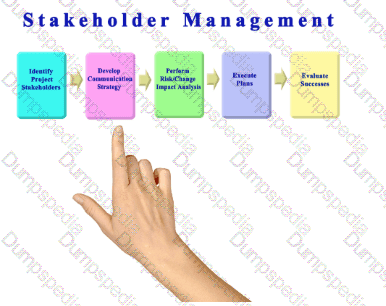
Per the PMI standards, while " Planning " creates the strategy, Manage Stakeholder Engagement is the active execution of that strategy to ensure stakeholders remain aligned with the project ' s success.
The features and functions that characterize a result, product, or service can refer to:
project scope
product scope
service scope
product breakdown structure
According to the PMBOK® Guide, it is critical to distinguish between " Project Scope " and " Product Scope, " as they represent two different aspects of the work to be performed.
Product Scope: This refers specifically to the features and functions that characterize a product, service, or result. It is measured against the product requirements to determine if the product is complete and functional. For example, if the project is to build a smartphone, the product scope includes the screen resolution, battery life, and operating system features.
Project Scope: This refers to the work performed to deliver a product, service, or result with the specified features and functions. It includes all the management and technical activities required. It is measured against the project management plan.
Relationship: The product scope is a subset of the project scope. You define what the product is (Product Scope) so that you can define the work required to build it (Project Scope).
Analysis of Other Options:
A. project scope: This is the " work " required to deliver the product. While it encompasses the product scope, it specifically refers to the actions and processes taken by the team, rather than the features of the end result itself.
C. service scope: While a result can be a service, " Service Scope " is not a formal term used in the PMBOK® Guide to define features and functions. These are universally covered under the umbrella of " Product Scope. "
D. product breakdown structure: An RBS or PBS is a hierarchical structure that breaks down the physical components of a product. While it helps visualize the product, it is a tool for decomposition, not the definition of the features and functions themselves.
Which project document is updated in the Control Stakeholder Engagement process?
Project reports
Issue log
Lessons learned documentation
Work performance information
According to the PMBOK® Guide (Project Management Body of Knowledge), specifically within the Project Stakeholder Management knowledge area and the Monitor Stakeholder Engagement process (referred to as " Control Stakeholder Engagement " in some exam versions):
Issue Log (Option B): This is a primary project document updated during this process. As stakeholders are engaged and their concerns or requirements are addressed, new issues may be identified or existing issues may be resolved. The Issue Log is used to document and track these items, ensuring that someone is assigned to resolve them and that the resolution is communicated back to the relevant stakeholders.
Project Reports (Option A): While communication is a key part of stakeholder engagement, " Project Reports " are typically an input to the process (providing information to share) or an output of Monitor and Control Project Work. They are not classified as a " Project Document Update " in the specific context of this process ' s standardized outputs.
Lessons Learned Documentation (Option C): While lessons learned are captured throughout the project, the formal update to the Lessons Learned Register is more characteristic of the Manage Project Knowledge or Close Project or Phase processes.
Work Performance Information (Option D): This is a Work Performance Data transformation that occurs during the process, but it is classified as a Process Output, not a " Project Document Update. " Project document updates refer specifically to existing files like the Issue Log, Stakeholder Register, or Project Schedule.
In the PMI framework, the Issue Log serves as a critical tool for maintaining trust with stakeholders. By actively documenting and addressing their concerns, the Project Manager can manage expectations and ensure that project objectives remain aligned with stakeholder needs.
Which organizational process assets update is performed during the Close Procurements process?
Procurement audit
Lessons learned
Performance reporting
Payment requests
According to the PMBOK® Guide, the Close Procurements process (often integrated into Control Procurements in the most recent editions) is the process of finishing each project procurement. A critical component of closing out any contract is the capture of knowledge for future use.
Organizational Process Assets (OPA) Updates: During the formal closure of a contract, the project manager and the procurement team update the organization ' s knowledge base. Lessons learned documentation is a primary OPA update. This includes documenting what went well during the procurement, what challenges were faced, and how the seller performed.
Purpose of Lessons Learned: Capturing this information helps the organization improve its future procurement processes, refine its " Preferred Seller " lists, and avoid repeating the same mistakes in subsequent projects.
Other OPA Updates: These may include the Procurement File, which is a complete set of indexed contract documentation (including the closed contract), and Final Acceptance notices.
Comparison with other options:
A. Procurement audit: This is a Tool and Technique used to identify successes and failures that warrant recognition in the preparation or administration of other procurement contracts. It is the action taken to generate the lessons learned, not the update itself.
C. Performance reporting: This is a tool and technique (or part of the Monitor and Control Project Work process) used during the execution and monitoring phases of the project to communicate progress, not a final OPA update during procurement closure.
D. Payment requests: These are typical activities or Inputs within the Control Procurements process throughout the project life cycle as work is completed. By the time you reach " Close Procurements, " final payments are typically being processed or confirmed rather than " requested. "
The degree, amount, or volume of risk that an organization or individual will withstand is known as its risk:
Analysis
Appetite
Tolerance
Response
According to the PMBOK® Guide (Project Management Body of Knowledge) and the PMI Lexicon of Project Management Terms, it is crucial to distinguish between " Appetite " and " Tolerance, " as they are often confused in practice:
Risk Tolerance: This is specifically defined as the specified range of acceptable results or the degree, amount, or volume of risk that an organization or individual is willing to withstand. It represents a measurable threshold. For example, a project might have a budget tolerance of plus or minus 10%. If the risk threatens to exceed that 10%, it is beyond the organization ' s tolerance.
Risk Appetite (Option B): This is the degree of uncertainty an organization or individual is willing to accept in anticipation of a reward. It is a more general, high-level guiding principle or " hunger " for risk rather than a specific measurable volume of withstandable risk.
Risk Analysis (Option A): This is the process of examining identified risks to estimate the probability and impact. It is a step in the Risk Management process, not a measurement of the capacity to withstand risk.
Risk Response (Option D): This refers to the specific actions or strategies (such as Avoid, Transfer, Mitigate, or Accept) taken to address risks once they have been analyzed.
In the context of the Standard for Risk Management in Portfolios, Programs, and Projects, " Tolerance " acts as the measurable boundary for " Appetite. " Because the question specifically asks for the " degree, amount, or volume " that can be withstood, Tolerance is the most precise and verified term.
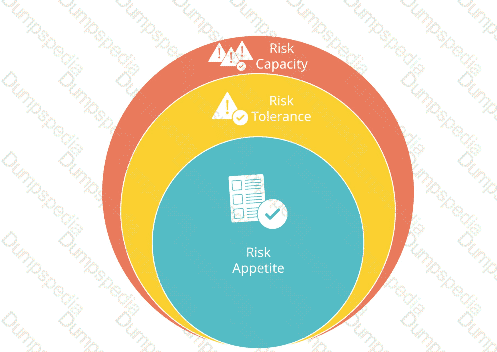
An input of the Plan Procurement Management process is:
Make-or-buy decisions.
Activity cost estimates.
Seller proposals.
Procurement documents.
According to the PMBOK® Guide, specifically the Plan Procurement Management process, the project team identifies which project needs can best be met by acquiring products or services from outside the organization.
Activity Cost Estimates as an Input: To determine whether a component should be purchased or built in-house, the project manager needs to know the expected cost of the work. Activity cost estimates, developed during the Estimate Costs process, provide the baseline for evaluating the reasonableness of bids or proposals submitted by potential sellers.
Linkage to Budget: These estimates help in the Make-or-Buy Analysis by providing the internal cost data required to compare against the market price of external procurement.
Other Key Inputs: Other standard inputs include the Project Charter, Business Documents (Business Case), the Project Management Plan (specifically the Scope Baseline), and Project Documents like the Requirement Documentation and Risk Register.
Comparison with other options:
A. Make-or-buy decisions: This is a primary output of the Plan Procurement Management process. It is the result of the analysis performed during this stage, not the information used to start it.
C. Seller proposals: These are inputs to the Conduct Procurements process. They are received after the procurement documents have been sent out and potential vendors have responded.
D. Procurement documents: These (such as the RFP, RFQ, or IFB) are outputs of the Plan Procurement Management process. they are the documents created to describe the project needs to potential sellers.
A project manager is seeking assistance from the business analyst for an IT project. What assistance can the business analyst provide?
Elicit product requirements.
Verify product functionality.
Manage the project schedule.
Allocate project resources.
In accordance with the PMBOK® Guide and the PMI Guide to Business Analysis, the roles of the Project Manager (PM) and the Business Analyst (BA) are complementary. While the PM focuses on the project ' s health (schedule, budget, and resources), the BA focuses on the product ' s health (requirements, value, and functionality).
Why Choice A is correct:
Primary Responsibility: The core competency of a Business Analyst is Requirements Elicitation. This involves using techniques like interviews, workshops, and surveys to " draw out " the true needs of the stakeholders.
Bridge to Solution: The BA helps the IT team understand what needs to be built. They transform high-level business needs into detailed functional and non-functional requirements.
Collect Requirements Process: During this process, the BA is the lead architect for the Requirements Traceability Matrix, ensuring that every technical feature requested by IT aligns with a business objective.
Analysis of other options:
B (Verify product functionality): This is primarily the responsibility of the Quality Control (QC) team or testers. While a BA might participate in User Acceptance Testing (UAT) to ensure requirements are met, " Verification " is a technical quality process.
C (Manage the project schedule): This is a core Project Manager responsibility. The PM owns the schedule, tracking critical paths and deadlines. The BA may provide input on how long requirements gathering will take, but they do not manage the overall project timeline.
D (Allocate project resources): Resource allocation is a Project Manager or Functional Manager task. It involves assigning people to tasks and managing the project budget. BAs generally do not have the authority to allocate corporate or project resources.
Key Concept: The Project Management Institute (PMI) emphasizes that the Business Analyst (Choice A) acts as the " translator " between the business world and the IT world. By focusing on eliciting accurate requirements, the BA reduces the risk of rework and ensures that the software delivered by the project manager actually solves the customer ' s problem.
During the project life cycle for a major product, a stakeholder asked to add a new feature. Which document should they consult for guidance?
Product release plan
Project release plan
Project management plan
Product management plan
In the PMBOK® Guide, when a stakeholder requests a change—such as adding a new feature—the project manager must follow the established procedures for Integrated Change Control.
Why Choice C is correct:
The " Master " Document: The Project Management Plan is the primary document that defines how the project is executed, monitored, controlled, and closed. It contains several subsidiary plans that provide the specific " guidance " requested here.
Change Management Plan: Contained within the Project Management Plan, this sub-plan describes the formal process for submitting, evaluating, and approving or rejecting project changes.
Scope Management Plan: This sub-plan explains how the project scope will be defined, developed, and managed. It dictates how the team handles new feature requests to prevent scope creep.
Governance: The project management plan tells the stakeholder who has the authority to approve the feature (e.g., the Change Control Board or the Project Sponsor) and what forms or analysis are required.
Analysis of other options:
A and B (Release Plans): Whether for a product or a project, a release plan is a high-level timeline that shows when specific sets of functionality will be delivered to the customer. While it shows what is currently planned, it does not provide the process guidance for how to add something new.
D (Product management plan): This is a broader document focused on the entire lifecycle of a product (from conception to retirement). While relevant for a Product Manager, in the context of a specific project (which is a temporary endeavor to create a product), the " Project Management Plan " is the definitive source for operational guidance during the project life cycle.
Key Concept: The Project Management Institute (PMI) emphasizes that the Project Management Plan (Choice C) is the " playbook " for the project. It ensures that when a stakeholder wants to add a feature, they don ' t just tell a developer to build it; instead, they follow a structured, documented process that assesses the impact on the project ' s time, cost, and quality.
Which of the following can a project manager use to represent dellned team member roles in a group of tasks?
Work breakdown structure (WBS)
Responsibility assignment matrix (RAM)
Organizational breakdown structure (OBS)
Resource breakdown structure (RBS)
According to the PMBOK® Guide, a Responsibility Assignment Matrix (RAM) is a grid that shows the project resources assigned to each work package. It is used to illustrate the connections between work packages or activities and project team members.
The RAM and RACI: A common example of a RAM is the RACI chart (Responsible, Accountable, Consulted, and Informed).
Responsible: The person who performs the work.
Accountable: The person with ultimate decision-making authority (only one per task).
Consulted: People whose opinions are sought.
Informed: People who are kept up-to-date on progress.
Purpose: The RAM ensures that there is clear assignment of responsibility for every task in the group, preventing confusion about who is doing what. On larger projects, RAMs can be developed at various levels (e.g., high-level for groups/units and low-level for specific individuals and tasks).
Integration: It bridges the gap between the work (WBS) and the people (OBS).
Analysis of Other Options:
A. Work breakdown structure (WBS): This is a deliverable-oriented hierarchical decomposition of the work to be executed. While it defines the tasks/deliverables, it does not inherently show the people or roles assigned to them.
C. Organizational breakdown structure (OBS): This is a hierarchical representation of the project organization, which illustrates the relationship between project activities and the organizational units that will perform those activities. It focuses on the organizational hierarchy, not the mapping of roles to specific tasks.
D. Resource breakdown structure (RBS): This is a hierarchical list of team and physical resources related by category and resource type. It is used for planning and controlling project work, but it lists what resources are available, not who is assigned to which specific task.
Following a project planning meeting with the team, a few team members approach the project manager to follow up on actions required. How can the project manager assess the effectiveness of the meeting?
Send the meeting minutes to all team members to verify that the required information is readily available.
Ask the team members to provide feedback for meetings in the phase retrospective.
Review the actions from the meeting with each of the project team members to ensure their understanding.
Consult the communications management plan to determine the success criteria for meetings.
According to the PMBOK® Guide and the Standard for Project Management, effective communication is not just about the distribution of information, but the confirmation of understanding. In the Monitor Communications process, the project manager must ensure that the communication artifacts (like meeting outcomes) have achieved their intended purpose.
Why Choice C is correct:
Closing the Feedback Loop: The true measure of a meeting ' s effectiveness is whether the participants can act on the decisions made. By reviewing the actions with team members, the PM identifies gaps in understanding or misinterpretations that occurred during the meeting.
Interpersonal and Team Skills: This approach utilizes active listening and feedback, which are core power skills. It allows the PM to verify that " noise " did not interfere with the message and that the team is aligned on the path forward.
Immediate Correction: Unlike waiting for a retrospective, this provides immediate insight into whether the planning session was successful or if the team is still confused about their responsibilities.
Analysis of other options:
A (Send the meeting minutes): Sending minutes is a standard administrative task (distribution), but it is passive. Simply having information " readily available " does not mean it was understood or that the meeting was effective in influencing behavior.
B (Wait for the phase retrospective): While retrospectives are excellent for process improvement, waiting until the end of a phase is too late to assess a specific planning meeting ' s effectiveness. The project may have already suffered from misalignment by then.
D (Consult the communications management plan): The plan defines how meetings should be conducted and what the criteria are, but it is a static document. Consulting it doesn ' t tell you how well a specific meeting actually went in practice.
Key Concept: The Project Management Institute (PMI) emphasizes that " Communication = Understanding. " Choice C is the most proactive and direct way to assess if the meeting ' s objectives were met by checking the " output " (team understanding) against the " input " (the meeting content).
Which activity is an input to the Conduct Procurements process?
Organizational process assets
Resource availability
Perform Integrated Change Control
Team performance assessment
According to the PMBOK® Guide, the Conduct Procurements process is the process of obtaining seller responses, selecting a seller, and awarding a contract.
Organizational Process Assets (OPAs): These are internal to the organization and serve as a primary input to the Conduct Procurements process. They provide the framework and historical data necessary to execute the procurement successfully.
Specific Examples: OPAs include a list of preferred sellers (vetted vendors), specialized procurement policies, established templates for contracts or evaluation criteria, and historical information from previous procurement activities that can help in selecting the right bidder.
Other Key Inputs:
Project Management Plan: Includes the procurement management plan and scope baseline.
Project Documents: Such as the lessons learned register, project schedule, and requirements documentation.
Procurement Documentation: Including the bid documents (RFP/RFQ), Statement of Work (SOW), and independent cost estimates.
Seller Proposals: The formal responses from vendors being evaluated.
Comparison with other options:
B. Resource availability: This is typically an output of the Acquire Resources process (representing the physical or human resources assigned to the project). While procurement involves external resources, " Resource Availability " as a specific document/status is not a formal input for Conducting Procurements.
C. Perform Integrated Change Control: This is a process, not an input. While change requests from Conduct Procurements are sent to this process, the process itself is not an input to procurement activities.
D. Team performance assessment: This is an output of the Develop Team process. It measures the effectiveness of the project team ' s performance and is not used as a criterion or input for selecting external sellers during procurement.
Which of the following can a project manager conduct if they have a stakeholder who is unresponsive and/or unsupportive?
Interactive communications
Pull communications
Push communications
Communication style assessment
According to the PMBOK® Guide, specifically the Plan Stakeholder Engagement and Manage Communications processes, when a stakeholder is not engaging as expected, the project manager must shift from " broadcasting " information to " analyzing " the interpersonal dynamics.
Communication Style Assessment: This is a tool and technique used to identify the preferred communication method, format, and content for stakeholders. If a stakeholder is unresponsive, it often means the current approach is not resonating with their personality, level of authority, or professional needs. An assessment helps the project manager determine if the stakeholder prefers direct data, high-level summaries, personal face-to-face interaction, or formal documentation.
Interpersonal and Team Skills: By assessing the style, the project manager can adapt their own communication to match the stakeholder ' s preferences. This is a key part of Stakeholder Engagement. For example, an " unsupportive " stakeholder might be won over if the communication is adjusted to focus on the specific benefits the project brings to their department.
Root Cause Analysis: While not explicitly in the option, a style assessment often reveals the root cause of the unresponsiveness—such as " information overload " or a " misalignment of expectations " —allowing for a more targeted engagement strategy.
Analysis of other options:
Option A: Interactive communications (like meetings or phone calls) require a willing participant. If the stakeholder is already " unresponsive, " attempting more interactive communication may lead to further frustration or continued silence.
Option B: Pull communications (like placing documents on a shared portal) are passive. An unsupportive or unresponsive stakeholder is unlikely to go out of their way to " pull " information that they are already ignoring.
Option C: Push communications (like emails or memos) are what the project manager is likely already doing. If the stakeholder is unresponsive, sending more " pushed " content usually results in the same lack of engagement.
Per PMI standards, the most effective way to address a breakdown in stakeholder engagement is to perform a Communication style assessment. This allows the project manager to pivot their strategy based on a better understanding of the stakeholder ' s behavioral and professional communication preferences.
Prototype development may be used as a tool for which of the following risk response strategies?
Avoid
Accept
Mitigate
Exploit
According to the PMBOK® Guide, Mitigation is a risk response strategy that seeks to reduce the probability of occurrence or the impact of a negative risk (threat) to within acceptable threshold limits.
Prototypes as a Mitigation Tool: Developing a prototype is a classic example of mitigation. By creating a functional or non-functional version of a product before full-scale production, the project team can identify technical flaws, usability issues, or design gaps.
Reducing Uncertainty: Taking early action to provide a " proof of concept " reduces the risk that the final product will fail to meet requirements or that the technology will not work as intended. This addresses the risk while there is still time to adjust the project plan.
Risk Context: This is particularly effective for high-risk, complex, or innovative projects where the probability of failure is high. Instead of " Avoiding " the task entirely, the team uses the prototype to " Mitigate " the potential negative impact of a failure in the final delivery.
Analysis of Other Options:
A. Avoid: Avoiding involves changing the project management plan to eliminate the threat entirely (e.g., changing the scope to remove a dangerous activity). While a prototype might lead to an " Avoid " decision later, the act of building it is a mitigation effort.
B. Accept: Acceptance means the team has decided not to act on the risk. Developing a prototype is a very proactive action, which is the opposite of acceptance.
D. Exploit: This strategy is used for opportunities (positive risks). It ensures that the opportunity definitely happens. While prototypes can be used to test opportunities, the term is most traditionally associated with mitigating technical threats in PMI documentation.
An output of the Manage Stakeholder Engagement process is:
change requests
enterprise environmental factors
the stakeholder management plan
the change log
According to the PMBOK® Guide (Project Stakeholder Management), the Manage Stakeholder Engagement process is the process of communicating and working with stakeholders to meet their needs/expectations, address issues as they occur, and foster appropriate stakeholder engagement in project activities throughout the project life cycle.
A primary output of this process is Change Requests. As the project manager interacts with stakeholders, their needs or expectations may evolve, or issues may be identified that require modifications to the project ' s scope, schedule, or budget. These requests are processed through the Perform Integrated Change Control process for approval or rejection.
Other key outputs include:
Project Management Plan Updates (specifically the Communications Management Plan and Stakeholder Engagement Plan).
Project Document Updates (such as the Change Log, Issue Log, Lessons Learned Register, and Stakeholder Register).
Analysis of Distractors:
B. enterprise environmental factors: These are typically inputs to the process (e.g., organizational culture, personnel administration) rather than outputs produced by managing engagement.
C. the stakeholder management plan: This is the primary output of the Plan Stakeholder Engagement process. While it may be updated during Manage Stakeholder Engagement, the document itself is created during the planning phase.
D. the change log: The Change Log is an input to this process. It is used to communicate to stakeholders which changes have been approved, deferred, or rejected. While it might be updated as an output, " Change Requests " is the more definitive output when new requirements or adjustments arise from stakeholder interaction.
A project team is working on a complex product and the work breakdown structure (WBS) is finalized. The team determines that the best approach is to use an adaptive delivery method and is now tasked with converting the WBS for adaptive delivery.
How can the team manage the conversion of the existing WBS to an adaptive approach?
Generate use cases for each WBS element and prepare a requirements document.
Produce a release plan for each WBS element and organize them into iterations for delivery.
Create themes for each WBS element and organize them into iterations for delivery.
Organize the WBS into a set of related themes, epics, and user stories.
According to the Agile Practice Guide and the PMBOK® Guide, moving from a predictive (Waterfall) framework to an adaptive (Agile) framework requires a shift from " task-oriented " structures to " value-oriented " structures.
Why Choice D is correct:
Structural Alignment: In a predictive approach, the Work Breakdown Structure (WBS) is a hierarchical decomposition of the total scope. In an adaptive approach, the equivalent hierarchy is the Product Backlog, which is organized by value.
The Conversion Process:
Themes: High-level functional areas or business goals (often corresponding to the top levels of a WBS).
Epics: Large bodies of work that can be broken down into smaller tasks (corresponding to WBS work packages).
User Stories: The smallest units of work that deliver a specific value to the end user (corresponding to the activities derived from work packages).
Outcome: By mapping WBS elements into these categories, the team ensures that the original scope is preserved while making it " consumable " for iterative development.
Analysis of other options:
A (Generate use cases and requirements document): This is a traditional requirements gathering approach. While use cases are helpful, simply writing a requirements document does not " convert " the WBS into a delivery framework; it just creates more documentation.
B (Release plan for each element): A release plan is a timeline. While you eventually need one, you cannot build a release plan directly from a raw WBS without first translating the work into backlog items (User Stories) that the team can estimate and prioritize.
C (Create themes and organize into iterations): This is close, but it skips the necessary granularity. Iterations (Sprints) are populated by User Stories, not broad Themes. Without breaking themes down into epics and stories (as seen in Choice D), the work is too large to fit into a typical 2-week iteration.
Key Concept: The Project Management Institute (PMI) emphasizes that in an adaptive environment, work must be decomposed by value rather than just by " work type. " Choice D provides the necessary structural bridge to take a finalized scope (WBS) and turn it into a living Product Backlog that an Agile team can actually execute.
Which type of project management office (PMO) supplies templates, best practices, and training to project teams?
Supportive
Directive
Controlling
Instructive
In accordance with the PMBOK® Guide (The Environment in Which Projects Operate), there are three primary types of Project Management Offices (PMOs) within an organization, categorized by the degree of control and influence they exercise over projects.
The Supportive PMO is characterized by the following:
Role: It provides a consultative role to projects by supplying templates, best practices, training, access to information, and lessons learned from other projects.
Degree of Control: The degree of control provided by this PMO is low. It serves as a project repository rather than a governing body.
Function: It acts as a service provider to the project manager and the project team, ensuring they have the necessary tools to succeed without mandating specific compliance or taking over the management of the project.
Analysis of Distractors:
B. Directive: This PMO takes control of the projects by directly managing them. Project managers are assigned by and report to the Directive PMO. The degree of control is high.
C. Controlling: This PMO provides support but also requires compliance through various means. This may include adopting project management frameworks or methodologies, using specific templates and tools, and conformance to governance frameworks. The degree of control is moderate.
D. Instructive: This is not a standard term used in the PMBOK® Guide to describe a type of PMO. While a Supportive PMO may provide " instruction " through training, " Instructive " is not a formal PMI classification.
Which of the following are outputs of define scope process in project scope management
Requirements documentation and requirements traceability matrix
Scope management plan and requirements management plan
Project Scope statement and project documents updates
Scope baseline and project documents updates
According to the PMBOK® Guide, the Define Scope process is the process of developing a detailed description of the project and product. It is critical because it describes the product, service, or result boundaries and acceptance criteria.
Project Scope Statement (Choice C): This is the primary output of the Define Scope process. It includes the product scope description, deliverables, acceptance criteria, and project exclusions.
Project Documents Updates (Choice C): This is the second standard output. During this process, documents such as the Assumption Log, Requirements Documentation, Requirements Traceability Matrix, and Stakeholder Register may be updated as more detail is uncovered about the scope.
Requirements documentation and RTM (Choice A): These are the primary outputs of the Collect Requirements process, which precedes Define Scope.
Scope Management Plan and Requirements Management Plan (Choice B): These are outputs of the Plan Scope Management process.
Scope Baseline (Choice D): The Scope Baseline is an output of the Create WBS process. It is composed of the approved version of the Project Scope Statement, the WBS, and the WBS Dictionary.
The transition from the Collect Requirements process to Define Scope is where the project manager selects the final requirements from the requirements documentation to be included in the project, which are then documented in the Project Scope Statement.
A project manager is performing the procurement management process with three vendors The project team is reviewing the requests for proposal (RFPs).
What type of procurement document is the RFP?
Bid document
Statement of work (SOW)
Source selection criteria
Independent cost estimate
According to the PMBOK® Guide, the Request for Proposal (RFP) is a specific type of Bid Document used in the Conduct Procurements process.
Bid Documents: These are the formal documents used to solicit proposals from prospective sellers. The term " bid documents " is an umbrella term that includes the Request for Information (RFI), Request for Quotation (RFQ), and Request for Proposal (RFP).
Purpose of an RFP: An RFP is used when there is a problem in the project and the solution is not easy to determine. It allows the buyer to describe the problem and ask the sellers to propose a solution, a technical approach, and a price.
Solicitation Process: The project manager uses the RFP to communicate the project ' s needs to the vendors (sellers) so they can provide a structured response that the project team can then evaluate against the source selection criteria.
Why other options are incorrect:
Option B: Statement of Work (SOW): The Procurement SOW is an input to the bid documents. It describes the procurement item in sufficient detail to allow prospective sellers to determine if they are capable of providing the products or services. The RFP contains the SOW, but they are not the same thing.
Option C: Source selection criteria: These are the standards developed by the buyer to rate or score seller proposals. They are used to evaluate the responses received from the RFP, but the RFP itself is the solicitation document, not the criteria.
Option D: Independent cost estimate: Also known as a " should-cost " estimate, this is a tool used by the buyer to provide a benchmark for evaluating the reasonableness of the prices submitted by the sellers. It is an internal document, not the solicitation document sent to vendors.
A risk that arises as a direct result of implementing a risk response is called a:
contingent risk
residual risk
potential risk
secondary risk
According to the PMBOK® Guide (Project Management Body of Knowledge), specifically within the Project Risk Management knowledge area and the Plan Risk Responses process, risks are categorized based on their relationship to the response strategies:
Secondary Risk (Option D): This is defined by PMI as a risk that arises as a direct result of implementing a risk response. For example, if a project team decides to mitigate the risk of a schedule delay by hiring an outside contractor, a " secondary risk " might emerge regarding the contractor ' s lack of familiarity with internal company standards. These risks must be identified and planned for just like primary risks.
Residual Risk (Option B): This is a risk that is expected to remain after the planned risk response has been implemented. It is the " leftover " risk that the project team decides to accept because it falls within acceptable risk thresholds.
Contingent Risk (Option A): This refers to a " Contingency Response Strategy, " which is a risk response that is executed only if certain predefined trigger conditions occur (also known as " fallback plans " ).
Potential Risk (Option C): This is a general term for any identified risk that has not yet occurred; it is not a technical classification within the PMI risk response framework.
In the PMI framework, the Plan Risk Responses process is iterative. When a response is chosen, the project manager must evaluate whether that response introduces new secondary risks or leaves behind residual risks that require further monitoring or a contingency reserve.
A project is composed of three phases that are implemented in parallel without affecting one another. The baselines for each individual phase have been approved by the major stakeholders, and there is a minimal ability to vary the baselines during the execution of the project.
Which methodology did the project manager adopt?
Incremental approach
Predictive approach
Hybrid approach
Iterative approach
According to the PMBOK® Guide and the Agile Practice Guide, the choice of methodology is dictated by the stability of the requirements and the flexibility of the baselines.
Predictive (Traditional/Waterfall) Characteristics: The key indicators in this scenario are that the baselines have been approved and there is minimal ability to vary them. In a predictive approach, the scope, schedule, and cost are determined early in the project life cycle. Any changes to these baselines typically require formal change control.
Parallel Phases: While predictive projects are often thought of as purely sequential, the PMBOK® Guide notes that phases can be overlapped (fast-tracked) or run in parallel to compress the schedule, provided the requirements are well-understood.
Minimal Variance: The " minimal ability to vary the baselines " is the hallmark of a predictive environment. Unlike adaptive or iterative models where the plan is expected to evolve, a predictive approach seeks to manage the project against a fixed plan to ensure high levels of certainty and control.
Analysis of other options:
Option A: An Incremental approach delivers functional portions of the project in parts. While it uses fixed baselines for each increment, it is usually focused on frequent delivery of working products rather than parallel phases with rigid, unvarying baselines for the whole project.
Option C: A Hybrid approach combines predictive and adaptive elements. Since this scenario emphasizes " minimal ability to vary " and does not mention any adaptive or agile components, " Predictive " is a more accurate fit.
Option D: An Iterative approach focuses on repeating activities until the product is " correct. " It explicitly allows for—and expects—the baselines to vary and evolve as the team learns more through each cycle.
Per PMI standards, a methodology characterized by pre-approved, rigid baselines with restricted change during execution is defined as a Predictive approach.
A project using the agile/adaptive approach has reached the Project Integration Management phase. What is the project manager ' s key responsibility during this phase?
Defining the scope of the project
Building a collaborative environment
Creating a detailed project management plan
Directing the delivery of the project
According to the PMBOK® Guide and the Agile Practice Guide, the role of the project manager in Project Integration Management shifts significantly when using an agile or adaptive approach.
In a predictive (waterfall) environment, the project manager is the primary integrator who consolidates various plans into a single, cohesive document. However, in an Agile/Adaptive environment:
Distributed Responsibility: The responsibility for integration and decision-making is often distributed among the team. The team members take the lead in integrating the various functional elements of the product themselves.
The PM ' s Role: The project manager’s (or servant-leader’s) primary responsibility becomes building a collaborative environment. This involves ensuring that the team has the necessary tools, resources, and culture to make integrated decisions.
Empowerment: The PM focuses on facilitating collaboration between the team and the Product Owner to ensure that the evolving product scope is integrated with the organizational goals and stakeholder expectations.
Analysis of other options:
A. Defining the scope: In Agile, the scope is evolving and managed primarily through the Product Backlog, often led by the Product Owner rather than being a " key responsibility " of the PM during the Integration phase.
C. Creating a detailed project management plan: This is a hallmark of Predictive project management. Agile avoids high-level, up-front detailed planning in favor of iterative planning.
D. Directing the delivery: Agile emphasizes " self-organizing teams. " The PM facilitates and supports rather than " directs " the team ' s delivery in a top-down manner.
Per PMI standards for adaptive environments, the Project Manager ' s value in integration is found in fostering communication and removing impediments so that the team can effectively integrate their own work.
What characteristic of servant leadership supports resource management in an agile environment?
Lecturing
Construing
Measuring
Coaching
According to the Agile Practice Guide and the PMBOK® Guide, servant leadership is the foundational leadership style for agile environments. It shifts the focus from " command and control " to supporting and developing the team.
Coaching as a Characteristic: In the context of resource management (specifically human resources), coaching is a vital skill. A servant leader doesn ' t just manage tasks; they focus on the development of the individuals. By coaching team members, the leader helps them improve their technical skills and collaborative abilities, which directly optimizes the " resource " performance and team velocity.
Supportive Environment: Coaching fosters a safe environment for learning and growth. Instead of penalizing mistakes, the servant leader uses them as coaching moments to ensure the team becomes more self-organizing and cross-functional over time.
Empowerment: This approach empowers the team to make their own decisions. The leader acts as a facilitator, removing " impediments " (roadblocks) so the team can focus on delivering value.
Analysis of other options:
Lecturing (Option A): This is the opposite of servant leadership. It implies a top-down, one-way communication style that stifles the collaborative and self-organizing nature of agile teams.
Construing (Option B): This means interpreting or explaining the meaning of something. While a leader may interpret requirements, it is not a defining characteristic of servant leadership that specifically supports resource management.
Measuring (Option C): While agile teams use metrics (like burn-up or burn-down charts), a servant leader ' s primary focus is on the people and the process, not just the rigid measurement of output. Measuring without coaching often leads to " command and control " behavior.
Per PMI standards, the primary role of a servant leader is to provide the team with what they need to be successful. Coaching is the primary mechanism used to develop the team ' s capabilities and ensure they can manage their own work effectively.
What are the inputs of the Estimate Costs process?
Project management plan, work performance data, enterprise environmental factors, and organizational process assets
Project management plan, project documents, enterprise environmental factors, and organizational process assets
Cost baseline, enterprise environmental factors, benefits management plan, and organizational process assets
Project management plan, enterprise environmental factors, basis of estimates, and organizational process assets
According to the PMBOK® Guide (6th Edition), the Estimate Costs process is the process of developing an approximation of the monetary resources needed to complete project work. To create an accurate estimate, the project manager must pull information from various foundational sources.
The inputs for the Estimate Costs process include:
Project Management Plan: Specifically the Cost Management Plan, Quality Management Plan, and Scope Baseline (which includes the Project Scope Statement, WBS, and WBS Dictionary).
Project Documents: This is a broad category including the Lessons Learned Register, Project Schedule, Resource Requirements, and Risk Register.
Enterprise Environmental Factors (EEFs): These include market conditions, published commercial information (like price lists), and exchange rates.
Organizational Process Assets (OPAs): These include cost estimating policies, cost estimating templates, and historical information from previous similar projects.
Analysis of Distractors:
A (Work performance data): This is an input for Monitoring and Controlling processes (like Control Costs). It represents raw observations and measurements identified during activities. It is not used to estimate costs, but rather to compare actual costs against the estimates.
C (Cost baseline / Benefits management plan): The Cost Baseline is an output of the Determine Budget process. It cannot be an input to Estimate Costs because estimating must happen before the baseline is established. The Benefits Management Plan is generally an input to the business side (Initiating/Planning) rather than activity-level cost estimation.
D (Basis of estimates): This is an output of the Estimate Costs process. It provides the supporting detail for how the cost estimates were derived (e.g., how risks were considered, what range of precision was used).
Managing procurement relationships and monitoring contract performance are part of which process?
Conduct Procurements
Plan Procurements
Administer Procurements
Close Procurements
According to the PMBOK® Guide, the process of managing procurement relationships, monitoring contract performance, and making changes and corrections as appropriate is defined as Administer Procurements (referred to as Control Procurements in more recent editions).
Core Functions: This process ensures that both the seller’s and buyer’s performance meets the procurement requirements according to the terms of the legal agreement.
Key Activities:
Monitoring Contract Performance: Verifying that the vendor is delivering what was promised within the agreed timeline and budget.
Managing Relationships: Maintaining a professional and functional working relationship between the buyer and the seller.
Financial Management: Managing payments to the seller (accounts payable).
Change Control: Processing contract amendments or change requests through the project’s integrated change control system.
Risk Monitoring: Identifying new risks arising from the procurement and monitoring existing ones.
Analysis of Other Options:
A. Conduct Procurements: This is the process of obtaining seller responses, selecting a seller, and awarding a contract. It is the " execution " of the procurement plan but occurs before administration/monitoring begins.
B. Plan Procurements: This is the initial planning process where the team decides what to buy, how to buy it, and identifies potential sellers.
D. Close Procurements: This is the process of completing each project procurement, including resolving open claims and finalizing the administrative aspects of the contract. It occurs after the administration/monitoring phase is complete.
Which of the following is an output from Control Scope?
Change requests
Variance analysis
Accepted deliverables
Requirements documentation
According to the PMBOK® Guide, Control Scope is the process of monitoring the status of the project and product scope and managing changes to the scope baseline.
Change Requests: This is a primary output of the Control Scope process. When the actual scope performance deviates from the scope baseline (detected via variance analysis), change requests are generated. These may include preventive or corrective actions, defect repairs, or enhancement requests, and they are processed for review and disposition through the Perform Integrated Change Control process.
Other Key Outputs:
Work performance information.
Project management plan updates (specifically scope baseline and other baseline updates).
Project documents updates.
Analysis of Other Options:
B. Variance analysis: This is a tool and technique used within the Control Scope process to determine the cause and degree of difference between the baseline and actual performance; it is not an output.
C. Accepted deliverables: This is the primary output of the Validate Scope (formerly Verify Scope) process, where the customer formally signs off on completed deliverables.
D. Requirements documentation: This is a key input to the Control Scope process, used as a reference to ensure that all defined requirements are being met and no " gold plating " is occurring.
Which document can help a project manager to leverage historical project information?
Lessons learned register
Schedule baseline
Work performance data
Deliverable acceptance forms
According to the PMBOK® Guide, specifically the Manage Project Knowledge process, the Lessons Learned Register is the primary document used to record knowledge gained during a project so that it can be used to improve the performance of the current project and future projects.
Leveraging Information: At the end of a project or phase, the information in the lessons learned register is transferred to a Lessons Learned Repository, which is an Organizational Process Asset (OPA). This allows project managers to " leverage historical information " to avoid repeating mistakes and to replicate successful techniques used in previous work.
Content: It typically includes the category of the situation, a description of the event, the impact, recommendations, and proposed actions.
Why other options are incorrect:
B. Schedule baseline: This is a specific version of the project schedule used as a basis for comparison to actual results. It is used for current project control rather than for leveraging historical information across projects.
C. Work performance data: These are the raw observations and measurements identified during activities being performed to carry out the project work (e.g., actual costs, actual durations). It is current status data, not historical knowledge.
D. Deliverable acceptance forms: These are formal documents indicating that the customer or sponsor has signed off on a deliverable. While they are records, they do not provide the " how-to " or " lessons " context required to leverage knowledge for future success.
A project manager is reviewing a few techniques that can be used to evaluate solution results. The intent is to uncover whether the solution responds properly to unintended cases.
Which evaluation technique should be used here?
Exploratory testing
Integration testing
User acceptance testing
Day-in-the-life testing
In both the PMI Guide to Business Analysis and the Agile Practice Guide, software and solution evaluation techniques are categorized based on their intent—whether they are checking against known requirements or searching for unknown risks.
Why Choice A is correct:
Defining Exploratory Testing: This is an unscripted testing technique where the tester " explores " the solution without following a predetermined set of test cases.
Unintended Cases: The specific goal of exploratory testing is to find " edge cases " or " unintended behaviors " that documented requirements and automated scripts might have missed. It relies on the tester’s intuition and experience to try to " break " the system in ways the developers didn ' t anticipate.
Adaptive Learning: As the tester discovers how the system handles weird inputs or unexpected sequences, they learn more about the solution ' s limits, making it the perfect tool for uncovering hidden defects in complex logic.
Analysis of other options:
B (Integration testing): This focuses on the interfaces between modules to ensure they communicate correctly. It is usually scripted and technical, aimed at data flow rather than testing " unintended " user scenarios.
C (User acceptance testing): UAT is conducted to confirm the system meets the agreed-upon requirements (the " Happy Path " ). It is used to prove the system works as intended for the end-user, not necessarily to investigate how it fails under unintended conditions.
D (Day-in-the-life testing): This is a form of observational testing where the solution is tested in a real-world environment following a typical workday. While it tests the flow, it is generally focused on " normal " operations rather than intentionally probing for " unintended cases. "
Key Concept: The Project Management Institute (PMI) emphasizes that while scripted testing ensures the product does what it should do, Exploratory Testing (Choice A) ensures the product doesn ' t do what it shouldn ' t do. It is an essential risk-mitigation technique for complex solutions where the range of user inputs is vast and unpredictable.
Project Scope Management is primarily concerned with:
Developing a detailed description of the project and product.
Determining how requirements will be analyzed, documented, and managed.
Defining and controlling what is and is not included in the project.
Formalizing acceptance of the completed project deliverables.
According to the PMBOK® Guide (Project Management Body of Knowledge), specifically within the introduction to the Project Scope Management knowledge area:
Defining and Controlling Scope (Option C): This is the primary and fundamental purpose of Project Scope Management. It ensures that the project includes all the work required, and only the work required, to complete the project successfully. It is focused on defining the project boundaries—what is " in scope " and what is " out of scope " —and implementing controls to prevent unauthorized changes (scope creep).
Developing a Detailed Description (Option A): This describes the Define Scope process specifically. While it is a critical part of scope management, it is a sub-component (producing the Project Scope Statement) rather than the primary concern of the entire knowledge area.
Requirements Management (Option B): This describes the Plan Scope Management or Collect Requirements processes. Requirements are the foundation of scope, but scope management goes beyond documentation to include the actual execution and control of the work boundaries.
Formalizing Acceptance (Option D): This refers specifically to the Validate Scope process. This is the closing mechanism for scope components but does not encompass the entire management philosophy of the knowledge area.
In the PMI framework, Project Scope Management is the " anchor " for the other constraints. Without a clearly defined and controlled scope, it is impossible to provide accurate estimates for schedule or cost. The Project Manager must constantly refer back to the Scope Baseline (comprised of the Scope Statement, WBS, and WBS Dictionary) to ensure the team remains focused on the authorized objectives.
Change requests are processed for review and disposition according to which process?
Control Quality
Control Scope
Monitor and Control Project Work
Perform Integrated Change Control
According to the PMBOK® Guide and the Standard for Project Management, the Perform Integrated Change Control process is the definitive process for reviewing all change requests, approving changes, and managing changes to deliverables, project documents, and the project management plan.
As per PMI standards, every change request—whether it involves corrective action, preventive action, defect repair, or updates to formally controlled documents—must be processed through this specific process. The key activities within this process include:
Reviewing: Assessing the change ' s impact on all project constraints (Scope, Schedule, Cost, Quality, Resources, and Risk).
Disposition: The formal decision-making step where the Change Control Board (CCB) or the Project Manager approves, rejects, or defers the change.
Communication: Ensuring that the results of the change request (disposition) are communicated to stakeholders and recorded in the Change Log.
The other options are incorrect based on the following PMI definitions:
Control Quality: This process is concerned with the correctness of deliverables and meeting the quality requirements. While it may result in a change request (for defect repair), it does not process the disposition of that change.
Control Scope: This process monitors the status of the project and product scope. Like other control processes, it may generate change requests to keep the project on track, but the actual approval happens in Integrated Change Control.
Monitor and Control Project Work: This is a high-level process used to track, review, and report the overall progress of the project. It provides the work performance reports that serve as inputs to the change control process but does not handle the disposition of individual changes.
As per the PMI Lexicon of Project Management Terms, Perform Integrated Change Control ensures that no change is made to the project ' s baselines without a formal assessment and approval, maintaining the integrity of the project plan.
A project manager read the initial contract when a project was started. The contract states a house has to be built in one year, and the foundation has to be completed in 30 days. What should the project manager do?
Add the milestones to the risk register, as time is short.
Add the two milestones to the project plan, as they are mandatory.
Calculate the duration of the two milestones stated in the contract.
Start the project as soon as possible, as time is short.
According to the PMBOK® Guide, specifically within the Develop Project Management Plan and Define Activities processes, requirements stipulated in a contract are considered Project Constraints.
Contractual Obligations: A contract is a legally binding document. If the contract specifies a final completion date (one year) and a specific interim deadline (foundation in 30 days), these are classified as Milestones.
Milestones vs. Activities: A milestone is a significant point or event in a project. Unlike activities, milestones have zero duration. Because these specific dates are " Hard " constraints dictated by the contract, they must be incorporated into the Milestone List and the Project Management Plan.
Mandatory Nature: The project manager does not have the discretion to ignore these dates. They form the basis of the Schedule Baseline. Once these milestones are added to the plan, the project manager will then sequence the necessary activities to ensure these deadlines are met.
Analysis of other options:
Option A: While the tight timeline represents a risk, milestones are primarily schedule components. You would record the risk of missing the deadline in the register, but you must first put the actual dates into the project plan to manage them.
Option C: This is a technical distractor. Milestones, by definition, have zero duration. They represent a point in time (the completion of the foundation), so there is no duration to calculate for the milestone itself—only for the activities leading up to it.
Option D: " Starting as soon as possible " is a proactive sentiment, but it is not a formal project management procedure. Proper planning (adding the constraints to the plan) must occur to ensure the " fast start " is actually directed toward the correct goals.
Per PMI standards, any date or requirement explicitly mentioned in a legal contract is a Constraint that must be documented in the Project Management Plan and tracked as a milestone to ensure compliance.
Which type of analysis would be used for the Plan Quality process?
Schedule
Checklist
Assumption
Cost-Benefit
According to the PMBOK® Guide, specifically in the Plan Quality Management process, the project manager must determine the standards and requirements for the project and its deliverables. One of the primary data analysis techniques used to achieve this is Cost-Benefit Analysis.
Cost-Benefit Analysis in Quality: This technique involves comparing the cost of the quality level (the investment in quality activities) against the expected benefit. The primary benefits of meeting quality requirements include less rework, higher productivity, lower costs, increased stakeholder satisfaction, and increased profitability.
The Goal of the Process: The analysis helps the project manager and team determine if the planned quality activities are cost-effective. In project management, the " optimal " level of quality is reached when the marginal improvement in benefits equals the marginal cost to achieve that improvement.
Cost of Quality (COQ): Closely related to cost-benefit analysis, COQ consists of all costs incurred over the life of the product by investment in preventing nonconformance to requirements, appraising the product or service for conformance to requirements, and failing to meet requirements (rework).
Decision Support: By performing this analysis during the planning phase, the team ensures that the project does not " over-engineer " a solution where the costs of high quality outweigh the actual business value, while also ensuring that the project does not " under-engineer " and incur high failure costs.
Comparison with other options:
A. Schedule: While schedule constraints affect quality planning, " Schedule Analysis " is a technique used in Develop Schedule or Control Schedule, not a specific tool for defining quality standards.
B. Checklist: A checklist is a data gathering tool used to verify that a set of required steps has been performed. While used in Manage Quality and Control Quality, the question asks for a " type of analysis " used for planning.
C. Assumption: Assumption and constraint analysis is a technique typically used during Identify Risks or Define Scope to explore the validity of assumptions and their impact on the project. It is not the primary analysis tool for quality planning.
The iterative process of increasing the level of detail in a project management plan as greater amounts of information become available is known as:
Continuous improvement.
Predictive planning.
Progressive elaboration.
Quality assurance.
In accordance with the PMBOK® Guide, Progressive Elaboration is the iterative process of increasing the level of detail in a project management plan as greater amounts of information and more accurate estimates become available.
This concept acknowledges that it is rarely possible to define every detail of a project at its initiation. Instead, the project management plan is developed in broad strokes early on and then refined and made more specific as the project team gains a better understanding of the objectives, deliverables, and constraints.
Relationship to Rolling Wave Planning: Progressive elaboration is the broader concept that encompasses Rolling Wave Planning, where near-term work is planned in detail while future work is planned at a high level.
Purpose: It allows a project management team to manage to a greater level of detail as the project evolves, ensuring the plan remains realistic and aligned with current project realities.
Distinction from Scope Creep: Unlike scope creep (uncontrolled changes), progressive elaboration is a controlled, intentional process of refining the existing authorized scope.
Analysis of Distractors:
A. Continuous improvement: Also known as Kaizen, this refers to an ongoing effort to improve products, services, or processes over time. While it is an iterative mindset, it is not the specific term for refining project plan details.
B. Predictive planning: This refers to a project life cycle (Waterfall) where the scope, time, and cost are determined as early as possible. While predictive projects use progressive elaboration, " predictive planning " is not the name of the iterative refinement process itself.
D. Quality assurance: This is the process of auditing the quality requirements and the results from quality control measurements to ensure that appropriate quality standards and operational definitions are used. It does not relate to the detail level of the management plan.
The scope of a project cannot be defined without some basic understanding of how to create the specified:
objectives
schedule
product
approach
According to the PMBOK® Guide, specifically within the Project Scope Management knowledge area, there is a fundamental distinction between Project Scope (the work performed to deliver a product, service, or result) and Product Scope (the features and functions that characterize a product, service, or result).
Interdependence: The scope of a project cannot be effectively defined without a basic understanding of the product to be created. This is because the " Project Scope " is entirely dependent on the requirements of the " Product Scope. "
Product Analysis: In the Define Scope process, Product Analysis is a key tool and technique. For projects that have a product as a deliverable, as opposed to a service or result, product analysis is a critical tool. Each application area has one or more generally accepted methods for translating high-level product descriptions into tangible deliverables.
Techniques involved: Product analysis includes techniques such as:
Product breakdown.
Systems analysis.
Requirements analysis.
Systems engineering.
Value engineering.
Value analysis.
The Logic: If the project team does not understand the technical specifications, functions, or physical characteristics of the product, they cannot accurately estimate the work (Project Scope) required to build it, nor can they create a Work Breakdown Structure (WBS).
Comparison with other options:
A. Objectives: While objectives provide the " why " and the overall goal, they are often high-level. You can define objectives (e.g., " Increase market share " ) without knowing how to build the specific product that achieves it, but you cannot define the scope of the work without that product knowledge.
B. Schedule: The schedule is a result of defining the scope. You cannot create a realistic schedule until after the scope (the work) has been defined. Therefore, the schedule is an output, not a prerequisite for defining scope.
D. Approach: The " approach " (or methodology) describes how you will manage the project (e.g., Agile vs. Waterfall). While important, the specific boundaries of the scope are dictated by the nature of the product itself rather than just the management approach used to get there.
A project is delivering an integrated solution to an external client on a fixed-price contract. The project has a significant technical component and has a dedicated technical project manager working with a business program manager and the client ' s project manager. The technical lead is requesting two new developers.
Which plan should the project manager use to identify who is responsible for finding the budget for additional developers?
Cost management plan
Business management plan
Stakeholder engagement plan
Resource management plan
According to the PMBOK® Guide, specifically within the Project Cost Management knowledge area, the project manager must refer to the established guidelines for managing and controlling costs, especially when a request for additional resources arises that was not originally budgeted.
Why Choice A is correct: The Cost Management Plan is the primary document that defines how the project costs will be planned, structured, and controlled. Crucially, it describes the level of authority for making financial decisions and the procedures for identifying and securing additional funding. In a fixed-price contract scenario, where the budget is rigid, the Cost Management Plan would specify the process for addressing budget overruns or requesting additional funds—including identifying who (e.g., the Program Manager, Sponsor, or Finance Department) is responsible for sourcing that budget.
Analysis of other options:
B (Business management plan): This is not a standard PMI document. While a " Business Case " or " Benefits Management Plan " exists, they focus on project justification and value realization, not the tactical responsibility of budget allocation for specific roles.
C (Stakeholder engagement plan): This plan outlines how to effectively engage stakeholders based on their needs and interests. While it helps identify who the stakeholders are, it does not define the financial procedures or budgetary responsibilities for resource acquisition.
D (Resource management plan): This plan identifies how to acquire, manage, and use physical and team resources. While it would help the technical lead define the roles of the two new developers, it typically defers to the Cost Management Plan to determine the financial " who " and " how " regarding the funding source for those resources.
In a complex structure involving a Technical PM, a Business Program Manager, and an External Client, the Cost Management Plan serves as the " source of truth " for financial governance and authority levels.
Which type of estimating is used to improve the accuracy of an activity ' s duration?
Analogous
Parametric
Three-point
What-if scenario analysis
According to the PMBOK® Guide (Project Management Body of Knowledge), specifically within the Estimate Activity Durations process, Three-point estimating is utilized to improve the accuracy of duration estimates by accounting for uncertainty and risk.
Traditional " single-point " estimates can be unreliable because they don ' t account for the risks or fluctuations inherent in project work. Three-point estimating improves accuracy by considering three distinct scenarios:
Most Likely ($t_M$): The duration based on a realistic evaluation of the available resources and anticipated interruptions.
Optimistic ($t_O$): The duration based on an analysis of the best-case scenario for the activity.
Pessimistic ($t_P$): The duration based on an analysis of the worst-case scenario.
By using these three values, the project manager can calculate an expected duration ($t_E$) using either the Triangular Distribution or the Beta Distribution (PERT).
A. Analogous: This technique uses the actual duration of previous, similar activities as the basis for estimating the duration of a current activity. While fast and less costly, it is generally less accurate than other methods.
B. Parametric: This uses a statistical relationship between historical data and other variables (e.g., square footage in construction) to calculate an estimate. It can be very accurate, but its primary purpose is based on scalable data rather than refining individual activity uncertainty through multiple scenarios.
C. Three-point: As explained, this specifically targets improving accuracy by reducing the impact of bias and uncertainty in the estimate.
D. What-if scenario analysis: This is a technique used in Develop Schedule and Control Schedule (under Modeling Techniques). It evaluates various scenarios to see their effect on project objectives but is not an estimating technique for an activity ' s duration itself.
Depending on the distribution used, the improved duration is calculated as follows:
Triangular Distribution: $t_E = (t_O + t_M + t_P) / 3$
Beta Distribution (PERT): $t_E = (t_O + 4t_M + t_P) / 6$
With regard to a project manager ' s sphere of influence in a project, which of the following does the project manager influence most directly?
Suppliers
Customers
Governing bodies
Project team
According to the PMBOK® Guide, the project manager’s Sphere of Influence is described as a set of nested circles representing the different groups the project manager interacts with and impacts.
The Project Team: This is the most direct level of influence. The project manager is responsible for leading, guiding, and motivating the team to achieve project objectives. Because the project manager typically has day-to-day interaction with team members—assigning tasks, resolving internal conflicts, and managing performance—this is where their influence is most immediate and concentrated.
Levels of Influence:
Direct: The Project Team and other managers within the project.
Internal to Organization: Managers, internal stakeholders, and the Sponsor.
External to Organization: Customers, suppliers, and external stakeholders.
Analysis of Other Options:
A. Suppliers: These are external entities. While the project manager influences them through contracts and procurement management, the relationship is governed by legal agreements and often mediated by a procurement department, making the influence less direct than with their own team.
B. Customers: Customers have significant influence over the project. While a project manager influences their expectations and satisfaction through communication, they do not direct the customers ' actions in the same way they direct the project team.
C. Governing bodies: These include PMOs, steering committees, or regulatory agencies. The project manager must comply with the standards set by these bodies. While the project manager may provide data to influence their decisions, they are generally accountable to these bodies rather than influencing them directly.
Completion of the product scope is measured against the product:
prototypes
requirements
analyses
benchmarks
According to the PMBOK® Guide, a clear distinction is made between Project Scope and Product Scope regarding how completion is measured:
Product Scope: The features and functions that characterize a product, service, or result. Completion of the product scope is measured against the product requirements to ensure that the delivered product has all the specified characteristics and functions.
Project Scope: The work performed to deliver a product, service, or result with the specified features and functions. Completion of the project scope is measured against the project management plan, specifically the scope baseline (which includes the scope statement, WBS, and WBS dictionary).
Validation: During the Validate Scope process, the formalized acceptance of the completed project deliverables is obtained. This involves inspecting the deliverables to ensure they meet the documented requirements and acceptance criteria.
Comparison with other options:
A. Prototypes: These are a tool used in the Collect Requirements process to provide a working model of the expected product. While they help define requirements, they are not the formal metric against which final completion is measured.
C. Analyses: Data analysis is a technique used throughout the project to make decisions or identify trends, but it is not the baseline for scope completion.
D. Benchmarks: Benchmarking involves comparing actual or planned practices to those of comparable organizations to identify best practices or provide a basis for measuring performance. It helps set the standard for requirements but is not the requirements document itself.
The process to ensure that appropriate quality standards and operational definitions are used is:
Plan Quality.
Perform Quality Assurance.
Perform Quality Control.
Total Quality Management.
According to the PMBOK® Guide, specifically within the Project Quality Management knowledge area, Perform Quality Assurance (often referred to as Manage Quality in newer editions) is the process of auditing the quality requirements and the results from quality control measurements to ensure that appropriate quality standards and operational definitions are used.
The Focus of Quality Assurance: Unlike Quality Control, which focuses on the product or the output, Quality Assurance focuses on the process. It is an executing process that uses data from the controlling process to confirm that the project is following the " rules " and standards set during the planning phase.
Operational Definitions: These are the specific descriptions of a project or product attribute and how the quality control process will measure it. Quality Assurance ensures these definitions are being applied correctly during the work.
Key Tool - Quality Audit: A structured, independent process to determine if project activities comply with organizational and project policies, processes, and procedures. The objective of a quality audit is to identify inefficient or ineffective policies and processes being used on the project.
Analysis of Other Options:
A. Plan Quality: This is the process where you identify which quality standards are relevant to the project and determine how to satisfy them. It creates the standards, but it is not the process that ensures they are being used during execution.
C. Perform Quality Control: This process is focused on monitoring and recording results of executing the quality activities to assess performance and recommend necessary changes. It is concerned with finding defects in the final deliverables rather than ensuring process standards.
D. Total Quality Management (TQM): This is an organizational philosophy and a management approach to long-term success through customer satisfaction. While TQM influences project quality management, it is not a specific process within the PMBOK® Guide framework.
Which schedule compression technique has phases or activities done in parallel that would normally have been done sequentially?
Crashing
Fast tracking
Leads and lags adjustment
Parallel task development
According to the PMBOK® Guide, specifically within the Develop Schedule process, Fast Tracking is a schedule compression technique used to shorten the project duration without reducing the project scope.
Mechanism: Fast tracking involves taking activities or phases that were originally planned to be performed in sequence (one after the other) and performing them in parallel for at least a portion of their duration.
Example: Starting the construction of a building ' s foundation before the final detailed architectural drawings for the upper floors are 100% complete.
Risk vs. Cost:
Unlike crashing, fast tracking typically does not result in increased costs because it doesn ' t necessarily require more resources.
However, it significantly increases risk and can lead to rework. If the activities being done in parallel are dependent on one another, a change in the first activity may require the second (already started) activity to be redone.
Critical Path: This technique is only effective if it is applied to activities on the critical path. Shortening non-critical activities will not reduce the overall project duration.
Analysis of other choices:
Choice A (Crashing): This is another schedule compression technique, but it works by adding resources to critical path activities to shorten their duration. This almost always results in increased costs (e.g., overtime, additional staff) but does not necessarily involve changing the sequence of work to be parallel.
Choice C (Leads and lags adjustment): While adjusting leads (advancing a successor) or lags (delaying a successor) can influence the schedule, it is a tool used during the Sequence Activities or Develop Schedule process to refine relationships. It is not the formal definition of the compression technique that puts sequential phases into parallel.
Choice D (Parallel task development): This is a descriptive phrase for what is happening, but it is not a formal PMI term or recognized " Schedule Compression Technique " in the PMBOK® Guide.
Processes in the Initiating Process Group may be completed at the organizational level and be outside of the project ' s:
Level of control.
Communication channels.
Scope.
Strategic alignment.
According to the PMBOK® Guide (Project Management Body of Knowledge), specifically the section regarding the Initiating Process Group, the relationship between the organization and the project boundaries is defined as follows:
Level of Control (Option A): The PMBOK® Guide states that the processes in the Initiating Process Group (such as Developing the Project Charter) often start at the organizational, program, or portfolio level. Because these high-level decisions—such as the initial business case or the decision to fund a project—occur before the project is formally authorized, they are considered to be outside of the project ' s level of control. The project manager is often assigned during or after these processes have been initiated by the organization.
Communication Channels (Option B): While communication channels are vital, they are established within the project and are not the limiting factor for where the Initiating processes reside. The organization and the project share communication channels; they are not " outside " them.
Scope (Option C): While the project scope is defined during planning, the initial project boundaries are set during Initiating. Saying a process is " outside the scope " usually implies it is not part of the work, but Initiating is the work required to define that scope. The key distinction in the PMI standard is the authority and control over those processes.
Strategic Alignment (Option D): This is the opposite of the truth. Projects must be inside or perfectly aligned with the organization ' s strategic alignment. Processes in the Initiating group are specifically designed to ensure the project aligns with the organization ' s strategy.
In the PMI framework, the Project Boundary is defined as the point in time that a project or a project phase is authorized to its completion. Processes occurring before this authorization (pre-project work) are technically outside the project ' s direct control.
Which of the following tools or techniques is used for Estimate Activity Durations?
Critical path method
Rolling wave planning
Precedence diagramming method
Parametric estimating
According to the PMBOK® Guide, the Estimate Activity Durations process is the process of estimating the number of work periods needed to complete individual activities with estimated resources.
Parametric Estimating: This is a core tool and technique used in this process. It involves using an algorithm or a statistical relationship between historical data and other variables (e.g., square footage in construction, lines of code in software development) to calculate an estimate for activity parameters, such as cost, budget, and duration.
Accuracy: The accuracy of this method depends on the sophistication and underlying data built into the model. It is generally more accurate than analogous estimating when the data is reliable.
Example: If the historical data shows that a painter can cover 20 square meters per hour, and the total area is 200 square meters, the parametric estimate for the duration would be 10 hours ($200 / 20 = 10$).
Comparison with other options:
A. Critical path method (CPM): This is a technique used in the Develop Schedule process to calculate the theoretical minimum duration of the project. It uses the activity durations (which were already estimated) to find the path with the least amount of float.
B. Rolling wave planning: This is a technique used in the Define Activities process. It is a form of iterative planning where the work to be accomplished in the near term is planned in detail, while future work is planned at a higher level.
C. Precedence diagramming method (PDM): This is a technique used in the Sequence Activities process to create a schedule model by representing activities as nodes and showing their logical dependencies (Finish-to-Start, etc.). It does not estimate the duration of the tasks themselves.
The business needs, assumptions, and constraints and the understanding of the customers needs and high-level requirements are documented in the:
Project management plan.
Project charter.
Work breakdown structure.
Stakeholder register.
In accordance with the PMBOK® Guide (Project Integration Management), the Develop Project Charter process is the process of developing a document that formally authorizes the existence of a project and provides the project manager with the authority to apply organizational resources to project activities.
The Project Charter is the specific document where the following elements are first formally recorded:
Business Needs: The high-level business case or the reason why the project is being undertaken (e.g., market demand, legal requirement).
High-Level Requirements: The preliminary requirements that satisfy stakeholder needs and expectations.
Assumptions and Constraints: Factors that are believed to be true without proof (assumptions) and limiting factors that affect the execution of the project (constraints).
Customer Needs: A high-level understanding of what the customer expects the project to deliver.
Analysis of Distractors:
A. Project management plan: While the project management plan eventually contains much more detailed versions of the requirements, assumptions, and constraints, it is a downstream document created during the Planning Process Group, whereas the Charter is the originating document in the Initiating Process Group.
C. Work breakdown structure (WBS): The WBS is a tool used to decompose the project scope into smaller work packages. It does not document business needs or high-level requirements in a narrative format; it is a hierarchical decomposition of deliverables.
D. Stakeholder register: This document is used to identify and categorize project stakeholders. While it may link stakeholders to their requirements, it does not serve as the primary repository for the project ' s business needs or high-level constraints.
Which is the Define Scope technique used to generate different approaches to execute and perform the work of the project?
Build vs. buy
Expert judgment
Alternatives identification
Product analysis
According to the PMBOK® Guide, specifically within the Define Scope process, Alternatives Identification is a technique used to generate different approaches to execute and perform the work of the project.
Purpose and Function: The primary goal of this technique is to find different ways to achieve the project ' s objectives and satisfy the requirements. It is a brainstorming and analytical exercise that looks for diverse methods of project execution.
Brainstorming and Lateral Thinking: Alternatives identification often employs various general management techniques, such as brainstorming, lateral thinking, and analysis of alternatives. For example, a project team might evaluate whether to use a traditional waterfall approach versus an agile approach for a specific phase, or compare different technical solutions to reach the same end-state.
Link to Project Scope: By identifying different ways to perform the work, the project manager can select the most efficient and effective path, which then dictates the specific tasks that will be included in the Project Scope Statement.
Comparison with other options:
A. Build vs. buy: While this is a form of looking for alternatives, it is a specific tool used within the Plan Procurement Management process to determine whether a particular product or service can be produced by the project team or should be purchased from outside sources.
B. Expert judgment: This is a technique used in almost all project management processes where individuals or groups with specialized knowledge or training provide input. While experts might suggest alternatives, " Alternatives Identification " is the specific name of the technique defined for generating different execution approaches.
D. Product analysis: This technique is used to define the features and functions of the product itself (Product Scope). It includes tools like product breakdown and value engineering, but its focus is on the what (the product) rather than the how (the different approaches to execute the work).
Which of the following response strategies are appropriate for negative risks or threats?
Share, Accept, Transfer, or Mitigate
Exploit, Enhance, Share, or Accept
Mitigate, Share, Avoid, or Accept
Avoid, Mitigate, Transfer, or Accept
According to the PMBOK® Guide, specifically within the Plan Risk Responses process, there are distinct strategies for dealing with negative risks (threats) versus positive risks (opportunities).
Negative Risk Strategies (Threats):
Avoid: Changing the project management plan to eliminate the threat entirely (e.g., extending the schedule, changing the strategy, or reducing scope).
Mitigate: Taking action to reduce the probability of occurrence or the impact of a risk (e.g., using less complex processes, performing more tests, or choosing a more stable supplier).
Transfer: Shifting the impact of a threat to a third party, together with ownership of the response (e.g., insurance, performance bonds, or warranties). This usually involves paying a risk premium.
Accept: Acknowledging the risk but not taking any proactive action. Passive acceptance requires no action except documenting the strategy, while active acceptance usually involves establishing a contingency reserve.
Analysis of Other Options:
A. Share, Accept, Transfer, or Mitigate: " Share " is a strategy for positive risks (opportunities), not threats.
B. Exploit, Enhance, Share, or Accept: Exploit, Enhance, and Share are all strategies specifically for positive risks.
C. Mitigate, Share, Avoid, or Accept: Again, " Share " is an opportunity strategy, making this combination incorrect for a list of purely negative risk responses.
An input to the Collect Requirements process is the:
stakeholder register.
project management plan.
project scope statement.
requirements management plan.
According to the PMBOK® Guide, the Collect Requirements process is the process of determining, documenting, and managing stakeholder needs and requirements to meet project objectives.
Stakeholder Register: This is a critical input to the Collect Requirements process. Because requirements are essentially the needs and expectations of those involved in or affected by the project, the project manager must first identify who those people are. The stakeholder register provides the list of stakeholders from whom requirements should be elicited.
Other Key Inputs:
Project Charter: Used to provide the high-level description of the project and high-level requirements.
Project Management Plan: Specifically the Scope Management Plan (which dictates how requirements will be defined) and the Requirements Management Plan.
Business Documents: Such as the Business Case.
Agreements: If the project is part of a legal contract.
Analysis of Other Options:
B. Project management plan: While the Project Management Plan contains the Scope and Requirements Management Plans (which are inputs), the Stakeholder Register is a more specific and direct project document input required to identify the sources of the requirements.
C. Project scope statement: This is an output of the Define Scope process. The Define Scope process actually occurs after Collect Requirements. You must collect the requirements before you can write the detailed scope statement.
D. Requirements management plan: In newer editions of the PMBOK® Guide, this is indeed an input (as a component of the Project Management Plan). However, in many PMP exam contexts and older versions of the standard, the Stakeholder Register is emphasized as the primary document for identifying who to talk to, whereas the plan only tells you how to talk to them. In a " best answer " scenario for this specific question set, the Register is the foundational document for the action of collecting.
The project manager and project team are developing approximations of the cost of resources needed to complete the project work. On which process are they working?
Plan Cost Management
Estimate Activity Resources
Estimate Costs
Determine Budget
According to the PMBOK® Guide, the process described is Estimate Costs. This is the process of developing an approximation of the monetary resources needed to complete project work.
Purpose: The key benefit of this process is that it determines the monetary resources required for the project. These estimates are expressed in units of currency (e.g., dollars, euros, etc.) to facilitate comparison between activities and projects.
Accuracy over Time: Cost estimates are refined throughout the project. For example, a project in the initiation phase may have a Rough Order of Magnitude (ROM) estimate in the range of −25% to +75%. Later in the project, as more information is known, estimates could narrow to a Definitive Estimate range of −5% to +10%.
Inputs and Tools: This process uses inputs such as the project management plan, project documents (like the lessons learned register and project schedule), and enterprise environmental factors. Common tools include Analogous, Parametric, Bottom-up, and Three-point estimating.
Why other options are incorrect:
Option A: Plan Cost Management: This is the process that establishes the policies, procedures, and documentation for planning, managing, expending, and controlling project costs. It defines how costs will be estimated, not the actual estimates themselves.
Option B: Estimate Activity Resources: This process (part of Project Resource Management) is about identifying the types and quantities of material, human resources, equipment, or supplies required. While it is a precursor to estimating costs, it focuses on the physical/human requirements rather than the monetary approximation.
Option D: Determine Budget: This is the process of aggregating the estimated costs of individual activities or work packages to establish an authorized cost baseline. Estimating the individual resource costs (Option C) must happen before they can be aggregated into a budget.
Which of the seven basic quality tools is especially useful for gathering attributes data while performing inspections to identify defects?
Histograms
Scatter diagrams
Flowcharts
Checksheets
According to the PMBOK® Guide, specifically within the Control Quality process, Checksheets (also known as tally sheets) are one of the seven basic quality tools used to organize data in a format that yields effective information about a specific quality problem.
Definition and Purpose: A checksheet is a structured, prepared form for collecting and analyzing data. It is especially useful for gathering attributes data while performing inspections to identify defects.
Attributes Data: This refers to qualitative data that can be categorized (e.g., " Pass/Fail, " " Yes/No, " or " Type of Error " ). When a project team inspects a deliverable, they use the checksheet to mark the frequency or location of specific defects they find.
Application:
Data Collection: It provides a consistent way for different inspectors to record data.
Trend Identification: Once the data is gathered on a checksheet, it is often used as an input for other tools, such as creating a Pareto diagram to determine which defects are occurring most frequently.
Example: In a software project, a checksheet might list common bug types (e.g., " UI Glitch, " " Logic Error, " " Security Vulnerability " ). As testers find bugs, they place a tally mark next to the corresponding attribute.
Comparison with other options:
A. Histograms: These are bar charts used to show the graphical representation of numerical data distribution. They show the central tendency and dispersion of a data set, but they are a method for displaying data rather than the primary tool for gathering attribute data during an inspection.
B. Scatter diagrams: These are used to plot data points on a horizontal and vertical axis to show how much one variable is affected by another (correlation). They do not collect raw attribute data during inspections.
C. Flowcharts: Also known as process maps, these display the sequence of steps and the branching possibilities that exist for a process. They help in understanding how a process works and where quality issues might occur, but they are not data collection forms for defects.
When large or complex projects are separated into distinct phases or subprojects, all of the Process Groups would normally be:
divided among each of the phases or subprojects.
repeated for each of the phases or subprojects.
linked to specific phases or subprojects.
integrated for specific phases or subprojects.
According to the PMBOK® Guide, when a project is divided into phases (such as design, build, and test), the five Project Management Process Groups—Initiating, Planning, Executing, Monitoring and Controlling, and Closing—are repeated for each phase.
Phase-Based Management: For a large or complex project, a single pass through the process groups is often insufficient. To maintain control, each phase is treated as a mini-project.
The Cycle of Groups:
Initiating: Occurs at the start of each phase to validate the business case and authorize the phase work.
Planning: High-level planning is refined into detailed plans for the specific work of that phase.
Executing: The actual work of the phase is carried out.
Monitoring and Controlling: Progress is tracked against the phase-specific baseline.
Closing: The phase is formally closed, and deliverables are handed off to the next phase or the customer.
Phase Gates: The transition between these repeated cycles is often marked by a " Phase Gate " or " Kill Point, " where the project ' s performance and continued linkage to strategic objectives are reviewed before the next phase ' s Initiating process begins.
Comparison with Other Options:
Divided among each of the phases (A): This is incorrect because you cannot have a phase that only has " Executing " without " Planning " or " Closing. " All groups are necessary for every phase.
Linked to specific phases (C): While process groups are active within phases, they are not merely " linked " to them; they are the functional engine that drives the completion of each phase.
Integrated for specific phases (D): " Integration " is a knowledge area, not a method of applying process groups to phases. While integration occurs throughout, the standardized application is the repetition of the full cycle.
Which is an output from Distribute Information?
Earned value analysis
Trend analysis
Project records
Performance reviews
According to the PMBOK® Guide, the Distribute Information process (referred to as Manage Communications in later editions) involves making relevant information available to project stakeholders as planned.
Project Records: This is a primary output of this process. Project records include correspondence, memos, meeting minutes, and other documents that describe the project. These records should be maintained in a searchable format and are often stored in the Project Management Information System (PMIS).
Other Key Outputs:
Organizational Process Assets (OPA) Updates: Specifically, the project records mentioned above, which become part of the historical database.
Change Requests: Occasionally, the distribution of information reveals the need for a change in the project or the communication plan itself.
Analysis of Other Options:
A. Earned value analysis: This is a tool and technique used in the Control Costs and Report Performance processes to assess project health; it is not an output of distributing information.
B. Trend analysis: This is a tool and technique used in Report Performance and Monitor and Control Project Work to examine project performance over time to determine if it is improving or deteriorating.
D. Performance reviews: These are tools and techniques used in Report Performance or Control Schedule/Costs to compare actual performance against the baseline. While the results of these reviews are distributed, the " reviews " themselves are not the output of the distribution process.
Which of the following factors is lowest at the start of the project?
Cost of changes
Stakeholder influences
Risk
Uncertainty
According to the PMBOK® Guide and the general principles of the Project Life Cycle, various project characteristics change as the project progresses from initiation to closure.
Cost of Changes: At the start of a project, the cost of making changes is at its lowest. This is because very little work has been completed, few resources have been committed, and no physical deliverables have been built yet. As the project moves toward completion, the cost of changes increases significantly because rework may involve scrapping completed components or re-ordering materials.
Stakeholder Influences: These are typically at their highest at the start of the project. Stakeholders have the greatest opportunity to influence the final characteristics of the project ' s product and the project ' s scope without significantly impacting cost.
Risk and Uncertainty: Both risk and uncertainty are at their highest at the start of the project. As the project progresses, team members gain more information, and many risks are either resolved or mitigated, causing these factors to decrease over time.
Comparison Summary:
Start of Project: High Risk, High Uncertainty, High Stakeholder Influence, Low Cost of Changes.
End of Project: Low Risk, Low Uncertainty, Low Stakeholder Influence, High Cost of Changes.
Which is the communication method used in the Report Performance process?
Expert judgment
Project management methodology
Stakeholder analysis
Status review meetings
According to the PMBOK® Guide, specifically within the Manage Communications process (historically referred to as Report Performance), Status review meetings are a primary tool and technique used to exchange and distribute project performance information.
Core Function: Performance reporting involves collecting and distributing performance information, including status reports, progress measurements, and forecasts. Status review meetings provide a structured forum for the project team to present this data to stakeholders.
Discussion and Feedback: These meetings allow for real-time discussion regarding project health, risks, issues, and work completed during the period. It is a collaborative method to ensure all parties have a consistent understanding of the project ' s " actuals " versus the " baseline. "
Information Shared: During these sessions, the Project Manager typically presents:
Work Performance Reports: Graphs and charts showing progress.
Earned Value Management (EVM): Metrics like CV, SV, CPI, and SPI.
Forecasts: Estimated time and cost to complete (ETC and EAC).
Issues and Risks: High-priority items requiring stakeholder attention.
Comparison with Other Options:
Expert Judgment (A): This is a general technique used to interpret data or assess the technical aspects of the project, but it is not a communication method for reporting performance to others.
Project Management Methodology (B): This refers to the overall framework or set of procedures used by an organization to manage projects. While the methodology might prescribe reporting, it is not a specific communication method itself.
Stakeholder Analysis (C): This is a tool used during Identify Stakeholders and Plan Communications Management to determine who needs what information; it is not the method used to actually deliver the performance reports.
A project manager in a bank is developing market risk-related processes and is midway through the project. More than half of the product backlog items are developed and delivered to the customer. Due to regulatory and compliance changes in the industry, new backlog items were added to the product backlog with a significant impact on the project schedule. Who should the project manager send this change request to?
The project steering committee (PSC)
The project management office (PMO)
The change control board (CCB)
The change management committee (CMC)
The change request should be sent to the Change Control Board (CCB) because the new regulatory and compliance backlog items have a significant impact on the project schedule. PMI defines a change request as a formal proposal to modify a document, deliverable, or baseline, and defines change control as the process through which modifications are identified, documented, approved, or rejected. A CCB is the formally chartered group responsible for reviewing, evaluating, approving, delaying, or rejecting project changes and communicating those decisions. In a regulated banking environment, schedule-impacting changes cannot be treated as ordinary backlog reprioritization if they affect approved constraints, commitments, or baselines. The PMO may provide governance standards, templates, or process support, but it is not normally the approving authority for specific project changes. A steering committee provides senior direction and may decide issues outside team authority, but formal change approval belongs to the designated CCB when baselines are affected. References/topics: Integrated Change Control, Change Requests, CCB, Schedule Baseline, Predictive Plan-Based Methodologies.
Which document includes the project scope, major deliverables, assumptions, and constraints?
Project charter
Project scope statement
Scope management plan
Project document updates
According to the PMBOK® Guide, specifically the Define Scope process, the Project Scope Statement is the primary output that provides a documented description of the project scope, major deliverables, and the work required to create those deliverables.
Detailed Content: While the Project Charter contains high-level information, the Project Scope Statement contains a much more detailed description of the scope components. It explicitly includes:
Product scope description: Progressively elaborates the characteristics of the product, service, or result.
Deliverables: Any unique and verifiable product, result, or capability.
Acceptance criteria: A set of conditions that is required to be met before deliverables are accepted.
Project Exclusions: Explicitly states what is excluded from the project to manage stakeholder expectations (the " out of scope " list).
Assumptions: Factors in the planning process that are considered to be true, real, or certain without proof.
Constraints: Limiting factors that affect the execution of a project, such as budget, schedule, or resources.
Comparison with other options:
A. Project charter: The charter is a high-level document. While it may contain a summary of scope and major deliverables, the " detailed " and " typical " repository for specific assumptions, constraints, and granular deliverables is the Scope Statement.
C. Scope management plan: This is a component of the Project Management Plan that describes how the scope will be defined, developed, monitored, controlled, and validated. It does not contain the actual scope itself.
D. Project document updates: This is a generic output category. While the scope statement is a project document, this option is too broad to be the correct answer for a document defined by these specific contents.
In the Plan Stakeholder Management process, expert judgment is used to:
Provide information needed to plan appropriate ways to engage project stakeholders.
Ensure comprehensive identification and listing of new stakeholders.
Analyze the information needed to develop the project scope statement.
Decide the level of engagement of the stakeholders at each required stage.
In accordance with the PMBOK® Guide (Project Stakeholder Management), specifically within the Plan Stakeholder Engagement process (referred to as Plan Stakeholder Management in earlier versions), Expert Judgment is a critical tool and technique.
Purpose of Expert Judgment: In this specific process, expert judgment is used to decide the level of engagement of each stakeholder at each required stage of the project. This involves evaluating the current vs. desired engagement levels to bridge the gap and ensure project success.
Application: Project managers seek input from individuals or groups with specialized knowledge of the organization’s culture, power structures, and politics. This expertise helps in determining the most effective strategies for communicating with and influencing stakeholders based on their specific needs and interests.
Stakeholder Engagement Assessment Matrix: Experts often help populate this matrix by identifying whether a stakeholder is Unaware, Resistant, Neutral, Supportive, or a Leader, and then deciding where they need to be for the project to meet its objectives.
Analysis of Distractors:
A. Provide information needed to plan appropriate ways to engage project stakeholders: While this sounds plausible, it is a broader description of the entire process output. Expert judgment is the means used to make specific decisions (like engagement levels) rather than just providing " information. "
B. Ensure comprehensive identification and listing of new stakeholders: This is a primary function of the Identify Stakeholders process, not the Plan Stakeholder Management process.
C. Analyze the information needed to develop the project scope statement: This activity belongs to the Define Scope process within the Project Scope Management Knowledge Area. It is unrelated to stakeholder engagement planning.
Which Control Quality tool is also known as an arrow diagram?
Matrix diagram
Affinity diagram
Tree diagram
Activity network diagram
According to the PMBOK® Guide (Project Quality Management), the Activity Network Diagram is a tool and technique used in both Quality Management (specifically within the Manage Quality and Control Quality contexts) and Schedule Management. It is also commonly known as an arrow diagram.
In the context of quality and process improvement, activity network diagrams (such as the Program Evaluation and Review Technique (PERT), Critical Path Method (CPM), and Precedence Diagramming Method (PDM)) are used to visualize the sequence of steps and the logical relationships between them.
Function: They help in understanding the flow of a process, identifying potential bottlenecks, and determining the impact of delays on the overall timeline.
AOA vs. AON: When referred to specifically as an arrow diagram, it often points to the Activity-on-Arrow (AOA) format, where activities are represented by arrows that connect nodes (events) to show the project ' s sequence.
Analysis of Distractors:
A. Matrix diagram: This is a quality management tool used to perform data analysis within the organizational structure created in the matrix. It shows the relationship between different factors, causes, and objectives in a table (rows and columns) format.
B. Affinity diagram: This is a tool used to gather and organize large amounts of data (such as ideas from a brainstorming session) into logical groupings based on natural relationships.
C. Tree diagram: Also known as a systematic diagram, this is used to represent hierarchies, such as the WBS, RBS, or OBS. While it shows decomposition, it does not use the " arrow " logic to represent a sequential flow of activities in the same way an activity network diagram does.
Creating the project scope statement is part of which process?
Manage Scope
Collect Requirements
Define Scope
Validate Scope
According to the PMBOK® Guide (6th Edition), the Project Scope Statement is the primary output of the Define Scope process. This process involves developing a detailed description of the project and product.
While requirements are gathered during the Collect Requirements process, they are often high-level or disparate. The Define Scope process selects the final project requirements from the requirements documentation and creates a detailed description of the deliverables and the work required to create them.
The Project Scope Statement typically includes:
Product scope description: The characteristics of the product, service, or result.
Deliverables: Any unique and verifiable product or result.
Acceptance criteria: A set of conditions that must be met before deliverables are accepted.
Project exclusions: Explicitly stating what is out of scope to manage stakeholder expectations (the " boundaries " of the project).
Analysis of Distractors:
A (Manage Scope): This is not a formal process name in the PMBOK® Guide. The Knowledge Area is Project Scope Management, which includes six distinct processes, but there is no specific process called " Manage Scope. "
B (Collect Requirements): This process focuses on gathering the needs and expectations of stakeholders. The output is Requirements Documentation and the Requirements Traceability Matrix, but not the formal Project Scope Statement.
D (Validate Scope): This is a Monitoring and Controlling process. It is the formal process of obtaining acceptance of the completed project deliverables by the customer or sponsor. It happens at the end of a phase or project, long after the scope statement has been created.
For a stakeholder with low interest and high power, the project manager should:
Monitor the stakeholder.
Manage the stakeholder closely.
Keep the stakeholder satisfied.
Keep the stakeholder informed.
According to the PMBOK® Guide (Project Management Body of Knowledge), specifically within the Project Stakeholder Management knowledge area and the Power/Interest Grid tool and technique used in the Identify Stakeholders process:
Keep Satisfied (Option C): Stakeholders with high power but low interest are influential individuals who are not currently concerned with the day-to-day details of the project. However, because of their high power, they can significantly impact the project ' s success if they become dissatisfied. The Project Manager ' s strategy is to keep them satisfied by meeting their needs and ensuring they do not become a source of resistance, without overwhelming them with excessive information.
Monitor (Option A): This strategy is reserved for stakeholders with low power and low interest. The Project Manager monitors them for any changes in their status but puts forth minimal effort.
Manage Closely (Option B): This is the strategy for " Key Stakeholders " who have both high power and high interest. These individuals require the highest level of engagement and frequent communication.
Keep Informed (Option D): This strategy applies to stakeholders with low power but high interest. These stakeholders are often helpful with project details and should be kept informed to maintain their support, but they lack the authority to dictate project direction.
In the PMI framework, the Power/Interest Grid is a fundamental tool for performing Stakeholder Analysis. By categorizing stakeholders into these four quadrants, the Project Manager can tailor the Stakeholder Engagement Plan to allocate resources efficiently, ensuring that the most influential figures are appropriately managed to support the project ' s strategic objectives.
Which statement is related to the project manager ' s sphere of influence at the organizational level?
A project manager interacts with other project managers to detect common interests and impacts between their projects.
A project manager facilitates communication between the suppliers and contractors on the project.
A project manager considers the current industry trends and evaluates how they can impact or be applied to the project.
A project manager may inform other professionals about the value of project management.
According to the PMBOK® Guide, a project manager ' s sphere of influence extends beyond the project team. It is categorized into several levels: the Project, the Organization, the Industry, the Professional Discipline, and Across Disciplines.
Organizational Level Influence: At this level, the project manager proactively interacts with other project managers. This is crucial for:
Resource Optimization: Managing shared resources that may be required across multiple projects.
Dependency Management: Identifying how the outcomes or delays of one project might impact another.
Alignment: Ensuring their project remains aligned with the organization ' s strategic goals and does not conflict with other internal initiatives.
Knowledge Sharing: Contributing to the organization ' s knowledge base (OPAs) by sharing lessons learned and best practices with peers.
Analysis of Other Options:
B. A project manager facilitates communication between the suppliers and contractors on the project: This falls under the Project Level sphere of influence. Managing stakeholders like suppliers and contractors is part of the project manager ' s internal responsibility to ensure the project ' s specific objectives are met.
C. A project manager considers the current industry trends and evaluates how they can impact or be applied to the project: This relates to the Industry Level sphere of influence. It involves staying informed about external factors, such as new technologies or market shifts, that exist outside the performing organization.
D. A project manager may inform other professionals about the value of project management: This pertains to the Professional Discipline sphere of influence. It involves advocating for the profession, mentoring others, and promoting the formal practice of project management to those outside the immediate organization or industry.
In an organization with a projectized organizational structure, who controls the project budget?
Functional manager
Project manager
Program manager
Project management office
According to the PMBOK® Guide, the organizational structure significantly influences how resources are assigned and who holds the power over project constraints, including the budget.
Projectized Organizational Structure: In this type of structure, the organization is arranged by projects rather than functional departments.
Authority: The Project Manager (PM) has a high to almost total level of authority.
Budget Control: Because the project is the primary unit of the organization, the Project Manager has full control over the project budget and the resources assigned to the project.
Reporting Lines: Team members are often co-located and report directly to the Project Manager. There are usually no functional managers, or if they exist, their role is minimal and focused on administrative support rather than project direction.
The " Varying Degrees " of Authority:
Functional Structure: The Functional Manager has full control of the budget; the PM has little to no authority (often just a coordinator).
Matrix Structure: Authority is shared between the Functional Manager and the PM. In a Strong Matrix, the PM has more control; in a Weak Matrix, the Functional Manager maintains control.
Projectized Structure: This is the opposite of the Functional structure. The PM is the primary decision-maker for the budget.
Comparison with other options:
A. Functional manager: In a functional organization, this individual controls the budget. In a projectized organization, functional managers typically do not exist in a way that interferes with project-level financial decisions.
C. Program manager: While a Program Manager oversees a group of related projects and may allocate funds to those projects, the day-to-day control and management of a specific project ' s budget within a projectized structure rests with the Project Manager.
D. Project management office (PMO): A PMO provides support, templates, and governance. While they may monitor budget performance or provide the framework for financial reporting, they do not " control " the individual project ' s budget in the same direct capacity as the Project Manager in this structure.
Which of the following is a tool and technique used in the Develop Schedule process?
Three-point estimates
Resource leveling
Precedence diagramming method
Bottom-up estimating
According to the PMBOK® Guide, the Develop Schedule process is the process of analyzing activity sequences, durations, resource requirements, and schedule constraints to create the project schedule model. Resource leveling is a specific tool and technique categorized under Resource Optimization.
Resource leveling is a technique in which start and finish dates are adjusted based on resource constraints with the goal of balancing the demand for resources with the available supply.
Scenario: It is used when shared or critical required resources are available only at certain times or in limited quantities, or when they have been over-allocated.
Impact: Unlike resource smoothing, resource leveling can often cause the original critical path to change, usually by increasing the project duration.
A. Three-point estimates: This is a tool and technique used in the Estimate Activity Durations process. While it provides the data used to build a schedule, the act of developing the schedule itself uses those durations as inputs.
C. Precedence diagramming method (PDM): This is a tool and technique used in the Sequence Activities process. PDM is used to create the project schedule network diagram by showing the logical relationships between activities.
D. Bottom-up estimating: This is a tool and technique used in Estimate Activity Resources and Estimate Costs. It involves estimating the components of work and then aggregating them to reach a total.
To build a robust schedule, a Project Manager also uses:
Critical Path Method (CPM): To identify the sequence of activities that represents the longest path.
Schedule Compression: Including Crashing (adding resources) and Fast Tracking (performing activities in parallel).
Leads and Lags: Adjusting the timing between successor and predecessor activities.
What-If Scenario Analysis: Using simulation (like Monte Carlo) to see how different variables affect the deadline.
A project manager uses their networking skills to build agreement with a difficult stakeholder. What level of influence did the project manager apply?
Project level
Organizational level
Industry level
Influential level
According to the PMBOK® Guide, a project manager operates in multiple spheres of influence. When a project manager uses networking, interpersonal skills, and political savvy to build consensus or agreement with stakeholders—especially those who may have conflicting interests or are " difficult " —they are exercising influence at the Organizational level.
The project manager ' s spheres of influence are typically categorized as follows:
Project Level: Influence over the immediate project team, other project managers, and resource managers to achieve project-specific goals.
Organizational Level: Influence throughout the performing organization. This includes networking with senior management, functional managers, and influential stakeholders to navigate the corporate culture, secure resources, and build the necessary buy-in for project success.
Industry Level: Influence outside the organization, staying informed about trends, professional development (like PMI standards), and market niches.
Professional Discipline: Contributing to the knowledge of project management as a whole (e.g., through mentoring or writing).
Analysis of other options:
A. Project level: While the stakeholder is involved in the project, the act of " networking " to navigate organizational politics and difficult relationships usually transcends the immediate team and reaches into the broader organizational structure.
C. Industry level: This would involve influencing competitors, standards bodies, or external professional communities, which is not the primary focus of managing a specific internal stakeholder.
D. Influential level: This is not a standard PMI classification for spheres of influence; it is a descriptive term rather than a categorized level within the PMBOK® Guide.
Per PMI standards, the ability to build and maintain networks and informal alliances is a critical component of the " Leadership " and " Strategic and Business Management " sides of the PMI Talent Triangle®, primarily used to move the needle at the Organizational level.
The creation of an internet site to engage stakeholders on a project is an example of which type of communication?
Push
Pull
Interactive
Iterative
According to the PMBOK® Guide, specifically within the Plan Communications Management and Manage Communications processes, there are three primary methods used to share information among stakeholders. These are classified based on how the information is sent and received:
Pull Communication: This method is used for very large volumes of information or for very large audiences. It requires the recipients to access the communication content at their own discretion.
Examples: Intranet sites, e-learning, knowledge repositories, and internet sites or project websites.
Mechanism: The information is " posted " to a central location, and the stakeholder must " pull " the information by navigating to the site to read or download it.
Push Communication: This is sent to specific recipients who need to receive the information. This ensures that the information is distributed but does not certify that it actually reached or was understood by the intended audience.
Examples: Letters, memos, reports, emails, faxes, and press releases.
Interactive Communication: This occurs between two or more parties performing a multi-directional exchange of information. It is the most efficient way to ensure a common understanding among all participants on specific topics.
Examples: Meetings, phone calls, instant messaging, and video conferencing.
Comparison with other options:
A. Push: An internet site is not " pushed " to a user; the user must proactively visit the URL to engage with the content. If the project manager sent an email with the site ' s updates, that specific email would be Push, but the site itself is a Pull source.
C. Interactive: While a website can have interactive elements (like a comment section), the fundamental classification for a broadcasted repository of information like an internet site is " Pull. " Interactive communication requires real-time or near real-time back-and-forth exchange.
D. Iterative: This is not a communication method defined in the PMBOK® Guide. Iterative refers to a project life cycle or a process of repeated cycles (as seen in Agile or progressive elaboration), but it does not describe how information is transmitted between stakeholders.
If the most likely duration of an activity is five weeks, the best-case duration is two weeks, and the worst-case duration is 14 weeks, how many weeks is the expected duration of the activity?
One
Five
Six
Seven
According to the PMBOK® Guide, specifically within the Estimate Activity Durations process, the Three-Point Estimating technique is used to improve the accuracy of activity duration estimates by considering estimation uncertainty and risk.
There are two commonly used formulas for three-point estimating. Unless otherwise specified, the PERT (Program Evaluation and Review Technique) or Beta Distribution is typically used in PMP exams:
Optimistic ($O$): 2 weeks (best-case scenario)
Most Likely ($M$): 5 weeks (realistic scenario)
Pessimistic ($P$): 14 weeks (worst-case scenario)
The Beta Distribution (PERT) Formula:
$$E = \frac{O + 4M + P}{6}$$
Step-by-Step Calculation:
Multiply the Most Likely duration by 4: $4 \times 5 = 20$
Add the Optimistic and Pessimistic durations: $2 + 20 + 14 = 36$
Divide the total by 6: $36 / 6 = 6$
The expected duration ($E$) is 6 weeks.
Note on Triangular Distribution:
If the question had asked for a simple average (Triangular Distribution), the formula would be $(O + M + P) / 3$.
Calculation: $(2 + 5 + 14) / 3 = 21 / 3 = 7$ (Choice D). However, PMP standards favor the weighted Beta/PERT average because it places more weight on the " Most Likely " outcome, making it more statistically accurate for most projects.
Analysis of choices:
Choice A (One): Incorrect calculation.
Choice B (Five): This is just the " Most Likely " value, not the weighted expected duration.
Choice C (Six): Correct based on the PERT formula.
Choice D (Seven): Incorrect as it represents the simple Triangular average rather than the standard PERT estimate.
Under which type of contract does the seller receive reimbursement for all allowable costs for performing contract work, as well as a fixed-fee payment calculated as a percentage of the initial estimated project costs?
Cost Plus Fixed Fee Contract (CPFF)
Cost Plus Incentive Fee Contract (CPIF)
Firm Fixed Price Contract (FFP)
Fixed Price with Economic Price Adjustment Contract (FP-EPA)
According to the PMBOK® Guide, specifically within Project Procurement Management, a Cost Plus Fixed Fee (CPFF) contract is a type of cost-reimbursable contract where the buyer pays the seller for all allowable costs (as defined in the contract) plus a fixed fee.
The Fixed Fee: The fee is calculated as a percentage of the initial estimated project costs. A critical characteristic of this contract is that the fee amount remains constant (fixed) unless the project scope changes. It does not change based on the seller ' s actual performance or actual costs.
Risk Allocation: In this arrangement, the buyer carries the risk of cost overruns, as they must reimburse the seller for all legitimate costs. However, because the fee is fixed, the seller has no incentive to unnecessarily inflate costs, as their profit does not increase with higher spending.
Usage: CPFF contracts are typically used when the scope of work is not well-defined or involves high risk, such as in research and development projects where the final outcome is uncertain.
Analysis of Other Options:
B. Cost Plus Incentive Fee Contract (CPIF): In this type, the seller is reimbursed for costs, but the fee is adjusted based on whether the seller meets specific performance targets (like cost savings). It involves a sharing formula (e.g., 80/20) rather than a fixed payment.
C. Firm Fixed Price Contract (FFP): This is the opposite of a cost-reimbursable contract. The price is set at the beginning and does not change regardless of the seller ' s costs. The seller carries all the cost risk.
D. Fixed Price with Economic Price Adjustment Contract (FP-EPA): This is a fixed-price contract that allows for pre-defined adjustments to the contract price due to changed conditions, such as inflation or cost increases for specific commodities (e.g., fuel or steel), over a long-term period.
What provides information regarding the ways people, teams, and organizational units behave?
Organizational chart
Organizational theory
Organizational structure
Organizational behavior
In accordance with the PMBOK® Guide (specifically within the Plan Resource Management process), Organizational theory is identified as a key Tool and Technique used to help develop the Resource Management Plan.
Definition: Organizational theory provides information regarding the way in which people, teams, and organizational units behave. It encompasses a body of knowledge that describes how individuals and groups function within an organization, regardless of the industry.
Application in Project Management: Using proven organizational theories can shorten the time, cost, and effort needed to create the Plan Resource Management outputs and improve planning efficiency. It helps the Project Manager understand how to structure the team to maximize productivity and harmony.
Common Theories Included: This often involves applying concepts like Maslow ' s Hierarchy of Needs, Herzberg’s Motivation-Hygiene Theory, McGregor’s Theory X and Theory Y, and McClelland’s Theory of Needs.
Comparison with Other Options:
Organizational Chart (A): A graphic display of project team members and their reporting relationships (e.g., a hierarchical chart).
Organizational Structure (C): Refers to the enterprise environmental factor (EEF) that defines how the company is organized (Functional, Matrix, or Projectized).
Organizational Behavior (D): While a related field of study, the specific Tool and Technique named in the PMI standards and PMBOK® Guide for the planning process is Organizational Theory.
At the start of a typical project life cycle, costs are:
low, peak as work is carried out, and drop as the project nears the end.
low, become steady as work is carried out, and increase as the project nears the end.
high, drop as work is carried out, and increase as the project nears the end.
high, become low as work is carried out, and drop as the project nears the end.
According to the PMBOK® Guide (Project Management Body of Knowledge), specifically within the section detailing Project Life Cycle and Organization:
Cost and Staffing Levels (Option A): This is the standard characteristic of a typical project life cycle. At the start of a project (Starting the Project phase), costs and staffing levels are relatively low. As the project moves into the middle phase (Organizing and Preparing / Carrying out the Work), costs and staffing levels peak due to the high volume of resource consumption and execution activities. Finally, as the project nears the end (Closing the Project), these levels drop significantly as deliverables are transitioned and resources are released.
Option B: This incorrectly suggests that costs increase at the end. While " Closing " has associated costs, it is significantly lower than the " Carrying out the work " phase.
Option C and D: These options incorrectly suggest that costs are high at the start. While risk and uncertainty are at their highest at the start, the actual expenditure of capital and human resources is typically minimal compared to the execution phase.
In the PMI framework, understanding the generic life cycle structure allows the Project Manager to plan for resource allocation and cash flow requirements. It highlights that the greatest opportunity for stakeholders to influence the final characteristics of the project ' s product (without significantly impacting cost) is at the start, as the cost of changes increases dramatically as the project nears completion.
The most commonly used type of precedence relationship in the precedence diagramming method (PDM) is:
start-to-start (SS)
start-to-finish (SF)
finish-to-start (FS)
finish-to-finish (FF)
According to the PMBOK® Guide, specifically within the Sequence Activities process of Project Schedule Management, the Precedence Diagramming Method (PDM) is a technique used for constructing a schedule model in which activities are represented by nodes and are graphically linked by one or more logical relationships to show the sequence in which the activities are to be performed.
Finish-to-Start (FS): This is the most commonly used type of precedence relationship. In this relationship, a successor activity cannot start until a predecessor activity has finished.
Example: The " Install Hardware " (Successor) activity cannot start until the " Build Foundation " (Predecessor) activity is finished.
Logical Significance: FS relationships are the default in most project management software because they represent the most intuitive and frequent flow of work in both traditional and agile projects.
Comparison with other options:
A. Start-to-start (SS): A successor activity cannot start until a predecessor activity has started. This is often used for overlapping activities but is less common than FS.
B. Start-to-finish (SF): A successor activity cannot finish until a predecessor activity has started. This is the least commonly used relationship and is rarely seen in standard project schedules.
D. Finish-to-finish (FF): A successor activity cannot finish until a predecessor activity has finished. This is used when activities must conclude at the same time (e.g., " Documentation " cannot finish until " Coding " finishes).
After missing a weekly communication meeting hosted by the project manager, a stakeholder looks at the latest report in the common repository.
What is the communication type used in this scenario?
Pull
Verbal
Written
Push
In the PMBOK® Guide, the Plan Communications Management process identifies three primary methods of communication. Understanding the direction of information flow is key to selecting the correct method.
Why Choice A is correct:
Pull Communication: This method is used for large volumes of information or for large audiences. The information is placed in a central repository (like a SharePoint site, intranet, wiki, or project management software), and the recipients must " pull " the information by accessing it at their own discretion.
Scenario Application: Since the stakeholder " looks at the latest report in the common repository " on their own time after missing a meeting, they are actively retrieving the data. This is the definition of pull communication.
Benefits: It allows stakeholders to access information when they need it without cluttering their inboxes, and it ensures everyone has access to the " single source of truth. "
Analysis of other options:
B (Verbal): This refers to spoken communication, such as the weekly meeting the stakeholder missed. Since the stakeholder is now reading a report, the communication has transitioned from a verbal/interactive format to a document-based one.
C (Written): While a report is technically written, " Written " is a communication format, not a communication method (type) in the PMI framework. The question asks for the " communication type, " which refers to the delivery method (Push, Pull, or Interactive).
D (Push): Push communication involves sending information directly to specific recipients who need to receive it (e.g., emails, memos, letters, or reports sent directly to an inbox). In this scenario, the information was not " pushed " to the stakeholder; the stakeholder went to a " common repository " to find it themselves.
Key Concept: The Project Management Institute (PMI) emphasizes that effective communication requires choosing the right method for the right situation. Pull Communication (Choice A) is an efficient way to manage transparency, as it empowers stakeholders to stay informed at their own pace while reducing the administrative burden on the project manager to manually distribute every report.
Which group creativity technique asks a selected group of experts to answer questionnaires and provide feedback regarding the responses from each round of requirements gathering?
The Delphi technique
Nominal group technique
Affinity diagram
Brainstorming
According to the PMBOK® Guide, specifically within the Collect Requirements process, the Delphi Technique is a specific group creativity technique (and a form of expert judgment) used to reach a consensus among a group of experts.
Process and Methodology: In the Delphi technique, a facilitator uses a questionnaire to solicit ideas about the project requirements from a selected group of experts. The responses are summarized and then recirculated to the experts for further comment.
Anonymity: A key characteristic of this technique is that the experts participate anonymously. This prevents any single participant from unduly influencing the others (the " bandwagon effect " ) and encourages honest, unbiased feedback.
Iterative Rounds: The process typically involves several rounds of questionnaires and feedback until a consensus is reached. This is highly effective for reducing bias in the data and ensuring that the requirements are not skewed by a dominant personality in a face-to-face setting.
Analysis of other choices:
Choice B (Nominal group technique): This technique enhances brainstorming with a voting process used to rank the most useful ideas for further brainstorming or for prioritization. It usually involves face-to-face interaction or direct collaboration.
Choice C (Affinity diagram): This is a tool used to allow a large number of ideas to be classified into groups for review and analysis. It is a categorization tool, not a feedback/consensus-gathering method.
Choice D (Brainstorming): This is a general technique used to generate and collect multiple ideas related to project and product requirements. It lacks the formal, iterative, and anonymous structure of the Delphi technique.

TESTED 08 Oct 2026