dumpspedia logo

Who starts the Daily Scrum?
(choose the best answer)
The Scrum Master. This ensures that the Developers have the event, and it stayswithin the timebox.
The person coming in last. This encourages people to be on time and helps to staywithin the timebox.
The Product Owner.
Whoever the Developers decide should start.
The person who has the token.
The Daily Scrum is an event for and by the Developers.They can choose whatever structure and technique they want, as long as they focus on the progress toward the Sprint Goal and produce an actionable plan for the next day of work12. The Scrum Master, the Product Owner, and the person coming in last are not necessarily the ones who should start the Daily Scrum.The person who has the token is a possible technique, but not the only one3.
Which statement best describes Scrum?
(choose the best answer)
A defined and predictive process that conforms to the principles of Scientific Management.
A complete methodology that defines how to develop software.
A framework to generate value through adaptive solutions for complex problems.
A cookbook that defines best practices for software development.
The best statement that describes Scrum is: A framework to generate value through adaptive solutions for complex problems.
Scrum is a lightweight framework that helps people, teams, and organizations to deliver valuable products in complex and uncertain environments.
Scrum is based on empiricism, which means that knowledge comes from experience and making decisions based on what is observed. Scrum employs an iterative and incremental approach to optimize predictability and control risk.
Scrum is not a defined and predictive process, a complete methodology, or a cookbook that defines best practices. Scrum provides the minimal boundaries within which teams can self-organize and create innovative solutions. References: Scrum Guide, Section 1 (Definition of Scrum) and Section 2 (Uses of Scrum)
Which are characteristics of the Daily Scrum?
(choose the best two answers)
It is facilitated by the team lead.
Its location and time remain constant.
It consists of the Scrum Master asking the team for status.
Its purpose is to inspect progress toward the Sprint Goal and adapt the SprintBacklog.
It is held first thing in the morning.
It is free form and designed to promote conversation.
 Scrum
Scrum
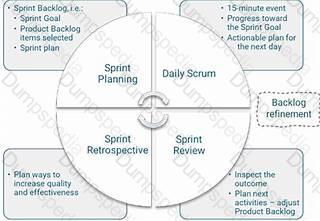
the Daily Scrum is a 15-minute event for the Developers of the Scrum Team that is held at the same time and place every working day of the Sprint.The purpose of the Daily Scrum is to inspect progress toward the Sprint Goal and adapt the Sprint Backlog as necessary, adjusting the upcoming planned work1.The other options are not characteristics of the Daily Scrum, as it is not facilitated by the team lead, it does not consist of theScrum Master asking the team for status, it is not held first thing in the morning, and it is not free form and designed to promote conversation234.
1:What is a Daily Scrum? | Scrum.org2:What Is the Daily Scrum? | A Guide to the Daily Event - Scrum Alliance3:What is Daily Scrum? | VivifyScrum4:Daily Scrum | Definition and Overview - ProductPlan
Which of the following are criteria to order Product Backlog items?
(choose all that apply)
Value of Product Backlog items.
Dependencies between Product Backlog items.
Dependencies to other products.
The availability of the Scrum Master.
All of the above.
The Product Owner orders the Product Backlog items according to various criteria, such as:
The value of Product Backlog items. The Product Owner aims to maximize the value of the product and the work of the Scrum Team. Therefore, they prioritize the items that deliver the most value to the stakeholders and the users, considering factors such as customer satisfaction, market share, revenue, social impact, etc.
The dependencies between Product Backlog items. The Product Owner tries to minimize the dependencies between items, as they may create complexity, uncertainty, and risk. Therefore, they order the items in a way that reduces or eliminates the dependencies, or resolves them as early as possible.
The dependencies to other products. The Product Owner also considers the dependencies that the product has to other products, such as platforms, frameworks, libraries, services, etc. Therefore, they order the items in a way that aligns with the availability and compatibility of those products.
When must the Product Owner participate in the Daily Scrum?
(choose the best answer)
When the Scrum Master asks the Product Owner to attend.
When the Product Owner is actively working on items on the Sprint Backlog;however, they participate as a Developer.
When there are impediments to discuss.
When the Product Owner needs to represent the stakeholders ' point of view to theDevelopers.
Which is NOT a valid consideration when ordering a Product Backlog?
(choose the best answer)
Dependencies on other Product Backlog items.
Importance to customers.
Alignment with business strategy and goals.
Tools and techniques.
Risk.
The Product Backlog is an ordered list of everything that is known to be needed in the product. It is the single source of truth for the Scrum Team and the stakeholders. It contains all the requirements, features, functions, enhancements, fixes, and anything else that can deliver value to the customers and users of the product.
The Product Owner is accountable for ordering the Product Backlog. The Product Owner orders the items in the Product Backlog based on factors such as value, risk, priority, dependency, feedback, or market conditions. The order of the Product Backlog items provides a clear and consistent indication of what is most important and urgent for the product. The order of the Product Backlog items also helps the Scrum Team and the stakeholders to plan and forecast effectively.
The tools and techniques used to create, manage, or refine the Product Backlog are not a valid consideration when ordering the Product Backlog. The tools and techniques are means to an end, not an end in themselves. The tools and techniques do not affect the value or quality of the product or service delivered. The tools and techniques may vary from one Product Owner to another, depending on their preferences, skills, or context. The tools and techniques may also change over time, as new technologies or practices emerge or evolve.
For the purpose of transparency, when does Scrum say a valuable and useful Increment must
be available?
(choose the best answer)
At the end of every Sprint.
Every 3 Sprints.
Before the Release Sprint.
After the Acceptance Testing phase.
When the Product Owner asks to create one.
The Scrum Guide states that " The Increment is the sum of all the Product Backlog items completed during a Sprint and the value of the increments of all previous Sprints. At the end of a Sprint, the new Increment must be ‘Done,’ which means it must be in useable condition and meet the Scrum Team’s definition of ‘Done.’ " 1 This means that a valuable and useful Increment must be available at the end of every Sprint, regardless of the release frequency or the Product Owner’s request. This ensures transparency, feedback, and continuous improvement.
1: The Scrum Guide2, page 14
2: The Scrum Guide
The " cone of uncertainty " can be used to do what?
(choose the best answer)
Determine whether to cut quality, similar to the " Iron Triangle " of projectmanagement.
Determine the cost of a project before it begins.
Illustrate that as a project forecast lengthens, it is increasingly less certain.
Determine the length of the next Sprint.
The “cone of uncertainty” is a graphical representation of the degree of uncertainty in a project estimate over time. It shows that the range of possible outcomes is wider at the beginning of the project and narrows down as the project progresses and more information becomes available.
The “cone of uncertainty” can be used to illustrate that as a project forecast lengthens, it is increasingly less certain. This means that the longer the time horizon for a project, the more variability and risk there is in the estimate. This also implies that shorter iterations and frequent feedback can help reduce uncertainty and improve accuracy.
The “cone of uncertainty” cannot be used to determine whether to cut quality, similar to the “Iron Triangle” of project management. The “Iron Triangle” is a model that shows the trade-offs between scope, time, and cost in a project. Quality is often considered as a fourth dimension that is affected by these three factors. Cutting quality is not a desirable option for any project, especially for Scrum projects that value delivering high-quality products that meet customer needs.
The “cone of uncertainty” cannot be used to determine the cost of a project before it begins. The cost of a project depends on many factors, such as the scope, the resources, the complexity, the risks, and the market conditions. The “cone of uncertainty” only shows the range of possible outcomes based on the available information at a given point in time. It does not provide a definitive or accurate estimate of the cost before the project starts.
The “cone of uncertainty” cannot be used to determine the length of the next Sprint. The length of the next Sprint is determined by the Scrum Team based on their empirical experience and their ability to deliver a potentially releasable Increment of value. The “cone of uncertainty” does not provide any guidance on how long a Sprint should be or how much work can be done in a Sprint.
Which of the following are criteria to order Product Backlog items?
(choose the best three answers)
The value of the Product Backlog items.
The availability of the Scrum Master.
Dependencies between Product Backlog items.
Their relevance to achieving the Product Goal.
The number of stakeholders who approve of the item.
A Product Owner orders a Product Backlog in any way they think will maximize the value of the product1. They take various factors into consideration when ordering the Product Backlog such as business value, risk, return on investment (ROI), dependencies and impact1. Dependencies between Product Backlog items and their relevance to achieving theProduct Goal are two of these factors12. The availability of the Scrum Master and the number of stakeholders who approve of the item are not valid criteria for ordering the Product Backlog3.
When should the Product Owner update the project plan?
(choose the best answer)
Before the Sprint Planning to know how much work will have to be done in the Sprint.
The Product Backlog is the plan in Scrum. It is updated as new information and insights emerge.
After the Daily Scrum to ensure an accurate daily overview of project progress.
The project plan must be updated prior to the Sprint Retrospective.
The Product Owner is responsible for managing and refining the Product Backlog, which is the single source of truth for the plan of the product development. The Product Backlog is a living artifact that changes as the product and the market evolve. The Product Owner updates the Product Backlog continuously based on feedback, learning, and stakeholder needs. There is no separate project plan document in Scrum.
[Scrum Guide], section 3.1: “The Product Backlog is an emergent, ordered list of what is needed to improve the product.”
[Professional Scrum Product Owner], chapter 5: “The Product Backlog represents everything necessary to develop and launch a successful product.”
[What is a Product Backlog?]: “The Product Backlog is a list of all things that need to be done within the project.”
Developers are self-managing, which of the following do they manage?
(choose the best answer)
Product Backlog ordering.
When to release, based on its progress.
Sprint Backlog.
Stakeholders for the Sprint Review.
Sprint length.
Developers are self-managing, which means that they decide how much work they can do in a Sprint, and how they will do it1. They manage the Sprint Backlog, which is the plan for how the Developers will achieve the Sprint Goal, and the single source of truth for the work to be done in the Sprint2. The Developers create and update the Sprint Backlog throughout the Sprint as more is learned[3][3] . The other options are not managed by the Developers, but by the Product Owner or the Scrum Team as a whole. The Product Owner is accountable for ordering the Product Backlog, which is an ordered list of everything that is known to be needed in the product4. The Product Owner also decides when to release the product, based on the value, risk, and stakeholder feedback5. The Scrum Team collaborates on inviting the stakeholders for the Sprint Review, which is an event where the Scrum Team and the stakeholders inspect the product Increment and adapt the Product Backlog. The Scrum Team also decides the Sprint length, which is the time-box within which the Scrum Team delivers a product Increment.
1: The Scrum Guide, November 2020, p. 6
2: The Scrum Guide, November 2020, p. 10
[3][3] : The Scrum Guide, November 2020, p. 10
4: The Scrum Guide, November 2020, p. 6
5: Managing Products with Agility, Scrum.org, accessed on December 16, 2023
The Scrum Guide, November 2020, p. 13
The Scrum Guide, November 2020, p. 9
Who is on the Scrum Team?
(choose all that apply)
Scrum Master.
Product Owner.
Developers.
Project Manager.
None of the above.
The Scrum Team consists of one Scrum Master, one Product Owner, and Developers. Within a Scrum Team, there are no sub-teams or hierarchies. It is a cohesive unit of professionals focused on one objective at a time, the Product Goal. The Scrum Master is accountable for establishing Scrum as defined in the Scrum Guide. They do this by helping everyone understand Scrum theory and practice, both within the Scrum Team and the organization. The Product Owner is accountable for maximizing the value of the product resulting from the work of the Scrum Team. They are responsible for creating and communicating a vision, ordering the Product Backlog, and ensuring that the best possible job is done to delight customers. The Developers are the people in the Scrum Team that are committed to delivering a “Done” Increment that meets the Definition of Done and the Sprint Goal. They are responsible for managing and organizing their work within the Sprint, collaborating with the Product Owner and the Scrum Master, and applying their skills and creativity to create a product that delivers value to the stakeholders and customers. A Project Manager is not a role in the Scrum Team, as Scrum does not recognize titles for Developers, regardless of the work being performed by the person. There is no need for a Project Manager, as the Scrum Team is self-managing and accountable for delivering value.
The Scrum Guide
The Scrum Team
Professional Scrum Product Owner™ I Certification
Which outcome is expected as a Scrum Team matures?
(choose the best answer)
The Sprint Retrospectives will grow to be longer than 4 hours.
They will improve their Definition of Done to include more stringent criteria.
A Scrum Master is no longer needed since they are a mature team now.
There will be no need for a timeboxed Sprint.
Sprint Reviews will no longer be needed.
A mature Scrum Team is expected to continuously improve their quality standards and deliver potentially releasable Increments of value that meet the Definition of Done12. The Definition of Done is a shared understanding of what it means to complete a Product Backlog item, and it may vary from one Scrum Team to another3. As the Scrum Team matures, they may expand their Definition of Done to include more rigorous criteria, such as higher levels of testing, documentation, performance, security, usability, etc . This way, they ensure thattheir product Increment is always ready for release and meets the expectations of the stakeholders and customers12.
What is the timebox for the Sprint Planning event?
(choose the best answer)
Monthly.
Whenever it is done.
8 hours for a one-month Sprint.
4 hours for a one-month Sprint.
The Sprint Planning is an event that occurs at the beginning of each Sprint, where the Scrum Team plans how to deliver a valuable product Increment. The Sprint Planning consists of two topics: What can be done this Sprint? and How will the chosen work get done? The outcome of the Sprint Planning is an agreed-upon Sprint Goal, a Sprint Backlog, and a plan for delivering the Increment.
The timebox for the Sprint Planning event is proportional to the length of the Sprint. For a one-month Sprint, the timebox is 8 hours. For shorter Sprints, the timebox is usually shorter. The Scrum Team may decide how much time to spend on each topic within the timebox, depending on their needs and preferences.
The timebox for the Sprint Planning event ensures that the Scrum Team does not spend too much or too little time on planning their work for the Sprint. The timebox also ensures that the Scrum Team has enough clarity and alignment on what and how they want to achieve during the Sprint.
As the Developers start work during the Sprint, they realize they have selected too much work to finish in the Sprint. What should they do?
(choose the best answer)
Find another Scrum Team to give the excess work to.
As soon as possible in the Sprint, work with the Product Owner to remove some work or Product Backlog items.
Inform the Product Owner at the Sprint Review, but prior to the demonstration.
Reduce the Definition of Done and get all of the Product Backlog items done by the new definition.
This is the best answer because it respects the Scrum values of openness, commitment, and focus. The Developers should be transparent about their progress and collaborate with the Product Owner to adjust the Sprint scope accordingly. The Product Owner is responsible for maximizing the value of the product and the work of the Developers, so he or she should be involved in any decisions that affect the Sprint Goal and the Product Backlog. References:
Scrum Guide, page 10: “If the work turns out to be different than the Developers expected, they collaborate with the Product Owner to negotiate the scope of Sprint Backlog within the Sprint.”
Scrum Guide, page 11: “The Product Owner is accountable for maximizing the value of the product resulting from the work of the Scrum Team.”
You are the Scrum Master for four Scrum Teams working from the same Product Backlog
Several of the Developers come to you complaining that work identified for the upcoming two
Sprints will require full-time commitment from a specialist who is external to the teams.
What should the Scrum Master consider in this situation?
(choose the best two answers)
The need to have enough work to keep all Developers busy.
The benefit of Developers figuring out a solution for themselves.
The desire to maintain a stable velocity.
The ability of the Scrum Teams to produce integrated Increments.
According to the documentation of Professional Scrum Product Owner™ (PSPO I), the Scrum Master should consider the following two answers in this situation:
B. The benefit of Developers figuring out a solution for themselves.
D. The ability of the Scrum Teams to produce integrated Increments.
The reason for choosing these two answers is that they align with the Scrum Master’s role as a servant leader, coach, and facilitator of the Scrum Team12. The Scrum Master should not interfere with the team’s autonomy and creativity, but rather support them in achieving their goals and delivering value to the stakeholders12. The Scrum Master should also ensure that the team can work together effectively and deliver a potentially releasable Increment at the end of each Sprint12.
The other two answers are not as relevant or appropriate for this situation:
A. The need to have enough work to keep all Developers busy.
C. The desire to maintain a stable velocity.
The need to have enough work to keep all Developers busy is not a valid reason for involving an external specialist in the Scrum Team12. The Scrum Team should be self-organizingand cross-functional, meaning that they can decide how to best accomplish their tasks without depending on external resources or expertise12. Moreover, having too much work can lead to scope creep, which can compromise the quality and value of the product12.
The desire to maintain a stable velocity is also not a valid reason for involving an external specialist in the Scrum Team12. Velocity is a measure of how much work can be completed by the team in a given time period, such as a Sprint or a release cycle12. It is not a fixed or objective number, but rather depends on various factors such as team size, complexity, skills, motivation, etc.12. Therefore, having an external specialist does not guarantee that the team will maintain a stable velocity, but rather may introduce additional challenges such as communication barriers, coordination issues, dependency risks, etc.12.
I hope this answer helps you understand how to apply your knowledge of Professional Scrum Product Owner™ (PSPO I) objectives and content in this situation. If you have any further questions or feedback, please let me know. Thank you for using Bing!????
During the Sprint Retrospective a Scrum Team has identified several high priority process
improvements. Which of the following statements is most accurate?
(choose the best answer)
The Scrum Team may add the items to the Sprint Backlog for the next Sprint.
The Scrum Team should decline to add a process improvement to the Sprint Backlogwhen things are running smoothly.
The Scrum Team should choose at least one high priority process improvement toplace in the Product Backlog.
The Scrum Master selects the most important process improvement and places it inthe Sprint Backlog
The Scrum Guide states that " By the end of the Sprint Retrospective, the Scrum Team should have identified improvements that it will implement in the next Sprint. Implementing these improvements in the next Sprint is the adaptation to the inspection of the Scrum Team itself. " 1 This means that the Scrum Team may add the high priority process improvements to the Sprint Backlog for the next Sprint, as part of their plan to deliver the Increment and achieve the Sprint Goal. The Sprint Backlog is owned and managed by the Developers, who can update it throughout the Sprint as more is learned.1
1: The Scrum Guide2, page 16
2: The Scrum Guide
What is the timebox for the Sprint Review?
(choose the best answer)
2 hours for a one-month Sprint.
1 day.
4 hours for a one-month Sprint.
As long as needed.
The timebox for the Sprint Review is four hours for a one-month Sprint. This is because:
The Sprint Review is an event where the Scrum Team and stakeholders inspect the Increment and adapt the Product Backlog if needed. The purpose of the Sprint Review is to elicit feedback and foster collaboration.
The timebox for each Scrum event is proportional to its frequency and duration. A one-month Sprint corresponds to a maximum calendar month.
The timebox for a one-month Sprint Review is four hours. For shorter Sprints, it is usually shorter.
The timebox ensures that there is enough time to inspect what has been done in relation to what could be done next and make any necessary adaptations to optimize value.
Other options, such as two hours for a one-month Sprint, one day, or as long as needed, are not valid answers as they do not reflect the correct timebox for the Sprint Review.
What is a Product Owner typically responsible for during a Sprint?
(choose the best two answers)
Attending every Daily Scrum to answer questions about the Sprint Backlogitems.
Creating financial reporting upon the spent hours reported by the Developers.
Nothing.
Updating the work plan for the Developers on a daily basis.
Collaborating with stakeholders, users, and customers.
Working with the Scrum Team on Product Backlog refinement.
The Product Owner is typically responsible for collaborating with stakeholders, users, and customers to understand their needs and expectations, and to validate the value of the product. The Product Owner is also responsible for working with the Scrum Team on Product Backlog refinement, which is the act of adding detail, estimates, and order to Product Backlog items.1 These two responsibilities help the Product Owner to maximize the value of the product and the work of the Developers.
1: The Scrum Guide2, page 18
2: The Scrum Guide
Why do the Developers need a Sprint Goal?
(choose the best answer)
A Sprint Goal only gives purpose to Sprint O.
Sprint Goals are not valuable. Everything is known from the Product Backlog.
The Developers are more focused with a common yet specific goal.
A Sprint Goal ensures that all of the Product Backlog items selected for the Sprint are implemented.
The Developers need a Sprint Goal because it gives them a common yet specific goal to focus on during the Sprint. This is because:
The Sprint Goal is a short-term objective that provides guidance and focus to the Scrum Team throughout the Sprint. It is a flexible and negotiable commitment that can be adjusted as more is learned throughout the Sprint.
The Developers are accountable for creating a “Done” Increment in every Sprint. They must ensure that every Product Backlog item they work on meets the Definition of Done before it is considered complete.
The Developers are self-managing professionals who organize and manage their own work. They decide how to best accomplish their work, rather than being directed by others outside the Scrum Team.
The Developers need a Sprint Goal to align their efforts and collaborate effectively as a team. The Sprint Goal helps them prioritize and optimize their work based on value and impact. The Sprint Goal also helps them cope with uncertainty and complexity by providing a clear direction and a shared purpose.
Other options, such as a Sprint Goal only giving purpose to Sprint 0, Sprint Goals being not valuable, or a Sprint Goal ensuring that all of the Product Backlog items selected for the Sprint are implemented, are not valid reasons why the Developers need a Sprint Goal. They may reflect a misunderstanding of what a Sprint Goal is or how Scrum works.
True or False: A Scrum Master fulfills the same role as a traditional Project Manager.
True
False
A Scrum Master does not fulfill the same role as a traditional Project Manager. A Project Manager is typically responsible for planning, executing, monitoring, controlling, and closing a project, as well as managing the scope, schedule, budget, quality, risks, and stakeholders of the project1. A Scrum Master is a servant-leader for the Scrum Team, who helps the team understand and enact Scrum values, principles, and practices, and removes impediments to the team’s progress2. A Scrum Master does not manage the project, the scope, the schedule, the budget, or the team, as these are either shared responsibilities or emergent outcomes of the Scrum framework[3] [3]. A Scrum Master also does not have authority over the team or the stakeholders, but rather facilitates collaboration and empowerment among them4.
True or False: The Product Owner should have the entire Product Backlog documented in detail before the first Sprint can start?
True
False
The Product Owner should not have the entire Product Backlog documented in detail before the first Sprint can start. This is because:
The Product Backlog is an emergent, ordered list of what is needed to improve the product. It is never complete and constantly changes to reflect the needs and desires of the customers, users, and stakeholders.
The Product Owner is accountable for maximizing the value of the product resulting from the work of the Scrum Team. They are responsible for identifying and articulating the Product Goal, which is a long-term objective for the product that guides all the activities of the Scrum Team.
The Product Owner collaborates with the Developers and the stakeholders to refine the Product Backlog as needed to ensure that there are enough items that are sufficiently clear and ready for selection in Sprint Planning. The amount of detail and precision required for each Product Backlog item depends on its order, size, and complexity.
The Product Owner does not need to have the entire Product Backlog documented in detail before the first Sprint can start, as this would imply a fixed and upfront plan that does not allow for feedback, learning, and adaptation. Instead, the Product Owner only needs to have enough items that are well understood and valuable for the Scrum Team to start working on them in the first Sprint.
Who is accountable for tracking the remaining work toward the Sprint Goal?
(choose the best answer)
The Developers.
The Project Manager.
The Product Owner.
The Scrum Master.
The Developers are the ones who are accountable for tracking the remaining work toward the Sprint Goal. The Developers are self-managing and decide how much work they can do in a Sprint1. They also create and update the Sprint Backlog, which is the plan for how the Developers will achieve the Sprint Goal, and the single source of truth for the work to be done in the Sprint2. The Developers use the Daily Scrum to inspect their progress toward the Sprint Goal and adapt the Sprint Backlog as necessary[3][3] . The Product Owner, the Scrum Master, and the Project Manager (if any) do not have the accountability for tracking the remaining work toward the Sprint Goal, as this is the responsibility of the Developers.
In order to maximize the value of the product, a Product Owner needs awareness of the following: (choose the best answer)
Competitive research.
Customer feedback.
Product vision.
Forecasting and feasibility.
All of the above.
None of the above.
In order to maximize the value of the product, a Product Owner needs awareness of the following:
Competitive research. The Product Owner should be aware of the competitive landscape and the market trends that affect the product. They should know who are the competitors, what are their strengths and weaknesses, how do they differentiate themselves, and what are their strategies and goals. This can help the Product Owner to identify opportunities, threats, and gaps in the market, and to position the product accordingly.
Customer feedback. The Product Owner should be aware of the customer needs, preferences, expectations, and satisfaction with the product. They should collect and analyze feedback from various sources, such as surveys, interviews, reviews, analytics, etc. This can help the Product Owner to validate assumptions, test hypotheses, measure outcomes, and discover insights that can inform the product decisions and priorities.
Product vision. The Product Owner should be aware of the product vision, which is a clear and compelling statement of the desired future state of the product. The product vision describes the purpose, value proposition, target audience, and key features of the product. It also aligns with the organizational vision and mission. This can help the Product Owner to communicate and inspire the stakeholders, to guide and focus the Scrum Team, and to evaluate and adjust the product direction.
Forecasting and feasibility. The Product Owner should be aware of the forecasting and feasibility of the product. They should estimate and plan the scope, time, cost, quality, and risk of delivering the product. They should also assess the technical, operational, legal, ethical, and social feasibility of developing and releasing the product. This can help the Product Owner to optimize the value of the work of the Scrum Team, to manage expectations and dependencies, and to handle uncertainties and changes.
True or False: Dependencies could influence how the Product Owner orders Product Backlog items.
True
False
Correct Answer: True
Dependencies are relationships between Product Backlog items that affect their order of implementation. For example, a Product Backlog item may depend on another one to be completed first, or it may have a dependency on a third-party system or resource. Dependencies could influence how the Product Owner orders Product Backlogitems, as they may introduce risks, constraints, or uncertainties that affect the value delivery. The Product Owner should try to minimize dependencies and order the Product Backlog items in a way that maximizes value and minimizes waste.
[Professional Scrum Product Owner], chapter 6: “Dependencies are relationships between Product Backlog items that affect their order of implementation.”
[Managing Dependencies on Agile Projects]: “Dependencies can have a significant impact on the delivery of value.”
When should a Sprint Goal be created?
(choose the best answer)
A Sprint Goal is not mandatory in Scrum.
It should have been created in the previous Sprint during Product Backlogrefinement.
It must be established before Sprint Planning in order to begin planning.
During Sprint Planning.
At any time during the Sprint.
The Sprint Goal is a short statement that gives the Sprint a purpose, direction, and focus. It is created by the entire Scrum Team during Sprint Planning, based on the Product Owner’s draft and the Developers’ input. The Sprint Goal is then added to the Sprint Backlog and guides the Developers’ work during the Sprint.
What is a Sprint Goal?
The Sprint Goal
How to Write and Use a Sprint Goal (With 5 Templates)
How is management that is external to the Scrum Team involved in the Daily Scrum?
(choose the best answer)
The Product Owner represents their opinions.
The Scrum Master speaks on their behalf.
Managers are not required at the Daily Scrum.
Management gives an update at the start of each Daily Scrum.
Management that is external to the Scrum Team is not involved in the Daily Scrum because:
The Daily Scrum is an event for the Developers to inspect their progress towards the Sprint Goal and adapt their Sprint Backlog accordingly. It is not a status meeting or a reporting session for managers or other stakeholders.
The presence of external managers may hinder the self-organization, collaboration, and transparency of the Developers. It may also create pressure, interference, or distraction for the team.
The Scrum Master is responsible for ensuring that the Daily Scrum is held and that only the Developers participate. The Product Owner and other stakeholders may attend as observers, but only if the Developers find it useful.
In accordance with Scrum theory, how should a group of 100 people be divided into multiple
Scrum Teams?
(choose the best answer)
Create a matrix of skills, seniority, and level of experience to assign people to teams.
Check with the allocation department to see who has worked together before and make these the first teams.
Understanding the product, the product vision and the rules of the Scrum framework, the people divide themselves into teams.
It does not really matter since you can rotate the teams every Sprint to spread knowledge.
In accordance with Scrum theory, a group of 100 people should be divided into multiple Scrum Teams by understanding the product, the product vision and the rules of the Scrum framework, and then dividing themselves into teams because:
It respects the self-organization and empowerment of the people. The people are the ones who have the knowledge, skills, and experience to create and deliver the product. They are also the ones who will work together as Scrum Teams, collaborating and coordinating their efforts. Therefore, they should have the autonomy and authority to decide how to form their teams, based on their preferences, interests, and capabilities.
It supports the alignment and coherence of the Scrum Teams. The people should have a clear and shared understanding of the product, the product vision, and the rules of the Scrum framework before forming their teams. This can help them to align their goals and missions, to ensure that they are working on the same product and towards the same vision. It can also help them to follow the same principles and practices of Scrum, to ensure that they are working effectively and consistently.
It fosters the collaboration and synergy of the Scrum Teams. The people should form their teams in a way that maximizes their collaboration and synergy. This can mean choosing team members that complement each other’s skills and strengths, that have good rapport and trust, that can communicate and coordinate well, and that can deliver a valuable Increment each Sprint.
What tactic should a Scrum Team use to divide a group of 100 people into multiple Scrum
Teams?
(choose the best answer)
Ask the people to divide themselves into teams.
Create teams based on their skills across multiple layers (such as database, UI,etc.).
Ask the Product Owner to assign the people to teams.
According to Scrum.org, when splitting a large group into multiple Scrum Teams, it can be beneficial to allow the people to self-organize into smaller teams12.This approach respects the principle of self-organization, which is a key aspect of Scrum12.It allows individuals to choose the team they feel they can contribute to most effectively12.However, it’s important to note that this process should be facilitated and guided to ensure a balanced distribution of skills and capabilities across the teams12.
True or False: A Product Owner is essentially the same thing as a traditional Project Manager.
True
False
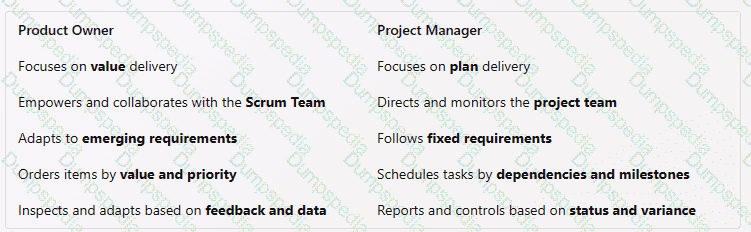
A Product Owner is not the same thing as a traditional Project Manager. A Product Owner is a role in Scrum, a framework for developing, delivering, and sustaining complex products. A Project Manager is a role in traditional project management, a discipline for planning, executing, and controlling projects.
A Product Owner is accountable for maximizing the value of the product resulting from the work of the Scrum Team. The Product Owner is responsible for managing and refining the Product Backlog, collaborating with the stakeholders and the Developers, and ordering the items in a way that best achieves goals and missions. The Product Owner represents the interests of everyone with a stake in the product and ensures that the Scrum Team works on the right things at the right time.
A Project Manager is accountable for delivering the project within the predefined scope, time, and cost constraints. The Project Manager is responsible for defining and managing the project plan, resources, risks, issues, and dependencies. The Project Manager coordinates and controls the activities of the project team and the stakeholders and ensures that the project meets the quality standards and expectations.
Some of the main differences between a Product Owner and a Project Manager are:
What does it mean to say that an event has a timebox?
(choose the best answer)
The event can take no more than a maximum amount of time.
The event must take at least a minimum amount of time.
The event must happen by a given time.
The event must happen at a set time.
To say that an event has a timebox means that the event has a fixed duration that cannot be exceeded. The Scrum Guide states that " All events are time-boxed events, such that every event has a maximum duration. Once a Sprint begins, its duration is fixed and cannot be shortened or lengthened. The remaining events may end whenever the purpose of the event is achieved, ensuring an appropriate amount of time is spent without allowing waste in the process. " 1 This means that the timebox sets an upper limit for the event, but the event can end sooner if the goal is met.
1: The Scrum Guide2, page 10
2: The Scrum Guide
What enhances the transparency of an Increment?
(choose the best answer)
Keeping track of and estimating all undone work to be completed in a " hardening " Sprint.
Doing all work needed to meet the Definition of Done.
Reporting Sprint progress to the stakeholders daily.
Updating Sprint tasks properly in the electronic tracking tool.
The Definition of Done is a shared understanding of what it means for work to be complete, and ensures transparency of the quality of the work done1. The Increment is the sum of all the Product Backlog items completed during a Sprint and the value of the increments of all previous Sprints2. The Increment must be usable and potentially releasable, meaning that it meets the quality standards set by the Scrum Team and the stakeholders[3][3] . Doing all work needed to meet the Definition of Done enhances the transparency of the Increment, as it ensures that the Increment is truly done and reflects the current state of the product4. The other options do not enhance the transparency of the Increment, as they either introduce unnecessary complexity, delay, or overhead, or do not provide a clear and consistent way to measure the quality of the work done.
When does a Developer become accountable for an item in the Sprint Backlog?
(choose the best answer)
During the Daily Scrum.
As soon as a Developer on the Scrum Team can accommodate more work.
Never. All Developers on the Scrum Team share accountability for items in the SprintBacklog.
At Sprint Planning when all of the Sprint Backlog items are split evenly across theDevelopers.
The Developers on the Scrum Team share accountability for the Sprint Backlog, which is a forecast of the work and the plan to deliver the Sprint Goal12. The Sprint Backlog is dynamic and can be updated by the Developers as more is learned during the Sprint34. The Developers are not individually accountable for the items in the Sprint Backlog, nor are they assigned by the Scrum Master or the Product Owner5.
When multiple Scrum Teams are working on a single product, what best describes the
Definition of Done?
(choose the best answer)
Each Scrum Team defines and uses its own. The differences are discussed andreconciled during a hardening Sprint.
The Scrum Masters from each Scrum Team define a common Definition of Done.
Each Scrum Team uses its own, but must make their definition clear to all otherteams so the differences are known.
When multiple Scrum Teams are working together on a product, they must mutuallydefine and comply with the same Definition of Done.
The reason for choosing this answer is that it is consistent with the Scrum Guide1 and the Professional Scrum Product Owner™ (PSPO I) objectives and content2. The Definition of Done is a formal description of the state of the Increment when it meets the quality measures required for the product3. It applies to all Scrum Teams that are involved in creating an integrated Increment, regardless of their size, complexity, or skills12. The Definition of Done ensures that the product meets the expectations and needs of the stakeholders and customers12.
The other answers are not as accurate or appropriate for this question:
A. Each Scrum Team defines and uses its own. The differences are discussed and reconciled during a hardening Sprint.
B. The Scrum Masters from each Scrum Team define a common Definition of Done.
C. Each Scrum Team uses its own, but must make their definition clear to all other teams so the differences are known.
These answers imply that there is no need for a common or shared Definition of Done among multiple Scrum Teams working on a single product12. However, this can lead to confusion, inconsistency, and conflicts in terms of quality standards, expectations, and feedback12. Moreover, having different Definitions of Done can compromise the integrity and value of the product as a whole12.
I hope this answer helps you understand how to apply your knowledge of Professional Scrum Product Owner™ (PSPO I) objectives and content in this question. If you have any further questions or feedback, please let me know. Thank you for using Bing!????
Who determines how many Product Backlog items the Developers select for a Sprint?
(choose the best answer)
The Scrum Team
The Developers.
The Product Owner.
The Scrum Master.
The stakeholders attending Sprint Planning.
The Developers are the ones who determine how many Product Backlog items they select for a Sprint. The Developers are self-managing and decide how much work they can do in a Sprint1. The Product Owner and the Developers collaborate on the scope of the Sprint during Sprint Planning, but the final decision is up to the Developers2. The Product Owner, the Scrum Master, and the stakeholders do not have the authority to tell the Developers how many Product Backlog items they should select, as this would violate the principle of self-management[3][3] .
In the middle of the Sprint, the customer decides that there are two new features she wants.
The Product Owner could:
(choose the best two answers)
Introduce these features at the next Daily Scrum.
Ask the Developers to consider whether they can add these features to thecurrent Sprint without endangering the Sprint Goal.
Add these features to the Product Backlog.
Have the Scrum Master add these features to the current Sprint.
The Product Owner is accountable for maximizing the value of the product resulting from the work of the Scrum Team. The Product Owner is responsible for managing and refining the Product Backlog, collaborating with the stakeholders and the Developers, and ordering the items in a way that best achieves goals and missions. The Product Owner represents the interests of everyone with a stake in the product and ensures that the Scrum Team works on the right things at the right time.
The Developers are accountable for creating a “Done” Increment that meets the Definition of Done each Sprint. The Developers are responsible for planning and executing the Sprint Backlog, designing and building the product functionality, testing and improving the product quality, and delivering a potentially releasable Increment. The Developers work closely with the Product Owner to understand and clarify the Product Backlog items, provide feedback and estimates, and suggest improvements and innovations.
A Sprint is a timebox of one month or less within which a “Done” product Increment is created. A Sprint consists of the Sprint Planning, Daily Scrums, the development work, the Sprint Review, and the Sprint Retrospective. A Sprint is also a feedback loop that allows the Scrum Team and the stakeholders to inspect and adapt the product and the process.
The Sprint Goal is a short statement of what the Scrum Team intends to achieve during a Sprint. It provides guidance and direction for the Scrum Team, as well as a basis for inspecting and adapting the product and the process. The Sprint Goal is aligned with the product vision and goals, and it reflects the value and purpose of the Sprint.
In the middle of a Sprint, if a customer decides that there are two new features she wants, there are two possible ways that a Product Owner could handle this situation:
Ask the Developers to consider whether they can add these features to the current Sprint without endangering the Sprint Goal: The Product Owner could discuss with the Developers if they have enough capacity and skills to accommodate these new features in their current Sprint Backlog. The Product Owner could also explain why these features are valuable or urgent for the customer or user. The Developers could then decide if they can or want to add these features to their current work plan, or if they prefer to defer them to a future Sprint. The Developers should not compromise on quality or scope to fit these features in their current Sprint. The Developers should also ensure that these features are aligned with or support the current Sprint Goal.
Add these features to the Product Backlog: The Product Owner could add these new features to the Product Backlog as new items. The Product Owner could then order these items based on their value, risk, priority, dependency, feedback, or market conditions. The Product Owner could also refine these items with more details or acceptance criteria. The Product Owner could then plan to include these items in a future Sprint, depending on their order and availability.
The other options are not valid or relevant ways that a Product Owner could handle this situation. They are either too disruptive, impractical, or irrelevant. They are:
Introduce these features at the next Daily Scrum: This is not a valid way for a Product Owner to handle this situation. The Daily Scrum is an event for the Developers to inspect their progress toward the Sprint Goal and adapt their plan for the next 24 hours. The Daily Scrum is not a status meeting or a reporting session for anyone else. The Product Owner may attend the Daily Scrum as an observer or as an invited participant if they have something valuable to contribute or if they need some clarification from the Developers. However, introducing new features at this event would be disruptive and inappropriate for both parties.
Have the Scrum Master add these features to the current Sprint: This is not a valid way for a Product Owner to handle this situation. The Scrum Master is not responsible for adding or removing any work from the current Sprint. The Scrum Master is accountable for establishing Scrum as defined in the Scrum Guide. The Scrum Master is responsible for promoting and supporting Scrum as defined in the Scrum Guide. The Scrum Master does this by helping everyone understand Scrum theory and practice, both within the Scrum Team and the organization.
True or False: The purpose of a Sprint is to produce a valuable, useful Increment.
True
False
The purpose of a Sprint is to produce a valuable, useful Increment that meets the Sprint Goal and the Definition of Done1. An Increment is a concrete step toward achieving the Product Goal and is the primary measure of progress in Scrum2. The Increment must be usable and potentially releasable, meaning that it meets the quality standards set by the Scrum Team and the stakeholders[3][3] .
Every Scrum Team should have:
(choose the best answer)
One Lead Developer and no more than 8 other members.
The competencies and skills needed to deliver an Increment in a Sprint.
At least one representative from each major department, such as, Quality Assurance,Development, and Marketing.
A Scrum Team is a cross-functional, self-managing team that has all the necessary competencies and skills to deliver a potentially releasable Increment of value at the end of each Sprint. The Scrum Team consists of one Scrum Master, one Product Owner, and Developers. The Scrum Team does not rely on external roles or hierarchies to complete their work. (Must be taken from Professional Scrum Product Owner™ (PSPO I) resources)
Professional Scrum Product Owner™ I Certification
Professional Scrum Product Owner™ Training
Which of the following practices might help the Product Owner minimize waste in developing
and sustaining the Product Backlog?
(choose the best two answers)
Avoid distracting the Scrum Team by maintaining newly gathered ProductBacklog items in a separate Product Backlog until they are fully understood.
Hand off ownership of the Product Backlog to someone else.
Remove items from the Product Backlog that have not been addressed in a longtime.
Only fully describe Product Backlog items when it seems likely they will beimplemented.
The practices that might help the Product Owner minimize waste in developing and sustaining the Product Backlog are:
Remove items from the Product Backlog that have not been addressed in a long time. This helps keep the Product Backlog relevant, concise, and focused on delivering value. Items that have not been addressed in a long time may indicate that they are not important, feasible, or desirable anymore. They may also clutter or confuse the Product Backlog and make it harder to order and prioritize.
Only fully describe Product Backlog items when it seems likely they will be implemented. This helps avoid spending too much time or effort on items that may change or be discarded later. Items that are likely to be implemented soon should have more detail and precision than items that are further away or uncertain. The level of detail and precision required for each item depends on its order, size, and complexity.
Other options, such as avoiding distracting the Scrum Team by maintaining newly gathered Product Backlog items in a separate Product Backlog until they are fully understood or handing off ownership of the Product Backlog to someone else, are not practices that might help minimize waste in developing and sustaining the Product Backlog. They may actually create more waste by reducing transparency, collaboration, alignment, or ownership.
True or False: When there are multiple teams working on one product, each Scrum Team should have a separate Product Owner.
True
False
When there are multiple teams working on one product, each Scrum Team should not have a separate Product Owner. This is because:
The Product Owner is accountable for maximizing the value of the product resulting from the work of the Scrum Team. They are responsible for identifying and articulating the Product Goal, which is a long-term objective for the product that guides all the activities of the Scrum Team.
The Product Owner is the sole person responsible for managing the Product Backlog, which is an emergent, ordered list of what is needed to improve the product. They must ensure that the Product Backlog is transparent, visible, and understood by everyone who needs to work on it.
Having multiple Product Owners for one product may lead to conflicts, inconsistencies, or confusion among the Scrum Teams and the stakeholders. It may also reduce the alignment, collaboration, and ownership of the product development.
Instead of having multiple Product Owners, it is recommended to have one Product Owner who works with representatives from each Scrum Team to ensure that they have a shared understanding of the product vision, goals, and priorities. The Product Owner may also delegate some of the Product Backlog management tasks to these representatives, but they remain accountable for the final decisions.
What is the purpose of a Sprint Review?
(choose the best answer)
To build team spirit.
To take time to judge the validity of the project.
To inspect the product Increment with the stakeholders and collect feedback on next steps.
To review the Scrum Team ' s activities and processes during the Sprint.
The Sprint Review is an event that occurs at the end of each Sprint, where the Scrum Team and the stakeholders inspect the Increment and adapt the Product Backlog if needed. The Sprint Review is an opportunity for the Product Owner to validate that the Increment meets their expectations and delivers value to the customers and users. The Sprint Review is also an opportunity for the Developers to demonstrate their work and receive feedback from the Product Owner and the stakeholders.
The purpose of a Sprint Review is to inspect the product Increment with the stakeholders and collect feedback on next steps. The Sprint Review is a collaborative and interactive session where the Scrum Team and the stakeholders discuss what was done in the Sprint, what problems were encountered, what was learned, and what can be improved or changed. The Sprint Review also provides input for updating the Product Backlog to maximize value in future Sprints.
The other options are not valid or relevant purposes of a Sprint Review. They are either too vague, unrelated, or incorrect. They are:
To build team spirit: This is not a valid purpose of a Sprint Review. While team spirit is important for any Scrum Team, it is not the main focus or outcome of a Sprint Review. A Sprint Review is a formal event that has a specific agenda and goal, not a casual or social gathering.
To take time to judge the validity of the project: This is not a valid purpose of a Sprint Review. Scrum does not have a concept of a project, but rather a product. A product is a valuable solution that evolves over time to meet customer needs and market conditions. A project is a temporary endeavor with a fixed scope, time, and cost. A Sprint Review is not a time to judge or evaluate the validity of the product or its development, but rather to inspect and adapt it based on empirical evidence and feedback.
To review the Scrum Team’s activities and processes during the Sprint: This is not a valid purpose of a Sprint Review. This is the purpose of another Scrum event called the Sprint Retrospective. The Sprint Retrospective is an event that occurs after the Sprint Review and prior to the next Sprint Planning, where the Scrum Team inspects how they worked during the Sprint and identifies improvements for the next Sprint. The Sprint Retrospective focuses on improving the Scrum Team’s performance and process, not on inspecting the product Increment or its value.
Which of the following are the Developers accountable for?
(choose the best two answers)
Organizing the work required to meet the Sprint Goal.
Selecting the Product Owner.
Reporting productivity.
Creating a plan for the Sprint, the Sprint Backlog.
The Developers are the people in the Scrum Team who are committed to creating any aspect of a usable Increment each Sprint. The Developers are accountable for organizing and managing their work.Only the Developers can decide how to perform the work during the Sprint1. The Developers plan the work necessary to create an Increment that meets the Definition of Done during the Sprint Planning event. This is often done by decomposing Product Backlog items into smaller work items of one day or less. How this is done is at the sole discretion of the Developers.The Sprint Backlog is the set of Product Backlog items selected for the Sprint, plus a plan for delivering the product Increment and realizing the Sprint Goal1.The Developers are responsible for creating and maintaining the Sprint Backlog1.The Developers are not accountable for selecting the Product Owner, reporting productivity, or any other activities that are not related to creating a Done Increment that meets the Sprint Goal123.References:
Scrum Guide
What is a Developer?
Who Determines How Work Is Performed During The Sprint?
[What is Sprint Planning?]
When multiple Scrum Teams are working on the same product, should all of their Increments be integrated every Sprint?
(choose the best answer)
Yes, in order to accurately inspect what is done.
Yes, but only for Scrum Teams whose work has dependencies.
No, each Scrum Team stands alone.
No, that is far too hard and must be done in a hardening Sprint.
When multiple Scrum Teams are working on the same product, they should integrate their Increments every Sprint because:
It allows them to accurately inspect what is done and what is potentially releasable. By integrating their work frequently, they can ensure that the product is in a usable and valuable state at the end of each Sprint, and that it meets the Definition of Done and the Sprint Goal.
It enables them to adapt to changes and feedback faster. By integrating their work frequently, they can reduce the complexity and risk of integration, and discover and resolve any issues or dependencies sooner. They can also incorporate any new insights or requirements into their Product Backlog and Sprint Planning.
It fosters collaboration and alignment among the teams. By integrating their work frequently, they can share their learnings and best practices, and coordinate their efforts towards a common vision and goal. They can also leverage the collective intelligence and creativity of the teams to deliver a better product.
What typically happens if the Product Backlog is not sufficiently clear at Sprint Planning?
(choose the best answer)
The Product Owner should select the Sprint Goal for the Scrum Team so that work can begin.
The Developers will find it difficult to create a Sprint forecast they are confident they can meet.
Nothing in particular.
The Scrum Master should not allow this to happen. Look for a new Scrum Master and re-start the Sprint.
Sprint Planning is canceled so refinement can be done first.
If the Product Backlog is not sufficiently clear at Sprint Planning, the Developers will find it difficult to create a Sprint forecast they are confident they can meet. This is because:
Sprint Planning is an event where the Scrum Team plans for the upcoming Sprint. The purpose of Sprint Planning is to align the entire Scrum Team around a common goal and a plan for delivering an Increment that meets that goal.
The Developers are accountable for creating a Sprint forecast, which is a selection of Product Backlog items that they intend to work on during the Sprint. The Sprint forecast should be realistic, achievable, and valuable.
The Product Owner is accountable for ensuring that the Product Backlog is transparent, visible, and understood by everyone who needs to work on it. They must collaborate with the Developers and provide clarifications, feedback, and guidance on what items are most important and valuable for the product.
If the Product Backlog is not sufficiently clear at Sprint Planning, it means that there are items that are not well defined, ordered, or estimated. This may make it hard for the Developers to understand what they are supposed to build and why. It may also make it hard for them to estimate how much work they can do or how long it will take them to do it. This may result in a poor or inaccurate Sprint forecast that may affect the quality or value of the Increment.
Other options, such as the Product Owner selecting the Sprint Goal for the Scrum Team so that work can begin, nothing in particular happening, the Scrum Master not allowing this to happen or looking for a new Scrum Master and re-starting the Sprint, or Sprint Planning being canceled so refinement can be done first, are not valid answers as they do not reflect what typically happens or what should happen in Scrum.
True or False: The Sprint Backlog is a result of Sprint Planning, and it includes the Sprint Goal.
True
False
It is true that the Sprint Backlog is a result of Sprint Planning, and it includes the Sprint Goal. This is because:
Sprint Planning is an event where the Scrum Team plans for the upcoming Sprint. The purpose of Sprint Planning is to align the entire Scrum Team around a common goal and a plan for delivering an Increment that meets that goal.
The Sprint Backlog is the set of Product Backlog items selected for the Sprint, plus a plan for delivering them as a “Done” Increment. The Sprint Backlog is owned by the Developers who use it to organize and manage their work during the Sprint.
The Sprint Goal is a short-term objective that provides guidance and focus to the Scrum Team throughout the Sprint. It is a flexible and negotiable commitment that can be adjusted as more is learned throughout the Sprint.
The Sprint Backlog is created by the collaborative work of the entire Scrum Team during Sprint Planning. The Product Owner proposes how the product could increase its value and utility in the current Sprint. The Developers discuss how they can deliver a “Done” Increment that meets this proposal. Together, they define a Sprint Goal that summarizes why the Sprint is valuable to stakeholders. Then, they select enough Product Backlog items from the top of the ordered Product Backlog to satisfy the Sprint Goal. Finally, they create a plan for how they will deliver those items as a “Done” Increment.
The Developers find out during the Sprint that they are not likely to build everything they forecast. What would you expect a Product Owner to do?
(choose the best answer)
Skip Product Backlog refinement activities.
Inform management that more Developers are needed.
Change the Sprint Goal.
Re-work the selected Product Backlog items with the Developers to meet the Sprint Goal.
Cancel the Sprint.
If the Developers find out during the Sprint that they are not likely to build everything they forecast, the best response from the Product Owner is to re-work the selected Product Backlog items with the Developers to meet the Sprint Goal. This is because:
The Sprint Goal is a short-term objective that provides guidance and focus to the Scrum Team throughout the Sprint. It is a flexible and negotiable commitment that can be adjusted as more is learned throughout the Sprint.
The Developers are accountable for creating a “Done” Increment in every Sprint. They must ensure that every Product Backlog item they work on meets the Definition of Done before it is considered complete.
The Product Owner is accountable for maximizing the value of the product resulting from the work of the Scrum Team. They must inspect the Increment at the end of each Sprint and assess how it delivers value and contributes to the Product Goal.
The Product Owner and the Developers must collaborate closely throughout the Sprint to ensure that they have a shared understanding of what they are building and why. The Product Owner must provide clarifications, feedback, and guidance to the Developers as needed to help them create a valuable Increment.
If the Developers find out during the Sprint that they are not likely to build everything they forecast, it means that there is a gap between their initial plan and their actual progress. This may happen due to various reasons, such as new insights, changing requirements, technical challenges, or unforeseen circumstances.
In this situation, the Product Owner should work with the Developers to re-work the selected Product Backlog items to meet the Sprint Goal. This may involve adding, removing, or modifying some items, as long as they still support the Sprint Goal and deliver value. The Product Owner should also communicate any changes or impacts to the stakeholders and customers as appropriate.
Other options, such as skipping Product Backlog refinement activities, informing management that more Developers are needed, changing the Sprint Goal, or canceling the Sprint, are not valid responses from the Product Owner as they do not reflect what should happen in Scrum or how to deal with uncertainty and complexity.
True or False: The value delivered by a product can only be determined by revenue.
True
False
The value delivered by a product can not be determined by revenue alone, because:
Revenue is only one aspect of value, and it may not reflect the true impact or benefit of the product for the stakeholders, the users, and the society. For example, a product may generate high revenue, but also cause environmental damage, ethical issues, or customer dissatisfaction.
Value is a subjective and relative concept, and it may vary depending on the context, the perspective, and the criteria of the evaluation. For example, a product may have different value for different segments of customers, or for different markets or regions.
Value is dynamic and emergent, and it may change over time due to various factors, such as feedback, competition, innovation, or regulation. For example, a product may lose its value as new alternatives or solutions become available, or as customer needs or preferences evolve.
Which topics should be discussed in the Sprint Review?
(choose the best answer)
The Scrum process, and how it was used during the Sprint.
Coding and engineering practices.
The product Increment.
All of the above.
The main topic of discussion is the product Increment, which is the sum of all the Product Backlog items completed during a Sprint and the value of the increments of all previous Sprints1.The product Increment is demonstrated and inspected by the attendees, and feedback is collected to inform the next Sprint Planning12.The Sprint Review may also include other topics, such as the Product Backlog, the Product Goal, the market conditions, the budget, and the timeline, but the product Increment is the essential topic1234.The Scrum process, and how it was used during the Sprint, is not a topic for the Sprint Review, but rather for the Sprint Retrospective, which is a separate event where the Scrum Team inspects and adapts its way of working1.Coding and engineering practices are also not relevant for the Sprint Review, as they are internal aspects of the Development Team that do not affect the value of the product Increment1. Therefore, the correct answer is C. The product Increment.


TESTED 15 Oct 2026